




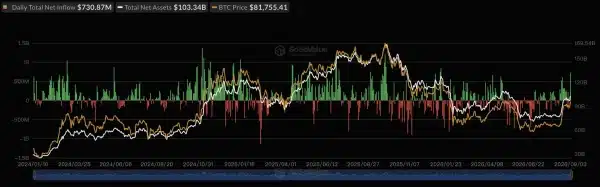
U.S. spot Bitcoin exchange-traded funds (ETFs) attracted $730.9 million in net inflows on Thursday, their biggest one-day haul since Jan. 14, as expectations for an improving macroeconomic backdrop helped lift demand for crypto assets.
The surge came as analysts pointed to Federal Reserve Governor Christopher Waller’s policy comments as a key macro catalyst. They highlighted his willingness to keep interest rates unchanged if inflation continues to cool as supportive for the market.
Crypto-linked stocks rallied alongside the move. Strategy jumped 17.6% to $144.82, Coinbase advanced 10.14% to $192.70, and Circle gained 16.46% to close Thursday at $103.23, according to Yahoo Finance data. Bitcoin also moved back above $81,000 late Thursday night before trading around $80,950 as of this writing.
The latest move added to a recovery that began in mid-August after the U.S. Treasury Department announced an expansion of its buyback program. Experts had subsequently said crypto prices would likely need another favorable macroeconomic signal to extend the rally.
BlackRock Leads Latest Bitcoin ETF Inflows
BlackRock’s IBIT captured roughly $454 million of Thursday’s ETF inflows, according to SoSoValue. Six other funds recorded positive flows, including products from Fidelity and Grayscale.
The $730.9 million daily total followed a strong month for U.S. Bitcoin ETFs. The funds attracted $3.5 billion last month, their largest monthly intake since September 2025.
Rachael Lucas, a crypto analyst at BTC Markets, said Thursday’s flows indicated that institutional investors were increasing their Bitcoin holdings. She viewed the heavy concentration in IBIT as particularly significant, saying institutions use that vehicle for larger allocations and that the pattern therefore pointed to allocation-driven demand rather than tactical positioning.
Inflation Data Could Test Bitcoin Rally
Whether the move can be sustained will depend in part on forthcoming macroeconomic signals, according to analysts, with Lucas identifying employment figures and the Consumer Price Index (CPI) as the principal near-term data risks.
Lucas said the supportive interpretation of Waller’s position depended on inflation continuing to cool, meaning a hotter inflation reading would directly undermine that premise. She also cited September’s weak seasonal history, noting that the two economic releases, together with the next several ETF trading sessions, would help establish whether the $81,000 level holds or the advance fades.
Beyond the immediate economic risks, Lucas also pointed to a shift in Bitcoin’s relationship with other asset classes. She said its 90-day correlation with gold had risen above 50% to a six-year high, while its correlation with the S&P 500 had declined to nearly zero. In her assessment, that pattern could suggest Bitcoin is being valued more as an inflation hedge than as a high-beta risk asset.
Lucas said that if the relationship persists, the latest ETF flows would need to be viewed differently over several months rather than days.