




A widely followed crypto trader has identified four bearish signals that could push Cardano to new lows, potentially sending ADA’s price to $0.12.
Like many other crypto assets, Cardano has faced significant selling pressure in recent weeks. Although ADA revived investors’ hopes earlier this month by climbing to $0.28, it has since dropped 25.7% from that level.
Four Signals Point to Further Downside
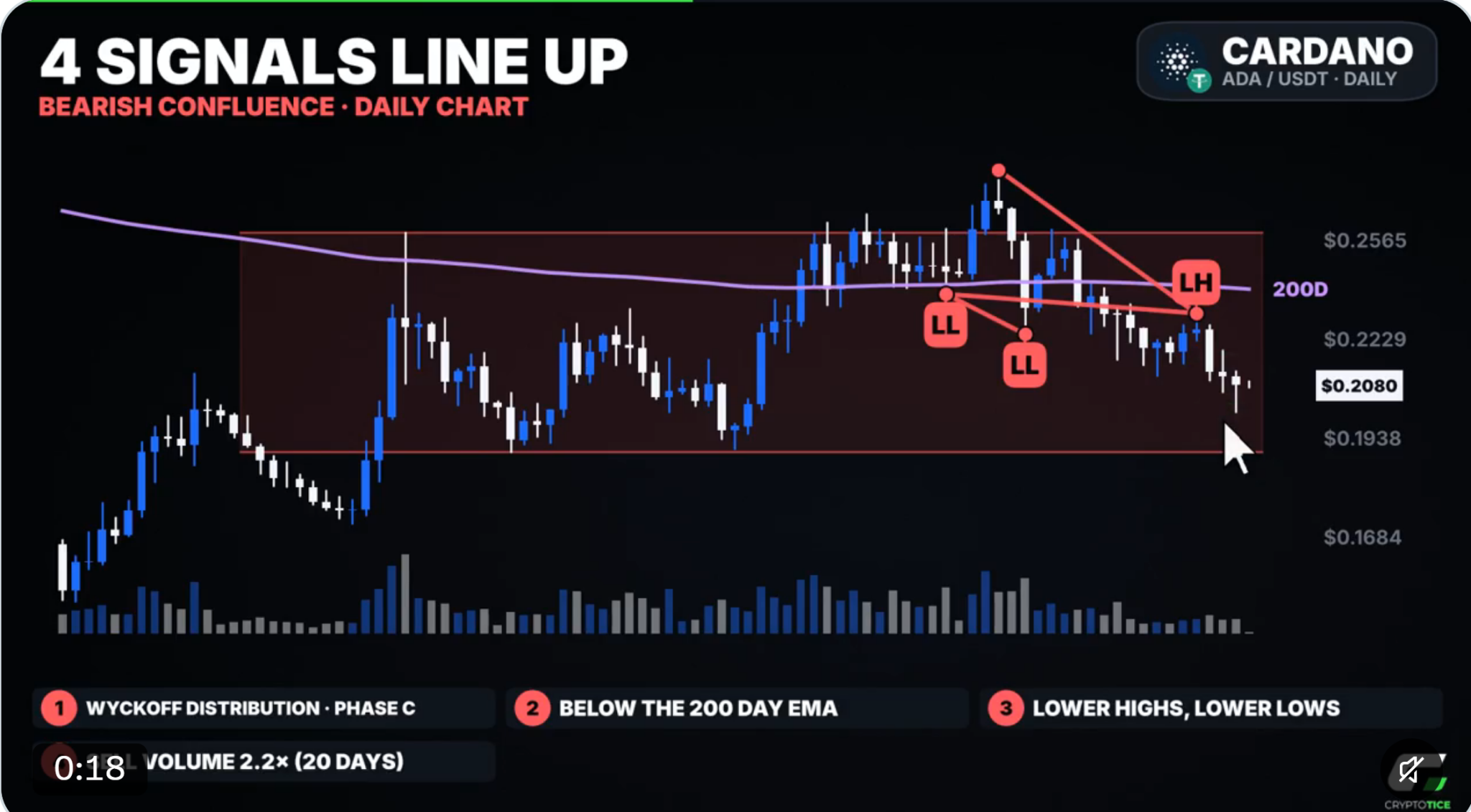
Despite the recent correction, prominent analyst and trader Crypto Tice believes Cardano could face further downside. His outlook rests on four bearish signals that suggest sellers remain in control of the market.
Potential Wyckoff Distribution
The first signal is a potential Wyckoff distribution pattern in Phase C, which he interprets as a sign that large market participants could be selling their holdings.
In Wyckoff analysis, the distribution phase describes a process in which assets move from stronger holders to buyers before a potential price decline. However, the chart pattern alone does not confirm that large investors are selling.
ADA Trades Below the 200-Day EMA
The second signal is Cardano’s position below its 200-day exponential moving average (EMA), which stands at $0.2385.
Since traders widely use this indicator to assess long-term price trends, ADA’s position below it suggests that the cryptocurrency’s broader momentum remains weak. Furthermore, the price would need to reclaim this level to show signs of a potential recovery.
Lower Highs and Lower Lows
Third, Cardano’s daily chart shows a series of lower highs and lower lows, a structure typically associated with a downtrend.
The chart annotations illustrate how ADA has struggled to regain previous highs around $0.28 while continuing to establish lower lows. Consequently, the pattern suggests that sellers have maintained control of recent price movements.
Selling Volume Exceeds Buying Volume
The fourth signal relates to Cardano’s trading volume. According to Tice, volume on declining days has been 2.2 times the volume recorded on advancing days over the past 20 days.
This imbalance suggests that selling activity has outweighed buying activity during the period. If the pattern persists, it could reinforce the bearish outlook by indicating stronger participation during price declines than during advances.
Crucial Level For Cardano
At the time of Crypto Tice’s analysis, Cardano traded at $0.2080, below its 200-day EMA and within a marked price range of $0.1938 to $0.2565.
Nonetheless, he acknowledged a potential counterargument to his bearish outlook: ADA was testing a rising trendline that had attracted four separate price touches. If buyers defend this trendline, it could provide support and interrupt the ongoing decline.
However, Crypto Tice maintained that the broader bearish outlook would remain intact while ADA trades below $0.2452. A failure to reclaim that level, combined with continued selling pressure, could expose the cryptocurrency to further losses.
Under this scenario, he identified $0.1204 as the next potential downside target. A decline from $0.2080 to $0.1204 would represent a drop of 42.1%.
Such a move would take ADA back to price levels last seen in November 2020. Notably, even during Cardano’s substantial correction earlier this year, it only fell to $0.1384 in June before rebounding.
Other Analysts Also Warn of Potential Downside
Although it remains uncertain whether Cardano will fall to $0.12, Crypto Tice’s projection adds to a series of bearish forecasts from other market commentators.
Recently, analyst Kevin Mercer highlighted a zigzag price pattern that could initially send ADA to $0.15 before a potential rebound to $0.27. Meanwhile, stake pool operator Sssebi also anticipated a possible dip followed by a recovery this week.
These projections highlight the uncertainty surrounding Cardano’s near-term price direction as traders monitor key support and resistance levels. Nonetheless, they remain speculative, not guaranteed outcomes. ADA could rebound if buyers defend support, so investors should consider the risks and avoid relying on any single analyst’s forecast.