


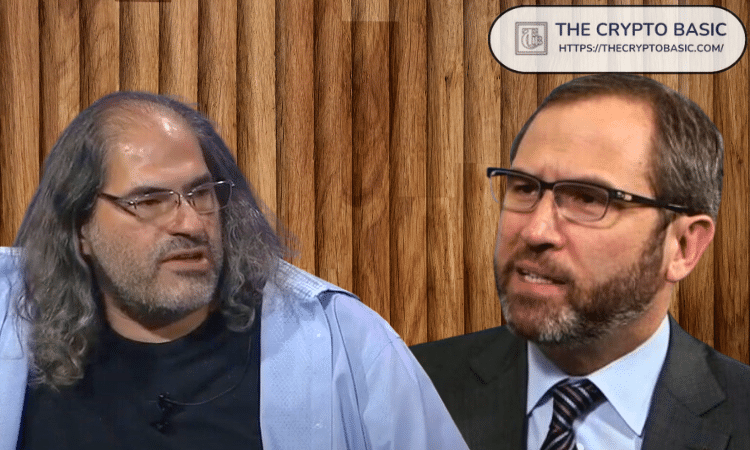

Ripple CEO Brad Garlinghouse and former Chief Technology Officer David Schwartz have shared their outlook on XRP and Ripple’s future.
Speaking at Ripple Swell 2026, Garlinghouse described XRP as a foundational technology for Ripple’s expanding financial services business. He also outlined how the company hopes to move a portion of its growing transaction volumes onto blockchain networks.
Garlinghouse believes blockchain will eventually become as commonplace as the internet, changing how people manage money, receive payments, and invest.
“XRP is Our Best Interest” — Garlinghouse
When asked where XRP will be in five years, Garlinghouse said XRP would continue to establish itself as the “institutional gold standard for crypto rails.”
He discussed Ripple’s business growth and how it creates opportunities for XRP. He described Ripple as a blockchain infrastructure company that initially focused on payments before expanding into corporate treasury services and prime brokerage.
According to the CEO, XRP remains foundational to the company’s strategy, although he acknowledged that it will not be the most suitable option for every transaction.
“Any place it makes sense, we’re going to prioritize XRP because candidly it’s in our own best interest,” he said.
Garlinghouse added that Ripple uses fiat currencies or its RLUSD stablecoin where those options better serve customers. He argued that focusing only on XRP’s share of transactions overlooks the opportunity created by growth in the overall payments market.
“If that means I’m going to use other methods, whether it’s fiat or a stable coin, RLUSD, that’s great because that still means I’m getting some of the pie,” he explained.
The executive also highlighted growth in Ripple’s customer base, saying its revenue had increased from $300 million to $900 million.
He referenced approximately $16 trillion in transaction value discussed at the previous year’s event, noting that nearly all of that activity relied on traditional financial rails. Garlinghouse said he hoped to report at next year’s event that 1% to 3% of that volume had moved onchain.
Schwartz Expects Mass Retail Adoption Within 5 Years
David Schwartz also discussed where XRP and Ripple could stand in five years. He predicted that blockchain technology would reach mass retail adoption by that time.
“Definitely there will be mass retail adoption like blockchain will be like the internet,” Schwartz said. “It will be how they manage their money. It will be how they get paid. It will be how they invest.”
He suggested that this transition could happen even sooner, with blockchain becoming an integral part of financial services within approximately three years.
Schwartz also pointed to the tokenization of real-world assets (RWAs) as an enabler of mass retail adoption. As more traditional assets move onto blockchain networks, he suggested, the technology could become accessible to more people for everyday financial activities.
XRP’s Future Depends on Institutional and Retail Adoption
Garlinghouse’s outlook places institutional adoption and the tokenization of traditional assets at the center of Ripple’s long-term strategy.
If more financial institutions move transactions onto blockchain networks, XRP could benefit where it is used to facilitate those activities. However, the CEO’s comments also make clear that Ripple intends to support different payment methods, including RLUSD, when they better fit a customer’s needs.