



The XRP Ledger’s native Lending Protocol has gained two additional validator votes, pushing support to 21 of 35 trusted validators, or 60%, as one of XRPL’s most consequential DeFi upgrades moves closer to the required supermajority.
XLS-66 needs 29 of 35 validators to vote in favor before it can enter the mandatory two-week majority period. That leaves the LendingProtocol amendment eight Yes votes short of the threshold.
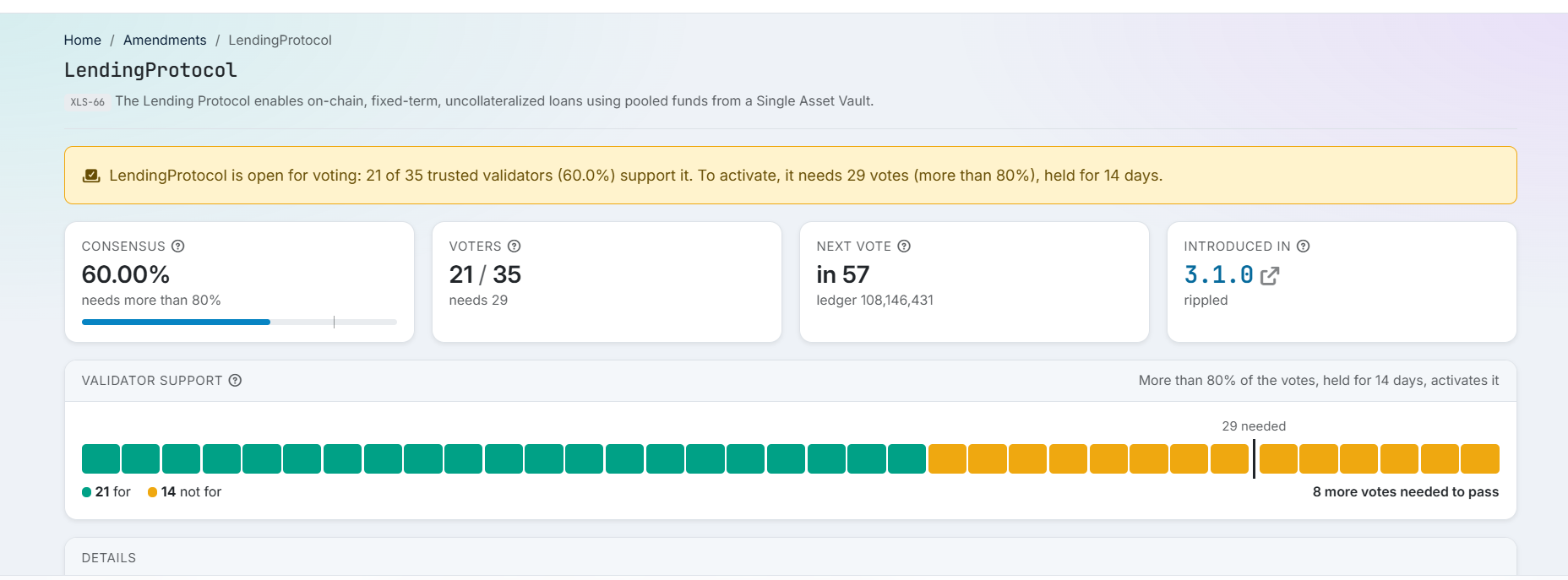
Support has risen from 19 validators in recent amendment snapshots to 21 now. The move represents further progress for a feature that entered validator voting following the release of XRPL v3.1.0.
What the XRP Ledger Lending Protocol Would Unlock
XLS-66 would introduce native, fixed-term, uncollateralized lending directly on the XRP Ledger.
Rather than relying on an external smart-contract lending platform, pooled capital would sit inside Single Asset Vaults. Loan terms, servicing and repayments would then be handled through XRPL‘s protocol-level lending infrastructure.
Credit assessment would remain off-chain. Underwriters would determine borrower creditworthiness and loan terms, while the ledger would handle execution once those terms are agreed.
The design also includes first-loss capital that can absorb losses before senior liquidity providers, providing an additional layer of protection for depositors.
For XRP, the upgrade could create another use for capital that would otherwise remain idle. Ripple has said XRP can be borrowed and lent through the lending infrastructure, alongside other supported assets.
That is why native lending has emerged as a major part of XRPL’s push beyond payments and settlement into credit markets.
Single Asset Vault Also Needs Validator Approval
XLS-66 does not operate alone.
The Lending Protocol depends on Single Asset Vaults under XLS-65, which aggregate capital from multiple depositors before those funds can be deployed into loans.
Current validator data shows SingleAssetVault further ahead at 23 of 35 votes, or 65.7%. LendingProtocol itself stands at 21 of 35.
Both components therefore still require approval before the full native lending stack can become operational.
The Crypto Basic previously reported that Evernorth plans to explore XLS-66 for institutional-grade yield on its XRP holdings, while SOIL and VS1.Finance have also prepared integrations.
The protocol has additionally undergone extensive security work. Earlier this year, XLS-66 was described as one of the most rigorously tested amendments in XRPL history, following audits, formal verification and fixes to issues discovered during testing.
Eight More Votes Would Start the Two-Week Clock
An XRPL amendment does not activate immediately after reaching the required vote count.
The network requires more than 80% of trusted validators to maintain support continuously for two weeks. With 35 validators currently participating, that means at least 29 Yes votes are required. If support later falls to 80% or below during the two-week period, the timer resets.
XRPL recently demonstrated the same process when the Batch amendment secured its 29th validator vote and entered its activation period.
For LendingProtocol, the next milestone is therefore clear: eight additional validators must move to Yes before the 14-day activation countdown can begin.
If XLS-65 and XLS-66 ultimately activate, XRPL would gain native infrastructure for pooling capital and extending underwritten credit—opening a new lending and liquidity layer directly on the network.