




Evernorth is expected to bring 473 million XRP to Nasdaq under XRPN while planning to deploy its treasury across XRPL lending, liquidity, and infrastructure.
Evernorth is preparing to bring one of the largest publicly traded XRP treasuries to Nasdaq, with the combined company expected to hold about 473 million XRP when the transaction closes.
Trading under the ticker XRPN is scheduled to begin Monday, Oct. 12, subject to completion of the deal.
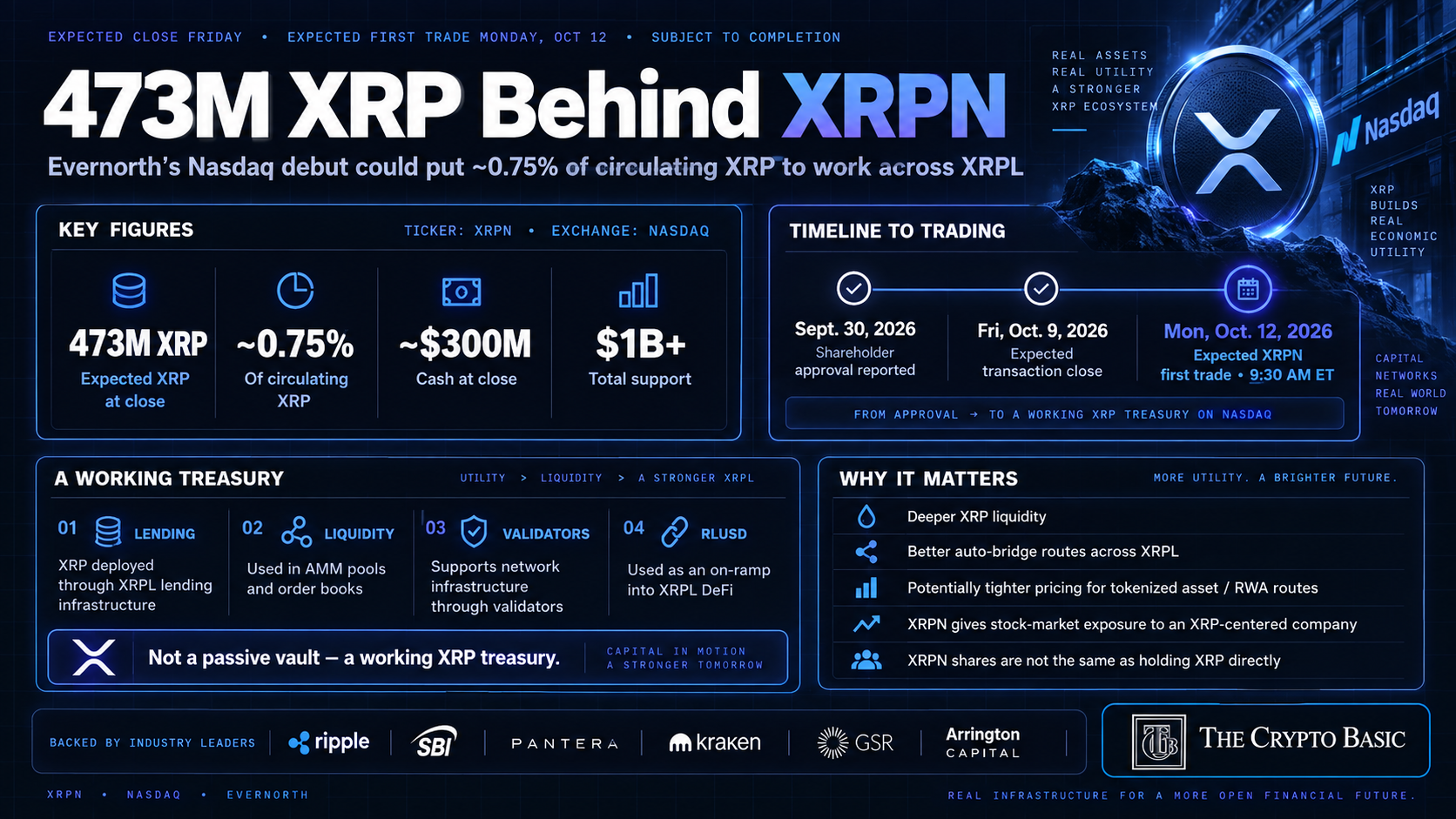
The size of the position is notable. At roughly 473 million tokens, Evernorth would control around 0.75% of XRP’s circulating supply, putting a sizable block of XRP behind a single publicly traded company.
The structure is also designed differently from a passive treasury. Evernorth plans to put part of the XRP to work across lending, liquidity, infrastructure, and other XRPL activity rather than simply leaving the tokens idle.
473M XRP Behind One Nasdaq Ticker
The planned Nasdaq listing follows the Evernorth transaction, which is expected to close Friday before XRPN begins trading Monday.
The company expects to hold roughly 473 million XRP at closing, alongside approximately $300 million in cash.
The broader transaction has attracted more than $1 billion in support, with participation from Ripple, SBI, Pantera, Kraken, GSR and Arrington.
That gives public-market investors exposure to a company whose balance sheet is heavily centered on XRP.
However, XRPN shares will not be the same as directly holding XRP. The stock will reflect Evernorth’s XRP holdings alongside its cash, liabilities, operating strategy and any premium or discount investors assign to the company.
Evernorth Plans to Put XRP Into Lending and Liquidity
The more important part of the strategy may be what Evernorth intends to do with the treasury.
Its stated plan includes lending XRP through XRPL-based lending infrastructure and deploying tokens into the network’s automated market maker pools and order books.
That could place part of the treasury directly into venues where XRP liquidity is used.
Evernorth also plans to run validators and use RLUSD as an on-ramp into XRPL DeFi, connecting its XRP holdings with a broader set of financial activity on the ledger.
The strategy therefore treats XRP as working capital inside the network rather than only as a balance-sheet reserve.
Why Deeper XRP Liquidity Could Matter
XRP has another role inside the ledger beyond being traded directly.
XRPL’s decentralized exchange can use XRP as an intermediate asset through auto-bridging.
If two assets do not have sufficient direct liquidity—or if routing through XRP offers better pricing—the trade can potentially pass through XRP instead.
That makes the depth of XRP order books important.
More XRP liquidity can mean better execution, less slippage and potentially tighter pricing for routes that use XRP as the bridge asset.
This becomes especially relevant as tokenized real-world assets and other issued tokens expand on XRPL.
Evernorth’s planned liquidity deployments would not guarantee that every tokenized-asset trade uses XRP. Routing depends on available markets and the best executable price. But deeper XRP books could make XRP-based routes more competitive.
With approximately 473 million XRP, a Nasdaq listing under XRPN, and plans to use the treasury across lending and liquidity, Evernorth is positioning the asset for a role that extends beyond corporate holdings.
The immediate milestone is now the transaction close, followed by the expected first XRPN trade on Monday.