


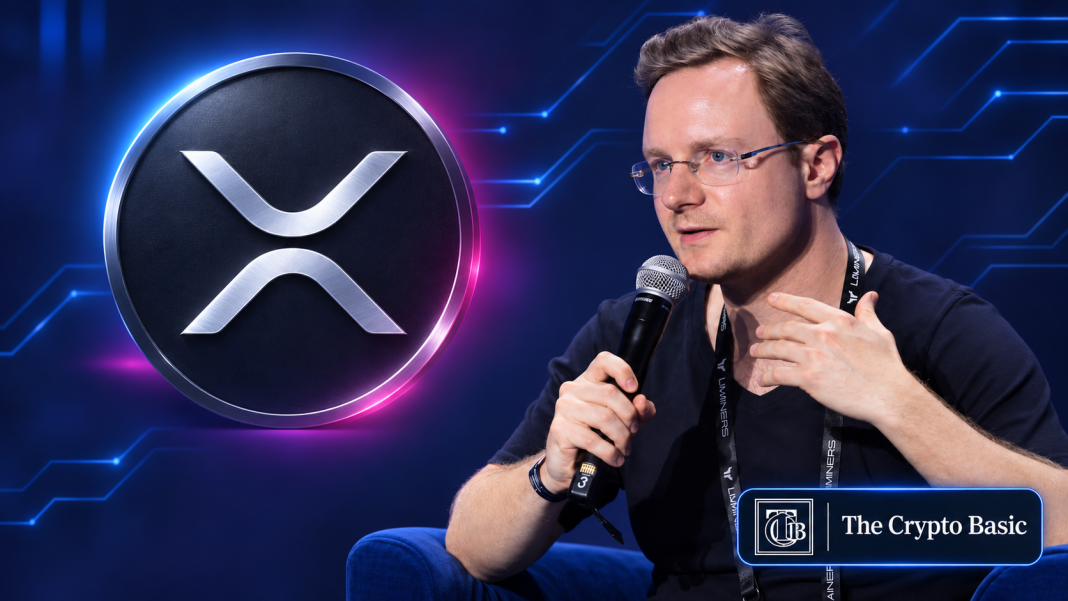

Flare cofounder Hugo Philion has pushed back against renewed criticism around XRP, arguing that the asset’s value proposition should not depend solely on what Ripple does—or does not do.
The comments come amid another wave of debate over XRP’s utility, Ripple’s growing focus on products such as RLUSD, and whether holders are relying too heavily on one company to create demand for the asset.
Philion argued that this framing has always been misguided. XRP, in his view, needs an ecosystem capable of turning dormant holdings into productive capital through lending, yield, trading, collateral and other financial applications.
“XRP’s value and narrative should never have been perceived as being based solely on the actions of one player,” Philion said.
There is renewed fud around XRP. Much of it based around what Ripple may or may not be doing.
IMO this has always been the wrong attitude to take. XRP’s value and narrative should never have been perceived as being based solely on the actions of one player. One of the reasons…
— Hugo Philion (@HugoPhilion) November 8, 2026
Philion Says XRP Holders Should Ask Three Different Questions
Rather than focusing primarily on Ripple, Philion outlined three questions he believes should define the XRP conversation.
The first is simply: “What are you doing to put your XRP to work?”
He also challenged the ecosystem to demonstrate why people who do not currently own XRP should want to hold it and, more broadly, to find ways of transforming XRP from a predominantly speculative asset into usable capital.
That argument closely matches Flare’s broader XRP strategy.
Through FAssets, XRP can be represented on Flare as FXRP, allowing the underlying value to participate in smart-contract applications including lending, collateralized borrowing, decentralized trading, yield strategies and staking-related products. Flare’s documentation lists lending, perpetual trading, vault strategies and XRP-backed stablecoin minting among the available or developing FXRP use cases.
The Crypto Basic previously detailed how Flare is expanding XRP utility through FXRP and smart contracts, while Philion has also proposed allowing XRP holders to borrow RLUSD directly from the XRP Ledger.
Debate Shifts From XRP to FLR
Philion’s remarks prompted a related question about Flare’s own native token.
One community member argued that XRP holders can now access Flare applications without visibly acquiring FLR and asked where FLR becomes something users actually need rather than an optional investment.
Philion rejected the premise that FXRP functions independently of FLR.
He explained that Flare Smart Accounts abstract the FLR requirement away from the user, but transactions still execute on Flare and require the network’s native gas mechanism underneath.
That distinction is supported by Flare’s technical documentation. Smart Accounts allow an XRP Ledger user to initiate Flare actions without personally holding FLR; an operator handles execution on Flare, effectively hiding the gas-token complexity from the user. Direct FXRP interactions outside that abstraction can require FLR for gas.
In other words, an XRP holder can experience a “no FLR required” interface while FLR remains part of the underlying network execution.
Flare Plans Broader Fee-Generating XRP Infrastructure
Philion said FLR’s opportunity should ultimately be measured through usage and wider fee generation, not transaction fees alone.
He pointed to upcoming products and partnerships combining privacy, portfolio optimization, interoperability, spot trading and perpetual futures, with Flare’s data infrastructure and confidential computing capabilities forming the foundation.
Those initiatives remain forward-looking until individual products and partnerships launch.
Flare has already expanded XRPFi in several directions. FXRP can be deployed as collateral, while Firelight allows FXRP holders to provide capital for DeFi cover and receive stXRP. Flare Smart Accounts can package the minting and deposit process into a flow initiated directly from an XRPL wallet.
The Crypto Basic has previously reported institutional use of FXRP through an 8 million-token Firelight stake and Philion’s broader plan to turn XRP into productive DeFi capital.
Philion’s broader message is therefore less about defending Ripple and more about reducing XRP’s dependence on any single company for its narrative. Under that view, the next phase of XRP utility depends on expanding the number of independent venues where holders can lend, trade, collateralize and deploy XRP as capital.