



XRP’s breakdown below a major support zone has turned increasingly costly for traders attempting to buy each successive dip, with price now near $1.08 after failing to reclaim the former $1.28-$1.31 support region.
Trader Nebraskangooner pointed to XRP as an example of why a cheaper price does not necessarily mean an asset has become a better buy after its market structure breaks.
“XRP is a great example of when to NOT BUY,” he said, adding that once major support fails, sellers can take control and continue pushing price lower. His message was straightforward: “Quit knife catching early!”
CoinMarketCap currently places XRP around $1.08, with the asset trading between approximately $1.08 and $1.16 over the latest 24 hours.
XRP Lost $1.28-$1.31 and Failed the Retest
The daily Binance structure shows why the breakdown matters.
XRP spent much of October repeatedly interacting with the $1.28-$1.31 region. That area initially acted as support, allowing several recovery attempts after price retreated from the $1.50 range.
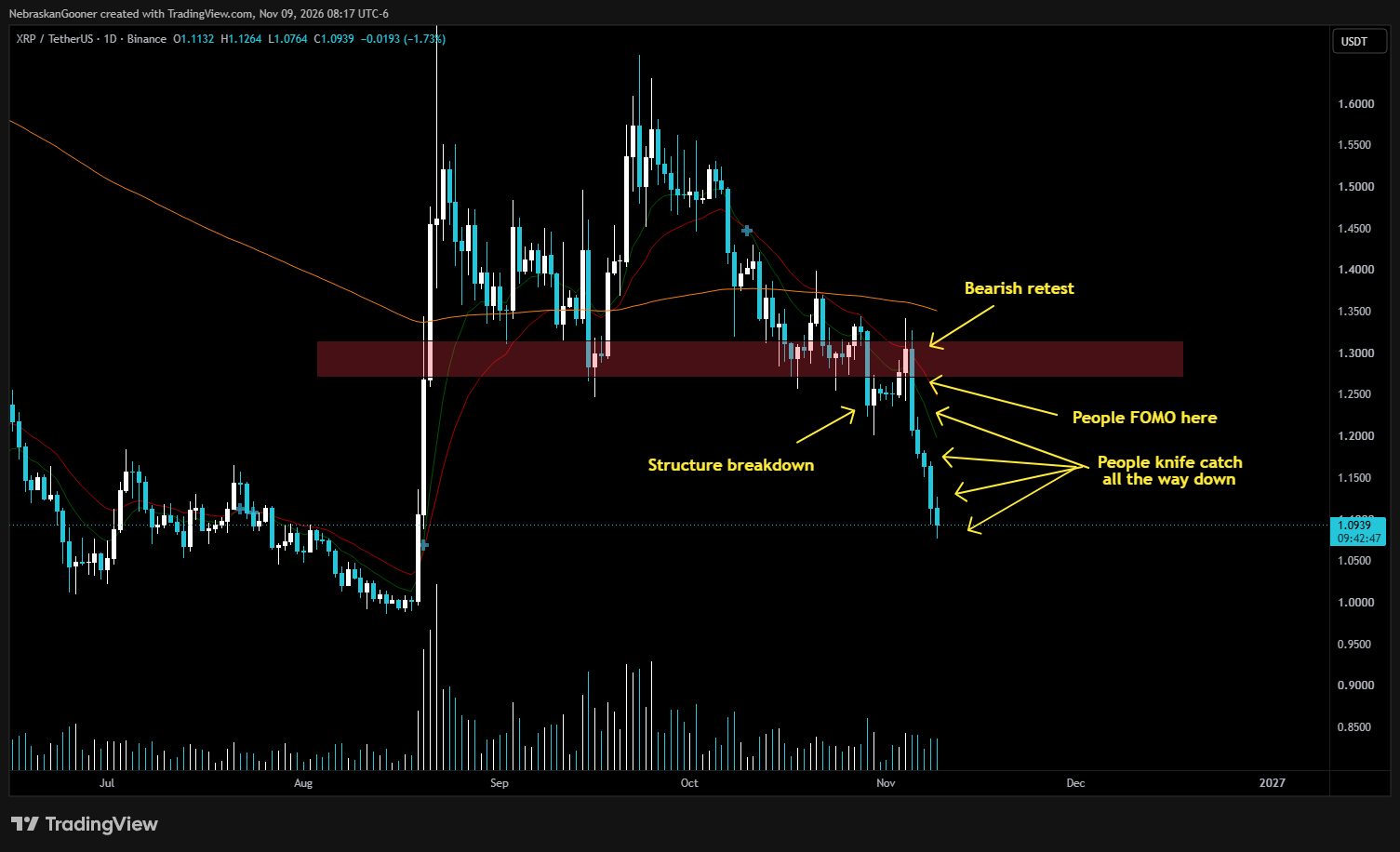
The structure changed once XRP decisively moved below it.
Price initially bounced after the breakdown and returned toward the underside of the former support zone. Instead of reclaiming the level, XRP was rejected, producing a classic bearish retest in which old support begins functioning as resistance.
From approximately $1.31 to the current $1.08 area, XRP has fallen about 17.6%.
The Crypto Basic previously highlighted XRP’s break below its former swing low as confirmation that sellers had taken control of the short-term structure.
Why Buying Every XRP Dip Has Been Risky
The decline has included several temporary rebounds.
Those short-lived recoveries can make lower prices appear attractive, particularly after XRP has already fallen substantially from previous highs. But the sequence of lower highs and lower lows means each rebound has so far occurred inside a broader bearish structure.
That is the core risk behind “knife catching.”
A falling asset can become progressively cheaper without establishing support. Buying simply because XRP has declined from $1.30 to $1.20—or from $1.20 to $1.10—does not establish that selling pressure has ended.
The same issue became visible when XRP lost $1.26. At that point, The Crypto Basic identified $1.10 as the next major downside area. Price has now reached and moved slightly beneath that region.
$1.07-$1.10 Is Now the Immediate Test
The Nov. 9 Binance daily candle opened at approximately $1.1132, reached $1.1264, and fell as low as $1.0764 before closing around $1.0939.
That puts XRP directly inside the $1.07-$1.10 support region.
The Crypto Basic has separately identified $1.07 as one of XRP’s final major support levels before deeper downside becomes increasingly relevant.
If XRP loses this region on completed daily candles, the psychological $1 level becomes the next obvious downside reference.
At $1.08, a move to $1 would require another decline of roughly 7.4%.
What Would Improve the XRP Structure?
The bearish structure would not materially change simply because XRP produces another intraday rebound.
The first requirement is stabilization around $1.07-$1.10. Beyond that, buyers would need to begin reclaiming levels lost during the decline.
The larger structural test remains $1.28-$1.31.
That zone previously acted as support and then rejected XRP during the attempted recovery. A sustained move back above it would provide much stronger evidence that sellers are losing control than simply buying another lower price.
Until then, XRP remains an example of why price being cheaper and price being technically attractive are not necessarily the same thing.