



Bitcoin’s combined 30-day demand estimate fell to approximately −348,000 BTC on November 10, its weakest reading so far this month, as deteriorating perpetual futures demand outweighed an improvement in spot conditions.
Analysis shared by CryptoQuant highlights a growing divergence between the two components. The spot demand proxy improved on every daily reading after November 7 through November 10, gaining approximately 29,500 BTC over that period. Meanwhile, the perpetual futures estimate deteriorated by roughly 63,500 BTC.
That left the combined measure approximately 34,000 BTC weaker across the three-day interval. Improving spot conditions have therefore softened the deterioration without reversing it.
Futures Weakness More Than Doubles the Spot Improvement
The perpetual futures decline was approximately 2.15 times the size of the spot improvement. This imbalance explains why the combined demand estimate continued falling even as the spot component became less negative.
| Component | Approximate change, November 7–10 |
|---|---|
| Spot demand proxy | Improved by 29,500 BTC |
| Perpetual futures estimate | Deteriorated by 63,500 BTC |
| Combined demand estimate | Deteriorated by 34,000 BTC |
Both components remained below zero. An improving spot proxy therefore indicates that contraction is easing; it does not yet establish positive spot demand growth.
The −348,000 BTC reading is a demand estimate expressed in Bitcoin units. It should not be interpreted as 348,000 BTC leaving exchanges, an equivalent amount of liquidations, or a directly measured spot sale.
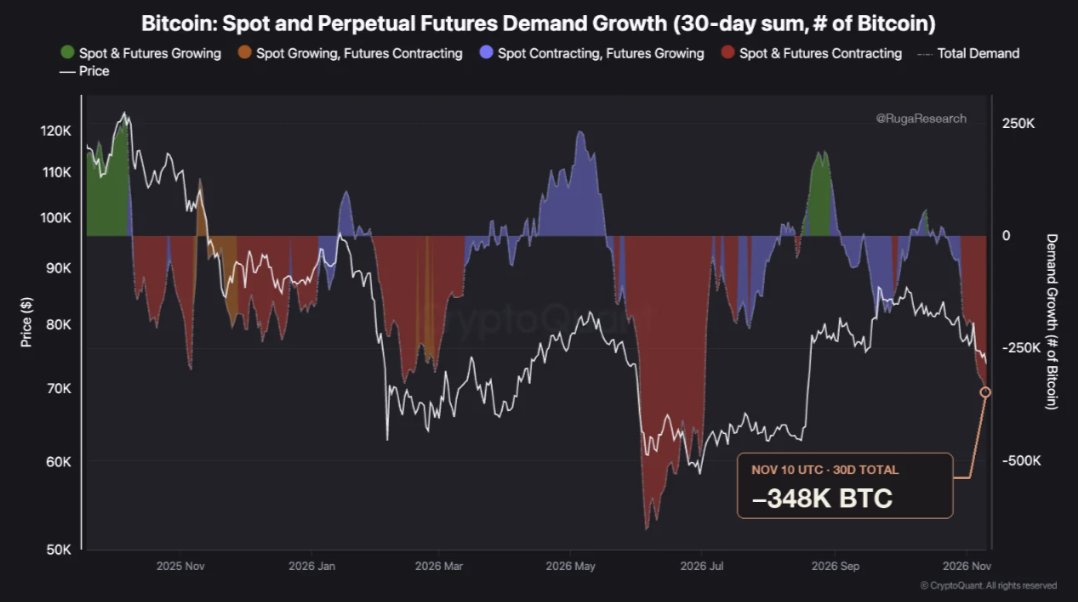
Why Demand Conditions Remain Red
The demand comparison separates four market conditions: green when spot and futures are both growing, orange when spot grows while futures contract, purple when spot contracts while futures grow, and red when both contract.
The latest red section reflects the continued negative position of both components. Spot can improve for several consecutive readings while the overall classification remains red if it has not crossed back above zero.
The white Bitcoin price line uses the left-hand dollar scale, while estimated demand growth uses the right-hand scale measured in BTC. The two series allow price performance and demand conditions to be compared without treating them as equivalent measurements.
The broader history also contains a visibly deeper negative demand trough around June. November 10 consequently represents the weakest reading of November so far, rather than the lowest reading across the entire displayed period.
The Rolling Window Makes Follow-Through Important
The indicator covers a rolling 30-day period. Each new reading adds the latest day and removes the oldest day from the calculation.
Changes can therefore reflect both fresh market activity and older observations leaving the window. The recent improvement does not, by itself, demonstrate that daily spot buying increased by 29,500 BTC.
Several successive readings will help establish whether spot contraction continues easing and whether the deterioration in perpetual futures begins to slow. A single improvement in one component carries less weight while the other continues weakening faster.
What Would Strengthen a Bitcoin Trading Range?
A stronger stabilization signal would combine further improvement in spot demand, a smaller drag from perpetual futures, and a combined estimate that begins flattening instead of falling.
Price would also need to defend its recent lows. Bitcoin’s retest of long-term support near $74,000 provides a separate price-based test of whether buyers can establish a durable floor.
Earlier progress has already proved vulnerable. Bitcoin’s September recovery above its 50-week moving average marked an improvement at the time, but the latest demand weakness underscores the need for sustained participation.
If spot continues moving toward zero while futures contraction eases and price holds its lows, the case for a trading range would strengthen. Continued futures deterioration would keep that stabilization scenario under pressure.