




Leading European crypto asset manager CoinShares has released the latest weekly report capturing the global flow of funds through crypto-based investment products.
According to the report, last week witnessed the second-largest weekly inflow on record into crypto-based investment vehicles, amounting to $1.84 billion.
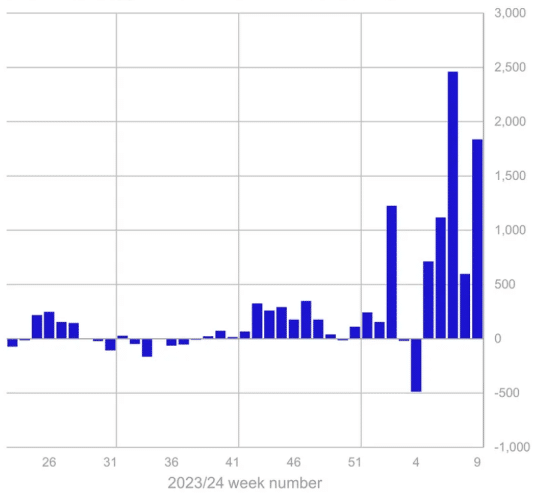
The report also highlighted that trading volumes in these investment products surged past a record $30 billion for the week. Moreover, it stated that the volume occasionally represented 50% of global BTC daily trading volumes on reputable exchanges.
CoinShares further observed that total assets under management (AuM), buoyed by recent price increases, are now nearing an all-time high at $82.6 billion.
In particular, crypto-based investment products are only $3.4 billion away from the $86 billion peak of November 2021.
Bitcoin Remains Dominant
Furthermore, the report highlighted that Bitcoin accounted for 94% of the inflows to the crypto investment products, amounting to $1.72 billion. Accordingly, the assets under management for Bitcoin reached $62.71 billion.
Also, CoinShares noted that short investors increased their positions despite recent price movements. Specifically, short-bitcoin investment vehicles witnessed an additional $22 million inflow.
Meanwhile, CoinShares revealed that Ethereum (ETH) experienced its highest weekly inflows since July 2022, with $85 million last week. However, its AuM at $14.6 billion remains miles away from the peak of $23.7 billion.
Besides, Polygon (MATIC) saw inflows of $7.6 million, accounting for 22% of its AuM. On the other hand, Solana (SOL) experienced outflows of $12 million.
Flows Per Region
Moreover, the report emphasized that the exchange-traded funds (ETFs) in the United States remained dominant, witnessing net inflows amounting to $1.88 billion last week. It acknowledged that this figure was somewhat subdued due in part to increased outflows from Grayscale.
Notably, Grayscale experienced total outflows of $1.46 billion in its Bitcoin ETF. Meanwhile, this trend was counterbalanced by new issuers, which attracted a total of $3.2 billion in inflows last week.
Interestingly, flows varied across other regions. Switzerland experienced inflows of $20 million, while Sweden, Canada, and Germany saw outflows totaling $32 million, $23 million, and $35 million, respectively.