



Bitcoin is pushing higher, but fresh data suggests the rally may not be as strong as it appears beneath the surface.
According to Ki Young Ju, CEO of CryptoQuant, the current market move is driven by derivatives activity rather than genuine buying demand in the spot market.
For context, Bitcoin’s price reached $79,488 today, one of its highest levels in two months, and is currently trading at $78,223. While the ongoing price action is impressive, analysts see reason for caution.
Key Points
- Bitcoin’s rally comes from futures, not real spot demand, raising concerns about the strength of the current uptrend.
- CryptoQuant CEO Ki Young Ju says rising open interest signals leverage, while on-chain demand remains weak.
- Despite billions in ETF inflows and institutional buying, Bitcoin’s 30-day demand metric is still negative.
- A recent short squeeze fueled price gains, but analysts warn the rally may be fragile and prone to sharp reversals.
Bitcoin Futures Driving the Move While Spot Demand Lags
In a recent update, Ki Young Ju explained that Bitcoin’s rally is “futures-driven,” pointing to rising open interest as a key signal. At the same time, on-chain apparent demand remains negative. This means real buying activity on the blockchain is still weak, despite ETF inflows and continued accumulation by institutional players.
For instance, Michael Saylor’s firm, Strategy, acquired $255 million worth of Bitcoin today after purchasing $2.54 billion in BTC just a week ago. At the same time, Bitcoin ETFs have acquired over $2.6 billion worth of BTC this month.
Yet, despite this aggressive buying pressure, CryptoQuant data shows that Bitcoin’s demand metric on a 30-day scale remains in negative territory. Meanwhile, demand from the futures market is in strongly positive territory.
This creates a disconnect. Historically, bear markets only fully end when both spot demand and futures activity recover together. Right now, that alignment is missing.


BTC Short Squeeze Fueled Recent Price Surge
Supporting this view, Carmelo Alemán, an on-chain analyst at CryptoQuant, recently broke down Bitcoin’s April 23 rally. It showed it was largely by a short squeeze rather than organic demand.
During that move, Bitcoin climbed from $76,351 to $79,447, a gain of 4.05%. However, the structure behind the rally tells a different story.
Open interest surged sharply from $24.88 billion to around $28 billion, signaling a rapid increase in leveraged positions. This spike in derivatives activity triggered widespread liquidations of short traders.
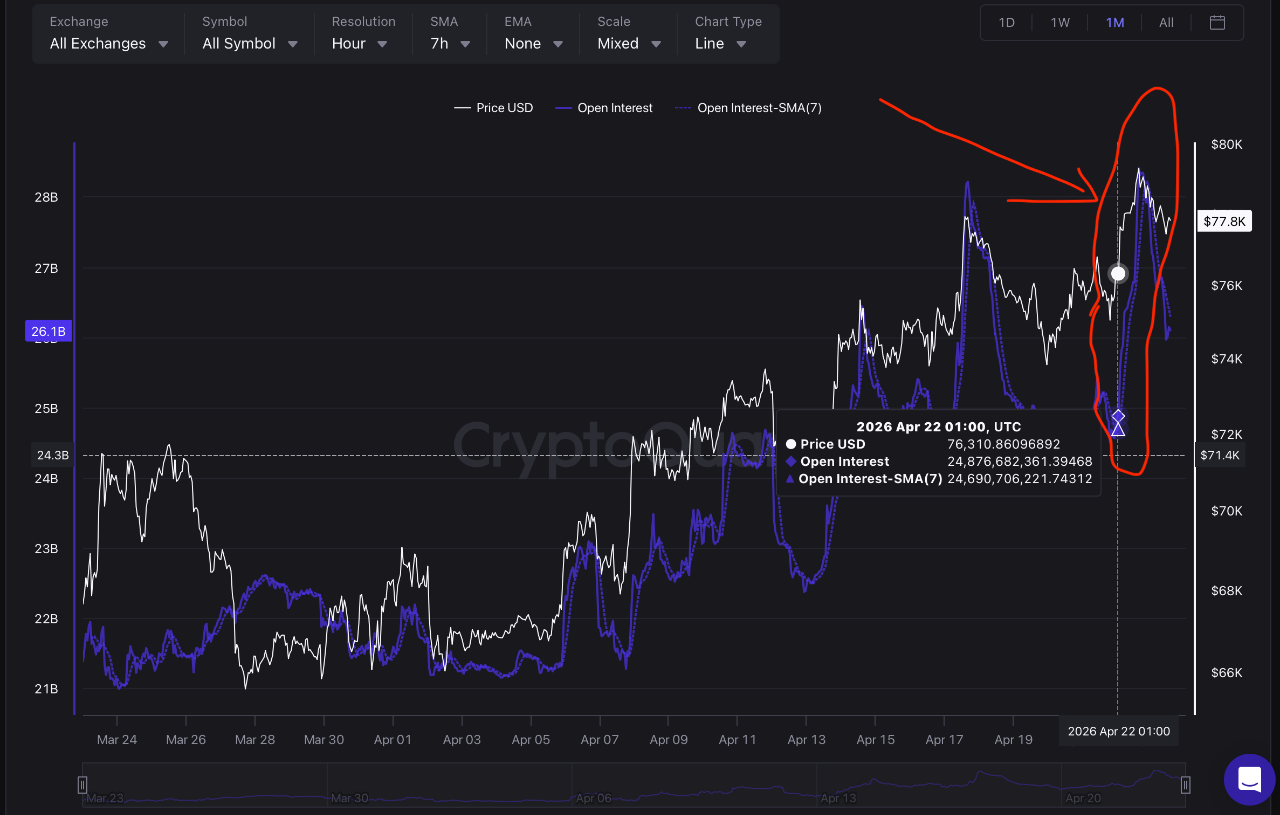
Short liquidations alone exceeded $607.9 million in Bitcoin and $580.9 million in Ethereum, bringing the combined total to roughly $1.19 billion. In contrast, long liquidations were significantly lower, totaling just over $111 million across both assets.
Fragile Rally With Reversal Risk
In sum, the data suggests that Bitcoin’s recent strength has not come from robust spot demand entering the market, but from forced buying as short positions were liquidated.
While this kind of move can be powerful, it is often unstable. When price is due to leverage than real demand, it becomes more vulnerable to sharp reversals once momentum fades.
Until both spot and futures demand recover together, the market structure may remain weak, even if prices continue rising in the short term.