


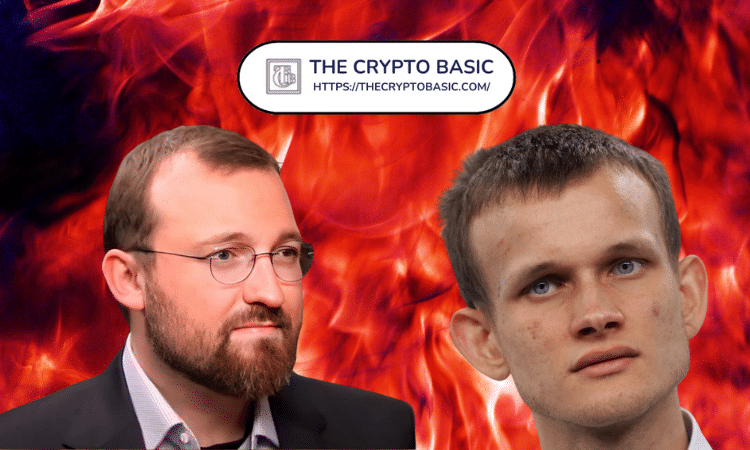

Cardano founder Charles Hoskinson has criticized Ethereum developers over a new Ethereum Foundation proposal exploring native UTXO-style payments.
He argued that Ethereum is adopting concepts Cardano has spent a decade developing without acknowledging its contributions.
The criticism followed a proposal by Ethereum Foundation developer Toni Wahrstätter titled “Native UTXOs on Ethereum”. The proposal suggests making payment transactions “one-shot objects” instead of permanent state entries.
According to Wahrstätter, borrowing elements of Bitcoin’s UTXO model could reduce Ethereum’s permanent state usage by about 99.8% for simple payment transactions. The design would preserve Ethereum’s existing account-based architecture.
Hoskinson Defends Cardano EUTXO Model
Responding on social media, Hoskinson said Cardano’s Extended UTXO (EUTXO) model is one of the biggest innovations in smart contract design.
“It’s not like I’ve been literally working on this topic for over 10 years,” he wrote. He also noted that Cardano once became the third-largest cryptocurrency by market capitalization and now serves millions of users.
Hoskinson further claimed that “it’s literally a crime in the Ethereum inner circles to mention Cardano.” He accused Ethereum developers of trying to replicate EUTXO concepts without giving Cardano credit.
During a follow-up livestream, Hoskinson expanded on his criticism. He said Cardano had already spent years solving challenges around UTXO-based smart contracts, including parallel transaction processing, reference inputs, and combining UTXO and account-based models.
He argued that Ethereum is now following a roadmap centered on technologies Cardano has been building since 2016.
Ethereum Proposal Targets More Efficient Payments
Indeed, Wahrstätter’s proposal does not mention Cardano. Instead, it describes the design as borrowing the one-time payment model introduced by Bitcoin.
The proposal introduces native UTXOs that would exist mainly in transaction history rather than permanent blockchain state. Each UTXO would include a source account, payment value, recipient address, and a protocol-assigned index to prevent double spending.
Instead of permanently storing every payment, the proposal records UTXO creation in event logs. Cryptographic proofs would be maintained through per-block commitment roots, reducing long-term storage requirements.
The design also integrates with the proposed EIP-8141 Frame Transactions architecture. This would allow UTXO inputs, account transfers, sponsorship mechanisms, and gas payments to be processed in a single transaction flow.
Hoskinson Predicts Ethereum Will Borrow More Ideas
Hoskinson argued that Ethereum has repeatedly dismissed Cardano’s innovations before later adopting similar concepts. He pointed to Cardano’s on-chain governance, treasury system, and the Ouroboros consensus family as examples of technologies Ethereum could eventually embrace.
He also highlighted Cardano’s privacy-focused Midnight project. According to Hoskinson, Ethereum will eventually move from hash-based cryptography to lattice-based cryptography as part of its post-quantum security roadmap.
While Hoskinson described the proposal as validation of Cardano’s technical direction, Wahrstätter presented it differently. His proposal aims to improve Ethereum’s scalability and state efficiency by adding UTXO-style payment mechanics alongside its existing account model, not replacing it.