



Pons (PONS) Coin Explained: Why the Robinhood Chain Launchpad Token Is Surging.
Pons (PONS) is the native token of the leading non-custodial launchpad on Robinhood Chain. Learn what it is, why its price has exploded from $0.003 to nearly $0.47, the buyback-and-burn flywheel, and its full price history.
Pons (ticker: PONS) is the native token of Pons, a non-custodial, permissionless token launchpad built exclusively for Robinhood Chain. Robinhood Chain is an Arbitrum-powered Ethereum Layer-2 that reached public mainnet on July 1, 2026.
Pons itself is not an official Robinhood product; it is operated by Pons Labs and was created by a pseudonymous developer known as MEADGod.
The platform lets anyone deploy a fixed-supply token (typically 1 billion tokens) and its trading pool in a single transaction directly from their own wallet. There is no coding required, and the platform never takes custody of user funds.
Early versions launched tokens straight into locked Uniswap V3 WETH pools. Later versions added a bonding-curve phase before tokens graduate into permanently locked Uniswap V4 pools once they reach a liquidity threshold (around 4.2 ETH). Creators pay a small launch fee (0.0005 ETH) and trading carries a 1% fee that is split between the token creator (70%) and the protocol (30%).
PONS captures value from this activity. Eighty percent of the protocol’s share of fees is automatically used to buy PONS on the open market via a TWAP process and send those tokens to a burn address.
The remaining 20% covers operations. This creates a direct flywheel: more launches and trading volume generate more fees, which buy and burn more PONS, shrinking supply while demand tied to platform usage grows. Roughly 29% of the original 1 billion max supply has already been burned, leaving a circulating supply of approximately 709–712 million tokens.
Why the Price Is Going Up
Several factors have driven the recent rally. First, Pons rapidly became the dominant launchpad on Robinhood Chain. It has processed hundreds of thousands of token launches, billions of dollars in volume, and frequently accounts for well over 60% of new-token trading activity on the chain. Daily tokenhttps://thecryptobasic.com/ creation often exceeds 20,000. High usage produces real protocol revenue—sometimes approaching $1 million in a single day—which directly funds buybacks.
Second, the tokenomics are aggressively deflationary. Continuous burns reduce circulating supply while CEX listings (MEXC, Gate, KuCoin and others) and growing on-chain liquidity have expanded access.
Third, product upgrades have broadened the platform’s appeal. V2 introduced bonding curves, Uniswap V4 pools, and support for additional quote assets including tokenized stocks and Coinbase’s wrapped Bitcoin (cbBTC) via Chainlink infrastructure. These features position Pons as more than a meme-coin factory; it is becoming infrastructure for a wider range of on-chain assets.
Market participants have also responded to Robinhood Chain’s overall growth and the first-mover advantage Pons captured shortly after the chain’s mainnet launch. Competition from other launchpads caused a sharp but temporary sell-off in early August; Pons later reclaimed leadership, and the token recovered strongly.
Complete Price Picture: From Launch to Today
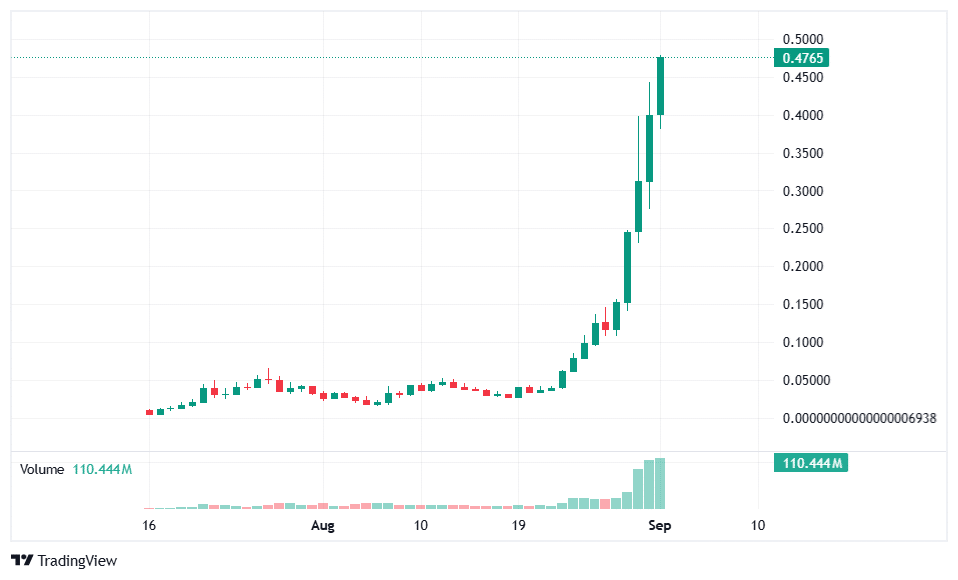
PONS began trading around July 15, 2026. Its all-time low arrived almost immediately: approximately $0.0033–$0.0035 on July 16–17.
Early enthusiasm around Robinhood Chain and the launchpad’s rapid traction pushed the price to an initial peak near $0.066 on July 27.
A competing launchpad (including Uniswap’s own offering) briefly captured market share in early August, sending PONS down more than 75% to the $0.016–$0.020 area.
The token then traded in a $0.02–$0.05 range through mid-August while the platform continued to post strong usage metrics and burns.
A new leg higher began in late August. Price closed August 24 near $0.078, climbed through $0.12 around the KuCoin listing on August 27, reached $0.245 on August 29, and closed August 30 near $0.31 after hitting $0.398.
On August 31, 2026, PONS recorded a new all-time high of $0.4438. As of September 1, 2026, it trades around $0.38–$0.39, with a market cap of roughly $270–276 million and 24-hour volume frequently exceeding $100 million. From the all-time low, this represents a gain of more than 11,000%.
The move has been volatile, typical of a young launchpad token on a new chain. Gains have been supported by measurable on-chain activity and a shrinking supply rather than pure narrative.
Pons (PONS) tokenomics
PONS center on a usage-driven flywheel rather than staking, governance voting, or traditional emissions. PONS is the protocol token of the Pons launchpad on Robinhood Chain. Its value is designed to accrue from launchpad activity through fee collection, automated buybacks, and permanent burns. The model is simple in structure but depends entirely on sustained trading volume of user-launched tokens.
Supply Structure
PONS has a hard-capped maximum supply of 1 billion tokens. There is no ongoing inflation or emission schedule. Circulating supply is lower than the cap because protocol buybacks send purchased tokens to a burn address.
As of late August 2026, roughly 29% of the original supply (about 290 million tokens) had been burned, leaving an effective circulating/total supply in the 709–712 million range. Sources describe the PONS launch itself as occurring in the public market shortly after Robinhood Chain mainnet, with limited evidence of large off-chain team or insider allocations held back from the start. Fee mechanics for individual launched tokens are snapshotted at creation and cannot be changed later.
How Revenue Is Generated
Two main fee sources exist:
- A 0.0005 ETH launch fee when a creator deploys a token.
- A 1% trading fee on every swap in the token’s pool (charged on both the launched token and WETH sides in the relevant versions).
Launched tokens themselves have a fixed 1 billion supply each. V1 launched tokens directly into locked Uniswap V3 WETH pools. V2 uses an ETH-denominated bonding curve that graduates into a permanently locked Uniswap V4 pool (via a custom hook) once a liquidity threshold around 4.2 ETH is reached. Liquidity is locked automatically; there is no later migration or withdrawal function for that LP.
Fee Split Mechanics
The 1% trading fee is split between the token creator and the Pons protocol. The split is recorded at launch and stays fixed for that token forever:
- Legacy factory tokens (earlier launches): 90% creator / 10% protocol.
- Current factory tokens (from a later block height): 70% creator / 30% protocol.
Creators receive their share in wrapped ETH rather than in their own launched token. This reduces immediate sell pressure on the new token because creators do not have to dump it to realize earnings. Unclaimed creator fees can be routed automatically. The protocol’s share is the portion that funds PONS tokenomics.
Protocol Buyback and Burn
Of the protocol’s fee share, 80% is allocated to buying PONS on the open market through an automated time-weighted average price (TWAP) process. The purchased PONS is sent to a burn address and permanently removed from supply. The remaining 20% covers infrastructure and team costs.
This is the core value-accrual loop: Platform activity (launches + trading volume) → protocol fees → TWAP purchases of PONS → burn → reduced circulating supply.
The buyback is not yet immutable. The team has stated it is intended to become fully decentralized and automated in a future release. Until then, the 80/20 policy and execution remain under current operational control. Burn-adjusted market cap is sometimes referenced as price multiplied by (total supply minus burned supply).
Optional Creator-Level Buybacks
Separate from protocol-level PONS burns, a creator can optionally divert part of their own fee share to buy back their launched token. Those tokens are not burned. They go into a shared vesting vault and are released linearly over five years, split according to the launch’s recorded fee shares. Vesting uses a weighted clock so later deposits do not accelerate earlier ones.
This feature is optional, comes only from the creator’s portion, and can fail (reverting funds) if liquidity or price impact is too high. It is designed to avoid sudden dumps of accumulated tokens.
The Flywheel and Its Limits
In theory the design is clean: more successful launches and higher volume produce more fees, which buy and destroy PONS, tightening supply while the token remains tied to the leading launchpad on a growing L2. Creators are paid in ETH, liquidity is locked, and a large share of protocol revenue is programmatically returned to PONS holders via burns.
In practice the model has several constraints. It is volume-dependent; if launch activity or trading on Robinhood Chain slows, fee revenue and buybacks decline.
Most tokens launched on any such pad go to zero, so protocol revenue is concentrated in the minority that attract real volume. The 80% buyback allocation is not yet locked in code as immutable policy. Competition from other launchpads on the same chain has already caused sharp price drawdowns.
PONS itself currently functions mainly as a value-accrual and burn token rather than a governance or utility token with additional on-chain uses (staking, fee discounts, or voting appear limited or future-oriented in available descriptions).
The tokenomics are therefore best understood as a high-beta claim on Pons launchpad usage, with an explicit deflationary overlay, rather than a self-contained monetary system. Performance tracks whether the platform keeps generating meaningful fee flow after the initial Robinhood Chain hype cycle.
Investors should still treat PONS as high-risk: launchpad tokens can lose value quickly if usage slows, competition intensifies, or broader crypto markets turn lower.
Always verify contract addresses (the canonical PONS contract on Robinhood Chain is 0x39dBED3a2bd333467115dE45665cC57F813C4571) and never invest more than you can afford to lose.