


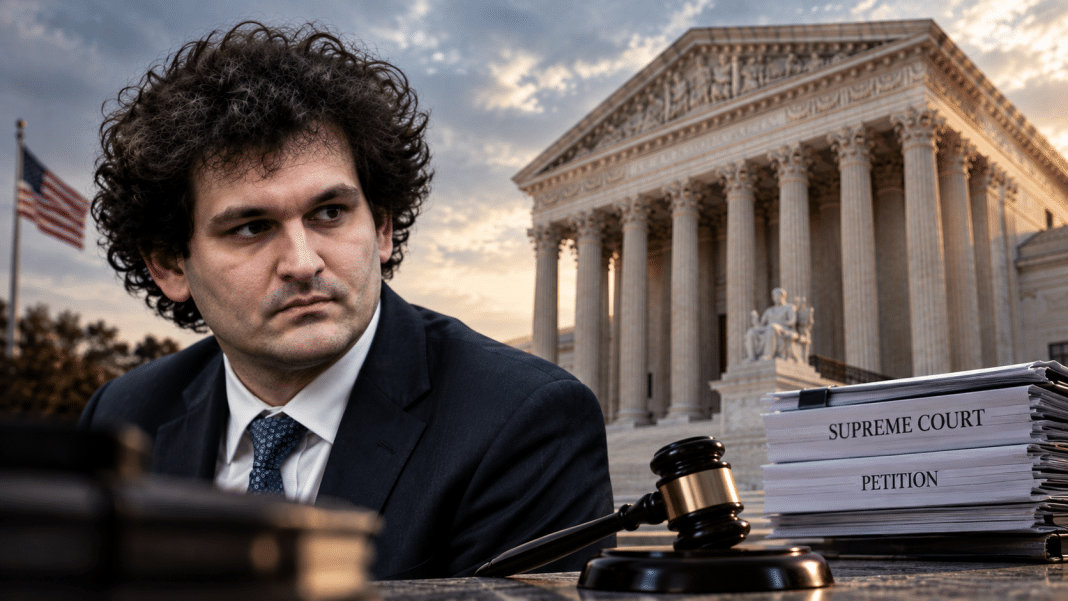

Sam Bankman-Fried is seeking relief from the U.S. Supreme Court, asking it to reverse a fraud conviction and eliminate an $11 billion forfeiture, arguing jurors received an incomplete picture of whether FTX customers ultimately lost money.
The FTX founder is serving 25 years in prison. A jury convicted him on seven fraud, money-laundering, and conspiracy counts over a multibillion-dollar scheme involving the misuse of customer funds and deception of the crypto exchange’s investors and lenders.
Bankman-Fried Contests Limits on Defense Evidence
A central issue in Bankman-Fried’s petition concerns what his lawyers were permitted to show jurors about the finances of FTX and Alameda Research. His defense maintains that the two businesses had assets sufficient to cover their obligations despite a temporary shortage of readily available funds.
The petition says the asset pool was large enough to make customers whole and points to their subsequent repayment with substantial interest.
Bankman-Fried argues that the handling of evidence at trial created an imbalance: prosecutors could put forward information indicating substantial customer losses, while his lawyers could not counter with evidence that customers would recover their money.
That dispute underpins one of the legal questions now presented to the Supreme Court. Bankman-Fried wants the justices to address the role of evidence about actual losses when prosecutors pursue fraud under a fraudulent-inducement theory that does not require victims to have suffered a financial loss. His petition argues that the court should not have allowed the government to introduce evidence of losses.
The filing separately attacks the $11 billion forfeiture as incompatible with the Eighth Amendment’s ban on excessive fines.
Kousisis Precedent Weighed Against Bankman-Fried
Bankman-Fried sought Supreme Court review after a three-judge panel of the U.S. Court of Appeals for the Second Circuit rejected his challenge to the conviction in June.
The appeals court relied on Kousisis v. United States, a 2025 Supreme Court decision addressing wire fraud. Under that ruling, liability does not require an intention to leave the victim economically worse off overall.
That interpretation defeated Bankman-Fried’s argument based on the absence of net financial harm.
According to CNN, the Supreme Court is expected to decide later this year whether to accept the case.