


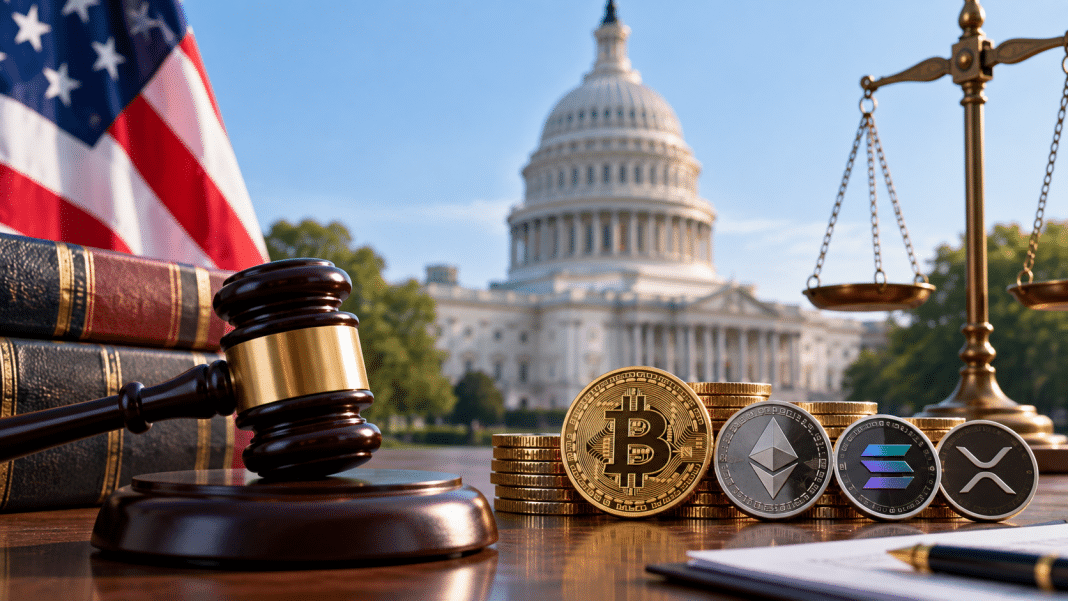

A U.S. Senate effort to establish a federal market structure for digital assets is approaching a critical procedural vote after Republican negotiators produced a revised CLARITY Act that makes concessions on government ethics, stablecoin rewards, and several regulatory provisions.
Sens. Cynthia Lummis, Tim Scott, and John Boozman released the latest version of H.R. 3633 late Sunday, calling it their final draft and saying it includes 126 substantive changes Democrats sought. The text would become the substitute amendment if senators agree on Tuesday, Sept. 15, to invoke cloture.
The revised ethics framework incorporates most of a proposal associated with Sens. Thom Tillis and Ruben Gallego. Among its provisions, state attorneys general would gain an enforcement role over conflict-of-interest requirements covering government officials.
Some Democrats had made the ethics language a condition of their support. The Associated Press previously reported that President Donald Trump had largely accepted the proposed restrictions.
Trump and his family have drawn political scrutiny over their involvement with crypto projects and assets, including World Liberty Financial, the USD1 stablecoin, and the TRUMP memecoin. A financial disclosure from Trump showed crypto-related income exceeding $1.4 billion in 2025, raising conflict-of-interest questions as his administration develops crypto policy.
Under the latest bill language, the restrictions would apply to public officials and employees as well as elected presidents, vice presidents and members of Congress. Their spouses would also be covered, while the text does not set comparable limits for other relatives such as their children.
Lummis said Trump had voluntarily accepted what she described as unusually stringent ethics restrictions for federally elected officials, judges and their spouses. She argued that the concessions addressed Democratic demands and that Democrats should now support the legislation.
Treasury Could Temporarily Curb Stablecoin Rewards
Another change targets concerns that payment stablecoins could pull deposits away from smaller banks. For the first 18 months following enactment, the Treasury secretary would have authority to activate restrictions on stablecoin rewards if community banks experience substantial deposit withdrawals linked to payment stablecoins.
The provision adds to an ongoing dispute between the banking and crypto industries over how stablecoin incentives should be treated. The legislation bars platforms from providing interest merely for holding stablecoins but leaves room for rewards tied to their use.
The American Bankers Association has sought stronger limits. Its president and CEO, Rob Nichols, said Sunday that bankers and customers had spent the August recess telling senators that locally held deposits support lending in their communities. He said the association was encouraged by increased Senate attention to what it calls a loophole involving stablecoin interest.
The draft makes changes beyond stablecoins. Certain software developers would face narrower money-transmission registration requirements through amendments to the Blockchain Regulatory Certainty Act, alongside a civil safe harbor. Provisions under the Senate Agriculture Committee’s jurisdiction would establish controls involving affiliate trading and conflicts of interest, while separate language addresses the reach of state consumer-protection laws.
Calendar Leaves Little Room After Tuesday’s Vote
Republicans cannot advance cloture on their own. The motion needs 60 votes, while the party controls 53 Senate seats. Assuming every Republican backs it, seven votes would therefore have to come from Democrats or independents.
Clearing that threshold would move the measure into debate rather than secure its passage. Senators would still need to deal with amendments and vote on the legislation itself, after which the House would have to act on the Senate’s substitute text.
Congress has limited time available for those steps. The Senate’s tentative calendar calls for a state work period starting Oct. 5 ahead of the Nov. 3 midterm elections. The House has also canceled its scheduled weeks of Sept. 21 and Sept. 28.
Patrick Witt, executive director of the White House Council of Advisors for Digital Assets, urged passage after negotiations that he said had lasted more than a year.
Lummis offered a more severe assessment of the consequences of missing the current Congress, saying last week that another opportunity to enact CLARITY could be delayed until 2030, with jobs, investment and tax revenue lost in the intervening years.
The revised draft also appeared to strengthen expectations that the bill would pass. On Polymarket, the probability of the CLARITY Act passing this year rose to roughly 32% from about 22%.