




Cardano has reached a notable decentralized finance (DeFi) milestone, with its stablecoin supply exceeding the total value locked (TVL) in its DeFi ecosystem by more than $11 million.
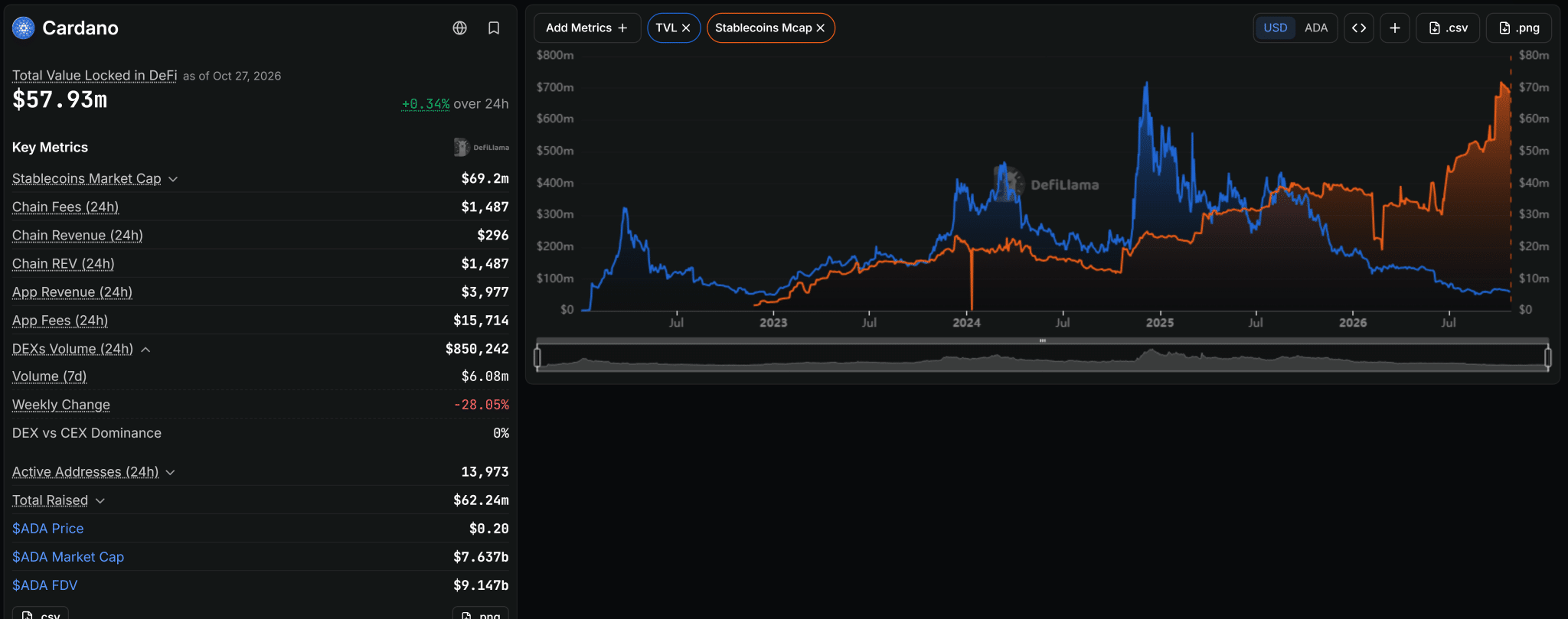
Data from DeFi aggregator DeFiLlama shows that Cardano’s stablecoin supply stood at $69.2 million at press time. Although the figure surpassed $72 million earlier this month, it has since declined below the $70 million threshold.
Nevertheless, Cardano’s stablecoin capitalization remains significantly higher than the value of assets locked in its DeFi protocols. At press time, the network’s TVL stood at $57.93 million, down from more than $71 million earlier this month.
Consequently, Cardano’s stablecoin supply exceeds its DeFi TVL by approximately $11.27 million, representing a stablecoin-to-TVL ratio of about 119.45%.
This ratio highlights the amount of stablecoin liquidity available on the network relative to the capital currently deployed in DeFi protocols. However, this does not necessarily mean that the entire difference represents capital ready to enter DeFi applications.
What Does This Mean
Cardano’s stablecoin figures raise an important question on whether the available liquidity will eventually flow into its DeFi applications and support broader network activity.
Generally, a stablecoin-to-TVL ratio above 100% indicates that the network’s stablecoin supply exceeds the value of assets locked in DeFi protocols. This could signal an opportunity for applications to attract additional capital, particularly if holders find compelling reasons to deploy their stablecoins into lending markets, liquidity pools, and other DeFi services.
However, the ratio alone does not establish how much capital remains idle or whether holders intend to use it in DeFi.
USDCx Dominates Cardano’s Stablecoin Supply
USDCx accounts for the largest share of Cardano’s stablecoin capitalization. Launched on Cardano’s mainnet in February, the stablecoin currently represents $43.52 million, or 62.9% of the network’s total stablecoin supply.
USDM follows with $13.24 million, accounting for 19.13%, while the recently launched RealFi stablecoin (USDrf) holds a valuation of $5.4 million, representing 7.80%.
The concentration of stablecoin liquidity in these assets highlights the importance of attracting stablecoin holders to Cardano’s DeFi applications. Nevertheless, growing stablecoin capitalization alone will not guarantee increased protocol deposits or trading activity.
Better DeFi Incentives Could Encourage Greater Capital Deployment
For Cardano to convert its stablecoin base into stronger DeFi activity, applications must offer attractive opportunities for users to deploy their assets. Competitive lending yields, deeper liquidity pools, and efficient decentralized trading services could encourage more stablecoin holders to participate.
However, the assumption that all stablecoins belong to users who can immediately deploy them may not hold. Issuers can mint tokens ahead of distribution and retain them in treasury or other company-controlled wallets. Consequently, some of the reported supply may not yet circulate actively among users.
Therefore, Cardano’s next important milestone will be its ability to attract additional stablecoin deposits and demonstrate sustained growth in capital deployed across its DeFi ecosystem.
Cardano DEX Activity Weakens Despite the Liquidity Milestone
Despite the stablecoin-to-TVL ratio exceeding 100%, Cardano’s decentralized trading activity remains subdued.
According to DeFiLlama, the network recorded $850,242 in DEX trading volume over the past 24 hours. Meanwhile, its seven-day DEX volume declined by 28.05% to $6.08 million.
These figures suggest that Cardano has yet to translate its stablecoin base into stronger decentralized trading activity. Rather than indicating an immediate surge in demand, the latest data highlights a gap between the stablecoin liquidity available on the network and the trading volume flowing through its decentralized exchanges.