
The Cardano community is considering a 9.6 million ADA funding proposal to expand a blockchain-based police evidence system, building on an existing deployment in India.
Submitted on October 21 by Trivolve Tech and the Cardano Foundation, the proposal seeks funding to develop the Police Force Management System (PFMS). The open-source platform aims to secure evidence records across police investigations, forensic laboratories, prosecution, and court proceedings.
Cardano Proposal Builds on Existing Police Deployment
The proposal builds on Trivolve’s existing evidence management system deployment in Uttar Pradesh, India, where the platform records cryptographic hashes of evidence on Cardano’s mainnet.
According to the proposal, the existing system processes 11,000 mainnet transactions monthly and has recorded more than 156,000 transactions in total. Each evidence scan generates a cryptographic fingerprint, while separate identifiers help establish the chain of custody by tracking evidence handlers.
This existing deployment provides the foundation for the proposed PFMS expansion. Rather than introducing an entirely new use case, Trivolve aims to extend the approach into a comprehensive system that tracks evidence throughout its lifecycle, from initial collection to court verification.
How PFMS Could Expand Cardano’s Role in Law Enforcement
The proposed platform would secure records across five stages: pre-crime evidence, investigations, evidence storage, prosecution, and court proceedings.
To achieve this, an edge agent would generate cryptographic hashes from records originating from sources such as surveillance cameras, call logs, and court filings. The system would then associate these fingerprints with device identities and officer credentials before recording them on Cardano in batches.
Notably, the Cardano blockchain would store only cryptographic fingerprints, not the underlying evidence files or personal information. Authorized parties could subsequently compare evidence against its on-chain fingerprint to determine whether anyone had altered the records.
If the proposal receives approval, Telangana would become the first deployment location for PFMS. According to the proposal, the Indian state government would cover transaction fees, infrastructure, and maintenance costs.
9.6M ADA Request Targets 1.5M Annual Transactions
Trivolve is requesting 9.6 million ADA to design, develop, and deploy PFMS as an open-source platform. At the proposal’s planning rate of $0.23 per ADA, the request amounts to $2.2 million.
However, the proposal caps spending at $0.30 per ADA, equivalent to $2.88 million. Any value exceeding this threshold would return to the Treasury.
The funding would be distributed across five milestone-based tranches over 15 months. Meanwhile, the Cardano Foundation would administer the funds, and an independent assurer would review deliverables before subsequent payments following the initial tranche.
Trivolve projects that PFMS could generate more than 1.5 million Cardano transactions in its first year, averaging 127,500 transactions monthly. If realized, this activity would increase average mainnet transaction activity by an estimated 18.2%.
Treasury Could Receive 70% of Verification Revenue
Beyond expanding on-chain activity, the proposal introduces a potential revenue stream through paid evidence-verification services for authorized parties, including prosecutors and defense lawyers.
The proposed pricing would start at $1.89 per verification request, with higher charges potentially applying to larger datasets.
Under the proposed revenue-sharing arrangement, Cardano’s Treasury would receive 70% of the proceeds, while 20% would support the maintenance of core Cardano libraries. Trivolve Tech would receive the remaining 10%.
Consequently, the model could link the proposed public-sector deployment to both Treasury revenue and funding for core infrastructure maintenance, provided the verification service attracts paying users.
Governance Approval Remains the Key Hurdle
Meanwhile, the proposed 9.6 million ADA withdrawal remains under governance consideration, with the proposal set to expire on November 20, 2026.
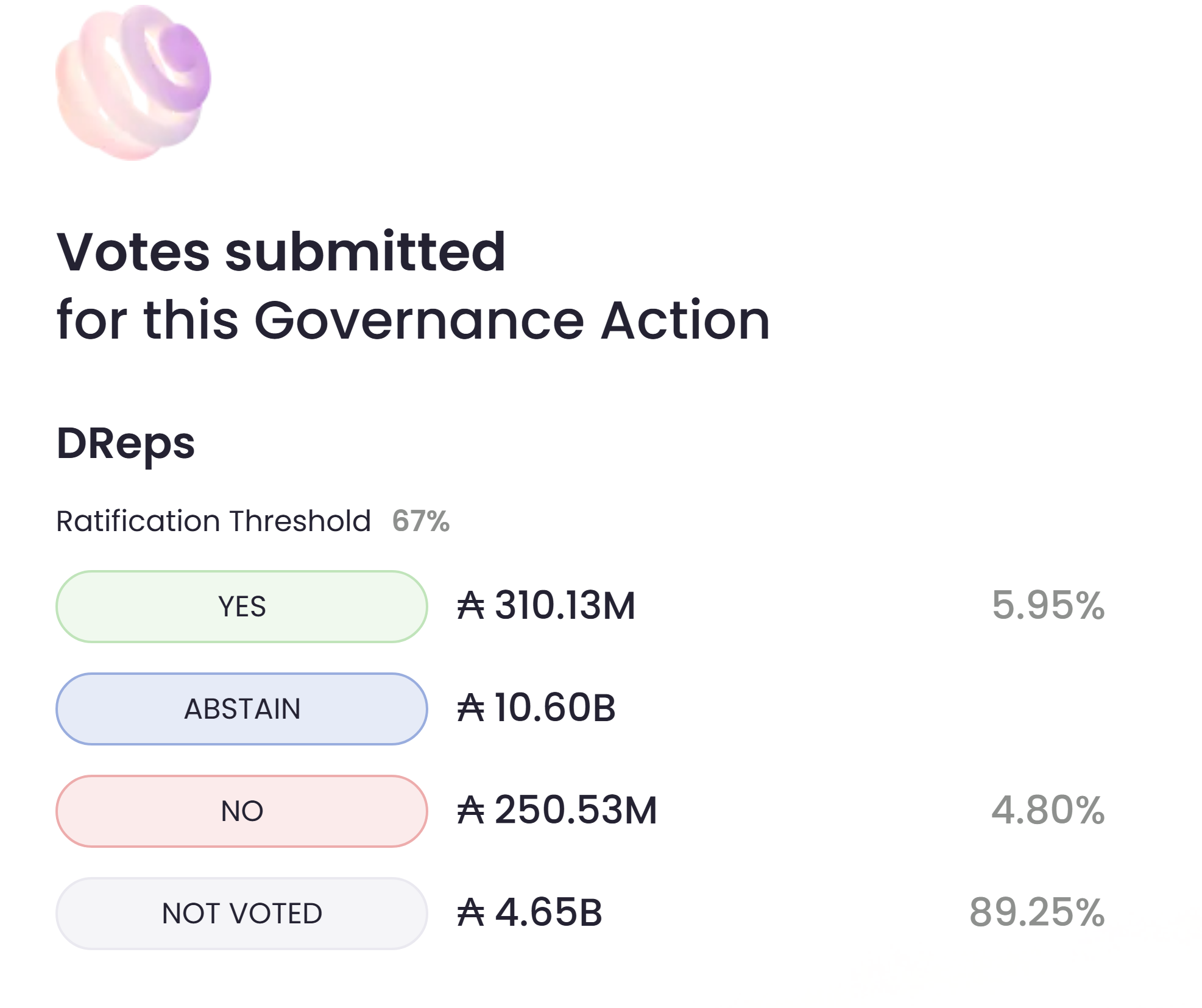
So far, 5.95% of DRep votes support the proposal, while 4.80% oppose it. The remaining 89.25% of DReps have yet to vote.
The proposal needs 67% DRep ratification by November 20, 2026, to pass. Therefore, its expansion plans, projected transaction growth, and potential Treasury revenue remain contingent on governance approval.