



XRP has entered a correction alongside the broader crypto market, but retail activity has increased across exchanges as whale dominance declines.
Notably, XRP fell from a local high of $1.52 on Oct. 6 to around $1.39 at press time. Several factors have contributed to the decline, including broader market selling, higher US Treasury yields, and leveraged liquidations.
The US 30-year Treasury yield climbed toward 5.72% on Oct. 7, reaching a level not seen in about 24 years. This rise in yields has weighed on risk assets, and XRP has also felt the impact.
XRP Retail Activity Increases as Whale Dominance Falls
Amid the decline in XRP’s price, exchange data shows a change in investor activity. Specifically, retail participation has increased across centralized exchanges, while the share of activity linked to larger holders has declined.
The main measure in this data is the Whale vs. Retail Spread (%). The metric assesses the difference between XRP exchange outflow activity from large holders and that from retail investors.
A falling spread does not necessarily mean whales are selling. What it does show is that the difference between whale and retail activity is becoming smaller.
Between Sept. 30 and Oct. 8, 2026, the All CEX Whale vs. Retail Spread fell from 64% to 46.7%. This represents a decline of 17.3 percentage points, or roughly 27% in eight days.
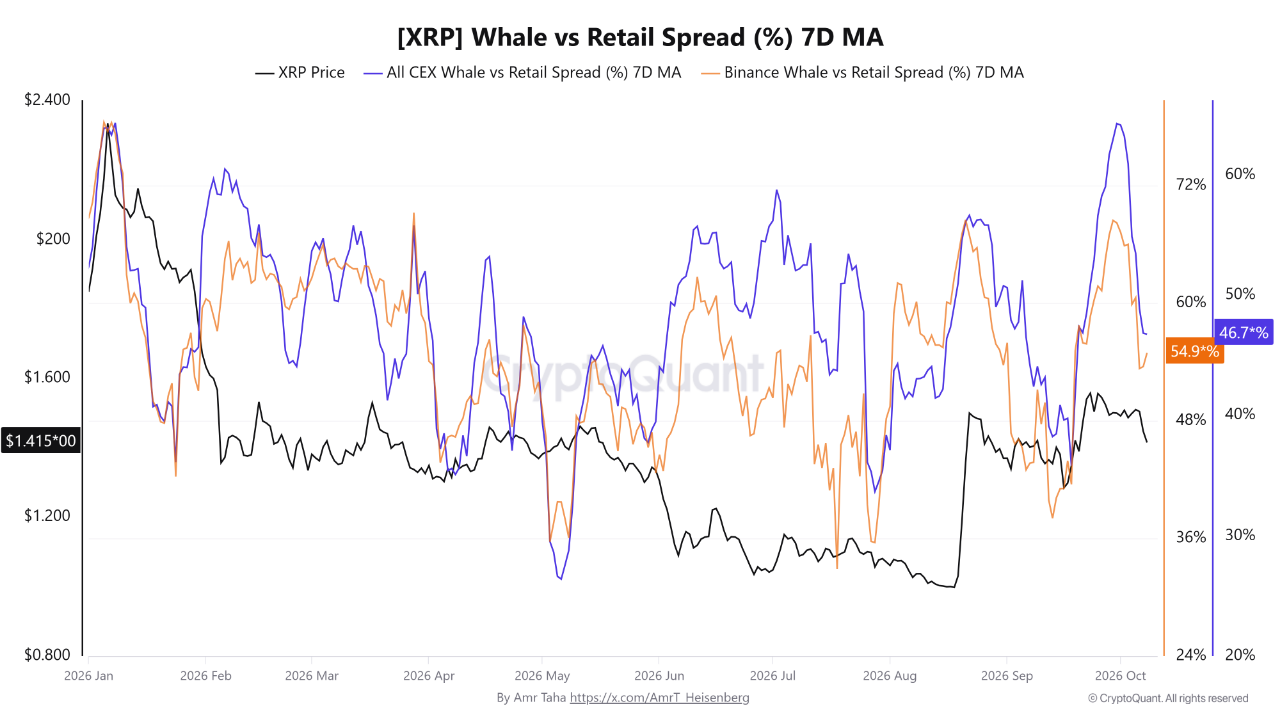
The sudden drop shows that retail investors have become a much larger part of XRP’s exchange outflow activity over the past week. This is important because it has happened while XRP’s price has dropped lower.
Binance Shows a Slower Change
While Binance has followed the same general trend, the change has been less pronounced. Between Sept. 30 and Oct. 8, 2026, the Binance Whale vs. Retail Spread fell from 68% to 54.9%.
This marks a decline of 13.1 percentage points, or about 19.3%. While the drop is worth noting, it is smaller than the decline recorded across all centralized exchanges.
Also, at 54.9%, Binance’s current reading remains 8.2 percentage points above the 46.7% reading for all centralized exchanges.
This suggests that whale activity still has a stronger influence on Binance than it does across the wider exchange market. However, both readings have moved lower, confirming that retail activity has gained ground in both cases.
In addition, Binance’s XRP reserves provide further evidence of continued activity from large holders. The exchange’s XRP reserves fell from 2.704 billion XRP to 2.631 billion XRP between Sept. 26 and Oct. 4. Interestingly, whale-sized outflows drove much of this decline during the period.
XRP RSI Reaches Deeply Oversold Levels
The recent price decline has also pushed XRP’s technical indicators toward extreme levels. According to a recent report from The Crypto Basic, the 4-hour XRP Relative Strength Index (RSI) has reached levels not seen since XRP traded at $1.05.
Similar oversold conditions can create room for a short-term rebound, but they do not guarantee one. Overall, the broader market remains under pressure, while higher Treasury yields and other macroeconomic factors could continue to limit demand for risk assets.