Home Blog Page 1004

“Better Buy Some Bitcoin,” CNBC’s Joe Kernen Tells Allianz Chief Economic Adviser

0

CNBC Squawk Box host Joe Kernen has recently admonished Allianz Chief Economic Adviser Mohammed El Erian to buy Bitcoin.

Bitcoin has come a long way from its niche libertarian roots to a $2 trillion asset standing at the door of mass adoption comparable to gold.

In perhaps the latest reminder of this, a clip showing a prominent CNBC show host nudging a renowned economist to adopt the asset over inflation concerns is making the rounds on the internet.

CNBC’s Joe Kernen Orange Pills Mohammed El Erian

CNBC Squawk Box host Joe Kernen has recently admonished Allianz Chief Economic Adviser Mohammed El Erian to buy Bitcoin.

In a clip shared by Bitcoin evangelist and MicroStrategy Chairman Michael Saylor on Wednesday, January 15, Kernen tells El Erian: 

“You better buy some Bitcoin, Mohammed.”

The clip is from a Thursday, January 9, Squawk Box episode that saw Kernen and El Erian go head-to-head over inflation concerns. 

On the show, El Erian argued for a 2.5% to 3% inflation target over the Federal Reserve’s current 2% target. He contended that fixation on a 2% target would mean a further rate hike and unnecessarily send the economy into a recession, which could hamstring innovations that could secure the economy of tomorrow. This higher inflation target is something the economist has advocated for over the past few years.

CNBC‘s Kernen, on the other hand, forcefully challenged the idea of a 3% inflation target, noting that it could imply a 50% increase in dollar devaluation, which could significantly hurt purchasing power and savings.

However, El Erian argued that these issues could be navigated by stable inflation expectations. Kernen retorted by nudging the economist to buy Bitcoin in a nod to arguments that the digital asset’s fixed supply makes it a suitable hedge against inflation and currency devaluation.

Old Sparring Partners?

It is notably not the first time Kernen has nudged El Erian towards Bitcoin. Previously, in December 2023, the journalist gave the economist accolades for taking a more favorable outlook on the digital asset. This came as the economist seemingly anticipated Bitcoin’s Q4 rally that year.

Kernan established himself as a Bitcoin bull in 2019 when he championed Bitcoin’s value over Facebook’s now-defunct crypto project Libra.

El Erian, on the other hand, while not a detractor, has often taken a conservative outlook on Bitcoin. He infamously asserted in October 2022 that massive institutional adoption was never going to come for Bitcoin and that it would never hit the $100,000 price point, though, at the time, he also asserted that the crypto industry had staying power within the ecosystem of payment options.

Meanwhile, El Erian has admitted to holding Bitcoin in the past, buying around the 2018 lows of $3,000 but selling at a profit in late 2020 when the asset climbed back to $19,000. He told CNBC in November 2021 that he regretted this decision after Bitcoin hit highs of $69,000.

As Bitcoin Hits $100,860, Bulls Eye Extension to $106,888

As Bitcoin temporarily surpasses the $100,000 mark, bullish momentum is back in the market. Will BTC continue its ascent to $106,888?

The release of the US CPI data has fueled momentum in the crypto market, with Bitcoin briefly breaking above the $100,000 mark. The BTC price rally reached a 24-hour high of $100,860, surpassing the previous level of $99,514, signaling renewed market optimism.

Bitcoin Price Analysis

Notably, the ongoing Bitcoin price rally follows the bullish setup predicted in our last BTC price analysis. At press time, Bitcoin’s price remains at $99,717 as it retests the broken resistance level.  

Bitcoin Price Chart
Bitcoin Price Chart

The bullish resurgence has merged the 50, 100, and 200 EMA lines in the 4-hour chart. This is in preparation for a bullish alignment. 

Furthermore, the RSI line is now fluctuating near the overbought boundary line. This reflects a surge in bullish momentum and increases the chances of an upside continuation. 

Institutional Support Drives Market Momentum

With the massive recovery in Bitcoin’s market price, institutional support is back in the game. On January 15, the daily net inflow of the 12 U.S. spot Bitcoin ETFs stood at $755.01 million. 

Bitcoin ETFs
Bitcoin ETFs

Fidelity led the charge, with an inflow of $463 million, followed by ARK Invest’s ARKB ETF, which accumulated $138 million. Notably, Grayscale Bitcoin Trust secured $50.54 million.

Several other issuers also reported positive flows yesterday with no outflow. In addition, three ETFs had zero net flow, while the remaining six showed positive inflows, indicating broad-based confidence among funds.

Rising Speculation in the Derivatives Market

With growing bullish demand, speculation in the derivatives market is on the rise. Bitcoin open interest has increased to $64 billion, with a 24-hour surge of 3.59%. This signals heightened activity in the derivatives space.

Bitcoin Derivatives
Bitcoin Derivatives

Consequently, the long-to-short ratio now reflects a greater number of bullish positions, with a ratio of 1.0149. However, the funding rate has dipped slightly to 0.0016%, indicating a minor pullback in sentiment, which is worth monitoring.

Over the past 24 hours, Bitcoin liquidations totaled $82.53 million, with short positions contributing $58.28 million. Bulls experienced liquidations of $24.25 million, further highlighting the dominance of bullish traders.

BTC Price Targets

Based on the price action levels, the recovery run will likely continue with a post-retest reversal. Traders are eyeing the next move above $102,000.

From there, buyers could challenge the supply zone near $102,557. Beyond that, the next key price target is $106,888, which may occur ahead of the Trump swearing-in ceremony.

On the downside, the crucial support level is the 20 EMA line at $97,129. A drop below this support could attract sellers into the market.

Top Analyst Says Get Ready for Shiba Inu Pump as Key Resistance Breaks

0

An analyst recently highlighted Shiba Inu breakout above a crucial trendline, signaling a potential price surge for the token.

Notably, Shiba Inu (SHIB) reached a multi-month high of $0.000033 in December 2024 but has since fallen to the $0.00002 range. Despite attempts to regain upward momentum, the token has struggled to sustain significant rallies. As of today, SHIB is trading at $0.00002223, showing a slight recovery.

While SHIB has performed poorly over the past month, the token has gained 3% in the last 24 hours and 4.40% over the past week.

Amid these recovery efforts, an analyst on X has identified a potential bullish signal based on a key trendline breakout.

Shiba Inu Ready for Pump after Breaking Downward Trendline 

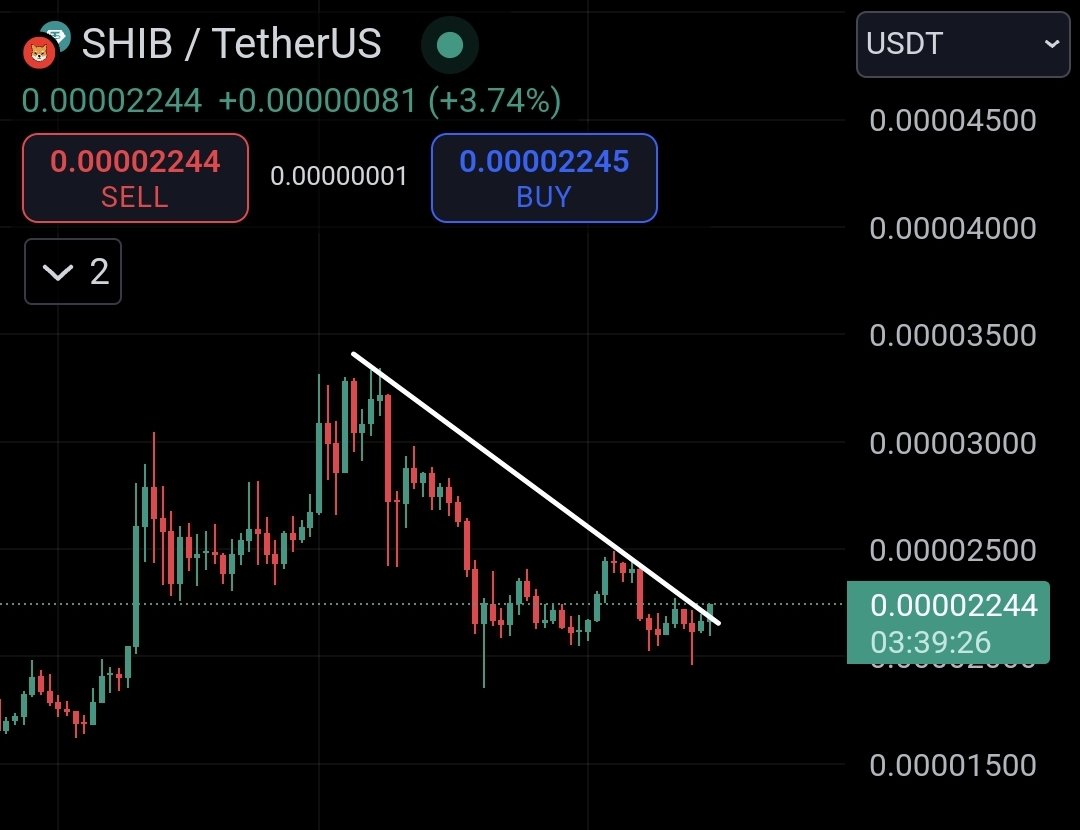
SHIB Knight, a pseudonymous analyst on X,  highlighted a key technical development in Shiba Inu’s price movement on January 15. According to him, “Shiba Inu is ready to pump.”

The analyst’s chart showcases a downward trendline connecting SHIB’s lower highs, which has consistently represented bearish sentiment over recent sessions. Notably, SHIB has broken above this trendline, a move that often signals a shift in market sentiment.

Breakouts from such trend lines typically indicate that sellers are losing control while buyers gain momentum.

According to the analyst, the Shiba Army should prepare for a pump, as this pattern could start a new upward trajectory for SHIB.

Image
Shiba Inu chart by SHIB Knight

Large Holders Exhibit Interest

Supporting this potential shift, data from IntoTheBlock reveals increased activity among SHIB’s large holders.

Over the past seven days, the net flow of SHIB into large accounts has risen by +1.93%, reflecting renewed accumulation. On a longer time frame, the 30-day net flow has surged by +765.83%, showing substantial accumulation following the December dip.

SHIB Large Holders Netflow

However, the 90-day net flow remains negative at -17.80%, indicating that SHIB has not fully recovered from earlier selling pressure. These mixed signals suggest that while confidence among large holders is growing, long-term caution persists.

Derivatives Data Promise Interest

Furthermore, derivative activity for SHIB also shows promising signs. A 30.74% increase in trading volume to $187.03 million suggests heightened interest in the token.

Further, open interest has risen by 9.90%, reaching $486.69 million, signaling that more traders are positioning themselves for potential price moves.

SHIB Derivatives Data

Liquidation data also underscores this momentum, with $405.15K liquidated in the past 24 hours. In the same time frame, $234,220 in short positions were liquidated, suggesting that bearish traders were caught off guard by SHIB’s price action.

Meanwhile, $170,920 in liquidated long positions reflects active trading during the upward movement.

Federal Court Slams BitMEX $100M Fine in AML Suit

0

A U.S. District Court has ordered cryptocurrency exchange BitMEX to pay a $100 million fine for violating anti-money laundering regulations. 

The penalty follows the platform’s guilty plea in 2022 for failing to adhere to the Bank Secrecy Act. This regulation mandates safeguards such as customer identity verification and anti-money laundering programs.

District Judge John Koeltl issued the ruling, marking one of the first major enforcement actions targeting the crypto sector.

Violations and Penalties

BitMEX, which pioneered cryptocurrency derivatives trading, processed over $200 million in transactions linked to unregistered money services and darknet markets. According to the U.S. Treasury Department, these activities violated compliance standards set forth by federal law. The case also concluded with BitMEX being sentenced to two years of probation.

The Justice Department originally brought charges against the exchange’s co-founders—Arthur Hayes, Benjamin Delo, and Samuel Reed—in 2020. Gregory Dwyer, an executive at BitMEX, faced similar charges.

All four pleaded guilty and, in addition to probation, agreed to pay $10 million each in fines. The Justice Department categorized these payments as proceeds derived from unlawful activities.

BitMEX Reacts to $100M Fine

BitMEX addressed the recent financial penalty imposed by the U.S. District Court through a post on the X platform.

The company expressed disappointment over the additional financial penalty. Meanwhile, BitMEX noted that the $100 million amount was significantly lower than the figures previously sought by the Department of Justice (DOJ).

In the statement, BitMEX highlighted that the DOJ initially demanded over $200 million to settle a plea deal during a negotiation process that spanned three years. After the company refused, the DOJ sought approximately $420 million in sentencing proceedings.

BitMEX viewed the final penalty as a justification for its stance, emphasizing that it was substantially below the amounts originally pursued.

The post also questioned whether U.S. taxpayer resources could have been better utilized during the prolonged legal proceedings, pointing to the years-long process as excessive.

Oklahoma Now Latest US State to Consider a Bitcoin Reserve

0

About six states are currently considering establishing a strategic Bitcoin reserve, with an Oklahoma congressman being the latest to propose the idea.

The tides are changing for cryptocurrency and Bitcoin adoption. The crypto firstborn has matured from being deemed a volatile asset without any intrinsic value to a widely adopted digital currency.

The ploy to adopt Bitcoin as a strategic reserve asset has become a trend among US states amid changing tides at the national level. Oklahoma is the latest state to consider this financial innovation.

Oklahoma Congressman Proposes Bitcoin Bill

As in five other states, an Oklahoman House of Representatives member has proposed adopting Bitcoin as a strategic reserve asset. In a Wednesday report, Rep. Cody Maynard submitted legislation to protect the Oklahoma treasury’s purchasing power using Bitcoin.

Oklahoma Bitcoin Reserve Bill

The bill proposed acquiring Bitcoin or any digital asset with a minimum market cap of $500 billion averaged over the past year. Notably, only Bitcoin, capped at $1.97 trillion, matches the criteria.

Maynard suggested that the Oklahoma state treasury invest a portion of the general, reserve stabilization, and constitutional reserve funds in Bitcoin amid growing inflation. He further proposed that the investment do not exceed 10% of the state’s reserve fund, suggesting they store the asset with a secured custodian.

Meanwhile, the proposal came on the heels of a senatorial discussion to allow salary payments in Bitcoin. This bill will give state employees the option of receiving compensation in cryptocurrency.

Timeline for Reserve Establishment

According to the filing on the Bitcoin bill, the state House of Representatives will consider the “Strategic Bitcoin Reserve Act” in the next legislative session, which resumes in early February. If the House approves the proposal, Oklahoma will start buying Bitcoin as early as November 1.

The FOMO Continues

With Donald Trump’s inauguration set for January 20, the world is observing his first policies, specifically concerning digital assets. The pro-crypto president teased a conducive environment for virtual assets and the creation of a US Bitcoin reserve.

As the prospect becomes more real, states in the US are already considering adopting Bitcoin before Trump does on the national level. States like Texas, New Hampshire, North Dakota, Pennsylvania, and Ohio are already contemplating buying Bitcoin.

Meanwhile, the FOMO (fear of missing out) has gone global, with Russia, Brazil, and the European Union considering a strategic Bitcoin reserve.

SEC Highlights Judge Torres Errors In Its Appeal Brief Against Ripple Victory

0

The United States Securities and Exchange Commission (SEC) has filed its much-awaited arguments in its appeal against Ripple’s legal victory. 

In its opening brief submitted to the Court of Appeals for the Second Circuit on January 15, the SEC argued that a New York District Court was wrong to declare that Ripple’s programmatic sales on digital exchanges were not securities. 

The regulator also disputed the lower court’s decision regarding Ripple’s XRP-related non-cash transactions, which were also deemed non-securities. 

SEC Faults District Court’s XRP Programmatic Sales Ruling

Recall that U.S. District Judge Analisa Torres held in July 2023 that Ripple did not violate federal securities laws through its programmatic sales of XRP. This held as retail investors did not expect profit based on the company’s efforts.

The judge cited affidavits from 3,000 XRP holders, who claimed they knew nothing about Ripple when they purchased the coin. 

In its opening brief, the SEC emphasized that Judge Torres erred in this reasoning. It contended that Ripple led retail investors to expect profit from their XRP investments through its public marketing campaign. According to the SEC, this campaign glorified the company’s efforts to increase XRP’s price. 

Additionally, the SEC faulted the district court’s position that required investors to know they were purchasing XRP from Ripple to expect profit based on the company’s efforts. The regulator argued that this requirement is unnecessary, asserting an issuer can lead investors to expect profit via indirect sales. 

Furthermore, the SEC opines that this requirement undermines the Federal Securities Act established to protect investors. 

“The undisputed facts demonstrate that retail investors expected profits based on Ripple’s efforts regardless of whether they knew that they were purchasing from Ripple or its affiliates,” the SEC remarked. 

Consequently, the SEC rebuked the district court’s distinction of what retail and institutional investors were led to expect. 

SEC Appeals Ruling Relating to Ripple Other Distributions of XRP 

Furthermore, the securities regulator poked holes in the district court’s decision on Ripple’s other distribution of XRP for non-cash considerations. Some of these transactions include charitable donations and grants Ripple made in the form of XRP. 

According to the SEC, the district court erred when it declared that these transactions were not investment contracts because they did not involve an investment of money- the first prong of the longstanding securities test, Howey.  

It argued that these transactions are equivalent to monetary payments. Hence, the lower court should have labeled them as securities. 

Attorney Hogan Reacts 

Expectedly, the SEC’s opening appeal brief elicited reactions from top legal experts, with Attorney Jeremy Hogan sharing his views.  

He noted that the SEC is only appealing the decision relating to Ripple’s XRP sales to retail investors while neglecting that investors were unharmed. Hogan characterized the filing as ‘lackluster,’ saying the SEC used half of the brief to highlight the district court’s decision. 

“It’s kind of like trying to talk a girl into going out with you and spending half your time telling her back the reasons she said “no” previously,” Attorney Hogan remarked. 

According to Hogan, the SEC has still not provided evidence that retail investors expected profit based on Ripple’s efforts. 

Potential Outcome of SEC Appeal 

The top lawyer predicted that the Second Circuit would not rule on the case, suggesting that the appeal would be dismissed. As previously reported, Ripple CLO Stuart Alderoty shared a similar sentiment, predicting that the next administration would abandon the appeal.  

However, if the next administration chooses to continue with the appeal and the Second Circuit sides with the SEC, it will remand the case to Judge Torres. She will decide on the next action, including whether to apply another Howey factor to the facts of the case. 

In the meantime, XRP remains unfazed as it continues to reach new heights. Yesterday, the coin surpassed the $3 price mark for the first time since 2018. It is currently trading at $3.11, up 11.25% over the past 24 hours and 34.99% in the past week. 

Yet, XRP is currently down 18.76% from its all-time high of $3.84, registered on January 4, 2018. 

Why a Litecoin ETF is “Most Likely” To Be Approved Next: Senior Bloomberg ETF Analyst

0

Litecoin is “most likely” to be the next crypto asset to receive an ETF wrapper in the U.S., according to Senior Bloomberg ETF analyst Eric Balchunas.

Following the SEC’s approval of spot Bitcoin (BTC) and Ethereum (ETH) exchange-traded funds (ETFs) in 2024, the big question for many crypto market participants has been which crypto asset would get the highly coveted traditional investment wrapper next.

While most of the chatter has been around Solana (SOL) and XRP, a Bloomberg analyst has tipped one unlikely contender to leapfrog these fan favorites: Litecoin (LTC). Here’s why.

SEC Engagement

Litecoin is “most likely” to be the next crypto asset to receive an ETF wrapper in the U.S., according to Senior Bloomberg ETF analyst Eric Balchunas.

Balchunas expressed this view on Wednesday, January 15, in response to reports that Canary Capital had filed an update to its S-1 filing for a Litecoin ETF, a likely indication of SEC engagement. An S-1 is a registration statement filed with the SEC by firms seeking to launch a new security.

Canary Capital updated its filing to show that U.S. Bancorp Fund Services would administer the proposed ETF, while Coinbase and BitGo will provide custody services for the fund’s Litecoin.

Bloomberg’s Balchunas asserted that the update supported Litecoin’s odds of getting the ETF wrapper next, though he noted that the looming SEC leadership change could be a huge deciding factor. 

This statement comes as next week, present SEC Chair Gary Gensler is set to step down as Donald Trump assumes the office of president. While Trump has nominated crypto-friendly Paul Atkins to take over from Gensler, it is unclear when the nomination will receive Senate approval.

Meanwhile, fellow Senior Bloomberg ETF analyst James Seyffart has charged that market participants keep an eye out for a 19b-4 filing, stressing that it would confirm that efforts were underway to approve or deny the offering. 

This form outlines listing rules and justification for the product. Unlike the S-1, which is filed by the prospective issuer, the 19b-4 is filed by self-regulatory organizations, typically the exchange the ETF plans to trade on. In the case of Canary Capital’s planned Litecoin ETF, this will be the Nasdaq.

No Surprise?

With some considering Litecoin as an older and less used crypto asset, many have expressed shock at the likelihood of the token getting an ETF before Solana and XRP. However, it should come as no surprise, considering the present SEC leadership’s stance on the classification of crypto assets.

The Gensler-led agency has repeatedly expressed apprehension about most crypto assets, except Bitcoin, and specifically named Solana and XRP as unregistered securities in ongoing enforcement actions.

With this in mind, it is easy to see why Litecoin could easily get the agency’s nod. It shares many similarities with Bitcoin, including the less active role of its original developers.

Following the recent Canary Capital S-1 filing amendment, Litecoin has unsurprisingly outperformed the top 20 crypto assets by market capitalization to trade nearly 17% higher on the day at over $119.

Investor Sells Shiba Inu Too Early, Misses Out on $234 Million Gain

0

An early Shiba Inu paper-hand buyer missed out on massive gains after dumping the meme coin before its exponential surge.

There are stories of users making life-changing gains by buying cryptocurrencies in their early phases before they gain traction. Specifically, meme coins like Shiba Inu and Dogecoin rewarded early adopters stupendously, turning meager inputs into outrageous returns.

For instance, The Crypto Basic reported the recent activities of a user who made $145 million in 2021 by adopting Shiba Inu before the famous price outburst. There are also reports of a user who turned $30,000 into $450,000 holding SHIB.

Meanwhile, a recent report shows a few Shiba Inu early adopters sold too quickly. One made just 0.05 ETH ($192 now) instead of $234 million.

Paper-Hand Trader Misses Staggering Gain

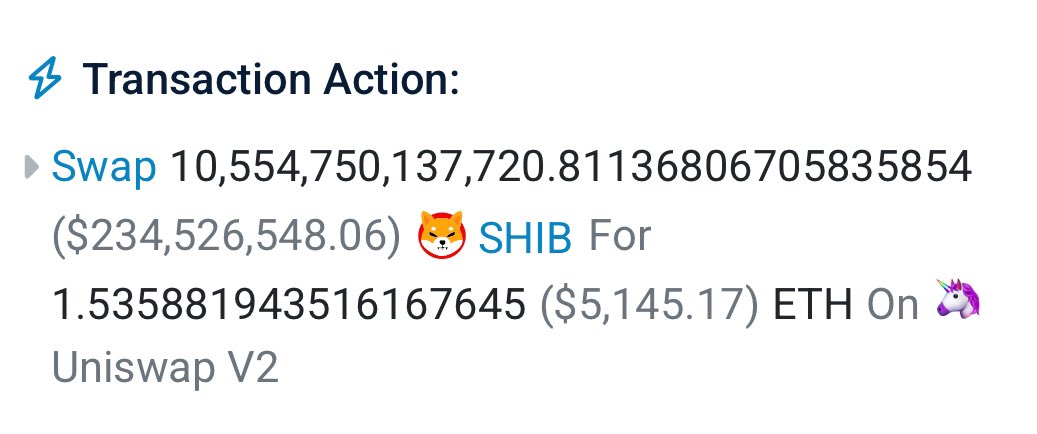
Meme coin analyst Kakashi recently decided to review early transactions as they pertain to Shiba Inu and uncovered a user who bought the meme coin pre-2021 pump but did not hold on. According to screenshots shared, the wallet amassed 10.5 trillion SHIB for 1.48 ETH four years ago.

The user swapped the $4,953 worth of Ether now for the massive amount of Shiba Inu when the meme coin still had more zeros, on the decentralized exchange Uniswap. However, SHIB exploded in the last quarter of 2021, reaching its current all-time high of $0.00008854.

Meanwhile, the user had sold before the pump, dumping the token as its slightest uptick. The user swapped the 10.5 trillion SHIB for 1.535 ETH ($5,145 now).

Shiba Inu User

Had the user kept his Shiba Inu stash today, it would be worth a staggering $934.5 million at SHIB’s all-time high three years ago, and about $234 million at current prices. However, the wallet owner missed an exponential portfolio growth due to the early sales.

Another User Misses on Massive Returns

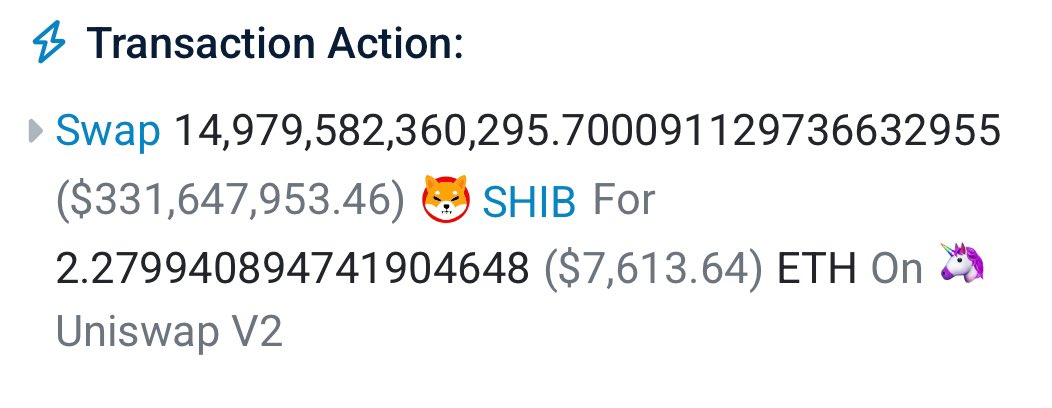
Kakashi also mentioned a user who missed out on a jaw-dropping gain with his early Shiba Inu sell-off. Although the initial capital remains a mystery, data confirms the investor managed to accrue 15 trillion SHIB.

However, the user sold the stash worth $331 million now for a penny. The wallet swapped the 15 trillion SHIB for 2.28 ETH ($7,613).

Shiba Inu User

Notably, the sales are justifiable owing to the unpredictable nature of meme coins. Users have made and lost a fortune trading tokens in the meme sector. As a result, some holders tend to tread cautiously.

Nonetheless, holding solid tokens like Shiba Inu has proved rewarding over the years. SHIB surged over 100% in 2024, spurred by its growing utility and the ever-cheering Shiba Army.

Analysts have also speculated more upsides, with lending exchange CoinW recently asserting the light-hearted doggy-themed token could reach $1, a difficult target. At press time, Shiba Inu trades at $0.00002228, down 2% in the past 24 hours.

Here’s How High DOGE Could Go If Solana Reaches $1,500 and ETH Hits $10,000

0

The price of Dogecoin could increase by seven-fold if it mirrors the price trajectory of Solana reaching $1,500 or Ethereum attaining $10,000.

Leading altcoins like Solana (SOL) and Ethereum (ETH) have been making continuous efforts to set the pace for the 2025 bull market. Meanwhile, in the meme coin space, Dogecoin (DOGE) has also been a notable performer, although recent pullbacks have dented its uptrend.

While the bears currently dominate market sentiment, analysts remain confident in the performance of altcoin market leaders Ethereum and Solana. Should the uptrend in these altcoins gain momentum, it will likely spill over to the meme coin sector, where Dogecoin reigns.

This article examines the potential price of Dogecoin in the upcoming bull market, assuming Solana reaches $1,500 and Ethereum reaches $10,000, as widely predicted by numerous market commentators.

Dogecoin Price if Solana Reaches $1,500

At press time, Solana is trading at $190, boasting a 2% gain over the last 24 hours. At this price, SOL is trading at an 11% discount compared to its weekly high. To reach a lofty $1,500, Solana would need to increase by 7X or grow by 690%.

Currently, Dogecoin is trading at $0.3406, up by 1.8% over the past day. If Dogecoin follows a similar trajectory as Solana, with a 690% surge, it would reach $2.69.

This price projection aligns closely with the predictions of several analysts regarding Dogecoin’s outlook for this year. 

For example, popular influencer Ash Crypto has argued that Dogecoin could reach $3 by May. Interestingly, while some see this as Dogecoin’s peak for the current cycle, others have suggested that the meme coin could even grow more than ten times from this level.

Dogecoin Price if Ethereum Reaches $10,000

At press time, Ethereum is trading at $3,300, up by 1% over the past day. Numerous market experts have suggested that Ethereum could reach $10,000 this cycle. A few weeks ago, analyst Ali Martinez predicted a $10,000 Ethereum, citing its correlation with the S&P 500.

Reaching $10,000 would require a growth of 203% from Ethereum’s current price level. A similar 2X growth for Dogecoin would be enough to send the meme coin to the much-anticipated $1 price point.

Notably, a $10,000 price for Ethereum would elevate its market cap to over $1.2 trillion, up from its current market cap of $395 billion.

Historically, Dogecoin has outperformed Ethereum during bull runs. For instance, in the past 90 days, Ethereum has been up by 25%, while Dogecoin has seen a more impressive 195% gain.

In other words, Dogecoin could see a significantly higher price valuation should Ethereum rally to $10,000, one that exceeds a 2X gain.

Ripple CLO Says SEC Appeal is Just Noise, Predicts It Will Be Dropped by Next U.S. Administration

0

Ripple CLO Stuart Alderoty has reacted to the SEC’s opening appeal brief in the regulator’s lawsuit against the crypto payments company. 

As expected, the U.S. SEC filed its opening appeal brief yesterday, challenging Ripple’s victory in their multi-year legal tussle. 

Ripple CLO Portrays SEC Appeal as “Noise” 

Shortly after the filing, Alderoty characterized the SEC appeal as a repetition of arguments that a district court had already rejected. 

He indicated that the SEC’s appeal against Ripple’s victory lacks merit and will likely be abandoned by the incoming administration. In the meantime, the Ripple CLO emphasized that the company will respond to the SEC appeal brief in due time. 

Notably, he portrayed the SEC lawsuit as “noise,” suggesting that the case is more of a distraction than a threat to Ripple’s business, which he claimed is thriving. 

Furthermore, Alderoty indicated that the United States would soon welcome a new era supporting pro-innovation regulation. His comment reassures Ripple stakeholders and the broader XRP community that the SEC lawsuit does not threaten the company’s operations. 

Overview of SEC v. Ripple Appeal 

Interestingly, he attached a link to the commentary, enlightening the broader crypto community about the appeal. Per the document, Ripple provided an overview of the SEC lawsuit, which it claimed to be politically motivated. 

The company emphasized that although the SEC lost all key issues of the case, it still chose to appeal. Nonetheless, Ripple is determined to fight against the SEC’s overreach, aiming to defend itself and the broader crypto community. 

The document educates the crypto community by clarifying the facts about the SEC appeal and Ripple’s cross-appeal. 

Parties Not Appealing Whether XRP Is a Security 

Notably, Ripple emphasized that the appeal does not challenge whether XRP is a security. Recall that Judge Analisa Torres declared that XRP is not a security in her landmark July 2023 decision. 

According to Ripple, both the SEC and its lawyers affirm that XRP, on its own, does not constitute a security. This gives XRP legal clarity, aligning the coin with Bitcoin and Ethereum, which were previously labeled non-securities. 

Furthermore, the document stated that the SEC’s appeal revolves around whether Ripple’s sales of XRP on digital exchanges and its other distributions of the token qualify as investment contracts, a special type of security. 

Ripple said the SEC is challenging the district court’s decision that these transactions do not require securities registration. 

Conversely, the company said it is cross-appealing the district court decision to preserve its defense, which includes that a transaction can only be deemed as an investment contract when it has contractual rights and obligations. 

Ripple’s cross-appeal is focused on overturning the decision on institutional sales of XRP, which Judge Torres declared in SEC’s favor. 

Notably, the appeal is filed in the Court of Appeals for the Second Circuit. The SEC filed its opening brief yesterday despite Ripple requesting that the filing be postponed.