Home Blog Page 1011

Binance’s Changpeng Zhao on Entering the Bitcoin Market: “Today is Earlier Than All the Days to Come”

0

Former Binance CEO Changpeng “CZ” Zhao sends a message to all those who have ever felt that they had missed out on investing in Bitcoin or learning about crypto early.

Bitcoin‘s price action over the past few weeks has likely given many present and impending investors pause for thought as the current macroeconomic outlook clouds the asset’s prospects.

However, amid the uncertainty, an influential figure in the industry has suggested that there is only one path of least regret.

“Today Is Earlier Than All the Days to Come”

Former Binance CEO Changpeng “CZ” Zhao has presented a message to all those who have ever felt that they had missed out on investing in Bitcoin or learning about crypto early. 

“Today is earlier than all the days to come,” he quipped in an X post on Tuesday, January 14, seemingly urging market participants to stop overthinking and act.

The recent statement highlights Zhao’s long-term belief in the industry while framing current market uncertainty as an opportunity, especially as he has sounded significantly optimistic about the industry’s potential with the turn of the new year.

“Send It Year?”

On January 3, Zhao asserted that “2025 will be a ‘send it year.'” ‘Send it’ is typically used to express excitement about soaring asset prices or highlight positive developments with positive price implications.

The sentiment comes amid anticipated regulatory clarity under the incoming Donald Trump administration and growing institutional adoption that has led many experts to set ambitious price targets for crypto assets this year. Bitwise, for example, tipped Bitcoin to hit the $200,000 price point in 2025.

For context, Bitcoin is trading around the $95,500 price point at the time of writing as hawkish Fed concerns have seen it unable to hold on to its record high of about $108,000 formed in December 2024.

Coinbase Secures Court Victory Against SEC in Its Rulemaking Petition Case

0

Leading cryptocurrency exchange Coinbase secures a legal victory against the U.S. SEC regarding its 2022 petition for crypto-specific rulemaking. 

The U.S. Court of Appeals for the Third Circuit issued its opinion in the Coinbase v. SEC lawsuit yesterday, rebuking the regulator for denying the exchange’s petition for rulemaking. 

Paul Grewal, Coinbase’s Chief Legal Officer (CLO), took to X to celebrate the exchange’s victory over the SEC, noting: “We just won our petition for a writ of mandamus at the Third Circuit.” 

Coinbase Rulemaking Petition 

In 2022, Coinbase asked the SEC to establish clear rules for securities offered and traded using digitally native methods. The exchange also sought clarity from the SEC to determine which crypto assets constitute securities. 

The SEC denied Coinbase’s request in 2023 instead of providing the desired response. Consequently, Coinbase initiated an appeal at the Third Circuit to compel the SEC to implement rulemaking for crypto assets. 

Court Grants Coinbase Petition in Part 

Per the recent statement, the Third Circuit granted Coinbase’s petition in part. However, the court declined to order the SEC to implement crypto-specific rulemaking as Coinbase had requested.

Judge Thomas Ambro stated that the SEC’s denial of Coinbase’s rulemaking petition was insufficiently reasoned, and the opinion was issued without supporting evidence.

Additionally, Judge Stephanos Bibas ordered the SEC to provide a full explanation for its denial of the petition. The judge cautioned the SEC against offering another “poor explanation,” as seen in previous cases.

Furthermore, Judge Bibas criticized the SEC for focusing on enforcing outdated rules against crypto companies that seek to comply with the law, rather than addressing fraud within the sector.

Court advising SEC not to make poor explantion
Court advising SEC not to make “poor explanation”

Difference Between Coinbase Rulemaking Petition and SEC Enforcement Action 

For clarity, this case differs from an enforcement action the SEC introduced against Coinbase in 2023. In that case, the SEC alleged that Coinbase broke the law by operating as an unregistered securities exchange.  

Last week, a federal court approved Coinbase’s request to pursue an interlocutory appeal against the SEC in the Second Circuit. Consequently, Judge Katherine Polk Failla paused all legal proceedings in the case at the district court level, pending its resolution at the appeal court. 

In the meantime, the SEC is edging closer to an administration change, with its current chairman, Gary Gensler, resigning on January 20. Notably, Paul Atkins will replace him as the next chair. Crypto proponents expect Atkins’ leadership to end the commission’s enforcement actions against the industry. 

XRP Now Acting as Safe Haven Against Ethereum, Dogecoin and Solana: Here’s How

0

A prominent market analyst shows how XRP is now acting as a safe haven against Ethereum, Dogecoin and Solana.

The crypto market has been in a state of flux over the past six weeks. After the global crypto market cap hit an all-time peak of $3.73 trillion in December 2024 and faced a correction, it has lingered between $3.1 trillion and $3.3 trillion since then, with asset prices facing corrections.

Interestingly, XRP appears to be showing more resilience than the rest of the market, especially over the past week. During this period, most assets have either consolidated or witnessed price drops. However, XRP has performed impressively, leading market analyst Dom to dub it a safe haven against other tokens.

XRP Now Safe Haven Against ETH, DOGE, SOL

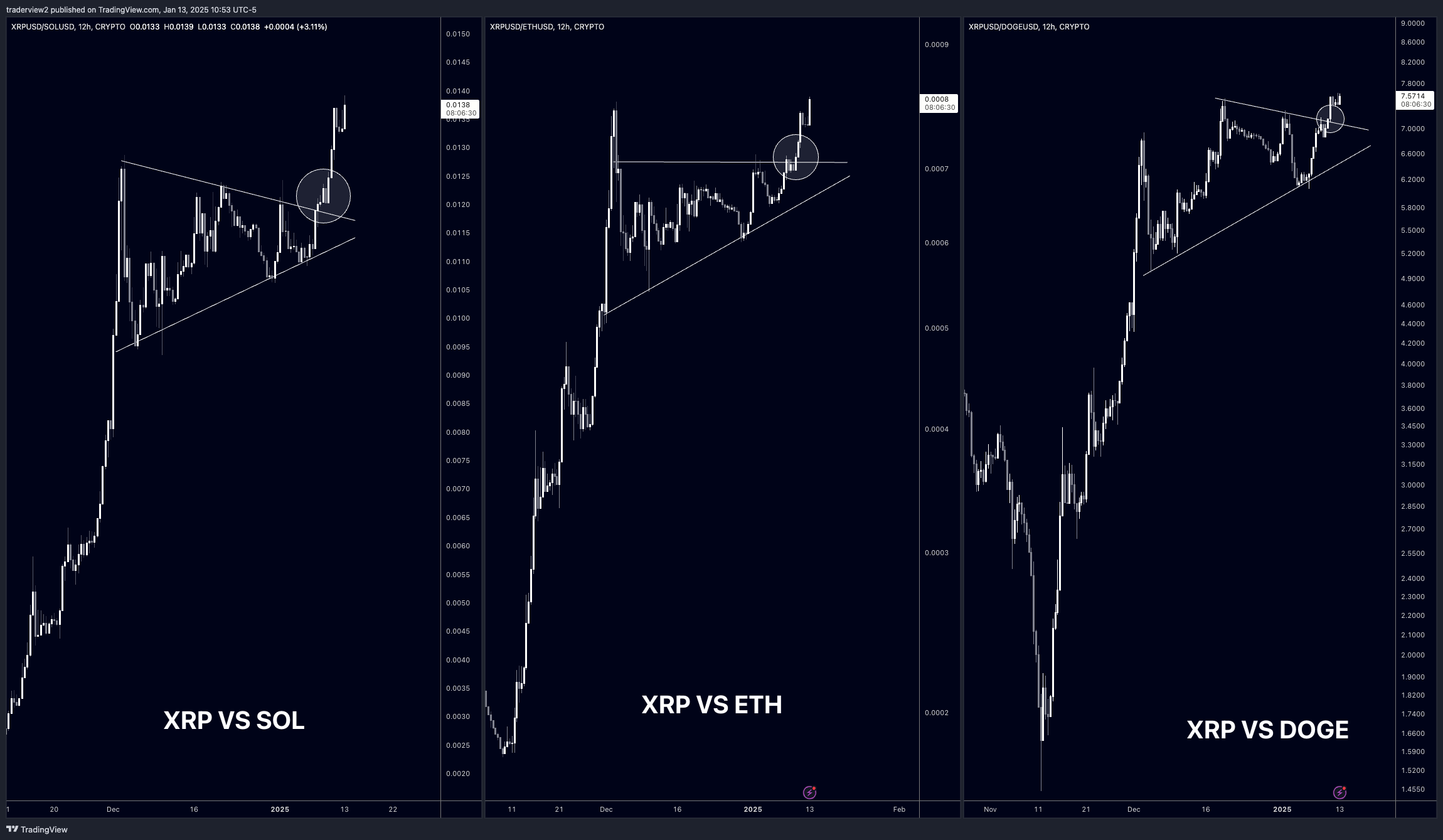
In a recent analysis, the market watcher shared three XRP charts against industry heavyweights Ethereum (ETH), Dogecoin (DOGE) and Solana (SOL). Notably, these assets, among the top 10 largest crypto tokens, have been victims of the market-wide turbulence.

For instance, Ethereum has dropped by about 10.3% over the last seven days, with most of its losses, about 8% drop, coming up on Tuesday, Jan. 7. However, XRP has demonstrated strength within this period, having gained by an impressive 8.7% with the past seven days. 

The XRP/ETH chart shows that XRP traded for 0.0006561 ETH as of Jan. 7. This price skyrocketed to close yesterday, Jan. 13, at 0.0008042 ETH, suggesting that XRP has outperformed Ethereum by a massive 22.5% in the last week.

Meanwhile, amid XRP’s 8.7% gain in dollar terms over the past seven days, Dogecoin has slumped by 10.8%. As a result, the DOGE/XRP chart shows that Dogecoin, which traded at 0.1597 XRP on Jan. 7, closed yesterday with a price of 0.1315. This indicates that DOGE dropped 17.6% against XRP within this period.

Further, over the past week, Solana collapsed 15.7%, posting the most losses for any asset on the list, as it relinquished the $200 and $190 Marks. Within this period, the XRP/SOL ratio went from 0.0105 to 0.0137, indicating that XRP outperformed by 30%.

XRP Outperforms the Market

Data also confirms that besides ETH, DOGE and SOL, XRP has also performed better than most assets on the topic 100 lists in the past week, including Bitcoin (BTC). This prompted Dom to brand it a safe haven amid the bearish volatility that has enveloped the broader market.

In his disclosure, Dom confirmed that XRP had broken out of its triangle against the trio of ETH, DOGE and SOL, marking bullishness. Notably, he revealed that XRP had hit a 1,400-day high against Ethereum, a 400-day top against Dogecoin and a 1,400-day peak against Solana.

Image

At press time, XRP changes hands at $2.53, up only 0.40% this morning. Its most promising performance came up over the weekend, as it surged nearly 10% on Saturday. Amid this run, market veteran Peter Brandt called XRP “the leader of the pack.”

Supreme Court Ruling Confirms US Securities Laws Apply to Binance Despite No US Office

0

The U.S. Supreme Court has made a significant decision in the class-action lawsuit by investors against Binance and its former CEO Changpeng Zhao (CZ).

Specifically, the Court declined to review an appellate decision affirming that U.S. securities laws apply to Binance even though the crypto exchange does not have a physical headquarters in the United States.

The case concerns whether Binance, which operates without a formal U.S. office, should be subject to U.S. securities regulations while providing services to American clients.

In its earlier ruling, the U.S. Court of Appeals for the Second Circuit determined that Binance must comply with U.S. securities laws. The court pointed out that U.S. investors used the platform and executed trades through U.S.-based servers.

Background of the Case Against Binance

For context, this case began when investors accused Binance of selling unregistered securities without proper registration, violating the Securities Act of 1933. The plaintiffs argued that Binance had illegally sold tokens that later lost significant value.

However, Binance contested the claim, asserting that it was not subject to U.S. laws since it lacks a physical presence in the country.

In March 2024, a U.S. district court ruled that U.S. securities laws applied to Binance despite the company’s lack of a physical office in the U.S. It noted that transactions were processed through U.S.-based servers.

Binance’s legal team contended that technological advancements had granted investors access to global financial markets. Therefore, the company should not be subject to U.S. jurisdiction.

Meanwhile, the Supreme Court’s latest ruling now paves the way for the case to proceed under U.S. securities laws.

Binance petition denial

Binance’s Ongoing Legal Troubles in the US and Abroad

Meanwhile, this lawsuit is only one of several legal challenges facing Binance in the United States. In mid-2023, the SEC filed a lawsuit against Binance and Zhao. The agency accused them of providing services to U.S. customers illegally.

In addition to the SEC case, Binance’s legal issues deepened in November 2023, when the company reached a settlement to pay $4.3 billion to the U.S. Department of Justice over violations related to money laundering and terrorism financing.

Meanwhile, these legal troubles also extend beyond the U.S. In April 2023, Binance faced a class-action lawsuit in Canada, accusing it of violating securities laws following its announcement to exit the country.

Bitcoin Head and Shoulders Invalidated? Brandt Calls Sweep of the Lows “Significant”

0

Veteran commodities trader Peter Brandt hints that the recent Bitcoin bounce has notable implications.

Over the past 24 hours, the market tested the faith of many Bitcoin holders as BTC price saw a sharp decline from near $96,000 to below the psychologically important $90,000 level. The decline, however, was short-lived as the asset bounced back even faster.

The price action likely has notable implications, as one veteran trader has recently hinted.

Bitcoin’s “Significant” Bounce 

Veteran commodities trader Peter Brandt has hinted that Bitcoin’s recent bounce has notable implications. In a Tuesday, January 14 response to a “Cheds Trading” X post highlighting the asset’s sweep of the lows below support and the recapture of the level, Brandt asserted that the price action was “significant.”

The comment comes as he has often touted a head-and-shoulders pattern on the asset’s daily candle chart in recent weeks. On Sunday, January 12, Brandt asserted that the pattern offered three possible outcomes.

These outcomes included fulfilling the pattern with a drop to $75,000 or failing and ending in a bear trap which would complete the “hump slump,” a correction pattern Brandt has stressed Bitcoin often repeats in parabolic runs. At the same time, he noted that the asset’s price could form an entirely different, bigger chart pattern.

Following Monday’s price action, the veteran trader may now be leaning more than ever towards the second possibility. To be sure, bears have taken significant losses with the market’s recent bounce, as CoinGlass data shows that shorts have lost a staggering $133 million in the past 12 hours compared to only about $16 million for longs.

$116K in View for Bitcoin?

On Monday, January 13, Brandt suggested that Bitcoin’s price could go two ways depending on how it reacted at the $90,000 support level, with a bull case of about $116,500 and a bear case of around $74,000.

At the time of writing, Bitcoin is trading just below the $95,000 price point following yesterday’s bounce, representing a nearly 2% gain over the past 24 hours.

Trump to Tackle “De-Banking” and Crypto Accounting Rules on First Day in Office: Report

0

David Sacks is spearheading discussions on Trump’s cryptocurrency policies, focusing on “de-banking” and reversing asset liability rules.

According to the Washington Post, David Sacks, Trump’s AI and Crypto Czar, is leading discussions with cryptocurrency stakeholders to finalize key policies. These include addressing “de-banking” and repealing an accounting policy requiring banks to classify digital assets as liabilities. According to the Washington Post, Trump could issue executive orders on these matters immediately after taking office.

Crypto Venture Capitalists Strengthen Ties

Notably, Trump’s relationship with Silicon Valley has seen a notable transformation, with prominent tech figures aligning with his administration.

A December 20 luncheon at Mar-a-Lago titled “America First: The Future of Space, AI, and Tech” brought together tech investors and policymakers. Hosted by firms like 1789 Capital and Type One Ventures, the event featured discussions on innovation and policy. Attendees included the pro-crypto Marc Andreessen, Cathie Wood of Ark Invest, and several venture capitalists.

Per the Washington Post, speakers at the event discussed reversing Biden-era policies perceived as restrictive, particularly in artificial intelligence (AI). Plans to revoke Biden’s AI executive order, which mandated equity-focused AI, were highlighted.

Industry representatives emphasized that experienced technologists are better suited to regulate emerging technologies. 

Crypto and AI to Highlight Inaugural Celebrations

Further reinforcing this collaboration, Trump’s inauguration will feature the first-ever “Crypto Ball,” hosted by David Sacks. The exclusive event, supported by sponsors such as Coinbase and MicroStrategy, highlights the administration’s pivot toward cryptocurrency. 

Fox Business’ Eleanor Terrett noted that President-elect Donald Trump is not expected to attend the event. The exclusive VIP reception offers tickets at a price of $100,000 each, making it one of the most high-profile gatherings in Washington, D.C.

For those seeking an enhanced experience, a premium package priced at $1 million is available. This package includes four tickets to the reception and an additional opportunity to attend a future dinner with President Trump.

Inaugural Donations

High-profile tech leaders, including Meta CEO Mark Zuckerberg, have also been involved in fostering relations with the incoming government. Meta made headlines with a $1 million donation to Trump’s inaugural fund, signaling a potential rapprochement after past tensions.

Ripple has taken a leading role in the cryptocurrency sector’s increased political contributions. The company recently contributed $5 million to support Trump’s inauguration fund.

Circle, the company behind the leading U.S.-issued stablecoin, USDC, has also emerged as a notable donor. On January 9, Circle revealed a $1 million donation, made entirely in USDC, to back Trump’s inauguration efforts.

Intesa Sanpaolo, Italy’s Largest Banking Group, Acquires 11 Bitcoin Worth Around €1M

0

Intesa Sanpaolo has acquired Bitcoin worth roughly a million euros, becoming the first bank in Italy to gain direct exposure to cryptocurrencies.

The global crypto adoption tide has made its next stop, this time in Italy. The nation’s largest banking giant, Intesa Sanpaola, has made history by becoming the first Italian bank to buy Bitcoin directly.

Initially a widespread rumor, local outlet Wired Italia recently confirmed that Italy’s largest banking giant has indeed dipped its toes in Bitcoin. Per the report, Intesa Sanpaolo acquired 11 BTC on Monday, January 13, for roughly €1 million.

Italy’s Most Prominent Banking Group Buys Bitcoin

The bank’s employees first leaked an internal email containing the news on the picture-sharing platform 4Chan. On the heels of the disclosure, Intesa Sanpaolo’s head of digital assets trading and investment, Niccolo Bardoscia, confirmed the rumor with an email to the media that the bank now owns 11 BTC.

Although Bardoscia confirmed the purchase, the executive refrained from disclosing why exactly it acquired Bitcoin. As a result, it is unclear if the purchase was to diversify Intesa Sanpaolo’s investment portfolio or if it was a pilot to offer crypto services.

However, the Bitcoin accrual marks a sentiment shift in Italy. Coming from its largest banking group, other financial institutions may look to emulate the giant, driving adoption.

In addition, this purchase transcends the norm in Italy. The nation’s central bank governor, Fabio Panetta, has repeatedly warned against digital assets like Bitcoin and Ethereum, calling them “unsecured.”

Intesa Sanpaolo’s Crypto Journey

Meanwhile, this is not the bank’s first foray into blockchain. In July 2024, Intesa Sanpaolo pioneered a €25 million digital bond issuance on the Polygon network in collaboration with state-owned bank Cassa Depositi e Prestiti SpA.

Furthermore, Intesa Sanpaolo broadened its crypto desk to allow spot trading. Before then, it only offered crypto options, futures, and exchange-traded funds (ETFs) to clients.

Broader Crypto Adoption

Intesa Sanpaolo’s 11 BTC purchase also came amid easing regulations in Europe. The Markets in Crypto Assets (MiCA) regulatory guideline came into full effect in December, making it easier for entities to hold digital assets.

The United States expects a similar clarity following Donald Trump’s imminent inauguration. The pro-crypto president has promised to support crypto, with speculation that he could sanction a Bitcoin reserve in his first 100 days in office gaining momentum.

Ripple President Says Large Banks May Launch ‘Market-Ready Tokenized Asset Offerings’ in US This Year

0

Ripple President Monica Long predicts that some of the world’s largest banks could launch market-ready tokenized asset offerings in the U.S. this year. 

Long made the prediction today in response to a recent statement from Frank Chaparro, the host of The Scoop podcast. 

In an X post yesterday, Chaparro suggested that large banks can do anything if allowed to custody crypto assets. He speculated that this move could unlock greater liquidity, support the crypto market structure, and reduce volatility associated with crypto assets 

Notably, Chapparo’s projection comes amid discussions that Donald Trump’s transition team, alongside his newly appointed White House AI & Crypto Czar, David O. Sacks, are collaborating with crypto stakeholders to develop a legislative plan for the industry. 

Part of the plan includes addressing pivotal issues affecting the industry. They include de-banking and a contentious policy that discourages banks from engaging with crypto by requiring them to hold digital assets and count them as liabilities on their balance sheets. 

Ripple President Highlights Large Banks’ Significant Interest in Tokenization 

With the upcoming administration working to address these issues, Ripple’s president suggests that large banks’ engagement with crypto via custodying will significantly impact the market. 

She shed light on how large financial institutions are showing significant interest in tokenization. Monica revealed that 15 of the world’s 25 largest banks have already piloted tokenized projects, indicating significant interest in tokenization. 

Consequently, she projected that most of these banks could roll out market-ready tokenized asset offerings in the United States this year. However, she emphasized that this will only happen if the United States government provides regulatory clarity, allowing banks to engage with crypto assets. 

Furthermore, the Ripple president expressed confidence that the industry could achieve the much-needed regulatory clarity this year. 

Ripple’s Tokenization Effort

It is worth noting that Ripple is aiming to be a major player in the tokenization sector. This market is projected to reach a valuation of $16 trillion by 2030. Specifically, the San Francisco-based company hopes to transform the real estate industry through tokenization. 

In 2023, Hong Kong-based Fubon Bank partnered with Ripple on a real estate tokenization pilot. The pilot, which combined e-HKD and tokenized real estate, allowed users to obtain collateral for loans using their real-world assets. 

There is still no official date when Fubon Bank will complete the test and launch a market-ready offering. 

Megaphone Pattern in XRP Chart Suggests Potential Path to $27: Here’s What to Watch

0

Market analyst EGRAG reintroduces his XRP megaphone pattern, expecting the structure to push prices to two-digit figures above $27.

The reintroduction comes on the back of the ongoing market uncertainty. Notably, despite this uncertainty, XRP has demonstrated resilience over the past few weeks. Just last weekend, the crypto asset rallied nearly 10% on Saturday before facing a mild pullback.

Amid a red Monday within the broader market yesterday, the pullback deepened, with XRP collapsing by over 6.6% to a low of $2.33 within eight hours. Interestingly, as the market recovered from this flush out, XRP is leading the pack, up 5.17% in the past week.

XRP’s Megaphone Pattern

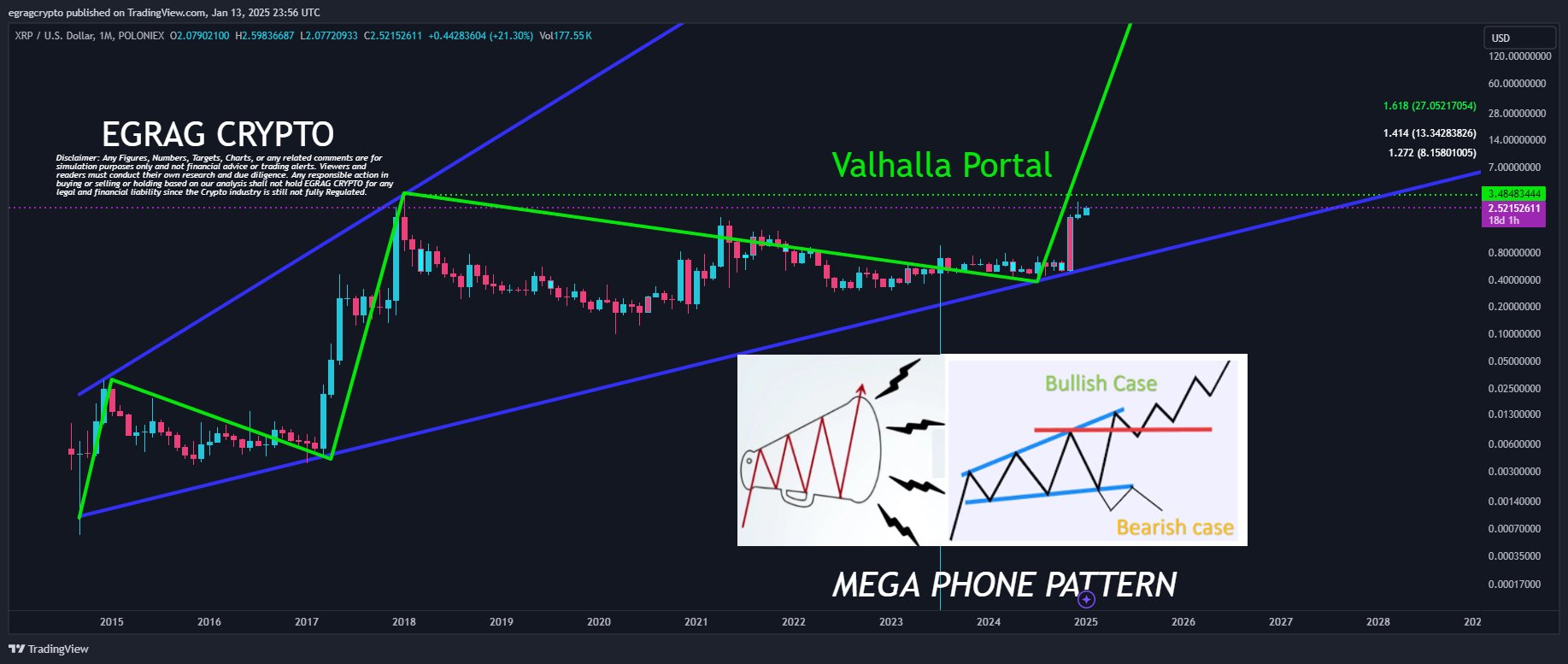
EGRAG’s latest analysis comes amid this recovery effort. As XRP rebounds above the $2.5 level, the market analyst leveraged a 1-month chart to highlight the formation of what he calls the “megaphone pattern.” For context, this structure refers to a large broadening pattern.

The analyst first highlighted the XRP megaphone pattern on the 25-day chart in March 2023. At the time, XRP changed hands at $0.3895. According to EGRAG, this pattern is quite efficient, boasting a 70% win ratio, but is more effective on longer timeframes.

In the latest disclosure, EGRAG emphasized that the megaphone pattern features higher highs and higher lows, suggesting that the bulls are generally in control amid an increase in volatility. 

XRP Megaphone Pattern EGRAG Crypto
XRP Megaphone Pattern | EGRAG Crypto

Typically, this structure boasts three major bottoming phases and three major price upswings. Data from the chart indicates that XRP formed the first bottom at a floor price of $0.00058 in September 2014. Notably, the altcoin recovered from this low with the first upswing, hitting a peak of $0.0306 in December 2014.

After this top, a correction ensued, pushing prices to the second bottom of $0.003 in January 2017. Again, XRP recovered from this bottom, soaring to a new peak of $3.5 in January 2018, representing its all-time high. This marked the second upswing.

Following this all-time high, another major pullback materialized, lasting for seven years and culminating in a third bottom of $0.3899 in July 2024. Now, XRP has engineered a rebound which EGRAG sees as the third upswing.

XRP Now Navigating the Third Upswing

He emphasized that during this third upswing, XRP price is expected to breach the previous top of $3.5 and not slump below this level again regardless of the pullback that ensues. 

Interestingly, the analyst leverages Fibonacci retracements to set three targets for XRP as it navigates this third upswing. 

The first price target lies on the Fib. 1.272 mark, representing a price of $8.15. A push above here would allow XRP aim for the second target at $13.3 (Fib. 1.414). Meanwhile, EGRAG sees a third target of $27.05, aligning with Fibonacci 1.618. 

Currently, XRP trades for $2.54 and would need a 964% increase to claim the $27.05 target. Notably, in the previous analysis, EGRAG set a more ambitious target of five digits. However, he chose not to mention his ultimate target this time, stressing that he does not wish to “mislead newbies.”

Meanwhile, EGRAG emphasized that to confirm the megaphone pattern, traders should monitor volume indicators for an increase. In addition, a confirmation would also come up with XRP persistently trading above the breakout point.

XRP Road to $20,000, Expert Mentions Possible Catalysts That Might Turn This Dream into Reality

0

An XRP community pundit makes a case for an XRP price rally to an ambitious five-digit figure, citing possible catalysts.

Chad Steingraber, a game developer and prominent voice in the XRP community, outlined a vision for XRP’s potential to reach $20,000 per token. In his commentary, Steingraber highlighted several factors he believes could drive this dramatic price increase.


XRP Deflationary Supply

Steingraber called attention to XRP’s capped supply of 100 billion tokens and its mildly deflationary design. For context, the XRP Ledger permanently burns a small amount of XRP with each transaction, steadily reducing the total supply, albeit at a slow rate.

He noted that much of the current circulating supply—now around 57 billion tokens—is available for public trading, but some of it has been permanently lost, further limiting accessibility. This shrinking supply, in addition to increased demand, could create conditions for a price surge, he argued.  

XRP Institutional Adoption and Private Ledgers  

One of Steingraber’s central claims is that XRP will become a reserve asset for banks, akin to gold. He suggested that financial institutions like Bank of America and JPMorgan could issue private digital currencies, such as BOAcoin or JPMorganCoin, on private XRP Ledgers. 

These coins, possibly backed by XRP, would enable banks to conduct internal and cross-border transactions securely and privately, he said. According to Steingraber, this setup would ensure banks rely heavily on XRP while keeping transactions off public ledgers, creating a demand spike.  

Steingraber also discussed the potential role of institutional liquidity providers (ILPs), which he described as intermediaries facilitating transactions between banks. He claimed these ILPs would hold large reserves of XRP and various bank-issued coins, enabling seamless exchanges without exposing counterparties to risk. 

For instance, if Bank of America needs to transfer funds to JPMorgan, XRP would act as the intermediary currency, facilitating the transfer through ILPs.  

Possible Supply Shock  

Interestingly, Steingraber warned that banks could eventually deplete the public supply of XRP. He speculated that financial institutions and ILPs might engage in a digital “arms race” to acquire XRP, potentially leading to a frenzy of institutional buying. 

According to him, this could wipe out the public supply on exchanges within hours, leaving retail investors sidelined as prices soar.    

Expanding his analysis, Steingraber pointed to the global financial system’s vast size, estimating the total U.S. dollar money supply at $40 trillion. Adding the global banking sector and derivatives market, he argued that demand for XRP could grow exponentially. 

He suggested that the public supply might shrink to as low as 21 million tokens—similar to Bitcoin’s hard cap—further boosting its value. At press time, XRP trades for $2.35, needing an 850,963% increase to reach $20,000. 

While Steingraber’s arguments are thought-provoking, they rest on several assumptions that warrant scrutiny. For one, banks adopting XRP as a reserve asset on a global scale would require widespread regulatory clarity and institutional trust in the technology.