Home Blog Page 1140

Here’s How Much 1 Shiba Inu Can be Worth if SHIB Reaches a $100B Market Cap 

0

Shiba Inu could witness a massive 796% spike in its price if its market cap grew from the current figure to claim the $100 billion mark.

The broader crypto market is on a recovery charge that saw Bitcoin (BTC), the industry’s firstborn, claim a new all-time peak above $76,000. While altcoins such as Shiba Inu have joined in this rebound campaign, they remain below their highs from the previous cycle.

SHIB Remains Below ATH

For instance, SHIB reached an all-time high of $0.00008845 during the last bull market in 2021. However, it has not decisively come close to reclaiming this level in the ongoing bull cycle, much less surpassing it.

Shiba Inu’s peak for this bull run is $0.00004567, a level it attained in early March. Since dropping from this price point, the meme coin sensation has failed to recover it. Most analysts believe a reclamation of this local top could prepare the groundwork for a greater push toward the ATH at $0.00008845.

However, despite its current price of 366%, which is away from the $0.00008845 peak, analysts and investors remain confident in Shiba Inu’s potential. As a result, multiple bullish predictions have engulfed the Shiba Inu community. 

Price of 1 Shiba Inu at a $100B Market Cap

While some expect rallies to $0.000081 during this cycle, others have made more ambitious projections. Notably, some analysts like Jake Gagain expect Shiba Inu to eventually reach a $100 billion market cap, positioning it as the first meme coin to achieve this feat.

For context, Shiba Inu’s all-time high market cap is $39 billion, a valuation it claimed during the 2021 bull run. At press time, Shiba Inu has a market cap of $11.2 billion, making it the 12th-largest cryptocurrency and the second-largest meme coin.

Despite projections of a potential rise in valuation to $100 billion, many remain oblivious to the price implications of this market cap. Consequently, we employed the services of a market resource, The Coin Perspective, to highlight what price SHIB would trade at the $100 billion valuation mark.

Data from the platform confirms that at a $100 billion market cap, Shiba Inu’s price will have reached $0.00017. This potential price level would mark a massive 796% increase from the current price. 

Interestingly, during the initial run this year, SHIB secured an impressive 379% rally from Feb. 24 to March 5, spiking from $0.00000952 to $0.00004568. The meme coin’s ability to secure such an upward push in less than ten days confirmed its potential.

As a result, some believe Shiba Inu can engineer a more substantial rally, especially when the altcoin season comes. Currently trading for $0.00001897, if Shiba Inu secures an 800% rise from this level, its price would rise to $0.00001707, taking it to the $100 billion market cap.

Here Are Returns if $10, $100, or $1,000 Was Invested in Shiba Inu at the Initial Price of $0.0000000013

0

Early Shiba Inu investors would be sitting on millions of dollars if they invested modest amounts in SHIB at its initial price and held through the past four years.

Shiba Inu is one of the most successful cryptocurrencies in this decade. The meme coin recorded massive rallies during the previous bull run, outperforming the rest of the market, and has continued to retain its relevance by maintaining a spot among the top 15 crypto assets.

Shiba Inu Historical Success

Due to its meme coin origins, industry leaders like Ethereum co-founder Vitalik Buterin expected an imminent collapse three years ago. However, SHIB has grown to surpass these expectations, performing better than most believed.

While Shiba Inu spiked to a new all-time high of $0.00008845 in October 2021, it has since dropped from this peak. Now trading for $0.00001896, SHIB is down 80% from its all-time high. However, this is largely due to the condition in the broader market rather than Shiba Inu’s unique struggles.

Nonetheless, during downturns like this, most investors regret their choice to hold their bags through an asset’s all-time high. For instance, a Shiba Inu investment worth $1 million at the $0.00008845 peak would have dropped to $191K at the current price, down by over $800K.

Despite this, data confirms that modest investments in Shiba Inu at its early stage still boast substantial returns today. According to CoinMarketCap, at the current $0.00001895 price, Shiba Inu is up 1,266,695.29% from its initial price. This translates to an initial price of $0.000000001334.

Returns on $10, $100, or $1,000 Invested in Shiba Inu at $0.000000001334.

We recently assessed how much an investor would hold currently if he invested varying amounts, such as $10, $100, and $1,000, in Shiba Inu at the initial trading price of $0.000000001334.

Specifically, if an investor purchased $10 worth of SHIB at $0.000000001334 per token in August 2020, this individual would have 7.496 billion tokens. At the current price of $$0.00001896, this initial $10 investment would still be worth $126,761, representing returns of over $126K.

Further, a $100 investment in Shiba Inu during its early stages would have claimed 74.96 billion SHIB tokens. Remarkably, the 74.96 billion tokens currently have a worth of $1.267 million at the prevalent price. This translates to returns of over $1.26 million from a meager $100 investment.

Meanwhile, if an investor had thrown $1,000 into Shiba Inu at its initial price, he would have 749.6 billion tokens. Notably, such an investment would be valued at $12.67 million at the current price of $0.00001896.

This assessment confirms the assertion that Shiba Inu is one of the most successful crypto assets in recent times. The token has outperformed nearly every asset in the top 100 list since 2020. This success has triggered optimism of a similar run in the future. However, this is not a guarantee.

Top Analyst Says No Surprise if XRP Hits $4 as it Pumps to 5-Week High

0

Amid XRP’s latest comeback, a widely followed analyst has suggested the asset could be headed for an all-time high in the $4 range.

XRP is finally joining the Bitcoin-led bull trend, setting a fresh monthly high as BTC enters unprecedented price territories. Earlier today, XRP reached $0.5740, marking an 11.67% increase from the $0.514 level it traded at yesterday.

Notably, $0.5740 is the highest price XRP has reached in about five weeks. During this period, Bitcoin surpassed its March peak of $73,750 and established a new high at $76,400. 

Given that XRP has ultimately capitalized on the market-wide upsurge, “CoinsKid,” a crypto trader with 140K followers on X, pondered whether the ongoing XRP rally could drive the altcoin to an all-time high.

XRP Rallying to ATH at $4 Would Be No Surprise

The analyst shared a two-year historical XRP chart on the weekly time frame. The chart identified three major resistance points for XRP, with the most crucial being at the $0.94 level.

Notably, XRP lost its bullish momentum at this level in July 2023, during the frenzy that followed the court verdict declaring it is not a security.

Other key points identified are psychological thresholds at $1.50 and $2.50. In addition to these resistance levels, CoinsKid also pointed to a now robust support at $0.3798 and a potential price discovery level at $4.

Image

According to the seasoned trader, it would be no surprise if XRP held firm on the support without needing a retest and broke through the $0.94 resistance, continuing upwards until it set a peak at $4.044.

Notably, for XRP to surpass the $0.94 level, it would need to stage a run that drives its value up by 71% from the current price of $0.55. However, this magnitude of growth has been a major hurdle for XRP in recent times. Meanwhile, for the price discovery phase at $4, XRP would require a much stronger surge of 627%.

The Bullish Narrative for XRP

A major narrative currently fueling a bullish perspective for XRP is the anticipation of Donald Trump dismissing SEC Chairman Gary Gensler.

Responding to CoinsKid, an investor noted that XRP can no longer revisit the support level at $0.37, arguing that the opportunity to buy at that low price was weeks ago. The commenter further suggested that, now that pro-crypto Trump has won the election, Gensler’s sack will “send XRP’s price soaring.”

In response, another proponent pointed out that XRP barely saw a 4% pump on the day Bitcoin first peaked at $75K after Trump’s victory, implying that the narrative suggesting an XRP rally due to Gensler’s dismissal might be weak.

Top 5 Platforms Simplifying Web3 Rewards For Businesses

0

Blockchain technology is emerging as a gamechanger in the loyalty rewards industry. Several major brands have in the recent past launched blockchain-based loyalty rewards programs, including the likes of Nike, Porsche, Louis Vuitton, American Express and Reebok. Luckily for these companies, they have enough resources for research and development.

But what about the smaller businesses that would like to leverage blockchain technology for advanced rewards models but lack in-house experts or the capital to outsource development?

Fortunately, there are quite a number of new Web3 platforms that are stepping in to bridge this gap, making it easier for companies to integrate blockchain rewards without needing deep technical knowledge. This article highlights the top five ecosystems enabling businesses of all sizes to tap into the benefits of web3 rewards with ease.

1. Me Protocol

Me Protocol
Me Protocol

The Me Protocol is one of the offerings by My AI Inc., a blockchain technology company whose goal is to create a global rewards economy with seamless interactions. At its core, the Me protocol is designed as an automated market maker (AMM) and features a modular infrastructure, allowing businesses to build trustless and interoperable rewards systems into their services or products.

The protocol’s simple API makes the process much easier for businesses. Whether an entity is launching a new rewards program or wants to integrate an existing one, Me Protocol’s plug-and-play development tools eliminate the technicalities involved. This allows anyone to instantly deploy interoperable rewards, also dubbed ‘Frictionless Open Rewards’, without limitations or the need to overhaul existing loyalty reward systems.

More importantly, the fundamentals of the Me Protocol token economy are based on a universal redemption model. Customers who receive rewards from brands that have launched on Me Protocol can redeem them with other brands in the ecosystem. This approach eliminates the usability barrier that both companies and consumers face in the current loyalty rewards models.

2. Hang

Hang
Hang

Hang is another Web3-powered platform that is focused on enabling businesses to launch personalized rewards programs and campaigns. The startup raised $16 million back in 2022 in a Series A funding round led by Paradigm. Brands with little technical knowhow or resources can leverage Hang’s Web3 infrastructure to curate NFT memberships to reward their long term customers in a trustless manner.

It is also worth highlighting that Hang combines Web3 with AI, making the most use of customers’ data. Companies looking to roll out personalized rewards programs can tap into Hang’s AI capabilities to automatically generate promotions or customized rewards programs. If a company is setting up a loyalty rewards program, all they have to do is set the key parameters and let Hang’s AI self-optimize the model or program.

Some of the notable brands that have launched loyalty rewards programs include San Francisco’s Boba Guys and Roam Artisan Burgers.

3. Sharingclub

SharingClub
SharingClub

Concordium’s Layer-1 blockchain is host to the SharingClub, a Web3 platform whose main purpose is to change the game of loyalty rewards programs. The platform allows merchants to list their stores as partners, creating an ecosystem where rewards can be redeemed from any of the featured merchants. But how exactly does it work?

SharingClub’s reward economy is powered by a native token dubbed $FASH; customers who interact with partner stores are issued with rewards which are then converted into $FASH tokens through Concordium’s blockchain technology. These tokens can be used by customers to purchase goods or services listed by other stores within the ecosystem.

The whole idea is to enable merchants to run more effective loyalty reward programs by offering their consumers a wider range of redeeming options. Notably, merchants who list on the SharingClub are also entitled to ecosystem rewards in the form of $FASH.

4. Blackbird Labs

Blackbird Labs
Blackbird Labs

Designed for the restaurant and food service industry, Blackbird Labs aims to solve the challenges in guest data optimization and loyalty rewards. Many are the times when businesses in the hospitality industry are limited to offering rewards programs that only include services in their menu.

Blackbird Labs changes this narrative by allowing restaurants to list on the platform and, in turn, incentivizing customers who check into these facilities through the platform with a native currency $FLY. The concept is pretty similar to airline points, but for the hospitality industry. Anytime a customer dines in a restaurant that is listed on Blackbird, they earn $FLY which can be used or redeemed across other service providers listed on the platform.

This model is not only beneficial to the customers who earn more flexible rewards but also to the restaurants that chose to leverage Blackbird’s technology to increase the utility or usability of their offerings/services.

5. Human Protocol

Human Protocol
Human Protocol

Human protocol is an open-source platform built to simplify the task management process. The platform allows anyone to launch automated tasks, providing a trustless ecosystem where one can evaluate and release payments upon completion.

Although primarily designed for automating different types of work, companies interested in launching blockchain-oriented loyalty rewards can use Human protocol’s infrastructure to do so. For example, an entity can initiate a micro-engagement or data sharing initiative targeting potential customers, and set rewards (payments) for different levels of engagement.

More importantly, HUMAN Protocol allows businesses and consumers to interact on a global level through its suite of applications and integrations. Instead of running loyalty rewards programs or campaigns locally, this protocol opens up avenues for businesses to scale through a decentralized approach to reward incentivization, among other areas.

Conclusion

While blockchain technology initially gained popularity through cryptocurrencies like Bitcoin and Ethereum, its value extends far beyond traditional finance. The platforms highlighted in this article demonstrate how blockchain’s utility is reshaping loyalty rewards, making it accessible for businesses without requiring deep technical expertise.

As more companies adopt open-source blockchain architectures, loyalty programs are set to undergo a major transformation, offering a more transparent, interoperable, and scalable approach to customer engagement.

For The Travel Industry, Web3 Says “Out With The Old, In With The New”

0

When it comes to certain things in life, the old version can be a pure classic. An espresso from a traditional machine vs. some plastic capsule device. The unchanged beauty of a European city center vs. a suburban string of mini-malls. The view from a mountain peak vs. the cheap imitation from a VR headset.

However, we can’t always look to the past, and what is old is not always considered “classic.” Sometimes the old version is there simply because it is waiting for something better to come along and replace it. Sometimes the new really is better, faster, cleaner, more enjoyable. Sometimes it’s okay to throw out the “old” to make room for the “new.”

The trick, as with all things, is to know when.  Some things are better left untouched because they are classic. Others aren’t broken, and maybe don’t need to be fixed. But in the world of travel, especially with traveling the world, there are plenty of aspects in sore need of improvement. We’ve experienced a massive change in everyday life the last few decades, with the internet, social media, and advanced logistics making life more interconnected and simplified.  However, this can’t always be said of global travel.  With the extra barriers of geographical borders, political systems and their laws, currencies, cultures, and overall technology levels, this same desire to integrate has been left wanting, and many travel services are still behind the standard practices of other industries (especially those more focused in a particular country or region).

Web3, with its interesting elements and benefits, may be exactly what the travel industry has been waiting for.  After all, Web3 is especially focused on decentralization, borderless currencies, trustless/smart contracts, and tokenization of products, services, and even Real World Assets (RWAs).  These are all areas where the travel industry has suffered from global complexity the most, and there is an especially interesting opportunity to apply Web3 throughout the travel industry that can throw out the old practices and usher in the new.  Let’s look at some examples of where Web3 is already working to help transform the travel industry.  At the forefront of this effort is the Web3 travel organization Camino Network; however, a transformation this large will take many Web3 partners to fully transform our current global travel system.

Booking/Scheduling

Being able to lock down a particular event, service, or product can still be difficult to do from afar. While common elements like making hotel reservations have become much easier, the ability to use a Web3 booking app can allow a smart contract to interact with future guests and ensure that reservations are accurate, logged, and without issue.  Customers are able to see their reservation on-chain, and perhaps hold an NFT or other type of token as proof of reservation. This can also lead to interesting opportunities for secondary market sales where allowed, ensuring that hotel cancellations do not end in a forfeiture but could be resold to another guest.

An example of this in action is Sleap, a Web3 platform that takes the basic hotel booking model and incorporates a Web3 layer. Users can search for hotels in a given area, and while they can pay using a standard credit card, there are major discounts offered once a Web3 wallet is added to the platform and is used to schedule the stay. In addition, the platform has its own NFT collection of highlighted destinations, with each NFT offering various travel rewards for the holder.

This same concept of booking and scheduling could be used to span into ride-sharing apps, replacing the traditional taxi experience. Depending on the location around the world, transportation can be problematic, with dubious taxi companies operating, long taxi queues, and the ability to book in advance.  Tour booking shares this opportunity, with the added bonus of an interactive app that can provide updates and information beneficial to those on the tour.

The ability to prove that you have reserved something is very important, especially when in a foreign country where you are more vulnerable to scams and want to be sure that you are getting what you pay for. Elements like paper tickets for events are quickly replaced by not just eTickets, but NFTs. As eTickets can still be scams, it takes something on-chain to show that a ticket is legitimate. Likewise, travel elements such as travel insurance can be purchased and proven through an NFT format, creating an on-chain representation of your contract and service.

Paying

Closely linked to scheduling and booking things is actually paying for them. With the taxi example above, being able to pay through Web3 tokens could be tremendously helpful in some regions, as there are limitations on the ability to use a standard western credit card as payment. Using tokenization can help greatly with this, keeping the currency borderless.

If you are paying with a borderless currency, it also solves two other key issues. First, a borderless currency doesn’t have to be converted upon payment, so the transaction is much simpler. Second, removing the need to trade out currency beforehand or during the transaction is helpful because it eliminates the harsh exchange fees and poor rates received when converting currency, saving you money very quickly. As mentioned above, the Camino Network is involved heavily in this along with reservations and does so by partnering with a growing number of travel companies globally.

On top of saving you money, the ability to simply pay with crypto instead of with cash would make a travel experience much smoother and easier, especially if the travel takes you to multiple countries with different currencies.  The “new” in this case saves time, money, and effort; it’s hard to want to go back to the “old” with this many benefits.

Exploring

Finally, there is simply the traveling aspect of exploring. Web3 can continue to take the concepts described above and apply them to many different use cases that the average traveler would encounter.  It could be as simple as sending an NFT postcard instead of mailing a physical postcard. It could be a dynamic travel agency that has booked your initial trip but can expand the trip in real time as you see new things on your travels, the app shares locations and trends with the Web3 smart contract, and the contract offers up new experiences for you to potentially enjoy.

As a last example, the element of rewards is especially transformative with Web3.  Tokenizing rewards can help users to earn, keep track, and spend their rewards, all on-chain. This can help prevent wasting expired rewards, help keep track of balances and potential prizes to redeem, and help to keep users engaged with the travel brand overall.

Looking Ahead

Throwing out the old for the sake of the new isn’t always bad, and in the case of travel services, Web3 is definitely ready to replace the old ways and prove how impactful it can be to the entire industry.  By exploring the many different use cases we see for a typical travel experience, it is clear that Web3 is what the global travel industry has been waiting for to tie it together, bring efficiency, and ensure that globe gets smaller and more welcoming every day.


Ethereum Rebounds to $2,800, Top Analyst Says ETH Bull Run Still in Early Stages, Critical Crossover Pending

0

Analyst Ali Martinez highlights the 180-day MVRV Momentum as a key bullish indicator for Ethereum, suggesting further gains for ETH following recent gains.

Ethereum has seen a significant uptick today, surging 8% to $2,800. This marks its highest level in three months, following a relatively quiet period in the market. The recent price movement has sparked optimism among analysts, who believe that Ethereum’s rally may be far from over.

Ethereum Growth Potential

Key market indicators point to the potential for continued upward momentum. Ali Martinez, a market analyst, has emphasized Ethereum’s 180-day MVRV Momentum, which measures the cryptocurrency’s price relative to its Market-Value-to-Realized-Value (MVRV) ratio.

Historical data suggests that when the 180-day MVRV Momentum crosses its moving average (MA), Ethereum typically enters a period of strong performance. Despite Ethereum’s price increase from $2,400 to $2,800, this critical crossover has not yet occurred, signaling the possibility of further gains.

Analysts Point to Recovery Signals

Other analysts like Benjamin Cowen have drawn attention to the ETH/BTC trading pair. Cowen suggests that if Ethereum’s performance relative to Bitcoin breaches its 50-day Simple Moving Average (SMA), it could indicate that Ethereum has reached a relative low against Bitcoin, and from that point forward, more upside could follow.

In another analysis, market observer Michael van de Poppe referred to Ethereum’s recent surge as a significant rebound. According to van de Poppe, Ethereum could maintain its upward trajectory by establishing a higher low in its price pattern, a common signal of continued bullish momentum. He also noted a surge in activity within the decentralized finance (DeFi) sector as a further bullish narrative for Ethereum.

Meanwhile, in a recent panel discussion, Matthew Sigel, Head of Digital Assets Research at VanEck, described Ethereum as being oversold and predicted that a resurgence of speculative interest could drive ETH’s value higher.

Short Squeeze and Speculative Interest 

Adding to the bullish outlook, the pseudonymous trader Byzantine General suggested that Ethereum could be poised for a significant short squeeze. Such events often trigger rapid price increases, potentially setting the stage for what he referred to as a “monster rally.”

Similarly, analyst Miles Deutscher observed that Ethereum outperformed Bitcoin over the past 24 hours, which has further bolstered market confidence.

Analyst Says Dogecoin Next Target is an 82% Uptick to Monthly Resistance at $0.34

0

TradingView analyst MadWhale claims Dogecoin’s subsequent upward trajectory would see it target its monthly resistance at $0.23 and $0.34.

Dogecoin’s bullish momentum has lost steam in the past 24 hours. The largest meme coin by market cap has corrected 4.52% in the past day and 10.2% from its weekly high of $0.2121, which it attained on Wednesday.

Before today’s price correction, Dogecoin had outperformed most assets in its caliber, fueled by its romance with Tesla CEO Elon Musk. The X owner’s profound involvement in Donald Trump’s reelection sparked an almost 80% increase in the dog-themed meme coin in the past 30 days.

Amidst the latest price correction, analyst MadWhale believes Dogecoin’s next upward push would target two major monthly resistances. The market analyst also gave a short-term price expectation for the meme coin.

MadWhale Insists Monthly Resistance is Next Dogecoin’s Target

In a November 7 TradingView analysis, the market commentator identified that Dogecoin has maintained a trendline in its price uptick in the 12-hour timeframe. This trendline acts as daily support for the token before its next bullish uptrend.

MadWhale asserted that he expects Dogecoin to retest the daily support zone around $0.17 before continuing its uptrend. After retesting the area, the market commentator noted that DOGE will target the two major monthly resistances at $0.23 and $0.34.

The market analyst’s commentary shows that the supply zones at $0.23 and $0.34 act as a multi-year resistance for Dogecoin, as it last traded around the region during the last bull cycle in 2021. Notably, a surge from DOGE’s current market price to the resistance zones will entail a 23% and 82% growth, respectively.

Dogecoin Analysis
Dogecoin Analysis

Meanwhile, MadWhale argued that Dogecoin’s ability to test the monthly resistance at $0.34 would confirm the meme coin is ready for a rally to new highs. Notably, the analyst did not give a timeline for the asset to retest the multi-year supply zone.

Other Dogecoin Price Predictions

MadWhale’s 82% projection follows similar bullish price predictions from other notable analysts. 

For instance, market veteran Peter Brandt predicted that Dogecoin is primed for a surge past its present all-time high to unprecedented values. This came after the expert noted that DOGE has confirmed its breakout from a multi-month descending channel.

Meanwhile, seasoned market analyst Ali Martinez expects a more ambitious parabolic expansion in Dogecoin’s price. He first called a surge to $10 for the meme coin before recently predicting that it might explode over 11,486% to $23.

In the meantime, DOGE exchanges hands for $0.1866, with its market cap down 3.94% in the past 24 hours to a $27.66 billion.

Donald Trump’s Greatest Gift to Crypto Could Be Passing the Bitcoin Act: CoinShares

0

With Donald Trump’s anticipated return to the White House, the crypto sector may see a major transformation, particularly with the potential adoption of the Bitcoin Act.

CoinShares’ head of research, James Butterfill, highlights that the proposed act could position Bitcoin (BTC) as a U.S. strategic reserve asset, similar to gold. Should it pass, this development could place up to 5% of Bitcoin’s total supply in U.S. national reserves, establishing greater legitimacy for the asset.

The Bitcoin Act, formally titled the Boosting Innovation, Technology, and Competitiveness Through Optimized Investment Nationwide (BITCOIN) Act, was introduced earlier this year by U.S. Senator Cynthia Lummis.

The legislation aims to reduce the national debt by accumulating 1 million BTC over five years. This signals an aggressive approach to integrating Bitcoin into the nation’s financial framework.

Trump, who voiced support for a Bitcoin reserve during his campaign, could actively pursue this plan now that he is president.

Bitcoin Act to Drive BTC to Unprecedented Height

CoinShares’ report suggests that implementing the Bitcoin Act would likely spark substantial interest from both institutions and government agencies, potentially driving Bitcoin’s value to new heights. 

In the past few days, the news of Trump’s victory in the elections alone has driven Bitcoin to a peak of $76,400.

Institutions are already accumulating Bitcoin through various means, including ETFs, which now hold over 1 million tokens. Others, like MicroStrategy, have been on a buying spree for four years and continue to sustain the trend.

With the proposed Bitcoin Act anticipated to pass, the crypto market could be welcoming a major narrative for an extensive upside in the coming years, as further buying pressure from the U.S. government could help keep Bitcoin’s price up.

Also, Trump’s administration will likely usher in a new era for crypto regulation, given his prior criticisms of the Securities and Exchange Commission (SEC) and its chairman Gary Gensler. 

CoinShares anticipates that new SEC leadership could prioritize a more favorable regulatory stance for crypto. Canaccord, a leading broker, echoed this sentiment, highlighting that shifts in the SEC’s approach could lead to mainstream financial adoption of crypto assets.

Michael Saylor Reveals MicroStrategy’s Bitcoin Treasury Operations

0

Michael Saylor, the executive chairman of MicroStrategy, provides insights into the company’s operations as a Bitcoin treasury company.  

Saylor made this known today, emphasizing that MicroStrategy is a Bitcoin treasury company whose operations are backed by the world’s largest cryptocurrency by market cap. He attached a chart to his X post showcasing how the company operates at this position.

MicroStrategy as a Bitcoin Treasury Company

MicroStrategy Operations 

Per the chart, MicroStrategy features Bitcoin reserves and BTC treasury operations. The chart highlighted some features of Bitcoin, suggesting that the asset is a financial instrument for capital preservation and productivity. Additionally, MicroStrategy claimed that the premier asset provides a hedge against inflation and entropy. 

Considering Bitcoin’s enormous potential, MicroStrategy embarked on an initiative to establish a treasury reserve for the asset class. According to the chart, MicroStrategy’s Bitcoin treasury operations include purchasing BTC using funds it raised through its issuance of securities. 

The business intelligence company also adjusts its leverage to optimize its Bitcoin purchases and fund dividends via the issuance of securities. Furthermore, the chart confirmed that MicroStrategy holds 252,220 BTC worth $18 billion in its reserve. 

Meanwhile, the chart highlighted the firm’s Bitcoin-related securities, including MicroStrategy options, convert, equity, and spot BTC ETFs. It ranked these assets on their volatility or leverage levels, ranging from 0.25x to 10x. 

Bitcoin Rally Pushes MicroStrategy Stock Above $260 

MicroStrategy boasts a heavy exposure to Bitcoin, so its stock typically trails the crypto asset. MicroStrategy’s stock (MSTR) has soared 38.54% over the past month. At press time, it trades for $257.81, with a market cap of $52.24 billion. 

Yesterday, MSTR soared to $260.82 from its previous day low of $226.59. MSTR’s surge coincided with Bitcoin’s, which hit an all-time high of $76,460 yesterday. Given MicroStrategy’s exposure to Bitcoin, MSTR’s performance closely mirrors BTC’s price action, making this rally unsurprising. 

Despite MicroStrategy’s heavy exposure to Bitcoin, the company plans to raise more funds to acquire BTC. As reported earlier, MicroStrategy is looking to raise $42 billion through fixed-income securities and equity sales over the next three years. Upon raising the fund, the company would acquire more BTC, increasing its holdings. 

Brandt Expects Ethereum and Solana to Make Upside Push, But Identifies Why SOL is More Bullish

0

Market veteran Peter Brandt notes that Solana and Ethereum are on the verge of recording an upside push, but confirms SOL has a more bullish setup.

Brandt highlighted that while both assets are on the cusp of potential upward breakouts (BOs) to catch up with Bitcoin (BTC) in its latest rally, he perceives Solana as the more promising investment due to its patterns and recent price behavior.

Ethereum Battles Overhead Resistance 

In the weekly Ethereum chart, Brandt reveals that the leading altcoin is currently grappling with a major overhead resistance zone. 

ETH was trading at $2,818 at the time of the analysis, showing a 14.63% weekly gain. However, the chart reveals that Ethereum encounters selling pressure as it moves towards higher levels. This shows substantial supply in the current range as old whales reawaken.

Notably, Ethereum is attempting to break through the overhead resistance near $3,000. This level is a crucial mark, as it aligns with previous high points where sellers emerged, creating a supply zone.

Ethereum 1W Chart Peter Brandt
Ethereum 1W Chart | Peter Brandt

Interestingly, at the reporting time, Ethereum’s price remains above the 8-week Simple Moving Average (SMA), which is currently around $2,587. The current position suggests upside momentum. However, ETH still faces multiple resistance zones on the path to new highs.

While Ethereum does show promise, the overhead supply at these levels could limit its immediate upside potential. The struggle to clear resistance may cause a slower progression for ETH compared to assets making new highs. Meanwhile, VanEck’s Matthew Sigel recently suggested Ethereum was oversold.

For the altcoin to sustain its upward momentum, it needs a convincing breakout above the $3,000 mark with strong volume support. At press time, Ethereum has spiked 3.40% and currently trades for $2,816, a three-month peak.

Solana Eyeing New Highs

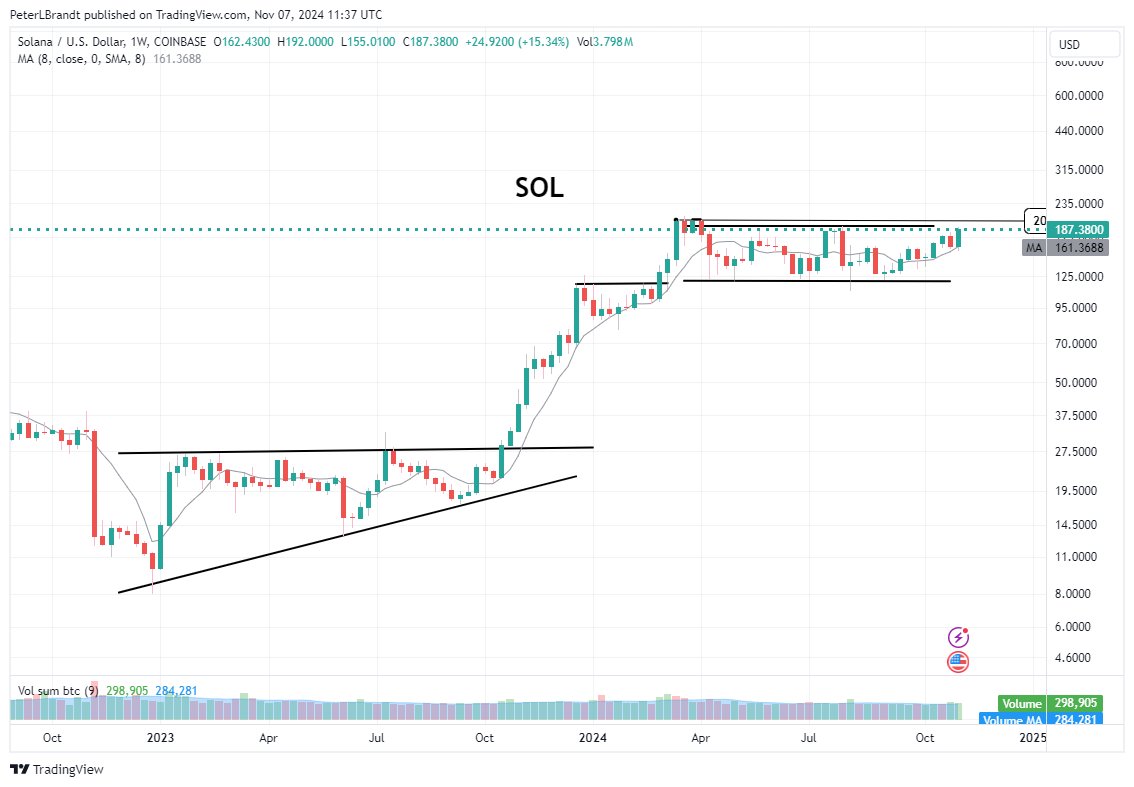
In contrast to Ethereum, Solana’s chart shows a much more bullish structure. At the time of analysis, Solana was trading at $187.38 with a weekly gain of 15.34% after overcoming the $180 resistance.

The chart highlights a prevalent consolidation channel, which has continued to dictate Solana’s price since March 11. Data confirms that SOL is making higher lows while testing the upper resistance near $200 multiple times, recently overtaking BNB in market cap. 

The latest attempt occurred during the recent Bitcoin uptrend, with SOL spiking to $191 today. This pattern suggests a consolidation period that has now resolved in favor of buyers, indicating a likely extension of the uptrend.

Solana 1W Chart Peter Brandt

Unlike Ethereum, Solana has cleared critical resistance zones and is in the process of establishing new highs. Breaking into new territory reduces the presence of overhead supply, meaning fewer resistance levels to impede SOL’s upward movement.

Notably, at a current price of $186.15, Solana is trading well above its 8-week SMA, currently at $161.36. Staying above this average shows strong bullish momentum, and any pullbacks are likely to find support at this level, strengthening the uptrend.