Home Blog Page 1166

Hoskinson Excited as Cardano Taps BitcoinOS to Unlock $1.3T Liquidity

0

As excitement sweeps the Cardano community following a major partnership on Thursday, Cardano founder Charles Hoskinson has thrown in a series of reactions to the development.

For context, EMURGO, one of Cardano’s major developers, announced a partnership with BitcoinOS to unlock $1.3 trillion in Bitcoin liquidity for the Cardano network. The symbiotic collaboration will unlock smart contracts and decentralized application features on the blockchain housing the largest crypto asset by market cap.

Hoskinson Reacts

In one of the Cardano founder’s reactions, he uploaded a picture, accompanied by a GIF, welcoming Bitcoin to the Cardano chain. The image featured two animations with the names of the two networks visibly written on them, with arms wide open in a gesture of embrace.

In another reaction, Hoskinson tapped Cardano’s native AMM-operated decentralized exchange, SundaeSwap. He jokingly tagged SundaeSwap, stating that he heard Bitcoin was looking for a DEX where all the assets that could be issued through the partnership with BitcoinOS.

Notably, the X post emphasized Hoskinson’s belief that the collaboration will unlock massive liquidity on the Cardano network, as DeFi developers based on the chain can access Bitcoin’s $1.3 trillion market without intermediaries. Meanwhile, SundaeSwap responded to Hoskinson’s tweet, noting it was “happy to get them situated.”

Bitcoin Ready to Leave Boring Live

Furthermore, Hoskinson emphasized the impact Cardano’s partnership will bring to the Bitcoin network. The founder noted that the interoperability unlocked will allow Bitcoin’s liquidity to flow into the broader cryptocurrency ecosystem.

He also stated that Bitcoin will finally get rid of its “boring life” for exciting features such as access to DeFi, GameFi, and smart contracts. These Dapps have been missing on the Bitcoin network since its inception due to its core functionality.

Notably, Hoskinson’s thoughts aligned with comments from BitcoinOS’s co-founder Edan Yago, who teased the collaboration during the Cardano 2024 Summit. Yago noted that the partnership with Cardano will bring certain innovations missing on the Bitcoin blockchain.

The BitcoinOS co-founder noted that before now, Bitcoin had been a store of value with a reputable transactional acumen. However, the introduction of zero-knowledge proofs on the Bitcoin network has allowed the deployment of dApps, smart contracts and enhanced interoperability.

Meanwhile, the massive liquidity that will be unlocked to the Cardano network has been tipped to boost the ecosystem substantially and finally set its native token, ADA, on the path to new highs. At the time of writing, ADA trades at $0.3424, with a market cap of almost $12 billion.

Cardano Founder Reacts as Cardano Prepares to Welcome First-Ever True Permissionless L2

0

Cardano founder Charles Hoskinson recently responded to the potential launch of the first-ever true permissionless layer-2 on the Cardano network.

Hoskinson’s reaction comes as the network prepares to witness the launch of Midgard, a unique and fully permissionless layer-2 (L2) solution, the first of its kind in the blockchain space.

Unlike many other L2 solutions across the blockchain ecosystem, Midgard looks to achieve a level of decentralization and trustlessness rarely seen, even in other high-profile networks.

Anastasia Labs’ Vision for Midgard on Cardano

The response from the Cardano founder follows a detailed X commentary recently shared by Philip DiSarro, the founder of Anastasia Labs. He disclosed his vision for Midgard, touting it as a breakthrough L2 solution powered by Cardano. 

According to DiSarro, the current blockchain space has yet to see a truly permissionless L2 protocol, as many so-called layer-2 networks are still reliant on custodial multisignatures. 

These structures often restrict decentralized governance and open participation, limiting blockchain’s potential for complete trustlessness. DiSarro believes Midgard will solve these issues, bringing a fully permissionless, non-custodial L2 to life.

Midgard’s architecture is uniquely enabled by Cardano’s extended UTXO (EUTxO) model, which differs significantly from models used by networks like Ethereum and Solana. 

DiSarro argues that specific design features of Cardano, such as UTXO contention, local state management, and transaction determinism, have laid the foundation for Midgard’s development. What other blockchains may consider limitations, he sees as features that allow Midgard’s functionality on Cardano.

Unique Qualities of Midgard’s Layer-2

Midgard stands out for its uncompromising adherence to decentralization. DiSarro listed several features that make Midgard distinct from existing L2 solutions, emphasizing its non-reliance on centralized systems. 

Unlike many other L2s, Midgard operates without a centralized sequencer, custodial requirements, or multi-signature dependencies. This ensures that all participants retain direct control over their assets.

Instead, Midgard adopts permissionless operator sets, trustless fraud proofs, and open withdrawal and deposit channels. Additionally, it has a reliable censorship resistance that leverages Cardano’s full L1 capabilities, ensuring that transactions cannot be blocked or manipulated.

Charles Hoskinson’s Positive Reaction

Charles Hoskinson, Cardano’s founder, welcomed this innovation with a simple response. Hoskinson’s reaction was a Rick and Morty GIF captioned, “This guy gets it.” While brief, the response conveyed his endorsement for Midgard.

This is one of Cardano’s recently teased developments that look to bolster its growing ecosystem. Notably, yesterday, The Crypto Basic confirmed a partnership between EMURGO and BitcoinOS to launch a bridge that would essentially make Cardano the smart contract layer for the Bitcoin network.

Ripple Mentions XRP, As it Submits New Filing In Its Cross Appeal Against SEC, Focuses on 4 Major Issues

0

Ripple files its pre-argument appeal statement, outlining four issues it seeks to cross-appeal against the SEC. 

The development comes two weeks after Ripple disclosed that its appeal will ensure that “nothing is left on the table.” 

Recall that Ripple lost on the issue of institutional sales of XRP, which were deemed investment contracts. Following this verdict, the federal court imposed an injunction on Ripple’s future institutional sales and a $125 million fine. 

However, with the SEC appealing the rulings (programmatic sales and other distributions of XRP) it lost to Ripple, the payments company also filed a cross-appeal notice to specifically challenge the decision on institutional sales. 

Ripple Cross-Appeal Pre-Argument Statement 

In the filing shared by Defense Lawyer James K. Filan, Ripple outlined four issues it intends to present to the Second Circuit in the appeal. The company urged the Second Circuit to review the issues independently de novo (from scratch without relying on the district court’s decision). 

The first issue Ripple intends to present in the Second Circuit is whether the Securities Acts of 1933 require an investment contract to have an actual contract, post-sale obligations, and the buyer’s rights to profit from the seller’s efforts. 

Second, Ripple seeks to ascertain whether the district court was incorrect in declaring that some of its XRP-related transactions satisfy the three elements of the SEC’s longstanding securities test, Howey. These include an investment of money in a common enterprise, with buyers’ expectations of profit from the seller’s efforts. 

Third, Ripple’s cross-appeal will focus on its fair notice defense. Specifically, Ripple questions whether it raised a genuine dispute of fact when it proffered evidence of the SEC’s inconsistent guidance and regulatory uncertainty to argue that it lacked fair notice on whether its conduct violated federal securities laws. 

Lastly, Ripple aims to nullify the injunction order to ensure it does not affect its future business operations. Ripple quizzes whether the Rule 65 requirements prevent the injunction by simply directing the enjoined party to obey the law. 

Next Steps of the Case 

Meanwhile, FOX Business Journalist Eleanor Terrett has outlined the next step of the SEC v. Ripple lawsuit. Following Ripple’s submission of the Form C statement, the Second Circuit will now issue the scheduling order for the briefings. In a previous statement, she noted that the SEC will first file its opening appeal brief, followed by Ripple’s response. 

Afterward, Ripple will file its cross-appeal brief, and the SEC will respond to the issues. According to Ripple’s CLO Stuart Alderoty, the entire briefing might end in July 2025, nine months from now. 

Furthermore, Terrett asserted that the Second Circuit will consolidate all relevant filings, including some from the district court. 

SEC Seeks Extension of Principal Brief Filing 

In the meantime, the U.S. SEC has asked the court to extend the deadline for filing its principal appeal brief. Notably, the SEC wants the deadline extended to January 15, 2025, less than three months for now. 

As expected, the development triggered reactions among XRP proponents, who suggested that the SEC has resumed its usual delay tactics, as observed at the district court level. However, the court has not decided on the SEC’s latest request. 

Analyst Predicts XRP Price if Bitcoin Hits $200K, Citing XRP/BTC Ratio

0

EGRAG recently discussed XRP price action against Bitcoin, predicting a surge to an XRP/BTC ratio that could lead to an ambitious XRP target.

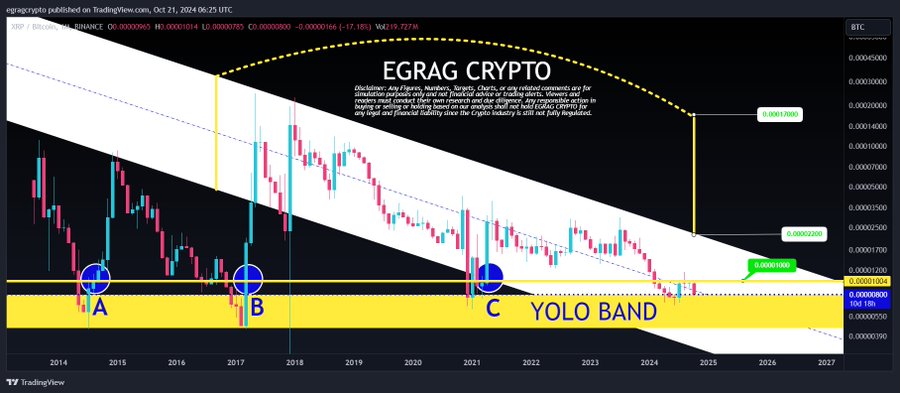
In the latest analysis, the market commentator drew attention to a support zone he calls the “YOLO Band,” which currently acts as a launchpad for XRP/BTC. The name, short for “You Only Live Once,” indicates the opportunities and risks within this price level. 

The YOLO Band, which EGRAG highlighted in yellow in the chart, is an area where past cycles have faced turning points. XRP/BTC is currently testing this zone, with EGRAG pointing out that a close below 0.00000667 would be bearish. However, an upside breakout holds massive potential.

XRPBTC 1M Chart EGRAG Crypto
XRPBTC 1M Chart | EGRAG Crypto

At present, the pair sits near 0.000008, currently trading at 0.00000777. This is below the important 0.00001 mark that EGRAG refers to as a potential launch point. 

XRP tested the 0.00001 level in late September, but heavy selling pressure prevented a break above it. According to the analyst, this price region is important, as crossing the range requires a massive surge, described as a “megathrust move.”

XRP Historical Context: Cycles A, B, and C

EGRAG also called attention to historical market cycles in his attempt to forecast XRP’s future moves. He references three distinct cycles in the chart, namely Cycle A, Cycle B and Cycle C.

Notably, Cycle A, which ran from July 2014, featured consecutive bullish candles. Meanwhile, Cycle B is notable for what EGRAG described as the “Mega God Candle,” a massive green candle that pushed XRP/BTC to a peak of 0.000245 in May 2017.

Lastly, the market analyst noted that Cycle C represented a phase that saw a substantial breakthrough, where XRP/BTC experienced a sharp rally, with the ratio spiking to 0.00003909 in May 2021.

EGRAG suggested that the current market setup resembles these past cycles, particularly Cycle C, which saw a powerful candle. The implication is that XRP/BTC is preparing for another breakout. This breakout could eventually lead to 0.000022 in the near term.

XRP Price if Bitcoin Hits $200K

EGRAG’s chart shows that XRP currently trades within a descending channel. The analyst believes that once XRP/BTC breaks out of this channel, it will likely reach 0.00017, which would signal an epic price rally for XRP.

Should this occur, EGRAG outlined what XRP price could skyrocket to based on Bitcoin’s potential value. If Bitcoin reclaims the $70K level while the XRPBTC pair is at 0.00017, XRP could hit $12, marking a new all-time high.

Meanwhile, if the firstborn crypto breaches the $70K region and claims a new all-time high at $100K, then XRP would reach a price of $17 at the XRPBTC ratio of 0.00017. However, if BTC clinches $130K, the ratio would push XRP to a $22 price.

Also, at a Bitcoin price of $160K BTC, XRP’s price would be $27. EGRAG has repeatedly predicted a rise to this price level in previous analyses. Finally, if Bitcoin reaches the $200K target recently set by Bernstein analysts, the XRP price will hit $34 at the 0.00017 XRP/BTC ratio.

Despite the upside potential, EGRAG also warns that failure to hold the 0.00000667 mark could indicate bearish momentum. A close below this threshold might signal a deeper retracement for XRP/BTC.

Ripple CEO Confirms IPO Not a High Priority but Provides New Timeline for Potential Offering

0

Ripple CEO Brad Garlinghouse has clarified the company’s stance on a potential initial public offering (IPO) amid growing interest in the XRP community.

In an interview with the Thinking Crypto podcast, host Tony Edward asked about the possibility of going public if the regulatory environment improves next year. Garlinghouse made it clear that an IPO is not currently a major focus for the company. “An IPO has not been a high priority for us,” he said.

Why Ripple Is Not Prioritizing an IPO

Garlinghouse explained that most companies pursue IPOs primarily to raise capital, but Ripple is in a unique position where financial strength is not an issue. He pointed out that Ripple has been able to make key acquisitions and continue investing in various projects, including those related to XRP, without the immediate need to raise additional funds.

This financial stability has allowed Ripple to deprioritize going public, as raising capital isn’t a pressing concern.

In addition to financial considerations, Garlinghouse mentioned the ongoing tension between the SEC and Ripple as another factor pushing IPO plans further down the line.

“We have a hostile SEC and regulatory environment in the U.S. Second, we don’t need to raise capital, so the idea of going public has been on the back burner,” he said.

Meanwhile, Garlinghouse noted that the company is ensuring its shareholders have liquidity and are satisfied, and that Ripple is valued appropriately. He emphasized that while the company isn’t ruling anything out, an IPO is simply not a high priority.

Timeline for a Ripple IPO

Garlinghouse hinted that even if Ripple decided to focus on an IPO, it would still take at least 12 months to materialize. 

Furthermore, he noted that if Gary Gensler were to step down as SEC Chairman next year, Ripple might consider prioritizing an IPO at that point. However, he stressed that executing would likely still take a year. He described this prospect as the best-case scenario for an IPO.

Why Web3 Needs Traditional Expertise To Thrive: From Finance To Gaming, Art, And Entertainment

0

The Web3 ecosystem is barely two decades old, Bitcoin’s first block with the famous embedded message “The Times 03/Jan/2009 Chancellor on brink of second bailout for banks” was mined in January 2009.

While there has been significant progress since then, one cannot help but notice that this new decentralized financial ecosystem could borrow a lot from the very system it was designed to replace. In fact, there are quite a number of notable instances that have proven Web3 indeed relies on the expertise from traditional teams in various fields such as finance, gaming and IT to move forward.

Of course, some Web3 diehards might argue otherwise, but looking at the most innovative developments so far, there is probably some input from a Web2 expert. From structuring Bitcoin Spot ETFs by tradfi experts in Wall Street to the building of next gen blockchain games by experienced game publishers such as the Funtico, which touts decades of expertise in game development.

This article will highlight the key areas where Web3 is already leveraging traditional technology experience; they include finance, gaming, art and entertainment.

Traditional Finance Meets Web3 Innovations

One of the crossover skills that seems to be already playing a fundamental role in shaping the future of Web3 is traditional finance. As of writing, there are quite a number of tailored financial crypto products that have been designed by some of the well known traditional asset managers and bankers.

A good example in this case would be crypto investment products such as Bitcoin ETFs; while BTC was accessible to anyone through exchanges prior to the approval, the expertise of firms such as Blackrock in structuring a spot ETF has attracted the much-awaited ‘institutional money’. This leading asset manager has an AUM of $17.24 billion, a significant amount given that Bitcoin Spot ETFs in the U.S. were only approved earlier this year.

It is also interesting to observe that some of the prominent figures in Web3 come from a finance background and have probably been leveraging their expertise on a daily basis. For example, Galaxy Digital Founder Mike Novogratz is a former partner at Goldman Sachs and Fortress Investment Group. Avanti Bank & Trust Founder Caitlin Long also worked as managing director at Morgan Stanley and Credit Suisse.

Experienced Game Publishers Setting the Stage in Web3

The Web3 gaming ecosystem is another niche that has undoubtedly benefited from the expertise and capital injections by traditional game publishers. Both Atari and Ubisoft have already made their debut into the Web3 gaming ecosystem, bringing the much needed expertise to create games that resonate with their already established user base.

Even more intriguing, there are Web3-focused gaming projects such as Functico which are taking the skill crossover to a whole new level. The team behind this project is building a full stack chain agnostic Web 3.0 gaming platform that will feature a Publisher-as-a-Service (PaaS) model, allowing Web2 game developers who are interested in Web3 to deploy games with ease.

Although still a relatively new Web3 gaming ecosystem, Funtico’s current gaming suite which includes a racing game ‘Formula Funtico’ and combat ‘Heroes of the Citadel’ is testament to the touch that Web2 game developers are bringing into the Web3 gaming experience. Instead of building games purely based on incentive models as was the case at the height of the NFT hype, traditional gaming experts are also paying attention to the most important aspect – the experience.

Art and Entertainment

NFT was the word of year in 2021 according to Collins dictionary; that’s how much crypto focused art was discussed during the previous bull run. But what actually drove this particular hype? Other than the speculative aspect of it, artists such as Beeple (Mike Winkelmann) had a huge role to play.

Beeple’s digital collection “Everydays: The First 5000 Days” sold for a whopping $69.3 million at a Christie’s auction. While one might be tempted to argue that Web3 did him a favor, it is also arguable that his breakthrough brought a lot of fresh perspectives in the NFT realm. This sale is what motivated more artists to share their work as NFT collections by listing them on decentralized marketplaces like OpenSea and Blur.

Another great artist that has sold their work in the form of NFTs include Damien Hirst, who is known for his contemporary work in conceptual art and installations. Both Beeple and Damien form part of the NFT success conversation; were it not for such creatives to share or monetize their work through blockchain, we probably would have never figured out the true value of integrating digital work or collections with borderless and on-chain economies.

Conclusion

Satoshi may have launched Bitcoin with the intention of doing away with Web2, but as time has proven, we can only do away with the infrastructure, not the expertise. Web3 currently needs experts from all traditional industries, whether IT, finance, healthcare, or supply chain. This will help developers and other major stakeholders to have a more informed perspective on what they are building or tap into already existing resources to structure more innovative products.

The most important thing is for experts across the divide to understand that it is not a zero-sum game between Web2 and Web3. The two iterations of the Web are intertwined, and the success of a decentralized future will depend heavily on tapping into the wealth of knowledge and experience that traditional industries bring to the table.

Macroeconomist Shares Short-Term Timeline for Bitcoin to Test $73K ATH

0

Michaël van de Poppe, a renowned market commentator and macroeconomist, has shared a bold, optimistic outlook for Bitcoin.

His latest commentary suggested that the leading cryptocurrency could test its all-time high (ATH) within the next two to four weeks. His prediction follows a minor market correction that he believes has concluded, potentially paving the way for a price rally.

Notably, Bitcoin hovered around the $65K level on Wednesday after an unsuccessful attempt to reach the $70K region at the start of the week. The pullback resulted in approximately a 6% correction in Bitcoin’s price.

Bitcoin to Test $73K “In Two Weeks”

With Bitcoin returning to the $67K level, van de Poppe believes the correction phase is over. His optimism is based on the start of the macroeconomic season, marked by the release of Purchasing Managers’ Index (PMI) data.

The PMI is a key indicator of economic health and van de Poppe suggests that strong macroeconomic data could support Bitcoin’s recovery.

He noted that he expects Bitcoin to make a fresh attempt at the $73K level, where the asset peaked in March. According to van de Poppe, Bitcoin could approach this level by mid or late November.

This commentary has gained traction within the community, with many agreeing with his perspective. One commenter pointed out that the recent dip cleared out weak hands, stating, “With PMI season here, it’s time for Bitcoin to gear up for that ATH push.”

Other Market Observers Disagree

However, not all market watchers share van de Poppe’s optimism. X user Mladen Pavla pointed out that Bitcoin’s bull market depends on a weaker U.S. dollar. Without a weak USD, there may be no significant rally, according to him.

Jay Singh Kang echoed a similar sentiment, expressing doubts that the correction is over due to macroeconomic factors like rising yields. He noted potential support zones for Bitcoin between $64K and $62K while monitoring the Dollar Index (DXY) amid a slight pullback.

Meanwhile, commenter Dan John expressed impatience with the current market, noting that activity has stagnated after an earlier bull run this year. He pointed out that altcoins are not moving as explosively as before, claiming that Bitcoin is ranging, and retail interest in crypto is fading. Despite this, he remains hopeful that the bull run will resume, and gains will return.

However, another investor, Kevin, disagreed with Dan’s view on altcoins, suggesting that perhaps Dan is holding the wrong ones. He highlighted altcoins like SUI and AERO as examples of projects performing well, even as the broader market remains flat.

Ethereum ICO Whale Dumps 3K ETH for $7.64M Amid Crashing Prices

0

Ethereum ICO whales have resumed sales, coinciding with a notable decline in crypto.

Ethereum (ETH), despite experiencing volatility, remains a significant focal point in the crypto market among prominent investors. As of today, the crypto has registered a 1.76% decline, pulling the price down to $2,531.

With a trading volume of $20.24 billion in the same period, ETH has faced a cumulative 3.18% decrease in the past week. These movements coincide with notable sales from Ethereum Initial Coin Offering (ICO) participants.

ETH Sale by ICO Participant

Notably, an on-chain analysis from Lookonchain highlights sales from an early Ethereum investor. It disclosed that a particular ICO participant offloaded 3,000 ETH today, valued at $7.64 million. This same whale previously sold 7,000 ETH worth $24.28 million in July, prompting a nearly 15% drop in Ethereum’s price. 

Originally receiving 254,908 ETH during Ethereum’s 2015 ICO at an initial cost of $79,000, this whale’s holdings have since appreciated to a current value of $646 million. As of now, the wallet maintains a balance of 37,070 ETH, worth approximately $93.8 million. Given this significant exposure to ETH, the wallet’s value remains highly sensitive to price fluctuations.

ETH ICO participant wallet

ETH ICO Sales Throughout October

The sell-off trend extends beyond a single participant. In early October, two more ICO wallets showed notable selling activity. On October 8, one of these whales transferred 5,000 ETH, worth $12.22 million at the time of the transfer, to the Kraken exchange. This transfer followed an earlier sale of 45,000 ETH (around $113.2 million) over the preceding two weeks at an average price of $2,516. 

Since the ICO, this whale has cumulatively sold 60,000 ETH for $149.68 million. Tracing back to 2019, the whale’s ETH liquidation began with a sale of 5,000 ETH at $218 per coin. In June 2024, the same wallet sold 10,000 ETH at $3,539 per token, capitalizing on market peaks.

Sales After Dormancy

A second whale, dormant for two years, resumed sales on October 1. This wallet initially received 150,000 ETH during the 2015 ICO, costing $0.31 per coin, and worth $358 million today. On October 1, the whale sold 4,000 ETH when ETH traded at $2,655. 

Later that day, it sold an additional 5,000 ETH, worth approximately $12.7 million. By October 3, the whale sold 19,000 ETH, valued at $47.54 million. Recent transactions include 6,000 ETH sales worth $14.7 million, with another 4,000 ETH sales as the price dropped to $2,380.

Michael Saylor Debunks Self-Custody Allegations, Says There is Freedom to Choose Custody

0

MicroStrategy Chairman and Bitcoin maxi Michael Saylor has come out to clear the air amid the backlash and widespread criticism he has received following his self-custody custody comments.

In a Wednesday tweet, the MicroStrategy co-founder noted that he supports self-custody. For context, self-custody, popularly known in crypto, involves taking full responsibility for one’s asset by storing it in a cold wallet.

Saylor Maintains Everyone Has the Freedom to Choose Custody

While reiterating his long-standing support for self-custody, he noted that it was for anyone “willing and able” to do so. By that, he implied that everyone was free to choose either self-custody or handing their assets to a qualified custodian.

Furthermore, he added that Bitcoin has benefitted from all forms of investment. As a result, crypto enthusiasts should welcome all forms of business venture that would improve the adoption of the premier crypto asset.

Notably, his comments came after crypto OGs like Ethereum co-founder Vitalik Buterin criticized his self-custody remarks in a Markets with Madison interview. Buterin said Saylor’s view on custody was “batshit insane,” arguing that he encouraged regulatory capture to protect Bitcoin.

For context, Saylor called those encouraging self-custody “paranoid crypto-anarchists,” noting they used the fear scheme to sell their products and get rich off crypto investors. The MicroStrategy chairman further stated that the myth that the concentration of Bitcoin holdings among large institutions would increase the chances of seizure, as seen in gold, was converse.

Analyst Says Saylor Was Right

Market analyst James Van Straten has agreed with Saylor’s view on the importance of institutional investors getting largely involved with Bitcoin. In a tweet, Straten stated that although he advocates for self-custody, the concept will not drive the adoption of the crypto sector.

The analyst shares Saylor’s thoughts that Bitcoin needs traditional financial systems, as a bunch of the global market money is situated there. He noted that the immense contribution of the Bitcoin spot exchange-traded funds in the crypto sector proves how much the industry needs these big financial players.

Notably, Straten also applauded Saylor and MicroStrategy’s ploy to become a Bitcoin bank, citing comments from Hal Finey, one of the premier asset’s early contributors.

Finey noted that a Bitcoin-backed secondary system, which will be an intermediary between financial institutions and Bitcoin, would be paramount to Bitcoin’s ultimate goal of becoming a “high-powered money.”

Solana Hits 12-Week High as Analysts Predict 2x or 3x Breakout if Bitcoin Claims $100K

0

Solana reaches a 12-week high at $174 amid rising sentiment, and mindshare, as analysts see potential for further gains.

Solana’s price clinched a twelve-week high today, moving against the broader market’s struggle for gains.

The cryptocurrency traded at $174, reflecting a 4.8% daily increase. This upward trend, which began around October 18, comes on the back of improving sentiment and strong mindshare metrics. 

Expert analyst Miles Deutscher observed that the rise aligns with a notable uptick in positive sentiment surrounding Solana, as well as increased market discussions. 

Improved Sentiment and Rising Mindshare

Recent sentiment analytics indicate that the positive tone of discussions around Solana has increased since October 18, paralleling its price rise.

This positive sentiment has contributed to a sustained upward momentum in Solana’s value. Notably, mindshare—a measure of the percentage of discussions Solana commands in the market—has also remained strong. 

This measure fluctuated throughout the week but recorded a notable increase around October 19, maintaining a consistent level through October 24.

In terms of total mentions, Solana has accumulated 14,528 mentions across various platforms, reflecting significant interest. Engagement has reached 605,579 interactions, while smart engagement—defined by more meaningful interactions—amounts to 11,843.

Analyst Predicts Further Upside

Miles Deutscher believes that Solana’s price still has growth potential despite its recent rally. He suggests that the price could double or even triple, particularly if Bitcoin reaches new highs, such as $100,000 to $120,000.

He noted that Solana’s continued strength against Ethereum, which could further bolster its standing. 

Deutscher also highlighted three ecosystem tokens with potential for higher returns than Solana itself. These include WIF, a leading memecoin within Solana’s network; Jupiter, a key trading hub for meme trading on Solana; and Radium, despite concerns about heavy supply releases that might limit upside.

Technicals Point to a Bullish Pattern

Another analyst identified a bullish “cup-and-handle” pattern forming on Solana’s price chart. This formation, typically a signal of a potential breakout, suggests that Solana is entering a new growth phase. The “cup” began forming in late 2021, followed by a bottom in 2023 and a gradual recovery by Q1 2024. 

The “handle” phase is now ongoing, marked by a period of consolidation since reaching $206 earlier this year.

The analyst argues that if Solana breaks through the handle’s resistance level, this pattern could trigger a massive price rally to $4,500—a 2,547% surge from current levels.