Home Blog Page 1169

Bloomberg Analyst: Bitcoin Could Face Challenges Ahead Amid Correlation with S&P 500

0

The relationship between Bitcoin and traditional markets like the S&P 500 and commodities, including gold and copper, suggests challenges ahead. 

Two recent charts from Bloomberg’s Senior Commodity Strategist Mike McGlone discuss Bitcoin’s position in the market. The charts suggest that Bitcoin may face challenges going forward, especially in maintaining its status as a high-beta risk asset.

Bitcoin’s High Correlation with S&P 500

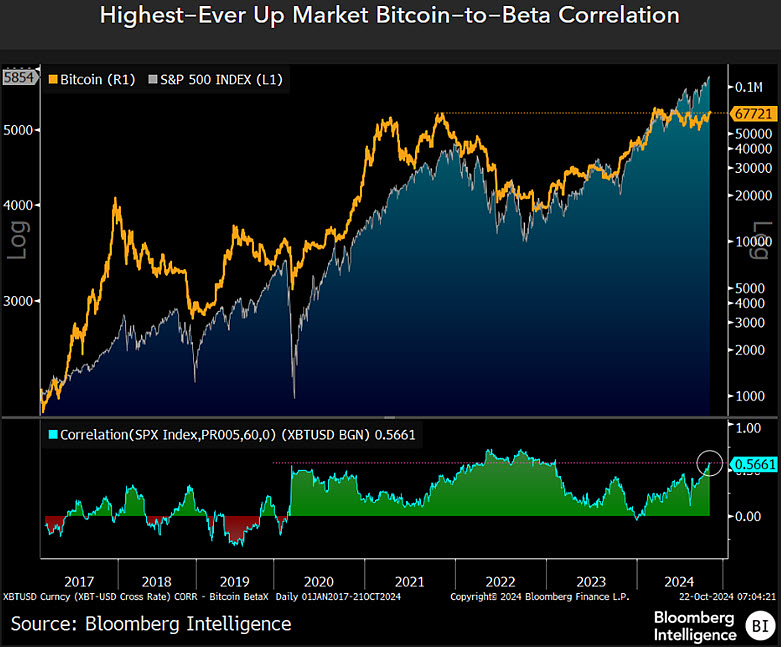
The first chart shows the highest-ever 60-day correlation between Bitcoin and the S&P 500 during a rising market. Notably, the correlation hit 0.5661, indicating that both assets are aligning strongly. This trend had stalled earlier in the year, per a previous report from The Crypto Basic.
Bloomberg Intelligence

The renewed correlation suggests that Bitcoin, which some market watchers have viewed as a decentralized and independent asset, is now trading in lockstep with traditional equity markets. 

This trend could signal a change in Bitcoin’s behavior. Investors have historically seen BTC as a hedge against traditional financial assets, but its growing correlation with the S&P 500 indicates that it is now behaving more like a high-beta risk asset. 

McGlone noted that this strong correlation may place a burden on Bitcoin’s beta to keep rising. Essentially, this means Bitcoin’s ability to outperform may depend on broader market performance, particularly in the context of economic growth and risk appetite.

Additionally, McGlone drew a parallel between Bitcoin and copper, suggesting that both assets face similar issues in terms of their beta performance. Veteran trader Brandt has also confirmed Bitcoin’s bearish consolidation, but he remains optimistic.

Meanwhile, copper has seen a trajectory that mirrors Bitcoin’s, indicating that both assets are sensitive to the shifts in economic growth expectations. This suggests Bitcoin may struggle to maintain its upward momentum if economic conditions weaken.

Gold Outperforming Bitcoin

The second chart points out Bitcoin’s underperformance relative to gold, despite the S&P 500 remaining relatively elevated. Brandt also previously discussed this position.

For context, the Bitcoin-to-gold ratio has fallen to 24 ounces of gold per Bitcoin, down from a high of 34 in March 2024 and a peak of 37 in 2021. This decline suggests that while Bitcoin has seen growth since 2021, it has not kept pace with gold’s recent strength.

McGlone suggested that this lagging performance could signal headwinds for Bitcoin and other risk assets. Gold’s outperformance during periods of economic uncertainty or market volatility has long established it as a safe-haven asset. 

The fact that Bitcoin, which most market commentators call “digital gold,” is struggling to keep up with physical gold raises questions about its long-term position as a store of value.

The continued growth of the S&P 500, despite Bitcoin’s lag relative to gold, may also point to market risks. While equities have remained strong, Bitcoin’s decoupling from gold may show growing investor caution cryptocurrencies. 

Discouragingly, this caution could become more pronounced if inflationary pressures, geopolitical risks, or other macroeconomic factors continue to weigh on global markets. At press time, BTC currently trades for $66,702, down 1.03% over the past 24 hours.

Nigerian Government Releases Binance Executive After Dropping Charges

0

The Nigerian government has ordered the release of Binance executive Tigran Gambaryan, who had been detained for seven months in the country.

According to a local media outlet, a court in Abuja acquitted Gambaryan during a session on Wednesday. This acquittance occurred after the federal government dropped money laundering charges against the Binance executive.

The Wednesday ruling came after Gambaryan was denied bail last week. The presiding court adjourned the executive’s next hearing to October 25 but arraigned him prematurely today and acquitted him of the money laundering allegations. 

Gambaryan Free to Receive Medical Care Abroad

Multiple sources confirmed that the Nigerian Economic and Financial Crimes Commission (EFCC) dropped the money misappropriation charges against the Binance executive due to his deteriorating health. One source noted that the dismissed allegation was to allow Gambaryan to seek medical attention outside the country.

Notably, the executive insisted on several occasions that he was ill, complaining about health challenges like malaria and the inability to walk properly. His wife and Binance CEO Richard Teng also criticized the lack of quality care Gambaryan received in the Kuje correctional facility, where he was detained.

It bears mentioning that Gambaryan was arrested alongside Nadeem Anjarwalla, Binance Africa’s regional manager, in February. However, the latter escaped from custody in March from their guest house in Abuja.

Nigerian Government to Continue Case With Binance

Meanwhile, Wednesday’s decision to drop charges against Gambaryan didn’t affect the Nigerian government’s case with Binance. The EFCC will pursue its indictment against the leading crypto exchange by trading volume for allegedly moving $26 billion in untraceable assets.

The federal government is seeking a $10 billion penalty for the alleged illicit activity, which it claimed devalued its currency. Notably, the Nigerian government has banned Binance from operating in the country and blacklisted the exchange’s websites.

Interestingly, the laundering charge differed from tax evasion and illegal operation charges against Binance. The exchange has pleaded not guilty to all charges.

Legendary Analyst Brandt Spots Bearish Bitcoin Signal but Longs BTC with $150K Target

0

Legendary trader Peter Brandt recently discussed the current price action of Bitcoin, highlighting his risky bet on an uptrend amid a bearish signal.

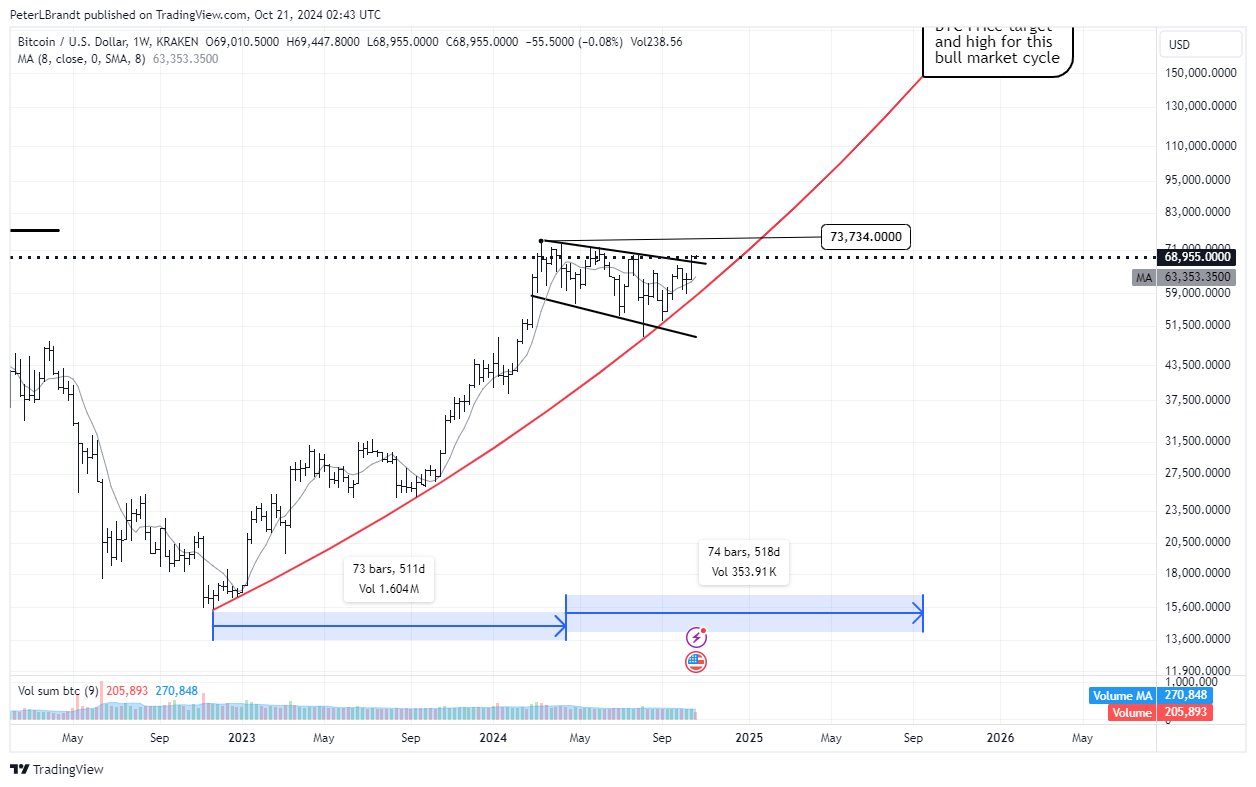
In an analysis published on October 21, Brandt identified a seven-month inverted expanding triangle formation that continues to shape Bitcoin’s price behavior. This pattern, also known as a “broadening formation,” has been unfolding since March, when Bitcoin reached its historic high.

The formation consists of two sloping trendlines that diverge over time, creating a broadening shape. It arises amid a series of lower lows and lower highs amid Bitcoin’s seven-month-long consolidation.

Image
Peter Brandt Bitcoin chart

Notably, the inverted broadening triangle observed on Bitcoin’s chart is typically a bearish signal. Brandt first called attention to the pattern in July.

In his latest analysis, he stressed that the formation has not been violated despite Bitcoin’s consistent uptrend since last month. This signals caution regarding the current trend. Meanwhile, Brandt disclosed that he is taking a risky bet on Bitcoin.

Brandt is Long on Bitcoin, Targets $150K

Specifically, despite the bearish signal, the seasoned trader noted that he is currently long on Bitcoin. He acknowledged that being long on Bitcoin at this time is his most considerable speculative position.

He posted a chart highlighting his anticipated target for Bitcoin in this cycle at the lofty $150K level, which he expects to materialize by September 2025.

At the time of the analysis on Monday, Bitcoin traded as high as $69,500. Meanwhile, at press time, Bitcoin is at $66,293, down 2% today alone.

In an earlier analysis, the veteran trader highlighted the significance of Bitcoin moving over the $72K price point to confirm whether Bitcoin’s month-long uptrend is sustainable in setting higher highs or whether a corrective downturn could emerge. 

However, Bitcoin has failed to hit $70K, and a correction phase is in progress, with ongoing attempts to breach the $65K level.

Brandt Says Technical Analysis Can Be Worthless

Interestingly, in a more recent update, Brandt stated that trend lines in technical price chart analysis are essentially worthless.

He pointed out that even the clearest and most accurately drawn price patterns are reliable only about 60% of the time. According to him, the true value of price charts lies in risk management and identifying asymmetric trading opportunities.

Here’s How Much Shiba Inu Can Make You in Various Countries if SHIB Hits $0.0008

0

A Shiba Inu rally has the potential to change the lives of investors earning minimum wage in various countries.

For context, data from blockchain resource IntoTheBlock confirms that 1,233,140 Shiba Inu investors hold between $0 and $1,000 worth of SHIB. This number accounts for 90% of all Shiba Inu holders.

Notably, Shiba Inu currently trades for $0.00001794 at the reporting time, indicating that a $1,000 investment currently holds 55.74 million SHIB tokens. 

Shiba Inu Holdings Distribution Matrix ITB
Shiba Inu Holdings Distribution Matrix | ITB

Shiba Inu Potential 

However, supposing these 1.233 million investors hold an average of $500 worth of Shiba Inu, this would translate to an average holding of 27.87 million tokens. This investment could make life-changing gains for investors earning minimum wage in various countries.

Several analysts have predicted a massive SHIB rally for this bull run due to its meteoric surge in the 2020-2021 bull market. Amid the predictions, a previous report from The Crypto Basic confirmed that Shiba Inu would hit $0.0008485 if its market cap reached $500 billion.

This would represent a massive 4,629% increase from its current price of $0.00001794. Such a rally would be beneficial, especially for the 1.23 million Shiba Inu holders who, on average, hold about 27.87 million tokens. Notably, these tokens would be worth $23,648 at $0.0008485.

Given the global nature of crypto investments, the impact of this rally would vary depending on where an investor lives. For someone earning minimum wage, this could be life-changing, but how long would it take to earn such an amount?

Shiba Inu Gains in Nigeria, India and Pakistan

Nigeria’s minimum wage, currently set at NGN 70,000 per month, translates to around $43.19. At this rate, it would take a Nigerian minimum wage worker about 45.6 years to earn NGN 38.3 million, which is the equivalent of $23,648. 

This indicates that a significant gain from Shiba Inu could compress decades of earnings into one potential investment for a minimum wage earner in Africa’s most populated country.

In India, minimum wages vary depending on the region and sector, but average around INR 5,340 ($63.51) per month. At this rate, it would take about 31 years for a worker earning minimum wage in India to accumulate INR 1.98 million (equivalent to $23,648). 

Meanwhile, according to local sources, Pakistan’s minimum wage sits at PKR 30,000 monthly, equivalent to $107.75. To accumulate PKR 6.58 million, which matches $23,648, a minimum wage earner would need to work for 18.2 years. 

Turkey, Argentina and Brazil

Notably, the Turkish government recently increased the gross minimum wage to TRY 20,000 ($583) per month. With this rate, it would take about 3.3 years to earn TRY 810,182 ($23,648). For Turkish investors, Shiba Inu’s potential could compress a few years’ worth of labor into one financial windfall.

In Argentina, where inflation is rampant, the minimum wage is ARS 271,571 ($276) monthly. To earn ARS 23.64 million, which equals $23,648, a worker would need to toil for about 7.1 years.

Meanwhile, sources suggest Brazil’s minimum wage is BRL 1,412 ($248.13) per month. It would take a Brazilian minimum wage worker 7.2 years to accumulate BRL 123,072, equivalent to $23,648.

Pundit: Floki Has Something That Shiba Inu, Dogecoin Do Not

0

A market commentator teased innovatory bragging rights that Floki has over Shiba Inu, Dogecoin, and PEPE after the launch of an auto-burn feature.

According to a tweet from community enthusiast Scofield, Floki’s latest auto-burn mechanism among other features has given it an edge as it trumps those of notable meme coins like Shiba Inu and Dogecoin.

Scofield noted that Floki has a money printer that automatically buys and burns the FLOKI token, enhancing the meme coin’s deflationary course. Notably, his comments came after the Floki team announced a major breakthrough in its burn mechanism.

Floki Buy/Burn Mechanism Now Live

On Friday, the Floki team announced that its trading bot’s buy/burn mechanism has resumed operation after overcoming technical challenges. The X post noted that the feature failed to work effectively following its mainnet launch, resulting in a pause in usage.

Notably, the auto-burn feature automatically collects and incinerates 50% of transaction fees generated from the Floki Trading Bot. For context, the Floki Trading Bot is a Telegram-based marketplace that allows users to buy and sell tokens across the Ethereum, Base, and Binance Chain networks.

Meanwhile, the Floki team announced that 50% of the fees raised from transactions on the trading bot before now will also be incinerated. The project further disclosed it has accrued over $1 million in fees since the Telegram-based trading platform went live.

It bears mentioning that the Floki Trading Bot charges 1% in transaction fees for any trading activity on the platform. Also, the remaining 50% of the fee will be transferred to the Floki Treasury.

Floki’s Burn Mechanism Compared to Other Chains

Floki’s new burn mechanism is similar to that of most of its meme coin counterparts. For context, most meme coins implement models to downsize their total token cap and maintain deflation.

Notably, Shiba Inu also has an automated burn mechanism in which 70% of base transaction fees on the Shibarium network are incinerated. The ecosystem confirmed the introduction of the new deflationary model on the back of a hard fork announcement in August.

However, Dogecoin does not support periodic token burns. The project adopts an inflationary model, ensuring it adds a fixed amount of coins to its total supply yearly. 

Elon Musk Distances Himself From Dogecoin, Says “Nothing Serious”

0

Elon Musk recently distanced himself from serious crypto involvement, calling his Dogecoin interest mostly casual.

At a recent Pennsylvania rally in support of Donald Trump, Tesla and SpaceX CEO Elon Musk shed light on his position regarding crypto, specifically Dogecoin. Musk, often linked to the broader digital asset space, clarified that his involvement with cryptocurrencies is not as serious as many might believe. 

Instead, he sees it as largely casual, underscoring his playful association with Dogecoin and his love for dogs and memes. He particularly says he likes Dogecoin because it is “the best source of humor.”

His comments came amidst increased attention to his potential role in shaping blockchain policies, but Musk asserted that this perception is overstated.

D.O.G.E. Department

This statement from Musk aligns with ongoing rumors suggesting that if Trump wins the upcoming presidential election, Musk could be appointed to head a new Department of Governmental Efficiency (D.O.G.E.). 

This department would focus on streamlining government operations. Notably, Musk has hinted at the connection between the department’s name and Dogecoin, leading to speculation among crypto enthusiasts.

On Tuesday, he tweeted, “D.O.G.E will fix it,” in response to a Los Angeles Times report indicating that California officials had barred his SpaceX company from launching additional rockets from the state.

Dogecoin’s Price Reaction 

Meanwhile, some crypto investors have interpreted Musk’s tweet as supportive of Dogecoin, likely due to his history with the meme coin. Following Musk’s tweet, the crypto saw increased social media activity, with users posting memes and sharing his message. 

This activity coincided with a 24-hour trading volume of approximately $1.5 billion for Dogecoin. Although the price has also dipped by 4.13% in the past 24 hours, the price recorded an 8.12% increase over the past week, reaching $0.1371 during this press.

Dogecoin’s Long-Term Potential

Amid this volatility, market analyst Ali Martinez has maintained a bullish outlook on Dogecoin, suggesting that the meme coin could reach a double-digit price soon. Martinez’s latest prediction, shared on October 18, targets a surge to $10, based on Dogecoin’s historical price patterns. 

Bitcoin Faces Crucial Test Amid Strong US Dollar and Declining Equities

0

The potential for Bitcoin to reclaim above the $69,000 mark this week is crucial in confirming the robustness of the broader crypto market, according to an analyst.

The bearish performance of the U.S. equity market and the strengthening of the U.S. dollar have recently wreaked havoc on the price actions of crypto assets. 

In particular, Bitcoin (BTC) has been down 1.28% in the past day, contributing to an overall negative trend in its seven-day performance. This has resulted in a decline across the broader crypto market, with the total valuation plunging by 1.28% to $2.31 trillion. 

With Bitcoin price hovering near the $66,000 level, the premier asset is currently at a crucial point that could impact its next movement. 

Several market watchers are observing Bitcoin’s behavior around its current position. Some of the analyses have focused on Bitcoin’s short-term exponential moving averages (EMAs). 

Bitcoin Needs to Higher High Above $69K This Week 

Specifically, Skew, a widely followed Bitcoin analyst, suggested that BTC needs to establish a higher high above the $69,000 price level before the end of this week to maintain its bullish trend. According to the expert, this potential spike would validate the strength of the ongoing bullish trend in the market. 

Meanwhile, the analyst identified the $66,500 price level as Bitcoin’s primary defense line. A decline below this mark could activate the second support at $65,000. If these supports fail to hold, Bitcoin’s price could crash to $61,065, which serves as a pivotal control point. 

BTC Shows Strength Against Strong USD

In the meantime, several macroeconomic factors, such as increasing inflation markers, declining U.S. equities, rising U.S. dollars (USD), political uncertainty, and concerns about the United States’ financial policies, have been impacting Bitcoin’s price actions lately. 

Interestingly, the premier crypto asset has displayed resilience against the USD, whose index (DXY) rose 3.4% month-to-date (MTD).

Typically, such a surge weakens crypto prices. However, Bitcoin has shown resilience against the U.S. fiat currency, with its 5% MTD gain.

Bitcoin’s Next Move?  

Meanwhile, market watchers are closely monitoring Bitcoin’s price for the remainder of the week as the asset hovers around crucial levels. 

Bitcoin bulls hope BTC will remain above the $66,500 support level to bolster its chances of breaching the $70,000 resistance this week. 

Conversely, bears will aim for further declines that could push Bitcoin to support levels of $65,000 or $61,065. Currently priced at $67,053, Bitcoin is down 9.44% from its all-time high of $73,750, registered on March 14, 2024. 

XRP Ledger Sees Mixed On-Chain Activity, But AMM Liquidity Provision Surges

0

Wenry Seoul, a lead analyst at CryptoQuant, recently published an in-depth analysis of XRP Ledger’s on-chain activity, showing mixed metrics.

The analysis, which covered the period between September 15 and October 15, shows that despite the general perception that XRP Ledger is less recognized by retail investors compared to other major Layer 1 networks, its transaction volume remains competitive.

Notably, it provides a breakdown of key on-chain metrics, token activity, NFT trading, and automated market maker (AMM) liquidity.

XRPL Basic On-Chain Metrics Show Mixed Signals

The report highlighted mixed results across XRP Ledger’s basic metrics. New wallet creation rose by 10.39%, with 18,321 new accounts. Likewise, active accounts surged by 14.19%, with 10,887 users engaging with the network daily.

However, total transactions fell by 17.57%, with the ledger processing 18.82 million transactions, while payments dropped even further, down 26.16% to 6.81 million. This divergence between user engagement and transaction volume suggests that fewer transactions are being made per account while more wallets are being created.

Image

AMM Liquidity Provision

Meanwhile, one of the standout metrics from the report is the growth in automated market maker (AMM) liquidity provision. 

AMMDeposit activity rose 62.35%, while AMMCreate surged by 143.10%, showing that users are increasingly providing liquidity to the XRP Ledger’s decentralized pools. 

This is further supported by a 65.22% increase in AMMVote, reflecting active participation in governance. Despite an 81.82% drop in AMMBid, the rise in deposits suggests robust confidence in the existing XRPL liquidity pools.

It’s worth mentioning that the AMM functionality on the XRP Ledger went live in March. Since then, approximately 14 million XRP has been locked in over 3,000 active pools. The total value locked in XRPL AMM pools is even more staggering, totaling a worth of 26.9 million XRP, of which 13.9 million consists solely of XRP tokens.

Token Activity and DEX Volume on XRP Ledger

While token trades decreased by 6.83%, dropping to 6.41 million, decentralized exchange (DEX) activity saw a positive trend. Specifically, DEX volume surged by 17.64%, climbing from $3.91 million to $4.60 million.

Meanwhile, XRP Ledger’s market cap dropped significantly, declining 15.24% to $87.56 million. Yet, the number of listed assets saw a mild spike of 1.17%, suggesting that developers and projects are still interested in launching new tokens on XRP Ledger.

XRPL NFT Trading Activity Declines Across the Board

NFT trading activity on the XRP Ledger witnessed substantial declines. NFTokenMinting, a key indicator of new NFT creation, plummeted by 70.66%. Likewise, NFTokenAcceptOffer dropped by 30.88%, and NFTokenCreateOffer also tanked by 33.30%.

Although there was a small uptick in NFTokenCancelOffer (+0.20%), the broader picture suggests that NFT activity on the XRP Ledger is currently facing a downturn.

Ethereum Fees Dip to $1.63 as Santiment Predicts Increased Network Usage

0

According to Santiment, Ethereum could attract an increase in network usage, as average transaction fees drop to lower levels.

Notably, Ethereum’s network fees recently reached an unusually low average of $1.63, according to an analysis by Santiment, a market intelligence platform. This shift marks a pivotal point for the blockchain as it nears its 10th anniversary.

Historically, low transaction fees have encouraged traders to increase transfer frequency, often leading to greater activity on the blockchain.

Shifting Transaction Fee Levels

The analysis’ visual highlights four key fee tiers, each carrying distinct implications for market behavior. Notably, the first tier describes when average fees surpass $10, which typically trigger a decline in user activity tends to decline, as seen during market tops when demand peaks.

Santiment
Santiment

Secondly, fees between $6 and $10 are associated with periods of heightened demand, often linked to FOMO-driven bull runs. During these times, increased user interaction contributes to elevated transaction costs. Furthermore, average fees ranging from $2 to $6 are more typical of flat or sideways markets, suggesting balanced network usage without excessive cost pressure.

Notably, fees below $2, the current average, encourage increased activity and utility, a trend commonly seen during market bottoms. The drop to this level indicates less congestion and greater affordability.

Impact of the Dencun Upgrade

A significant driver behind the recent fee reduction in the ecosystem is the implementation of Ethereum’s Dencun upgrade, which rolled out on March 13. This upgrade introduced a new mechanism for reducing transaction costs on Layer-2 (L2) networks.

The update allowed L2 networks to utilize a new data storage method known as Binary Large Objects (blobs), resulting in a notable decline in transaction costs. For instance, the average transaction fee on Optimism, a popular L2 network, dropped from $2.44 to $0.068 shortly after the upgrade’s launch. 

Similarly, fees on Coinbase’s Layer-2 Base decreased from $1.212 to $0.196 within the same period. 

Shiba Inu’s Use as Gas Fees?

Meanwhile, discussions had earlier emerged within the Shiba Inu community regarding the feasibility of using SHIB as gas fees on the Ethereum network. However, Lucie, the marketing lead for the Shiba Inu ecosystem, recently clarified the technical challenges of such an integration. 

Ethereum’s architecture relies solely on ETH for transaction fees to incentivize validators and maintain network operations. Integrating an alternative token like SHIB would require significant infrastructure changes, potentially compromising the network’s security and efficiency. 

Expert Says No Excuse to Hold or Trade XRP After Latest Event

0

Prominent figures in the crypto community criticizing Ripple chairman’s monetary donations to Kamala Harris’s presidential campaign have urged market participants to boycott XRP.

Chris Larsen, co-founder and chairman of Ripple, has deepened his financial commitment to Vice President Kamala Harris’s presidential campaign.

In a notable development, Larsen recently added $10 million worth of XRP to Harris’s campaign fund. This latest contribution follows a $1 million donation made just two months prior. As a result, Larsen has now contributed over $11.8 million to Harris’s campaign efforts.

No Excuse to Own XRP

The reaction to Larsen’s donations has been mixed. Some view them as a political move that diverges from XRP’s core mission. Notably, Mike Alfred, a known value crypto investor and board director, disapproved of Larsen’s contributions.

Specifically, Alfred emphasized that market participants have “no excuse” for owning XRP or supporting the token in any way, given the Ripple founder’s continued financial support for Harris’s presidential ambition.

This disapproval followed a response by X user Layah Heilpern, who criticized XRP’s leadership for “dumping” on their community to support what she describes as “Marxist” politicians.

Alfred’s perception concerning XRP amid Ripple’s chairman’s donation is widely shared in the crypto community. Ryan Selkis, the founder of the analytics platform Messari, even declared XRP “dead” amid the financial support for Harris’ presidency.

Early Contributions 

It is important to note that Larsen’s involvement in Harris’s campaign began earlier this year with a $6,600 donation. These initial contributions set the tone for a consistent pattern of financial help from other supporters toward Harris’s campaign. 

Other major contributions include $10 million each from Dustin Moskovitz, co-founder of Facebook. The nonprofit Evidence for Impact also added $9 million, while Illinois Governor JB Pritzker contributed $5 million.

Ripple’s CEO Response 

Amid the controversy, Ripple’s CEO, Brad Garlinghouse, commented on Larsen’s decision. Garlinghouse emphasized that individuals, including Larsen, have the right to support their preferred political candidates. 

He clarified that Ripple maintains bipartisan engagement as an organization, advocating for pro-crypto policies regardless of party lines. Garlinghouse pointed to the current administration’s stance on crypto regulation, indicating that the company aims to promote policies that foster blockchain innovation regardless of political outcomes.