Home Blog Page 1204

Paypal Makes First Business Transaction Using Its Native Stablecoin PYUSD

0

Payment giant PayPal has completed its first business transaction with its dollar-pegged digital asset, PYUSD.

As first reported by Bloomberg, the leading financial technology solution firm utilized the PYUSD for an official business transaction for the first time. On September 23, PayPal paid accounting firm Ernst & Young LLP an undisclosed amount of money using the Paxos-based stablecoin.

PayPal Expands PYUSD Utility

The transaction further enforces the capabilities of stablecoins for adverse usage in the traditional financial system. Notably, PayPal completed the payment to Ernst & Young using the SAP SE platform.

German-based SAP SE, widely known for its cloud computing venture, processed the transaction, ensuring swift delivery. Notably, the SAP SE protocol allows users to send and receive digital assets globally.

Stablecoins are a modern alternative to the slow, costly traditional cross-border transactions. Their cheap and swift qualities have grown their adoption among payment institutions, including PayPal.

According to PayPal’s general manager of the blockchain, cryptocurrency, and digital currency group, Jose Fernandez da Ponte, the September 23 transaction demonstrates the vast usage of stablecoins. He noted that its US dollar-pegged stablecoin was well-suited for transactional settlements of this kind.

Launched in August 2023 on the Paxos network, the PYUSD offers its users the advantages associated with stablecoins. Aside from a hedge against inflation—for areas with volatile local currencies—the digital currency also aids cross-border payments. At the time of writing, the PYUSD is capped at $716 million.

Notably, PYUSD gained further utility in the crypto market after crypto exchange OKX added the stablecoin for spot trading. With the integration, users can now trade cryptocurrencies against the stablecoin.

Bitcoin’s MVRV Peaks Lower Than Previous Cycles, Suggesting Room for Gains

0

While Bitcoin has struggled to set a new all-time high for over six months, its MVRV ratio remains below past peaks, signaling potential for further gains.

According to a recent analysis by IntoTheBlock, Bitcoin exhibits signs of potential upside, regardless of ongoing bearish sentiment. The analysis highlights the importance of the MVRV (Market Value to Realized Value) ratio in gauging Bitcoin’s cycle top.

In the current market cycle, Bitcoin’s MVRV ratio peaked at 2.64 in March, a relatively low value compared to previous bull markets. Accordingly, the market intelligence platform suggested that Bitcoin’s rally may not be complete, with room for further upward movement before the market reaches a true top.

Historical MVRV Peaks

IntoTheBlock’s historical data reveals key insights into Bitcoin’s past performance. During the 2017 market cycle, the MVRV ratio reached a peak of 4.35, while the 2021 cycle saw a high of 3.7. 

Hence, the current MVRV of 2.64 remains significantly lower, indicating that the cryptocurrency still has some distance to cover before reaching a cycle’s top comparable to previous cycles. 

Whales Yet to See Massive Profit From Bitcoin

Another indication that Bitcoin’s top is not in yet may be seen via whale activity. The founder of CryptoQuant, Ki Young Ju, has observed that Bitcoin whales, particularly those holding large amounts of the cryptocurrency, have not yet seen substantial profits in this market cycle. 

Many new whale wallets, including custodial wallets and ETF-related accounts, have shown limited gains. This suggests that these major holders are likely to continue holding rather than selling off their positions.

This accumulation of Bitcoin by whales further supports the notion that the market may have more room to grow. The whales are reportedly acquiring large quantities of Bitcoin through over-the-counter (OTC) markets, adding to the pressure on Bitcoin’s supply without contributing directly to the price volatility in exchanges.

At press time, Bitcoin is trading around $61,000, down by over 4% since this week.

Spain Second-largest Bank Moves to Rival Ripple, Tether in $172B Stablecoin Market

0

Spain’s second-largest bank, BBVA, has announced plans to launch its stablecoin in 2025 in partnership with Visa, positioning itself to compete in the $172 billion stablecoin market.

This move positions BBVA as the latest entrant in the increasingly competitive stablecoin market, following the footsteps of other financial giants like Ripple and PayPal.

Francisco Maroto, BBVA’s head of digital assets, revealed in an interview that the bank is presently in the sandbox phase of Visa’s initiative designed to help financial institutions develop their tokenized assets. BBVA aims to transition from prototype to live operations by 2025.

Details On BBVA’s Stablecoin

While specific details about the stablecoin remain under wraps, Maroto mentioned that the bank has yet to decide on the backing for the asset. Options under consideration include money market funds, deposits, or fiat currencies like the U.S. dollar or euro. The primary use case for BBVA’s stablecoin will be as a settlement layer on exchanges.

Maroto highlighted that BBVA’s choice to collaborate with Visa over existing stablecoin solutions was driven by Visa’s robust brand and compliance. Notably, this gives the bank a strategic advantage, especially in Europe, where stablecoin regulations have recently been established. 

Accordingly, BBVA’s stablecoin is expected to be primarily euro-based, focusing on settlement for tokenized asset exchanges.

While BBVA’s stablecoin is poised for a 2025 launch, Maroto noted that U.S. operations are not part of the immediate plans. Notably, BBVA has been exploring the digital asset landscape since 2014. Maroto expressed optimism that this venture would allow the bank to capitalize on the burgeoning trend of asset tokenization, including private credit funds and real estate.

Currently, BBVA offers Ethereum, Bitcoin, and USDC custody and trading services in Switzerland for institutional clients and private banking. It plans to expand into Turkey.

Giants in the Stablecoin Market

The stablecoin landscape has grown substantially over the past decade, with dollar-backed options like Tether (USDT) and USDC Coin (USDC) seeing a surge in popularity.

USDT currently boasts a valuation of $119.67 billion, commanding over 50% of the $172.59 billion stablecoin market. USDC, which closely follows, has a market cap of $35.57 billion.

Recent entries from traditional financial entities include PayPal’s PYUSD stablecoin, which was launched in August 2023 and has a market cap of $716.17 million.

Prominent payment firm Ripple is joining the stablecoin market via RLUSD in this last quarter. The RLUSD stablecoin is currently undergoing various operational testing phases.

Analyst Sets Timeline for Bitcoin Breakout to Elliott Wave 5

0

Bitcoin fell below $61,000 amid geopolitical tensions within the Middle East, but technical and historical analysis suggests a potential recovery.

Bitcoin’s price experienced a significant drop below $61,000 as heightened geopolitical tensions shook the markets. The conflict escalated after Iran initiated missile strikes on Israel, triggering a broad sell-off in the crypto space.

Leading altcoins, including Ethereum and Solana, also faced steeper losses, with declines ranging between 5% to 15%. The pullback in prices has added pressure to the crypto market, which had seen relative stability in recent weeks.

Bitcoin’s Wave (4) Correction Nears Completion

Notably, a report shared by analyst Mikybull suggests that Bitcoin is close to the end of its correction. According to the analyst’s Elliott Wave theory chart, Bitcoin is currently in a corrective wave (4), part of a larger five-wave upward structure.

The wave (4) correction is expected to conclude soon, potentially leading to a breakout into wave (5), which is typically an impulsive upward move. Mikybull predicts that the wave (5) expansion could occur this month, particularly on the 22nd.

Bitcoin 1-week Chart

The analyst also highlights key Fibonacci extension levels, with the 1.618 level positioned at over $90,000, marking a major resistance point for Bitcoin once the correction phase ends. There is also a 2.272 Fibonacci extension at $110,000, which could be a longer-term target for Bitcoin once wave (5) takes off.

Alternative Bullish Outlooks 

In addition to this technical analysis, other market watchers have shared more conservative bullish predictions. Raoul Pal, a known advocate for Bitcoin’s long-term potential, has backed a forecast made by another analyst, MartyParty, on X.

This outlook is based on Wyckoff’s Accumulation model, which suggests that Bitcoin is currently in a prolonged accumulation phase, a setup that could precede a significant breakout.

The analysis further projects Bitcoin surpassing $73,777 in the near future, with MartyParty predicting a potential surge beyond $80,000. 

Historical Trends and Possible Year-End Gains

Yet another Bitcoin insight provider shared a forecast based on historical trends, predicting that Bitcoin could exceed $100,000 if it follows the usual post-September gains. The projection estimates that Bitcoin could reach $80,518 in October, $89,727 in November, and $106,718 by December.

Historically, October has delivered an average return of 20.66%, while November leads with a 46.81% increase. Meanwhile, December has typically shown more modest gains, with an average increase of 5.45%.

Pro-XRP Lawyer Details Potential Timeline and Process of SEC v. Ripple Appeal

0

Attorney Fred Rispoli provides a detailed outlook of the potential timeline for the SEC v. Ripple appeal in the U.S. Court of Appeals for the Second Circuit. 

The lawyer issued the analysis after the SEC filed an appeal notice in the Southern District of New York yesterday. Following the development, Attorney Rispoli highlighted the process and potential timeline of the appeal resolution. 

Opening Briefs Timeline 

According to the lawyer, the SEC appeal brief will likely be due on December 2. However, he speculated that the commission might request a 30-day extension, potentially moving the deadline beyond January 1, 2025. 

In this brief, the regulator will highlight the issues it wishes to appeal and explain to the Second Circuit why it believes Judge Analisa Torres’ ruling was incorrect. 

Additionally, the legal expert expects Ripple to cross-appeal. The crypto payments company stated that it was considering whether to appeal the court’s verdict. If this happens, Attorney Rispoli projects that the company’s opening appeal brief will be due around the same time as the SEC’s. 

Potential Timeline for Opposition and Reply Briefs 

After the parties have filed their opening briefs, both sides would be expected to submit their opposition briefs. Attorney Rispoli predicts that the opposition briefs would be due by February 2, 2025. 

Notably, he expects Ripple to request a 30-day extension that could move the deadline to March 2, 2025. With the opposition briefs due by March, the lawyer expects the parties to file their replies by the end of the month. 

Oral Arguments 

Furthermore, the lawyer explained that after the written briefs are submitted, the Appellate Court will schedule oral arguments between September and October 2025. 

During this proceeding, the legal counsel representing the SEC and Ripple will physically present their cases, arguing why the court should rule in their favor. 

Appeal Court Final Ruling 

After the parties had presented their written and oral arguments, Attorney Rispoli predicts that the Appellate Court would issue its ruling in the case by early 2026. Specifically, he forecasts that the Second Circuit ruling in the Ripple case might come by January 2026 at the earliest. 

Additionally, he believes the court could issue the decision in March or April 2026. Meanwhile, Attorney Jeremy Hogan also expects the Appellate Court ruling between late 2025 and early 2026. 

Franklin Templeton Files for Bitcoin and Ethereum Index ETF With the SEC

0

Multi-trillion asset manager Franklin Templeton files for a Bitcoin and Ethereum index exchange-traded fund (ETF) with the US SEC.

Crypto enthusiasts may have a single ETF allowing exposure to both Bitcoin and Ethereum. Per a recent filing, Franklin Templeton has applied with the SEC to launch an index fund that exposes investors to the two largest cryptocurrencies by market cap.

Franklin Templeton Pursue Index ETF for Bitcoin and Ethereum

According to the October 2 filing, the leading asset manager requests a rule change to offer a Bitcoin and Ethereum index. An index fund is a contract that tracks the performance of an asset, either stocks, bonds, or crypto, and gives holders exposure to the asset without directly holding it.

If approved, the Franklin Templeton Bitcoin and Ethereum Crypto Index ETF will trade on the Chicago Board Options Exchange (Cboe). Per the filing, America’s largest custodian, Bank of New York Mellon, will hold and distribute the funds’ cash and cash equivalent, while Coinbase will custody the fund’s Bitcoin and Ether tokens.

Notably, Franklin Templeton will sell the fund in large chunks of 50,000 block shares. The product’s net asset value (NAV) will determine the value per share. It bears mentioning that the index fund will be benchmarked against the CF Institutional Digital Asset Index, which tracks the performance of Bitcoin and Ethereum.

Franklin Templeton Expands Crypto Offering

If approved, the fund will further expand Franklin Templeton’s crypto offerings. Notably, the asset manager already offers clients exposure to Bitcoin and Ethereum spot ETFs.

The filing also came a few hours after the asset manager announced a collaboration with the Aptos Foundation to launch its on-chain US Government Money Market Funds (FOBXX). The funds allow investors exposure to FOBXX by purchasing the BENJI token.

Meanwhile, BNY Mellon will receive its first ETF custody after the US SEC issued the bank a non-objective injunction allowing it to hold digital assets. Notably, the exemption prompted it to hold only Bitcoin and Ethereum ETFs. However, the SEC boss, Gary Gensler, clarified that BNY Mellon could hold any digital asset if it followed certain guidelines.

Brandt Pokes at XRP But Admits XRP Now in a Continuation Triangle for a Bull Move

0

Veteran trader Peter Brandt has analyzed XRP price action following the latest drop, critiquing the altcoin and yet suggesting it may be gunning for a bullish move. 

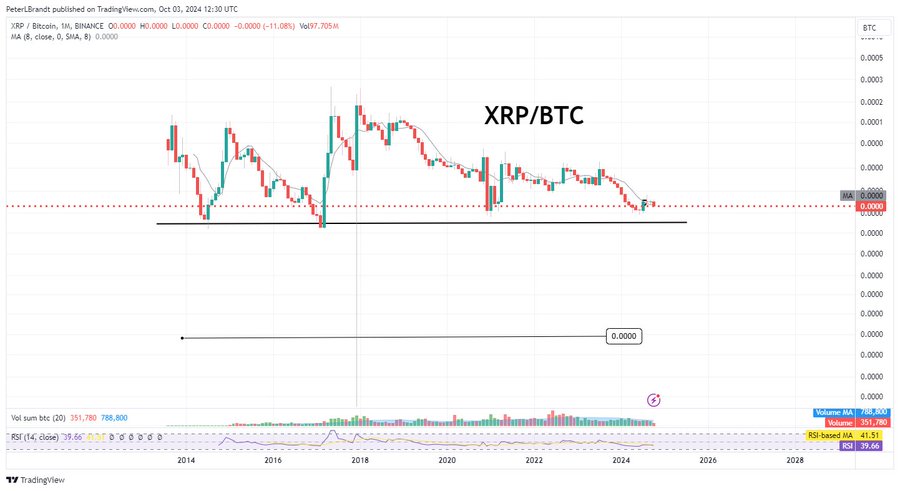
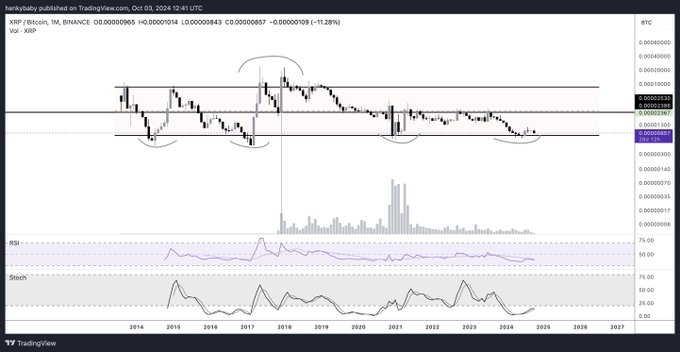
Known for his long-standing criticism of XRP, Brandt recently shared an XRP/BTC monthly chart highlighting what he called an 11-year complex head-and-shoulders (H&S) pattern. 

Brandt Pokes at XRP

Mockingly, Brandt argued that if this pattern completes, XRP could drop to zero against Bitcoin. He presented this following a major downturn after the SEC’s appeal notice in the Ripple lawsuit, which caused XRP to drop sharply.

Following reports of the appeal notice, XRP collapsed by 9.77% yesterday, and another 2.95% today. Overall, XRP is down 19.69% over the past four days. Despite the general downturn in the broader market, XRP’s sharper decline led to a 9.47% intraday crash in the XRP/BTC chart.

However, Brandt’s chart shows that the recent collapse led to XRP hitting a significant support level against BTC. Notably, this level has acted as a range low where the altcoin typically bounces back. If XRP respects this support, there is potential for another rebound. 

XRPBTC Peter Brandt
XRPBTC | Peter Brandt

The market has on multiple occasions tested the long-standing range between 0.00000857 BTC and higher resistance levels above 0.00002000 BTC. Amid the latest drop, XRP collapsed to a two-month low of 0.00000843 BTC today, but has since recovered, now trading at 0.00000863 BTC.

XRP’s ability to hold this range low suggests that the bearish outlook may not be as clear-cut as Brandt’s criticism implies. The veteran trader’s subsequent remarks on XRP’s price action confirmed this.

XRP Might be Setting up for a Bull Move

Notably, another seasoned trader responded to Brandt’s criticism, sharing a different view. This trader presented a similar XRP/BTC monthly chart but confirmed the strength of the support at the range low.

HTL-NL on X
HTL-NL on X

He pointed out that while Brandt may expect a collapse, XRP is currently sitting at a level where previous bounces occurred. The trader noted that XRP has consistently bounced from this range, with a “beautiful range” forming between the lows and highs over the years. 

Interestingly, Brandt agreed with the suggestion of a possible reversal. He affirmed that his earlier report was an attempt at riling up XRP enthusiasts, whom he has persistently criticized over the years.

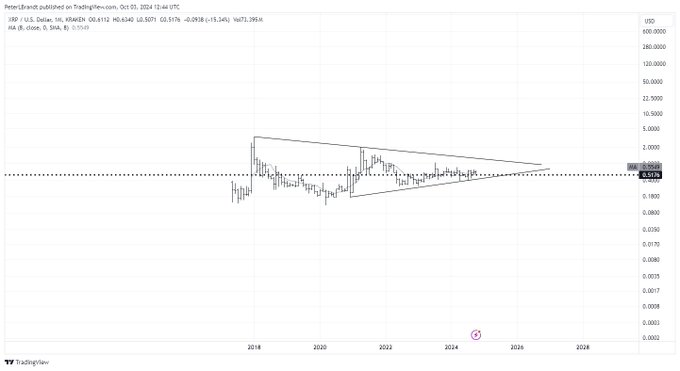
To support the bullish outlook, Brandt shared an XRP/USD monthly chart. Despite his critiques, the market veteran acknowledged the possibility of a bullish continuation triangle forming. 

XRPUSD Chart Peter Brandt
XRPUSD Chart | Peter Brandt

The chart highlights a symmetrical triangle that could lead to a breakout. As XRP/USD trades around $0.5176, it finds itself consolidating within the triangle, which formed in January 2018. Data shows that XRP is near the apex of this triangle, and a breakout may be imminent.

Major Resistance at 8 SMA

The XRP/USD chart also shows the 8-period SMA ($0.5560) acting as resistance, which XRP has struggled to break in recent months. XRP closed September above this moving average but has now dropped below it amid the recent crash.

However, if XRP manages to break above the new resistance level, it could trigger a significant bullish move, bolstered by the completion of the triangle. If the pattern plays out, XRP/USD could see a major upside, with the next resistance level at $1.00. 

Solana ‘Is Centralized,’ Says Bitcoin Pundit Edward Snowden, Citing Risks to Network Autonomy

0

Renowned Bitcoin pundit Edward Snowden boldly asserts that Solana “is centralized,” reigniting debates about the network’s design.

Speaking virtually at the Singapore Token 2049 conference, Snowden responded to a question on how blockchain networks could be designed from a “first principles” perspective to remain secure.

He pointed to Bitcoin’s design as a system built to withstand state intervention, in contrast to Solana, which he argued is at risk due to centralization. Snowden warned that Solana’s structure could easily fall under state control if governments chose to intervene.

His comments echoed previous critiques regarding Solana’s governance model. Crypto advocates have long expressed concerns about Solana’s centralization, with Snowden’s remarks amplifying the discussion. According to Snowden, if a network is not designed to resist government intervention from the ground up, it risks losing autonomy, as seen with platforms like Telegram. 

Other Centralization Concerns

The issue of centralization within Solana has been a focal point for critics for a while now. Stake with Pride, a well-known Cardano supporter, recently highlighted data that suggested over 73% of Solana validators comply with Know Your Customer (KYC) and Anti-Money Laundering (AML) requirements. This led to further questions about the extent of decentralization in Solana’s network. 

Furthermore, Stake with Pride pointed out that Solana’s validator program, driven by its Foundation, automatically subsidizes validators who follow predefined rules. This has led to comparisons between Solana’s structure and traditional banking systems, further fueling concerns about its centralization.

Solana Supporters’ Defence

In response to Snowden’s remarks, Mert Mumtaz, co-founder of Helius Labs and a strong advocate for Solana, challenged centralization claims. Mumtaz emphasized the need for factual evidence, pointing out that Snowden did not provide specific data to support his statements that “Solana is centralized.”

He argued that Solana’s network, with thousands of geographically distributed nodes across different jurisdictions, makes it resilient to centralized control. Mumtaz further noted that Solana’s decentralization is evolving, with multiple clients, such as Frankendancer, now live on the mainnet, ensuring that the system has no single point of failure.

Meanwhile, despite the ongoing debate, Solana continues to gain attention for its potential. Analysts like Jelle have recently expressed optimism about the network, suggesting it may soon break out of its consolidation phase to an all-time high despite the broader crypto market’s struggles.

Here’s How Much Your 10K XRP Would be Worth if XRP Hits $2, $6, $10 or $50

0

Investors holding just 10,000 XRP could experience substantial returns on their investments depending on XRP’s top price for the ongoing bull market.

The crypto market is currently witnessing a pause on the current bull run following rapid price surges from Q4 2023 to Q1 2024. Bitcoin (BTC), the largest crypto asset, clinched a new all-time high alongside a few altcoins. However, XRP failed to even breach the $1 level, facing resistance at $0.7440 in March.

XRP Accumulation Steadies

Despite the underwhelming performance, multiple market commentators believe XRP would not miss out on this bull phase despite concerns raised by veterans such as Raoul Pal. Amid this optimism, several bullish projections have sprung up. As a result, accumulation remains at a reasonable level, with shrimp addresses leading the charge.

Data from Rich List confirms that addresses holding between 10,000 and 25,000 XRP have surged to 150,541 at press time. Further, the XRP market now boasts about 284,567 addresses holding 10,000 XRP and more as optimistic investors sustain the accumulation push. 

According to Santiment, wallet addresses holding between 1,000 and 10,000 XRP have procured 30 million XRP since August, with their cumulative holdings now sitting at 1.95 billion tokens. Meanwhile, those with 10,000 to 100,000 XRP have purchased 120 million XRP within the same timeframe, now holding 6.97 billion tokens.

XRP Addresses Santiment
XRP Addresses | Santiment

Investors looking to enter the 10K club would have to spend $5,800 to procure the 10,000 XRP tokens. However, these assets would skyrocket in value if any of the price targets for XRP materializes.

Worth of 10K XRP at Varying Price Targets

Last November, market analyst EGRAG predicted that XRP could rally to $2 amid the formation of a “Steel Foundation.” Should XRP claim this $2 price, the 10,000 XRP tokens would grow to be worth $20,000, presenting returns of $14,200 for investors in this category.

Meanwhile, in April 2024, another analyst Mikybull spotlighted an imminent massive bullish XRP wave. Citing historical data, the market analyst argued that this wave could push XRP to $4. If this $4 price comes into play, the 10,000 XRP would appreciate in value to $40,000, yielding a profit of $34,200.

Interestingly, just three days ago, market commentator Cryptobilbuwoo also cited XRP’s historical data to project a possible XRP surge against Bitcoin. He believes this surge would possibly lead to a $6 price for XRP. At this $6 level, investors holding 10,000 XRP would see their holdings rise to $60,000.

In August, a pseudonymous analyst known as Spectre predicted that XRP might target $10 in this market cycle. A $10 price would put 10,000 XRP tokens at a worth of $100,000.

Despite the seemingly ambitious nature of the $10 prediction for this cycle, some market commentators believe it is an underestimate. For instance, Armando Pantoja projected three months back that XRP might be heading to a massive $20 price. If XRP hits $20, the 10,000 XRP would be worth $200,000.

Also, another market analyst Amonyx believes the $50 target is attainable for XRP. Notably, investors holding 10,000 tokens would be sitting on a whopping $500,000 if the $50 target materializes. Meanwhile, as discussions around a $100 price for XRP gains steam, this price level would put 10,000 XRP tokens at a worth of $1 million.

Top Lawyer Highlights 7 Key Insights About SEC Appeal Against Ripple 

0

Attorney Jeremy Hogan provides a critical analysis of the SEC’s decision to appeal the Ripple ruling.

As earlier reported, the SEC has revealed its intentions to appeal Judge Torres’ verdict in the Ripple case. Although the agency has not officially filed the appeal brief, there are speculations that the upcoming appeal would revolve around Judge Torres’ decision on Ripple’s programmatic sales and other distributions of XRP, which were deemed non-investment contracts. 

This speculation emanates from the fact that the regulator had attempted to overturn these decisions through an interlocutory appeal. While the judge denied this interlocutory appeal request at the time, there are indications that the SEC would resume its quest to overturn the decision in the Second Circuit. 

SEC Poor Risk Calculation 

In a recent analysis, Attorney Hogan characterized the SEC’s appeal decision as a “big mistake.” He said the securities regulator would likely appeal Judge Torres’ programmatic sales ruling. The lawyer mentioned that the SEC did not calculate the risk of appealing the Ripple ruling. 

He noted that the SEC could get Ripple to pay more fines if it wins the appeal. Conversely, the regulator risks destroying its ability to regulate cryptos should Ripple raise the “Blue Sky” argument and win. 

Consequently, the pro-XRP lawyer referred to the SEC’s appeal decision as a poor risk calculation, emphasizing that the regulator would make a poor stock trader. 

Right to Appeal

The lawyer stated that the SEC’s latest appeal notice differs from the previous attempt denied by Judge Torres. Hogan said this appeal is the SEC’s right. As a result, the trial judge cannot deny the request. 

High Likelihood of Losing 

In addition, Attorney Hogan stated that the SEC would likely lose the appeal, citing Judge Torres’ decision’s fact-heavy nature. It is noteworthy that Judge Torres issued the Ripple decision by applying the Howey Test to the case. 

For instance, the programmatic sales decision was based on the third factor of the test, which revolves around the expectation of profit derived from the efforts of others. 

The judge, who cited affidavits from over 3,000 XRP holders, noted that retail buyers of XRP did not expect to make profits by relying on Ripple’s efforts. 

It’s a Matter of Money 

Furthermore, the legal expert noted that even though the SEC wins the appeal, the impact would likely be limited to Ripple paying more money in fines. 

He contended that a favorable decision for the SEC would not change how Ripple uses XRP, adding that the regulator cannot appeal the non-security status of the token. 

Potential Timeline of Appeal Ruling 

Attorney Hogan predicted that the Second Circuit will not issue a final decision until late 2025 or early 2026. Although he previously speculated that the appeal ruling could be issued in Summer 2025, he admitted he was wrong. 

The lawyer argued that the SEC could file its actual appeal brief by mid-December, potentially revealing the issues it wishes to appeal. 

Resignation of SEC Enforcement Director  

The legal expert indicated that there might be a deeper connection between the resignation of SEC’s enforcement director, Gubir Grewal, and the commission’s appeal decision. Notably, the SEC filed its appeal notice in the Ripple case hours after Grewal announced plans to leave the commission.  

A similar pattern occurred during the initial filing of the Ripple lawsuit. At the time, Bill Hinman, the former SEC director who declared Ethereum (ETH) as a non-security, left the SEC less than two months before the commission charged Ripple with violating federal securities laws. Additionally, the SEC sued Ripple on the last day of former chairman Jay Clayton’s tenure. 

This coincidence has raised eyebrows among crypto proponents, with some, like Hogan, suggesting that there could be some deep connection between these events. 

What Could Bring an Early End to SEC Appeal 

While Hogan expects the appeal to be concluded by late 2025 or early 2026, he hinted that there is a likelihood the case could be finalized sooner. The lawyer highlighted factors like change in SEC leadership, with Donald Trump as president, could result in early resolution of the appeal. 

Several crypto proponents, including Ripple CLO Stuart Alderoty, have backed Trump, as they believe he would introduce favorable regulations for the industry. In the meantime, Ripple is considering whether to file a cross-appeal.