Home Blog Page 1384

Pundit Claims Hashdex Index ETF Will Buy 215K+ XRP for Every New 1,000 Shares, But There’s a Catch

Crypto commentator Chad Steingraber claims that the Hashdex Nasdaq Crypto Index ETF would purchase 215,854 XRP for every 1,000 new shares created.

The prominent XRP community figure recently made this bold statement on X, while discussing the latest crypto ETF developments. Steingraber’s comments have stirred quite a bit of discussion within the crypto community.

According to information from Hashdex’s website, the Hashdex Nasdaq Crypto Index ETF (HDEX.BH), which tracks the Nasdaq Crypto Index (NCI), contains a variety of cryptocurrencies with different weightings. Bitcoin holds the largest share at 64.33%, followed by Ethereum at 26.08%, Solana at 5.26%, and XRP at 1.48%.

Claims of XRP Purchase

The ETF currently has 79,579 shares outstanding, each valued at a net asset value (NAV) of $7,008. Based on the current price of XRP at approximately $0.4714 per token, each share holds about 215.85 XRP, worth around $101.7. This means XRP makes up 1.48% of the ETF’s holdings.

Steingraber claimed that at the rate of 215.85 XRP per share, the creation of 1,000 new shares would lead to the purchase of 215,854 XRP, regardless of the token’s price at the time. He emphasized that the fund’s supposed cash create model would require it to buy the underlying assets from the market when new shares are issued.

However, a closer examination reveals a crucial situation that Steingraber may have overlooked. The Hashdex Crypto Index ETF operates under an in-kind redemption model, not a cash create one. 

This means that instead of purchasing additional XRP from the market when new shares are created, the fund exchanges assets to create these new shares. This model helps maintain the fund’s balance without exerting additional market pressure by buying more XRP.

An Erroneous Conflation

Notably, Steingraber’s commentary conflated the existing Hashdex Nasdaq Crypto Index ETF with the soon-to-be-launched Hashdex Nasdaq Crypto Index US ETF. The US-based product, which the SEC recently acknowledged in its 19b-4 filing, follows a different structure and regulatory framework than its predecessor. 

For context, Hashdex introduced the existing Hashdex Nasdaq Crypto Index ETF in February 2021, launching it for trading on the Bermuda Stock Exchange. The product has been trading ever since, boasting a returns rate of 66.97% since launch. The product is up 93.60% over the last year.

The forthcoming Hashdex Nasdaq Crypto Index US ETF is expected to cater primarily to US citizens. Notably, while the fund does feature a cash create redemption model, it does not hold XRP or any other asset besides Bitcoin and Ethereum. 

Analyst Who Predicted Current Shiba Inu Drop Now Projects Upcoming Rally to $0.000059

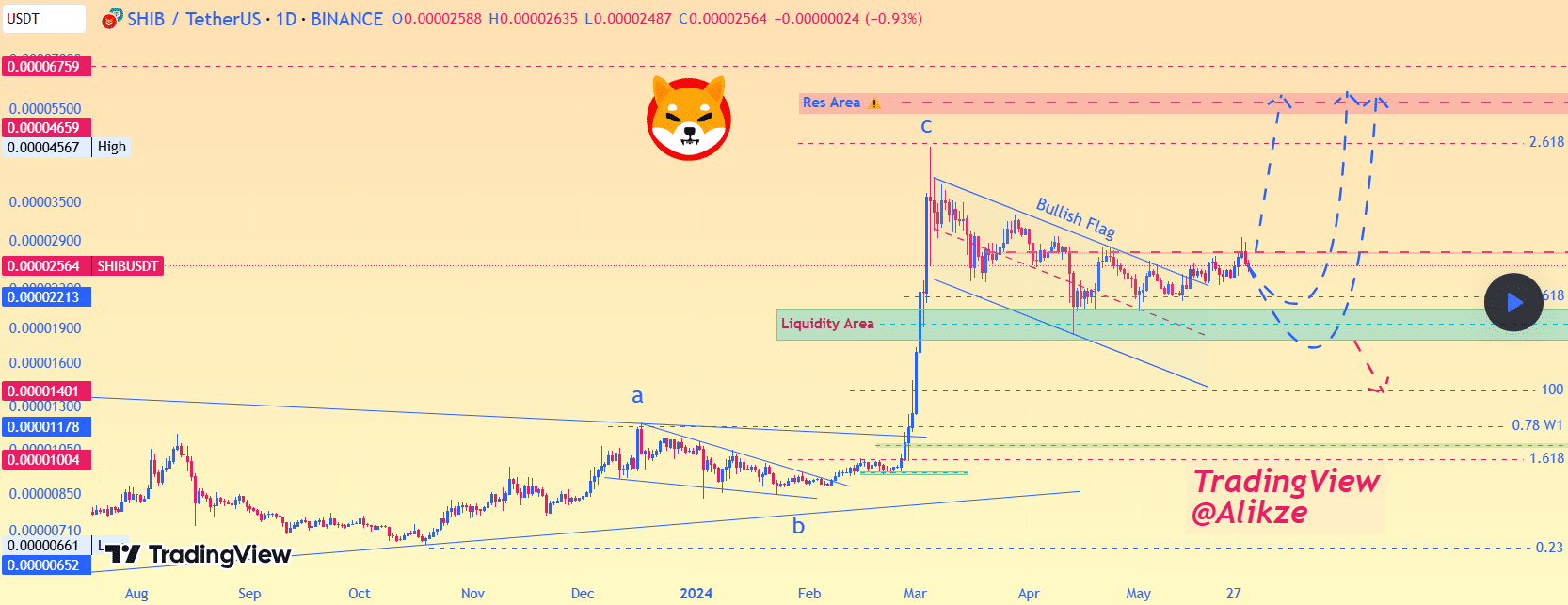
Alikze, a TradingView view analyst who accurately predicted the current Shiba Inu collapse, now projects an imminent upsurge to the $0.000059 price territory.

The market watcher first presented his analysis on May 31, when the downtrend was still in its infancy. At the time, Shiba Inu traded between a low of $0.00002487 and a peak of $0.00002635. During this period, SHIB held strong above the $0.00002 territory, still making attempts at retesting $0.00003.

While most commentaries then predicted a surge toward $0.00003, Alikze warned that SHIB would record steeper drops. He presented an ultimate target above $0.00005 but noted that the meme coin could take one of three paths to this level. 

Shiba Inu Daily Chart Alikze
Shiba Inu Daily Chart | Alikze

Shiba Inu Records Steep Declines

The first path could see Shiba Inu follow the path predicted by most analysts, laughing straight to $0.00005. In the second path, SHIB would retest a region between $0.00002084 and $0.00001786 and then skyrocket to $0.00005. He calls this region the liquidity area, marking a robust support level.

However, for the third path, Alikze predicted that Shiba Inu would reach the liquidity area and then breach below it. He predicted that if the support at the liquidity area breaks, SHIB could drop to $0.00001707. Notably, this scenario eventually played out.

Having ended June with a 32.13% collapse, Shiba Inu has broken below the liquidity area and now trades at $0.00001716. While Alikze expects an imminent recovery, he predicts steeper drops to the Fibonacci 100 area, aligning with $0.00004. He predicts this region to serve as the launchpad for greater heights.

A Potential Rally to $0.00005

When this rally eventually materializes, Alikze maintains his initial target of the $0.00005 territory. Specifically, he projects Shiba Inu to reach a price range of $0.00005387 to $0.00005937. The market commentator calls this area the resistance area. 

Notably, the last time SHIB saw this price was in November 2021, during its drop from the $0.00008845 all-time high. Market analyst Davie Satoshi also projects an imminent SHIB return to the $0.00005 price territory.

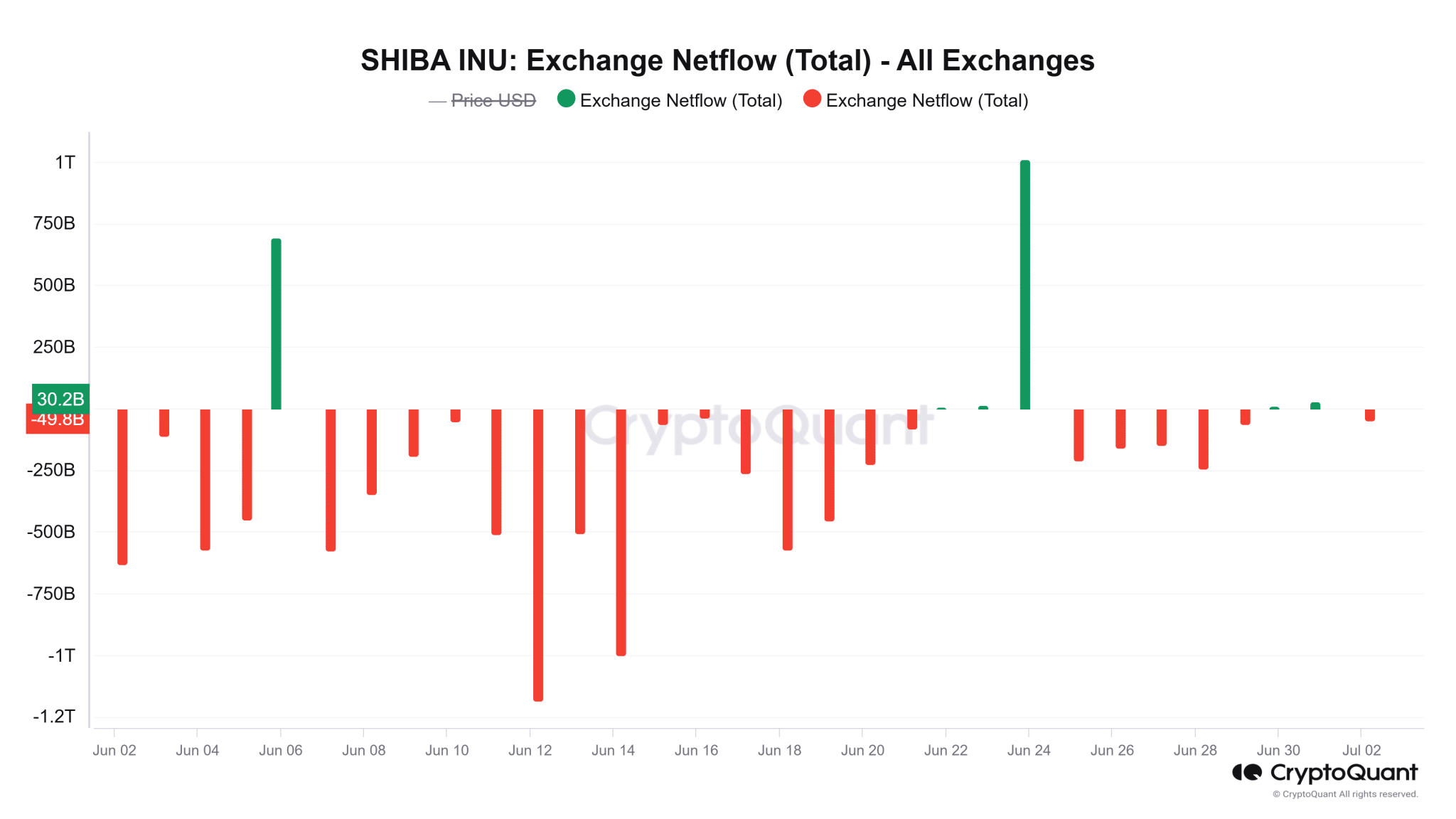
Shiba Inu could receive enough strength for such an upward push if the ongoing trend of exchange net outflows persist. CryptoQuant data shows that since June 2, SHIB has recorded 23 days of negative exchange flows. These outflows have exceeded 8.6 trillion Shiba Inu over the last month.

Shiba Inu Exchange Netflow CryptoQuant
Shiba Inu Exchange Netflow | CryptoQuant

Meanwhile, despite starting July with a mild increase, SHIB is now down 0.45% this month. However, with its RSI currently at 33.68, the token hovers around oversold territories. Santiment also confirmed this in a recent report, stressing that Shiba Inu’s MVRV has dropped to -1.5.

Crypto Payment Gateways Vs Traditional Payment Methods: Pros And Cons

0

In the world of finance, things change fast, and payment processing is key to the consumer experience and business efficiency. A crucial development in this sphere is the crypto payment gateway, a technology that facilitates transactions with cryptocurrencies. So, understanding the difference between crypto payment gateways and traditional payment methods is important.

Payment Gateways

A payment gateway is a technology used by merchants to accept debit/credit card payments from customers. The customer initiates a payment, the gateway encrypts the data, and the payment processor verifies the transaction with the customer’s bank. Traditional payment gateways have been the norm of e-commerce but cryptocurrency payment gateways are giving them a run for their money.

Traditional Payment Methods

Credit cards, debit cards, and bank transfers are the traditional methods. They’ve been around for so long because they’re convenient and widely accepted. When you use a credit card, you simultaneously involve multiple parties: the card network (like Visa or MasterCard), the acquiring bank, and the issuing bank. Each of these parties takes a fee, which adds to the cost for merchants and customers.

Pros:

  • Widespread: Accepted everywhere;
  • Secure: Credit card companies have fraud protection and chargebacks;
  • Easy: Established and familiar.

Cons:

  • More Money: More middlemen means more fees for you;
  • Slower: Settlement times can be longer, especially for international transactions;
  • Security Risks: Credit card info can be stolen, thus fraud and identity theft can happen.

Cryptocurrency Payment Gateways

Cryptocurrency payment gateways use digital currencies like Bitcoin, Ethereum, etc. Merchants can accept crypto payments and convert them to fiat if needed. A crypto payment gateway runs on blockchain technology; so, transactions are secure, transparent, and irreversible.

Pros:

  • Cheaper: Since there are fewer intermediaries involved, the charges are lower;
  • Fast: The selling and purchasing of crypto take a shorter time, regardless of the time zone or the geographic location;
  • Secure: Blockchain ensures high security;
  • Global: Accepted in every corner of the globe.

Cons:

  • Volatile: Conversion rates may fluctuate significantly;
  • Unregulated: The legal status of cryptocurrencies is not even around the world.
  • Limited: Not all merchants accept cryptocurrencies.

The Role of Digital Wallets

The two methods of payment, traditional and crypto, utilize digital wallets. A digital wallet securely stores payment information and passwords. And users can quickly access it to pay for products, goods, and services. Having a crypto wallet for a business, merchants can receive cryptocurrencies from users and win all the benefits of crypto payment gateways (cheap, fast, secure, and global transactions). Moreover, they can easily overcome the con of volatility since crypto wallets can instantly convert crypto into fiat.

Comparative Analysis

Transaction Speed

Cross-border transactions through traditional credit card options can take three to five working days to clear. Crypto payments, in contrast, take virtually no time to process on the blockchain network, which can offer a boost to the business on the operational cash flows.

Cost Efficiency

Intermediaries involved in the traditional payment methods also come with different fees that may be huge. Crypto payment gateways reduce these fees. Other monetary costs are lowered through such systems because there are no middlemen in crypto transactions.

Fraud Prevention

While generally protected, it is worth noting that the traditional payment system is at high risk of experiencing security vulnerabilities and fraud. Fraudulent credit card hacking and other related problems affect the customers’ data and information. However, blockchain technology, which can be applied to crypto payments, offers additional measures, such as encryption or decentralization, which make it more resistant to scams.

Global Reach

Traditional payment methods are constrained by geographical areas and banking systems. This is where cryptocurrencies stand above these shortcomings as they can be accepted as a form of payment by any individual with access to the Internet. They are useful, especially in the areas with little or no advanced form of banking to venture into.

Adoption and Market Trends

The acceptance of virtual currencies is on the rise, with consumers opting for innovative solutions and entrepreneurs embracing the blockchain. Business firms are beginning to see the benefit of effectively using crypto payment gateways: they facilitate payments and reduce transaction costs. Yet, there is still significant hesitation because the regulatory environment for crypto transactions is uneven and cryptocurrencies themselves are volatile.

Conclusion

A regular payment solution and a crypto-based payment gateway come with their respective strengths and weaknesses. Conventional approaches provide reliability and broad tolerance but possess higher latency costs with added security vulnerabilities. In contrast, crypto payment gateways offer relatively cheaper services, fast transactions, and increased security. At the same time, crypto is volatile, and compliance standards may be lacking in some regions.

Knowledge of the subtle differences in each type of payment option might prove useful for a variety of scenarios, from a business owner striving to get their settings perfect to an ordinary consumer who wants to learn how to protect their transaction with maximum efficiency.

Disclaimer: This article is provided by the Client. The Client is solely responsible for this page’s content, quality, accuracy, products, advertising, or other materials. Readers should conduct their own research before taking any actions related to the material available on this page. The Crypto Basic is not responsible for the accuracy of info and any damage or loss caused or alleged to be caused by the use of or reliance on any content, goods, or services mentioned in this article.

Please note that The Crypto Basic does not endorse or support any content or product on this page. We strongly advise readers to conduct their own research before acting on any information presented here and assume full responsibility for their decisions. This article should not be considered investment advice.


Bitcoin Price Forecast: Can BTC Reach $70k in July 2024?

Bitcoin’s price made a positive start to the week, soaring 5% within the daily timeframe to reach the $63,700 mark on July 1. Rising accumulation among bullish traders could propel BTC further upwards in the days ahead. 

Bitcoin price kicks off July with 5% Surge

The global crypto market was subject to intense volatility in June 2024. While buyers remained active, several bearish events, including the US Fed deciding against an H1 2024 interest rates cut and delays surrounding the Ethereum ETFs launch, have prevented the market from maintaining an upward momentum during the month.

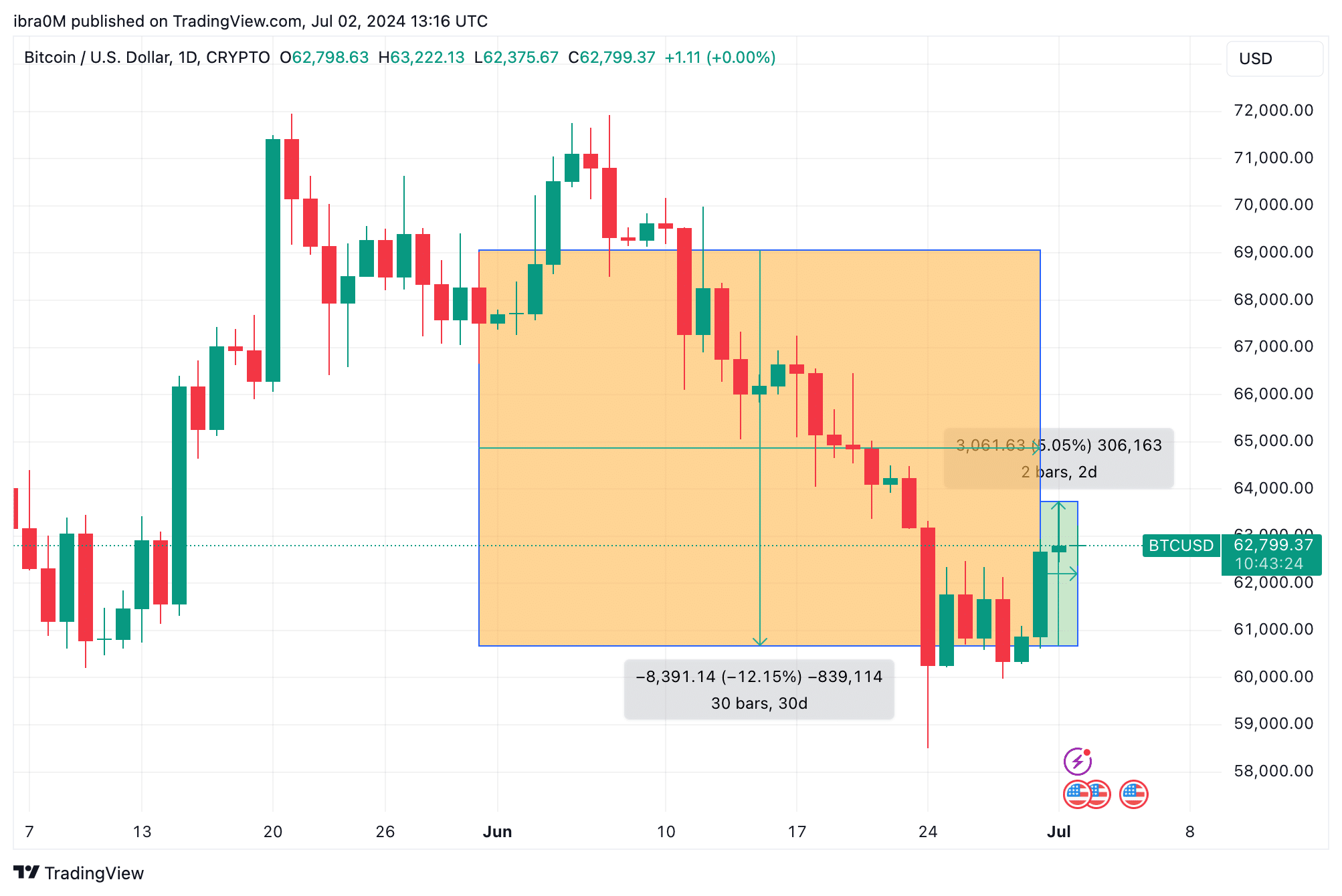
Bitcoin closed the June 2024 with loses in excess of 16% as it fell from $67,800 on June 1, to crash towards $60,600 on June 30. But since the start of July, BTC has flashed promising signals of a prolonged bullish phase.

Bitcoin price action | (BTC/USD) July 2024 | TradingView

The chart above shows how the BTC price closed in June 2024 with a 12.15% negative growth performance. But over the last 48 hours, Bitcoin bulls have swung into action, flipping the tide, and shot for a strong start to July.

Since June 30, Bitcoin price has now climbed 5% to reach the $62,800 level at the time of writing on Tuesday, June 2. With 3 consecutive green candles, Bitcoin pulls now appear to have seized control of BTC short-term market momentum.

However, looking beyond the price action, on-chain data suggest that the ongoing Bitcoin resurgence is being supported by persistent bullish activity among institutional investors.

Bitcoin Price Forecast: BTC Could Retest $70,000 in July

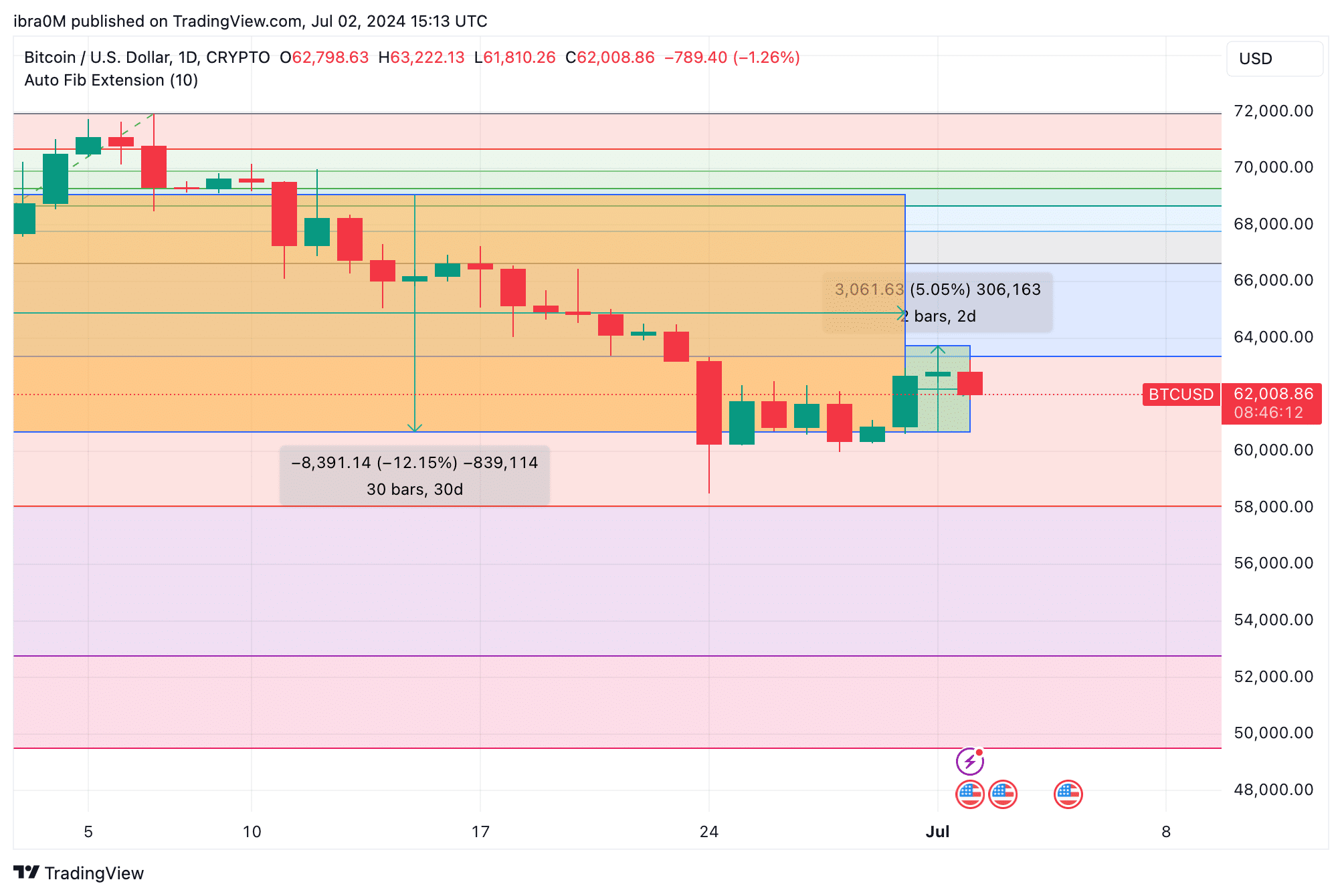
Since June 30, Bitcoin’s price has experienced a 5% increase, reaching approximately $62,800 by Tuesday, July 2. This recent upward momentum is captured in the Fibonacci retracement chart, which provides critical insights into potential future price movements. The Fibonacci levels indicate key resistance and support zones that traders should watch closely.

The immediate resistance for Bitcoin is identified between the $64,000 and $65,000 range, as highlighted by the Fibonacci extension levels. This area represents a significant hurdle that Bitcoin needs to overcome to continue its upward trajectory.

A successful breach above this level could set the stage for a retest of the next major resistance zone, around $68,000 to $70,000. This upper resistance is not only a key Fibonacci level but also a psychological barrier, marking a potential target for bullish investors in July.

Bitcoin Price Forecast | BTC/USD

On the support side, Bitcoin finds strong backing near the $60,000 level. This support level has historically acted as a crucial pivot point, preventing deeper declines during bearish phases.

The Fibonacci chart reinforces the significance of this support, indicating that if Bitcoin were to face selling pressure, the $60,000 level would likely serve as a critical floor. Further down, additional support is found around the $58,000 mark, providing another layer of defense against potential downturns.

Given the current market dynamics and the support from institutional investors, Bitcoin appears well-positioned to maintain its bullish momentum. If the price can break through the $64,000 to $65,000 resistance, it stands a strong chance of retesting the $70,000 level in July.

XRP ETP Launches on Nasdaq Stockholm Exchange

An XRP exchange-traded product (ETP) has launched on Nasdaq Stockholm, the premier stock exchange in the Nordic region.

In an official press statement on Tuesday, Swedish digital asset manager Virtune disclosed the debut of its Virtune XRP ETP on Nasdaq Stockholm. The Virtune XRP ETP aims to offer investors a way to tap into the performance of XRP, the seventh-biggest crypto project with a valuation of over $26.63 billion.

XRP ETP Starts Trading on Nasdaq Stockholm

The report noted that the newly launched XRP ETP is fully collateralized and 100% backed by physical XRP tokens. Virtune has partnered with leading U.S. exchange Coinbase to serve as the custodian of its XRP reserve.

Interestingly, this XRP investment product commences trading today, July 2, with the ticker VIRXRP. Catering to the Nordic market, it is denominated in Swedish kronor (SEK) and can be accessed through Avanza and Nordnet.

Notably, investors pay a 1.49% annual management fee. According to the press statement, the XRP ETP is accessible to retail and institutional investors through various banks and brokers.

With this launch, Virtune joins the growing list of asset managers, establishing investment products for XRP outside the United States. 

In February, European asset manager Valour launched an XRP ETP on the Nordic Growth Market. On the other hand, 21Shares has listed an XRP ETP for half a decade already.

XRP ETP Fulfils Demand for XRP Investment

In its announcement, Virtune spotlighted XRP’s unique value proposition as a crypto asset optimized for rapid and cost-effective cross-border payments. The company noted that XRP stands out from traditional banking systems by enabling transactions to be completed in seconds. 

Virtune acknowledged that this proposition makes XRP an attractive solution for multinational transfers. The Swedish firm also acknowledged that XRP benefits from a strong and devoted community alongside its backing from American fintech Ripple.

Reacting to the launch of the XRP ETP, Christopher Kock, CEO of Virtune, remarked that the new product meets the increasing demand from investors seeking a secure way to invest in XRP.

Robinhood Brings Shiba Inu to New Markets: Hawaii, Puerto Rico, and US Virgin Islands

0

Hawaii, Puerto Rico, and U.S. Virgin Islands residents can now trade Shiba Inu (SHIB) through Robinhood’s trading platform.

Robinhood revealed the development in an X post today, emphasizing that the move is part of efforts to extend its services across the United States.

Robinhood to Foster SHIB Adoption Via Expansion Plans 

With Robinhood’s trading service now available in Hawaii, Puerto Rico, and the U.S. Virgin Islands, crypto enthusiasts residing in these U.S. territories can buy and sell digital assets supported on the platform, including Shiba Inu. 

Robinhood’s expansion into the regions will further bolster Shiba Inu’s visibility and potentially drive the token’s mainstream adoption. This is not the first time that Robinhood has expanded Shiba Inu’s coverage across the United States. 

In October, the firm extended its crypto trading service to Nevada, enabling users to trade 15 crypto assets, including SHIB. Furthermore, Robinhood made SHIB, Compound (COMP), and Avalanche (AVAX) available to New York customers in April. 

Not relenting, Robinhood has extended its crypto trading service to more U.S. territories, such as the U.S. Virgin Islands, Hawaii, and Puerto Rico. Although Robinhood did not share specific details about the recent milestone, expanding into these regions requires the firm to obtain relevant licenses. 

SHIB Soars 1.07% Amid Robinhood’s Continuous Support 

At the time of writing, Shiba Inu is up 1.07% over the past 24 hours to $0.00001731. The gain aligns with Bitcoin’s (BTC) price action, which has witnessed a 24-hour increase of 0.76%. 

For context, Robinhood listed SHIB in April 2022 following immense pressure from Shiba Inu community members. Since then, Robinhood has been one of the avenues for hefty acquisitions of SHIB. In May, a crypto whale moved 1.75 trillion SHIB from Robinhood to an untagged blockchain wallet. 

Robinhood’s SHIB Holdings 

Meanwhile, Robinhood is currently among the top holders of Shiba Inu, with one of its wallets holding 33.95 trillion SHIB, equivalent to $588 million, making the wallet the fourth largest holder of the dog-themed token. 

Additionally, two other wallets affiliated with Robinhood hold 5.68 trillion and 4.8 trillion SHIB, respectively. Interestingly, these addresses are ranked among the top 20 largest holders of SHIB. 

Ripple Announces XRP Ledger Japan and Korea Fund Now Open for Applications 

0

RippleX, the development arm of Ripple, launches XRPL Japan and Korea Fund to boost innovation, support partnerships, startups, and community growth in the Japanese and Korean markets.

RippleX recently disclosed that the fund, which could bolster innovation within the XRP Ledger (XRPL) ecosystem across these Korean and Japanese markets, is now open for applications.

This fund aims to support various initiatives, including corporate collaborations, investments in startups, grants for developers, and community expansion. 


Fund Opens Doors

The newly launched fund is now accepting applications from businesses, developers, and community members. The initiative seeks to encourage the development and integration of XRPL-based solutions in Japan and Korea. 

The fund will provide financial backing and resources for corporate partnerships, startup investments, developer grants, and community-building efforts.

This could help accelerate fund aims to accelerate the adoption and utilization of the XRP Ledger in these regions. According to the announcement, RippleX’s support is expected to inspire new ideas and innovations leveraging the XRP Ledger’s capabilities. 

Ripple’s Global Expansion

This announcement follows another development by SBI Holdings, a Ripple partner. SBI has started minting non-fungible tokens (NFTs) on the XRPL for the 2025 World Expo in Osaka, Japan.

A total of 920 NFTs have been created as part of this initiative. This development is part of SBI’s plans announced six months ago to launch the “EXPO 2025 Digital Wallet NFT” service.

Emi Yoshikawa, Ripple’s VP for Strategic Initiatives, emphasized the progress and the ability to track the minting process in real-time through on-chain data.

In another notable development, Ripple recently expanded its collaboration with Archax, the first registered crypto exchange and custodian in the United Kingdom.

The objective of this extended partnership is to introduce a significant volume of tokenized real-world assets (RWAs) to the XRP Ledger by next year, with Ripple and Archax aiming for a substantial amount in tokenization.

Grok Comments on X Adopting XRP for Payments

Grok, the AI chatbot on Elon Musk’s social media platform X (formerly Twitter), has commented on the prospect of the platform adopting XRP or XLM for payment services. 

Speculation about the potential integration of crypto like XRP for payment services on X remains a hot topic within the community. Recently, Dubai-based crypto influencer Amelie posed a question to X’s in-house AI chatbot, Grok. 

Specifically, she inquired whether the platform would adopt XRP or its competitor Stellar (XLM) as a payment method. Amelie shared a screenshot of her interaction with the crypto community on X.

Grok Thinks XRP Has a Chance

The AI chatbot Grok responded by acknowledging the excitement and speculation surrounding the possibility of X adopting XRP or XLM for payments. Grok mentioned that it has picked up on hints and rumors suggesting that the platform might consider XRP for its payment feature. 

It even noted a rumor that Elon Musk has been “testing” XRP payments on the platform. According to the X chatbot, this would be quite a plot twist if true.

Meanwhile, Grok cautioned against jumping to conclusions about XRP’s potential integration. The AI tool pointed out that X has also been linked to XLM and that both cryptocurrencies share a common founder, Jed McCaleb, and similar goals in international payments.

Grok concluded that there is no clear answer yet regarding which direction X will take with its long-announced payment initiative. As a result, it suggested that the crypto community will have to wait and see how things unfold.

Clarifications

Notably, the reports of Musk allegedly testing XRP payments re-emerged two months ago when some community members pointed to an XRP wallet labeled ‘Musk’ with transactions with popular pro-XRP exchanges like Bitstamp and Uphold. 

This led to widespread speculation about whether X was indeed testing XRP for its payment initiative. However, this rumor has since been debunked, as anyone can choose any name for an XRP wallet, making the speculation unfounded.

Notably, if X were to adopt a cryptocurrency, Dogecoin would likely be more favorable in the eyes of Elon Musk than XRP and XLM. For instance, some goods at Tesla Shop are buyable with Dogecoin.

Currently X has already received payment license in 31 US states.

Here’s Why July May Bring a Big Decision for Ripple and XRP

0

Dizer Capital founder Yassin Mobarak highlights the significance of July for Ripple and XRP. 

The crypto enthusiast highlighted that two important legal rulings relating to XRP and Ripple were issued over the past two years, specifically in 2022 and 2023. 

In July 2022, Mobarak stated that Judge Sarah Netburn, one of the judges in the Ripple lawsuit, called out the SEC’s hypocrisy regarding the admissibility of William Hinman’s emails. Also, in July 2023, Judge Analisa Torres issued the highly anticipated summary judgment decision. 

Recall that the July 2023 decision gave the parties partial victory. While Ripple emerged victorious in the decisions relating to XRP’s legal status, programmatic sales, and other distributions of the coin, the court held that the company violated federal securities laws through its institutional sales.

Interestingly, the Dizer Capital founder said he was on overseas vacation when the judges issued both rulings, hinting at a humorous coincidence. 

Will SEC v. Ripple See Another Significant Ruling this July?  

Notably, he urged XRP enthusiasts to be optimistic, emphasizing that it is July again, and he is preparing for another overseas vacation by next week.  

“We are in July, and I’m going on an overseas vacation next week. You know what that means,” he remarked.  

The statement suggests that the court could issue another significant ruling this month based on the timing of other major decisions in the lawsuit and Mobarak’s vacation plans.

Parties Awaiting Final Judgment 

Meanwhile, the SEC and Ripple are currently awaiting the court’s final judgment. As reported earlier, the parties concluded the remedies brief in May.

While the SEC requested a nearly $2B fine for Ripple’s securities law violation, the company argued for a $10M penalty. Last month, Ripple filed a supplemental authority, citing the Terra settlement to support its argument for a lower penalty. 

Since the filing, the court has not provided any update. Nonetheless, top Ripple stakeholders are confident that the highly anticipated final verdict will be issued before year-end. Specifically, Ripple CEO Brad Garlinghouse speculated that Judge Torres might issue the decision before the end of summer 2024.

Possible Factor Delaying Final Judgment 

In May, prominent XRP community member Ashley Prosper identified the court’s decision on Ripple’s motion to exclude the declaration of one of SEC’s witnesses as the only factor standing in the way of the final verdict.

Recall that Ripple asked the court to exclude the declaration of Andrea Fox, a top-level SEC accountant. The company characterized Fox as an expert witness, stating that the SEC should have made her report available for deposition before the end of the remedies-related discovery. 

However, the SEC denied this claim, describing her as a summary witness who only summarized Ripple’s financial statements. 

The court is expected to decide on the matter at any time. It remains to be seen whether the court will issue this decision alongside the final judgment or schedule separate dates for both rulings. 

Cryptic Message Accompanies Ripple 1 Billion XRP Unlock

Ripple has unleashed 1 billion XRP from its escrow for July as scheduled, but this month’s escrow executions carried strange memos for community members.

The escrow transactions occurred late July 1 via the Ripple 24 and 25 wallets. Notably, the company unlocked the 1 billion tokens in bits, with one transaction bearing a 500 million XRP value, while two other transactions unlocked 400 million and 100 million XRP.

As is customary, Ripple has already returned 800 million XRP to escrow, with the leftover reserved for liquidation this month.

Cryptic Memo Follows Ripple Unlock

Interestingly, the July escrow transactions carried with them a mysteriously coded message that sparked the attention of community members. Blockchain architect Marty Party called attention to the development in a post on X.

The memo made subtle references to Ripple CEO Brad Garlinghouse and prominent community member Moon Lambo. While the exact meaning of the message remains unclear, it included a sarcastic remark suggesting that one-day “XRP will power the world.”

Although Marty Party suggested that a whale “unstaked” a large amount of XRP and left the cryptic message, it is important to clarify that this was actually Ripple’s scheduled escrow release for July. Additionally, the executor of the escrow release was not responsible for the memo.

Vet, an XRPL dUNL validator, clarified that anyone could create such memos because the escrow creator does not have to execute the “escrow finish” themselves. Furthermore, the author of the cryptic message confirmed that the memo did not originate from Ripple.

Similar Occurrences 

Notably, this isn’t the first time a mysterious message has accompanied Ripple’s escrow execution. A similar incident occurred during the May unlock. 

On that occasion, the author left a message directed at Bitcoin maximalists who frequently criticize XRP enthusiasts. It states that if XRP’s value were to surge, the maximalists could react with a dismissive, “Meh, meh, meh, wah, no XRP.”

Meanwhile, a more prominent case occurred in August, where the message, though still mysterious, carried a more relevant context concerning events within the XRP community. Essentially, Ripple’s monthly escrow unlocks have continuously been used as an avenue to pass cryptic messages to the crypto community.