Home Blog Page 1407

TD Sequential Flashes Shiba Inu Buy Signal After Retest of April Lows

The TD Sequential indicator has flashed a buy signal for Shiba Inu after consecutive days of collapsing price, suggesting a short-term price relief.

The crypto market bears have dealt Shiba Inu a significant blow for nearly two weeks. At press time, SHIB trades at $0.00002042, reflecting a 12% loss in its weekly performance and a more significant 16% crash from the value it sold for a month ago.

Moreover, the bearish pressure ultimately forced Shiba Inu to revisit the $0.000019 price channel. SHIB was last seen at this threshold during the severe price correction of April 13, which was influenced by the escalated global political crises. 

While Shiba Inu touched the bottom of $0.00001965 three days ago, it has only posted a 3.92% gain from this low, considering its current price of $0.00002042. Now, a crucial technical indicator suggests now might be the optimal time to buy SHIB.

Shiba Inu Buy Signal Emerges

In a recent post on X, prominent market watcher Ali Martinez revealed that Shiba Inu could be poised for a rebound. He cited that the TD Sequential indicator has shown a buy signal on the SHIB daily chart. 

At the time of the update, SHIB was trading at $0.00002077. Its current lower price suggests that the anticipated relief rally has yet to happen. As a result, today’s Shiba Inu investors may still have a good chance to profit from the expected rally.

Notably, the TD Sequential indicator has consistently proven to be a reliable predictor for Shiba Inu, with its suggestions frequently turning out to be accurate over the past few months. Martinez has highlighted numerous instances of these successful predictions in various updates.

What Price to Target?

However, for the recently issued buy signal, the analyst did not specify a price target for Shiba Inu enthusiasts to watch for.

Meanwhile, in a post seven weeks ago, Martinez argued that Shiba Inu was forming a bull flag on the 24-hour chart. Consequently, he disclosed that he would place a buy order for SHIB at $0.00001834. 

At that time, Shiba Inu was trading in the $0.000021 range, indicating that the recent dip to $0.00001965 was expected. The analyst noted that he was setting his buy order to capitalize on a bullish breakout that could send SHIB to $0.00007232.

Another Indicator Supporting SHIB Rebound

Notably, a Shiba Inu rebound is further supported by a recent report from The Crypto Basic, which reveals a decreasing number of SHIB tokens available for sale on centralized exchanges. This trend is accompanied by the continuous accumulation of SHIB by whales.

Hoskinson Predicts Cardano Growth Could Outpace Bitcoin Stability

0

Cardano founder Charles Hoskinson discusses Cardano’s flexibility, governance, and potential to surpass Bitcoin due to its adaptability and innovative approach.

In a recent YouTube video, Charles Hoskinson, the founder of Cardano, laid out his vision for why Cardano could eventually surpass Bitcoin. 

Hoskinson attributes this potential to Cardano’s flexibility, decentralization, and effective governance, comparing its adaptability to the rigidity of companies like BlackBerry, which failed to evolve and eventually became obsolete.

He also argues that the only value proposition Bitcoin has is because it’s big and successful. Last month, the Cardano founder asserted that Bitcoin cannot survive without the broader crypto market. He contended that BTC could be replaced by another “digital gold” with similar properties.

Flexibility and Governance as Key Differentiators

Hoskinson highlights Cardano’s ability to absorb new technology and adapt to changing competitive realities as a crucial factor in its potential success. He argues that while Bitcoin can be compared to gold, Cardano’s focus on first principles thinking, Edinburgh decentralization, measure decentralization, and on-chain governance sets it apart. 

The industry leader emphasizes that good governance is vital for long-term success, citing examples from the tech industry where poor governance led to the loss of market share for companies like Microsoft. Cardano’s approach, he believes, empowers individuals and communities to build and launch new projects, contributing to a thriving ecosystem.

Cardano’s Resilience and Upcoming Milestones

Hoskinson also addressed the skepticism surrounding the project recently, asserting that Cardano is here to stay amid widespread fear, uncertainty, and doubt (FUD). He pointed out the significant disconnect between Cardano’s actual progress and the portrayal by crypto influencers and the media. 

Notably, Cardano is on the brink of a major milestone with the upcoming Chang hard fork, scheduled for this quarter. This hard fork will usher in a new era of governance for Cardano, a result of years of rigorous testing and community participation. 

Additionally, the Cardano community is experiencing rapid growth in decentralized applications (dApps), indicating a thriving ecosystem gaining traction among developers and users.

Current Market Performance

Meanwhile, at press time, Cardano (ADA) is changing hands at $0.4128 amid a mild 0.32% gain over the past day. It also boasts a 24-hour trading volume of $185,782,743. However, over the past week, ADA has seen a 6.46% decline, with a current market cap of $14.6 billion, making it the 10th largest crypto asset.

In comparison, Bitcoin (BTC) is priced at $66,452.76, marking a 0.43% price increase in the last 24 hours and a -4.61% decline over the past week. BTC currently has a 24-hour trading volume of $14,426,845,233.53. Bitcoin’s market cap currently stands at $1,310,007,732,209. 

Top Ripple Lawyer Says SEC Has Abandoned Its $2B Demand

0

Stuart Alderoty calls attention to the SEC’s action in the Ripple case, indicating that the regulator appears to have abandoned its request for nearly $2 billion.   

The Ripple Chief Legal Officer (CLO) made this known in an X post over the weekend, emphasizing that the securities regulator has abandoned its ‘absurd’ demand of $2 billion. 

SEC’s Proposal in Ripple Case 

On March 22, the SEC requested nearly $2 billion in fines for Ripple’s violation of federal securities laws through the unregistered sales of XRP to institutional investors. The fine consists of a civil penalty of $876.3 million, disgorgement of $876.3 million, and a prejudgment interest of $198.15 million, totaling $1.95 billion. 

Although Ripple opposed the demand earlier, the crypto payments company recently leveraged the Consent Judgment in the TerraForm Labs’ (TFL) case to argue for a lower penalty of $10 million instead of the SEC’s proposed $2 billion. 

In the TFL lawsuit, the defendants agreed to pay a fine of over $4 billion, comprising a $420 million civil penalty and a $3.587 billion disgorgement. 

Consequently, Ripple claimed that the TFL’s civil penalty constitutes 1.27% of the company’s $33 billion gross sales, stating that the figure is significantly lower than the amount the SEC requested in its case. 

SEC’s $2B Could Drop to $1.1B 

However, the SEC faulted Ripple’s claims about TFL’s fine. It argued that the ratio between $420 million and $3.587 billion, as demanded in the TFL lawsuit, amounts to 11.7%. The SEC added that Ripple could pay a civil penalty of $102.6 million if it applies the same 11.7% ratio to the $876.3 million disgorgement it seeks. 

This representation could significantly reduce the SEC’s demand from nearly $2 billion to $1,177,050,000 ($1.17 billion). The figure includes $876.3 million in disgorgement, $198.15 million in prejudgment interest, and the newly proposed $102.6 million in civil penalty. 

Alderoty Addresses SEC’s Other Arguments  

Meanwhile, Alderoty addressed some arguments in the SEC’s latest brief. First, he pointed out that Ripple defended itself, agreeing to none of the SEC’s accusations.  

The Ripple CLO said the court gave XRP clarity, declaring the coin a non-security. Additionally, Alderoty noted that the Ripple case has no victims who need compensation. Lastly, he suggested that Ripple is still thriving despite being embroiled in the multi-year legal tussle. 

In the meantime, the parties are awaiting the court’s final verdict, which could be delivered at any moment. Nonetheless, Ripple CEO Brad Garlinghouse estimated that the court could issue the verdict before the end of summer 2024. 

Shiba Inu Poised to Claim $0.0001011 After Breakout from Bull Flag

0

Michael, a notable technical analyst in the crypto market, projects Shiba Inu to reach a $0.0001011 price target following a breakout from its multi-month bull flag.

The latest analysis from Michael comes when Shiba Inu is struggling to regain lost ground amid a broader market collapse. SHIB has continued to witness sustained declines since June 6 following a retest of the $0.00002622 price threshold that day. This is largely due to Bitcoin’s (BTC) downturn, which has impacted the rest of the market.

Shiba Inu Forms Bull Flag

However, when viewed from a larger perspective, Shiba Inu’s current downtrend extends beyond recent weeks. Notably, SHIB has been witnessing lower lows and lower highs on the weekly timeframe since it dropped from $0.000045 on March 5, data from Michael’s chart confirms. 

As a result, the charts indicate a sustained downward trend that has persisted for over three months. Interestingly, this downward trend appears to have resulted in the formation of a bull flag. The pole of the flag formed when SHIB spiked 370% to $0.000045 in March, while the flag itself has formed from the ongoing downtrend.

Such a market structure typically indicates a pause to the uptrend, resulting in bearish consolidation or downward trend for a period before the uptrend resumes. For Shiba Inu to continue its uptrend, it must break above the downward channel formed by the market turbulence. Michael expects this breakout to occur soon.

A $0.00010114 Price Target

Known for his use of Elliott Wave structures to discuss price movements, the analyst emphasized through his chart that SHIB is currently following a typical five-wave Elliott Wave pattern. According to him, Shiba Inu currently trades within the fourth wave, which usually features market declines.

Nonetheless, he expects the fifth wave to begin with a breakout from the downward channel over the next few weeks. Should this occur, Michael projects a $0.00010114 price as the ultimate target for when Shiba Inu completes Wave 5. This would mark a 398% increase from SHIB’s current value of $0.00002028.

At the current level, Shiba Inu’s ultimate goal is to retain the $0.00002 psychological support as it awaits a rebound from the broader market. A push below this support before such a rebound would only leave SHIB with more ground to cover on the path to the $0.00003 level when such a resurgence occurs. This reduces Shiba Inu’s chances of greater heights.

Nonetheless, SHIB witnessed a renewal of interest over the weekend, with the Accumulation/Distribution metric recovering from 12.67 trillion to 14.16 trillion SHIB on Sunday. In addition, Shiba Inu’s RSI, currently sitting at 34.89 suggests that there is room for much higher price appreciation.

BitBoy Names Top 10 ‘S-Tier’ Altcoins That Could Transform Investors’ Financial Status

0

Popular crypto influencer and YouTuber Ben Armstrong (a.k.a BitBoy) highlights the top 10 ‘S-Tier’ altcoins capable of transforming investors’ financial status. 

Top 10 S-Tier Altcoins 

In a recent YouTube video, Armstrong revealed the list of S-Tier altcoins, emphasizing that these assets could give investors massive gains in the upcoming bull run. 

Solana (SOL) 

Topping the list of S-Tier altcoins is Solana (SOL), the fifth-biggest cryptocurrency by market cap. The top influencer noted that SOL should be categorized as a ‘god-tier’ asset and encouraged investors to accumulate the coin at every crash. At press time, SOL is trading at $144, boasting a market cap of $66.58 billion. 

XRP (XRP) 

The second crypto on BitBoy’s S-Tier list is XRP. He speculated that XRP could witness a massive rally during this season’s bull run. With a market cap of $26.66 billion, XRP is the seventh-biggest cryptocurrency. The coin trades at $0.48 in the hours leading up to press time. 

Dogecoin (DOGE) 

BitBoy highlighted Dogecoin (DOGE) as the third asset in the S-Tier list. DOGE made the list due to its affiliation with Tesla founder Elon Musk and its potential integration as a payment method on X. Dogecoin ranks as the eighth-biggest cryptocurrency, boasting a market cap of $19.77 billion. The token changes hands at $0.1367 at press time. 

Near Protocol (NEAR) 

Near Protocol (NEAR) is the fourth altcoin on the list. BitBoy believes Near Protocol could be a ‘massive noisemaker’ in the crypto space this bull run. Currently, NEAR trades at $5.62, with a 24-hour trading volume of $283.3 million. It is ranked as the 18th biggest crypto on CoinMarketCap, with a market cap of $6.12 billion. 

Filecoin (FIL) 

Filecoin (FIL) made BitBoy’s S-Tier list as the fifth crypto asset. The influencer expects Filecoin’s price to spike tremendously this bull season due to the huge investments in the project and its dominance in the storage niche. Ranked as the 31st crypto asset, Filecoin has a market cap of $2.97 billion and a price of $5.27. 

Bittensor (TAO) 

BitBoy handpicked Bittensor (TAO) as the sixth S-Tier altcoin. TAO’s artificial intelligence functions made it suitable for the S-Tier ranking, according to BitBoy. Bittensor is ranked as the 47th biggest cryptocurrency, currently boasting a $2.13 billion market cap. It is trading at $307.97 at the time of writing. 

Dogwifhat (WIF) 

Popular Solana-based memecoin Dogwifhat (WIF) made BitBoy’s list of S-Tier altcoins. The influencer expects WIF to embark on a parabolic run that could push it to the top 10 cryptos by market cap. At press time, WIF ranks 42nd in the global crypto ranking with a market cap of $2.4 billion. 

Sui (SUI)  

According to BitBoy, Sui (SUI) is the eighth S-Tier altcoin. He characterized Sui as the ‘Apple of blockchains,’ speculating that the coin could perform extremely well in the bull run. Ranked as the 43rd biggest crypto on CoinMarketCap, SUI boasts a price of $0.9436 and a valuation of $2.28 billion. 

Sei (SEI) 

Sei (SEI) made it to the list as the ninth S-Tier asset. Like the aforementioned cryptos, BitBoy also has huge expectations for Sei. At press time, it was trading at $0.4207. SEI is the 64th largest crypto with a market capitalization of $1.28 billion. 

Ondo (ONDO)   

BitBoy’s 10th and last recommendation is Ondo (ONDO). The influencer believes that ONDO has great potential that could positively impact its performance this season. It is currently trading at $1.22 per coin. Ranked as the 54th biggest crypto, ONDO has a market cap of $1.7 billion. 

The Biggest Advantage To A Thriving Web3 Ecosystem Is A DAO-Centered Mindset

0

Web3 is going to change the digital world by moving from centralized systems to decentralized networks. This means more power to the user, more security and everything is more transparent.

One of the best things about Web3 is the rise of DAOs (Decentralized Autonomous Organizations). These DAOs align the community’s interests with the platform’s success, so the community is motivated and engaged to help the platform grow.

What is Decentralization

Decentralization is the core principle of blockchain technology which aims to create a secure and transparent system for digital transactions without a central authority like banks. This vision became a reality with Bitcoin, the first cryptocurrency, which proved a decentralized system could work.

As blockchain technology evolved decentralization became the key to Web3, the next generation of the internet. Web3 gives users control over their data and online identities, shifts power from big tech companies to individuals and communities. This solves problems like data privacy, censorship and the dominance of a few large corporations.

In simple terms decentralization means spreading out authority and decision making so no one entity is in control.

This makes the system more secure by removing single points of failure, more transparent since everyone can see and audit transactions and users have a say in how the platform is run.

In the world of blockchain and Web3 decentralization is more than just a technical feature; it’s about building fairer and more equal systems. By cutting out middlemen and empowering users, decentralized networks can create a more inclusive and participatory digital world where people have more control over their online lives.

Web3 Ecosystems

The Web3 ecosystem is a broad and constantly changing space with platforms like Ethereum, Polkadot and Solana leading the way.

Ethereum is known for its decentralized apps and smart contracts. It’s currently upgrading to Ethereum 2.0 to improve scalability and security with a new proof-of-stake system.

Polkadot stands out by allowing different blockchains to talk to each other and share information, balancing user input with effective governance. Solana is fast and low cost thanks to its Proof of History system and is already popular even though it’s not as decentralized as Ethereum or Polkadot.

Decentralization varies across these platforms. Ethereum has a large network of nodes and active developers but has scalability issues. Polkadot promotes network collaboration with strong governance.

Solana is fast and efficient even if that means less decentralization. At the other end of the spectrum are platforms like Bitcoin and some DAOs which are fully governed by the community with no central control.

Web3 is made up of many platforms each contributing to decentralization in their own way, so it’s a dynamic and varied space.

How Prom Shows the Benefits of a DAO-Centered Approach

Prom’s DAO is all about community control, no external influence, including the developers.

Here’s how it works: Community members submit proposals as smart contract addresses which include submission time, votes received and implementation status. Everything is transparent and trackable.

Once a proposal is submitted it’s stored in a dedicated contract. The community has 14 days to vote on it. If 20% or more of the members vote yes, the proposal is auto implemented. This is all automated, no one, not even the Prom developers can change or cancel proposals. Changes can only happen through new proposals that the community votes on, keeping the system decentralized and integrity intact.

This gives the community the ability to directly influence the direction of the platform. For example they can update the allow-list addresses of NFTs on the Prom Rental and Marketplace which is super important for security and relevance. But this also means the community must vote responsibly and consider the security risks and possibly get third party audits for big changes.

Prom’s DAO ensures all governance decisions are democratic and transparent, making the platform more resilient and adaptable. This gives members a sense of ownership and engagement, showing the benefits of a DAO centered model for a secure, transparent and community driven ecosystem.

The DAO Mindset

A Decentralized Autonomous Organization (DAO) is a new way to run things in the Web3 world. Instead of a central leader, DAOs are run by the community who make decisions together using tokens. Blockchain technology ensures everything is transparent, secure and decentralized so everyone has a say.

DAOs use smart contracts which are like self executing agreements on the blockchain. These contracts handle proposals, voting and implementing decisions so everything is clear and tamper proof. Members vote on various issues using tokens, spreading power across the community and eliminating the need for a central authority.

By giving decision making power and rewards to members, DAOs keep people engaged and benefit from the platform’s success. This setup creates a community working together towards common goals, innovation and resilience. And because DAOs are decentralized they avoid corruption and inefficiency making for a stronger organization.

DAOs are the embodiment of decentralization and community empowerment. They make governance more transparent and efficient and create motivated communities. DAOs is a blueprint for fairer more sustainable digital ecosystems.

Conclusion

The future of DAOs in Web3 is looking good and moving fast. We’ll see more advanced governance models and broader use beyond blockchain, in finance and real estate. Better UIs will make DAOs for everyone.

DAOs will change how organizations work by making everything transparent, secure and community driven. They’ll distribute power more fairly, less centralized control and more innovation and collaboration in Web3.

Platforms should adopt DAO models to tap into community wisdom and growth. This gives users a sense of ownership and aligns decisions with community.

Disclaimer: This article is provided by the Client. The Client is solely responsible for this page’s content, quality, accuracy, products, advertising, or other materials. Readers should conduct their own research before taking any actions related to the material available on this page. The Crypto Basic is not responsible for the accuracy of info and any damage or loss caused or alleged to be caused by the use of or reliance on any content, goods, or services mentioned in this article.

Please note that The Crypto Basic does not endorse or support any content or product on this page. We strongly advise readers to conduct their own research before acting on any information presented here and assume full responsibility for their decisions. This article should not be considered investment advice.


Solana Price Plunges to 30-Day Low: Here’s What SOL Traders Can Expect

Solana’s price tumbled to a 30-day bottom of $139 on Friday, June 14; on-chain analysis explores some of the key metrics that could trigger an SOL rebound phase in the days ahead. 

Solana Succumbs to More Downside After Hawkish US Fed Rate

Since the Ethereum ETF approval drew investors’ attention away from other competing Layer-1 projects in late-May, the likes of Solana (SOL), Avalanche (AVAX) and Cardano (ADA) have all struggled for traction.

However, despite Solana node validators’ best efforts to cool the selling pressure, the SOL price surrendered to even more downside this week after the US Fed rate pause decision dashed bullish investors’ hopes of a rate cut in H1 2024.

Solana price action (SOL/USD) | TradingView

As seen above  Solana price tumbled towards $139 on June 14, its lowest since May 13 2024. This underlines how Solana has struggled since Ethereum ETFs were approved by the United State Securities and Exchange Commission (SEC).

In early, June Solana node validators began to stake more SOL coins, in a bid to earn passive income amid the market downtrend and also slow down the selling pressure. However, the hawkish US Fed rate decision this week has negatively impacted SOL’s rebound prospect.

Solana Price Forecast: Traders Mount $120M LONG Positions as Bottom Nears

Solana’s price has fallen below the critical psychological support level at $140, but recent trends observed among speculative traders suggest that the SOL market bottom could be near.

After 30-days on the downward trajectory, Solana traders are now making strategic moves to anticipate the market bottom.

Coinglass’ Liquidation map chart compares the value of SOL LONG contracts against the active SHORT contracts listed across various derivatives trading platforms.

As shown below SOL Long traders have place active contracts worth $120 million around the current prices, in a bid to score outsized profits when spot prices begin to rise again.

Meanwhile, in comparison, the total active Short contracts currently stand at about $109 million. Effectively, this shows that LONG contracts have exceeded the SHORTs by over $10 million, signaling that bulls are making moves to seize control in the next market phase.

Solana price forecast | Liquidation Heatmap | TradingView

In terms of short-term support and resistance level, bulls are likely to face an imposing sell-wall at the $150 area. In indication of this, the chart shows that over $96 million worth of the active SHORT contracts have been placed at $150.54 level.

To avoid such large losses over, the majority of those traders could stage massive sell-offs and deploy stop-loss triggers as the SOL price approaches the $150 level in the days ahead, potentially slowing down the rebound phase.

But if bull can avoid that setback, the resulting short-squeeze could drive the rebound phase toward the $170 mark.

Conversely, in the event of a prolonged correction phase, Solana Bulls can count on the $130 level as the next major support cluster.

Litecoin Price Forecast: LTC Whales’ Avert $75 Reversal, Is $90 Rebound Next?

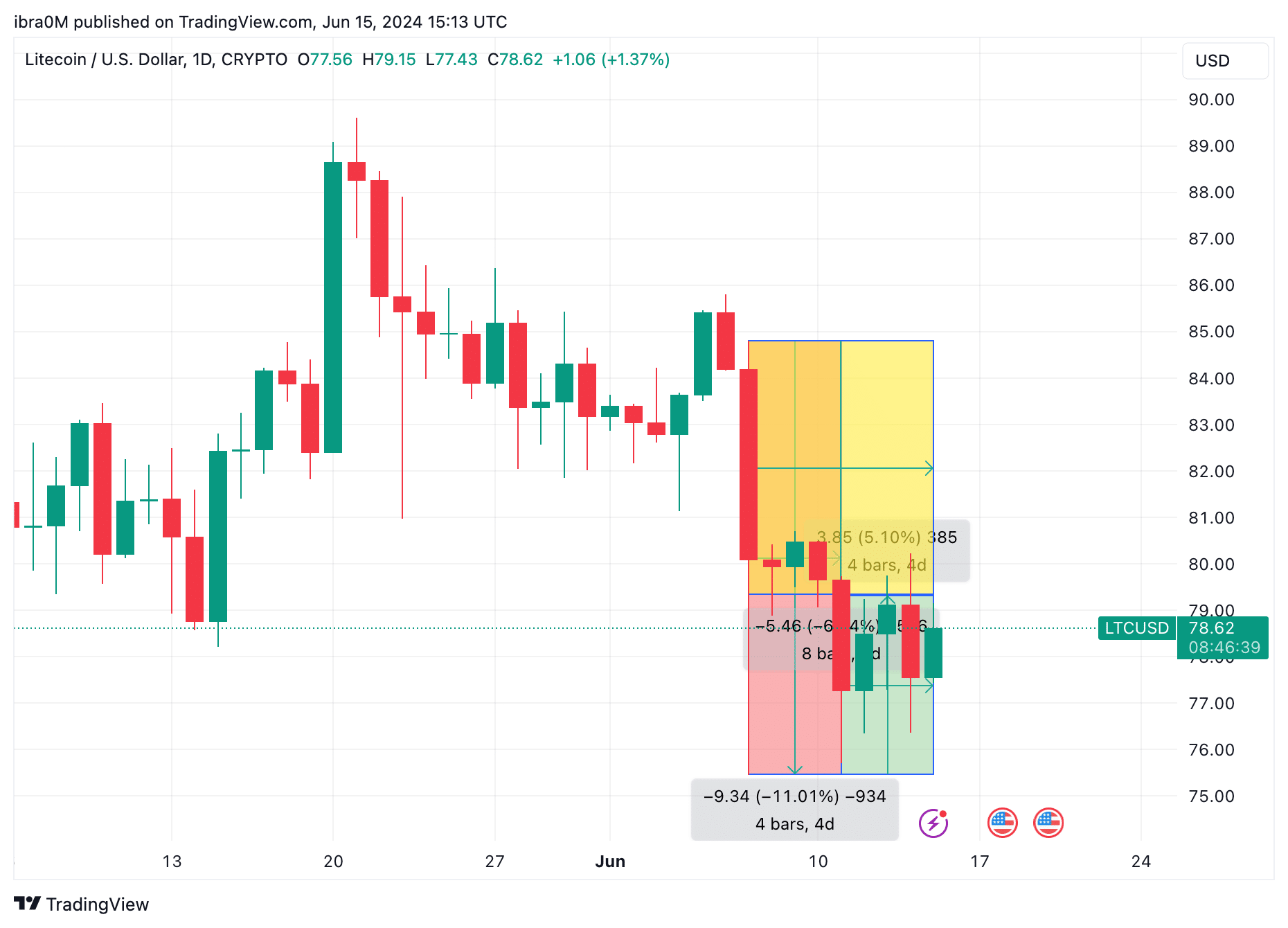
Litecoin price fell 8% within the weekly timeframe, reaching its lowest of $75.7 on Tuesday June 11, but recent trends observed among whale investors could spark an early rebound phase.

Litecoin price holds $75 Support Amid Intense Crypto Market Volatility

The crypto market has witnessed significant turbulence this week, amid hawkish macro economic indices reported by US authorities. But notably, Proof of Work (PoW) projects like Litecoin (LTC) and Bitcoin (BTC) have shown greater resilience this week, while the likes of Solana (SOL), and Ethereum (ETH) are battling double-digit losses.

Litecoin Price Action | LTC/USD | TradingView

Looking at the weekly price chart, LTC price had plunged into an 11% downswing by Tuesday June 11. But since then, bull traders have regained foothold, reversing more than half of those loses, by the end of trading on Friday, June 14.

At the time of writing on June 15, Litecoin is exchanging hands around $78.9, reflecting a 5.10% increase within the last 3 days which have been riddled with several bearish macro market catalysts.

Whale Investors Pushing for LTC Rebound Against all Odds

Over the last 3-days, the US Federal Reserve opted to hold interest rates unchanged, after the Bureau of Labor statistics published CPI reports showing slowing inflation. This event has triggered negative reaction among crypto investors. But despite these strong bearish headwinds, LTC price has managed to advance from the $75 resistance.

On-chain data analysis identifies Litecoin whale investors as the main drivers behind this resilient LTC price performance amid the intense market volatility.

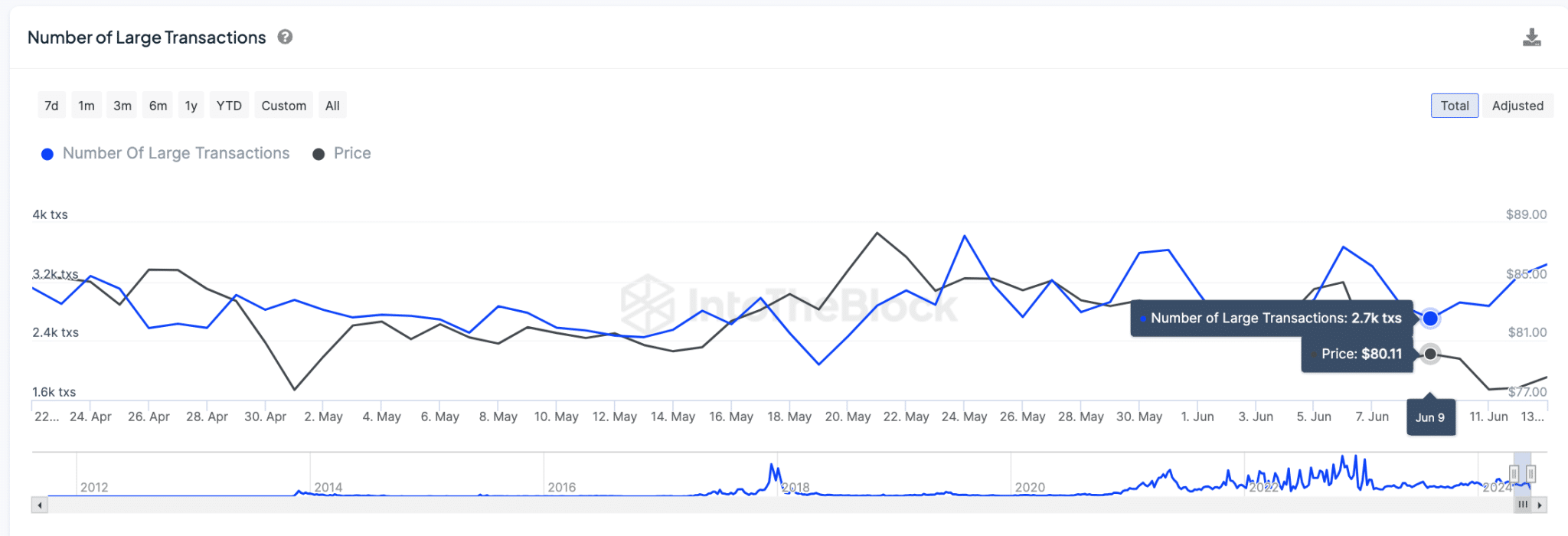
IntoTheBlock’s Large Transactions chart below tracks whale investors’ activity by counting daily number of transactions that exceed $100,000 in nominal value.

Litecoin price vs. LTC Large Transactions | IntoTheBlock

The spate of whale activity on the litecoin network has increased considerably over the past week. The chart above shows that as of June 9, LTC investors conducted only 2,700 transactions exceeding $100,000.

Interestingly, the figure has now skyrocketed to 3,430 large transactions recorded on at the close of June 14. This shows that there has been a 27% increase in whale demand for Litecoin over the past week.

Increased whale activity during market downtrends is often interpreted as a bullish price signal for a few reasons.

Firstly, the whales’ large volume purchases provides much needed market liquidity which helps panic sellers to exit without major price impact. More so, the whales buying trends also increases confidence among other investors.

Litecoin Price Forecast: $83 Resistance Looms Large

The 27% surge in whale demand explains why Litecoin price has posted a relatively more resilient performance compared to the like of Solana during the week. However, it remains to be seen if the LTC bull can generate sufficient momentum to break above the next critical resistance at $83 in the days ahead.

Litecoin price forecast | LTC/USD

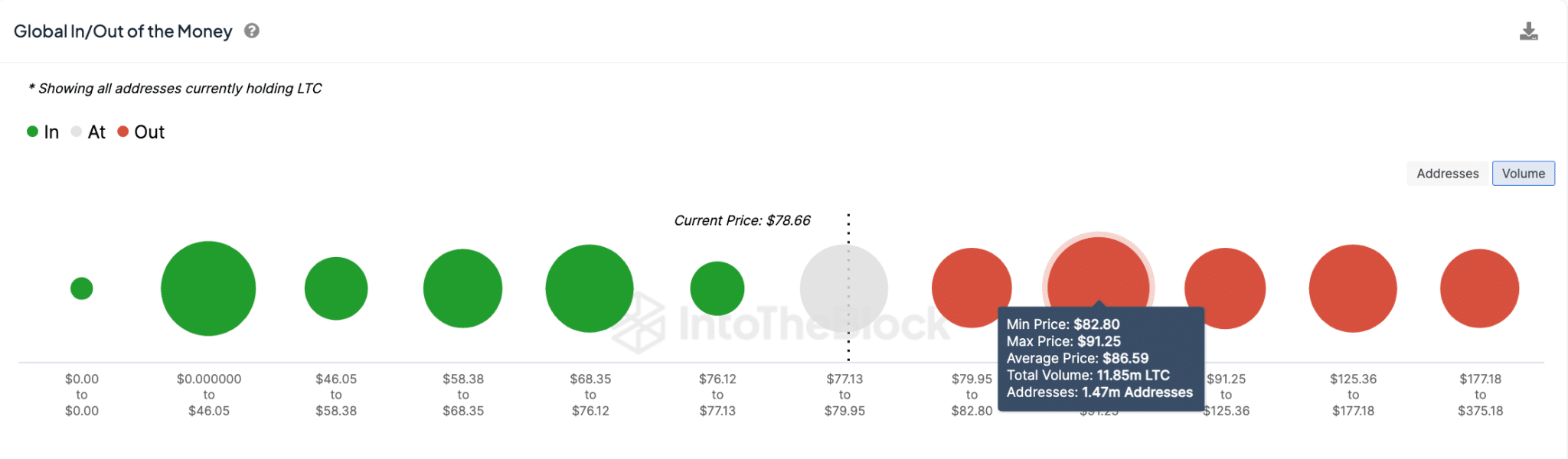
As depicted below, the over 1.47 million addresses had purchased 11.85 million LTC at the average price of $82.80. If majority of them opt to book profits early, Litecoin price could struggled to advance further.

Hence given the whales’ intent to defend the $75 support, LTC price is like to avoid major swings and rather consolidate around the $76 to $80 channel as the weekend unfolds.


Ethereum Price Forecast: Volatility Ahead amid Surge in ETH Sell Pressure

Ethereum price rapidly tumbled to a 25-day low of $3,428 on June 13, 2024, amid intense volatility in the wake of the US Fed rate pause announcement; on-chain data trends suggest more downside ahead.

Ethereum Price Falls Below $3,500 First Time Since ETF Approvals

The crypto market has been in a consolidation phase for the better part of the past month. During that period, ETH managed to outperform the market average thanks to bullish tailwinds from the ETF approval from the US SEC in late May.

However, three weeks after the official approval verdict, the fund sponsors are still stuck, making final adjustments to filings before the official market listing of the Ethereum ETFs.

After another week of little progress, with no tentative listing date in sight, investors now seem to be growing impatient. This led to a major price downswing on June 14, after the US Fed announced a hawkish rate pause, ending hopes of an H1 2024 cut as many bullish analysts had expected.

Ethereum Price Action (ETH/USD) | TradingView

As seen above ETH price fell 9.71% within the weekly time-frame, surrendering most of gains earned in the wake of the ETF approval. The chart shows that as ETH tumbling towards $3,362 on June 14, before rebound towards the $3,550 mark at the time of writing on Saturday June 15.

But notably, the last time ETH price traded below $3,400 was May 21, before the rally that greeted the de-facto ETH ETF approval news broken by the Bloomberg Analysts. This shows that the delays surround the ETFs official launch has adversely impacted demand for Ethereum this week, raising the risk of more price downside.

Selling Pressure from ETH Long-term Holders Rises 10%

Evidently, the recent Ethereum market demand is now in decline as bulls have grown fatigued amid the 3-week hiatus around the official ETH ETF launch.

However, looking at the on-chain data, recent activity among existing ETH holders shows the market volatility may not be over yet.

Santiment’s Mean Coin Age data tracks the average amount of days that all ETH coins in circulation have spent in their current addresses. A decline in Mean Coin Age occurs when a large number of long-term holders are actively selling, and vice versa.

Ethereum Mean Coin Age vs. ETH price | Santiment

The chart above illustrates how the ETH Mean Coin Age (365d) has been in a rapid decline since May 29, as it became evident that the Ethereum ETFs would take weeks to launch after the official SEC verdict on May 24.

Between May 29 and the time of publication on June 15, Ethereum’s mean coin age has declined 10% from 172.23 to 164 average days held.

Such a significant decline within a short period shows a growing selling trend among long-term Ethereum investors who had previously held their coins unmoved for one year or more. This suggests that they have been selling their coins behind the scenes, capitalizing on the price surge in the aftermath of the ETF approval.

With a significant number of coins locked-up for over year now is circulation again, ETH price is likely to experience more volatility in the days ahead.

Analysis at Frankfurt Stock Exchange Projects 20X Rally for XRP to $10

Recent chart analysis on the floor of the Frankfurt Stock Exchange in Germany suggests that XRP could soar by over 2,000% this year to $10.

This analysis was conducted by Oliver Michel, CEO of Tokentus Investment AG, during a recent interview with a Der Aktionär reporter. Specifically, the analysis focused on the potential performance of XRP in 2024 and why investors are hopeful. 

The correspondent sought clarification on the stark difference between the charts of Ethereum and Solana compared to XRP. Unlike the uptrends observable in Ethereum and Solana, XRP’s chart depicted falling candles.

In response, Michel explained that the XRP chart is in a monthly view, spanning from 2014 to June 2024. He acknowledged that XRP has shown little movement over the past year, hovering between $0.50 and $0.52.

Analyzing XRP 20X Potential

Meanwhile, Michel pointed out that from 2014 to early 2017, XRP formed a wedge pattern that led to an initial breakout of a whopping 4,300%. Remarkably, XRP traded as low as $0.006 in January 2017 but soared to $0.2522 by December, marking a 40-fold increase, as the CEO pointed out.

Michel further noted that XRP moved sideways for a few days before completing the breakout rally, which sent it to an all-time high of $3.84. He estimated that XRP’s trajectory from its bottom prices before the ATH represented an astonishing 39,700% increase.

According to the CEO, the widespread optimism in XRP is grounded in this historic performance. Specifically, he stated the community is hoping for this impressive percentage growth amid XRP’s current underperformance. 

Michel highlighted that the optimism stemmed from the observation that a similar bullish wedge has been forming over the years. “The pressure is building, and everyone is anticipating an upward breakout soon,” he remarked. 

XRP to $10 This Year

However, the analyst stated the breakout rally does not have to be a 40-fold increase like before. Michel noted that he would be satisfied with a 20-fold gain, where XRP reaches price levels of $8, $9, or $10 this year.

“That would be quite nice. It’s something to hope and wait for, and that’s what I’m doing,” he remarked.

XRP DROPZ, a prominent community-based account, highlighted this bullish analysis presented by the Tokentus Investment CEO at the Frankfurt Stock Exchange.


Notably, Michel is a well-known XRP bull, with his investment in the asset being public knowledge. In a previous analysis, the CEO boldly asserted that XRP has the potential to be a world reserve currency.