Home Blog Page 145

Cardano Founder Says Ripple Should Launch an XRP Buyback Model

0

Cardano founder Charles Hoskinson recently extended his criticism of Ripple’s XRP strategy during an interview on Paul Barron’s podcast.

Speaking with Barron, Hoskinson argued that XRP would become much more attractive if Ripple directly used part of its revenue to buy back XRP tokens.

Key Points

  • Charles Hoskinson said Ripple should dedicate 20% to 30% of revenue toward XRP buybacks to strengthen XRP’s market appeal.
  • Hoskinson says Ripple continues selling XRP while keeping financial gains within the company, with no rewards to holders.
  • Ripple has confirmed buying XRP on secondary markets since 2020, mainly to support On-Demand Liquidity expansion.
  • Hoskinson also criticized Ripple’s original XRP supply allocation, claiming it favored corporate control.

Cardano Founder Extends Ripple Criticisms

During the episode, Barron presented a question from a viewer about what Ripple might do for XRP utility if the Clarity Act becomes law. The individual asked whether Ripple would likely do nothing or whether the company could introduce measures such as XRP buybacks or revenue-sharing staking.

In response, Hoskinson said he does not expect Ripple to introduce a buyback system. He argued that Ripple will likely continue selling XRP, earning billions of dollars, and then using that money to buy hard assets through the company itself. 

According to Hoskinson, XRP holders do not benefit from ownership of those assets. The Cardano founder further claimed that Ripple’s pattern for more than 10 years has involved selling XRP while keeping the financial benefits within the company with products like RLUSD.

Hoskinson Calls for Direct XRP Buybacks

Notably, Barron pointed out that Ripple does reinvest money from XRP sales back into the XRP Ledger ecosystem. He suggested that this could still count as a meaningful investment in the broader XRP network.

Hoskinson acknowledged this, but argued that it is not enough. He said Ripple should directly connect its business profits to XRP through a buyback model. 

For perspective, the Cardano founder called attention to Hyperliquid, which he claims has used buybacks successfully to increase token value and improve investor appeal.

Hoskinson argued that if Ripple committed 20% to 30% of its earnings to XRP buybacks, its XRP relationship would become far more appealing. However, he claimed Ripple currently has no financial or legal reason to share that wealth with token holders. 

He also compared the situation to Block.One and EOS, highlighting how Block.One raised $4 billion but later stated that it had no fiduciary duty to EOS holders.

Ripple Has Confirmed XRP Purchases

However, it is important to note that Ripple has publicly confirmed purchasing XRP on the secondary market since at least 2020. Ripple disclosed these purchases in its XRP Markets Reports, mainly to support its growing On-Demand Liquidity (ODL) operations and maintain healthy market liquidity.

For instance, in Q1 2022, Ripple purchased $1.081 billion worth of XRP but reported net sales of $273.27 million. In Q2 2022, Ripple’s purchases rose to $1.717 billion, while ODL-related sales reached about $2.126 billion, producing net sales of $408.9 million.

By Q1 2023, Ripple reported XRP purchases totaling $2.569 billion, compared with $2.737 billion in Q4 2022. Meanwhile, Ripple recorded net sales of $361.06 million during Q1 2023, compared with $226.31 million in the previous quarter. 

Ripple consistently explained that these purchases help secure enough XRP supply for its growing payment business while limiting market disruption. However, they do not function as traditional corporate buybacks.

Previous Criticisms

Hoskinson’s recent comments build on criticisms he also shared earlier during an interview on The O Show. In the discussion, he pointed out that Ripple originally allocated between 70% and 80% of XRP’s total supply to itself at launch, giving the company major control over the asset.

He argued that Ripple’s large reserve position allows the company to sell XRP, generate cash, acquire assets, and grow its business. According to Hoskinson, XRP holders have no legal claim to the corporate assets or profits Ripple builds through those sales.

Hoskinson claimed this allows Ripple to benefit from XRP-driven momentum while holders only retain the token itself and access to the network. He compared Ripple’s model to Tether, where a centralized company takes in most economic value while token holders receive no direct share of company profits.
XRP OI Z-Score Flattens to Levels Before the 580% Surge to $3.4

The XRP Open Interest Z-Score on Binance has now flattened below the zero mark amid a decline in derivatives activity.

Interestingly, historical data indicates that when this metric dropped so low in late 2024, what followed was an impressive 580% spike from $0.5 in November 2024 to the January 2025 high of $3.4. Could XRP replicate a similar upward push this time?

Key Points

  • The XRP Open Interest Z-Score on Binance recently dropped below the 0 mark, reaching a negative value.
  • When the metric collapsed below 0 in late 2024, what followed was an impressive price surge.
  • During this period, XRP rallied 580% from $0.5 in November 2024 to $3.4 by January 2025.
  • A similar gain from the current price of $1.39 would push XRP above $9.
  • While the OI Z-Score dropped to lower levels earlier in the year, an upward surge did not follow.

XRP Open Interest Z-Score Flattens on Binance

Market commentator Greg Miller called attention to the recent decline, citing data provided by CryptoQuant’s Arab Chain. Specifically, data confirms that by April 25, the XRP Open Interest Z-Score on Binance had dropped to -0.16 over the last 30 days, sustaining a trend of negative values that began the previous day. 

XRP Open Interest Z-Score on Binance CryptoQuant
XRP Open Interest Z-Score on Binance | CryptoQuant

For the uninitiated, a drop in the XRP Open Interest Z-Score on Binance means open interest has fallen below its normal range on the world’s largest crypto trading platform, showing that fewer leveraged positions are active. This usually comes from traders closing positions and reducing risk.

“Speculation is washed out. Leverage is gone. The market is reset,” Miller said, speaking on the recent development. According to him, phases like this tend to lead to the start of a new trend.

Notably, when the metric drops to such lows, confirming a period of de-risking among traders, it can lead to a “reset” as the market becomes more neutral and prepares for the next phase. This typically gives the market a chance to trigger renewed bullish momentum if there’s enough buying pressure.

Historical Data

Miller cited historical data to prove his point. Specifically, he pointed out that when the XRP derivatives market witnessed a similar compression on Binance, the XRP price rallied from $0.5 to $3.40.

For context, this trend played out between late 2024 and early 2025. Notably, at the start of November 2024, the XRP Open Interest Z-Score on Binance started recording an observable decline. The metric collapsed to -0.27 on Nov. 3, 2024, and then dropped further to -0.58 the next day. During this period, the XRP price stood at $0.50.

Interestingly, this coincided with President Donald Trump’s victory in the U.S. election, which resulted in renewed interest among traders. The OI Z-Score picked up shortly after, alongside an XRP price spike. By January 2025, the XRP price had soared to a high of $3.4, representing a 580% increase from the $0.50 level in November 2024.

Could Another XRP Rally Play Out?

Currently, XRP changes hands at around $1.39 after pulling back from the $1.43 high. To put things into perspective, a similar 580% increase from the current levels would push XRP’s price to $9.4, marking a new all-time high. 

However, this remains highly speculative at press time. There’s no guarantee that XRP would see another upward push this time, as multiple factors beyond the low OI Z-Score would have to align for such a rally. Notably, the metric dropped to lower levels in late January 2026, but XRP lacked the necessary buying pressure to stage a rally.

Cardano Is the Only Blockchain Mirroring Bank-Grade Identity Systems With Bitcoin Design — CEO

0

Cardano Foundation CEO Frederik Gregaard argues that Cardano leverages architectural principles pioneered by Bitcoin to replicate identity systems used by banks.

Speaking during an interview at Paris Blockchain Week, Gregaard emphasized that Cardano is actively carving out a distinct role by aligning with the same architectural principles that underpin modern banking systems.

Key Points

  • Cardano Foundation CEO Frederik Gregaard stated that Cardano borrowed Bitcoin’s security architecture to deliver identity systems used by banks.
  • He claimed that this approach makes Cardano the only blockchain that mirrors banking identity and verification structures.
  • He suggests that leveraging and enhancing aspects of Bitcoin’s architecture gives Cardano an advantage in areas where BTC’s design is more limited.
  • While Bitcoin is known as a store of value, Gregaard stresses that Cardano supports broader applications such as metadata management, finance, and digital identity.

“Cardano Is Only Blockchain Mirroring Banks’ Identity System”

Gregaard explains that Cardano builds on Bitcoin’s proven security model while moving beyond its core function as a store of value. Notably, Bitcoin’s success lies in its simplicity, trust, and its decentralized, highly secure system.

According to Gregaard, Cardano leverages aspects of Bitcoin’s architecture and extends them into an identity framework. Gregaard draws parallels to systems like the Legal Entity Identifier, which banks use globally to verify and identify institutions.

By integrating similar identity frameworks, Cardano introduces a layer of verifiable identity directly into blockchain transactions. As a result, Cardano does not merely adopt Bitcoin’s design; it expands it.

Gregaard argues that Cardano is the only blockchain actively mirroring the identity and verification structures used in today’s banking system.

Having the Best of Both Worlds on Cardano

Gregaard further argues that combining Bitcoin’s security with enhanced identity capabilities gives Cardano “the best of both worlds.”

While Bitcoin serves as a store of value and digital currency, Cardano broadens its scope significantly. In particular, he stressed that Cardano focuses on multi-purpose utility, including identity systems, metadata layers, and diverse real-world applications.

Consequently, the network can support sectors such as finance and digital identity, areas where Bitcoin’s design remains less flexible.

Potential Implications for Cardano

Cardano has historically lagged behind platforms like Ethereum and Solana in institutional adoption. However, by aligning with established banking frameworks such as the Legal Entity Identifier, Cardano could strengthen its position and potentially drive greater institutional interest.

The $606 Million Problem: Why DeFi’s Security Crisis Is Crypto’s Biggest Obstacle to Mass Adoption

0

April 2026 has been a brutal month for decentralized finance. More than $606 million was stolen from crypto protocols in just 18 days, the worst run of losses since the Bybit breach in February 2025. Two attacks alone, the Drift Protocol exploit and the KelpDAO breach, accounted for nearly all of it. And the month wasn’t even over.

For anyone who follows crypto closely, the headline numbers are shocking enough. But the more alarming signal is the trend beneath them. Attack frequency is up 68% year-over-year, with 47 separate DeFi incidents recorded in the first four and a half months of 2026. That’s not a bad streak. That’s a structural problem.

Hackers Are Getting Smarter

What’s changed isn’t just the scale. It’s the sophistication. Early DeFi exploits typically targeted obvious smart contract bugs. Auditors adapted, code reviews improved, and the industry told itself the problem was being solved.

It wasn’t. Attackers have pivoted. The new wave of exploits cuts across infrastructure attacks, compromised signing keys, and AI-driven social engineering campaigns, including attacks on wallet interfaces that no amount of smart contract auditing can prevent. The KelpDAO hack is a case in point: the contracts themselves were never broken. The attacker compromised the off-chain verification layer that the bridge relied on, a threat that sat entirely outside the scope of any audit the project had run.

The attack surface has expanded faster than the defenses. With DeFi’s total value locked now exceeding $120 billion and cross-chain bridge infrastructure proliferating across dozens of networks, there are more entry points than ever.

Technical audits are still necessary. They’re just no longer sufficient.

The Trust Deficit Is Real

Hacks don’t just drain liquidity. They drain confidence. Every major exploit resets the clock on mainstream adoption, reinforcing the perception that crypto is too risky, too complex, and too unforgiving for ordinary users.

That perception isn’t entirely unfair. DeFi, by design, places full responsibility on the user. There are no chargebacks, no fraud protection teams, no account recovery flows. When something goes wrong, and in April 2026 things went very wrong, there is no safety net.

The downstream effects of a single exploit can be enormous. Following the KelpDAO breach, Aave alone experienced $8.45 billion in outflows over 48 hours, as broader DeFi TVL collapsed into the mid-$80 billion range. Ledger’s head of security put it bluntly: “2026 will most likely be the worst year in terms of hacks, again.”

This is the core tension the industry needs to reckon with: decentralization is crypto’s greatest strength, and in the hands of bad actors, it’s also its greatest liability.

Not All Crypto Carries the Same Risk

Here’s what often gets lost in the post-hack news cycle: DeFi is one part of the crypto ecosystem, not the whole of it.

There’s a meaningful difference between locking assets into an unaudited yield protocol and simply using crypto as a payment method. A crypto card, for example, lets users spend Bitcoin or stablecoins at everyday merchants without touching smart contracts, without bridging assets across chains, and without exposing funds to the attack vectors that have defined April’s carnage. The transaction happens at the Visa network layer. The exploit risk that brought down KelpDAO simply doesn’t apply.

This distinction matters enormously for the adoption conversation. The barriers to everyday crypto use don’t need to be DeFi’s barriers. Spending crypto shouldn’t require understanding liquidity pools, signing infrastructure, or bridge mechanics. It should feel like using a card, because it can.

Regulation Is Coming, Ready or Not

Against this backdrop, regulators are paying close attention. On April 21, SEC Chair Paul Atkins announced that the agency is on the cusp of releasing an “innovation exemption” allowing tokenized securities to trade on-chain for the first time in a compliant framework. This follows a joint SEC-CFTC token taxonomy published in March 2026, which classified most crypto assets as outside securities law entirely.

The direction of travel is toward legitimacy, but legitimacy comes with expectations around user protection that much of DeFi currently cannot meet. Jefferies has already warned that the string of high-profile hacks could temporarily slow Wall Street’s appetite for DeFi tokenization projects, even as institutional money continues to arrive.

The Path Forward

The DeFi security crisis is real, and it won’t be solved quickly. But it also doesn’t have to be the defining story of crypto’s relationship with mainstream users.

The industry has mature, battle-tested infrastructure that lets people hold, earn, and spend cryptocurrency without stepping anywhere near the vulnerabilities that dominate April’s headlines. The work now is making that infrastructure visible, and making it clear that “crypto” and “DeFi exploit risk” are not synonyms.

Mass adoption won’t come through protocols that lose half a billion dollars in a fortnight. It will come through products ordinary people can trust with their money. That bar is achievable. The question is whether the industry is willing to clearly separate what’s ready from what isn’t.

XRP Eyes $13 Price as Analyst Maps $0.90 Bear Market Floor From Multi-Year Pattern

Analyst Ali Martinez has pointed to a long-term structure forming on XRP monthly chart, suggesting the asset could be preparing for a double-digit price run.

The bullish outlook comes as XRP continues to hold around $1.42, losing over 1.1% of its earlier gains.

Key Points

  • XRP could target $13, as a multi-year ascending triangle signals strong long-term breakout potential.
  • Analyst Ali Martinez identifies $0.90 as a key bear market floor before any sustained rally begins.
  • Short-term downside risk remains, with XRP dropping before building momentum for a larger move.
  • Rare “Bull Switch” signal reappears, which has historically led to major rallies in 2017, 2021, and 2025.

Road to $13 XRP

According to Martinez, XRP has been trading within a massive ascending triangle that has developed over several years. This pattern shows a rising support trendline and a strong resistance zone near previous highs.

Based on this structure, he identifies a bear market bottom under $1, where the price could find strong support before any major move higher.

On the upside, the same formation projects a long-term breakout target of around $13. From today’s price, XRP holders are looking at a price surge of over 9x.

Short-Term Risk Before a Bigger Move

Despite the bullish long-term outlook, the analysis suggests XRP may still face near-term downside pressure. Specifically, Martinez stated that XRP’s price could drop toward the $0.90 zone before any sustained rally begins. He considers this level a potential bottom for the next upward wave.

At the time of analysis, XRP is trading around $1.43, with a 5% gain over the past month. While the $2 and $3.32 regions remain key barriers, Martinez’s chart shows that a strong momentum may easily overcome these resistance levels and establish a new peak in the double-digit range.

ImageCommenting on the analysis, popular XRP market watcher ChartNerd approved it, saying it makes logical sense for XRP’s path. He has repeatedly argued that XRP’s price could fall to the $0.70–$1 range before the next major leg up.

Other Technical Patterns Calling for $10+ XRP

Meanwhile, in a recent separate statement, ChartNerd highlighted additional technical structures that make a bullish case for XRP’s price.

Specifically, he said a rare XRP signal called the “Bull Switch” has reappeared. He noted that it has only shown up three times in 13 years, each followed by a major rally in 2017, 2021, and 2025.

The pattern typically marks a shift from bearish to bullish momentum after long consolidation phases. With XRP recently recovering from a drop between $3.66 and $1.11, the signal suggests a possible new uptrend. It indicates that XRP may be preparing for another breakout.

However, unlike Martinez, ChartNerd did not provide a short-term price target for XRP based on this technical observation.

In another analysis, EGRAG argued that XRP remains within its long-term “Bifrost Bridge” channel dating back to 2014, keeping the broader uptrend intact despite recent declines. He insists XRP can reach a $13 target, which aligns with Martinez’s projection.

Bitcoin Rally Driven by Futures, Not Real Demand — CryptoQuant CEO Warns of Fragile Structure

Bitcoin is pushing higher, but fresh data suggests the rally may not be as strong as it appears beneath the surface.

According to Ki Young Ju, CEO of CryptoQuant, the current market move is driven by derivatives activity rather than genuine buying demand in the spot market.

For context, Bitcoin’s price reached $79,488 today, one of its highest levels in two months, and is currently trading at $78,223. While the ongoing price action is impressive, analysts see reason for caution.

Key Points

  • Bitcoin’s rally comes from futures, not real spot demand, raising concerns about the strength of the current uptrend.
  • CryptoQuant CEO Ki Young Ju says rising open interest signals leverage, while on-chain demand remains weak.
  • Despite billions in ETF inflows and institutional buying, Bitcoin’s 30-day demand metric is still negative.
  • A recent short squeeze fueled price gains, but analysts warn the rally may be fragile and prone to sharp reversals.

Bitcoin Futures Driving the Move While Spot Demand Lags

In a recent update, Ki Young Ju explained that Bitcoin’s rally is “futures-driven,” pointing to rising open interest as a key signal. At the same time, on-chain apparent demand remains negative. This means real buying activity on the blockchain is still weak, despite ETF inflows and continued accumulation by institutional players.

For instance, Michael Saylor’s firm, Strategy, acquired $255 million worth of Bitcoin today after purchasing $2.54 billion in BTC just a week ago. At the same time, Bitcoin ETFs have acquired over $2.6 billion worth of BTC this month.

Yet, despite this aggressive buying pressure, CryptoQuant data shows that Bitcoin’s demand metric on a 30-day scale remains in negative territory. Meanwhile, demand from the futures market is in strongly positive territory.

This creates a disconnect. Historically, bear markets only fully end when both spot demand and futures activity recover together. Right now, that alignment is missing.

Image

BTC Short Squeeze Fueled Recent Price Surge

Supporting this view, Carmelo Alemán, an on-chain analyst at CryptoQuant, recently broke down Bitcoin’s April 23 rally. It showed it was largely by a short squeeze rather than organic demand.

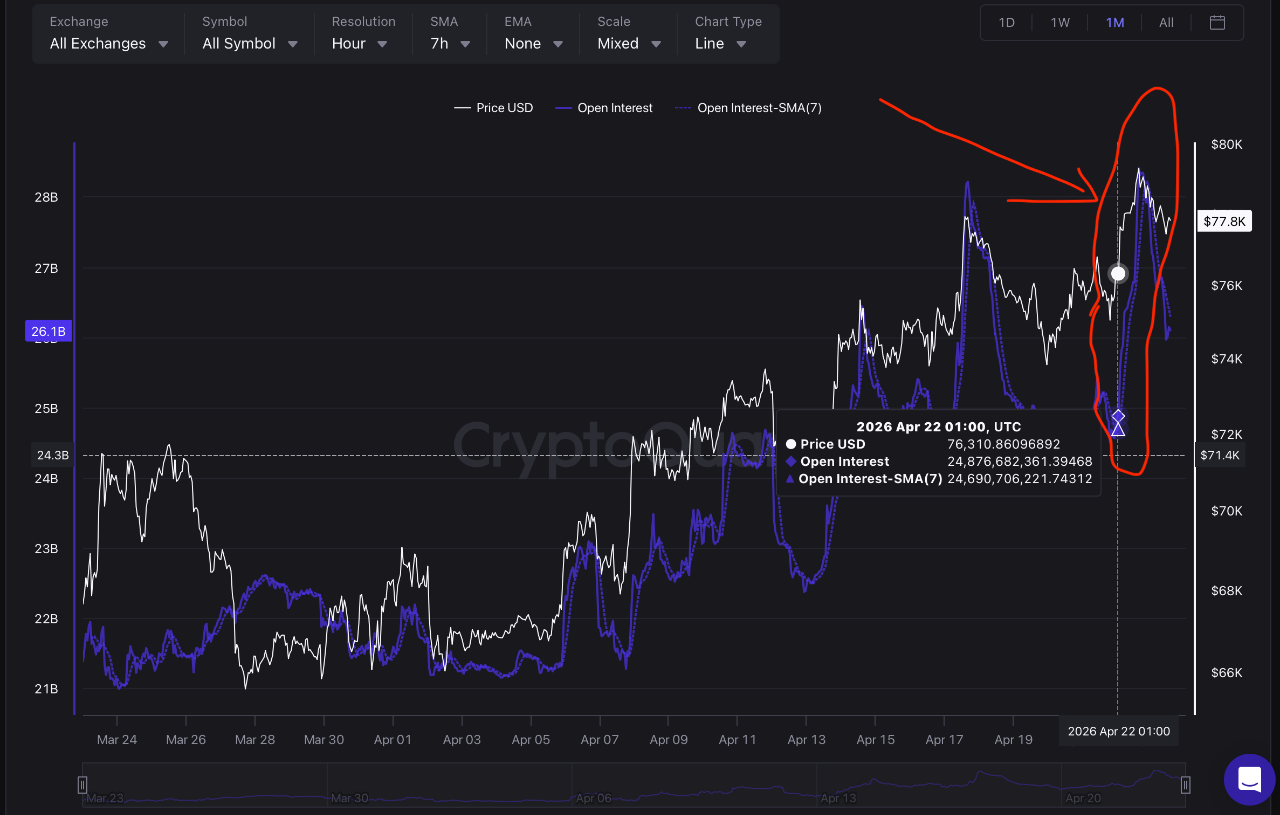
During that move, Bitcoin climbed from $76,351 to $79,447, a gain of 4.05%. However, the structure behind the rally tells a different story.

Open interest surged sharply from $24.88 billion to around $28 billion, signaling a rapid increase in leveraged positions. This spike in derivatives activity triggered widespread liquidations of short traders.

Short liquidations alone exceeded $607.9 million in Bitcoin and $580.9 million in Ethereum, bringing the combined total to roughly $1.19 billion. In contrast, long liquidations were significantly lower, totaling just over $111 million across both assets.

Fragile Rally With Reversal Risk

In sum, the data suggests that Bitcoin’s recent strength has not come from robust spot demand entering the market, but from forced buying as short positions were liquidated.

While this kind of move can be powerful, it is often unstable. When price is due to leverage than real demand, it becomes more vulnerable to sharp reversals once momentum fades.

Until both spot and futures demand recover together, the market structure may remain weak, even if prices continue rising in the short term.

Market Updates: Kbank Tests Ripple Wallet for Remittances, Banking Circle Targets Stablecoin Settlement in Europe, Crypto ETPs Extend Winning Streak on Bitcoin Strength

0

Latest Market Updates: As of 27th April 2026.

Today in crypto, institutional and regulatory shifts are unfolding in parallel across regions. In South Korea, Kbank is testing a Ripple-based remittance wallet, while in Europe, Banking Circle is accelerating the push toward stablecoin-based settlement systems. 

At the same time, crypto ETPs are extending their inflow streak as Bitcoin trades above $76K, signaling continued investor demand. On the regulatory front, France has intensified its crackdown on crypto-related crime, charging 88 suspects in a series of wrench-attack cases.

Kbank Partners with Ripple to Test Blockchain Remittances

In South Korea, digital bank Kbank has partnered with Ripple to explore blockchain-based international remittance solutions. Notably, the agreement was formalized in Seoul by Kbank CEO Choi Woo-hyung and Ripple’s Asia-Pacific head Fiona Murray, according to local reports.

The collaboration aims to improve the speed, cost efficiency, and transparency of cross-border transfers. To achieve this, the partners have launched phased technical trials.

The first phase tested a standalone mobile remittance system. The second phase now integrates customer accounts with internal banking infrastructure to assess operational stability and scalability.

As part of these trials, transfers are being tested across key remittance corridors, including Thailand and the United Arab Emirates. The initiative reflects a broader push to modernize global payments using distributed ledger technology.

Banking Circle Expands Stablecoin Settlement in Europe

Meanwhile, in Europe, USDC issuer Circle has formally entered the stablecoin settlement market after securing a Crypto Asset Service Provider (CASP) license on April 15.

This regulatory approval allows the firm to facilitate fiat-to-stablecoin conversions for institutional clients. Supported assets include Paxos’ USDG, Circle’s USDC, and its own euro-backed stablecoin, EURI.

EURI, first introduced in August 2024, marked Banking Circle’s initial step into digital asset settlement. Since then, the company has scaled significantly, now serving over 750 financial institutions and marketplaces and processing more than €1.5 trillion annually.

Chief Digital Asset Officer Kirit Bhatia described stablecoins as a natural extension of the firm’s existing infrastructure. He further emphasized their potential to reduce costs and improve transaction efficiency in institutional payments.

Crypto Investment Products Extend Winning Streak

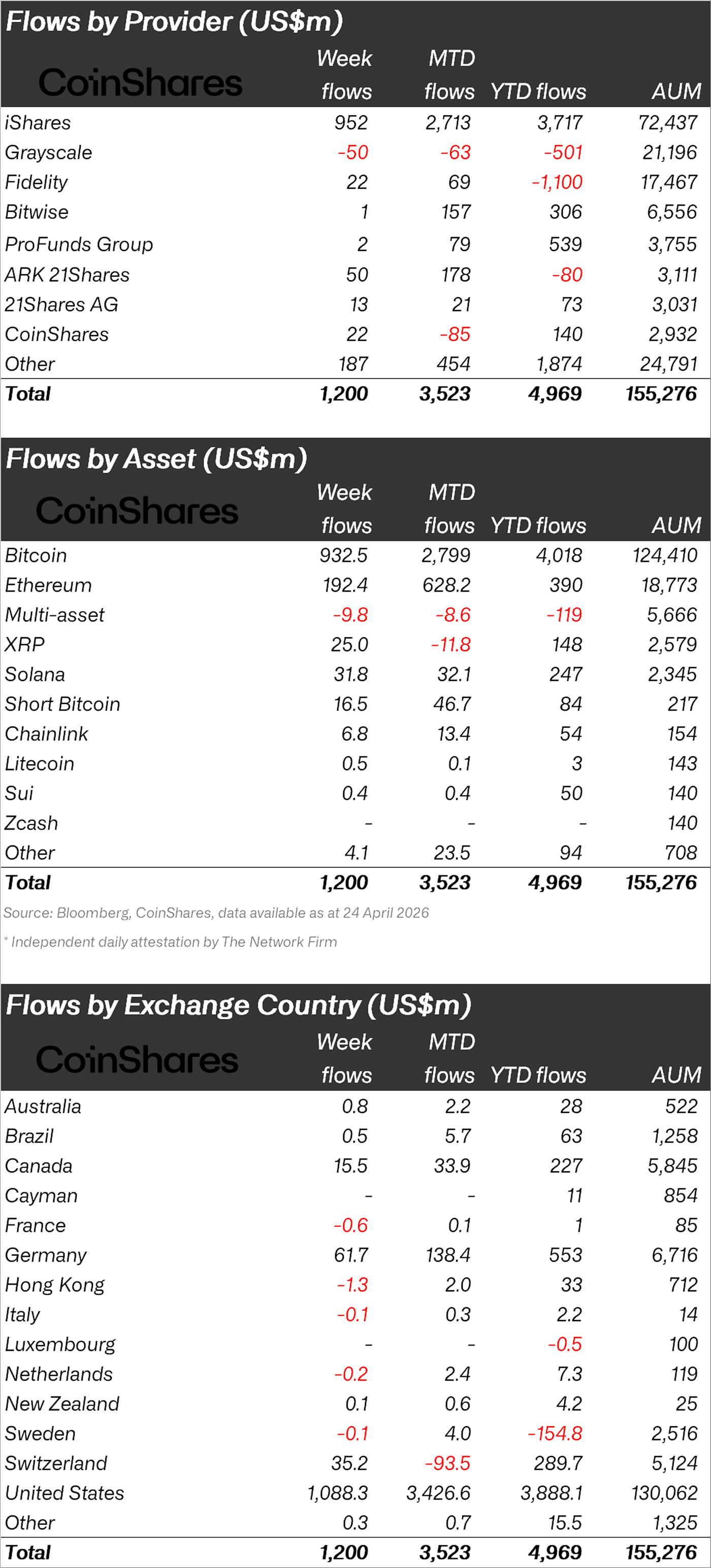
At the same time, investor appetite for crypto exposure continues to strengthen. CoinShares reports $1.2 billion in inflows into crypto exchange-traded products (ETPs) over the past week, extending a four-week streak of positive momentum.

This brings total inflows over the past month to approximately $3.53 billion, significantly above the previous monthly peak of $2.53 billion seen in March. Consequently, total assets under management (AUM) have risen to $155 billion, the highest level since February 1.

Bitcoin-linked products led the inflows with $932.5 million for the week, bringing year-to-date inflows to $4 billion. U.S.-listed spot Bitcoin ETFs contributed roughly $824 million of that total, according to SoSoValue data.

Ethereum products followed, recording $192 million in inflows and marking their third consecutive week above $190 million. Meanwhile, XRP funds returned to positive territory after recording $56 million in outflows the previous week.

Interestingly, short-Bitcoin products still saw $16.5 million in inflows, suggesting that some investors continue to hedge exposure despite overall bullish sentiment. Analysts at CoinShares interpret this as measured risk management rather than a reversal in market outlook.

Bitcoin itself is currently trading above $76,000, its highest level since the February correction, reinforcing broader market optimism.

France Intensifies Crackdown on Crypto-Linked “Wrench Attacks”

On the regulatory and enforcement side, France has escalated its response to a surge in violent crypto-related crime.

Vanessa Perrée, the national prosecutor for organized crime, confirmed that 88 individuals have been charged in connection with a series of so-called “wrench attacks,” which involve coercion, home invasions, kidnappings, and extortion to gain access to crypto holdings. The suspects include 10 minors, with 75 currently held in pre-trial detention.

The cases span 12 ongoing investigations overseen by the Paris Judicial Court and the National Prosecutor’s Office for Organized Crime (PNACO).

PNACO reports a sharp rise in these incidents, with 18 cases recorded in 2024 and 67 in 2025. So far in 2026, authorities have already documented 47 cases.

Notably, this trend is not limited to France. Blockchain security firm CertiK reported a 75% global increase in similar attacks in 2025 compared to the previous year.

Peter Schiff Criticizes Saylor’s Bitcoin to $1M Forecast as Strategy Acquires Fresh 3K BTC

0

Gold advocate Peter Schiff has criticized the Bitcoin to $1 million forecast by Michael Saylor following Strategy’s latest BTC purchase.

The recent buy has pushed Strategy’s total Bitcoin holdings to 818,334 BTC. While the firm has now entered a profitable position after months of being underwater, Schiff’s criticism insists this is underwhelming.

Key Points

  • Strategy purchased 3,273 BTC for $255 million at $77,906 per bitcoin, bringing total holdings to 818,334 BTC.
  • Strategy funded the purchase by selling over 1.4 million MSTR shares, generating $255 million in net proceeds.
  • At current prices, Strategy’s Bitcoin stash is worth $63.7 billion, putting the company $1.9 billion in profit.
  • Peter Schiff criticized the recent Strategy purchase, calling attention to Saylor’s Bitcoin to $1 million forecast.
  • Schiff argued that Bitcoin could fall below $60,000 by the time Strategy reaches 5% of total supply.

Strategy’s Latest Bitcoin Purchase

Strategy has bought another batch of Bitcoin, with Chairman Michael Saylor announcing on X that the company purchased 3,273 BTC for roughly $255.0 million, at an average price of about $77,906 per bitcoin.

Alongside the purchase, Saylor reported that Strategy had achieved a Bitcoin Yield of 9.6% year-to-date in 2026. As of April 26, 2026, the company’s total holdings stand at 818,334 BTC, bought for a combined $61.81 billion at an average price of $75,537 per bitcoin.

With Bitcoin trading at around $77,850 at the time of writing, Strategy’s total stash is now worth $63.7 billion, putting the company about $1.9 billion in profit. 

This is a turnaround from earlier in the year, when Bitcoin spent much of its time below $70,000 and kept Strategy’s position underwater. The company is now in the green, though the margin is slim and the position is still far from comfortable. 

Saylor also shared Strategy’s official Form 8-K filing with the U.S. SEC as supporting documentation for the announcement. According to the Form 8-K filing dated April 27, Strategy paid for its latest Bitcoin purchase entirely through its at-the-market offering program. 

Between April 20 and April 26, 2026, the company sold 1,451,601 shares of its Class A common stock under the ticker MSTR, bringing in net proceeds of $255.0 million after commissions. During the same period, Strategy sold none of its preferred stock series.

Peter Schiff Criticizes Saylor’s $1M Bitcoin Prediction

Gold advocate Peter Schiff responded to Saylor’s latest announcement, specifically criticizing a prediction Saylor made in 2025 that Bitcoin would reach $1 million per coin if Strategy acquired 5% of the total supply. 

Schiff noted that Strategy now holds 3.9% of the supply after procuring 231,666 BTC since that forecast, and argued that if the next 231,666 BTC purchases move Bitcoin’s price by the same amount as the last 231,666 did, the asset could actually fall below $60,000 by the time Strategy crosses the 5% mark.

The latest comments are part of Schiff’s long-running effort to challenge both Bitcoin as an asset and Strategy’s BTC accumulation campaign, as he continues to advocate for gold as the better store of value.

Recent Criticisms

Schiff had also spoken up the day before Strategy revealed the latest purchase. Specifically, he argued against claims that Bitcoin only needs to rise 2% per year to cover the 11.5% yield on STRC, pointing out that Saylor keeps increasing issuance. 

His argument was that the more STRC Strategy sells, the more Bitcoin has to rise to cover the yield, and that a drop in STRC’s price would force the company to raise that yield even further. 

According to him, selling Bitcoin to pay the yield would drag Bitcoin’s price down, setting off what he calls a death spiral that could only stop if Strategy cancels the dividend. However, he argued that this move would in turn crash STRC, pull MSTR down with it, and take Bitcoin along for the fall.

XRP “Bull Switch” That Printed Only 3 Times in the Last 13 Years Has Appeared Again

A rare technical pattern is drawing attention to XRP, with market watchers suggesting it could hint at another major move.

Analyst ChartNerd recently highlighted what he calls a “Bull Switch” signal on XRP’s long-term chart. According to him, this setup has appeared only three times over the past 13 years, and each instance was followed by a major rally.

Key Points

  • XRP’s rare “Bull Switch” signal has appeared again, sparking talk of a potential major price move.
  • Analyst ChartNerd says the pattern has printed only 3 times in 13 years, each followed by strong XRP rallies.
  • Previous signals aligned with major XRP breakouts in 2017, 2021, and a recent 2025-style move.
  • XRP remains in consolidation as traders await confirmation, with history suggesting possible bullish expansion.

A Pattern Tied to XRP Biggest Moves

The chart shows that previous “Bull Switch” moments aligned with XRP’s powerful price surges in 2017, 2021, and more recently in 2025. Each time, the signal appeared after an extended period of consolidation, a strong upward trend followed.

Notably, this “Bull Switch” indicator represents a bottoming point where market structure shifts from bearish or neutral momentum into a sustained bullish phase. On the chart, these transitions are marked by a move from red zones into green zones, with price stabilizing before pushing higher.

Image

Notably, XRP has been in a bearish trend over the past nine months, during which its price dipped from $3.66 to $1.11 before stabilizing around $1.30. Now, ChartNerd believes the “Bull Switch” has flashed again.

Accordingly, he argues that if the same pattern repeats, the market could be setting up for another significant move heading into 2026.

At the time of writing, XRP is trading around $1.41, down 0.74% on the day. The slight dip comes as the asset consolidates after recent gains, with no clear breakout yet.

XRP Outlook If Structure Holds

While optimistic, ChartNerd has not provided a specific short-term price outlook for XRP in this latest analysis. However, in earlier work, he shared long-term targets as high as $18 under a “Staircase to Valhalla” thesis.

Meanwhile, that projection depended on XRP holding above $1.80, a level it has not sustained over the past four months.

XRP Bifrost Bridge and $9–$13 Target

Separately, analyst EGRAG argues that despite recent weakness and six straight monthly declines, XRP is still moving within a long-term ascending channel called the “Bifrost Bridge,” which has guided price action since 2014. As long as XRP remains inside this structure, the uptrend remains valid, according to EGRAG.

He believes the extended consolidation has built energy for a larger breakout, keeping his $9–$13 target in play. From current levels, that implies a potential 5x–8x upside if the bullish channel holds.

Despite these promising outlooks, ChartNerd also acknowledges that a drop below $1 remains possible. However, he views such a scenario as a potential opportunity to accumulate at lower prices.

Patience Over Fear

In sum, rather than reacting to short-term volatility, analysts stress a longer-term view.

If the “Bull Switch” fully forms again, according to ChartNerd’s observation, XRP may be entering another accumulation phase, setting up for an explosive rally. However, this remains uncertain, as historical patterns may not necessarily repeat.

Market Updates: Ethereum Foundation Unstakes 17K ETH, Litecoin Releases 13-Block Reorg Analysis, Aave Seeks Release of Kelp DAO Funds Held on Arbitrum

0

Latest Market Updates: As of 27th April 2026.

In recent developments in the digital asset sector, the Ethereum Foundation has reduced its staking position as it approaches its long-stated ~70,000 ETH target.

At the same time, Litecoin has released a post-mortem following an unusual 13-block chain reorganization. Meanwhile, Aave has submitted a governance request to Arbitrum for temporary access to frozen funds associated with a Kelp DAO exploit.

On the policy front, Donald Trump has publicly endorsed the CLARITY Bill, signaling support for clearer crypto regulations in the United States.

Ethereum Adjusts Staking Exposure Near Internal Target

The Ethereum Foundation has unstaked 17,035 ETH, worth roughly $40 million, according to data from Arkham. The withdrawal involved converting wstETH via Lido, with final settlement pending completion of the withdrawal queue.

EF Unstaking Ethereum

As of this writing, the foundation has not provided an official explanation for this move. Meanwhile, this move comes after several months of steady accumulation.

From February to April, the foundation has expanded its staking exposure from just over 2,000 ETH to approximately 69,500 ETH. That positioned it just below its internal 70,000 ETH target before the recent reduction.

Moreover, the development also reopens governance discussions around staking concentration. Ethereum co-founder Vitalik Buterin has previously cautioned that excessive staking centralization could introduce neutrality risks. These concerns become especially relevant during contentious upgrades or potential chain splits.

Litecoin Recovers After Block Reorganization Incident

Meanwhile, Litecoin, a proof-of-work Layer 1 network, has released a post-mortem following a rare 13-block chain reorganization triggered by a zero-day vulnerability.

Specifically, according to the update, the issue stemmed from a denial-of-service (DoS) condition affecting mining pools using newly updated software. This temporarily reduced their hashing contribution, allowing older nodes to gain disproportionate influence over block production.

Consequently, the network processed several transactions incorrectly, including activity involving decentralized exchanges and cross-chain systems. Some transactions also interacted with Litecoin’s MimbleWimble Extension Blocks privacy layer.

However, the network later restored order once updated nodes regained majority control. The chain ultimately restructured itself, reversing the affected blocks and removing invalid transactions from the final ledger. The disruption lasted more than three hours and impacted blocks 3,095,930 through 3,095,943.

Following the recovery, the Litecoin team confirmed that the vulnerability has been fully patched. Meanwhile, Alex Shevchenko described the incident as potentially coordinated, noting signs of double-spending attempts during the event.

Aave Proposes Release of Frozen Kelp DAO Funds

On the DeFi front, Aave Labs has formally appealed to the Arbitrum community to unfreeze funds tied to the Kelp DAO exploit.

The proposal requests the release and redirection of approximately $73.5 million in ETH from a larger frozen pool of around 30,765 ETH. The Arbitrum Security Council locked these assets following a $293 million exploit affecting the Kelp DAO ecosystem.

Aave’s plan proposes channeling the recovered funds into a coordinated recovery initiative called “DeFi United.” The initiative aims to restore backing for rsETH and compensate affected users.

Several ecosystem participants, including Kelp DAO, LayerZero, Compound, and Ether.fi, have expressed support for the proposal. Aave argues that unlocking and reallocating the funds would help stabilize broader conditions across Arbitrum and restore user confidence following the exploit.

Trump Endorses CLARITY Act in Mar-a-Lago Address

On the policy front, U.S. President Donald Trump voiced support for the CLARITY Act during a private luncheon at Mar-a-Lago.

The event, attended by top holders of his meme coin project “Official TRUMP,” included a 45-minute address covering cryptocurrency regulation and broader political themes.

Trump stated he would sign the CLARITY Act into law if it reached his desk. The bill aims to establish clearer regulatory frameworks for the digital asset sector.

Galaxy Digital CEO Mike Novogratz also commented on the bill’s prospects, suggesting it could reach committee review by early May 2026. If momentum continues, he expects a rapid legislative path, potentially leading to enactment as early as June.