Home Blog Page 169

Hoskinson Backs Draper Dragon After Cardano Community Approves Orion Fund With 50M ADA Seed

0

Cardano founder Charles Hoskinson confirmed a meeting with Draper Dragon, the firm selected to manage a newly approved treasury-backed venture fund seeded with 50 million ADA. 

His disclosure follows the approval of the Orion Fund proposal, signaling deeper collaboration between the Cardano ecosystem and blockchain-focused venture capital firms.

Key Points 

  • Charles Hoskinson confirmed he recently met with Draper Dragon, which will manage Cardano’s newly approved venture fund. 
  • The Cardano community approved the Orion Fund, allocating an initial 50 million ADA to the ecosystem treasury. 
  • The fund will support early-stage Cardano-native and integrated startups building on the network. 
  • Following his meeting with Draper, Hoskinson described the team as “good people with a good strategy.”

Cardano Community Approves Treasury-Backed Venture Fund 

The Cardano community recently approved the Draper Dragon Orion Fund through its on-chain governance system. The initiative allocates an initial 50 million ADA (about $15 million) from the treasury to seed the fund, with oversight from the Cardano Foundation.

The fund will support early-stage Cardano-native and integrated startups through direct investments, venture studio programs, and accelerator initiatives developed alongside Draper University. 

Moreover, it targets a total size of at least $80 million, with future allocations subject to further governance approval.

Hoskinson Backs Draper Dragon Partnership 

Following the approval, Hoskinson stated that he met with the Draper Dragon team, describing them as “good people” with a “good strategy”. His comments reflect confidence in both the partnership and the fund’s direction. 

Furthermore, his endorsement signals a broader shift toward professionally managed investment structures designed to bring capital, networks, and operational expertise into the ecosystem. This approach strengthens Cardano’s ability to compete for high-quality startups and institutional backing. 

Orion Fund Introduces Structured Investment Model 

Meanwhile, the Orion Fund marks one of Cardano’s first large-scale treasury-backed venture initiatives. Instead of relying solely on grants, it introduces a structured investment model to support projects across infrastructure, decentralized finance (DeFi), payments, and real-world asset (RWA) platforms.

Under this model, Draper Dragon will deploy capital across three key areas. These include direct investments, venture studio programs for product development and scaling, and accelerator programs to onboard new founders. 

To ensure transparency, an ownerless special-purpose vehicle, dubbed Arouet Holdings, will represent the treasury’s interests, while the Cardano Foundation will act as the constitutional administrator.

The move highlights the growing importance of venture partnerships as blockchain ecosystems compete on more than technology alone. If successful, the Orion Fund could accelerate Cardano’s growth by improving access to capital, expanding developer pipelines, and connecting startups to global venture networks. 

Market Updates: Bhutan Offloads 319.7 BTC, Bitcoin Dev Unveils Quantum-Resistant Wallet, US Treasury Drafts Strict Stablecoin AML Rules

0

Latest Market Updates: As of 9th April 2026.

Bhutan Continues Strategic Bitcoin Transfers

The Royal Government of Bhutan continues to methodically reduce its Bitcoin holdings, transferring 319.7 BTC (≈$22.67 million) into two wallets.

According to OnchainLens, one destination appears to be a newly created address, potentially linked to an exchange. Meanwhile, the other has a history of routing funds through platforms like OKX and Galaxy Digital.

This move follows a steady cadence of late-March transactions: 519.7 BTC on March 25, 123.7 BTC on March 27, and 374.9 BTC on March 31. Notably, one of the earlier transactions involved a wallet associated with trading firm QCP Capital.

Despite ongoing outflows, Bhutan still holds approximately 3,954 BTC (≈$280.57 million), according to Arkham data. However, that figure represents a sharp reduction from its peak of around 13,000 BTC in October 2024. With over 2,000 BTC sold this year alone, the pattern highlights a sustained, strategic liquidation rather than isolated activity.

Bitcoin Developer Unveils Quantum-Resistant Wallet Solution

As sovereign players rebalance positions, technical development is shifting toward long-term resilience, particularly against quantum-related risk.

Olaoluwa “Roasbeef” Osuntokun, CTO of Lightning Labs, has introduced a prototype wallet verification tool designed to be quantum-resistant.

Specifically, the tool enables users to verify wallet ownership using their private seed, without exposing it. This approach sidesteps reliance on traditional digital signatures, which could become vulnerable in a post-quantum environment.

Interestingly, the prototype is already operational on consumer-grade hardware. It can generate a proof in about 55 seconds and verify it in less than two seconds.

Although it has not yet been formally proposed for integration into Bitcoin, the tool represents a practical step toward solving a long-debated security concern.

Brag House and Dogecoin Arm Secure Merger Approval

On the corporate front, consolidation and expansion continue. Shareholders of Brag House Holdings have approved its merger with House of Doge Inc., with over 98% backing the deal.

The combined entity aims to merge sports media, blockchain infrastructure, and digital finance into a unified platform. Brag House contributes its collegiate sports and content ecosystem, while House of Doge, supported by the Dogecoin Foundation, gains a pathway to public markets via a Nasdaq listing.

This move builds on House of Doge’s earlier collaborations, including its partnership with 21Shares, which introduced Europe’s inaugural Dogecoin ETP, as well as alliances with Robinhood and CleanCore for treasury and custody services.

South Korean Court Sides with Upbit Operator

Meanwhile, in South Korea, Dunamu, the operator of Upbit, secured a notable legal victory against the Financial Intelligence Unit (FIU).

Earlier today, the Seoul Administrative Court overturned a three-month partial suspension of Upbit’s operations, citing unclear regulatory standards around transactions below 1 million Korean won.

Critically, the court recognized that Dunamu had implemented sufficient safeguards, including user attestations and transaction monitoring systems designed to block dealings with unregistered entities.

Consequently, it ruled there was no evidence of intentional misconduct or gross negligence, thereby highlighting the challenges regulators face in applying legacy frameworks to evolving crypto activity.

U.S. Treasury Pushes New Stablecoin Compliance Rules

In contrast, U.S. regulators are moving toward stricter controls. The Treasury Department, in coordination with FinCEN and OFAC, is preparing a proposal targeting stablecoin issuers.

Under this framework, robust anti-money laundering (AML) and sanctions compliance systems would be required, including the capability to identify, block, and freeze suspicious transactions. Additionally, it emphasizes risk-based monitoring and cooperation with law enforcement in tracing illicit flows.

Cardano Down Over 90% from ATH—Any Hopes of a Rebound?

0

Cardano is deep in the macro corrective phase, but history shows that this period has usually preceded a turning point for the altcoin.

Indeed, Cardano (ADA) is navigating a prolonged correction, with the price dropping sharply from its peak. The altcoin reached its all-time high of $3.10 in September 2021, but its current price of $0.25 represents a 91.9% decline from that peak.

During this period, sentiments turn negative and interest fades. However, ADA’s price action is now approaching a critical demand zone that could shape its next major move. Despite continued pressure on lower timeframes, the broader structure suggests a possible base is forming if key levels remain intact.

Key Points

  • Cardano (ADA) is navigating a prolonged correction, with its price dropping 91.9% from the peak of $3.10.
  • On the daily chart, an accompanying chart shows that a descending resistance trendline continues to cap upward movement.
  • While price action appears bearish, higher timeframes show potential accumulation for Cardano.
  • Attention is now on the macro demand zone between $0.13 and $0.18, where ADA is currently testing.
  • Holding above this region would suggest that accumulation may be underway, potentially laying the groundwork for a broader recovery phase.
  • A decisive break below $0.13 would significantly weaken prices and potentially lead to deeper downside.

Cardano Price Declines from Prior Highs

An analysis from CoinCodex discussed Cardano’s current price trend and what could happen next. Currently, its price behavior reflects a sustained downtrend, with ADA consistently forming lower highs and lower lows over several months.

After peaking at $1.019 in August 2025, the coin has steadily dropped, recording declines in every month since. It has fallen by 75% from that peak, demonstrating the strong bear dominance that characterizes bear markets. This type of structure has weighed heavily on sentiment, gradually eroding confidence as repeated recovery attempts have stalled.

Cardano Still Under Pressure on Lower Timeframe

On the daily timeframe, the accompanying chart shows that a descending resistance trendline continues to cap upward movement, reinforcing the bearish tone in the short term. At the same time, technical indicators on the daily chart remain weak.

Cardano 1D Descending Resistance Trendline/CoinCodex

Momentum has yet to shift decisively, and moving averages continue to slope downward, suggesting that sellers still hold control for now. For context, ADA has failed to decisively break above the 50 MA, currently at $0.26, with attempts earlier in the week failing. It also remains well below the 100 MA at $0.30, reinforcing the bearish structure.

However, while price action appears bearish, zooming out to higher timeframes shows potential accumulation for Cardano. Moreover, its market cap is not in free fall but rather within a range, indicating strength.

Another positive is the recent ADA classification as a digital commodity. Specifically, the US SEC added Cardano to this category, alongside 16 other cryptocurrencies, a move that confirms its legitimacy.

Key Zone That Could Decide Next ADA Move

Attention is now on the macro demand zone between $0.13 and $0.18, where ADA is currently testing. Historically, this range has attracted buying pressure, making it a critical area to watch. Holding above this region would suggest that accumulation may be underway, potentially laying the groundwork for a broader recovery phase.

The accompanying chart shows that holding this support and breaking above the descending resistance opens the way for Cardano to retest the next major resistance around $1.01. This aligns with the 0.236 Fibonacci level and represents a 304% increase from the current market price.

Conversely, a decisive break below $0.13 would significantly weaken prices and potentially lead to deeper downside. As such, how ADA reacts to this zone would likely determine whether it stabilizes or extends its correction.

Shiba Inu Breakout Could Be Massive as Range Tightens and Selling Pressure Fades

0

Shiba Inu is gearing up for a range breakout after an extended period of consolidation, with dwindling selling pressure adding to the prospect.

A push above the $0.0000060 price level for Shiba Inu (SHIB) stalled again, as the market still lacks sufficient momentum to sustain a higher trend. However, this energy is building up for SHIB as it consolidates within a price range, bringing the prospects of an upward breakout into focus.

Key Points

  • Shiba Inu is gearing up for a range breakout after an extended period of consolidation.
  • SHIB entered this channel on March 11 and has since consolidated between its upper resistance around $0.0000060 and support around $0.0000057.
  • This pattern of accumulation often aligns with periods where an asset builds momentum for a decisive price move.
  • If Shiba Inu breaks out from this range, then higher prices should be in order, with the closest resistance at the 100-day SMA at $0.00000669.

Shiba Inu Consolidates Within Range

Notably, the meme coin reclaimed $0.0000060 earlier in the week, reaching an intraweek high of $0.00000618 on Tuesday. The momentum was not isolated but rather followed a broader market trend, spurred by progress in the US-Iran peace deal.

However, it has peaked in that area, a trend that has recurred several times recently. For context, SHIB topped out around this area multiple times in recent weeks, with the last happening on April 1, when it reached an intra-day high of $0.00000613.

On the 1-day chart, this level above $0.0000060 aligns with the upper boundary of a price range. SHIB entered this channel on March 11 and has since consolidated between its upper resistance and lower support around $0.0000057.

Shiba Inu 1-Day Chart

Meanwhile, this pattern of accumulation often aligns with periods where an asset builds momentum for a decisive price move. SHIB is also tightening within this range, suggesting that a breakout is not far off. Typically, the longer the pattern continues, the stronger the breakout will be.

Potential Targets Upon Breakout

If Shiba Inu breaks out from this range, then higher prices should be in order. The closest resistance is the 100-day SMA at $0.00000669. Breaking above this moving average would further strengthen the upward push.

Notably, SHIB has failed to sustain an uptrend because each rally fails to break previous highs, resulting in a new lower high. As such, the token will break bearish structure if it pushes past the previous lower high in February 14’s peak of $0.00000725, representing a 23.5% rise from the current market price of $0.00000587.

If the broader crypto market conditions improve, Shiba Inu could rally further. The next possible targets are the resistance at $0.0000090 and the yearly high of $0.0000109, representing upticks of 53% and 85.6%, respectively.

Shiba Inu Selling Pressure Dwindles

Adding to this bullish outlook is the drop in selling pressure. Data from CryptoQuant shows a negative exchange netflow of 7.89 billion SHIB, indicating that holders withdrew their tokens from trading platforms to self-custody wallets.

Shiba Inu Net Outflow of $7.89B/CryptoQuant

This move eliminates immediate sell-offs and suggests that holders are accumulating rather than distributing. Such accumulation provides the required fundamental support for the bullish technical outlook.

Cumulative XRP Netflow Hits -$11.23B on Binance, but Leverage Has Not Yet Returned

While investors have continued to move their XRP tokens out of Binance, derivatives data indicates that leverage has not yet returned to the market.

XRP saw a short-lived rebound after the ceasefire agreement between the U.S. and Iran. The price climbed to a local high of $1.39, but the move lost strength, pushing XRP back to the $1.33 level.

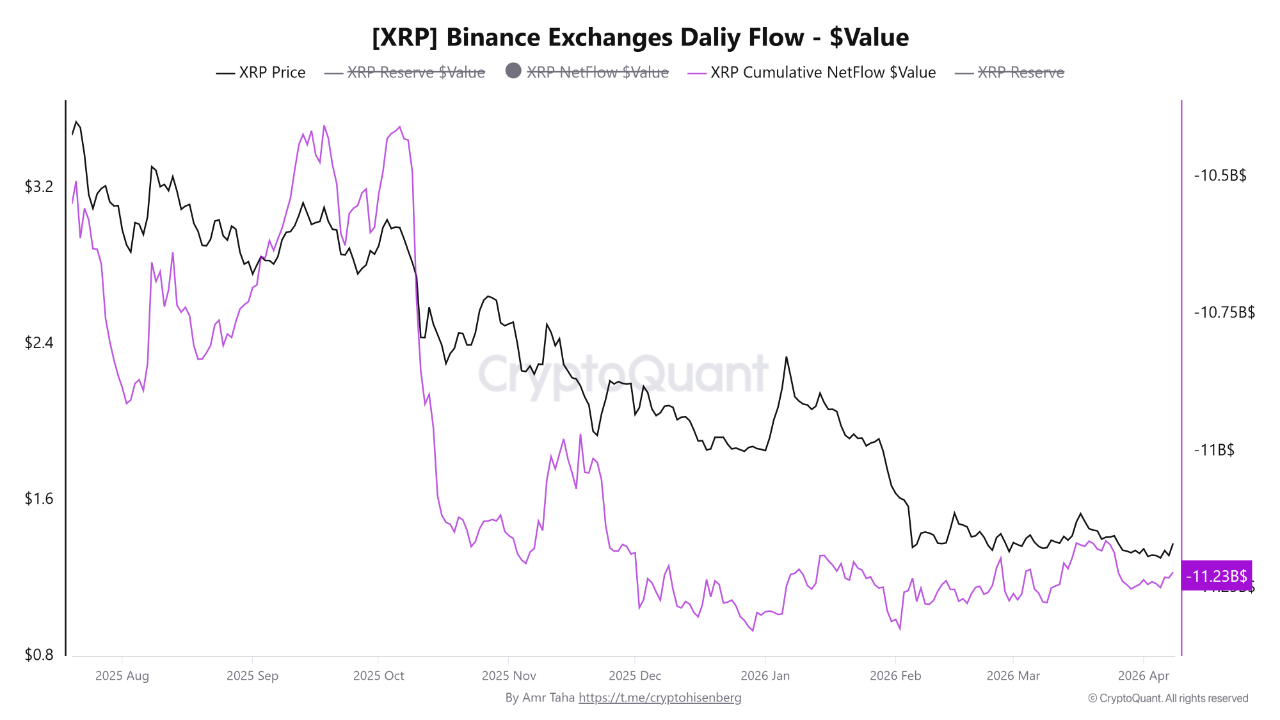
Amid the pullback, CryptoQuant analyst Amr Taha recently revealed that while investors have continued to move XRP off Binance, leveraged traders have not yet returned.

Key Points

  • Amid XRP’s latest relief bounce, Binance cumulative XRP netflow has declined to -$11.23 billion.
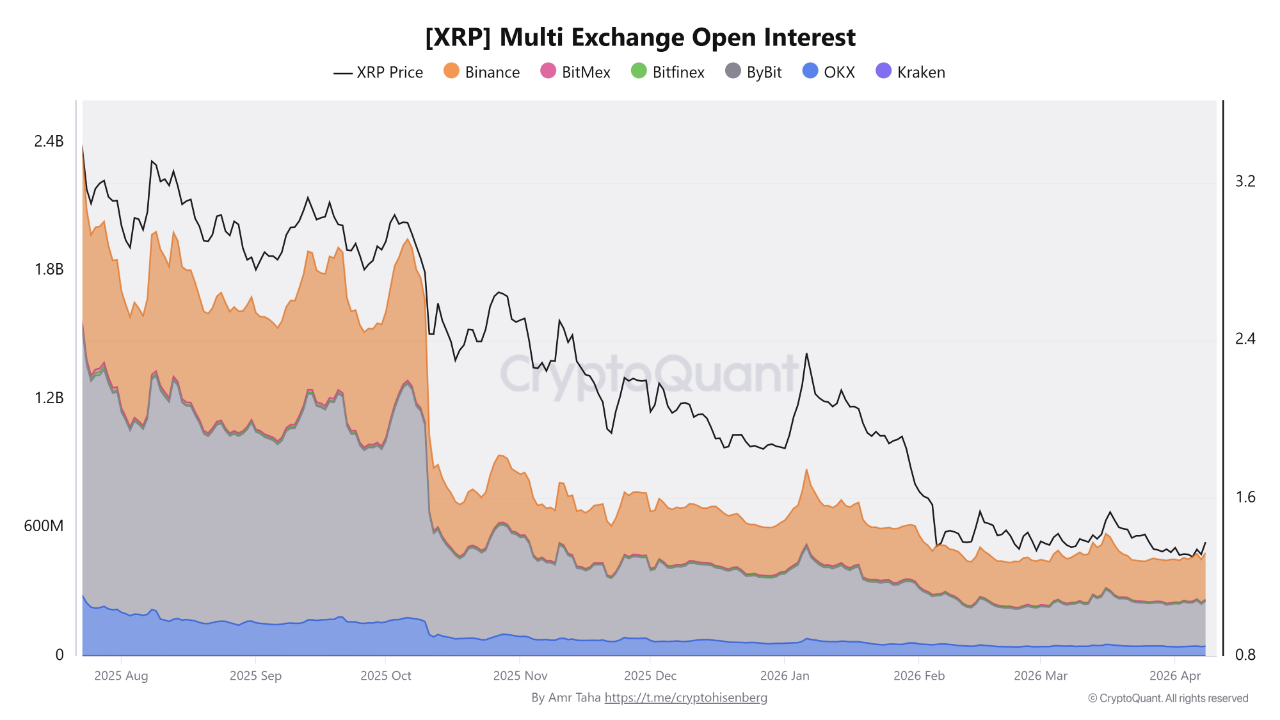
  • XRP open interest on Binance has remained just above $200 million since mid-February 2026, indicating reduced leverage.
  • The drop in leverage activity suggests traders remain cautious after the downtrend that began in October 2025.
  • Continued XRP outflows indicate reduced selling pressure, but weak speculative demand limits the chances of a strong breakout.

XRP Binance Outflows Grow While Leverage Remains Low

Taha explained that XRP outflows from Binance have continued to increase, showing a steady drop in the amount of XRP held on the exchange. 

He called attention to XRP’s cumulative netflow data, which declined from about -$10.4 billion in mid-August 2025 to -$11.23 billion now. This shows that more XRP is leaving the platform, reducing the supply available for immediate selling.

XRP Cumulative Netflow on Binance CryptoQuant
XRP Cumulative Netflow on Binance | CryptoQuant

However, the derivatives shows that Binance XRP open interest has stayed just above $200 million since mid-February 2026, which means some trading activity is still there, but not at levels that show strong confidence from high-leverage traders. 

Chart data confirms that total open interest sits a little above $400 million across top exchanges. This is much lower than the $1.5 billion to $2.3 billion range seen between August and October 2025. The figure dropped below $1 billion in October 2025 when the ongoing downtrend began and has stayed low since then.

XRP Multi Exchange Open Interest CryptoQuant
XRP Multi Exchange Open Interest | CryptoQuant

According to Taha, this trend of increased exchange outflows and declining leverage leaves the market in a position where selling pressure may be easing, but there is not enough strong buying to push prices sharply higher.

Investors Remain Cautious After Early Losses

Essentially, these trends confirm that the market is still recovering from earlier losses. Many leveraged traders were likely forced out during past price drops, and confidence has not fully returned. Even with the recent bounce, the low OI shows that traders are not yet convinced that a steady uptrend has started.

Specifically, ongoing macro uncertainty and memories of failed recoveries are likely keeping traders from taking bigger risks. As a result, many are waiting on the sidelines instead of jumping back in with aggressive positions.

At the same time, the steady movement of XRP off Binance suggests that some investors are accumulating or simply choosing not to keep their tokens on exchanges for quick selling. This reduces available supply, which can support prices over time. 

Still, without stronger demand from leveraged traders, XRP may continue to move slowly or trade within a range. A stronger rally would likely need a clear return of high-leverage participation.

XRP Could See Further Downside

Meanwhile, market analyst Casi believes the recent rebound has already played out. According to her, XRP reached the 0.618 Fibonacci retracement level at $1.39 during the relief bounce, completing her Wave 2 pattern that started in early April.

XRP 1h Chart Casi Trades
XRP 1h Chart | Casi Trades

Based on this, the market could now enter a Wave 3 phase, which will bring downward movement. Casi expects XRP to drop to around $1.09 and noted that the move could happen quickly.

Hoskinson Rejects Claims That IOG Has Abandoned Cardano

Charles Hoskinson, founder of Input Output Global (IOG), has pushed back against rumors that his company has abandoned Cardano development.

His remark responded to claims circulating online that IOG had stopped working on Cardano and shifted its focus to the privacy-focused blockchain Midnight.

Key Points

  • Charles Hoskinson has dismissed claims that he and his company have abandoned Cardano in favor of Midnight.
  • He argues that the narrative persists largely because of a lack of critical thinking among some observers.
  • The speculation gained traction following the launch of Midnight’s mainnet and after Input Output Global paused development on Project Acropolis and the Tiered Pricing mechanism.
  • Despite these changes, the broader strategy continues to prioritize Cardano’s long-term growth and ecosystem development.

Hoskinson Subtly Shades Critics Behind Rumors

Taking to X, Cardano founder Charles Hoskinson dismissed speculation that IOG stepped away from the network. His remark came after “JUST_JINX,” an ambassador of the Midnight project, asked why some commentators in the community insisted that Hoskinson and IOG had left the project for Midnight.

To challenge the narrative, the ambassador highlighted recent updates to the Leios scaling initiative. The update appeared only hours earlier, demonstrating that development on Cardano continues actively.

In response, Hoskinson stated that critics spread the claims “because there is no IQ requirement to use a computer”. His remark suggested that many individuals share misinformation without verifying facts or applying critical thinking.

Potential Factors Behind the Rumors

Speculation about Hoskinson and IOG abandoning Cardano largely emerged following two major developments. First, the Midnight mainnet, a privacy-focused sidechain connected to the Cardano ecosystem, recently launched. During the rollout, Hoskinson and other top IOG figures actively promoted the project, which led some observers to believe the team had shifted priorities.

Second, IOG announced a strategic shift that halted development of the Acropolis project and scrapped the proposed tiered pricing model for the network. Instead of continuing those initiatives, IOG decided to redirect resources toward chain-abstraction technologies and research related to the Ouroboros Leios protocol.

For context, Leios is widely viewed as a key component of Cardano’s future scalability strategy. Specifically, the protocol aims to significantly increase transaction throughput and overall network efficiency.

Moreover, it forms a central part of Cardano’s 2026 roadmap, which Hoskinson believes will help the network address the blockchain trilemma.

IOG Still Prioritizing Cardano

As part of this strategic shift, IOG confirmed it would return 4.1 million ADA previously allocated to the Acropolis and pricing initiatives back to the Cardano treasury. The move ensures that the funds support developments aligned with Cardano’s long-term growth.

Despite the restructuring, development across the Cardano ecosystem continues. Engineers are still publishing updates related to Leios and other improvements. Consequently, Hoskinson maintains that the claims that IOG abandoned the project stem from confusion over shifting priorities, not from any real departure from the network.

Crypto Gets A Foot In The Door of U.S. Financial Infrastructure

0

For many years, the narratives surrounding the rise of digital assets have framed the relationship between crypto and traditional finance as a head-to-head conflict, pitting revolutionary cryptocurrencies against the more established fiat. 

This view, however, misses the mark. The real revolution isn’t about choosing one currency to rule them all, but rather about finding a way for both to converge as part of a new and improved digital payments infrastructure that enables more efficient financial transactions. 

Earlier this year, the first steps toward this new, inclusive paradigm were made. Kraken Financial made history in March by becoming the first crypto-native firm to achieve direct access to the Federal Reserve’s payment rails. It’s the first time a crypto payment gateway has transitioned from operating parallel to the traditional financial system to operating within its infrastructure. 

The impact of this milestone reaches well beyond a single company, showing how blockchain payments integration can evolve from a narrative into real-world infrastructure. What we’re seeing are the early stages of convergence between traditional rails and blockchain-based systems; it’s the progress we need to make instant crypto payments a thing of the now. 

Crypto plugged in

In 2026, a line that had long separated crypto from the traditional financial system has begun to dissolve. In March, Kraken Financial was granted a Federal Reserve master account. With it, a crypto-native institution stepped inside the core infrastructure of the U.S. financial system. A master account provides direct access to the Federal Reserve’s payment rails. 

These are the systems that move money between banks, clear transactions, and settle value at the highest level of the financial system. Until now, that access has been limited to traditional institutions. 

Crypto companies have always depended on intermediary banks to access fiat systems. Those intermediaries introduced friction, delays in settlement, policy constraints, and, in many cases, outright restrictions. Direct access to Federal Reserve infrastructure bypasses that layer entirely. 

It reduces dependency; increases speed; changes the mechanics of how value moves between systems. The integration of crypto payment gateways onto traditional banking rails blurs the line between them, leading to a convergence of previously distinct financial operations.

Building on better rails

The ongoing debate about cryptocurrency incorrectly focuses on the kind of money that will ultimately prevail, whether it’s which asset will replace the dollar, or if stablecoins or CBDCs will become dominant. 

These questions fundamentally misunderstand the core issue. The financial system has always had various forms of value; what it has consistently lacked are efficient ways to transfer that value. We don’t need new money; we need superior infrastructure or “rails” for movement.

The current system is hampered by layers of intermediaries, slow settlement times, and fractured networks. Transactions are slow not by necessity, but due to the demands of the existing infrastructure. Every step introduces friction, and every intermediary adds cost and complexity. 

Cryptocurrency did not emerge to compete with fiat currency; it emerged to solve this infrastructure problem. Blockchain-based systems enable the direct and rapid movement of value, settling transactions faster and reducing reliance on third parties. Crucially, they allow different asset types to operate on a single, shared underlying infrastructure.

Where it’s already happening

From my vantage point within this space, the move toward integrated infrastructure is already underway. At ForumPay, our crypto payment gateway, we’ve focused from the beginning on solving the exact friction at the core of this debate: not what form money, or value, takes, but rather how it moves. 

ForumPay is designed as a payments infrastructure that bridges digital assets and traditional finance, enabling businesses to accept crypto while settling in fiat or stablecoins, without inheriting the complexity involved in setup and management of blockchain rails.

By integrating directly with banking rails and leveraging blockchain for settlement, we remove intermediaries, reduce friction, and make different asset types, from Bitcoin to tokenized assets, usable at the point of payment. The result is a unified transaction layer where value can move seamlessly regardless of its origin. 

That’s the direction payments and finance is headed, reinforcing the point that the real power of digital assets can be felt when its infrastructure facilitates fluid interoperability between previously siloed asset classes.

One step closer to an interconnected financial network

The modernization effort is not exclusive to the crypto space; it is taking place across the entire financial system. Central banks and financial institutions are overhauling the underlying infrastructure for payments. This includes introducing real-time settlement and redesigning legacy processes. The objective is no mystery: faster movement, fewer delays, and enhanced connectivity.

This evolution is a necessary response to a digital economy whose demands the current system can no longer meet. Businesses and consumers expect immediate, real-time capital movement globally. However, the existing infrastructure is hampered by outdated processes and fragmented networks. Crypto’s role was not to cause this pressure, but to expose it.

Blockchain technology established a new standard by demonstrating the potential for instant, low-friction value transfer. Traditional finance is now moving toward this same efficiency benchmark, albeit through different means. The result is a clear convergence, not the replacement of one system by another. 

As such, the distinction between “crypto” and “traditional finance” is losing relevance. The key is in empowering an infrastructure that facilitates their connection.

Market Updates: Iran Considers Bitcoin Fees for Oil Tankers, Morgan Stanley Launches Spot BTC ETF, Ethereum Foundation Sells 416 ETH

0

Latest Market Updates: As of 8th April 2026.

Iran Considers Bitcoin Fees for Oil Tankers

Iran is exploring a plan to charge oil tankers transit fees in Bitcoin as they pass through the Strait of Hormuz, according to the Financial Times. The proposal is linked to a temporary two-week ceasefire with the United States, with officials suggesting the system could help monitor shipments and prevent misuse of the truce.

Hamid Hosseini, spokesperson for Iran’s Oil, Gas and Petrochemical Products Exporters’ Union, noted that only fully loaded vessels would be subject to the fee. Tankers would need to submit cargo details via email in advance for approval.

The toll is expected to be set at $1 per barrel, with payments settled in digital assets based on official instructions.

Morgan Stanley Debuts Spot Bitcoin ETF

As geopolitical actors experiment with crypto utility, traditional finance continues accelerating its adoption. Morgan Stanley has launched its own spot Bitcoin ETF, a significant milestone for Wall Street.

The Morgan Stanley Bitcoin Trust (MSBT), now listed on NYSE Arca, directly holds Bitcoin instead of relying on derivatives. This structure aligns with growing investor preference for physically backed products.

With a 0.14% annual fee, the fund is now the lowest-cost option in its category. Custody will be handled by Bank of New York Mellon and Coinbase Custody Trust Company.

The launch positions Morgan Stanley as the first major U.S. bank to bring a spot Bitcoin ETF to market under its own name.

Ethereum Foundation Liquidates ETH Holdings

Within the crypto ecosystem, institutional activity is also drawing scrutiny. The Ethereum Foundation has sold 416.67 ETH for approximately $933,340 in DAI, prompting speculation about further sales.

The move follows a more than 7% price surge in Ethereum after the U.S.–Iran ceasefire. At the time of writing, ETH was trading near $2,228, suggesting the Foundation may be capitalizing on recent gains.

Polygon Labs Targets $100M for Payments Expansion

Meanwhile, crypto firms are refining their strategic focus. Polygon Labs is seeking up to $100 million to expand its presence in the payments sector, according to The Information.

This initiative builds on a previously announced $250 million acquisition program, including deals involving Coinme and Sequence.

By shifting focus from general Layer-2 scaling to payment infrastructure, Polygon aims to create a vertically integrated ecosystem. This would cover fiat on- and off-ramps, card distribution, and developer tools, signaling a more targeted approach to real-world adoption.

CEA Report Challenges Stablecoin Risk Narrative

At the policy level, the debate around crypto’s systemic impact continues to evolve. A new report from the Council of Economic Advisers (CEA) finds no evidence that stablecoin rewards drive bank deposit outflows.

This conclusion directly challenges concerns about financial instability raised by critics. Based on analysis by government economists, the report examines how stablecoins interact with traditional banking systems.

Its findings are likely to influence upcoming regulatory discussions and strengthen the case for broader integration of stablecoins into the financial system.

Veteran Economist Jim Rickards Says Bitcoin ‘Easier to Hack Than People Realize’ 

Veteran economist and bestselling author Jim Rickards has claimed Bitcoin is “very easy to hack” from a forensic standpoint, while also casting doubt on its real-world utility.

Speaking in a recent podcast, Rickards clarified that while blockchain as a technology remains robust, cryptocurrencies built on top of it may not be as secure or useful as widely believed.

Key Point

  • Jim Rickards says Bitcoin is easier to trace and analyze, raising concerns about user privacy.
  • He distinguishes secure blockchain tech from cryptocurrencies, arguing assets on it may be less reliable.
  • Rickards likens crypto markets to a casino, with assets like stablecoins acting as chips in a closed system.
  • He questions its real-world utility, saying crypto may not be suitable for spending despite rising institutional adoption.

Blockchain Works, But Bitcoin Raises Concerns

Rickards acknowledged that blockchain technology itself is reliable and has been in development since the 1980s, noting its growing role in record-keeping systems. However, he highlighted a distinction between blockchain infrastructure and assets like Bitcoin.

He pointed out that while blockchains are not “very easy to hack,” transactions on networks like Bitcoin can be traced and analyzed more easily than many assume. Drawing from his experience working with U.S. national security operations, he suggested that forensic tracking tools can make Bitcoin activity more transparent than users expect.

“It’s a lot easier forensically to hack than people realize,” Rickards remarked.

“Crypto Is Like a Casino”

Beyond security concerns, Rickards questioned the fundamental use case of cryptocurrencies. After years of studying the sector, including reviewing Satoshi Nakamoto’s original Bitcoin whitepaper, he said he ultimately views crypto as functioning more like a speculative system than a utility-driven innovation.

He compared cryptocurrencies to casino chips, arguing that their value is largely confined within the crypto ecosystem.

According to him, traders move among assets such as Tether, Ethereum, and Solana in a closed loop, similar to gamblers exchanging chips in a casino.

In this analogy, stablecoins such as Tether act as a “holding tank,” allowing users to move liquidity between trades without leaving the crypto ecosystem.

‘No Clear Spending Utility’

Rickards further argued that cryptocurrencies lack practical use outside trading environments. He claimed that while users can convert crypto back into fiat and spend that, direct everyday use of assets like Bitcoin remains limited.

Rickards’ remarks highlight a longstanding divide between crypto skeptics and proponents. While critics question utility and security, supporters point to growing adoption, improving infrastructure, and expanding real-world applications.

Ultimately, even as institutional capital flows deeper into the space, the debate over whether cryptocurrencies are speculative instruments or foundational financial technology remains.

Clarity Bill: White House Supports Crypto in the Stablecoin Yield Battle With Banks

0

The White House has released a report that squashes the banking industry’s claims on the negative impact of stablecoin yield on their operations.

The new report from the White House’s Council of Economic Advisers suggests that restricting stablecoin rewards may have minimal impact on banks’ lending services, adding another layer to the ongoing Clarity Act policy debate in the United States.

Key Points

  • A new report from the White House’s Council of Economic Advisers suggests that restricting stablecoin rewards may have minimal impact on banks’ lending services.
  • Prohibiting yield offerings on stablecoins from the Clarity Act would increase traditional lending by just 0.02%, equivalent to about $2.1 billion.
  • Per the report, this will add only $500 million to community banks, while larger ones will increase their lending capacity by $1.6 trillion.
  • Restricting such rewards would provide little protection for lending activity in banks while removing potential benefits for consumers seeking competitive returns.

Stablecoin Yield Not a Problem: White House

According to the Wednesday report, prohibiting yield offerings on stablecoins from the Clarity Act would increase traditional lending by just 0.02%, equivalent to about $2.1 billion. However, most of this effect would likely benefit larger financial institutions rather than community banks.

Excerpt of Report from the White House’s Council of Economic Advisers
Excerpt of Report from the White House Council of Economic Advisers

If stablecoin yields are removed, larger banks will control 76% of the additional lending, while smaller banks (those with assets less than $10 billion) will control 24%. Per the report, this will add only $500 million to community banks, while larger ones will increase their lending capacity by $1.6 trillion.

As such, the economists argued that the broader impact on the banking sector would be limited, insisting that its effect has been exaggerated. They also added that restricting such rewards would provide little protection for lending activity in banks while removing potential benefits for consumers seeking competitive returns.

Report Challenges Banking Industry Concerns

This position contrasts with claims from the Independent Community Bankers of America, which has warned that smaller banks could face significant losses if stablecoin rewards are widely permitted. The group previously suggested that as much as $1.3 trillion in deposits and $850 billion in loans could be at risk.

The Bank of America also shared an even more preposterous projection. Its CEO, Brian Moynihan, stated that these rewards would attract $6 trillion in deposits from banks, representing 35% of their total deposits.

However, the White House-backed analysis presents a much smaller projected effect, highlighting the gap between the two perspectives. While banning stablecoin yield could boost lending, they emphasized it would only, at most, have a 6.7% or $129 billion boost for community banks’ lending in “implausible conditions.”

Regulation Debate Continues Around Stablecoins

Notably, stablecoins remain central to the discussion. These assets are typically pegged to the U.S. dollar and designed to maintain stable value, making them attractive for payments and other financial applications.

In July 2025, Donald Trump signed the GENIUS Act into law, offering a regulatory framework for stablecoin issuers. The law restricts issuers from offering direct yield but still allows third-party platforms to provide rewards linked to stablecoin balances.

As a result, regulators are seeking to address this cap in the proposed Digital Asset Market Clarity Act by either banning such rewards entirely or formally recognizing them. However, disagreements between the banking sector and digital asset firms have delayed the passage of the bill in the US Senate.

Consequently, ongoing negotiations led by the White House aim to find a compromise that balances innovation with financial stability. The Wednesday report appears to back stablecoin yield, which is in favor of the crypto sector.