Home Blog Page 1690

Market Watcher Projects a New XRP Uptrend as XRP Outperforms Ethereum

0

Market analyst Cryptoes is looking out for a fresh XRP uptrend in the long run, as data suggests XRP has continued to outperform Ethereum (ETH) in 2023 despite recent trends.

Taking to X, Cryptoes shared combined charts detailing XRP’s price movements on a weekly timeframe, and Ethereum’s price movements within the same timeframe. The period of interest spans January 2023 through December 2023.

Cryptoes called attention to XRP’s price action throughout this year, which has been primarily encouraging. However, the recollection was necessary amid the waning optimism among XRP investors, as the crypto asset fails to capitalize fully on the recent Bitcoin uptrend.

XRP Outperforms Ethereum 

Data from Cryptoes’ chart suggests that XRP has appreciated 116% this year. XRP began January 2023 on a bullish standing, following three consecutive months of decline from October to December 2022. 

XRP Outperforms Ethereum
XRP Outperforms Ethereum | Cryptoes

The cryptocurrency closed January 2023 at $0.4057 amid a 19.68% increase. This increase ended its monthly losing streak. XRP has continued to register intermittent upswings and declines since then. As of press time, the asset changes hands at $0.6330. 

According to Cryptoes’ disclosure, Ethereum has also recorded a similar bullish year, but its rate of growth has slowed in comparison to XRP’s. Data from the chart suggests that Ethereum has appreciated 91% since the start of 2023.

Despite XRP’s substantial price upsurge this year, Cryptoes pointed out that the asset still has a long way to go before it can catch up to Ethereum in terms of market capitalization. Notably, ETH boasts a market cap of $270.5 billion, while XRP’s market cap stands at $34 billion.

A Potential Fresh Uptrend

Ethereum’s market cap is nearly eight times XRP’s. At the current figures, XRP would need to soar 706% from its current price to a value of $5.08 to hit Ethereum’s market cap. While most market watchers have discussed the possibility of this surge, it remains uncertain.

Citing the current realities, Cryptoes disclosed that he was looking out for a fresh and long-term uptrend for XRP. The Crypto Basic recently revealed that XRP witnessed a similar dull performance at the start of the bull run in 2017. However, the asset eventually outperformed Bitcoin and other tokens.

XRP is up 4.68% over the past week, while ETH has rallied 9.8%. However, interest in XRP remains on the high side, with trade volume seeing a 19% surge in the last 24 hours to $1,936,448,897.

Litecoin (LTC) Record Shocking Wallet Exodus, A Twist May Lie Ahead

0

Litecoin (LTC) is experiencing a major on-chain drawdown as holders seem to be offloading their bags. 

According to Santiment, 199,000 wallets that held Litecoin about 10 days ago no longer hold the digital currency. This trend might account for the relatively poor performance of the coin over the past week and for the year, compared to other top cryptocurrencies profiled earlier.

Trading at $72.90, it has lost about 2.1% of its price over the past 24 hours at the time of writing, a slump that has also impacted its market capitalization, which has recently declined to $5,391,113,193.

Litecoin Exodus May Be a Blessing in Disguise

The 199,000 drop in total wallets holding LTC is the biggest recorded since October 2022. Another crucially concerning trend is that LTC’s market value has dropped by 55% against Bitcoin.

Per the chart presented, as many as 2.13% of all Litecoin wallets have liquidated their LTC since late November. At the moment, at least 9.11 million addresses are holding at least 0 coins on the Litecoin network. 

An interesting discovery made by Santiment is that the addresses selling LTC are for the small HODLers while the whales and sharks in the ecosystem are holding steady.

Notably, on-chain trends like this where there is a perceived selloff can trigger Fear, Uncertainty, and Doubt (FUD) which may usher in an even bigger selloff.

To Santiment, this trend may promptly come with a revival as tokens sold by small wallets generally find their way back into the hands of sharks and whales whose HODLing strength can help spark a recovery.

Halving Effect Waned Too Quickly

Litecoin’s relatively poor performance at this time is shocking, considering the number of predictions that went out ahead of its latest Halving cycle that took place in August.

With the Litecoin rewards slashed from 12.5 LTC to 6.25 LTC, it has effectively deflated the rate of emission of the digital currency. Demand has not been sustained since the halving, considering how hype quickly shifted toward XRP amid Judge Analisa Torres’ July ruling.

Emerging Bitcoin spot ETF conversation also notably shifted the focus away from Litecoin to BTC, a trend that has made the latter bag up to 165% growth Year-to-Date (YTD).

XRP and Cardano Still Missing as Binance Web3 Wallet Now Supports Bitcoin and Dogecoin

0

The largest crypto trading platform, Binance, has now added support for five blockchain networks in its Binance Web3 Wallet service.

The exchange communicated this update via a recent blog post and on X. Per the notification, the new additions were in response to feedback from the crypto community.

Notably, the five networks now incorporated into the Binance Web3 Wallet include the blockchains of Bitcoin (BTC), Dogecoin (DOGE), Litecoin (LTC), Bitcoin Cash (BCH), and Sei Network.

XRP and Cardano Still Missing

Following the new integration, users can seamlessly transfer tokens to and from these networks using Binance Web3 Wallet. Existing supported networks include BNB Smart Chain, Ethereum, Polygon, Avalanche, and Arbitrum One. 

However, notable  blockchain networks still missing include the XRP Ledger and Cardano. This implies that investors cannot send and receive ADA and XRP through the tokens’ native networks on the Binance self-custody solution, only through other networks like BNB Smart Chain.

It is worth mentioning that the support for Bitcoin and Dogecoin on Binance Web3 Wallet comes precisely a month after the exchange introduced the platform. Notably, the Binance Web3 Wallet supports storing non-fungible tokens (NFTs) on specific networks.

Binance Web3 Wallet

Binance noted that its Web3 wallet service streamlines the path for users as it eliminates complex setups. Specifically, the Binance Web3 wallet eliminated the need to write down seed phrases, a process typical of standard crypto wallets.

Binance claimed users benefit from the seed-phrase-less setup while retaining the advantages of security and self-custody.

Besides, Binance users need to perform no extra actions to own and control this Web3 Wallet. Users can navigate to the wallet from the Binance app with just two clicks: [Wallets] > [Web3].

It is worth noting that, similar to other services, crypto self-custody solutions mean that users have total control over their wallets, and forgotten passwords are not retrievable. 

“If you forget your password and lose access to your device (or delete the Binance app), you won’t be able to access your wallet or its contents,” Binance stated.

Crypto Industry Slams “Hypocrite” JPMorgan CEO for Negative Speech on Crypto

0

JPMorgan CEO Jamie Dimon has received backlash from the crypto community after claiming he would shut down Bitcoin and crypto if he were the U.S. government.

In a congressional hearing on Wednesday, JPMorgan CEO Jamie Dimon criticized the crypto industry. According to the banking mogul, there is no “true use case” for cryptocurrencies except for negative vices such as money laundering, terrorism financing, and drug trafficking.

The JPMorgan CEO added that he would “close down” crypto if he were the government, a sentiment that did not go down well with prominent voices in the cryptocurrency industry. Crypto-focused lawyer John Deaton was among those to hit back, labeling Jamie Dimon a “hypocrite” and “criminal.”

Deaton pointed to publicly available records showing that the government has imposed over $35 billion in fines on JPMorgan. The fines are largely related to illegal and fraudulent activities such as market manipulation, trading scandals, illicit credit card offerings, and currency manipulation.

As John Deaton pointed out, none of the crimes for which the U.S. government has fined JPMorgan are linked to using crypto. Hence, any monetary solution, including crypto, is susceptible to being used by bad actors.

Crypto Industry Reacts to JPMorgan CEO

Beyond John Deaton, key thought entrepreneurs and thought leaders in the cryptocurrency industry also responded to Jamie Dimon’s negative speech. 

Solana co-founder Anatoly Yakovenko used an analogy to describe the JPMorgan CEO comments, which recommended shutting down a technology that competes with traditional banking. The Solana co-founder said it would be the same as Google wanting to shut down AI startup OpenAI, which has built ChatGPT as a competition.

LinksDAO founder Mike Dudas noted that Dimon’s comments highlight the need for “permissionless money on public blockchains,” especially coming a few months after multiple U.S. bank failures. He noted that current realities emphasize a clear need for these solutions.

Meanwhile, the JPMorgan CEO’s comments come despite the bank’s ongoing blockchain development efforts. JPMorgan is known to have in-house distributed ledger technology for institutional client payments and has also been reported to be building blockchain-based solutions for the tech giant Siemens.

Report: SEC May Soon Approve A Spot Bitcoin ETF As Talks Advances to Technical Details  

0

Top industry executives speculate that the United States could be on the verge of welcoming its first-ever spot-based Bitcoin exchange-traded fund (ETF).  

According to a Reuters report today, the SEC and companies seeking to launch a spot Bitcoin ETF are now discussing the technical details for these products. 

Notably, half a dozen industry executives told Reuters that the SEC may soon approve the launch of a spot Bitcoin ETF, given the advancement of talks. 

Discussion Between SEC and Potential BTC ETF Issuers Advances 

Per the report, the ongoing discussions between the SEC and firms seeking to launch a spot BTC ETF now cover specific technical details like custody arrangements, investor risk disclosures, as well as creation and redemption mechanisms. 

Interestingly, Reuters pointed out that Cathie Wood, CEO of Ark Invest – one of the companies seeking to launch a spot Bitcoin ETF – also corroborated this claim during a Yahoo Finance interview last month. 

The leading media outlet noted that Wood confirmed that the nature of the discussion with the SEC had changed. She speculated that the SEC would approve several spot Bitcoin ETF applications at once. 

Quest to Launch a Spot Bitcoin ETF

For context, 13 asset management companies, including BlackRock, Fidelity, and Grayscale, have filed with the SEC to launch a spot-based ETF. 

While the SEC has previously approved future-based Bitcoin ETFs, the regulator has continued to deny multiple applications to launch a spot version. 

With the SEC denying Grayscale’s application to convert its Bitcoin trust into an ETF, the crypto asset management company took legal action against the regulator. Consequently, in August, an Appeal Court ordered the SEC to review the decision to deny Grayscale’s application. 

Since the ruling, the SEC has been engaging with potential spot-based ETF issuers to get substantive details about the investment product. 

Notably, approving a spot Bitcoin ETF could allow more institutional investors to gain access to the world’s largest cryptocurrency. Market analysts speculate that demand for BTC could surge as high as $3 billion in the first few days. 

Citing SEC public memos, Reuters noted that firms seeking to launch these investment products have met with the regulator multiple times since September 2023. 

It is worth mentioning that previous meetings were held with staff from the SEC’s Trading and Markets division. However, recent discussions have been with officials from SEC chair Gary Gensler’s office. 

Furthermore, the SEC has intensified the pace at which it requests information from these firms in recent weeks. Notably, some companies seeking to launch these products have also updated tier filings to reflect some of the details requested by the SEC. 

Earlier this week, BlackRock updated its filing, adding new languages, including anti-money laundering and compliance. 

SEC Faces January 10 Deadline 

Meanwhile, the Securities and Exchange Commission has a deadline of January 10 to issue its final decision regarding Ark Invest’s filing for a spot BTC ETF. Whether the SEC will approve Ark’s filing remains to be seen. 

Although speculations are high that the SEC is on the verge of approving one or more applications for a spot Bitcoin ETF, the regulator has not publicly confirmed any of these claims. 

From Bullish Rallies to Steady Gains, Here’s Top 10 Cryptos Year-to-Date Performance

0

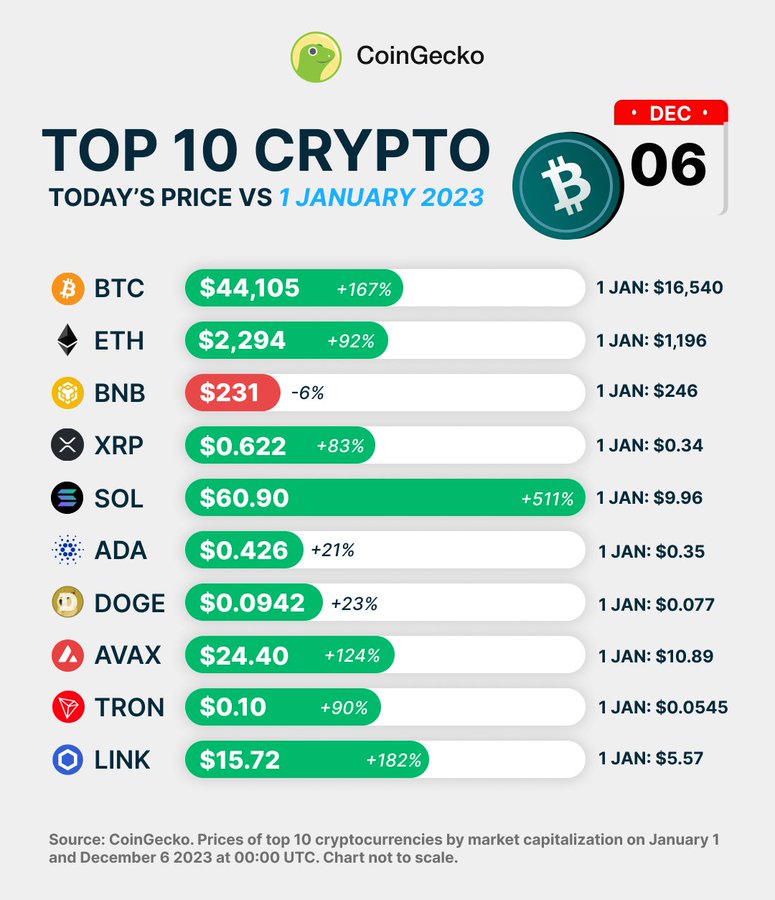
Emerging from the crypto winter, 2023 has seen a dramatic twist in the price action of the top cryptocurrencies. Here’s how the top 10 most capitalized coins performed Year-to-Date (YTD).

The compilation made by Coingecko underscores how much dynamism lies in the crypto ecosystem, with gains ranging from a 6% slump for Binance Coin (BNB) to a gain of 511% recorded by Solana (SOL). The impressive market performance also pegs Binance Coin as the only crypto in gains from January 1 to December 6 when it compiled the data.


How Did the Big Coins Fare?

Bitcoin (BTC) opened the year with a price of $16,540, with its price of $44,105 as of December 6, it has grown by 167%. The basis for this growth is understandable, seeing that the coin was the subject of Bitcoin ETF hype from the 3rd quarter to date. 

Ethereum opened the year at $1,196 and, after several corrections, has grown to $2,294, registering an outstanding gain of 92%. Binance Coin’s slight price retracement from $246 at the beginning of the year to $231 is unprecedented, considering how growth-oriented the coin is per its positive ecosystem.

The 6% slump stems from the impacts of the regulatory challenges the exchange is facing in the US. While it has settled with the United States Department of Justice (DOJ) in a historic $4.3 billion charge, allegations of operating a security brokerage outfit by the SEC remain a headwind to deal with.

XRP’s recognition as a non-security fueled its 83% surge from $0.34 on January 1 to $0.622 as of December 6. Solana was the biggest of the coins profiled, with a 511% jump. By moving from $9.96 in January to $60.90 this month, SOL has ultimately broken free from the impacts of the FTX implosion.

More Altcoin Wonder Showcased

Cardano (ADA) managed a 21% growth by moving from $0.35 to $0.426, and Dogecoin (DOGE) recorded a 23% jump after shifting from $0.077 at the start of the year to $0.0942. The Shiba-Inu-themed meme coin could not hit the $0.1 price mark as of the time Coingecko compiled its data.

Avalanche (AVAX) pulled one of the most dramatic comebacks of the top 10 assets profiled, entering the elite mark atop its sustained 27% growth for the week. In the YTD period, it grew from $10.89 to $24.40, a massive 124% gain. Tron (TRX) mimicked this bullish trend with its 90% growth after moving from $0.0545 to $0.10.

Chainlink (LINK), as the dominant oracle, did not disappoint, ranking in second place with an 182% jump garnered when its price moved from $5.57 on January 1 to $15.72 as of December 6.

BitMEX Founder Backs Solana (SOL) to $100 Rally

0

Arthur Hayes has hinted at a possible altcoin season that could potentially push Solana (SOL) above $100.

One of the biggest performers in the top ten cryptocurrencies this year, Solana (SOL), has enjoyed tremendous growth. The crypto asset has gained more than 500% since January, while the Solana DeFi ecosystem has topped the charts in terms of new capital attracted in the past month.

However, former BitMEX CEO Arthur Hayes hints that there might be more to come for SOL holders. Hayes, who has returned to his primary role as a sophisticated crypto trader since leaving BitMEX, thinks Solana will rise above $100 soon.

While Hayes’s primary comment suggests that such a rise could happen as soon as over the weekend, The prediction seems to stem from an expectation of an “alt-season” in the crypto market. 

Will Solana (SOL) Thrive In the Altseason?

The term “alt-season” describes a period in the crypto market where so-called alternative coins to Bitcoin deliver more returns than the leading digital asset. 

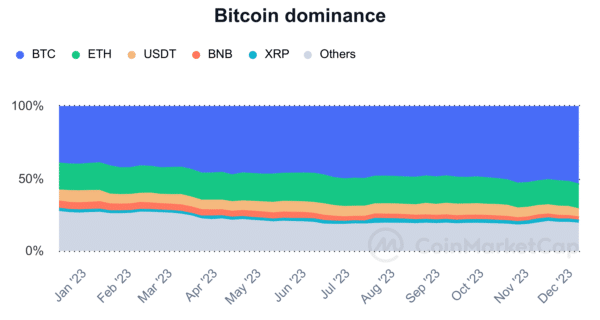
So far, Bitcoin has largely outperformed other crypto assets, growing its market share and dominance as bullish sentiment returns. Since late December 2022, Bitcoin’s share of the global crypto market has jumped from 39.30% to nearly 54%.

bitcoin dominance Coinmarketcap
Bitcoin dominance Coinmarketcap

The rise in Bitcoin dominance is primarily a result of less speculative behavior in the crypto market. During a bearish market, investors historically consolidate their holdings in the apex crypto asset, with newcomers also allocating a significant portion of their portfolio to BTC.

Yet the return of bullish market sentiment (as it has been since the start of the year’s final quarter) often sees Bitcoin lead the race. Afterward, altcoins have their stint in the spotlight, with gains first accruing to majors and then to smaller cap assets.

It is evident that under such favorable market conditions, Arthus Hayes expects Solana (SOL) to grow its value further. The last time SOL traded above $100 was in April 2022, leading up to the infamous Terra (LUNA) collapse.

Meanwhile, SOL is trading around $63.5 at the time of writing, representing a 5.5% increase in the past seven days. SOL has also cemented its position as the sixth-largest crypto by market cap. Its $27 billion market cap is slightly higher than its closest blockchain rival, Cardano, which has a market value of $15.4 billion.

JPMorgan Cites XRP and Ripple as Players in Unlocking $120B Value Trapped in Cross-Border Payments

0

JPMorgan, a prominent global financial services firm, released a report concerning unlocking $120 billion value in cross-border payments, citing XRP and Ripple.

Notably, the report sought to elaborate on how banks could leverage central bank digital currencies for corporate purposes.

JPMorgan highlighted that multinational corporations transfer approximately $23.5 trillion internationally each year. The firm noted that this value constituted around 25% of the global GDP. 

However, to facilitate these massive transactions, the multinationals depend on cross-border payment systems that fall short in cost-efficiency, speed, and transparency. 

Furthermore, JPMorgan mentioned that these sub-optimal processes generate substantial annual transaction costs of $120 billion. Also, it noted that the system triggers additional expenses related to foreign exchange conversion, trapped liquidity, and delayed settlements.

Screenshot 2023 12 07 111313
Cross-Border Payment Value and Trapped $120 billion | JPMorgan report

Ripple and XRP Among Efforts to Solve Cross-border Payment

Meanwhile, JP Morgan noted several private sector entities like Ripple, SWIFT, and the CLS Group have undertaken efforts to address the challenges of cross-border settlement and delays.

As for the CLS Group, the report noted that it features a multi-currency FX net intended to eliminate settlement risks. However, the solution only supports 18 currencies, with significant challenges to adding more.

Furthermore, the report highlighted that SWIFT established a system to enhance transparency in cross-border payments and reduce processing time.

However, it pointed out that SWIFT still depends on the antiquated correspondent banking system involving multiple intermediaries. Consequently, the challenges of trapped liquidity and settlement risk persist.

On the other hand, JPMorgan acknowledged the real-time nature of Ripple’s cross-border payment infrastructure that uses XRP as a settlement instrument. The issue it cited with Ripple’s system is cryptocurrency’s inherent volatility. 

“High volatility of XRP leading to limited willingness from banks in using it to facilitate payments,” the statement read.

As a result, JPMorgan concluded that the efforts of various private sector entities to solve the challenges in cross-border payments have been merely a partial success.

“We are yet to see a scalable and seamless solution that can work across countries, currencies, and payment systems,” the report claimed.

In response, JPMorgan proposed that a multi-currency central bank digital currency (mCBDC) network could serve as a viable blueprint to address multiple issues concurrently. 

It claimed the approach has the potential to make 24/7, real-time cross-border, cross-currency payments a tangible and achievable reality.

Analytic Firm Mentions Good Sign For Cardano As ADA on Track to $0.75

0

Cardano (ADA) is seeing impressive on-chain activity that has pushed its price by 7% to almost its 2023 high.

With the rally, ADA is now worth $0.4545 with a market capitalization of $15,524,358,829. The coin’s trading volume complements this growth, soaring by 26.23% to $15,524,358,829. 

The bullish growth of Cardano comes despite the protracted losses some altcoins are recording today. According to crypto analytics provider Santiment, the current resurgence in Cardano might be fueled by a hoard of small traders selling off their bags to the whale holders.


Cardano Shift in Ownership Trends

Per the Santiment data, the shift in ownership of ADA is a positive development for Cardano. 

The price of ADA has grown concerning the transfer of ADA from smallholders to whales. Per the chart shared, funded Cardano wallets with at least 0 balance hit an almost 4-month peak around November 18 before tanking significantly in the period between November 14 and November 22.

In this period, a total of 32.1K ADA wallets were liquidated. This liquidation was also recorded in the three days leading to December 7, where a total of 223 ADA wallets were liquidated. A common trend observed by Santiment was that some of the wallets selling did so at a loss, a move that is ultimately beneficial to the whales.

What Comes Next for ADA?

Intrigued by the bullish move in ADA, top market analyst, Ali Martinez highlighted how the coin reflects a similar growth pattern recorded in the 2018 – 2020 trajectory, discounting the COVID-19 era.

While volatility is still a major consideration, Martinez confirmed that if the historical patterns hold, it may breach the $0.45 resistance level. However, this is not the ultimate target for ADA, as Martinez, alongside other analysts, believes a push toward the $0.75 by late December cannot be ruled out.

If achieved, the $0.75 price will be the biggest ADA valuation since May 2022.

Ripple and Bhutan CBDC Partnership to Enter Pilot Phase in 2024

0

The collaboration between Ripple Labs Inc. and the Central Bank of Bhutan to create a Digital Ngultrum will enter the pilot phase in 2024.

The plan for this next phase was detailed in a Policy Brief detailing the key agenda to transform the Bhutanese economy into a vibrant and self-sustaining one.

With the Central Bank Digital Currency (CBDC) or Digital Ngultrum a key part of its plans, the apex bank is optimistic the alternative currency can truly make a difference to the average Bhutanese.

Bhutan CBDC: Key Timeline to Watch

The Bhutan CBDC project started as early as 2021, with Ripple Labs playing a frontline role. So much has been achieved since the project was commissioned, with three distinct phases completed from 2021 to date.

Ripple and the Bhutan Central Bank have carried out a needs assessment to highlight how a Digital Ngultrum will benefit the masses. After completing this needs assessment phase, the project went on to carry out the CBDC design and scoping, after which it then carried out the “technical design and proof of concept.”

With Ripple playing a frontline role every step of the way, the project is now slated for Pilot implementation starting next year. This next phase is bound to progress until 2026, according to the schedule of events in the Policy paper.

The goals for this pilot phase and the entire Bhutanese CBDC push are summarized in determining how a Digital Ngultrum is deployed and integrated into existing financial infrastructures in the country.

Having developed the technology to facilitate both retail and wholesale CBDCs, Ripple Labs’ solutions will enable the transition of these systems and further bolster the drive toward financial inclusion.

CBDC Race Might Heat Up Soon

According to the International Monetary Fund (IMF), at least 100 countries are actively researching or developing CBDC in one form or another.

While different countries have unique reasons for developing their own digital money, the need to quickly update their financial infrastructures and not lag may heat the push for CBDCs in the coming year.

While countries are still deciding whether or not to launch CBDCs, players like Ripple Labs and Mastercard are already a step ahead in researching innovative ways to power the interconnection between these CBDCs for cross-border payments when they eventually go live.