Home Blog Page 175

They Lied to You about $100 XRP in 2025: Analyst

Prominent XRP commentator Zach Humphries has pushed back against extreme price predictions surrounding XRP.

In a recent video, he stated that many investors have been misled by unrealistic expectations, such as a $100 XRP in 2025. However, the coin continues to trade under $1.4 today.

Meanwhile, Humphries explained that his decision to hold XRP is not due to speculative targets like $20,000 per coin or the belief that market cap is irrelevant. Instead, he views XRP as a strategic way to gain exposure to the future of crypto adoption.

Key Points

  • Zach Humphries says he holds XRP for adoption, not $20K price targets or market cap hype.
  • Many XRP price predictions, like $100 in 2025, mislead investors, Humphries warns.
  • XRP adoption may rise even in recessions, despite short-term downside pressures.
  • Ripple’s strategy and XRP’s role are misaligned; long-term gains come from utility, not hype.

Speculation vs Reality in XRP Narratives

Humphries noted that a major issue within the XRP community is the tendency to jump to extreme conclusions during uncertain macroeconomic periods. According to him, narratives suggesting that a recession would immediately trigger a massive XRP price rally misunderstand how markets behave.

He argued that both bullish and bearish conditions can exist simultaneously. For instance, a recession could create short-term downside pressure on assets like Bitcoin and XRP. It could also accelerate long-term adoption as financial systems face stress.

Essentially, focusing too much on the optimistic side without considering associated risks could harm investors.

Disconnect in Ripple and XRP

Another key point Humphries raised was a disconnect between Ripple as a company and XRP as an asset. He noted that Ripple continues to expand its focus into emerging areas like AI and tokenization. However, XRP’s role within that strategy is not always clearly aligned in the minds of investors.

He added that although cross-border payments remain a valid use case for XRP, the space is becoming increasingly competitive. Stablecoins and large banking institutions are dominating that segment, potentially limiting XRP’s direct influence there.

Long-Term Opportunity Despite Short-Term Risks

Despite his criticism of exaggerated price predictions, Humphries maintained a constructive long-term outlook. He emphasized that periods of economic stress often act as “pressure tests” that reveal which technologies and use cases are truly valuable.

In his view, while a recession could lead to short-term losses, it may ultimately strengthen XRP’s relevance as outdated financial systems are forced to evolve.

However, he cautioned investors against overexposing themselves based on hype. He stressed that sustainable gains come from understanding how different market scenarios can unfold.

Ultimately, Humphries concluded that the biggest opportunities in crypto markets often emerge not from consensus, but from recognizing shifts in utility and adoption before they become widely accepted.

T54ai CEO Explains Why XRP and XRPL Are Built for the AI Agent Economy

The conversation around the future of AI-driven finance is gaining traction, and according to industry leaders, XRP and the XRP Ledger may be at its center.

In a recent podcast discussion, Evernorth CEO Asheesh Birla and T54.ai CEO Chandler Fang outlined why blockchain, and specifically XRPL, is uniquely suited to power the emerging AI agent economy.

Key Points

  • AI-driven finance is rising, with XRP and XRPL emerging as central infrastructure for the AI agent economy.
  • AI agents need 24/7 automated payments, making blockchain like XRPL ideal over traditional bank systems.
  • XRPL offers microtransaction-friendly fees and fast settlements, enabling scalable AI-native financial activity.
  • Ripple’s global network and XRPL integrations support a trusted, agentic economy for international AI transactions.

Why AI Agents Need Crypto Infrastructure

Fang explained that traditional financial systems don’t work well for AI agents. Unlike humans, AI runs nonstop and interacts through APIs, not apps or interfaces. So it needs a system that works 24/7, like an “internet of money.”

Banks and older systems have limited hours and rely on manual processes, so they can’t keep up. Blockchain, on the other hand, is always on, automated, and easy to program, making it a better fit for AI-driven transactions.

XRP Ledger’s Edge: Cost and Efficiency

Fang emphasized that cost is one of the most critical factors for AI-driven transactions. Based on T54.ai’s experience processing over 20 million agent-native transactions, most of these payments are microtransactions.

This is where XRPL stands out.

Transactions on the network cost fractions of a cent, often with multiple zeros after the decimal, making it economically viable for agents to transact at scale.

High fees or slow throughput on other chains would make such use cases impractical, but XRPL’s design enables fast, low-cost settlement that aligns with the needs of automated systems.

Ripple’s Network and Global Reach

Beyond cost, Fang pointed to the more expansive ecosystem built by Ripple as a major advantage.

Ripple’s established network of financial institutions and cross-border payment corridors provides AI agents with access to a global financial infrastructure. This includes connections to hundreds of destinations worldwide, enabling seamless international transactions.

He also highlighted the growing ecosystem around XRPL, including stablecoin integrations and treasury management capabilities, which expand the range of use cases for both supply and demand sides of the economy.

Building the Agentic Economy on XRPL

Combining ultra-low fees, high speed, and deep financial integrations, Fang argued that XRPL is uniquely positioned to support “trusted agentic economy.”

As AI agents increasingly handle tasks like payments, trading, and resource allocation, the need for efficient, scalable financial rails will only grow. In this context, XRP and XRPL are emerging not just as payment tools, but as foundational infrastructure for a new class of digital economic activity.

Overall, the idea is that the next big wave in crypto may be driven not just by people, but by AI systems that need quick, cheap, and global ways to move money.

Grok Confirms No Forced XRP Sell-Off for Ripple Under Clarity Act 20% Rule

Fresh commentary from AI tool Grok is reshaping how the XRP community views the potential impact of the Clarity Act and the widely debated 20% holding threshold.

According to insights shared by Brad Kimes, Grok suggests that Ripple may not be required to sell off or reduce its XRP escrow holdings solely to comply with the proposed legislation. This reasoning hinges on XRP’s new classification and how the bill defines “control” within a blockchain system.

Key Points

  • Grok analysis suggests Ripple may not need to sell XRP to comply with the Clarity Act 20% rule.
  • The 20% threshold is a guideline, not a strict cap, for determining blockchain “maturity.”
  • XRP’s status as a commodity reduces regulatory pressure from ownership concentration.
  • Ripple’s 38.5B XRP holdings may not trigger forced sales if it lacks decisive network control.

20% Threshold Not a Hard Limit

Grok’s analysis highlights a key distinction that challenges earlier fears in the XRP community. The 20% supply threshold in the Clarity Act is not a strict cap forcing divestment. Instead, it serves as one of several factors to determine whether a blockchain qualifies as a “mature system.”

Under the bill, maturity depends on conditions such as decentralization, open-source infrastructure, and functional utility, not just token concentration.

While holding more than 20% of the supply may raise questions about control, it does not automatically trigger a legal obligation to sell or burn tokens.

This interpretation directly counters earlier speculation that Ripple could be forced to offload over 14 billion XRP from its escrow to meet the requirement.

Commodity Status Changes the Equation

A major factor in Grok’s conclusion is XRP’s recognition as a digital commodity, placing oversight under the Commodity Futures Trading Commission rather than the U.S. Securities and Exchange Commission.

This transition significantly reduces regulatory pressure tied to ownership concentration. Once a blockchain system is certified as “mature,” it benefits from lighter compliance requirements. Moreover, it benefits from clearer secondary trading rules and stronger protections for decentralized finance and self-custody.

Certification Process and Flexibility

Notably, the Clarity Act allows blockchain projects to demonstrate that they are “mature”. Regulators can review and challenge this, but they do not rely on strict rules; they consider the overall situation.

Guidelines can also be adjusted when needed, and the law provides projects with time and safe harbors while they become more decentralized.

Revisiting Ripple’s Escrow Debate

This latest perspective adds a new layer to the long-running debate over Ripple’s escrow holdings, which continue to stir concerns about centralization. Ripple currently holds over 33.5 billion XRP in escrow, exceeding the 20% reference point.

When adding 5 billion XRP in spendable wallets, the total rises to 38.5 billion XRP, close to 40% of the total supply.

Commentators have suggested solutions like large institutional sales, restructuring escrow, or even burning tokens. However, this new perspective from Grok suggests those steps may not be necessary. This alleviates a major concern around massive XRP sales, which could impact price.

XRP Has Solved Some of the Tokenization Problems Recently Identified by the IMF: Validator

0

An XRPL validator says XRP addresses some of the concerns recently raised by the IMF regarding the adoption of tokenized finance.

The International Monetary Fund (IMF) recently shared a note on tokenization and blockchain technology, stressing that while the idea shows promise, it could also bring risks to the global financial system. Reacting to this, Vet, a vocal validator on the XRP Ledger, argued that XRPL already solves some of the issues the IMF pointed out.

Key Points

  • The IMF stated that tokenization enables instant settlement, automation, and real-time liquidity, fundamentally transforming how financial systems operate.
  • However, it also warned of multiple issues that it may pose due to its speed, complexity, and potential for market fragmentation.
  • XRPL validator Vet argues that XRPL solves the compliance concerns through features like XLS-80 and XLS-81.
  • He added that instead of complex systems requiring 190 liquidity pools for 20 central banks, a neutral bridge asset like XRP could be a better choice.

IMF Lists Key Risks in Tokenized Finance

In the recently released note, the IMF said risk is the biggest concern with tokenization. While it reduces some traditional issues like counterparty risk, it also brings new ones. 

For instance, due to transactions, margin calls, and liquidations happening instantly, market stress could lead to rapid sell-offs and sharp volatility before regulators can react.

The note also warned that real-time settlement could remove traditional buffers, meaning institutions must always have enough liquidity, which increases the risk of sudden shortages. Also, shared systems may become single points of failure.

The IMF also argued that errors in smart contracts or data feeds could cause automatic failures, while systems like margin calls may worsen downturns by forcing simultaneous selling. It further raised concerns about weaker economies losing control over their currencies due to foreign stablecoins.

XRPL Already Addresses Compliance Issues

In response, Vet said the IMF made a major mistake by not considering built-in compliance features on XRPL, especially its Permissioned DEX and Permissioned Domain. He argued that these features already solve the compliance concerns the IMF raised.

Vet noted that the IMF prefers institution-controlled permissioned blockchains over permissionless ones because of KYC and AML requirements. 

However, he said XRPL has already solved this through upgrades like XLS-80 and XLS-81, which introduced Permissioned Domain and Permissioned DEX earlier this year. These features allow compliant trading, lending, and other financial activities to happen directly on-chain.

The XRPL validator also called attention to decentralized identity (DID) and credential systems, saying they support even more use cases and improve compliance within the XRPL system.

XRP as a Neutral Bridge

Speaking further, Vet agreed with the IMF that liquidity fragmentation is a real problem. He stressed that the IMF suggests using synthetic central bank digital currencies (sCBDCs), which private issuers would create but back with central bank reserves, to deal with risks like money market runs.

However, he argued that the IMF did not fully address the settlement asset issue. In its model, central banks would need to provide liquidity for every stablecoin pair. He explained that if 20 central banks are involved, this would require 190 liquidity pools, making the system difficult to manage.

Vet questioned whether central banks would realistically agree to so many bilateral arrangements, especially given current trust issues. Instead, he suggested a simpler approach: using a neutral bridge asset to bring liquidity together without needing multiple agreements. Notably, XRP could act as this neutral bridge.

Hoskinson Demands Apology from Cardano Operator Over Midnight Launch

Tensions are rising within the Cardano ecosystem following the mainnet launch of Midnight, a privacy-focused partner chain backed by $200 million.

Midnight enters the market with features such as zero-knowledge proofs, which enable shielded transactions. It positions itself as a major infrastructure expansion aligned with Cardano’s long-term growth strategy.

However, instead of being a smooth milestone, the launch has sparked a public clash between community members and Cardano founder Charles Hoskinson.

Key Points

  • Cardano tensions rise after Midnight launch sparks debate over bridge design and one-way asset flow concerns.
  • Critics warn Midnight could drain ADA liquidity, while supporters call it a major step for growth and privacy.
  • Hoskinson defends Midnight’s value, urging critics to apologize amid growing backlash within the community.
  • A whale swaps 940K ADA for 4.14M NIGHT, signaling early confidence despite ongoing controversy.

Bridge Design Sparks Backlash

The controversy centers on how Midnight’s bridge works. Critics say that, for now, assets can move from Cardano into Midnight, but not back. They argue this setup could pull liquidity away from ADA instead of strengthening the ecosystem.

Dave, a well-known Cardano stake pool operator, strongly criticized the design. He said it could hurt Cardano and argued that Midnight offers fewer features than the main network. He also questioned its value, saying it doesn’t yet do anything Cardano can’t already handle.

The debate has since grown. Community member Pyro called out Charles Hoskinson’s response, warning that his tone could make things worse. Another voice, Dagnum, backed Dave and said his long-time support for ADA deserves respect and an apology from leadership.

It’s worth noting that Midnight’s bridging functionality appears to be rolling out in stages. While full bidirectional transfers may not yet be available, the system is designed to eventually allow assets to move both ways between Cardano and Midnight.

Hoskinson Fires Back

Meanwhile, Hoskinson pushed back strongly. He said Midnight is an important project that could bring billions of dollars into the Cardano ecosystem. He warned that ignoring it could hurt Cardano’s future growth.

Meanwhile, Hoskinson asked Dave to apologize, comparing the situation to past internal disputes that slowed progress.

Dave refused, asking what he did wrong and calling for clearer details on how Midnight will actually add value. He pointed out a key issue: if money can only move out of Cardano into Midnight, it’s unclear how value flows back.

This dispute highlights broader concerns about how new projects connect to existing networks. While Midnight aims to improve privacy and scalability, its launch has raised questions about liquidity, incentives, and overall alignment with Cardano.

Whale Swaps 940K ADA for 4.14M NIGHT After Midnight Launch

While controversy continues among Cardano ecosystem developers, whales are already making major moves following Midnight’s launch.

As The Crypto Basic reported, a Cardano whale swapped 940,000 ADA (~$225K) for 4.14 million NIGHT shortly after Midnight’s mainnet went live. The wallet now holds 4.43 million NIGHT and has realized about 57,727 ADA (~$14K) in gains at the time of the report.

Some praised the move as strategic, while others criticized it as abandoning ADA, noting that Midnight is meant to complement, not replace, Cardano.

Backed by Charles Hoskinson, Midnight aims to bring privacy-focused DeFi to Cardano, with features like selective disclosure to attract institutional adoption.

XRP Falling Wedge Presents One of the Best Buying Opportunities

0

While XRP continues to record declines, its multi-month falling wedge may present one of the best buying opportunities.

XRP remains under selling pressure, with its price down 28.49% since the start of 2026. This extended drop has kept investors cautious, but data suggests the resulting falling wedge structure could present an attractive buying setup, targeting $8.3.

Key Points

  • XRP has followed a falling wedge pattern since the ongoing downtrend began in July 2025.
  • During this period, the price has dropped from $3.6 to $1.3 after reacting at the upper and lower trendlines.
  • XRP could again retest the upper trendline at $1.8 before witnessing a pullback toward $0.83, an intersection of the lower trendline and the Atlas Line.
  • If XRP respects the Atlas Line, a confirmed breakout could drive a larger move toward $8.30.

XRP Falling Wedge Presents Buying Opportunity

This is according to a recent analysis from market commentator EGRAG Crypto. Notably, he pointed out that XRP is trading within a falling wedge, a pattern that often leads to potential bullish recoveries, amid the ongoing downturn.

From October 2025, XRP has now recorded six straight months of declines, its longest losing streak since 2014. The trend has continued into April, where XRP is already down 1.81%, putting it on pace for a seventh consecutive monthly loss, the first in history.

The falling wedge structure started forming after XRP dropped from the $3.6 high in July 2025. It includes a descending resistance line at the top and a support line at the bottom, with the price moving between both levels. XRP has tested these lines several times, showing that the pattern holds.

XRP Falling Wedge EGRAG Crypto
XRP Falling Wedge | EGRAG Crypto

According to EGRAG, while the chart looks bearish at first, it may actually present one of the strongest buying opportunities, as the price continues to compress within this structure.

Historical Reactions Within the Wedge

The wedge has already reflected several key price movements. During the infamous market crash on Oct. 10, 2025, XRP fell from $2.8 to $1.378, touching the lower trendline. This level held as support and pushed the price back above $2 shortly after.

In early 2026, XRP attempted a recovery and climbed to $2.41 on Jan. 6, 2026, where it tested the upper trendline. However, it could not break through, and the resistance led to another pullback.

The pressure continued in early February 2026, when XRP dropped to $1.1 by Feb. 6, 2026. Once again, the price touched the lower trendline, and support held firm, leading to another bounce. These repeated reactions show how important both trendlines have been in guiding the price.

Critical XRP Price Levels and the Atlas Line

At the moment, XRP trades around $1.3, sitting within the wedge. The next possible move could take it toward $1.8, where it would test the upper resistance again. However, this level may be difficult to break and could lead to another rejection.

If the price fails at $1.8, the chart suggests a possible drop toward a major long-term upward sloping support trendline called the Atlas Line, which aligns with the wedge support at about $0.83. 

After reaching $0.83, data from EGRAG’s chart indicates that XRP could bounce back above $1, then pull back again to test the Atlas Line around $0.91 before making a stronger upward move.

XRP Breakout Conditions and Long-Term Target

After retesting the $0.91 support, data shows XRP could then push toward the upside target at $8.30, which confirms the large breakout move if the bullish case plays out. At the same time, EGRAG also highlighted $0.83 as the major bottom level within the current structure.

However, the chart shows that if XRP closes above the upper trendline at $1.80, this would cancel the falling wedge pattern and negate the current setup. In addition, a drop below the Atlas Line support around $0.83 to $0.91 would indicate deeper weakness and raise the risk of further decline.

Coinomi Integrates StealthEX for Instant 2,000+ Asset Swaps: Limitless Trading for the Self-Custodial Era

0

The landscape of digital asset management is undergoing a tectonic shift. As the mantra “not your keys, not your coins” moves from a niche warning to a foundational principle for millions of global users, the demand for sophisticated, in-wallet financial services has never been higher. Leading this charge is Coinomi, one of the industry’s most storied multi-asset crypto wallets, which has recently supercharged its ecosystem through a strategic integration with StealthEX, a premier non-custodial instant cryptocurrency exchange.

This partnership brings a massive liquidity injection and asset variety to Coinomi users, allowing for the seamless exchange of over 2,000 cryptocurrencies without ever relinquishing control of private keys or undergoing intrusive registration processes.

The Evolution of In-Wallet Swaps: From Complexity to Convenience

For years, the “crypto experience” was fragmented. To trade assets, a user typically had to navigate a cumbersome cycle:

  1. Withdraw funds from a hot or cold wallet to a Centralized Exchange (CEX).
  2. Wait for multiple network confirmations.
  3. Complete mandatory KYC (Know Your Customer) checks that often involve sharing sensitive personal data.
  4. Execute the trade, paying both network and platform fees.
  5. Withdraw the new asset back to a private wallet for safekeeping.

This friction didn’t just cost time and money; it created a significant security risk. Every minute an asset sits on a centralized platform is a minute it is subject to the exchange’s security protocols, withdrawal limits, or potential insolvency.

The industry has evolved toward Self-Custody 2.0. Modern users demand the security of a private wallet with a built-in exchange. The Coinomi and StealthEX integration represents the pinnacle of this evolution. By embedding the StealthEX API directly into the Coinomi interface, the “middleman” of the centralized exchange is eliminated. Users can now react to market volatility in seconds, swapping between thousands of pairs while their assets remain protected by Coinomi’s battle-tested security layer.

A Deep Dive into the Integration: 2,000+ Reasons to Swap

The standout feature of this integration is its sheer scale. While many in-wallet swap services limit users to a few dozen popular assets (like BTC, ETH, and stablecoins), the StealthEX integration opens the floodgates to the long-tail of the crypto market.

Unparalleled Asset Variety

Coinomi users can now access over 2,000 coins and tokens. This includes:

  • Major Blue-Chips: Seamless transitions between BTC, ETH, USDT, and XRP.
  • Privacy Coins: Secure swaps involving assets like ZEC and XMR.
  • DeFi & Emerging Gems: Hundreds of low-cap tokens and “hidden gems” that are often difficult to find on mainstream exchanges.

The User Experience: Precision and Speed

The integration is designed for both the “crypto-native” and the beginner. The process is elegantly simple:

  1. Select: Choose the asset you have and the asset you want.
  2. Verify: View the transparent exchange rate and estimated arrival time.
  3. Confirm: Since it is non-custodial, the swap is executed directly on the blockchain via StealthEX’s liquidity providers.

Technical Performance and Liquidity

The integration utilizes StealthEX’s high-throughput API to ensure that users receive competitive rates. In the world of instant swaps, slippage, the difference between the expected price of a trade and the price at which the trade is executed, is a critical metric.

Through StealthEX, the slippage is kept to a minimum. By aggregating liquidity from multiple sources, the integration ensures that even during periods of high market volatility, users can execute large trades without the significant price impact usually seen on smaller DEXs.

About StealthEX: Privacy and Freedom as a Service

Launched in 2018, StealthEX has carved out a reputation as a privacy-centric powerhouse in the exchange space. Unlike traditional platforms that require accounts, passwords, and identity verification, StealthEX operates on a “no-registration” model.

Key Features of StealthEX:

  • Non-Custodial Nature: StealthEX does not hold user funds. It acts as a bridge, ensuring that the exchange happens “wallet-to-wallet.”
  • Unlimited Swaps: There are no arbitrary upper limits on how much a user can exchange, making it a preferred choice for “whales” and institutional-grade users seeking privacy.
  • Security Vetting: Every asset listed on StealthEX undergoes a rigorous assessment to ensure network stability and legitimacy before being offered to the public.

StealthEX has spent years building a robust network of partners, integrating its API into respected names. By joining forces with Coinomi, StealthEX further democratizes access to a borderless, private financial system.

Coinomi: The Gold Standard of Multi-Chain Security

To understand the impact of this integration, one must look at the foundation provided by Coinomi. Established in 2014, Coinomi is one of the oldest and most respected wallets supporting multiple blockchains in existence.

A Legacy of Zero Hacks

In an industry where security breaches are a weekly occurrence, Coinomi boasts a legendary track record: zero hacked wallets since its inception. This is not due to luck, but rather a relentless focus on privacy-first engineering.

Why Users Trust Coinomi:

  • Ultimate Privacy: There is no IP linking, no identity binding, and no transaction tracking. Coinomi’s servers anonymize requests by hiding your IP address from prying eyes.
  • Extreme Versatility: With support for multiple blockchains and tokens, Coinomi is the “all-in-one” hub for the modern investor.
  • Standard-Setting Growth: Recent data indicates that Coinomi’s focus on user experience is paying off. The platform has seen a 50% Year-over-Year (YoY) growth in Monthly Active Users (MAU).
  • Increased Trust: Perhaps more impressively, the Average Order Value (AOV) for in-wallet swaps has increased by 90% since mid-2024. This suggests that users are not just using this non-custodial mobile wallet for small trades, but are trusting it with significant capital for their exchange needs.

By adding StealthEX to its roster of providers, Coinomi reinforces its status as a premier “super-app” for crypto, a single place where you can buy, store, stake, and now, swap an almost limitless variety of assets.

The Future of Self-Custodial Finance

The partnership between Coinomi and StealthEX is more than just a technical update; it is a statement of intent for the future of decentralized finance (DeFi). It proves that the security of cold-storage-like custody can coexist with the liquidity and speed of a professional trading floor.

As regulatory pressure on centralized exchanges continues to mount, the shift toward non-custodial crypto exchanges within privacy-focused wallets is inevitable. Users no longer want to choose between safety and opportunity. They want both.

Through this integration:

  • The Investor gains access to 2,000+ assets instantly.
  • The Privacy Advocate maintains their anonymity without KYC.
  • The Security Enthusiast sleeps soundly knowing their private keys never left their device.

The barrier to entry for the “untouchable” crypto portfolio has been lowered. Whether you are swapping Bitcoin for a new Layer-1 protocol or diversifying into emerging DeFi tokens, the Coinomi-StealthEX bridge is your most powerful tool.

Summary of Benefits at a Glance

  • Feature: Coinomi + StealthEX Integration
  • Asset Selection: 2,000+ Cryptocurrencies
  • Custody Type: Non-custodial (You own your keys)
  • KYC Requirements: None (No registration required)
  • Slippage: Minimized via high-throughput API
  • Wallet Security: 10-year track record with zero hacks
  • Privacy: IP masking and no identity linking

Experience the future of trading today.

Download or update your Coinomi wallet and explore the vast liquidity of StealthEX directly from your dashboard.

Disclaimer: This Press release article is provided by the Client. The Client is solely responsible for this page’s content, quality, accuracy, products, advertising, or other materials. Readers should conduct their own research before taking any actions related to the material available on this page. The Crypto Basic is not responsible for the accuracy of info and any damage or loss caused or alleged to be caused by the use of or reliance on any content, goods, or services mentioned in this press release article.

Please note that The Crypto Basic does not endorse or support any content or product on this page. We strongly advise readers to conduct their own research before acting on any information presented here and assume full responsibility for their decisions. This article should not be considered investment advice.

Crypto Trading Volume Hits $20.5T in Q1 2026 as Derivatives Dominate, Binance Tightens Grip

The crypto market processed a massive $20.57 trillion in trading volume in the first quarter of 2026.

Meanwhile, beneath the surface, activity is showing signs of cooling and is becoming increasingly concentrated in derivatives and on top exchanges.

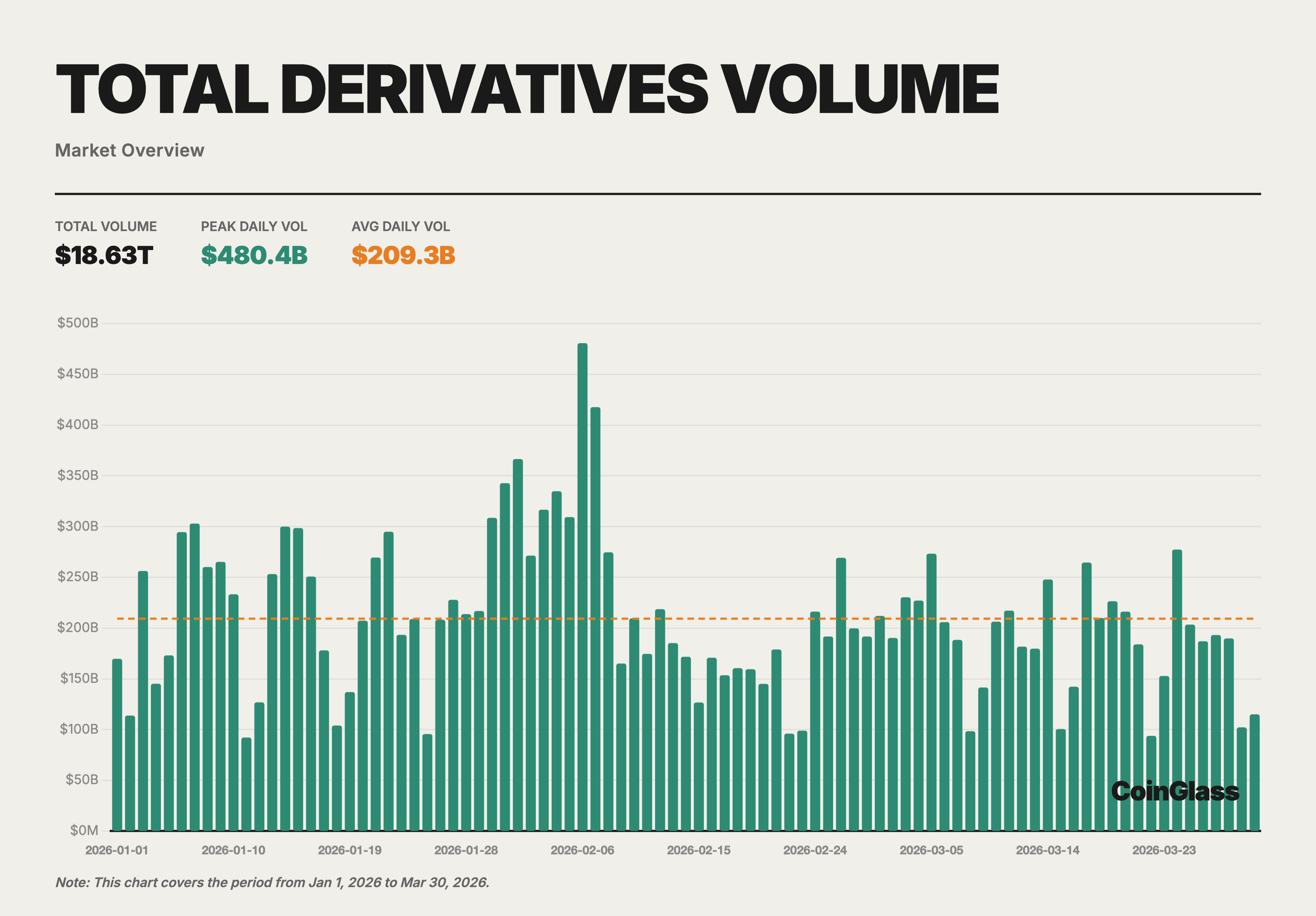
Data from CoinGlass reveals that derivatives trading accounted for a staggering $18.63 trillion of total volume. This figure dwarfs the $1.94 trillion recorded in spot markets.

Notably, the derivatives-to-spot ratio held near 9.6x. This highlights a growing preference among traders for leverage, hedging, and short-term positioning rather than direct asset accumulation.

Key Points

  • Crypto trading hit $20.5T in Q1 2026, but most activity shifted to derivatives, not spot markets.
  • Derivatives reached $18.6T vs $1.9T spot, showing strong demand for leverage and short-term trades.
  • Volumes declined after January, reflecting caution following late 2025 market deleveraging.
  • Binance led with ~35% share, as trading becomes more concentrated among top exchanges.

Market Activity Slows After January Peak

Trading activity declined steadily through the quarter. January recorded the highest volumes before tapering off in February and hitting a low in March. This slowdown reflects lingering caution across global markets following the sharp deleveraging event in late 2025, which continues to weigh on investor risk appetite.

On average, daily derivatives trading reached around $209.3 billion, compared to just $21.8 billion in spot markets. This further highlights where liquidity is flowing during this phase of market adjustment.

Total Derivatives Volume Coinglass
Total Derivatives Volume | Coinglass

Binance Extends Dominance Across Markets

Meanwhile, Binance maintained its commanding lead in both spot and derivatives trading.

In derivatives, Binance posted approximately $4.9 trillion in volume, securing a 34.9% market share among top exchanges. Its lead is particularly striking, with trading volume exceeding the combined total of key rivals OKX and Bybit.

The exchange also dominated in user assets, holding about $152.9 billion, far ahead of competitors. This highlights strength not just in trading activity, but also in capital retention and liquidity depth.

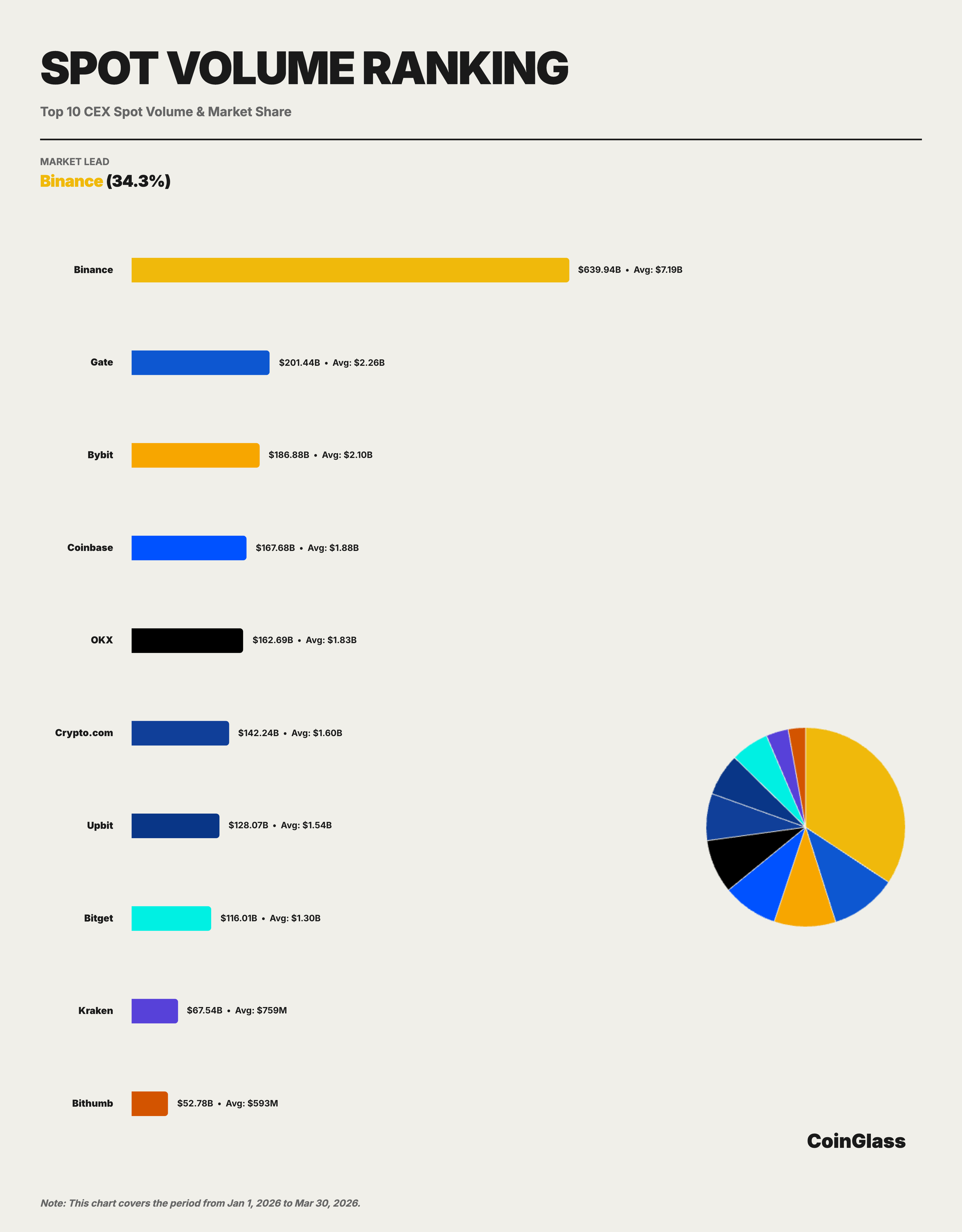
In spot markets, Binance recorded $639.9 billion in volume, capturing roughly 34% of market share. Notably, even as total spot volume declined by over 20% during the quarter, Binance’s share slightly increased.

Spot Volume Ranking Coinglass
Spot Volume Ranking | Coinglass

Second-Tier Exchanges Compete as Gap Widens

Behind Binance, OKX remains the closest challenger in derivatives, though its volume still trails significantly at roughly 45% of Binance’s level.

Meanwhile, Bybit, Gate.io, and Bitget continue to compete closely, particularly in derivatives and open interest metrics. In the spot market, competition is more evenly distributed, with platforms like Coinbase also maintaining a solid presence.

However, a noticeable gap has emerged between the top five exchanges and the rest of the market, suggesting increasing centralization of trading activity.

Decentralized Players Begin to Break Through

One of the more notable developments in Q1 was the rise of decentralized derivatives platforms. Hyperliquid entered the top 10 exchanges by derivatives volume, recording approximately $492.7 billion.

This marks a shift in market structure, as on-chain derivatives platforms begin to compete more directly with centralized exchanges. Still, their overall scale remains significantly smaller than that of industry leaders.

Ultimately, the CoinGlass’ Q1 2026 report confirms that crypto trading remains very active, but most of it now occurs in derivatives rather than spot markets. Activity is also becoming more concentrated on a few big platforms.

Big exchanges like Binance are pulling further ahead, showing the market is consolidating rather than spreading out.

Cardano Founder Gives Stamp of Approval to New Midnight Ad

0

Cardano founder Charles Hoskinson is in love with a new Midnight ad highlighting the need for privacy in blockchain technology.

Whether it is a marketing stunt or genuine admiration, a new Matrix-themed advertisement for Midnight has caught the Cardano founder’s attention. He reshared the 47-second clip in his Friday X post with the caption, “I love these new Midnight ads.”

Key Points

  • Cardano founder Charles Hoskinson is in love with a new Midnight ad highlighting the need for privacy in blockchain technology.
  • He reshared the 47-second clip in his Friday X post with the caption, “I love these new Midnight ads.”
  • The clip highlighted why privacy matters in a heavily monitored blockchain space and how Cardano’s sidechain, Midnight, comes in.
  • Midnight, a fourth-generation, privacy-centered blockchain, utilizes ZK proofs to address data protection challenges.
  • The Cardano founder sees Midnight as the missing piece for mainstream crypto adoption.

Midnight Preaches Privacy, the Cardano Founder Agrees

The clip highlighted why privacy matters in a heavily monitored blockchain space. The main theme of the ad was that privacy is eroding and that users can stay ahead of the curve with Midnight.

The blockchain is a public ledger, meaning that every transaction is recorded and can be monitored by everybody globally. While this is one of its perks as an emerging technology, data could land in the hands of bad actors.

Meanwhile, the clip featured two major characters in the famous Matrix movie, Neo and Morpheus, and part of the scene where the latter explained the concept of the matrix to Reeves.

After the explanation in a voice-over that every click, search, and purchase was monitored, it offered a lifeline: selective disclosure. One either allows them to track their activities or select what information is available for access.

Information in the Wrong Hands Can Be Detrimental

A session of the ad also emphasized that the wrong personal information in the hands of bad actors can be detrimental. It redirected events of crypto heists, physical kidnaps, and robberies involving cryptocurrencies to undue access to users’ on-chain activities.

Data breaches are also another pressing issue, as users’ personal and financial details are leaked, further increasing risk. The clip painted Midnight as a solution to these drawbacks.

Midnight, a fourth-generation, privacy-centered blockchain and Cardano sidechain, utilizes zero-knowledge (ZK) proofs to address data protection challenges. It draws a balance between compliance and data privacy, allowing selective disclosure while using the blockchain.

Midnight Mainnet Launch

The network launched on the mainnet on March 30 after months on the beta testnet. Hoskinson sees the Cardano sidechain as the missing piece for mainstream crypto adoption.

With its data privacy and protection, institutions and major players accustomed to information sensitization in traditional markets are now encouraged to enter the digital asset rails with comparable or even stronger protections.

Meanwhile, the technology is already gaining traction. In March, Monument became the first UK-regulated bank to tokenize retail deposits on a public ledger, doing so on the Midnight network.

Grayscale Lists Altcoins Currently Presenting “Potentially Compelling Entry Points”

Grayscale recently shared a report suggesting that the current market situation may present “potentially compelling entry points” for altcoins.

The crypto market has struggled amid the downturn that started in Q4 2025, as sentiments turn sour. Despite this, asset manager Grayscale Investments believes the current situation may present a chance for investors to enter the altcoin market at more favorable levels.

Key Points

  • The crypto market has been in a downturn since Q4 2025, but Grayscale says current altcoin prices may present strong entry opportunities.
  • Crypto has shown relative strength recently, with the Grayscale Crypto Sectors Index gaining 4% in March.
  • The total crypto market cap has risen by $25.93 billion, up 1.15% this week, to reach $2.29 trillion.
  • Altcoins remain heavily discounted, down about 59% from their highs since January 2024.
  • Despite this, Grayscale maintains that the market has not yet confirmed a bottom.

Grayscale Identifies “Potentially Compelling Entry Points”

Grayscale shared these findings in its latest market report. The firm emphasized that choosing the right time to invest is never easy, especially with ongoing war-related tensions affecting the global economy. 

However, it noted that several major altcoins now trade at levels that look appealing. The report specifically mentioned assets such as Ethereum (ETH), Solana (SOL), Chainlink (LINK), Sui, and Avalanche (AVAX) as examples.

Grayscale also highlighted the recently improving market performance. Over the past month, crypto assets have shown some strength, as traditional markets struggled. For instance, the S&P 500 dropped by about 5% in March, while the Grayscale Crypto Sectors Index rose by roughly 4% during the same period.

Crypto Market Showing Newfound Resilience

The firm said this contrast could mean that crypto assets have been oversold and are now stabilizing amid still-positive fundamentals. This may explain why prices have held up better than expected in recent weeks.

Data from the global crypto market cap index (TOTAL) confirms the bullish situation. After the latest market drop, TOTAL has started to recover, with the current weekly candlestick turning green. The market has added $25.93 billion over the week, a 1.15% increase, bringing the total value to $2.29 trillion.

TOTAL 1W Chart
TOTAL 1W Chart

The altcoin market cap index, TOTAL2, has also moved higher, rising by 0.63% and adding $6.26 billion during the same period. At the same time, the red bars on the MACD histogram in the weekly TOTAL chart have begun to shrink. This suggests that while sellers are still in control, their pressure is starting to weaken.

Historical Valuation Indicates Undervaluation

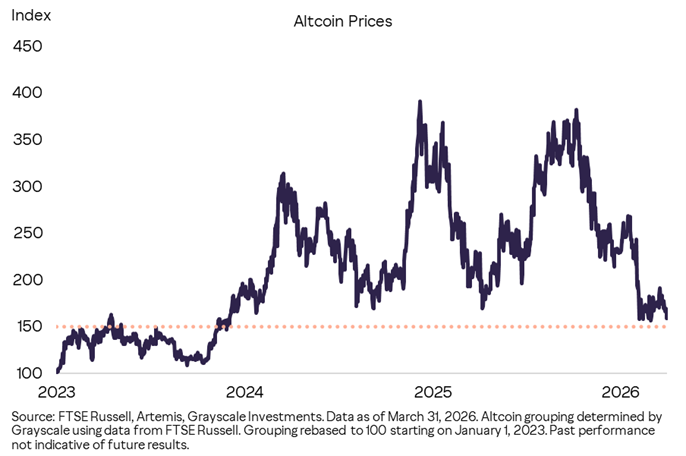
Looking at past performance, Grayscale noted that altcoins remain below their previous highs. Since the launch of crypto exchange-traded products in January 2024, its altcoin basket has declined by about 59% from its peak and has gained only around 2% from its lowest point.

Grayscale Altcoin Basket

This places current prices close to the lower end of their three-year range. While the firm expects volatility to continue, it said that these lower levels could present a good entry point compared to recent history. Although Grayscale said it cannot confirm that the market has reached its bottom, it sees recent price movements as a positive sign.

Notably, a previous report from The Crypto Basic referenced CryptoQuant data, which shows how much pressure the altcoin market is under. Specifically, more than 40% of altcoins are now trading close to their all-time lows, indicating deep losses across the sector.

While Bitcoin has remained relatively stable, major altcoins such as Cardano, XRP, and Solana are far below their previous peaks, with some like ADA down as much as 92%. 

Interestingly, most analysts also believe the current downturn could create opportunities. However, they insist that investors need to be careful and focus on stronger projects, as competition in the altcoin market continues to increase.

Altcoin Trading Strategy

Elsewhere, crypto market veteran Michaël van de Poppe shared a similar suggestion while discussing his approach to altcoins. He said he is currently keeping 50% of his portfolio in AI-related altcoins.

According to him, if Bitcoin drops further, altcoins will likely fall as well. However, he expects them to recover more strongly when the market turns upward. Based on this, van de Poppe confirmed that he continues to invest regularly using a dollar-cost averaging strategy, adding to his positions every month.