Home Blog Page 200

North Carolina Lawmakers Push to Invest Public Funds in Bitcoin with New Bill

0

Lawmakers in North Carolina have introduced a bill that could integrate Bitcoin into the state’s financial framework.

Specifically, the proposal would allow a portion of public funds to be invested in Bitcoin. The move is part of an effort to modernize financial management and explore digital assets as a long-term store of value.

If adopted, the move would position North Carolina among a growing number of states that are reconsidering traditional asset allocation models.

Key Points

  • North Carolina lawmakers have introduced Senate Bill 327, aiming to allow the State Treasurer to invest in Bitcoin.
  • Under the bill, up to 10% of public funds could be invested, with strict rules governing its use and liquidation.
  • Governance measures include oversight by a specialized Treasurer division and a Bitcoin Economic Advisory Board to ensure security and accountability.
  • Bitcoin could potentially be used to support public projects, back bonds, and fund economic development initiatives.

Bill Framework and Legislative Progress

The proposal, known as the North Carolina Bitcoin Reserve and Investment Act, has been filed as Senate Bill 327. It comes with the support of Senators Brad Overcash and Todd Johnson.

Notably, the bill has already passed its first reading in the state Senate and now awaits review by the Rules and Operations Committee. If it advances, the legislation would authorize the State Treasurer to allocate up to 10% of public funds into Bitcoin.

How the Bitcoin Reserve Would Operate

Under the framework, the Treasurer’s office would assume direct control of the reserve, providing unified oversight. Additionally, Bitcoin funds would be secured in offline wallets that require multiple signatures for access.

Furthermore, the bill calls for the creation of a specialized division within the Treasurer’s office to oversee custody and day-to-day management of the assets.

To strengthen accountability, a Bitcoin Economic Advisory Board would be established. This means that a panel of industry experts would provide strategic guidance and conduct monthly audits to review balances, system integrity, and overall performance.

Acquisition Strategy and Usage Limits

Alongside governance measures, the legislation outlines a structured approach to acquiring and managing Bitcoin. Purchases will take place on authorized U.S. exchanges, with timing aimed at maximizing market opportunities. The legislation also supports bulk-buying strategies.

In addition, the Treasurer is directed to explore Bitcoin mining as a potential way to expand state holdings over time.

Despite these investment plans, strict limits would govern the use of the reserve. Funds could only be deployed during periods of significant financial strain, for sanctioned investment opportunities, or to support public works and initiatives that promote economic growth.

The proposal also allows expenditures for research, educational programs, and business initiatives related to Bitcoin.

Strict Controls on Liquidation and Transparency

At the same time, the bill introduces significant safeguards around liquidation. For instance, disposal of any Bitcoin assets is contingent upon receiving approval from two-thirds of members in both legislative chambers.

Beyond serving as a reserve asset, the Bitcoin holdings could also be used to back bonds, thereby offering an alternative financing mechanism for public projects.

To ensure transparency, the Treasurer would be required to publish quarterly reports detailing the reserve’s value, status, and performance. These reports would be publicly accessible online.

Part of a Broader U.S. Trend

In a broader context, North Carolina’s proposal reflects a wider national trend toward exploring Bitcoin as a component of public finance. States such as Texas, Arizona, and New Hampshire have already taken steps in this direction.

Meanwhile, similar proposals are under consideration in Illinois and Michigan, with ongoing reviews in Pennsylvania and Utah. However, efforts in Florida and Montana have stalled.

Taken together, these developments highlight a growing interest among states in diversifying financial reserves and also considering Bitcoin as a potential hedge against economic uncertainty.
Cardano Enters Final Preparation Phase for Major Network Upgrade

0

Cardano is entering a critical phase in its upgrade roadmap as it prepares for the launch of Protocol version 11, dubbed the van Rossem hard fork. 

At the center of this transition is the anticipated release of Cardano Node 10.7.0, a critical software upgrade that will enable ecosystem-wide readiness and testing before deployment to mainnet. 

Key Points 

  • Cardano is approaching a critical upgrade phase as it prepares for the van Rossem hard fork tied to Protocol Version 11. 
  • Node 10.7.0, which is essential for the upgrade, is expected to roll out in a matter of days. 
  • A compatible DBSync version will follow shortly to ensure seamless data synchronization. 
  • The 10.7.x series will transition to Protocol Version 11 through phased testnet deployments before mainnet rollout. 

Cardano Nears Key Upgrade

According to an announcement from Intersect, Cardano is approaching a major upgrade milestone, with the Node 10.7.0 pre-release expected within days. This release represents one of two critical node versions required to activate Version 11, known as the van Rossem hard fork.

Previously, Node 10.6.2 initiated upgrade preparations in February. Node 10.7.0 will advance the process and move the network closer to activation.

Beyond basic hard fork readiness, Node 10.7.0 introduces new features and improvements that require ecosystem-wide integration and testing. Developers, infrastructure providers, and stake pool operators will all play a role in this phase. Meanwhile, Intersect hinted at plans to roll out additional minor updates depending on performance outcomes.

In addition, a compatible DBSync version is expected shortly after release to support seamless data synchronization. In the meantime, no serialization changes have been introduced, ensuring continued compatibility with hardware wallets and minimizing disruption.

Subsequently, the 10.7.x series will transition to Protocol Version 11, enabling staged upgrades across testnets before reaching the mainnet. 

Cardano upgrade
Cardano upgrade

New Capabilities Under Version 11

Once activated, Version 11 will introduce several new Plutus built-in functions at the protocol level, enhancing smart contracts and decentralized applications.

These include: Modular exponentiation (CIP-109), dropList operations (CIP-132), Multi-scalar multiplication using BLS12-381 (CIP-133), Array handling (CIP-138), and MaryEraValue support (CIP-153)

Notably, these features are already live for testing on the upgraded SanchoNet. At the same time, tools such as the Scalus smart contract tooling have been upgraded to support early development. 

Since the upgrade is structured as a non-disruptive intra-era fork, it preserves transaction formats while enhancing functionality and performance.

Timeline and Ecosystem Outlook

Although the exact launch date for Protocol Version 11 remains uncertain, speculation suggests a possible mainnet rollout later this month, following the launch of Midnight. In the meantime, Intersect plans to provide ongoing updates through its Discord channel.

Looking ahead, these developmental milestones strengthen the case for 2026 as a breakout year for Cardano.

With the van Rossem hard fork and Midnight approaching launch, Cardano founder Charles Hoskinson has also hinted at introducing Ouroboros Leios to improve network scalability. Similarly, broader efforts to expand DeFi activity and enhance competitiveness continue to gain momentum.

Veteran Analyst Shares XRP Conservative Bull Target After Final Shakeout

A veteran market watcher is pointing to a critical support level for XRP as the asset navigates what could be its final correction phase before a large breakout.

Tara, a long-time Bitcoin and XRP analyst active since 2015, says she is closely watching the $1.47 region. She describes it as a key macro level that could determine the next major move.

Key Points

  • XRP tests key $1.47 support, with analyst Tara calling it a “textbook” level that could mark the end of its correction phase.

  • Some analysts warn of a deeper shakeout, with downside targets between $0.70 and $0.93 still in play before a rally.

  • Despite short-term risks, Tara sets a conservative $9 target, implying over 6x upside from current price levels.

  • Long-term outlook stays mixed as XRP lags its $3.84 ATH, with recovery tied closely to market and Bitcoin strength.

XRP Macro Support

According to Tara, XRP is testing an important support level around $1.47. This level is significant because it aligns with a key Fibonacci retracement (0.618), which traders often monitor.

She described this as a “textbook” support area, suggesting that holding above it could imply the correction is nearing completion. This support also fits into the broader sideways pattern XRP has been moving within for months.

XRP Ripple price prediction bitcoin btc crypto market crypto charts crypto news technical analysis bullish pump dollar trump war iran oil gold commodity

Short-term charts show XRP pulling back after a push toward the $1.60 range, with the price now hovering just below $1.50. This places the asset right on top of the support zone Tara highlighted.

“Final Shakeout”

Tara’s outlook comes as other analysts warn that XRP may still face a deeper shakeout before a sustained rally begins.

Recent analysis from market commentator ChartNerd suggests XRP could revisit the $0.70–$0.80 range as part of a broader “triangle crossroads” formation.

This aligns with earlier discussions from analysts like Casi Trades, who identified potential accumulation zones between $0.87 and $0.93. Meanwhile, both Casi and Tara expressed doubt that XRP would necessarily revisit those lower levels.

Conservative Target: $9 and Beyond

Despite near-term uncertainty, Tara remains firmly bullish on XRP’s long-term trajectory. Responding to concerns from a community member about a possible drop to $0.87, she emphasized that any bottoming phase could present a significant opportunity.

Specifically, she pointed to $9 as a conservative upside target, representing over 6x gains from current levels.

Her projection echoes a growing sentiment among some analysts that XRP’s long-term potential is being underestimated. In previous discussions, Tara and Casi argued that expectations around $6 may be too modest, especially considering the asset’s nearly decade-long development cycle.

Long-Term Outlook Still Unclear

Some commentators argue that prices below $10 remain undervalued, citing the scale of global payments infrastructure and the increasing push toward faster settlement systems. Supporters believe blockchain-based assets like XRP could benefit significantly from this shift.

At the same time, skepticism remains around timing. While bullish projections continue to rise, many investors note that XRP has spent years below its 2018 all-time high of $3.84, testing the patience of long-term holders.

At this point, no one knows for sure whether the next move will be another dip or the start of a larger rally. Ultimately, XRP’s direction will depend on the overall market recovery from the ongoing bear phase, especially Bitcoin’s rebound.

75% of Ethereum on Binance Now Leveraged: CryptoQuant

A new market signal is flashing caution for Ethereum traders, as leverage levels on Binance surge beyond previous highs.

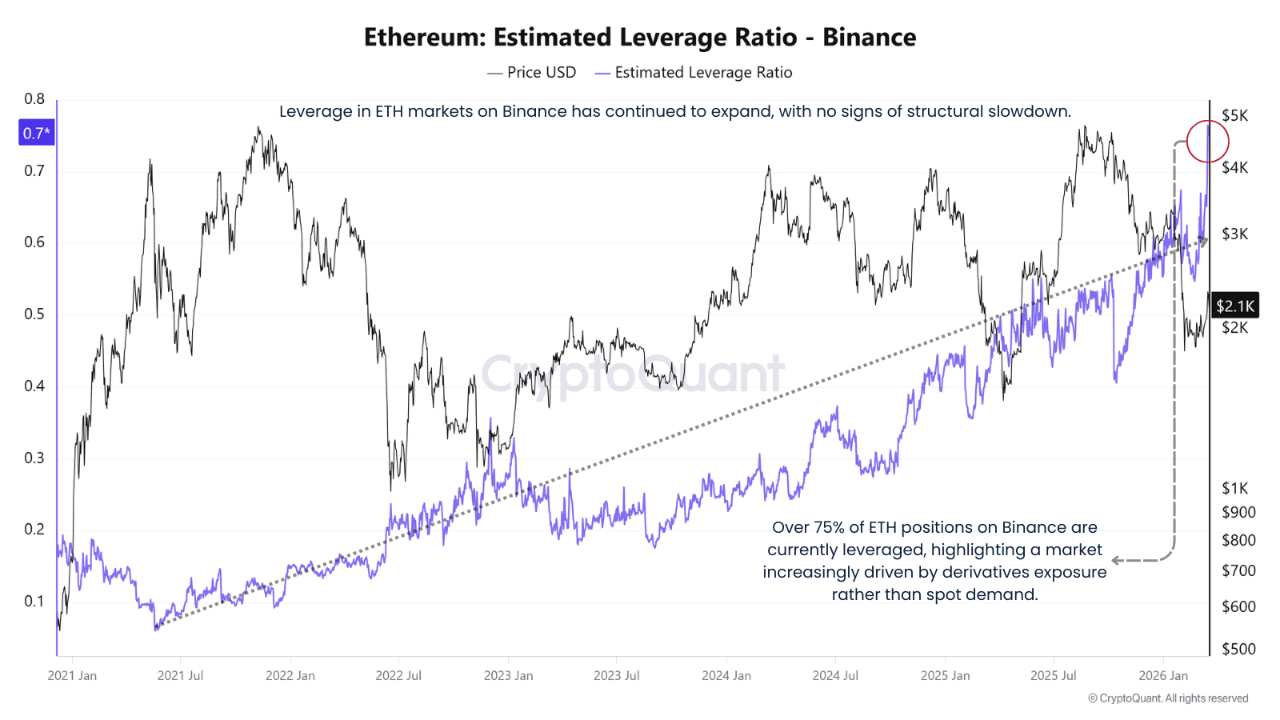
According to CryptoQuant analyst Moreno DV, roughly 75% of ETH exposure on Binance is now tied to leveraged positions. This marks a full recovery and expansion following the October 10, 2025, market-wide deleveraging event, during which $19 billion evaporated from markets.

Key Points

  • Ethereum leverage on Binance has surged to 75%, marking a full recovery since the October 2025 deleveraging event.

  • Binance is the only major exchange where ETH leverage has exceeded pre-deleveraging levels, signaling rising risk.

  • Analysts say recent ETH gains are driven more by futures trading than organic spot demand, increasing fragility.

  • High leverage and crowded positions raise the risk of sudden liquidations and sharp volatility if sentiment shifts.

Ethereum Leverage Surges Beyond Previous Highs

The data shows that Binance is currently the only major exchange where Ethereum leverage has not only rebounded but also exceeded pre-deleveraging levels. This points to a growing concentration of risk in the derivatives market.

Using the Estimated Leverage Ratio (ELR), a metric that compares open interest to exchange reserves, Moreno found that leveraged exposure now dominates ETH positioning on the platform. At the same time, Binance holds about 3% of Ethereum’s total supply, or roughly 3.4 million ETH.

Derivatives Driving Price Action

The rapid buildup in leverage suggests that Ethereum’s recent upside may be driven less by organic spot demand and more by aggressive futures positioning.

For context, ETH’s price briefly spiked to $2,384 this week. After a mild correction, the asset is still trading with an 8% gain on the monthly chart.

This relief rally may have contributed to the recently observed surge in leveraged Ethereum positions on Binance. It suggests the market is now heavily reliant on borrowed capital and short-term trading activity.

In this kind of setup, prices can rise quickly, but they can also fall just as fast, making the market more unstable.

quicktake-image

Fragility Risks Increase

With leverage building at a rapid pace and little consolidation, the market may be entering crowded territory. This often means too many traders are on the same side, increasing the risk of sudden sell-offs.

If sentiment changes or negative news emerges, it could trigger rapid liquidations and sharp price swings.

At the moment, leverage is driving Ethereum’s move rather than following it. While this can push prices higher in the short term, it also makes the market more vulnerable to sudden declines.

Long Squeeze Risk as Price Hits $2,100

Interestingly, a separate analysis confirms ETH is under pressure with over $2.5 billion in leveraged long positions at risk if the price falls below $2,000.

ETH dropped to $2,140 today, marking a 7% daily decline, while $144 million in ETH longs were liquidated in the past 24 hours.

ETH’s weakness follows the US FOMC decision to keep rates unchanged, highlighting macro-driven volatility that has historically caused 16–43% corrections after similar announcements.

Benjamin Cowen Says Everything in the Cryptoverse Eventually Bleeds Back to Bitcoin

0

Into the Cryptoverse founder Benjamin Cowen argues that despite innovation across the crypto market, value ultimately consolidates back into Bitcoin over time.

He shared this view in a recent X post. He highlighted Bitcoin’s first-mover advantage, deep liquidity, and growing institutional recognition as factors that keep it at the center of the ecosystem.

Key Points

  • Benjamin Cowen asserts that crypto value consistently rotates back to Bitcoin.
  • While altcoins often outperform during bull phases, he emphasizes that Bitcoin ultimately reabsorbs liquidity in later cycles.
  • Although Bitcoin has retraced much of its recent gains, it still maintains roughly 57% market dominance.
  • Sustained ETF inflows and ongoing corporate accumulation continue to reinforce Bitcoin’s long-term leadership.

Everything in Cryptoverse Bleeds Back to Bitcoin

According to Cowen, assets across the cryptoverse, including major altcoins and emerging protocols, tend to “bleed back” into Bitcoin within a cycle or two. His commentary suggests that while altcoins may outperform Bitcoin in the short term, capital often flows from these projects to Bitcoin over the long term.

Historically, this pattern unfolds in stages. First, Bitcoin rallies strongly as fresh capital enters the market. Afterward, investors rotate profits into altcoins in search of higher returns.

However, investors rotate that capital back into Bitcoin for stability, causing altcoin prices to bleed significantly. This cycle helps BTC reasserts dominance, absorbing liquidity from overhyped projects.

Historical Context

For instance, in November 2024, Bitcoin surged from about $70,000 to $100,000 amid macro-driven momentum. Meanwhile, capital rotated into major altcoins like Solana, which climbed to an all-time high near $295 in January 2025.

Nonetheless, Bitcoin regained momentum months later, eventually reaching a record $126,000 in October 2025 as both institutional and retail demand intensified. However, Solana failed to reach a new peak during the same period.

In the current bear market, while Bitcoin trades about 44% below its peak, Solana is down nearly 70%. Other altcoins, such as Shiba Inu, are faring much worse, trading at losses of over 90% from their highs.

Present Condition

This week, a similar dynamic emerged during a market relief rally. Although Bitcoin gained less than 10% over the week, altcoins such as Hyperliquid and XRP posted stronger double-digit gains. Even so, Cowen’s thesis suggests that, over time, such outperformance often fades as capital rotates back into Bitcoin.

Meanwhile, the broader market has pulled back. Bitcoin slipped below $70,000, while Ethereum dropped under $2,150. Despite this decline, Bitcoin continues to dominate the market, trading around $69,459 with a $1.38 trillion market cap and 57.74% dominance.

This strength is further supported by sustained institutional inflows into Bitcoin ETFs, alongside continued accumulation by firms like Strategy.

Ripple CTO Emeritus Speaks on the Chances of XRP Reaching $100

0

David Schwartz, Ripple’s CTO Emeritus, recently discussed the prospect of XRP reaching the ambitious $100 price level.

Responding to a question from an investor on the chances of XRP realistically hitting $100, the former Ripple CTO said if investors truly believed in extreme upside scenarios, such as XRP to $100 or Bitcoin to $500,000 within two years, large-scale buying would already have pushed prices higher, which has not happened.

Key Points

  • The XRP community has repeatedly discussed the prospect of XRP reaching the $100 mark, which remains ambitious, given current market realities.
  • With XRP currently trading for $1.45, the crypto asset would need to rise 6,796% to reach the $100 price.
  • Schwartz implied that if investors reasonably expected XRP to hit $100, large-scale buying from them would have already pushed prices much higher.
  • According to him, if large whales have not bought an asset to push its price higher despite bullish predictions, it’s because they do not believe those predictions.

The XRP to $100 Calls

Schwartz’s comments come amid consistent predictions from community figures that XRP has the chance of reaching $100. 

Notably, while XRP has largely traded between $1.2 and $3.5 since its November 2024 rally, investors continue to push the idea of a move to $100, making it one of the most talked-about long-term targets in the XRP community. 

Interestingly, one community figure, Jake Claver, had predicted that XRP would hit $100 by the end of 2025, but this forecast failed to play out. Instead, the price dropped further. With XRP now trading at $1.45, it would need a massive 6,796% increase to reach $100.

Bitcoin’s History Gives Hope to XRP Investors

Schwartz’s commentary on the matter came as he discussed how he and other Ripple insiders underestimated XRP’s potential to reach greater heights, especially when it traded for as low as $0.005 during its early stages.

The former CTO stressed that this pessimism was not limited to XRP but cut across the entire crypto market. According to him, he entered the crypto space at a time when Bitcoin traded for $2. If someone had asked him the chances of BTC reaching $100 then, he would have given a 10% chance.

XRP investors have also discussed such impressive growth from Bitcoin, leveraging it to argue that XRP, which currently trades for $1.45, could equally reach the $100 price someday. They believe the skepticism XRP currently battles with is the same Bitcoin faced when predictions of $100 emerged early in its history.

Schwartz Speaks on XRP Reaching $100

Riding on this optimism, an XRP community member asked Schwartz to give a clear and serious answer about the chances of XRP reaching $100, without avoiding the question. 

In response, Schwartz said crypto prices tend to make sense over the long term. He argued that if people truly believed an asset had a 70% chance of doubling within a year, the price would already reflect that belief because investors would buy early and push it higher. Schwartz admitted that not everyone agrees with him, but he maintains that view. 

He used Bitcoin as an example. According to him, if investors really believed there was a 50% chance of BTC reaching $500,000 within two years, wealthy investors would already be buying heavily. 

This kind of demand would likely push Bitcoin above $100,000 today. Since this has not happened, he believes the market does not truly expect such an outcome. He added that this same logic applies to all liquid and easily tradable assets. This includes XRP.

Essentially, the comment implies that if most investors really believe XRP could realistically reach $100 anytime soon, wealthy market participants would have already scooped up large amounts of XRP to benefit from that rally, and this would have pushed the price up. The fact that this large-scale buying has not happened yet means most investors don’t believe the forecast.

Market Veteran Insists Capital Will Not Rotate from Bitcoin to Gold as Both Pull Back

0

Market veteran Benjamin Cowen insists Bitcoin will not receive any capital rotation from gold, as it typically drops whenever gold struggles.

The crypto market has faced another roadblock to the latest recovery effort that began on Feb. 28, with Bitcoin (BTC) eventually losing the pivotal $70,000 psychological level after reaching $76,000 earlier this week.

Interestingly, the ongoing pullback experienced by Bitcoin occurs alongside a price crash suffered by gold (XAU), the largest asset in the world. This adds weight to a long-standing belief held by Benjamin Cowen, who insists capital rotation will not flow from gold to Bitcoin.

Key Points

  • Bitcoin has faced a roadblock to the latest recovery push, recently collapsing below $70,000, as it dropped 8.78% from the $76,000 peak earlier this week.
  • The recent Bitcoin correction comes amid a similar turbulence in the gold market, as the precious metal crashes 8.54% this week alone.
  • Cowen believes Bitcoin’s drop alongside gold’s market struggles confirms his theory that capital will not rotate from metals to Bitcoin.
  • The market veteran’s suggestion contradicts the belief among Bitcoin enthusiasts that BTC could eventually rally after capital rotates from precious metals.
  • Despite Bitcoin’s struggles, the crypto firstborn has begun gaining ground against gold after six consecutive weeks of declines.

Bitcoin Meets Roadblock Amid Latest Rebound

Cowen, who serves as the CEO of Into The Cryptoverse, discussed this amid Bitcoin’s latest pullback. For context, Bitcoin engineered its latest recovery campaign after initially collapsing in response to the escalation of the Israel-Iran conflict on Feb. 28.

Following a drop to $63,000, BTC rebounded almost immediately and maintained the uptrend until it faced its first roadblock at $74,000, corrected mildly, and then resumed the rally. After reaching $76,000 on March 17, Bitcoin has now corrected 8.54% from this peak, trading below $70,000.

Bitcoin 1D Chart
Bitcoin 1D Chart

Bitcoin’s Pullback Occurs Alongside Gold’s Crash

Benjamin Cowen pointed out that the latest Bitcoin pullback appears to be occurring alongside similar turbulence in the gold market. Citing this phenomenon, he reiterated his long-term belief that, for now, Bitcoin will not witness any capital rotation from gold.

For context, with Bitcoin dropping below $70,000, gold has extended a decline that began on the back of the Israel-Iran war, shattering its appeal as a safe haven for now. 

Specifically, gold has recorded two consecutive weeks of declines, and is on track to see a third one for the first time since last November. During this period, gold has collapsed 12.5%, losing the psychologically important $5,000 level, now trading for $4,616 per ounce. 

“No Rotation”

With gold correcting, crypto enthusiasts believe capital could rotate from the precious metal to Bitcoin, supporting Bitcoin’s price action, but that has not played out as expected. Amid this occurrence, Cowen called attention to a suggestion he made in late January, 

Notably, at the time, precious metals like gold and silver recorded impressive rallies, with gold reaching an all-time high of $5,597 on Jan. 29, and silver hitting a peak of $121 on the same day. Typically, after metals record such rallies and then pull back, capital often rotates into Bitcoin, giving the crypto market a boost.

While Bitcoin investors expected this phenomenon to occur when gold and silver correct, Cowen insisted that it may not play out this time. He pointed out at the time that just as capital did not rotate from Bitcoin to altcoins last year to kickstart the altcoin season, capital will also not rotate from metals to Bitcoin.

This suggestion faced pushback from market enthusiasts, who argued that it would turn out wrong. Interestingly, a day later, when gold dropped 4%, BTC also collapsed 4%, and Cowen ensured to highlight this. Now, gold is struggling, and Bitcoin has joined in the turbulence, prompting another response from the market veteran.

Bitcoin Gaining Ground Against Gold

However, despite Bitcoin’s latest pullback, market data confirms it has indeed continued to gain ground against gold. After witnessing six consecutive weeks of declines against gold from January to February 2026, Bitcoin has flipped the trend, recording two consecutive weekly gains.

Bitcoin Gains Ground Against Gold

Up 4.32% against gold this week, Bitcoin is now on track to print the third consecutive bullish weekly close, as it recovers from 12 ounces of gold early this month to 15 at press time. However, BTC/XAU still faces potential resistance at the middle and higher Bollinger Bands stationed at 18 and 26, with the price still well below them.

BestChange Announces Update To Its Referral Program: A Move To Strengthen Its Position as a Market Leader

0

Dubai, UAE – BestChange, a trusted name in cryptocurrency and financial market exchange monitoring since 2007, has officially announced significant updates to its referral program. The revised conditions are designed to improve partners’ earning potential.

According to the BestChange team, the new improvement will reinforce the platform’s long-standing commitment to transparency, reliability, and user value. The referral program introduces improved reward structures and more competitive terms. This has positioned it as one of the most profitable partnership opportunities currently available in the crypto and finance market.

The BestChange community members already recommend the new affiliate model for users to earn huge passive income in the crypto and finance market.

BestChange’s More Competitive Updated Referral Model

The newly revised affiliate program focuses on maximizing partner returns while maintaining clarity and fairness in its structure. Participants can now benefit from a multi-layered reward system, including:

  • Up to $5.00 for each attracted user.

  • Up to 30% of each AML (Anti-Money Laundering) check payment

  • 30% of referral income generated by users they bring to the platform

This structure allows partners to earn not only from direct referrals but also from ongoing activity within their network. This creates a sustainable long-term revenue model.

Basic Statistics Best Change

BestChange’s approach reflects broader market demand for sustainable and transparent affiliate systems. Unlike short-term promotional offers that often lack consistency, this updated referral model is built for long-term collaboration. This makes it particularly attractive for content creators, website owners, and digital marketers seeking reliable monetization strategies in the cryptocurrency and fintech space.

Flexible Promotion Opportunities

The newly revised BestChange affiliate model allows partners to promote its services across a wide range of platforms. Partners can now promote on websites, blogs, YouTube channels, Telegram communities, and social media accounts. The program is designed to reward clear, informative content that helps users understand the value of exchange monitoring.

Effective formats include step-by-step instructions, detailed reviews, checklists, and educational materials explaining how to use BestChange and how to conduct risk assessments of cryptocurrency addresses.

To support partners, BestChange provides ready-made promotional assets. These include texts, banners, and other materials, all accessible immediately after registration through the participant’s personal account.

Transparent Tracking and Partner Tools

The referral program is supported by a comprehensive personal account that gives participants full visibility into their performance. Within the account, partners can track:

  • User acquisition and action statistics.
  • Accrued rewards and commission history.
  • Available withdrawal options.

This level of transparency enables partners to monitor their growth and optimize their strategies.

Expanding Beyond Monitoring: A Growing Ecosystem

In addition to the referral program enhancements, BestChange continues to evolve as a comprehensive ecosystem for digital currency users. The platform has expanded far beyond its original monitoring service to include a suite of tools designed to improve accessibility and user experience.

These include a mobile app that lets users track exchange rates and opportunities on the go, a Telegram bot for quick updates and notifications, and a mini app that integrates seamlessly into messaging apps. Browser extensions further streamline the process, enabling users to access BestChange functionality directly from their web interface.

Meeting the Needs of a Changing Market

The cryptocurrency and digital payments landscape continues to evolve rapidly, with increasing demand for reliable infrastructure and transparent services. BestChange’s updated referral program reflects a strategic response to these changes, aligning partner incentives with the platform’s broader mission of delivering accurate and user-focused solutions.

By combining competitive payouts with a robust technological ecosystem, BestChange is positioning itself as a long-term partner for individuals and businesses operating in the digital finance space.

About BestChange

BestChange is a leading exchange monitoring platform established in 2007. It provides users with up-to-date information on cryptocurrency and electronic currency exchange rates, helping them find the most profitable offers across a wide range of services.

Over the years, the company has grown into a ‘one-stop’ ecosystem, offering a mobile app, Telegram bot, mini app, and browser extensions to enhance accessibility and usability. With its latest referral program update, BestChange reaffirms its commitment to innovation and transparency, further strengthening its position as a trusted player in the global crypto and fintech industry.

To register for the referral program, prospective partners must read the Terms and Conditions on the BestChange official page, then proceed to the registration page and complete the form.

Media Contact

Company Name: BestChange

Company Website

Social Media

X

Youtube

Disclaimer: This Press release article is provided by the Client. The Client is solely responsible for this page’s content, quality, accuracy, products, advertising, or other materials. Readers should conduct their own research before taking any actions related to the material available on this page. The Crypto Basic is not responsible for the accuracy of info and any damage or loss caused or alleged to be caused by the use of or reliance on any content, goods, or services mentioned in this press release article.

Please note that The Crypto Basic does not endorse or support any content or product on this page. We strongly advise readers to conduct their own research before acting on any information presented here and assume full responsibility for their decisions. This article should not be considered investment advice.

Everlight Shards Give Passive Crypto Holders Access to Real Network-Generated Rewards

The question most passive crypto income participants eventually run into is deceptively simple: where does the yield actually come from? Most passive income models in 2026 distribute rewards from inflationary token issuance, lending interest paid by borrowers, or liquidity provision fees — all of which depend on continued platform activity, token demand, or counterparty solvency to sustain themselves. The effectiveness of most passive income methods depends on the token’s market stability, the demand for liquidity, and the security of underlying smart contracts or custodial infrastructure — variables that can deteriorate simultaneously in a risk-off environment. Running a validator node removes some of those dependencies but introduces a different barrier: minimum stake requirements measured in hundreds of thousands of dollars, specialized hardware, and ongoing operational overhead that makes direct node participation viable only for well-capitalized institutional operators.

Everlight was built to address that gap — a validation network where participants connect to node-level reward economics through a single shard activation step, with no hardware requirements and no technical configuration of any kind.

The Infrastructure Layer Behind Shard Rewards

Everlight’s node layer handles three functions: transaction routing, network coordination, and reward distribution. When a transaction enters the network, nodes verify signatures and routing availability, manage quorum confirmation, and forward the transaction to its destination. Routing micro-fees generated by that process are allocated based on measurable performance data — how long a node stays online, how much routing volume it handles, how quickly it delivers transactions, and how consistently it completes them.

That performance-weighted distribution model is what makes the reward source structurally different from most passive income alternatives in 2026. The fee pool is produced by actual transaction throughput flowing through the infrastructure. As network usage grows, the pool available for distribution grows with it.

Shard holders connect to that fee pool without operating any of the underlying infrastructure themselves. The Everlight dashboard — accessible on desktop and mobile — handles everything technical on the user’s behalf, displaying live BTCL accrual during presale, tier progress, and native cryptocurrency reward tracking after mainnet launch.

Two Earning Phases, One Shard Position

Participation in Everlight spans two distinct earning phases, both accessible through the same shard position without any manual transition required.

During the presale phase, BTCL tokens are available at $0.0008 per token with a minimum entry of $50, accepted across more than nine cryptocurrencies. As a participant’s cumulative USD commitment builds toward a tier threshold, their shard position sits dormant until the threshold is crossed — at which point the shard activates automatically and BTCL rewards begin accumulating immediately. Those rewards continue throughout the presale period at a fixed APY determined by whichever tier is active.

When mainnet launches, the presale reward phase closes and the same shard position transitions automatically into live network participation. From that point, rewards are drawn from real transaction routing fee activity and distributed in native cryptocurrency.

Tier Structure and Network Credibility

Three shard tiers are available during the current presale phase. The Azure Shard activates at a $500 cumulative commitment and earns up to 12% APY in BTCL through the presale period. The Violet Shard activates at $1,500 with up to 20% APY — the most commonly activated tier on the platform — while the Radiant Shard activates at $3,000 with up to 28% APY and carries the highest network participation weight into the mainnet reward phase.

Everlight’s token supply is fixed at 21 billion BTCL with no inflation mechanism built into the protocol — a design choice that mirrors the scarcity model of the network it operates alongside. Of that supply, 45% flows directly to presale participants, 20% is reserved for node rewards and network incentives, and the remaining 35% is split across exchange liquidity, team vesting, and ecosystem development.

Independent verification of the project was completed before the presale opened, with dual smart contract audits through Spywolf and Solidproof, alongside KYC verification through Spywolf — all publicly linked from day one of the presale.

Phase 1 Is the Current Entry Window

Everlight is currently in Phase 1 of its presale — a phase running for 6 days, with 472,500,000 tokens available at $0.0008 per token. Participants who activate shards during this phase lock in at the earliest available pricing, begin accumulating BTCL rewards immediately, and carry their position into the mainnet native cryptocurrency reward phase without any additional steps required.

The platform, including the dashboard and live shard activation flow, is accessible here.

Disclaimer: This Press release article is provided by the Client. The Client is solely responsible for this page’s content, quality, accuracy, products, advertising, or other materials. Readers should conduct their own research before taking any actions related to the material available on this page. The Crypto Basic is not responsible for the accuracy of info and any damage or loss caused or alleged to be caused by the use of or reliance on any content, goods, or services mentioned in this press release article.

Please note that The Crypto Basic does not endorse or support any content or product on this page. We strongly advise readers to conduct their own research before acting on any information presented here and assume full responsibility for their decisions. This article should not be considered investment advice.

Bitcoin Resilient as Other Major Assets Crash on the Oil Boom: Possible BTC Scenarios

0

Bitcoin is not falling as much as other major assets in the global market, showing resilience in the midst of the oil boom due to geopolitical tension.

Notably, Bitcoin is struggling, as are most other global assets. The only exception here is oil, which has been barreling nortahward. However, BTC’s correction comes with a glimmer of positivity, as it has held up better than most analysts expected.

Key Points

  • Today, Brent oil surpassed $116, continuing its price expansion over the past few weeks.
  • In contrast, Bitcoin is down over 3% in the past 24 hours, falling below the $70,000 price mark again.
  • However, Bitcoin is not falling as much as other major assets in the global market, showing resilience in the midst of the oil boom due to geopolitical tension.
  • After facing a clear rejection near the $76,000 resistance on Tuesday, Bitcoin has drifted lower toward a key support zone between $69,000 and $70,000.
  • If prices stabilize here, it could create conditions for another push higher, especially if broader market sentiment improves.
  • If this support does not hold, attention shifts lower, with $60,000 and lower as the possible targets.

Oil, the Shining Light in a Bloody Market

Today, Brent oil surpassed $116, continuing its price expansion over the past few weeks. The growth followed a recent strike on oil refineries and gas plants in the Middle East.

Globally, oil prices have risen considerably as geopolitical tensions and supply concerns continue to support prices. Analyst Michael van de Poppe highlighted that the natural mineral has been the only shining light in a gloomy market. 

According to him, all assets, except oil, have been selling off in the past 24 hours. This divergence highlights the current uncertainty across global markets, as capital shifts toward oil, which analysts have tipped to become increasingly scarce as geopolitical tensions persist.

Bitcoin Correcting Too, but There’s a Catch

In contrast, Bitcoin has entered a corrective phase. The premier asset is down over 3% in the past 24 hours, falling below the $70,000 price mark again, after a string of bullish price action pushed it to $75,000 earlier in the week.

However, the pullback remains relatively controlled compared to broader market weakness, van de Poppe suggested. He noted that BTC has not corrected as much as he presumed, signaling its resilience in the face of uncertainty.

Data backs this sentiment. Specifically, gold is down over 9% in two days, correcting nearly 6% alone today. Silver is looking even worse, dipping 10% since the start of today. This means that the asset has now dropped 15% since Wednesday.

The US stock market is also bleeding, with $120 billion wiped out yesterday alone. The broader corrective move relative to Bitcoin highlights the cryptocurrency’s fair downside.

Key Bitcoin Support to Watch for a Rebound

After facing a clear rejection near the $76,000 resistance on Tuesday, Bitcoin has drifted lower toward a key support zone. The area between $69,000 and $70,000 is emerging as an important level for BTC, as it is critical for its short-term direction.

Bitcoin at Key Support Band/Michael Van de Poppe

This zone has previously served as a strong resistance, and holding above it suggests the current move is a healthy retracement. Holding it suggests the current downtrend is a mere retest rather than the start of a deeper decline.

Van de Poppe highlighted that if prices stabilize here, it could create conditions for another push higher, especially if broader market sentiment improves. Notably, a strong reaction in this region would indicate that buyers are still active despite broader market uncertainty.

What Happens If Support Fails

If this support does not hold, attention shifts lower. The analyst mentioned the next major support at the low $60,000s and even below. This area could act as a point where whales step in again to prevent further downtrend.

Meanwhile, this would see BTC reenter the range between $69,000 and $63,000 that defined its move for weeks between early February and March. In the meantime, the apex cryptocurrency trades at $69,800, aligning with the lower end of the support band. This keeps the hopes of a rebound alive.