Home Blog Page 264

XRP Will Take the #1 Spot from Bitcoin Within 6 Years: American Veteran

0

A former U.S. Army combat medic and entrepreneur has suggested that XRP could overtake Bitcoin as the largest crypto asset over the next six years.

This bold forecast came from Patrick L. Riley, who calls himself an acquired savant on X. Riley has persistently made bullish statements surrounding XRP, especially considering institutional adoption and price action, insisting that XRP has the potential to replace Bitcoin at the top.

Key Points

  • Since it kick-started the cryptocurrency market in 2009, Bitcoin has remained the largest asset in the space, maintaining a large gap with others.
  • While XRP still holds a much lower valuation than Bitcoin, XRP community figures have insisted that the altcoin has the potential to overtake the premier crypto asset.
  • Patrick L. Riley, an American veteran and XRP community influencer, believes XRP could take the no. 1 spot from Bitcoin within six years.
  • Currently, XRP changes hands at $1.42, with its $86 billion market cap far below Bitcoin’s valuation of $1.378 trillion.
  • XRP would have to rise to $22.6 to claim the $1.378 trillion market cap that would allow it challenge BTC for the top spot.

Bitcoin’s Current Market Position Relative to XRP

Riley’s latest comments come on the back of the ongoing market downturn that has pushed Bitcoin’s market value from an all-time peak of $2.52 trillion in October 2025 to the current $1.37 trillion. This indicates that Bitcoin has lost $1.15 trillion since the current downtrend began in Q4 2025.

Despite this, Bitcoin still maintains a large gap of more than $1 trillion between second-placed Ethereum at $242 billion. As for XRP, the market turbulence pushed its valuation from the $216 billion peak in July 2025 to the current $85.83 billion. With this, Bitcoin is nearly 16x larger than XRP.

Could Bitcoin Drop to $1,000?

Still, Riley believes XRP has the potential to overtake Bitcoin. In his recent commentary, the market commentator first called attention to three trendlines that have guided Bitcoin’s price action since launch. The first trendline, a red one, emerged when Bitcoin launched, while the second one, a green trendline, sprang up in 2014, essentially 12 years ago. The third purple trendline came up after the December 2017 peak.

XRP 1W Chart Patrick L Riley
XRP 1W Chart | Patrick L Riley

Notably, Bitcoin slipped below the 12-year-old green trendline when it dropped from the September 2021 high of $69,000. Since then, Bitcoin has failed to reclaim this trendline despite hitting a new all-time high of $126,000 in October 2025. For BTC to push above this trendline, its price must rise toward the $600,000 area, a 776% increase from here.

Amid the ongoing downtrend, Bitcoin has even slipped below the red trendline, which acted as support until late January this year. According to Riley, it is imperative that Bitcoin reclaims the green stationed around $600,000. According to him, if the premier crypto asset fails to do this, its price could drop to $1,000, representing a 98% crash.

XRP to Take Top Spot in 6 Years?

Speaking further, Riley argued that whether Bitcoin reclaims the trendline at $600,000 or drops to $1,000, XRP could still take the top spot from it. He suggested that this could happen within six years, putting the deadline in 2032. 

According to him, once XRP becomes the top crypto asset, this development would relegate Bitcoin to a mere “nostalgia collectible.” With BTC boasting a market cap of $1.37 trillion, XRP would have to rally to $22.6 per token to challenge it for the top spot. This would represent a 1,491% increase from the current price of $1.42. However, such an event remains highly speculative.

Riley has been known in the XRP community for making such audacious claims. For instance, last week, he suggested that Adam Back was Bitcoin’s enigmatic creator, Satoshi. Also, last month, he claimed that the Bitcoin price crash was an orchestration to prevent XRP’s price from breaking out.
Beginner’s Guide to Paying with Stablecoins Using Crypto Cards

0

Today, a lot of people are starting to keep part of their savings in stablecoins. But there’s still a simple question many people have: how do you actually spend this crypto on everyday things like groceries, subscriptions, or travel?

That’s where crypto cards come in. They let you spend stablecoins almost the same way you would use a USDT debit card. In this short guide, we’ll show you how crypto cards work and how you can start using them yourself.

What Are Stablecoins and Why Use Them for Payments?

Stablecoins are a type of digital currency whose value is tied to a stable asset — typically the US dollar. Thanks to their relatively steady price, they’re widely used both for saving funds and for everyday spending. Many users prefer stablecoins for money transfers and online payments, as transactions are generally faster, come with lower fees, and avoid the usual banking bureaucracy.

What Is a Crypto Card and How It Lets You Pay with Stablecoins?

A crypto card is a payment card that’s linked to your crypto wallet or platform account and allows you to spend stablecoins just as easily as regular money. When you pay in a store or online, your stablecoins are automatically converted into fiat currency (such as USD or EUR), so the merchant receives the payment in the usual way.

This means you can use your digital assets for everyday spending — including shopping, subscriptions, and travel — and even pay through Apple Pay or Google Pay if the card supports it. For the user, the process looks just like a normal bank card payment, while all the technical conversion happens in the background.

How to Start Paying with Stablecoins Using a Crypto Card?

Today, crypto cards make it possible to spend stablecoins as easily as regular money — in online stores, everyday services, and even offline via Apple Pay or Google Pay. If you’re just getting started, the process usually looks like this:

  1. Choose a platform that offers a crypto card that supports stablecoins such as USDT or USDC. This can be an exchange or a payment service. Some platforms issue virtual-only cards — for example, Cryptomus, where the card can be connected to Apple Pay / Google Pay and used for everyday purchases.
  2. Register and complete KYC verification.
    In most cases, you’ll need to verify your identity, as required by payment networks.
  3. Issue your card (usually virtual at first).
    After issuance, you receive the card details just like with a regular bank card.
  4. Top up the card with stablecoins — typically USDT or USDC.
    Funds are transferred from your crypto wallet or platform balance.
  5. Add the card to Apple Pay or Google Pay (if supported).
    This allows you to pay using your phone or smartwatch.
  6. Make purchases just like with a traditional bank card.
    Your stablecoins are automatically converted into fiat, and the merchant receives payment in their local currency.
  7. Manage the card through the app.
    You can usually view your balance and transaction history, receive notifications, and freeze or unfreeze the card when needed.

Practical Tips for Beginners

If you’re just starting to use a crypto card and pay with stablecoins, it’s best to move gradually and pay attention to the details. This will help you avoid unnecessary fees and common mistakes, especially in the beginning.

  • Start with a small amount. Make one or two small purchases first to understand how conversion works and what fees apply.
  • Be aware of fees in advance. Some platforms charge for loading the card, others for spending — both are normal, as long as you understand the structure.
  • Keep most of your funds in your wallet, not on the card. Treat the card like a spending account rather than long-term storage.
  • Enable notifications. Push alerts help you track every transaction and react quickly if something looks suspicious.
  • Use 2FA and freeze/unfreeze options where available. This is an easy way to increase account security.
  • Keep an eye on limits. Many cards have daily or monthly caps — it’s normal, just be aware of them.

Crypto cards that support stablecoins make using digital assets far more practical and closer to traditional banking tools. You can store your money in a stable currency while spending it just like regular cash — online, offline, and while traveling. 

At the same time, each provider has its own terms, fees, and features, so it’s important to understand how the card works and what role it plays in your everyday finances. When used thoughtfully, a crypto card can become a convenient and reliable way to manage everyday payments in a world where cryptocurrency is gradually becoming part of everyday life.

Disclaimer: This Press release article is provided by the Client. The Client is solely responsible for this page’s content, quality, accuracy, products, advertising, or other materials. Readers should conduct their own research before taking any actions related to the material available on this page. The Crypto Basic is not responsible for the accuracy of info and any damage or loss caused or alleged to be caused by the use of or reliance on any content, goods, or services mentioned in this press release article.

Please note that The Crypto Basic does not endorse or support any content or product on this page. We strongly advise readers to conduct their own research before acting on any information presented here and assume full responsibility for their decisions. This article should not be considered investment advice.

Varntix Introduces Stablecoin-Denominated Income Participation Model

0

Digital asset markets have gone through several cycles of sharp movement and long pauses. Each phase has pushed investors to rethink how they deploy capital. As volatility returns and fades, attention often shifts from short-term gains to income and planning.

Periods like these highlight a common issue in crypto. Many income options still depend on changing yields and constant monitoring. For investors thinking beyond quick trades, this creates uncertainty around returns and time commitment.

In response, interest is growing in more structured income approaches. These models focus on defined terms, clearer expectations, and reduced dependence on market swings. Varntix developed within this shift, offering a stablecoin-denominated income participation model built around predefined participation and long-term planning.

The limits of variable yield models

Most crypto income products depend on staking or lending. Returns often change without notice, and high yields in strong markets may fall quickly in weaker periods. This creates uncertainty for investors relying on steady income.

Variable models also demand constant monitoring. Investors must watch rates, protocols, and market signals. For larger allocations, this can be time-consuming and stressful. As a result, many participants are now seeking simpler, more structured solutions.

Why stablecoins matter for income

Stablecoins have become central to digital markets. They are widely used for trading, settlement, and treasury management. Their value remains close to the US dollar, making them easier to plan with than volatile tokens.

Income paid in a stablecoin gives clarity. Investors know the dollar value of what they will receive, removing confusion caused by price swings. For many, stablecoins are now the preferred unit for predictable crypto income.

Income participation versus staking

Income participation models operate differently from staking. Staking rewards depend on network activity and market demand. Income participation uses predefined terms and fixed rates, agreed before capital is deployed.

This structure mirrors traditional fixed income products. Investors know the duration and expected return, and there is less need for continuous decisions. Focus shifts from trading to long-term planning. By offering predictable returns, platforms like Varntix provide a stable foundation for crypto investors seeking structure.

Varntix’s stablecoin-denominated framework

Varntix has launched a stablecoin-denominated income participation model. It offers fixed interest rates set in advance, with investment terms ranging from six to twenty-four months. Income is paid in USDT or USDC.

Returns are not linked to short-term performance and remain constant during the investment period. This allows investors to calculate expected income early and supports a fixed income mindset. By combining clear terms with stablecoin payments, Varntix offers a more predictable alternative to traditional crypto income models.

On-chain execution and transparency

Varntix places its income instruments on-chain. Smart contracts handle interest payments and redemptions automatically, reducing manual processing and operational delays. This also improves visibility for participants.

Ownership records are stored on an immutable ledger. Payments follow predefined rules written into code, creating a clear audit trail. Investors can see how and when obligations are met. This level of transparency supports trust and predictability, key elements in fixed income investing.

Flexibility and early access to capital

Some income products lock capital with no options, limiting investor flexibility. Varntix allows early redemption without hidden penalties, supporting better personal liquidity planning.

Access to capital matters during uncertain markets. Investors may need funds earlier than expected. Flexible structures reduce stress in these situations, aligning with long-term fixed income thinking.

Treasury diversification as a design choice

Varntix manages a diversified digital asset treasury. Holdings are spread across multiple cryptocurrencies, unlike single-asset treasury models. Diversification is used to manage exposure, not chase returns.

A multi-asset approach reduces reliance on one market outcome. It reflects a broader risk management mindset. The goal is stability within a volatile asset class, which supports a more balanced fixed income structure.

What this says about the market

Stablecoin-denominated income reflects a maturing market. Investors are moving beyond short-term strategies and want clearer expectations with less daily involvement. Structured products like Varntix’s are gaining attention as a result.

Digital asset platforms are adapting to this demand. More emphasis is placed on predictability, transparency, and long-term planning. Income design now borrows from fixed income principles, signaling growing discipline in digital finance.

A shift toward structured digital income

The Varntix model highlights this broader transition. It shows how fixed income ideas are entering digital finance, offering clarity in uncertain markets. Stablecoin-based income provides predictable returns and transparency.

For investors, this shift makes digital assets more approachable. Platforms that prioritize structure over speculation help participants plan, budget, and allocate capital with confidence. Varntix’s approach reflects the growing importance of predictability in crypto wealth management.

Varntix is a digital wealth platform focused on fixed income in crypto and on-chain convertible notes. Learn more at varntix.com.

Disclaimer: This Press release article is provided by the Client. The Client is solely responsible for this page’s content, quality, accuracy, products, advertising, or other materials. Readers should conduct their own research before taking any actions related to the material available on this page. The Crypto Basic is not responsible for the accuracy of info and any damage or loss caused or alleged to be caused by the use of or reliance on any content, goods, or services mentioned in this press release article.

Please note that The Crypto Basic does not endorse or support any content or product on this page. We strongly advise readers to conduct their own research before acting on any information presented here and assume full responsibility for their decisions. This article should not be considered investment advice.

Binance Completes RLUSD Integration on XRP Ledger; Ripple Exec Reacts, “Let’s Go”

0

Binance has officially completed the integration of Ripple USD (RLUSD) on the XRP Ledger (XRPL), another milestone in Ripple’s expanding stablecoin strategy.

According to a February 12 announcement, deposits for RLUSD on the XRP network are now open. Withdrawals will be enabled once sufficient liquidity is available on the platform.

The update confirms that RLUSD is now live on XRPL within Binance’s infrastructure, strengthening the link between Ripple’s regulated stablecoin and the XRP ecosystem.

Key Points

  • Binance completes RLUSD integration on the XRP Ledger, enabling deposits.

  • Ripple exec Reece Merrick reacts, calling the move a major step forward.

  • RLUSD expands from Ethereum to XRPL, deepening XRP liquidity links.

  • Analysts say the update could boost XRPL activity and utility.

Ripple Executive Reacts: “Let’s Go”

Reece Merrick, Ripple’s Managing Director for the Middle East & Africa, reacted enthusiastically to the development. In a post on X, Merrick wrote “Let’s go,” celebrating Binance’s completion of RLUSD integration on the XRP Ledger network.

His reaction reflects Ripple’s internal delight as RLUSD expands across major exchanges and networks.

Meanwhile, prominent XRP community analyst EGRAG described the update as “very big”. The comment suggests market participants see deeper implications beyond just deposits going live.

From Ethereum First to XRPL Now

The latest move builds on Binance’s earlier listing of RLUSD. When Binance first announced support for the stablecoin in January, initial integration was on Ethereum. Supported trading pairs included RLUSD/U, RLUSD/USDT, and XRP/RLUSD.

At the time, Ripple CEO Brad Garlinghouse subtly reinforced XRP’s importance in a celebratory post. He described the listing as “eXtRemely Positive,” deliberately capitalizing X, R, and P — a stylistic nod widely interpreted as reaffirming XRP’s central role in Ripple’s strategy.

That message came amid community concerns that RLUSD’s expansion could overshadow XRP. However, Ripple leadership has repeatedly emphasized that XRP remains foundational to the company’s long-term vision.

Why the XRP Ledger Integration Matters

With Binance now completing RLUSD’s integration on the XRP Ledger itself, the ecosystem impact could be significant. The presence of RLUSD on XRPL within the world’s largest crypto exchange may:

  • Increase on-chain activity on the XRP Ledger
  • Strengthen liquidity in the XRP/RLUSD trading pair
  • Expand RLUSD’s utility in cross-border and institutional flows

Notably, RLUSD is a compliance-focused, enterprise-grade stablecoin. Its expansion into Binance’s deep liquidity pools shows that institutions are becoming more comfortable with Ripple’s ecosystem.

For XRP holders, the development may represent more than a technical update. As EGRAG put it, this is “very big.”

Bitcoin Approaching Historical Accumulation Phase as Price Bottom Nears

0

While still in the capitulation zone, history shows that Bitcoin is approaching levels at which it reaches its price bottom and begins to recover.

This would come as a relief to diamond-handed users who have held through the several months of price correction. Notably, BTC has been in a 4-month downtrend, and all indications point to a fifth unless the momentum shifts dramatically before the end of February.

Key Points

  • The Bitcoin Market Value to Realized Value (MVRV) Adaptive Z-Score dictates that BTC is in the capitulation phase.
  • At the time of the analysis, this metric lies at -2.66, which is within the capitulation band.
  • Despite this, the MVRV Adaptive Z-Score indicates we are approaching a historical accumulation phase, where Bitcoin bottoms.
  • If true, this is a strong buying opportunity for Bitcoin, as a swing in momentum could spark a bullish price turnaround.

Bitcoin in the Capitulation Phase

A recent analysis from on-chain analytics provider CryptoQuant identified an optimistic development for BTC as its correction persists. The analysis shared by verified author GugaOnChain uses the Bitcoin Market Value to Realized Value (MVRV) Adaptive Z-Score to dictate which phase the pioneering cryptocurrency is in the market cycle.

It identified that Bitcoin is in the capitulation phase, marked with intense volatility and a predominant bearish trend. Although it might see a relief rally at times, like the jump from $60,000 to $70,000 between February 5 and 6, the structure remains bearish.

Notably, the BTC MVRV Adaptive Z-Score measures whether Bitcoin is undervalued or not. It compares the market value to the asset’s realized value, which reflects the last price at which users moved their bitcoins.

At the time of the report, this metric lies at -2.66, within the capitulation band. For the uninitiated, an MVRV score between 0 and -3.0 is capitulation, while a score less than -3.0 is accumulation.

BTC MVRV Z-Score/CryptoQuant

But There is a Catch

The analysis highlighted that, while the capitulation zone remains in play, the MVRV Adaptive Z-Score indicates we are approaching a historical accumulation phase. In simple terms, Bitcoin is nearing its price bottom, signaling seller exhaustion.

Interestingly, this is a strong buying opportunity for Bitcoin, as a swing in momentum could spark a bullish price turnaround. During the accumulation phase, the sharp price correction ends, and buyers step in to reclaim control of the market.

Bitcoin Bottom, Really?

Although this might sound optimistic, several other analysts share a conflicting view. Recently, XWIN Research highlighted that Bitcoin is in an early bear market and the current retracement is not a short sideways trend in a bull market.

Other analysts also expect BTC to slide further from the current levels. Veteran trader Peter Barndt sees the asset’s bottom around $42,000, citing his famous banana chart. Traders are also increasingly betting on a decline to $48,000 by the end of the year, according to Kalshi data.

The strong arguments from both sides of the camp further add to the uncertainty in the crypto market. Meanwhile, the next direction BTC will take will become clearer in the coming days.

Ark Invest Buys Circle, Bullish, and Robinhood in Fresh Crypto Equity Push

0

Cathie Wood’s Ark Invest increased its exposure to crypto equities on Wednesday, initiating new positions in Bullish and Circle while adding to its existing stake in Robinhood.

The trades, disclosed in Ark’s latest filings, underscore the firm’s ongoing conviction in companies closely tied to digital assets.

Key Points

  • Ark purchased 364,044 shares of Bullish across three ETFs, worth roughly $11.6 million.
  • The firm has added to Bullish for 10 consecutive trading days, indicating a steady accumulation strategy.
  • Ark acquired 75,559 shares of Circle, valued at approximately $4.4 million.
  • The firm increased its Robinhood holdings by 433,806 shares, valued at approximately $33.8 million.

Ark Deepens Position in Bullish

The largest share of new capital flowed into Bullish. Ark purchased 364,044 shares of the Peter Thiel-backed crypto exchange across three exchange-traded funds, a buy worth roughly $11.6 million based on Wednesday’s closing price.

Notably, this marks the tenth consecutive trading day that Ark has expanded its stake in Bullish. The steady accumulation suggests a consistent strategy rather than a one-off allocation.

Bullish shares have been volatile in recent days. The stock closed at $24.90 on February 9, its lowest recent finish. Since then, the shares have rebounded 28.3% over five days. Despite that recovery, the stock dipped 0.5% on Wednesday, closing at $31.88, according to Yahoo Finance.

Ark’s portfolio framework helps explain these adjustments. The firm limits any single holding to no more than 10% of a fund’s assets. Consequently, positions are often recalibrated when price movements shift portfolio weightings.

Circle and Robinhood See Additional Investment

Beyond Bullish, Ark also directed capital toward other crypto-linked names. The firm acquired 75,559 shares of Circle, the issuer of the USDC stablecoin, in a transaction valued at about $4.4 million.

Circle’s shares declined 3.2% on Wednesday, ending the session at $57.86. Although the stock has risen 7.8% over the past five days, it remains down 30% over the past month. This mixed performance comes amid broader volatility in digital asset markets.

At the same time, Ark expanded its Robinhood position by purchasing 433,806 shares valued at approximately $33.8 million, reinforcing its exposure to retail-focused crypto and equities trading platforms.

Market Context and Crypto Prices

Meanwhile, these purchases took place amid subdued trading in broader U.S. equity markets. On Wednesday, the Dow Jones Industrial Average slipped 0.13%, the Nasdaq Composite declined 0.16%, and the S&P 500 finished largely unchanged.

In contrast, major cryptocurrencies moved higher. Bitcoin rose 1.6% over 24 hours to $67,884, while Ethereum gained 2% to trade at $1,983.

Bitcoin Risks Falling to $50,000 and Ethereum to $1,400: Standard Chartered

0

Standard Chartered has warned that weakening market sentiment and deteriorating macroeconomic conditions could push Bitcoin and Ethereum lower. 

Geoff Kendrick, the bank’s Global Head of Digital Asset Research, reignited concerns within the crypto community after outlining downside risks for Bitcoin and Ethereum.

Key Points

  • Standard Chartered warns that weakening market sentiment and macroeconomic pressures could drive Bitcoin and Ethereum lower.
  • Analysts project Bitcoin could decline to $50,000, while Ethereum may drop to $1,400, about 30% below current levels.
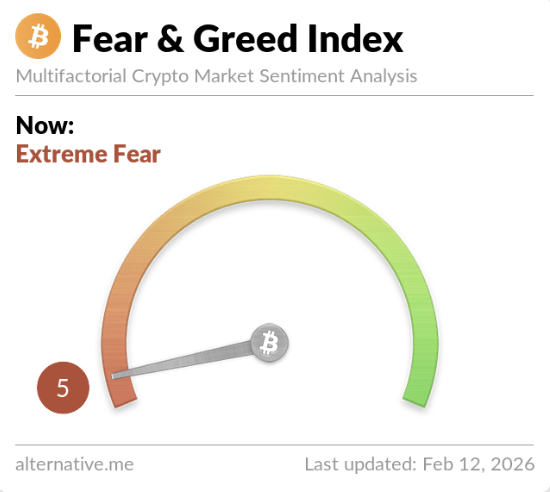
  • The Crypto Fear & Greed Index recently plunged to an all-time low of 5, signaling extreme fear.
  • ETF flows, which previously supported Bitcoin and Ethereum prices, have recently turned bearish. 

Bitcoin could fall to $50,000, while Ethereum risks a slide to $1,400

In a recent commentary shared by reporter Walter Bloomberg, Kendrick projected that Bitcoin could fall to $50,000, while Ethereum might decline to as low as $1,400. The projected targets imply sharp declines of 26% for Bitcoin from $67,724 and 29% for Ethereum from $1,986. 

He attributed the potential downturn to a softening U.S. economy, declining holdings in digital asset ETFs, and delayed expectations for Federal Reserve rate cuts until at least June, all of which continue to weigh on crypto markets. 

Markets Still Under Bearish Pressure 

Notably, Kendrick’s warning follows one of the market’s sharpest recent pullbacks. As technology stocks and precious metals tumbled last week, Bitcoin dropped to a 16-month low of $60,008, while Ethereum slid to a nine-month low of $1,751. 

Although both assets have since rebounded to trade around $67,724 and $1,986, respectively, Kendrick maintains that they remain under bearish pressure as investor appetite for risk assets continues to weaken. 

Moreover, sentiment across the market has been bearish since last week. Earlier today, the Fear & Greed Index slumped to 5, marking its lowest level on record, and signaling extreme fear.  

ETF Outflows Persist 

Furthermore, key supporting metrics have also weakened in recent times. In particular, flows into Bitcoin and Ethereum ETFs, which fueled last year’s rally, have reversed sharply. Inflows have faded, and most sessions now end in net outflows. 

Yesterday, Bitcoin ETFs recorded $276.3 million in outflows, while Ethereum ETFs posted only $129.1 million in inflows, underscoring the fragile state of demand.  

Meanwhile, Kendrick’s latest warning has stunned investors, especially after his bullish forecasts just last month. At the time, he projected Bitcoin at $150,000 and Ethereum at $7,500 this year. 

Consequently, the abrupt shift in outlook has intensified market scrutiny, with investors now closely tracking the next moves of the two largest cryptocurrencies, as their direction could ripple across the broader market. 

2030 XRP Wealth Legacy Discount: Finance Coach Says Investors Will Regret Listening to “Weak Minds”

0

Widely followed financial commentator Coach JV has described XRP and Bitcoin as trading at “legacy discounts” ahead of 2030.

In a recent post, JV argued that years from now, many investors will regret sitting on the sidelines. The statement comes amid volatility across the crypto market, where XRP recently experienced sharp swings that tested investor conviction.

Notably, XRP’s price crashed to $1.11 this month and continues to trade over 60% below its 2025 peak. 

Key Points

  • Coach JV sees XRP and BTC as “legacy discounts” ahead of 2030.
  • XRP fell to $1.11, over 70% below its 2025 peak.
  • JV says “wealth is built in fear,” urges DCA in downturns.
  • Analysts see major upside by 2030 despite volatility.

“Wealth Is Built in Fear”

Coach JV has consistently emphasized accumulation during downturns rather than chasing momentum during rallies. His latest comments reinforce that approach.

Earlier this month, he publicly disclosed buying XRP during the steep sell-off that pushed the token down toward $1.11. While many traders turned cautious, JV revealed he was dollar-cost averaging (DCA) into positions across XRP, Bitcoin, and WLFI.

At the time, XRP had dropped more than 30% from monthly highs, triggering widespread fear across the market. Yet JV maintained that emotional reactions during red markets often create the very opportunities long-term investors seek.

He calls for disciplined accumulation during uncertainty to build long-term wealth. “Wealth is built in fear,” he said.

Transparency Around XRP Dip Buys

During the downturn, JV shared screenshots showing multiple purchases, including thousands of dollars allocated to XRP across two separate entries.

While some questioned the size of the buys relative to his public profile, JV responded that deploying capital gradually reduces regret and improves long-term positioning. 

Rather than attempting to time an exact bottom, he argued that buying on the way down and even on the way up creates a more balanced approach.

Notably, XRP rebounded nearly 40% after bottoming near $1.11, briefly rewarding those who accumulated during peak fear.

Public Figures Accumulating XRP

Coach JV is not alone. Media personality Patrick Bet-David also confirmed increasing his exposure to XRP during the recent crash. He stated that buying dips is emotionally difficult but strategically necessary for long-term investors.

The 2030 Vision

Several XRP commentators have projected substantial upside before 2030. Analyst 24hrscrypto recently stated that while XRP may not be near $100 today, he believes it could reach that level before the end of the decade. 

Other educators point to institutional adoption, on-chain financial infrastructure, and regulatory clarity as long-term catalysts.

Meanwhile, some asset managers project XRP in the double-digit range by 2030 under standard growth assumptions. More aggressive models extend higher under optimal conditions.

Ultimately, while critics argue that markets could see further downside, supporters view pullbacks as generational buying windows.

Glassnode Researcher Debunks Claims XRP Supply on Exchanges Has Dropped to 1.6B

0

A Glassnode blockchain researcher has debunked circulating claims that the XRP supply on exchanges has dropped to 1.6 billion.

Claims of an XRP supply shock re-emerged after Glassnode data showed that exchange balances had fallen to 1.6 billion XRP, representing just 2.6% of the 60.9 billion XRP in circulation. Some commentators and media platforms interpreted this figure as the total XRP available for sale and argued that such low exchange reserves could indicate tightening supply.

However, a Glassnode blockchain researcher recently explained that the metric only tracks wallets Glassnode has identified as belonging to exchanges and that it includes custodial holdings without distinguishing what is actually for sale. 

Key Points

  • Glassnode data showed 1.6 billion XRP on exchanges, equal to 2.6% of the 60.9 billion circulating supply.
  • As a result, XRP community figures and media platforms interpreted this figure as the total supply on exchanges, rejuvenating the supply shock discussions.
  • A Glassnode blockchain researcher has debunked this, confirming that the metric only shows wallets Glassnode has verified as exchange-owned and includes custodial holdings.
  • He explained that Glassnode tracks only a small portion of exchange wallets, which makes the reported balance appear unusually low.
  • Glassnode plans to add more exchange addresses identified through XRPL block explorers, which could raise the reported balance.
  • XRPScan data from December 2025 showed exchanges held up to 16 billion XRP, with 10 billion XRP across Upbit, Binance, Binance.US, and Uphold.

Glassnode Researcher Confirms XRP Exchange Supply Surpasses 1.6B

The researcher’s response was shared by pseudonymous XRP commentator, Crypto Arsenal. According to him, the posts circulating online misunderstand what the exchange balance metric actually measures.

XRP Balance Glassnode
XRP Balance | Glassnode

The blockchain researcher first clarified that Glassnode’s “balance on exchanges” metric only shows XRP held in wallets that the company has internally identified and verified as belonging to exchanges. 

These wallets include all XRP stored there, including custodial holdings. In other words, the metric does not separate tokens that are actively available for trading from those being held on behalf of users.

Crypto Arsenal then pointed out that Glassnode tracks only a limited portion of exchange wallets. Because the company has not yet identified all exchange-related addresses, a large share of XRP held on exchanges does not appear in the current data. This confirms why it reports lower figures.

On-Chain Data Has Limits

He further noted that no one can assess how much XRP is truly available for sale using on-chain data alone. Notably, wallet balances do not reveal whether tokens belong to long-term holders, custodial accounts, or active traders. As a result, drawing firm conclusions about “available supply” based only on identified exchange wallets can lead to misleading claims.

Meanwhile, he confirmed that Glassnode plans to expand its tracking by incorporating exchange addresses identified through XRPL block explorers like XRPScan. This process will begin soon. 

As more exchange wallets get added to the system, the reported exchange supply could increase. He advised that if the exchange balance figure rises, market participants should not panic, as such a change would show improved data collection rather than new XRP flowing onto exchanges.

Exchanges Hold Nearly 16B XRP

Notably, this is not the first time the supply shock claim faced criticism. The Crypto Basic found last December that the idea of XRP exchange balances collapsing had flaws. Data from XRPScan showed that exchanges held as much as 16 billion XRP, representing 26% of the circulating supply.

Further data revealed that four major exchanges, including Upbit, Binance, Binance.US, and Uphold, alone held up to 10 billion XRP tokens. These figures surpass the numbers propagated then and also differ from the 1.6 billion XRP shown in Glassnode’s current metric.

Bitcoin Prediction for Feb 12: Where Next as BTC Holds Above $67K And Liquidations Hit $145M

0

Bitcoin stabilizes near key support while elevated liquidations and volatility highlight fragile momentum and ongoing uncertainty in market direction.

Bitcoin (BTC) is holding firm above the $67,000 level, but beneath the surface, price action shows a market still searching for a clear direction after weeks of sustained volatility. BTC is currently trading at $67,242.84, marking a modest 0.5% gain over the past 24 hours. 

During the session, the price fluctuated within a defined daily range between $65,932.08 and $68,371.34. This relatively wide intraday band highlights ongoing volatility even as Bitcoin stabilizes near its mid-range, suggesting both buyers and sellers remain active near current levels.

Meanwhile, market structure reflects strong underlying scale and liquidity. Bitcoin’s market cap stands at about $1.34 trillion, up 0.85%. Trading activity remains elevated, with 24-hour volume reaching $50.86 billion, also up 12.3%, confirming sustained participation across markets. 

Despite the latest intraday recovery, broader performance remains mixed, with BTC up 0.5% on the day but still down 4.7% over the past 7 days. However, the next decisive breakout or breakdown could determine whether BTC is preparing for renewed upside expansion or extending its broader consolidation phase.

Bitcoin Price Analysis

Bitcoin’s technical structure remains fragile, with price still trading near the lower boundary of its volatility range. Immediate support is now established around the lower Bollinger Band near $60,012, which acted as a critical defense point during the recent sharp selloff. This level represents the last major volatility floor before the deeper psychological zone around $60,000. 

Bitcoin 1D Chart
Bitcoin 1D Chart

So far, BTC has managed to hold above this band and stabilize near $67,541, suggesting buyers are attempting to form a short-term base. However, any decisive daily close below $60,012 would signal renewed downside expansion and could accelerate selling pressure toward lower structural support zones.

On the upside, resistance remains firmly layered and continues to cap recovery attempts. The first barrier exists at the Bollinger Band midline, placed around $77,007. This level now acts as the primary recovery threshold and marks the point where the broader trend would begin to neutralize. After that, the upper band near $94,003 represents the longer-term resistance zone. 

Further, volatility indicators reinforce the elevated risk environment. The Average True Range currently reads approximately 4,016, reflecting significantly expanded price movement compared to prior consolidation phases. This elevated ATR confirms that recent price swings are large but have started declining.

Bitcoin Liquidation 

Bitcoin’s recent liquidation data reveals that over the past 24 hours, total liquidations reached approximately $145.92 million, with short positions accounting for $82.71 million, compared to $63.20 million in long liquidations.

Bitcoin Liquidation Data

However, the broader 12-hour liquidation structure presents a more balanced but still volatile picture. Total liquidations reached $16.30 million, with long positions accounting for $10.11 million and shorts at $6.20 million.

Shorter timeframes reinforce the trend of aggressive short-side pressure. In the past 4 hours alone, total liquidations reached $3.20 million, with $2.66 million coming from short positions and only $544,510 from longs.