Home Blog Page 274

Web3Alert Founder Shares Why Many XRP Investors Lose Money

0

Web3Alert founder Nick has criticized emotional decision-making among XRP investors, arguing that it explains why retail participants often underperform. 

Amid the broader market downturn, he highlighted a recurring psychological trap: XRP investors confidently buy when prices are high but retreat in fear when prices fall, and uncertainty rises. His commentary underscores how emotion-driven behavior continues to erode returns for many retail traders. 

Key Points 

  • Commentator Nick criticized emotion-driven trading among XRP investors. 
  • He observes that investors eagerly buy XRP at higher prices but let fear keep them from buying at lower prices. 
  • The broader market reflected similar fear, with the Fear & Greed Index dropping to 5. 
  • Ripple CEO Brad Garlinghouse urges a contrarian strategy, quoting Warren Buffett’s investment advice. 

Why Many Investors Lose Money 

In his X post, Nick contrasts investor behavior across different XRP price levels. He notes that many investors eagerly buy XRP at elevated prices, including $3.50, $2.50, or even $2.00, when optimism and hype dominate. 

However, when XRP drops sharply to $1.20, fear takes over, prompting investors to stay on the sidelines. Consequently, Nick argues that this pattern explains why many crypto investors lose money, as they chase excitement and avoid fear-driven markets.

XRP Investors’ Contrarian Strategy

Nick’s commentary highlights the powerful role psychology plays in market outcomes. Investors often equate rising prices with safety and falling prices with danger, even when fundamentals remain largely unchanged. 

As a result, they tend to buy late in rallies and sell during downturns, effectively acting against a disciplined strategy. His message reinforces the need for emotional control, contrarian thinking, and a predefined plan in volatile markets. 

Historical Context 

In July 2025, anticipation of a potential end to the Ripple lawsuit drove investors into XRP, pushing its price to around $3.66. Even as early buyers took profits, some investors continued buying. However, as XRP later fell below $1.50 yesterday for the first time since November 2024, investors rushed to safety, triggering even further declines.

Notably, XRP’s decline mirrored the broader market, as reflected in the Fear & Greed Index, which showed extreme fear with a reading of 5.

Ultimately, fear of further losses, negative headlines, and uncertainty often overwhelms rational analysis, even though lower prices may offer better risk-reward opportunities. 

Ripple CEO Highlights Classic Investment Strategy 

Meanwhile, Ripple CEO Brad Garlinghouse has offered an alternative to emotion-driven investing. Drawing on Warren Buffett’s well-known maxim, he advised XRP investors to be cautious when markets turn greedy and to act opportunistically when fear dominates. 

In effect, this approach encourages investors to avoid chasing soaring prices and instead consider accumulating during strong pullbacks.

Despite XRP’s steep decline, proponents argue that the sell-off does not reflect token-specific flaws. They maintain that XRP’s fundamentals remain intact, citing its spot ETF exposure, utility in cross-border payments, and positioning as a reserve asset. 

Long-Time Investor Sets $1,000,000 XRP Order at $1

0

A well-known early Bitcoin investor is making a bold bet on XRP as the market reels from one of its steepest corrections in months.

Pumpius, an investor who has publicly disclosed buying Bitcoin as early as 2013, revealed that he has placed a $1 million buy order for XRP at exactly $1. The move suggests he is positioning for a deeper XRP price flush.

Key Points

  • Early Bitcoin investor sets a $1M XRP buy order at $1 as the market sells off
  • Pumpius’ $1M Bitcoin order filled at $66.5K, while the XRP order remains open
  • XRP plunges nearly 70% from its peak, reigniting debate over a $1 retest
  • Some analysts see the dip as brief, while others warn of further downside

$1M Bitcoin and XRP Orders

In a post shared today on X, Pumpius stated that he placed two aggressive limit orders: one for Bitcoin and another for XRP.

According to his tweet, he set orders to buy $1 million worth of Bitcoin at $66,500 and $1 million worth of XRP at $1.00. He even urged his followers to bookmark the call.

Shortly after, he confirmed that his Bitcoin order had already filled as BTC dipped sharply over the past day, briefly touching $60,000. The XRP order, however, remains unfilled for now.

Notably, Pumpius first disclosed placing a $1 million XRP buy order in December 2025, when XRP was trading above $2. Today, XRP is much closer to the $1 level.

XRP Slides to $1.11 as Sell-Off Accelerates

Over the past 24 hours, XRP dropped to around $1.11, marking a 26% daily decline and extending losses to 32% over the past week.

From its July peak of $3.66, XRP is now down roughly 70%, placing it in what many traders are calling a historic correction. The sudden weakness has reignited debate over whether XRP could briefly revisit the psychologically important $1 level.

Zach Rector: A Dip Below $1 May Be Brief

XRP YouTuber and community commentator Zach Rector weighed in on the decline. He believes XRP could momentarily fall below $1, but argues such a move may not last long.

Rector revealed that he is already preparing buy orders through brokerage firm Caleb & Brown. This suggests some market participants are treating the ongoing drop as an accumulation opportunity ahead of the next uptrend.


Past Crashes Shape Trader Strategy

Experienced traders are drawing confidence from XRP’s history of sharp but brief crashes. In previous sell-offs, such as one in October 2025, XRP dumped heavily before rebounding quickly, rewarding traders who had deep limit orders in place.

This appears to be the strategy Pumpius is positioning for early. The move comes as broader market fear grows, with the crypto fear index now sitting at just 5, highlighting extreme fear across the market.

As volatility rises, traders remain divided between expecting another leg down and quietly preparing for a rebound.

Will XRP Actually Print $1?

At the time of writing, XRP remains above $1 and has rebounded to around $1.30, while Bitcoin trades near $65,000. Meanwhile, some analysts believe a deeper dip to $0.50 remains on the table for XRP.

XRP Will Rise as Alleged Bitcoin–Epstein Links Spark Sell-Off: Pundit

0

A crypto pundit has sparked controversy with a provocative post linking Bitcoin to disgraced financier Jeffrey Epstein while simultaneously predicting a bullish outcome for XRP. 

The post, which quickly went viral on X, relied on unverified rumors to cast doubt on Bitcoin and positioned XRP as a potential beneficiary of any resulting market uncertainty.

Key Points

  • Controversy links Bitcoin to disgraced financier Jeffrey Epstein while forecasting a bullish outcome for XRP. 
  • Morgan Ariel suggests that investors were selling Bitcoin after learning of its alleged ties to Epstein. 
  • She argued that capital rotation away from Bitcoin could benefit XRP, positioning it as a potential market winner amid growing uncertainty. 
  • Epstein-related documents also referenced XRP and Ripple. 

XRP Could Benefit From Bitcoin Sell-Off 

In the post, crypto commentator Morgan Ariel labeled Bitcoin an “Epstein pedocoin,” citing viral claims that connect the asset to Epstein. These claims reference screenshots of emails and reports of Epstein’s documented donations to the MIT Digital Currency Initiative, which supported early Bitcoin developers. 

Additionally, recently released Epstein files mentioned Bitcoin’s pseudonymous creator, Satoshi Nakamoto, prompting renewed speculation that Epstein may have been involved in the creation of BTC. 

Building on these rumors, Ariel claimed that investors were selling Bitcoin after learning of its alleged ties to Epstein. She then asserted that XRP would benefit, suggesting that capital rotation away from Bitcoin could drive XRP higher. 

Even without verified evidence linking Epstein to Bitcoin’s creation, the post reflects a broader narrative within the XRP community. Supporters argue that skepticism toward Bitcoin—driven by slower transaction speeds and high energy consumption—could work in XRP’s favor by highlighting it as a more efficient, utility-focused alternative.

Factors Behind the Bitcoin Sell-off 

Her comments followed a sharp downturn across the broader crypto market. During the sell-off, Bitcoin fell to around $60,000, while XRP also declined sharply, dropping to around $1.15.

However, despite Ariel’s assertions, analysts point to broader macro-driven forces behind the decline. Analysts largely attribute the sell-off to weakening risk sentiment, fueled by volatility in precious metals and a widespread drop in technology stocks. 

As traders prioritized capital preservation, the pressure pushed crypto prices toward their November 2024 lows. 

Notably, XRP and Ripple also appeared in the Epstein documents, though under different circumstances. Previously reported excerpts show that Epstein learned about XRP in its early stages and was advised by Blockstream co-founder Austin Hill not to invest in Ripple or Stellar, which he viewed as threats to the ecosystem he and others were building. 

Don’t Sell When XRP Falls, Wait Until XRP Gets $4 to $10: Analyst

0

XRP is once again testing the patience of long-term holders after a dramatic market-wide sell-off pushed prices deep into the red. 

As fear spreads, some veteran XRP investors are signaling that this phase is familiar territory, one that has historically rewarded those willing to wait.

Analyst CryptoBull weighed in today after XRP touched $1.11, sliding more than 20% in 24 hours. From its recent peak of $3.66, the token is now down roughly 70%. The move followed the global market downturn triggered by Bitcoin’s drop from nearly $79,700 to $60,000.

Despite the severity of the move, CryptoBull said the decline was part of a repeating cycle XRP has gone through multiple times before.

Key Points

  • XRP slides 70% from $3.66 to $1.11 as market-wide sell-off shakes investor confidence.

  • Veteran holders remain patient, seeing the dip as familiar terrain that rewards long-term investors.

  • Analyst CryptoBull cites historical XRP cycles, targeting $4 next and $10 in the longer term.

  • Other investors quietly accumulate, with some placing million-dollar buy orders near $1.

“I Never Sold During Drops”

In a post on X, CryptoBull reflected on XRP’s past crashes, noting that he has lived through multiple drawdowns that looked just as brutal at the time.

Since entering the market, XRP has fallen from $0.25 to $0.11, $0.65 to $0.17, and $1.96 to $0.28. In each instance, he said he held through the decline. 

While he did sell a portion of his holdings during the recent rally between $2.30 and $3.37, he now believes the market has returned to a waiting phase.

According to CryptoBull, the focus now shifts back to patience, with the next major objectives sitting well above current prices. He pointed to $4 as the first level that would confirm renewed strength. He also believes a longer-term move toward $10 is possible.

XRP’s Historic Correction Deepens

Today’s drop places XRP among the hardest-hit large-cap assets. The decline has extended losses to more than 30% over the past week, as forced liquidations and risk-off sentiment continue to dominate trading.

The sell-off comes amid extreme fear across crypto markets, with many traders debating whether XRP could briefly dip below the psychologically important $1 level before stabilizing. While some expect further downside, others see the current zone as part of a larger accumulation range.

The Bigger Picture

CryptoBull’s patience is rooted in a longer-term technical thesis he has shared before. In earlier analysis, he argued that XRP’s current market structure closely resembles past cycles, but with one key difference: time.

On higher timeframes, XRP has spent years consolidating below major resistance levels. In previous bull markets, similar consolidation phases eventually gave way to sharp impulse moves that carried price multiples higher. This time, the accumulation period has been significantly longer, which some analysts believe could support a larger expansion once momentum returns.

Based on this framework, CryptoBull has previously outlined a $11 target as the next major impulse level.

Waiting While Others Accumulate

Notably, CryptoBull’s comments come as other seasoned investors quietly position around current levels. Earlier today, long-time investor Pumpius revealed a $1 million buy order for XRP at $1

Others, including YouTuber Zach Rector, have also disclosed plans to buy XRP under $1 should the opportunity present itself. Interestingly, even Ripple CEO Brad Garlinghouse has subtly urged market participants to buy XRP’s price dip, as The Crypto Basic reported earlier.

Tether Mints Another $1B USDT Amid Historic Bitcoin Dump

0

Tether has printed another $1 billion in USDT, pushing total stablecoin issuance to dramatic levels at a time when Bitcoin and crypto markets are under pressure.

On-chain trackers flagged the latest mint at the Tether Treasury, adding to a series of large issuances seen over the past week. Earlier this week, two separate $1 billion USDT mints were recorded, bringing Tether’s February total to $3 billion.

Key Points

  • Tether minted another $1B USDT as crypto markets slid, pushing February issuance to $3B.

  • Circle joined the surge, adding $500M USDC, bringing weekly stablecoin mints to $4.75B.

  • Bitcoin fell over 10% to $60K, triggering $2B+ in liquidations amid heavy market pressure.

  • Analysts warn stablecoin mints signal liquidity prep, not automatic bullish momentum.

$4.75B in Stablecoins Minted in One Week

Meanwhile, the activity hasn’t been limited to Tether. Circle has also increased issuance, with $500 million in USDC minted across two recent transactions. Combined, Tether and Circle have added roughly $4.75 billion in new stablecoins to the market in just seven days.

This surge in supply comes as Bitcoin trades below recent highs. Specifically, Bitcoin’s price crashed more than 10% in the last 24 hours to hit $60,000, triggering over $2 billion in liquidations. The flagship asset last traded in this range in October 2024.

Now, this new issuance has raised questions about whether the fresh liquidity signals incoming dip-buying or something more structural.

Why Stablecoin Mints Aren’t Automatically Bullish

Meanwhile, market commentators caution against treating stablecoin issuance as a direct buy signal. Analysts say that large issuances often imply trading desks restocking liquidity after sell-offs, rather than fresh confidence that prices will rise soon.

Stablecoins are usually minted to keep capital ready, not because traders are eager to take risks. What matters more is where that money goes next: onto exchanges to trade, or into wallets to sit on the sidelines.

Even though stablecoin supply is near record highs, past cycles show that supply growth alone doesn’t drive prices. High issuance has occurred during rallies, flat markets, and downturns alike.

What Analysts Are Watching Next

In his commentary, widely followed analyst Milk Road said headline mint numbers matter less than what happens next. The real signals come from follow-through data, including whether net issuance outweighs redemptions, stablecoins are moving onto exchanges, and transaction activity is picking up.

He added that investors should also watch how stablecoin flows align with macro trends, ETF inflows, and derivatives funding rates. Until these indicators line up, he noted, new stablecoin mints do not necessarily mean the market is turning bullish.

Market Veteran Brandt Identifies the Bitcoin Structure that Led to Current BTC Downturn

0

Trading veteran Peter Brandt has now identified the Bitcoin price structure that led to the ongoing downturn that has dominated the market.

Notably, Bitcoin (BTC) and the rest of the crypto market have been on a downward spiral since October 2025, with the losses intensifying on the back of the latest wave of selling pressure. Specifically, the global crypto market cap lost $311 billion yesterday alone, marking the largest intraday loss since the Oct. 10, 2025, crash.

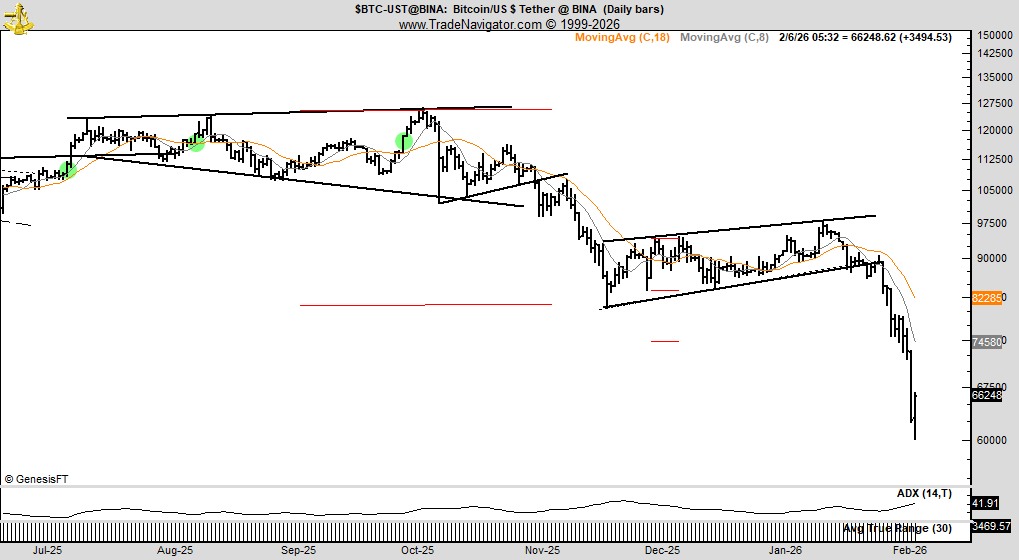
Expectedly, Bitcoin contributed the most to this Thursday crash, $206 billion that day, as prices broke below the $70,000 mark to hit $66,000 at press time. Amid these declines, Peter Brandt recently confirmed that a broadening top alongside a large flag kick-started the ongoing downturn months back.

Key Points

  • With Bitcoin now down 42% since Q4 2025, Peter Brandt has now identified the structure that led to the ongoing downturn.
  • Brandt suggested that a broadening top, which led to a large flag formation, kick-started the current market turbulence.
  • The market veteran had identified this structure as far back as October 2025, when Bitcoin still traded for $110,000.
  • At the time, Brandt set downward targets of $81,000 and $58,000, but his analysis faced pushback from the Bitcoin community.
  • Bitcoin hit an 18-month low of $59,900 earlier today, eerily close to the $58,000 target.

Bitcoin Down 42% Since Q4 2025

Brandt’s latest commentary, which sought only to remind the investing public of his earlier suggestions, comes as Bitcoin loses the $70,000 psychological support and retests lows around $59,000 for the first time since October 2024. 

While the crypto asset currently trades for $66,000 at press time, it had dropped to $59,900 earlier today before a sharp rebound. Despite an 8.48% uptick today, Bitcoin is down 42% since the fourth quarter of 2025. Also, with a 22% decline this year, the premier crypto asset has lost $392 billion worth of valuation within this period.

Brandt Identifies Broadening Top as Downturn Trigger

With the losses piling up, Brandt highlighted the broadening top pattern on the daily chart as the primary driver of the recent downturn. The market veteran criticized certain Bitcoin analysts, whom he called “amateurs,” for pushing back with his suggestion months ago and insisting that BTC was witnessing a H&S structure.

According to Brandt, the broadening top led to the formation of a large flag, which resulted in the steeper decline that has pushed Bitcoin below $70,000 at press time. “Sorry, amateurs, redraw your charts correctly,” Brandt quipped.

Bitcoin’s Broadening Top

For context, a broadening top or megaphone pattern occurs when price swings grow wider over time, forming higher highs and lower lows. Notably, it shows rising volatility and growing disagreement between buyers and sellers.

Essentially, the market looks more chaotic within this structure, as momentum weakens and control slowly shifts away from buyers. This pattern often warns that an uptrend may lose strength and could reverse downward. 

Bitcoin Broadening Top Peter Brandt
Bitcoin Broadening Top | Peter Brandt

Bitcoin’s broadening top formation started forming after the July 2025 peak of $123,000. From here, Bitcoin saw higher highs of $124,517 in August and $126,272 in October 2025. Meanwhile, it also registered lower lows of $112,000 in August, $107,488, and $103,530 in October 2025.

These price movements led to price swings that grew wider with time, forming the megaphone shape that defines a broadening top structure. As a result, Peter Brandt called attention to the pattern on Oct. 30, 2025, revealing that he was now short Bitcoin due to the formation of a megaphone. 

Brandt Responds to Previous Backlash

With Bitcoin trading for $110,000 at the time of his October 2025 analysis, the asset still looked safe. This led to a wave of backlash from Bitcoin proponents who insisted that BTC remained bullish. 

Notably, during his earlier analysis, Brandt had set the first downside target at $81,000, with the possibility of steeper declines to $58,000. Today, BTC dropped to $59,900 before rebounding.

Bitcoin Slides to $56,000 on Bithumb After $133M BTC Mistakenly Airdropped to Users

0

Bitcoin briefly traded at a steep discount on South Korea’s Bithumb exchange after an internal error allegedly sent large amounts of the cryptocurrency to users.

The sudden disruption rattled local markets and drew attention at a sensitive time for the exchange, which is already under regulatory scrutiny.

Key Points

  • Bitcoin prices on Bithumb dropped roughly 10% below global benchmarks during the incident.
  • An estimated 2,000 BTC, worth approximately $133 million, was allegedly distributed across hundreds of user accounts.
  • Recipients reportedly sold the unexpected Bitcoin immediately, pushing prices on Bithumb down to around $56,000 (82 million won).
  • Trading later stabilized, with Bitcoin rebounding above $66,000 (98 million won).
  • Bithumb has not publicly confirmed the error, the amount involved, or whether affected trades will be reversed.

Accidental Distribution Triggers Price Shock

The anomaly emerged when Bitcoin prices on Bithumb fell roughly 10% below global benchmarks. Industry observers attributed the divergence to a distribution mistake inside the exchange.

According to Definalist, a core member of the crypto collective Dumpster DAO, a Bithumb employee mistakenly selected Bitcoin instead of cash while processing a promotional payout. The intended reward was reportedly worth about 2,000 Korean won, less than two US dollars.

Instead, Bitcoin was distributed. Consequently, an estimated 2,000 BTC, valued at roughly $133 million, was allegedly credited across hundreds of user accounts. The account spread rapidly online, though Bithumb has not confirmed the details.

Rapid Selling Deepens the Drop

Once the funds appeared, recipients acted quickly. Many users reportedly sold the unexpected Bitcoin immediately at market prices, thereby intensifying selling pressure on Bithumb’s Bitcoin pairs.

The impact was swift. Prices on the exchange fell to around $56,000, or approximately 82 million won, sharply widening the gap with international markets. Later, trading stabilized, and Bitcoin rebounded above $66,000, near 98 million won.

Even so, the episode highlighted how quickly liquidity imbalances can emerge when internal controls fail.

Silence From Bithumb Raises Questions

Bithumb has yet to provide a public explanation of the incident. The exchange has neither confirmed the alleged transfer error nor disclosed the amount involved.

Important details also remain unresolved. Specifically, it is still unclear whether the funds were withdrawn, frozen, or reversed. Bithumb has not said whether affected trades will be canceled.

This lack of clarity has left traders waiting for answers. It has also amplified concern, given the broader regulatory context surrounding the exchange.

Regulators Already Examining Advertising Practices

Just days before the incident, South Korea’s Fair Trade Commission (FTC) had turned its attention to Bithumb. On February 4, two investigators visited the exchange’s headquarters in Seoul’s Gangnam district, according to Yonhap News Agency’s EInfoMax service.

The inquiry centers on whether Bithumb overstated its market strength in recent marketing campaigns. For instance, promotional materials published in March and April 2025 claimed the exchange offered the highest liquidity in the domestic crypto market.

South Korean newspaper Chosun Ilbo reported that regulators consider these claims potentially misleading. Under local law, exaggerated advertising can result in fines or other disciplinary measures.

Market Share Data Underpin the Review

Market data plays a central role in the investigation. Figures from CoinGecko, cited by broadcaster KBS, show that Upbit dominated trading volumes in the Korean won last year.

Specifically, Upbit held about 68% of the market, while Bithumb accounted for roughly 28%. Therefore, regulators are now weighing whether Bithumb’s messaging aligned with these figures.

The review could influence how exchanges describe their competitiveness in future campaigns.

Past Promotions Also Under Review

Beyond advertising language, regulators are also examining earlier customer incentives. South Korean media report that late last year, Bithumb ran a promotion offering about $70 to new users who connected through its application programming interface (API).

More than 50,000 people reportedly joined the program. However, Bithumb allegedly changed the eligibility rules mid-campaign, leaving around 30,000 participants without the expected payout.

The FTC is now considering whether those changes unfairly disadvantaged users.

Bitcoin Rebounds 13% to $68,000 Following Biggest Single-Day Drop Since FTX Crash

0

Bitcoin is seeing its largest single-day bullish candlestick in ten months today after dumping the hardest since the FTX collapse just yesterday.

Notably, BTC dropped a staggering 14% on February 5, its steepest decline in one day since collapsing 14.4% on November 9, 2022. The date coincided with the collapse of FTX, the US crypto exchange founded by Sam Bankman-Fried, after it faced a bank run.

Key Points

  • Bitcoin is seeing its largest single-day bullish candlestick in ten months today after dumping the hardest since the FTX collapse on Thursday.
  • BTC dropped a staggering 14% on February 5, its steepest decline in one day since collapsing 14.4% on November 9, 2022.
  • The Thursday collapse sparked a broader crypto bloodbath, wiping out over $2.5 billion in leveraged positions.
  • The correction was more leverage-driven, with no clear fundamental triggers.
  • Bitcoin has bounced nicely, rallying over 11% from its Friday lows to reclaim $67,000.
  • The major level under the radar is the $60,000 support level, and a break below could drive BTC to the mid-$50,000s.

Bitcoin Dumped, Then Bounced

Notably, the Thursday collapse sparked a broader crypto bloodbath. Bitcoin extended this momentum to earlier today, dropping to a low of $59,000, its lowest level since October 2024, dragging altcoins with it.

Ethereum dropped below $2,000, and XRP crashed near $2, forcing leveraged traders out of the market. In total, crypto liquidations in the past 24 hours exceeded $2.5 billion, with most of them involving long positions. Notably, the bloodbath forced the second-largest capitulation in two weeks.

However, today brought some relief for the broader crypto market. After the earlier scare, Bitcoin has bounced nicely, rallying over 13% from its Friday lows to reclaim $68,000. At the time of writing, this represented an over 8.6% growth from yesterday’s closing price, marking its largest green candle since April 9, 2025.

Bitcoin 1D Chart
Bitcoin 1D Chart

Leveraged-Driven Sell-Off

Notably, the correction was more leverage-driven. With no clear fundamental triggers, the crash stemmed from growing fear, doubt, and uncertainty, with investors panic selling as leveraged positions unwound.

The market is now resetting after the over-leverage wash. Volatility remains high, and investors are still cautious. Bitcoin spot ETF outflows further add to the caution. Notably, the investment products saw an outflow of $434 million on Thursday, marking their third consecutive intraday outflow.

The major level under the radar is the $60,000 support level, as market participants observe how Bitcoin reacts to it. So far, Bitcoin has seen a relief rally. Meanwhile, sentiment will turn bearish again if Bitcoin loses this support, with mid-$50,000 as the next possible target.

8 Public Firms Committed $2,000,000,000 in XRP Strategic Treasury Reserves

0

A growing number of publicly traded companies have added XRP to their balance sheets, committing more than $2,000,000,000 ($2 billion) combined to their announced treasury strategies.

According to a breakdown shared by crypto educator X Finance Bull, at least eight public firms have disclosed XRP treasury allocations through public filings or official announcements. The data was attributed to TokenRelations and compares the trend to MicroStrategy’s early Bitcoin treasury strategy, this time centered on XRP.

Key Points

  • Over $2B committed across eight publicly traded companies
  • Institutions are positioning early ahead of regulatory clarity
  • XRP may shift from a payment tool to a treasury reserve asset
  • Market watching filings, timelines, and balance-sheet impact

XRP From Speculation to Balance Sheets

X Finance Bull argues that the move signals a shift in how institutions view XRP, from a short-term trade to a long-term treasury asset. He stressed that the firms are not private funds or venture capital, but public companies across multiple industries, including healthcare, energy, gaming, technology, and agriculture.

Indeed, several of the firms have already begun deploying capital, while others have formally announced future allocations.

Image

Largest Allocation: Evernorth Leads With Over $1B

The largest reported XRP treasury commitment comes from Evernorth (XRPN).

  • Investment: $1+ billion
  • Status: Active via SPAC merger

According to the report, Evernorth has already raised the funds and begun deploying capital, making it the largest XRP treasury strategy disclosed to date.

$500M–$300M Commitments 

Other firms are also making sizable balance-sheet decisions. Trident Digital Tech (TDTH) has disclosed a $500 million investment, while Webus International (WETO) has also announced a $300 million investment in XRP.

These nine-figure allocations suggest XRP is being considered at scale, not as an experimental exposure.

Energy, Healthcare, and Logistics Join In

Beyond tech  firms, traditional industries are also appearing on the list

Vivopower (VVPR)

  • Investment: $100 million
  • Sector: Sustainable energy

Wellgistics (WGRX)

  • Investment: $50 million
  • Sector: Healthcare logistics

X Finance Bull noted that these are conventional businesses making formal treasury decisions, rather than crypto firms chasing short-term trends.

Smaller Allocations Expand Industry Diversity

Several additional companies round out the reported list:

  • Nature’s Miracle (NMHI) – $20 million (AgTech)
  • Gumi (3903.T) – $17 million (Japanese gaming company, active holding)
  • Hyperscale Data Inc. (GPUS) – $10 million (Data infrastructure, active holding)

While smaller in size, the allocations further broaden the range of sectors and regions adopting XRP as a reserve asset.

$2B Total, Spanning Multiple Sectors

In total, the report cites over $2 billion committed across eight publicly traded companies. X Finance Bull says institutions are positioning early, ahead of clearer regulations and market conditions. The move signals a shift for XRP, from mainly a payment asset to a treasury reserve held by public firms.

Cardano Founder Reveals Over $3B in Personal Crypto Loss as ADA Crashes 92%

0

Cardano founder Charles Hoskinson has responded to public criticism of his wealth and motives, revealing that he has personally lost over $3 billion through his crypto holdings. 

Hoskinson made the disclosure during a recent livestream, stressing that his long-term involvement in crypto is driven by principles and purpose, not personal profit. 

Key Points

  • Cardano founder Charles Hoskinson says his personal crypto paper losses have surpassed $3 billion.
  • He attributes the losses to his decision not to cash out during market peaks.
  • Hoskinson maintains that his commitment to crypto is rooted in principles, not profit.
  • Although ADA has rebounded to $0.2645, it remains 91.46% below its all-time high of $3.10.

Cardano Founder Records Over $3B in Unrealized Losses 

During the session dubbed ‘Red Days,’ he directly addressed claims that his wealth insulates him from the struggles of everyday investors. In response, he said he lost more than $3 billion in paper value by refusing to cash out during market peaks. 

Despite the scale of the loss, he emphasized that he doesn’t care about losing it all. According to him, anyone who believes his participation in crypto is money-driven is mistaken.

Moreover, Hoskinson pointed to his clean track record in an industry often plagued by controversy as further proof of his stance. He noted that his name has never appeared in major scandals such as the FTX collapse or other high-profile financial and ethical crises, including the Jeffrey Epstein saga. 

More Red Days Ahead 

His remarks come amid one of the sharpest crypto market downturns in recent times. On February 5, the market plunged, wiping out nearly 10% of total value within hours. Bitcoin, Ethereum, and Cardano all recorded double-digit losses. 

Notably, ADA fell to $0.2262 yesterday, marking a 32% drop from its January 1 opening price of $0.3328. Although it later rebounded to $0.2645, the token remains down 91.46% from its all-time high of $3.10.

Looking ahead, Hoskinson warned that more red days could lie ahead in the coming weeks and months. He explained that such resistance is expected as the crypto industry pushes to transform the global financial system. 

In his view, investors face two choices. They either walk away by declaring everything a scam and collapsing, or brace themselves and view the downturn as one of many challenges on the difficult path toward financial freedom.