
Home Blog Page 276

Messari Q4 XRP Report Shows RLUSD Marketcap on XRPL Rose 164.2% as Adoption Grows

0

Leading crypto market intelligence platform Messari has shared its “State of XRP Ledger” report for the last quarter of 2025.

Notably, the report identified how the XRP ecosystem performed in Q4 2025, using key financial metrics. Details of the recent publication identified progress in XRP’s institutional adoption but highlighted a decline in certain crucial indicators.

Key Points

  • Prominent crypto market intelligence platform Messari has shared its “State of XRP Ledger” report for the last quarter of 2025.
  • Major US spot ETFs launched in Q4 2025, reaching over $1 billion in assets under management in four weeks.
  • Distributed RWAs issued on the XRP Ledger recorded a quarter-over-quarter (QoQ) growth of 37%.
  • The RLUSD stablecoin’s market cap on the Ledger rose 164.2% QoQ to hit $234.9 million, and 48.8% on Ethereum, reaching $1.04 billion.
  • Most other ecosystem pointers recorded severe downturns to reflect the poor performance of the crypto space in the last quarter of 2025.
  • XRP’s circulating supply dropped 34.5% QoQ from $170.3 billion in Q3 to $111.6 billion in Q4.

XRP ETF Crossed $1B Amid Spotless Q4 Run

Notably, major US spot ETFs launched in Q4 2025, with the Canary Capital XRP ETF pioneering the entrance into the traditional financial market. Currently, there are five asset managers offering pure spot XRP products in the US, including Franklin Templeton, Grayscale, Bitwise, and 21Shares.

Interestingly, the funds had a bright start after their market debut, reaching over $1 billion in assets under management in four weeks. They enjoyed a spotless inflow streak, with zero single-day outflow throughout Q4 2025. Notably, the inflows were the largest among all other crypto-related ETF launches since Ethereum.

The report noted that as of January 28, the US spot ETFs held 789.8 million XRP, representing 1.3% of the asset’s circulating supply. Each of the funds held more than 100 million XRP, with Canary Capital (182.6 million XRP) holding the most. Such capital influx reflects pent-up institutional demand for XRP, as Wall Street massively accrued the product upon launch.

All-Time High Distributed RWA Market Cap

Furthermore, Messari indicated that the XRPL real-world asset (RWA) market is thriving, another metric confirming institutional traction. Specifically, distributed RWAs issued on the XRP Ledger recorded a quarter-over-quarter (QoQ) growth of 37%.
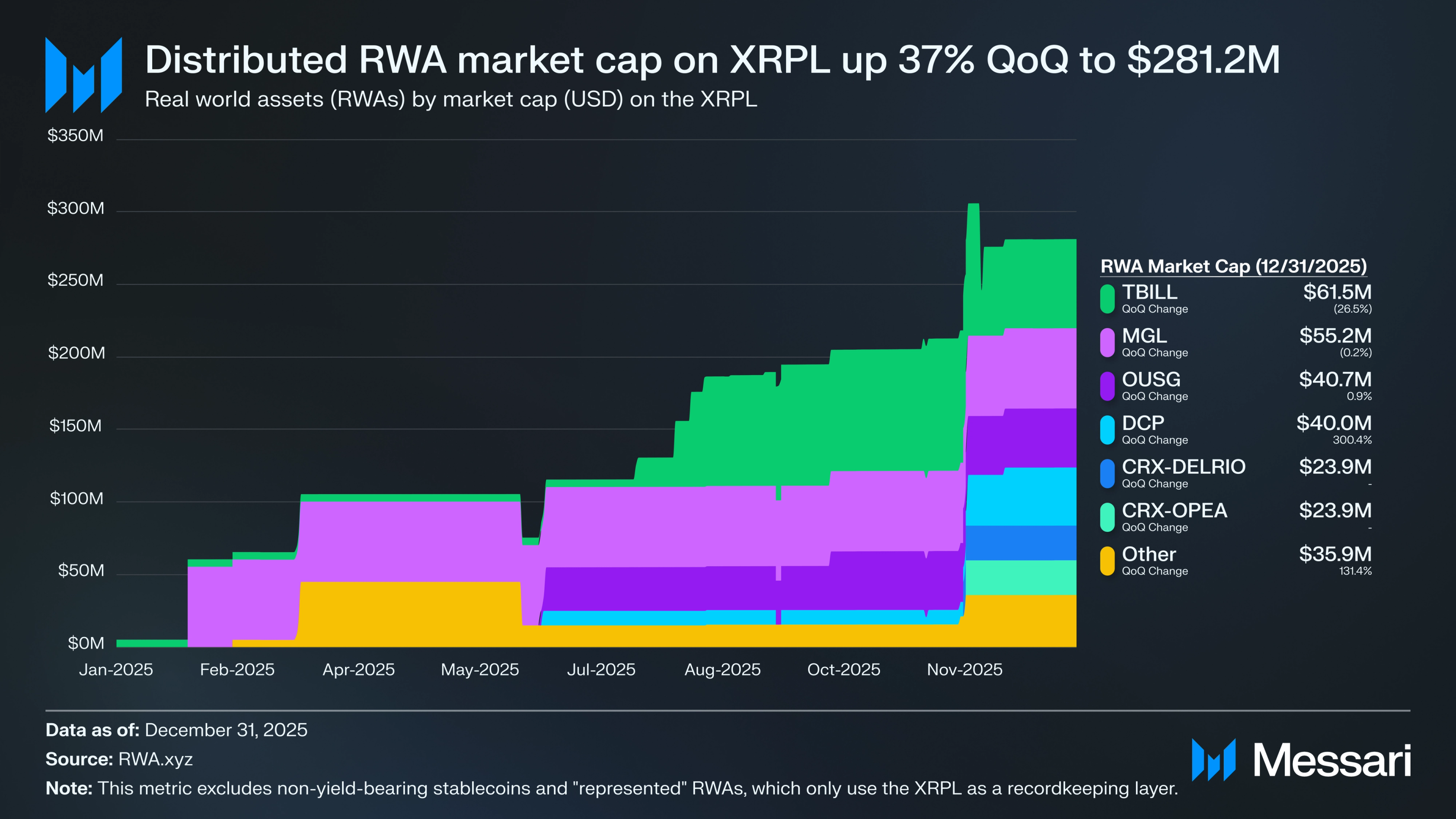
Distributed RWA Growth/Messari

Remarkably, XRP Ledger closed Q4 with its highest-ever distributed RWA market cap of $2281.2 million, reflecting the issuance growth among several RWAs launched earlier in the year. Notably, the distributed RWAs exclude non-yield-bearing stablecoins and represented RWAs.

RLUSD Expansion and Positives on XRP Ledger in Q4 2025

The RLUSD supply on the XRPL also grew tremendously in the previous quarter. Notably, the stablecoin’s market cap on the Ledger rose 164.2% QoQ to hit $234.9 million. RLUSD issued on Ethereum saw milder growth of 48.8%, reaching $1.04 billion in Q4 2025. Combined, RLUSD closed with a market cap of $1.28 billion.
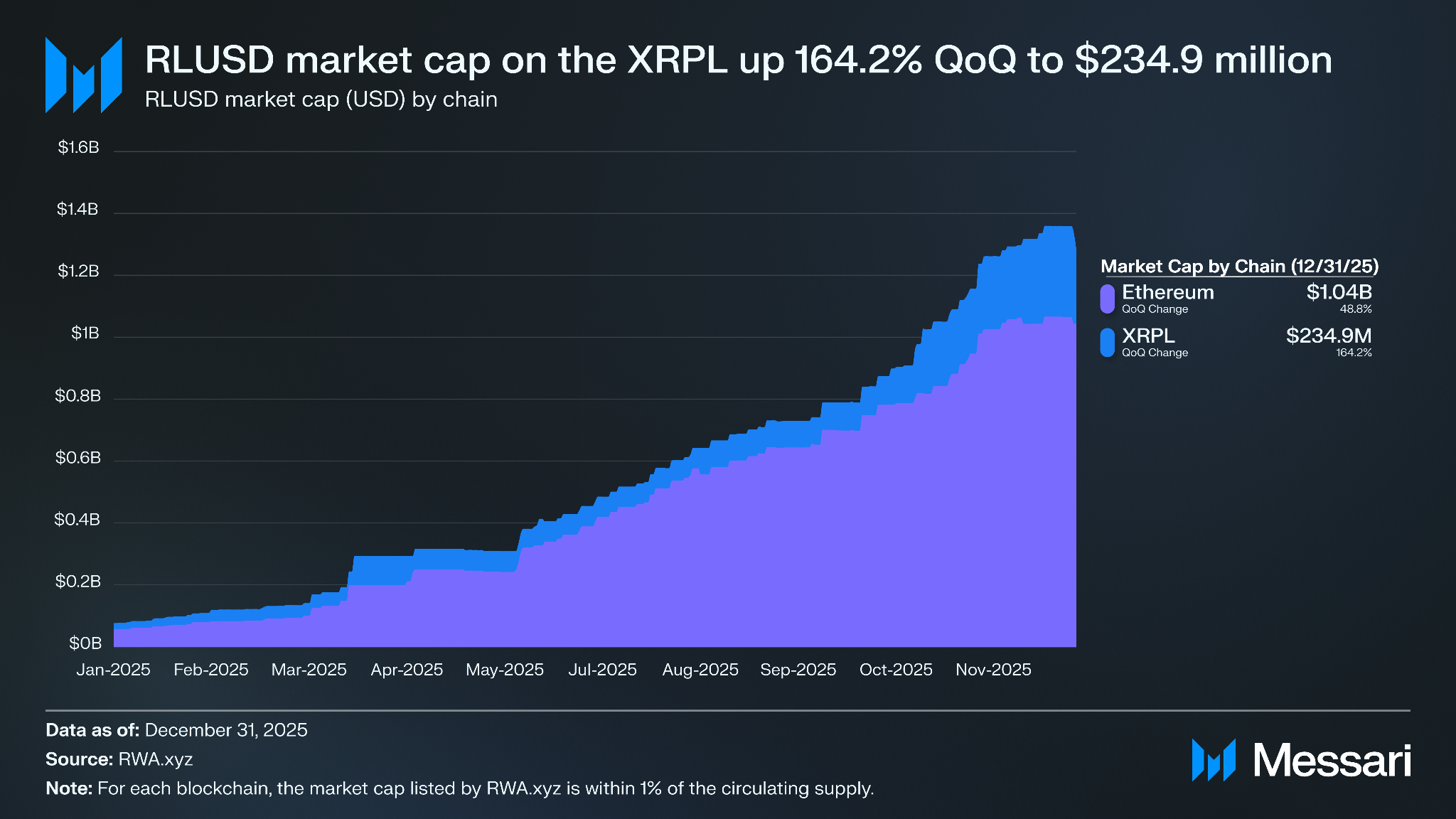
RLUSD Growth QoQ/Messari

The RLUSD stablecoin market cap has continued to grow since then. Per RWA.xyz, it now has a market cap of $1.49 billion, with $1.1 billion on Ethereum and $347.7 million on the XRP Ledger.

Other positives highlighted in the Messari report include growth in average daily transactions on the XRPL. The metric grew 3.1% to 1.83 million. However, the total daily average active address reduced 8.2% QoQ to 49,000.

Drop In Key XRPL Financial Metrics

Aside from the positives mentioned earlier, most other ecosystem pointers recorded severe downturns to reflect the poor performance of the crypto space in the last quarter of 2025. For context, XRP’s circulating supply dropped 34.5% QoQ from $170.3 billion in Q3 to $111.6 billion in Q4.
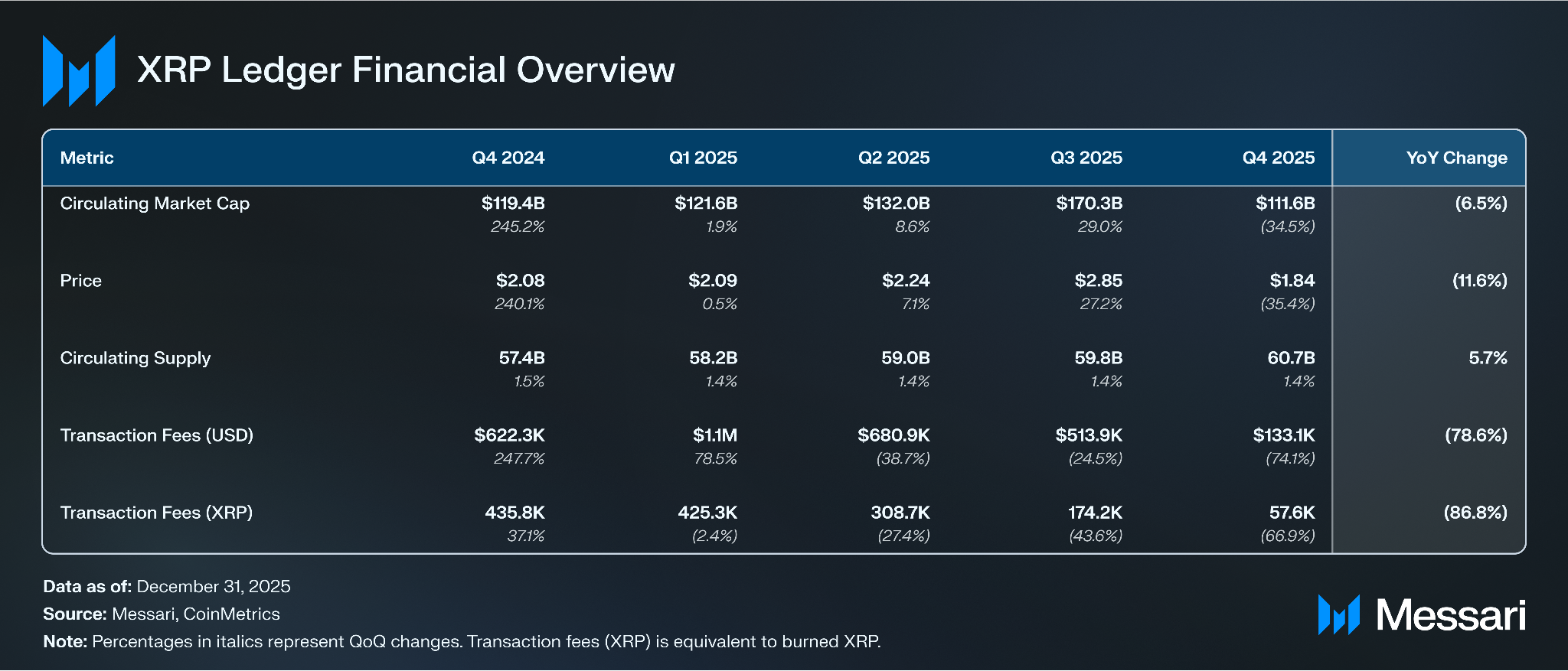
Key XRPL Financial Metrics/Messari

Its price also dropped 35.4% from $2.85 to $1.84. Meanwhile, XRP has continued to trend lower, changing hands close to $1.20 at the time of writing.

Generated transaction fees on the XRPL also dropped a staggering 74.1% to $133,100, as user traction stalled and prices declined. The total new addresses also dropped 4.9% to 425,400.

Bitwise CEO Says Bitcoin Slump Offers “Generational Buying Opportunity” for Institutions

0

Institutional investors are increasingly viewing the current Bitcoin slump as a long-term buying opportunity, according to Bitwise Asset Management executives.

Meanwhile, the broader crypto market continues to struggle through a deep downturn.

Key Points

  • Institutional investors increasingly view Bitcoin’s sell-off as a long-term entry opportunity.
  • Bitcoin ETF trading volumes have surged to 3–4× normal levels, signaling heightened institutional engagement.
  • The crypto market has experienced a prolonged downturn (“crypto winter”) since early 2025, per Bitwise’s CIO.
  • Institutionally linked assets have outperformed retail-driven tokens, masking underlying weakness in retail participation.
  • Ongoing ETF and corporate treasury accumulation is helping stabilize Bitcoin prices despite steep market-wide losses.

ETF Activity Signals Growing Institutional Engagement

Speaking to CNBC, Bitwise co-founder and chief executive Hunter Horsley said trading activity in Bitcoin exchange-traded funds has surged well above normal levels. ETF volumes, he noted, are running three to four times higher than their recent 30-day averages. This underscores heightened engagement from both buyers and sellers.

Horsley described a clear divide in investor behavior. Long-term holders appear hesitant amid ongoing volatility, while newer institutional participants are seeing price levels they once assumed were out of reach.

According to him, many institutions view the current pullback as a renewed opportunity to enter the market at more attractive valuations.

That sentiment is translating into action. Horsley said a recent conversation with a wealth management firm revealed growing urgency among clients eager to deploy capital and seeking guidance on when to move.

Market-Wide Losses Provide a Stark Backdrop

These institutional dynamics are unfolding amid steep losses across digital assets. Since October 10, the global cryptocurrency market has declined by roughly 50%. The steep drop has consequently erased an estimated $2.2 trillion in market capitalization.

Bitcoin has closely tracked that broader decline. The asset has now erased its entire post-election rally and is down about 10% since Donald Trump’s election victory.

At the time of reporting, Bitcoin was trading near $66,157. This marks a decline of 6.3% over the past 24 hours, 20.3% over the past week, and nearly 48% from its October 6 peak of $126,080.

Bitwise CIO Characterizes the Sell-Off as a Crypto Winter

Against this backdrop, Bitwise chief investment officer Matt Hougan offered a longer-term perspective earlier in the week. Writing on the social platform X, Hougan said the crypto market entered a sustained downturn at the start of 2025.

He cautioned investors against viewing the current environment as a short-term correction. Instead, Hougan characterized it as a full-scale crypto winter, driven by excessive leverage and widespread profit-taking by early investors.

Moreover, drawing parallels to the downturns of 2018 and 2022, he argued that positive developments, such as regulatory progress or adoption headlines, rarely translate into higher prices. They only have an impact once overall market sentiment has fully reset.

Institutional Flows Mask Underlying Retail Weakness

Hougan also addressed how institutional activity shaped market performance throughout 2025. He pointed to divergences within the Bitwise 10 Large Cap Crypto Index. Specifically, assets tied to ETFs or corporate treasuries declined less sharply than tokens without institutional access.

Retail-focused crypto assets, he said, have remained in a deep slump since January 2025. While institutional inflows temporarily masked that weakness for certain assets, they did not alter the broader downward trend.

Still, Hougan noted that large-scale Bitcoin accumulation by ETFs and corporate treasuries has helped stabilize prices. He also cited XRP’s improved outlook following greater legal clarity in its case with the U.S. Securities and Exchange Commission.

Cautious Optimism Emerges Despite Ongoing Pressure

Despite persistent price pressure, Hougan suggested the market may be closer to a turning point than many expect. Prolonged downturns, he said, are typically marked by widespread fear, falling prices, and investor exhaustion—conditions he believes are now firmly in place.

While acknowledging that the crypto winter has stretched on since early 2025, Hougan expressed cautious optimism that a recovery may not be far off.

Ultimately, his view reinforces a broader message from Bitwise leadership: for institutions willing to tolerate volatility, the current environment could represent a pivotal long-term opportunity.

Ripple Moves 534,000,000 XRP as Price Drops to 15-Month Low

0

Ripple recently shuffled over 534 million XRP across multiple wallets amid the latest selling wave that pushed prices to a 15-month low.

Notably, the blockchain payment firm made the recent fund movements using four different wallets, transferring 300 million XRP to a single address and then re-routing over 117 million from this address to another wallet. 

Key Points

  • Ripple recently shuffled more than 534 million XRP tokens across four different wallets within three hours.
  • The movements involved the transfer of 300 million XRP to a single wallet and then re-routing 117 million tokens from the wallet to another address.
  • On-chain data links one of the wallets involved to persistent whale transactions that the community has tracked since December 2025.
  • The latest fund flows come amid the recent wave of selling pressure that has since pushed XRP to a new 15-month low.

Ripple Sends 300M XRP to Central Address

Whale Alert, a crypto resource tracking whale movements, first called attention to the series of transactions, which involved multiple wallets. The fund flows began with the transfer of 200 million XRP worth $234 million at the time from rBg…91m to rJq…8nE on Thursday at 21:50 UTC.

Notably, Whale Alert suggested that the assets moved from a Ripple address to an unknown wallet. However, rBg…91m (Ripple 1) and rJq…8nE (Ripple 50) both actually belong to Ripple. The firm has repeatedly utilized these wallets for routing its assets.

Ripple Address Receives 300M XRP

Two hours later, Ripple (1) made another transaction, this time involving 100 million XRP worth $122 million, to Ripple (50). This brought the total assets received by Ripple (50) to 300 million XRP valued at $356 million at the time of the transactions.

117M XRP Re-routed to Another Wallet

From the 300 million XRP received, Ripple (50) moved 20 million XRP to rp4…xv3 and 15 million XRP to raR…NRf within four minutes. Hours later, Ripple (50) then transferred 117 million XRP worth $148 million to another address, rnU…R5J, today at 02:33 UTC. 

While Whale Alert tagged the address as unknown, on-chain data confirms that it was activated by Ripple (50) in November 2021 and has served as a re-routing destination for Ripple since then.

117M XRP Rerouted to Another Wallet

An hour after receiving the 117 million XRP, rnU…R5J re-routed all the tokens to rpx…ZY1. Interestingly, on-chain data shows that rpx…ZY1 has no direct link to Ripple. So far, this address has held onto the 117 million XRP received.

Links to Past Whale Transactions

However, an investigation carried out by The Crypto Basic confirms that this address, rpx…ZY1 was the primary wallet responsible for multiple whale transactions identified by the XRP community over the past few weeks. 

For context, late last month, The Crypto Basic called attention to the accumulation of 120 million XRP within an hour by a new whale. Interestingly, the 120 million XRP came from rpx…ZY1 and moved through an intermediary wallet to the receiving whale. 

Moreover, The Crypto Basic revealed earlier this month that multiple XRP whales had shuffled 1.59 billion XRP since the start of the year. Data shows that this same rpx…ZY1 was the central address behind most of the whale transactions, routing millions to other wallets. This suggests Ripple may actually be behind these transactions, but there’s no concrete confirmation.

XRP Price Drops to 15-Month Low

Meanwhile, the latest 534 million XRP movements from Ripple come at a time when the XRP price has suffered another wave of bearish pressure. Notably, XRP recently collapsed below the $1.3 to a low of $1.11, marking a 15-month low, before recovering mildly to the current price of $1.29.

As XRP Price Crashes 70% From Peak, Ripple CEO Shares Warren Buffett’s Classic Investment Advice

0

Amid the ongoing crypto downturn that triggered a 20% XRP crash, Ripple CEO Brad Garlinghouse invoked a well-known investment principle from billionaire investor Warren Buffett. 

Recently, crypto prices suffered steep losses as risk appetite faded, pushing major assets deep into the red. Over the past 24 hours alone, XRP plunged more than 20% to $1.13, while Bitcoin and Ethereum dropped over 12% to about $60,000 and $1,700, respectively.

Notably, from its peak of $3.66 in July 2025, XRP is now down 69.12%. Bitcoin has also declined roughly 50% from its $126,200 peak.

Overall, market sentiment has sunk to some of its lowest levels in months, with investors rushing to safety and questioning whether the sell-off will continue.

Key Points

  • The latest collapse in crypto prices, including XRP, pushed market sentiment to multi-month lows.
  • Ripple CEO Brad Garlinghouse quoted Warren Buffett’s famous advice on fear and greed.
  • The quote promotes a contrarian investment mindset during periods of panic.
  • Strategy Executive Chairman Michael Saylor has urged investors to continue holding despite recent losses.

Ripple CEO Drops Famous Warren Buffett Quote

Today, the crypto Fear & Greed Index has fallen to 5, signaling extreme fear across the crypto market. This reading suggests investors are selling or staying sidelined based more on emotion than fundamentals.

In response, Garlinghouse echoed Buffett’s famous advice to be cautious during periods of greed and opportunistic during times of fear. Notably, this stance contrasts with current market behavior, as many investors continue to capitulate by shifting holdings into stablecoins.

However, by sharing Buffett’s investment principle, Garlinghouse highlighted a contrarian strategy: exercising restraint when prices surge and, conversely, viewing periods of widespread fear and sharp declines as potential opportunities for long-term accumulation at discounts.

What This Means for XRP Investors

For short-term traders and long-term holders of assets like XRP, Garlinghouse’s reference to Warren Buffett’s maxim reinforces the importance of a disciplined, strategic mindset.

First, it underscores the need to avoid emotional decisions, as panic selling often locks in losses. Moreover, it frames the current fearful market sentiment as a potential opportunity.

While extreme fear has, at times, coincided with market bottoms, it does not guarantee an immediate rebound.

Ultimately, despite the unsettling downturn, Garlinghouse’s message urges investors to view volatility through a long-term, historical lens rather than focusing solely on short-term price swings.

Strategy Chairman Urges Investors to Hold

Meanwhile, as retail investors continue to capitulate, Strategy executive chairman Michael Saylor has maintained a resolute stance.

Despite Strategy posting more than $4 billion in unrealized losses on its Bitcoin holdings, Saylor reiterated his long-standing advice, “HODL”, encouraging investors to ignore near-term price fluctuations, as the company is doing the same.

At the same time, Robert Kiyosaki, author of Rich Dad, Poor Dad, has signaled intentions to resume buying Bitcoin. According to him, he stopped purchasing BTC when it was still trading at $6,000 and may resume buying following the latest dip.

Currently, the Fear & Greed Index has fallen to 5. However, the price of XRP has staged a modest rebound from, with the token now trading at $1.27 as it tries to recover from yesterday’s low of $1.13. Bitcoin and Ethereum have also rebounded and currently trade at $65,300 and $1,915, respectively.

‘It’s Now in the Air Pocket,’ Wolf of All Streets Explains Why XRP is Dumping Harder Than Most

0

Scott Melker, the Wolf of All Streets, recently revealed that XRP has dropped into the air pocket, which explains why it now records steeper declines.

His recent commentary comes on the back of the latest wave of selling pressure that hit the market. Notably, this pressure led to $889 million in realized losses for Bitcoin (BTC), marking its second-largest capitulation event since 2022, as prices dropped to $66,000. BTC has since collapsed further below $65,000, bringing down the rest of the market with it.

As a result, XRP has seen similar declines to the $1.2 region, slipping into the air pocket on the weekly chart. For context, this air pocket represents the downside area below the horizontal support trendline at $1.61, where there is minimal buying support. According to Melker, XRP’s drop to this area explains why it sees steeper declines than other assets.

Key Points

  • The crypto market has witnessed yet another wave of selling pressure, pushing Bitcoin (BTC) and other assets to new lows.
  • This latest selling pressure also triggered an XRP collapse to $1.2, leading to a drop below its 1-week horizontal support trendline.
  • The area beneath this support trendline has little buying support, representing XRP’s air pocket.
  • Dips toward an air pocket often trigger larger declines due to little buying pressure in the area, and this explains XRP’s further downward push.
  • While XRP may eye its next support around the 200W MA at $1.1, this moving average has recently failed to protect other altcoins.

Latest Selling Wave Leads to Large Declines

The latest selling wave has now put a dent in investor confidence, dashing any residual hopes of an imminent recovery in the near future. Specifically, this collapse has pushed BTC below the $65,000 mark for the first time since October 2024, as it has dropped nearly 26% this year so far.

The global crypto market cap has now lost $430 billion over the past six days, and XRP has contributed some of the largest losses to this decline, with a 30.56% decline year-to-date. While it has held up better than Ethereum (-35%) in the same timeframe, XRP has collapsed harder than BNB (-28%) and Cardano (-24%).

XRP Has Slipped into the Air Pocket

Scott Melker, the Wolf of All Streets, stressed that XRP’s steeper declines have materialized due to the asset’s drop into an air pocket below the horizontal support trendline at $1.61 on the weekly chart. For context, this trendline acted as a solid support level during the April 2025 collapse and the 10/10 crash. 

When XRP also dropped from the $1.93 high on Jan. 28, this trendline presented a cushion against further declines as prices hit the $1.6 to $1.5 region. Now, the latest selling wave has breached this support, leading to the air pocket below it, as XRP enters dangerous territory.

XRP Now in the Air Pocket Scott Melker
XRP Now in the Air Pocket | Scott Melker

For the uninitiated, an air pocket refers to a price zone on the order book that has very little buying interest. As a result of this minimal buying pressure, the price has no major support to slow down the selling pressure, leading to rapid price declines. Melker revealed that XRP’s descent into the air pocket explains why it has dropped harder than most other altcoins. 

Where is XRP’s Next Support?

Meanwhile, the Wolf of All Streets called attention to the 200-week moving average (MA) at $1.1, which represents the next noticeable support area below the air pocket. However, the market analyst pointed out that this moving average failed to provide sufficient support for other altcoins and has so far given way to bearish pressure.

For instance, Ethereum, which has declined 35% this year, dropped below its 200W MA at $2,456 last week, even before the latest selling wave. Moreover, Solana, with a 36% drop year-to-date, also breached below its 200W MA at $103 last week. As a result, Melker has little faith in this moving average.

He suggested that most of the potent support levels for XRP at this point reside below the $1 psychological level. It bears mentioning that XRP has not traded below this level since the November 2024 rally. The asset would need to drop by a further 21.8% to reach the $1 price.

Bitcoin Sees Second-Largest Capitulation Spike in Two Years as Price Dips to $66K

0

Bitcoin is showing clear signs of market stress, as Glassnode data confirms one of the largest capitulation events in the past two years. 

The spike indicates a dramatic rise in forced selling, as traders and investors rush to de-risk amid heightened volatility. For context, Bitcoin’s price has dropped over 11% today, trading at $66,900 at press time. Bitcoin last traded near this level in November 2024, just before Donald Trump won his reelection.

Key Points

  • Bitcoin drops 11% to $66,900 amid second-largest capitulation in 2 years.

  • Forced selling spikes as traders rush to de-risk in volatile market conditions.

  • Realized losses hit $889M/day, the highest since November 2022.

  • Spot price falls below key on-chain cost levels, pressuring short-term holders.

Capitulation Metric Signals Elevated Stress

According to Glassnode, capitulations typically occur when traders rush to exit positions, forcing leveraged players out of the market. Recent on-chain data shows this metric jumping as Bitcoin pulled back from its highs.

Image

Notably, Bitcoin is now down more than 47% from its all-time high of $126,200. Historically, these moments signal a market reset, with weaker holders selling and long-term investors reconsidering their positions.

Realized Losses Hit Highest Level Since 2022

Pressure intensified on February 4, when Bitcoin’s Entity-Adjusted Realized Loss (7-day SMA) climbed to $889 million per day—the highest daily loss realization since November 2022.

This metric reflects actual on-chain losses incurred when coins are sold below their acquisition price. The surge indicates that a significant portion of the market capitulated at a loss, reinforcing the scale of the ongoing de-risking phase.

Image

Spot Price Drops Below Key On-Chain Cost Levels

Glassnode noted that as Bitcoin plunged to $69,700, it fell well below several major on-chain price models, highlighting how deeply the price has undercut recent investor cost bases. At the time of the report, the data showed:

  • Short-Term Holder (STH) Cost Basis: $94,000
  • Active Investors Mean: $86,800
  • True Market Mean: $80,100
  • Spot Price: $69,700
  • Realized Price: $55,600

Image

Meanwhile, at press time, Bitcoin’s price had fallen even lower, suggesting the metric may now be worse. With the spot price trading below the average cost of recent buyers, many short-term holders are now underwater. This condition historically amplifies volatility and emotional selling, partially explaining why BTC’s price has dipped over 11% today.

What This Means for Bitcoin Next Move

While capitulation events are often painful, they have historically helped reset market structure. Periods of heavy realized losses and forced selling can pave the way for stabilization once excess leverage is flushed out.

For now, Glassnode’s data suggests Bitcoin remains in a high-stress environment. Market participants are closely watching for support levels where selling pressure could ease.

Ethereum Founder Vitalik Buterin Sells 2,900 ETH

0

Ethereum co-founder Vitalik Buterin has reduced his ETH holdings as the coin approaches the $2,000 mark, its weakest level in nine months.

Key Points

  • Buterin sold roughly 2,900 ETH over three days, worth about $6.6 million, at an average price of $2,228 per ETH.
  • The ETH sales follow a prior commitment of 16,384 ETH earmarked for long-term projects.
  • Ethereum is currently trading at $2,057, its lowest since May 8, 2025.
  • Institutional investor BitMine holds 4.28 million ETH and faces over $7 billion in unrealized losses due to recent price declines.
  • BitMine’s CEO, Tom Lee, defends the long-term strategy, noting short-term losses are expected.

On-Chain Data Shows Gradual ETH Sales

Blockchain analytics firm Lookonchain reported that wallets publicly linked to Buterin sold roughly 2,900 ETH over the past three days, valued at approximately $6.6 million. The average sale price was $2,228 per coin.

Rather than executing a single large transaction, Buterin’s ETH was sold through multiple smaller swaps. Lookonchain noted on X that using decentralized protocols likely helped minimize immediate market disruption.

Sales Linked to Earlier Funding Commitment

The recent sales follow a disclosure Buterin made days earlier. Last week, he announced that 16,384 ETH from his personal holdings had been earmarked for long-term projects.

In a detailed post on X, Buterin explained that the allocation would fund open-source development, secure infrastructure, and public-goods research. At current prices, the reserved ETH is valued at around $34 million.

Given this prior announcement, market participants largely interpret the sales as operational funding aligned with stated goals rather than a sudden change in outlook triggered by declining prices.

As of this report, Ethereum was trading at $2,057, down 8% over the past 24 hours and roughly 30% over the past week. This slide places ETH at its lowest level since May 8, 2025.

BitMine Faces Large Unrealized Losses

The downturn has affected large institutional investors as well. BitMine, a crypto investment firm chaired by Tom Lee, reportedly faces over $7 billion in unrealized losses tied to its Ethereum holdings.

BitMine currently holds 4,285,125 ETH, ranking it among the largest corporate owners of the asset. The firm accumulated its position at an average cost of $2,317 per coin, representing a total investment of roughly $9.92 billion. At its October 2025 peak, the holdings were valued at nearly $14 billion.

Tom Lee Defends Long-Term Strategy

Despite the scale of the losses, Lee has remained firm in defending BitMine’s approach. He has stated that short-term price declines are an expected outcome for an ETH-linked treasury vehicle.

Addressing claims that BitMine acted as exit liquidity for early Ethereum holders, Lee said such criticism misunderstands the company’s strategy. He emphasized that BitMine’s valuation is designed to rise and fall in line with Ethereum’s market price.

Furthermore, comparing index funds during broader market slumps, Lee argued that unrealized losses do not compromise the firm’s long-term vision. According to him, the strategy remains intact despite current market conditions.

Hoskinson Shares New Update for Cardano Projects Concerning Logan

0

Cardano founder Charles Hoskinson has invited all Cardano-based projects to meet Logan, his newest design and highly discussed AI agent.

Hoskinson called on all Cardano-based meme coins, NFTs, and culture projects to share their documentation with Logan, an AI-powered agent tied to the Cardano network. According to him, it was time the tool got to “know about them.”

Key Points

  • Cardano founder Charles Hoskinson has invited all Cardano-based projects to meet Logan, his newest design and highly discussed AI agent.
  • On February 1, the Cardano founder first disclosed deploying Logan on Moltbook.
  • Today, he called on all projects based on the network to share their documentation so that Logan becomes aware of them.
  • Hoskinson released a new version of Logan earlier today, titled “From Shell with Love.” 
  • The Cardano founder noted that he integrated the Lace wallet, allowing Logan to decide which projects to buy.

Logan to Become Aware of Cardano Projects

Since relinquishing control of his X personal account, Hoskinson has repeatedly teased going all in on “building” again. On February 1, the Cardano founder disclosed his latest invention: an AI agent on Moltbook called Logan.

Popularly known as Logan, the Exit Liquidity Lobster, the AI agent has been dominating most conversations on Hoskinson’s X account. He developed and deployed Logan to share Cardano-related posts regularly on Moltbook—a platform widely known as the social media for AI.

Today, he took another step in his roadmap to introduce the AI agent to the Cardano ecosystem. In his Thursday post, he called on all projects based on the network to share their documentation so Logan can become aware of them.

The announcement came shortly after he disclosed that he had just created a plugin system for Logan to store information about Cardano projects. Hoskinson called this the Pluggy McPlugFace.

AI Agent Can Buy Tokens Too

Notably, Hoskinson released a new version of Logan earlier today, titled “From Shell with Love,” aligning with his vision of integrating Cardano projects into the AI agent. It added eight new tools, expanding Logan’s features.

They include TapTool, a token analytics API that enables the AI agent to display token details such as price and market cap; the blockchain data tool Cexplorer; and the Ada handle. Others are CSWAP, ADA Anvil, Metera, GovCircle, and NBU VPN.

The Cardano founder highlighted a new twist in his recent post. Specifically, he had integrated Cardano-native wallet service provider Lace. He noted that this would allow Logan to decide which projects to buy.

Coin Controversy Emerges

Releases of this nature often come with quick-fingered developers launching a token to capitalize on the trend. Among several tokens created in this regard, one has caught the attention of even Hoskinson himself.

While he has not officially endorsed the LOGAN token, with contract address “423486003…,” Hoskinson is following the token’s X account. This has sparked community discussions. A user was seen asking why Hoskinson was following the account, a move some suggest could signal approval.

Meanwhile, the token has surged over 2,000% since today. It reached higher prices before a significant correction. Data from TapTools did not display its market cap, but shows it has a fully diluted value of $182,520 and a daily volume of $546,970.

Strategy and Bitmine Face Over $12B in Combined Unrealized Bitcoin and Ethereum Losses

0

Michael Saylor’s Strategy and Tom Lee-led Bitmine are now sitting on billions of dollars in unrealized losses from their Bitcoin and Ethereum holdings.

This outcome follows the ongoing market downturn amid global market weakness and policy uncertainty. Heavy selling in tech stocks across Asia and the U.S. intensified the pullback, dragging Bitcoin to its lowest level since November 2024.

Consequently, the downturn rippled across the crypto market, hitting the balance sheets of major crypto treasury firms such as Strategy and Bitmine.

Key Points

  • Strategy and Bitmine are currently facing billions of dollars in unrealized losses on their Bitcoin and Ethereum holdings.
  • The recent crypto downturn stems from heavy selling in tech stocks across Asia and the U.S., which spilled into crypto markets.
  • Strategy, which holds 713,502 BTC, now faces an unrealized loss of roughly $4.89 billion.
  • Bitmine, holding 4.28 million ETH, has a paper loss of about $7.7 billion.

Strategy and Bitmine Face $12B Unrealized Bitcoin and Ethereum Losses

Earlier today, Bitcoin fell below $70,000 for the first time since November 2024, while Ethereum dropped below $2,100. This sell-off deepened the unrealized losses at both Strategy and Bitmine.

Notably, Strategy, the largest corporate holder of Bitcoin, began accumulating BTC in August 2020 and now holds about 713,502 BTC at a total cost of $54.26 billion. On the other hand, Bitmine, the world’s largest corporate holder of Ethereum, holds roughly 4.28 million ETH acquired for about $16.5 billion.

With Bitcoin trading near $69,200 at press time, Strategy’s holdings stand at $49.37 billion, resulting in an unrealized loss of $4.89 billion. Similarly, Bitmine’s Ethereum position is worth about $8.79 billion at ETH’s current price of $2,050, translating to an unrealized loss of $7.71 billion.

What This Means

Large crypto treasury positions significantly amplify price exposure. They generate outsized gains during bull markets and also trigger sharp drawdowns during corrections.

However, these headline figures do not represent realized losses. Unrealized losses fluctuate with market prices and only become permanent if the assets are sold at lower levels.

For now, both companies continue to hold their positions, seeing current prices as part of a market cycle rather than a lasting decline. Moreover, a meaningful recovery in Bitcoin and Ethereum could quickly reverse today’s paper losses into gains.

Both Companies Remain Committed

Despite sustained bearish pressure in recent weeks, crypto treasury firms such as Bitmine and Strategy have remained active buyers. Rather than retreating, both companies continue to expand their digital asset holdings during the downturn.

Bitmine recently completed an acquisition of 41,788 ETH earlier this week, while Strategy added 855 BTC on February 2, 2026. These moves suggest that neither firm is slowing its accumulation strategy.

In the meantime, Strategy has not disclosed a ceiling for its Bitcoin purchases. In contrast, Bitmine has outlined a clear objective to acquire 5% of Ethereum’s total supply. With its current holdings at approximately 3.55%, the company’s accumulation phase is set to continue.

$4T JPMorgan Says Bitcoin Now Looks More Attractive Than Gold

0

While Bitcoin has collapsed 56% against gold since August 2025, JPMorgan insists the premier crypto asset now looks more attractive than gold.

Bitcoin and gold have moved in different directions over the past seven months. Specifically, since August 2025, Bitcoin has lost nearly 40% of its value, falling from about $115,000 to $69,900 today. Over the same period, gold surged by more than 46%.

This divergence shows in Bitcoin’s value relative to gold. In August 2025, 1 BTC equaled 32 ounces of gold. Today, the ratio has dropped to 14 ounces, meaning Bitcoin has lost about 56% of its value when measured against gold. Despite this decline, JPMorgan argues that the imbalance has strengthened Bitcoin’s long-term investment appeal.

Key Points

  • Bitcoin’s value against gold has fallen from about 32 ounces in August 2025 to roughly 14 ounces today, representing a 56% drop.
  • However, JPMorgan says Bitcoin looks more attractive now than gold, suggesting its risk-adjusted appeal has improved.
  • On a volatility-adjusted basis, Bitcoin’s market value would need to reach about $266,000 per coin to match private-sector investment levels in gold.
  • The bank notes that Bitcoin trades below its estimated $87,000 production cost, a level that has historically acted as a soft price floor.

JPMorgan Sees Strength in Bitcoin’s Long-Term Risk Profile

JPMorgan disclosed these views in a recent note, suggesting that Bitcoin’s position relative to gold has improved after months of extreme divergence. Nikolaos Panigirtzoglou, the bank’s quantitative strategist, highlighted gold’s strong outperformance since October 2025 and the sharp increase in gold’s volatility as factors behind this change.

According to the bank, this has altered the risk-adjusted comparison between the two assets. Specifically, the bitcoin-to-gold volatility ratio has dropped to 1.5, representing the lowest level ever recorded. 

Meanwhile, JPMorgan also noted that, on a volatility-adjusted basis, Bitcoin’s market cap would need to rise to the equivalent of $266,000 per coin to match the level of private-sector investment currently held in gold.

Market Headwinds Weigh on Crypto Sentiment

JPMorgan acknowledged that several headwinds have pressured crypto markets in recent weeks. Notably, the weakness across broader risk assets, combined with a correction in gold and silver, has weighed on crypto assets. 

However, despite these pressures, the bank observed that liquidation activity remained more restrained than in the previous quarter. JPMorgan highlighted smaller deleveraging moves in perpetual futures markets and steadier positioning in CME Bitcoin and Ethereum futures. 

Nonetheless, spot Bitcoin ETFs have continued to record outflows, losing $6.435 billion worth of capital since November 2025. This confirms that the negative sentiment has spread across both institutional and retail investors.

Bitcoin Trades Below Its Production Cost

JPMorgan also highlighted that Bitcoin currently trades well below its estimated production cost of $87,000. For context, the price has dropped below $70,000 to $69,900 at press time. Historically, the $87,000 level has acted as a soft price floor, suggesting that long-term downside risk may remain limited.

Panigirtzoglou also explained that the recent contraction in stablecoin supply shows a delayed response to the broader decline in total crypto market cap, not necessarily a wave of investor exits.

The bank emphasized that these structural factors confirm that Bitcoin’s long-term risk-adjusted potential has improved. From its perspective, the latest pullback has pushed Bitcoin into a more attractive valuation zone.

Bitcoin Undervalued Against Gold

JPMorgan’s latest assessment aligns with earlier views from both the bank and external market analysts. For context, last October, JPMorgan already described Bitcoin as undervalued relative to gold. 

More recently, crypto market veteran Michaël van de Poppe stated that Bitcoin now trades at a deeper discount against gold than when Bitcoin last traded at $152, citing the BTC/XAU Z-Score. The BTC/XAU RSI also confirmed this undervaluation.

Dimon’s Skepticism

JPMorgan’s position stands out, considering its leadership’s long-standing skepticism toward Bitcoin. In the past, CEO Jamie Dimon has dismissed Bitcoin as a “pet rock” and reiterated his opposition to the crypto sector. 

Despite these views, the bank took steps into the market in May 2024 by serving as an authorized participant in spot Bitcoin exchange-traded funds, including products launched by BlackRock, and by investing in them. Last May, Dimon confirmed that JPMorgan clients could buy Bitcoin despite his personal skepticism.