Home Blog Page 281

Analyst Challenges Shiba Inu Team’s “SHIB Will Come Back” Claim, Calls for Smarter Portfolio Strategy

0

Crypto commentator Zach Humphries weighed in on whether Shiba Inu can recover, responding to optimistic remarks from SHIB’s marketing lead, Lucie. 

This week on X, Lucie argued that weak, influencer-driven projects will fade, while Shiba Inu will return strong. She made these comments to reassure investors following the recent downturn that pushed SHIB below $0.0000064.

Although Lucie cautioned investors to risk only what they could afford to lose, her optimism drew criticism from leading community figures. Commentators like Humphries urge investors to balance optimism with realism, research, and diversification.

Key Points

  • Lucie believes influencer-driven projects will fade, while Shiba Inu will return strong.
  • Zach Humphries argues Shiba Inu’s marketing lead fails to address the market conditions plaguing SHIB.
  • He warns investors against relying solely on positive messaging from project teams.
  • The SHIB team is potentially planning to roll out a new income opportunity.

Market Pressures Still Weigh on SHIB

In a video shared on X, Humphries said Lucie’s outlook was understandable but incomplete without acknowledging market challenges. He noted that altcoins have struggled since the 2021 bull run and warned investors against relying solely on the project team’s positive commentary.

Drawing on his long history covering SHIB, from under a $1 billion market cap to nearly $50 billion, he stressed that narratives alone do not move markets.

He added that Shiba Inu’s performance closely tracks Ethereum’s, and since ETH has lagged Bitcoin, SHIB has struggled to gain momentum.

While still expecting Ethereum and altcoins to recover, Humphries revealed that he has shifted much of his capital into Bitcoin, which he views as the strongest performer over the past four years.

Comeback Remains Possible, but With Trade-Offs

Meanwhile, Humphries did not rule out a SHIB comeback. He noted that SHIB remains a top-25 cryptocurrency with a market cap of roughly $4 billion. However, he warned that holding altcoins passively carries opportunity costs.

As a result, he encouraged investors to consider rotating into assets such as Bitcoin, stocks, or real estate until clear signs of an altcoin rally appear—then rotate back when conditions improve.

Despite being optimistic about crypto’s long-term future, Humphries cautioned against unchecked positivity. He warned that hopeful messaging can push investors to overcommit to a single asset. Instead, he advised looking beyond social media reassurances and diversifying across asset classes.

Is SHIB Planning a New Project?

In the meantime, speculation suggests the Shiba Inu ecosystem team may be preparing a new project. Lucie recently hinted at this in her “SHIB Will Come Back” post, saying the community could see new opportunities to make money.

In a follow-up commentary, she teased an upcoming update from lead developer Kaal Dhairya, without sharing details.

Despite the optimism, Lucie again urged investors to commit only spare funds. As Humphries cautions, investors must conduct due diligence and make decisions aligned with their personal financial goals.
Over 81% of the 7.5M XRP Wallets Hold Less Than 500 XRP

0

On-chain data indicates that most of the existing XRP wallets, about 81%, hold less than 500 XRP, indicating wide retail participation.

While the XRP price has persistently come under bearish pressure since Q4 2025, leading to sour retail sentiments, on-chain data confirms that retail participation has actually not slowed, with XRP witnessing a consistent increase in total hosted wallets despite the price struggles.

For context, total XRP wallets have increased to 7.573 million at press time, representing an addition of over 500,000 wallets since Q4 2025. Interestingly, of the total figure, up to 81% or 6.18 million hold less than 500 XRP. This confirms that retail participation dominates the XRP market, as balance spreads across small wallets.

Key Points

  • The XRP price has come under consistent bearish pressure, down 44% since Q4 2025, as it now trades below $1.6.
  • Despite the downturn, adoption has not slowed, with the total number of hosted wallets rising by over 500,000 since Q4 2025 to 7.573 million. 
  • Of the total number of wallets, 6.18 million, representing 81%, hold less than 500 XRP each, indicating broad retail participation.
  • However, these wallets hold just 0.24% of the total supply, with only 2,004 wallets at the top controlling about 48% of the supply, triggering centralization risks.

XRP Adds 500,000 Wallets Despite Price Struggles

This is according to data sourced by the community-driven XRP Rich List platform. Notably, when XRP changed hands at around $2.8 at the start of Q4 2025, total XRP wallets stood at 7,050,000 after adding about 1 million addresses from January to October 2025.

Despite the downturn that began in Q4 2025 and has now pushed the XRP price to $1.57, marking a 44% crash, XRP wallets have increased rapidly. Today, the total XRP wallets stand at 7,573,624, representing an addition of 523,624 wallets since the price decline began in the fourth quarter of 2025.

81% of XRP Wallets Hold Less Than 500 XRP

Meanwhile, a more interesting stat revolves around balance distribution among these existing 7.573 million wallets. Specifically, data confirms that 6,187,166, or about 81% of the total XRP wallets, hold less than 500 XRP. Notably, in this cohort, 3.637 million wallets hold between 0 and 20 XRP, while 2.55 million wallets hold 20 to 500 XRP.

XRP Wallets
XRP Wallets

This stat suggests broad retail participation on the surface. It confirms that millions of small investors seek to gain exposure to XRP, even tiny amounts. Notably, this sort of wide user base often supports long-term relevance, a sentiment held by Galaxy Digital CEO Mike Novogratz, who has persistently praised the XRP community’s strength.

However, further data indicate that, while a wide range of retail investors shows interest in XRP, these investors actually hold insignificant amounts. The 6.187 million wallets or 81% of total wallets have a cumulative balance of just 242.169 million XRP tokens, representing only 0.24% of the total XRP supply of around 99 billion tokens.

Wealth Concentrated in a Few XRP Wallets

In contrast, most of the XRP supply sits within a few wallets at the top. Notably, there are only 2,004 wallets or about 0.026% of the total wallets holding 1 million XRP or more. Despite their smaller number, these 2,004 wallets control 48.7 billion XRP tokens, representing 48.7% of the existing supply of 99 billion tokens.

This concentration of wealth in a few wallets can be both bearish and advantageous to the XRP ecosystem. On one hand, the stat triggers centralization risks, especially as a few wallets hold the power to crash prices if they sell. 

On the other hand, these wallets may belong to institutions and larger players, who now have an incentive to see the XRP price afloat. Moreover, large institutions develop greater resilience against sudden price dips during market struggles than retail investors. Essentially, they are less likely to panic sell when the price drops.

How Vietnamese Users Choose Crypto Exchanges When Buying with VND In 2026

0

Vietnam has become one of Southeast Asia’s most active crypto markets, driven by high mobile banking adoption and a growing retail investor base. By 2026, while regulatory frameworks around digital assets are still evolving, the practical question for most users is no longer whether crypto can be bought with Vietnamese dong (VND), but how to choose the right exchange for that purpose.

In practice, Vietnamese users do not select exchanges based on size or brand alone. Instead, they follow a decision logic shaped by payment access, experience level, and intended use.

The Core Question: Access Method Comes Before Platform

For VND users, the most important factor is not the exchange itself, but how local currency is converted into crypto.

Most users follow one of three paths:

  1. Converting VND into stable assets through fiat on-ramps
  2. Using peer-to-peer (P2P) markets to acquire crypto via bank transfers
  3. Relying on region-oriented platforms that simplify onboarding and payment flows

This means that the concept of a single “best exchange” is often misleading. Instead, exchanges serve different roles at different stages of the user journey.

Global Exchanges: Liquidity After Conversion

Large global exchanges are typically used after VND has already been converted into crypto.

Platforms such as Binance and OKX are commonly chosen for their deep liquidity, wide asset coverage, and established trading infrastructure. In Vietnam, access to these platforms often relies on P2P marketplaces, where users first acquire stable assets before entering spot or derivatives markets.

These exchanges tend to be favored by experienced users who are comfortable navigating complex interfaces and managing multiple transaction steps. For beginners, however, the learning curve can be significant.

Streamlined Platforms for Experienced Users

Some users prioritize speed and execution efficiency over simplicity. Bybit, for example, is often used by traders who already understand exchange mechanics and market risk.

In this context, fiat purchase flows are treated as a functional step rather than the core experience. This model works well for users who already know how to manage custody, transfers, and volatility.

Region-Oriented Platforms: Lowering the Entry Barrier

A different segment of users focuses on minimizing complexity at the entry stage. These users often prefer platforms designed specifically for regional markets, where payment flows and interfaces are adapted to local habits.

One example of this category is HIBT, which operates as a region-oriented exchange serving Southeast Asian users. Rather than competing on advanced trading features, platforms in this category emphasize clearer onboarding, localized payment support, and core spot trading functionality.

This approach tends to appeal to:

  • First-time crypto buyers
  • Users primarily interested in buying and holding assets
  • Participants who value clarity over advanced tools

Importantly, such platforms are often used alongside global exchanges rather than as replacements.

Why There Is No Single “Best” Exchange for VND Users

Market behavior suggests that Vietnamese users increasingly adopt a multi-platform strategy:

  • One platform for converting VND into crypto
  • Another for accessing liquidity and broader markets
  • Additional tools for market data and independent research

This separation reflects a broader trend across emerging markets, where exchanges are viewed as infrastructure rather than decision-makers.

As a result, the idea of a single best exchange oversimplifies how crypto is actually used in Vietnam.

What Matters Most in the Decision Process

Across user segments, several factors consistently outweigh brand preference:

  • Reliability of VND payment channels
  • Transparency of fees and settlement timelines
  • Security features such as two-factor authentication
  • Ease of transferring assets to self-custody wallets

Users also place increasing emphasis on access to market data and educational content, particularly as the ecosystem matures.

Conclusion: Exchange Choice Is Context-Dependent

In 2026, choosing a crypto exchange for buying crypto with VND depends less on rankings and more on context. Global exchanges offer liquidity, P2P markets provide flexibility, and region-oriented platforms simplify entry.

For Vietnamese users, the “best” exchange is not a single destination, but a combination of tools that align with their experience level, risk tolerance, and intended use.

This context-driven approach explains why multiple platforms — including global exchanges and region-focused services like HIBT — continue to coexist within Vietnam’s evolving crypto landscape.

Disclaimer: This Press release article is provided by the Client. The Client is solely responsible for this page’s content, quality, accuracy, products, advertising, or other materials. Readers should conduct their own research before taking any actions related to the material available on this page. The Crypto Basic is not responsible for the accuracy of info and any damage or loss caused or alleged to be caused by the use of or reliance on any content, goods, or services mentioned in this press release article.

Please note that The Crypto Basic does not endorse or support any content or product on this page. We strongly advise readers to conduct their own research before acting on any information presented here and assume full responsibility for their decisions. This article should not be considered investment advice.

XRP 8-Year Consolidation: Can It Repeat Gold Parabolic Run?

0

New comparisons with gold, silver, and Ethereum are reviving discussions around whether the extended XRP consolidation could be laying the groundwork for a major breakout.

Key Points

  • XRP has spent nearly eight years consolidating, far longer than gold, silver, or Ethereum.
  • Analysts say long consolidations precede explosive, parabolic market breakouts.
  • Despite recent pullbacks, XRP’s multi-year structure and accumulation remain intact.
  • Elliott Wave analysts view $6 as a conservative target for XRP once expansion begins.

Gold, Silver, and the Power of Long Consolidation

In a post on X, Ethereum analyst Poseidon highlighted a recurring market pattern among financial assets, particularly gold, silver, and ETH. He noted that gold spent four years in consolidation before a parabolic run.

Similarly, silver spent five years consolidating before its recent parabolic move. As for Ethereum, he noted that it has also spent five years consolidating and is still compressing, with a breakout possible at any time.

According to Poseidon’s analysis, markets move explosively after long periods of range-bound trading. While his focus was on Ethereum, XRP community members were quick to note that XRP has been consolidating for far longer.

XRP: Eight Years of Compression

XRP community analyst Cryptoinsightuk joined the conversation, noting that XRP has been in an eight-year consolidation.

From a macro perspective, XRP has spent most of the past eight years moving sideways within a broad range, unlike gold and silver, which eventually broke out after fewer years of compression. Some analysts argue that this extended range is not a weakness but a structural buildup.

At the micro level, XRP has recently lost several psychological levels, falling from a 2026 high near $2.40 to around $1.50. Despite the pullback, long-term analysts say the broader structure remains intact.

Gold’s Move

Recent price action in precious metals has intensified these comparisons. Gold surged to an all-time high near $5,600 this year, briefly pushing its market capitalization close to $39 trillion. At the same time, silver climbed past $120 before sharply correcting.

Market observers noted that gold added more than $2 trillion in market cap in a single day during the January parabolic run. For context, that is more than 20 times XRP’s entire market capitalization.

While the scale is vastly different, analysts stress that crypto markets are far thinner, meaning they can move much faster once momentum shifts.

XRP in an Eight-Year Accumulation

Elliott Wave analyst XForceGlobal argues that XRP’s long-range behavior is consistent with accumulation across both macro and micro timeframes. According to him, XRP has been ranging within its current structure for over a year and, from a full-cycle perspective, for more than eight years.

He notes that extended consolidations compress prices into tight structures, which historically precede strong expansion phases. As such, ongoing pullbacks are viewed as normal volatility rather than structural failure.

His technical analysis shows XRP still holding a multi-year triangle pattern, with the overall trend intact despite short-term weakness. From an Elliott Wave perspective, this kind of setup could lead to a sharp move once accumulation transitions into expansion.

XRP chart by XForceGlobal

“$6 Is Conservative”

XForceGlobal maintains that $6 remains a conservative XRP target, requiring just under a 4x move from current levels. This target aligns with minimum Fibonacci extensions from previous impulsive moves. This suggests higher levels are possible if momentum accelerates.

With gold and silver having already made historic moves after years of compression, some XRP watchers believe the token’s eight-year consolidation could eventually rhyme with that history.

Whether the breakout comes soon or after further downside, many agree that XRP’s quiet phase may not last forever.

Mysterious Whales Have Moved 1,590,000,000 XRP Since January

0

Mysterious XRP whales have persistently moved millions in XRP since last December, leading to speculations of an ongoing accumulation trend.

XRP has remained under pressure in recent weeks, frustrating traders focused on short-term price movement. However, blockchain data shows whales remain active. Specifically, large holders have continued to move enormous amounts of XRP amid the weak market sentiments.

Interestingly, these transfers involve tens and sometimes hundreds of millions of XRP at a time, involving 1.59 billion XRP since January. This has led to speculations of a possible accumulation campaign as the unknown addresses show no links to centralized exchanges.

Key Points

  • Specific whale transactions accelerated in early December 2025 and continued steadily into January 2026 despite XRP’s weak price performance.
  • A total of 1.590 billion XRP, valued at approximately $2.54 billion, has moved since January.
  • In the past 24 hours, four large transactions transferred 364 million XRP, worth about $600 million at the time.
  • Individual transfers ranged from 60 million to over 131 million XRP, with estimated values between $100 million and $230 million per transaction.
  • One address, rpxh…ZZY1, has acted as a central hub, routing XRP to three recurring destination wallets.
  • None of the wallets involved showed links to exchanges or known entities, leaving the purpose behind the activity unclear.

An Accumulation Pattern?

Market commentator XFinanceBull recently highlighted this trend, arguing that it may represent an accumulation. He highlighted repeated XRP transfers of 60 million, 73 million, 100 million, and more than 131 million XRP, occurring consistently, and not as isolated incidents. Each transaction carried an estimated value ranging from $100 million to $230 million at the time.

XFinanceBull noted that these transfers moved from unknown wallets to unknown wallets and did not involve identifiable exchanges. He also stressed that exchange supply barely changed during this period, leading to his argument that the activity indicates accumulation, not selling. 

According to his assessment, transactions of this size fall far outside retail behavior and relate more to funds, market makers, institutional investors, or corporate treasuries.

Speaking further, XFinanceBull spotlighted the growth of RLUSD, the increase in bank partnerships, and the continued development of XRP’s infrastructure. He pointed out that these fundamentals remain intact despite the broader market selloffs.

XRP Whale Activity Accelerated in December 2025

Meanwhile, on-chain data confirms that this trend did not start in January alone. The pace of large XRP transfers picked up in early December 2025 and has continued without interruption since then. 

Over the past 24 hours, Whale Alert recorded four separate transactions of this nature. Together, these transfers totaled 364 million XRP, valued at $600 million at the time. 

XRP Whale Transactions

Since January, tracked transactions have moved a total of 1.590 billion XRP, worth about $2.54 billion at press time. Earlier, The Crypto Basic called attention to similar movements, including one instance where a single address accumulated 120 million XRP within one hour.

One Central XRP Wallet Stands Out

A look at the data reveals a persistent routing pattern. Specifically, most of the large transfers originated from a single wallet identified as “rpxh…ZZY1.” This address appears to act as a central hub, receiving XRP from multiple sources before redistributing the tokens.

In most cases, rpxh…ZZY1 sent millions of XRP to three recurring destination wallets: “rJUd…PYXE,” “rL1q…Vrkjf,” and “rGMi…9bQ9j.” This indicates that the transactions represent coordinated internal movements, not random transfers between unrelated parties.

At the time of writing, none of the wallets involved show links to known exchanges or publicly identified entities. This leaves both the identities behind the wallets and the purpose of the transfers unclear at press time.

Michael Saylor Shares Two New Rules of Bitcoin Amid Market Turmoil

0

Michael Saylor has once again doubled down on his long-standing Bitcoin conviction, even as the market remains under pressure and his company faces scrutiny.

Key Points

  • Michael Saylor restates his Bitcoin creed: buy BTC and never sell.
  • Bitcoin slid to $74K, dragging crypto stocks down, but Saylor’s long-term stance holds firm.
  • Strategy briefly dipped into unrealized losses, yet continues buying through volatility.
  • As ETFs see outflows, Saylor signals nothing has changed: accumulate and hold.

The Rules of Bitcoin

In a brief post on X today, the Strategy executive chairman shared what he called “The Rules of Bitcoin.”

  1. Buy Bitcoin
  2. Don’t Sell the Bitcoin

The message comes at a tense moment for Bitcoin and for Strategy, the largest publicly traded corporate holder of the asset.

Saylor Reaffirms Long-Term Conviction as Bitcoin Slides

Bitcoin has struggled in recent days, recently trading at $74,000 after pulling back from January highs near $98,000. The decline stirred concerns across crypto-linked equities, with Strategy shares also sliding alongside other firms exposed to crypto assets.

Despite the downturn, Saylor’s post reinforces a position he has maintained since Strategy’s first Bitcoin purchase in August 2020: accumulate and hold, regardless of short-term price action. The company has not sold a single Bitcoin since adopting its treasury strategy more than five years ago.

Strategy’s Bitcoin Bet Under Water

Market volatility has placed Strategy’s balance sheet under fresh examination. With an average Bitcoin purchase price hovering at $76,000, recent dips briefly pushed the firm’s holdings into unrealized losses.

Still, Strategy continues to expand its position. On Monday, Saylor made another purchase with his now-familiar “More Orange” message, confirming additional Bitcoin acquisitions during the market pullback. The move aligns with the company’s consistent dollar-cost averaging approach, even during periods of heightened uncertainty.

Notably, with Bitcoin trading at $78,500, Strategy is back in a profitable position, at press time.

Strategy's Bitcoin Porfolio
Strategy’s Bitcoin Portfolio

Simple Message in a Complex Market

Saylor’s two-rule post also arrives as spot Bitcoin ETFs face heavy outflows and risk assets struggle amid a painful market correction. While some analysts warn of further downside, others argue that Bitcoin now offers a “fantastic buying opportunity” for the next uptrend.

For Saylor, the message remains unchanged. At a time when investors are debating bottoms, losses, and macro risks, his stance remains: buy Bitcoin, hold it, and ignore short-term volatility.

As Bitcoin navigates its latest stress test, Saylor’s rules suggest nothing fundamental has changed.

Dried-Up Spot Demand Contributing to Bitcoin Struggles as Price Enters 5th Month of Downturn

0

While the Oct. 10, 2025, market crash kick-started the ongoing Bitcoin downturn, dried-up spot demand has contributed to the current struggles.

Bitcoin has remained under pressure since the market crash on Oct. 10, 2025, extending a prolonged downturn that has now reached its fifth month. Despite a brief rebound attempt in January 2026, the market has continued to see weak demand.

Notably, market data confirms that factors such as declining spot demand, falling trading volumes, stablecoin outflows, and lingering futures market damage have all contributed to Bitcoin’s struggles.

Key Points

  • Bitcoin has fallen 31% since October 2025, shedding $710 billion in market cap as it currently trades for $78,000.
  • The October 10, 2025, crash kick-started the ongoing downturn, erasing over $8 billion from futures markets in one day.
  • Stablecoin liquidity declined by roughly $10 billion, indicating tightening market conditions and lower trading activity.
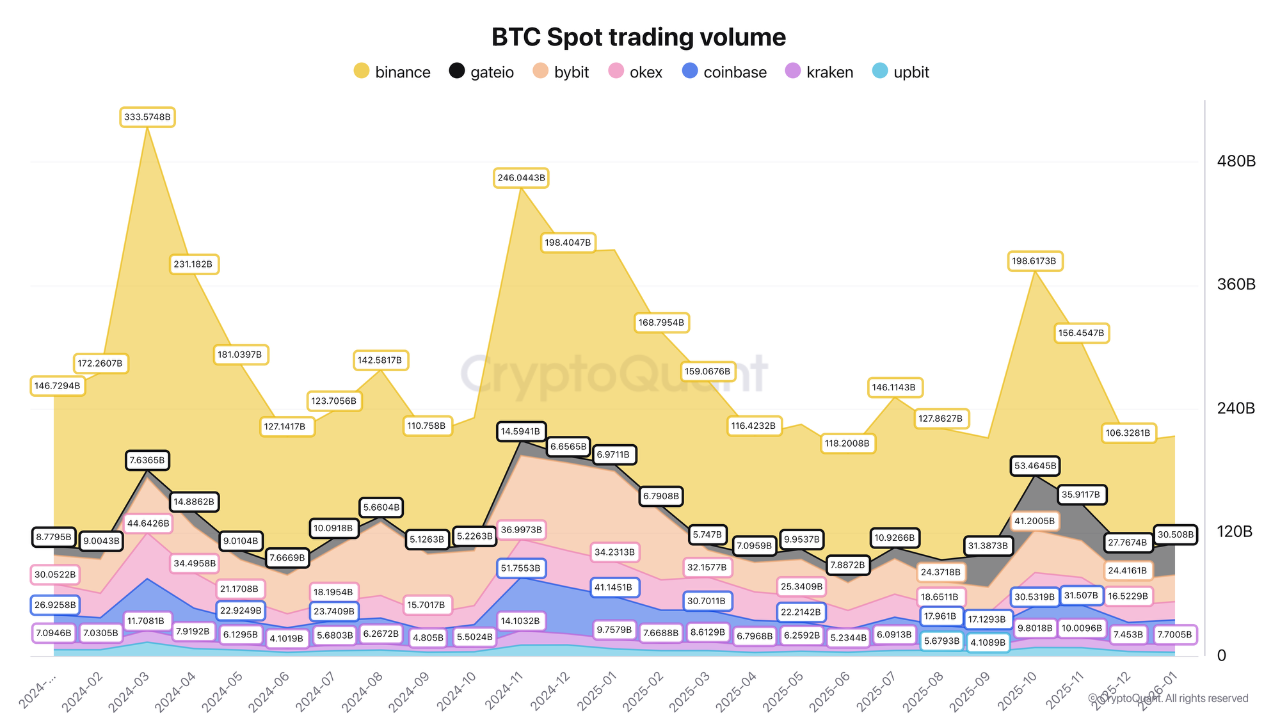
  • Bitcoin spot trading volumes have dropped by nearly 50% since October 2025, returning to levels last seen in 2024 and contributing to the downturn.
  • Binance’s spot volume fell from nearly $200 billion in October 2025 to about $106 billion, with further declines across Gate.io, Bybit, Kraken, and Coinbase.

Liquidity Shock Still Weighs on the Market

CryptoQuant analyst Darkfost recently discussed this, highlighting weakening demand as a major reason behind Bitcoin’s ongoing struggles. He explained that the 10/10 crash triggered a severe liquidity shock, especially in the futures market, and that impact continues to weigh on prices.

Darkfost noted that open interest dropped by more than 70,000 BTC in a single day, wiping out over $8 billion in futures positions almost instantly. While this event kick-started the downturn, he stressed that several other factors have contributed to the current struggles.

Stablecoin Outflows Add to Bitcoin Demand Pressure

First, Darkfost highlighted growing stress in overall market liquidity, spotlighting steady stablecoin outflows from exchanges. These outflows suggest that traders have reduced activity and lowered their appetite for risk. Over the same period, the stablecoin market lost approximately $10 billion in total cap.

The shrinking liquidity and cautious sentiment have created an environment that discourages aggressive buying. Darkfost emphasized that uncertainty continues to dominate market behavior, making it difficult for Bitcoin to attract fresh demand or sustain a meaningful recovery.

Bitcoin Spot Volumes Show Investor Disengagement

Spot market data also confirms that demand has weakened sharply. Since October 2025, Bitcoin spot trading volumes have fallen by nearly 50% across major exchanges. Binance remains the largest spot venue, but its current volume stands at around $104 billion, far below earlier levels.

In October 2025, Binance’s spot volume nearly reached $200 billion, while Gate.io recorded $53 billion and Bybit handled $47 billion. Since then, volumes across the market have continued to decline, returning to levels among the lowest seen since 2024.

Bitcoin Spot Trading Volume CryptoQuant
Bitcoin Spot Trading Volume | CryptoQuant

Spot volume charts confirm this trend. After peaking at $198 billion in October, Binance’s volume has steadily dropped to about $106 billion at press time. Similar declines have appeared on Gate.io, Bybit, Kraken, and Coinbase.

Bitcoin Also Constrained by Macro Factors

Speaking on Bitcoin’s current struggles, market analyst Michaël van de Poppe called attention to the ISM Manufacturing PMI. According to him, it is now approaching its first reading above 50 in more than three years. This marks one of the longest manufacturing downturns in recent history.

Van de Poppe argued that Bitcoin’s earlier rally came primarily from the launch and liquidity impact of spot Bitcoin ETFs rather than organic demand. He highlighted a contrast between the current cycle and the end of 2021, when the U.S. Federal Reserve began quantitative tightening and aggressively raised interest rates. 

According to him, this time, quantitative easing has started as economic growth weakens and interest rates decline. He added that recent peaks in gold and silver show the end of this macro phase, projecting a strong final bull market for Bitcoin and crypto over the next 1 to 3 years.

Bitcoin Could Hit New High in 2026 and $1 Million in 10 Years, Says Bitwise

0

Bitcoin could hit a fresh all-time high in 2026 as institutional participation deepens and traditional market cycles fade in influence, according to executives at crypto asset manager Bitwise.

Key Points

  • Bitwise predicts that Bitcoin could reach a new all-time high in 2026 and $1 million over the next decade.
  • Traditional four-year halving cycles are losing influence on Bitcoin price trends.
  • Institutional capital inflows could reach tens of billions in 2026.
  • ETF and brokerage access expands Bitcoin demand, reducing post-halving price slumps.
  • Bitcoin’s volatility has decreased over the past decade and is now lower than that of several major stocks.
  • Correlation with U.S. equities is weakening; Bitcoin may act as a distinct portfolio asset.

Bitwise Calls 2026 a Turning Point

Ryan Rasmussen, Bitwise’s Head of Research, said in a recent interview that Bitcoin is well-positioned to set a new price record in 2026. He pointed to rising institutional participation as a key driver and added that, if adoption continues to expand, Bitcoin could eventually reach $1 million within the next decade.

These remarks build on a Bitwise client report focused on 2026. In that analysis, the firm urged investors to prepare for a market that differs sharply from previous Bitcoin cycles. According to Bitwise, the asset is maturing just as large financial players increase their exposure.

As part of this shift, Bitwise said the long-observed four-year Bitcoin cycle is gradually breaking down. The firm argued that price behavior is becoming less dependent on predictable supply events and more influenced by broader market structure.

Why the Four-Year Cycle Is Losing Influence

Bitwise Chief Investment Officer Matt Hougan expanded on this view in written commentary, saying the forces that once drove Bitcoin’s boom-and-bust cycles have weakened over time. While halvings, interest rate movements, and leverage-fueled rallies previously played central roles, their impact has diminished as the market has grown more sophisticated.

The Bitcoin halving, which reduces new supply by cutting miner rewards in half, once shaped price trends almost mechanically. However, Bitwise now believes its influence is fading. The firm also cited expectations of lower interest rates and reduced leverage following widespread crypto liquidations in late 2025.

At the same time, access to Bitcoin has widened significantly. Hougan noted that inflows from spot Bitcoin exchange-traded funds, combined with easier access through major brokerage platforms, are changing demand dynamics. He said these forces could support prices into 2026 rather than lead to a typical post-halving slump.

Hougan also challenged the perception of Bitcoin as an unusually volatile asset. He noted that Bitcoin experienced less volatility than Nvidia shares during 2025. He also highlighted that price swings have steadily declined over the past decade, as the expansion of ETF ownership broadened the investor base.

Correlation With Stocks Expected to Weaken

Bitwise also expects Bitcoin’s correlation with U.S. equities to weaken over time. Hougan said crypto-specific factors, such as regulatory progress, broader adoption, and continued product innovation, are likely to play a larger role in shaping price movements.

Consequently, the firm believes Bitcoin could increasingly function as a distinct portfolio asset. Bitwise estimates that tens of billions of dollars in institutional capital could flow into the market during 2026.

Short-Term Pressure, Long-Term Optimism

This bullish outlook comes amid ongoing market stress. Bitcoin recently fell below $80,000 for the first time since April 2025. 

At the time of reporting, Bitcoin was trading near $78,340, down 11% over the past week. The cryptocurrency is also roughly 38% below the peak of $126,080, reached on October 6, 2025.

Despite the current selling pressure, Bitwise maintains that structural shifts in market participation and access could set the stage for a stronger phase ahead.

Russia’s Largest Stock Exchange to Launch Indices and Futures Contracts for XRP

0

Moscow Exchange, the largest stock exchange in Russia, plans to expand its crypto product offerings to include assets like XRP, Solana, and Tron.

Specifically, the leading stock exchange plans to roll out three new crypto indices to reflect the performance of these assets this year. Additionally, the XRP, Solana, and Tron indices would have corresponding futures products, offering Russian investors alternative exposure to additional digital assets.

Key Points

  • Moscow Exchange, the largest stock exchange in Russia, plans to expand its crypto product offerings to include assets like XRP, Solana, and Tron.
  • The leading stock exchange seeks to roll out three new crypto indices to track the performance of these assets this year, along with a corresponding futures contract.
  • Like Bitcoin and Ethereum futures, the XRP and Solana futures contracts will be cash-only and follow the Bank of Russia’s strict guidelines.
  • Moscow Exchange is considering debuting perpetual futures and options for Bitcoin and Ethereum this year.
  • Cryptocurrencies are gradually becoming accessible to Russian investors amid a milder stance in the country.

Moscow Exchange to Offer XRP, TRX, Solana to Investors

For context, a crypto index is a tool that tracks the performance of a group of assets. Holding them indirectly gives investors access to the asset’s price movements without direct spot exposure.

Before now, the Moscow Exchange only offered indices for Bitcoin and Ethereum, two of the largest cryptocurrencies by market cap. However, local media outlet RBC confirmed that the stock exchange plans on offering indices for XRP and two other digital assets.

It cited an announcement on RBC Radio by Maria Silkina, the Chief Product Manager for the Derivative Market group at Moscow Exchange. Specifically, Silkina noted that the platform would expand its crypto offerings throughout 2026, and the top coins, Solana, XRP, and Tron, are among the major candidates.

In addition to creating crypto indices, they will roll out futures products based on these benchmarks. These would provide a new source of liquidity, allowing qualified investors to predict the near- and mid-term price trajectory of these cryptocurrencies.

Meanwhile, like Bitcoin and Ethereum futures, the XRP futures contract will be cash-only and follow the Bank of Russia’s strict guidelines. It would also be settled monthly, in line with existing regulatory requirements.

Bitcoin and Ethereum Perpetual Futures in Consideration

Interestingly, Silkina also reported that the Moscow Exchange is considering debuting perpetual futures and options for Bitcoin and Ethereum this year. This, it will launch gradually, reflecting the platform’s renewed focus on cryptocurrencies.

The difference between the existing futures and the perpetual futures is that the latter have no expiration date. Perpetual futures use funding rates to align with spot prices, allowing contract holders to keep their positions indefinitely.

The Moscow Exchange launched four crypto futures in 2025, including the Ethereum and Bitcoin ETFs of BlackRock’s iShares and the Moscow Exchange Bitcoin and Ethereum indices. With Russians increasingly inclined towards cryptocurrencies, the trading platform plans to introduce more in 2026.

Notably, cryptocurrencies are gradually becoming accessible to Russian investors. This aligns with the ongoing embrace of digital assets in the country. 

Recall that talks are ongoing to ease crypto regulations, allowing everyday market users to access Bitcoin and crypto, a trend that is becoming rampant globally. Moreover, Russia’s largest bank, Sberbank, has launched a Bitcoin-tied investment product.

Elon Musk Confirms Plan to Send Dogecoin to the Moon by 2027

0

The world’s richest man, Elon Musk, has reaffirmed his commitment to have SpaceX send Dogecoin (DOGE) to the Moon as early as next year.

In a brief exchange on X, Musk reignited speculation around Dogecoin after responding to a resurfaced post about the mission. His commentary once again attracted attention to his long-standing association with the meme token. 

Key Points 

  • Elon Musk has reaffirmed SpaceX’s plans to send Dogecoin to the Moon.
  • He suggested the mission could take place as early as next year.
  • Musk has repeatedly renewed this commitment since first making the claim in 2021.
  • Despite the renewed attention, DOGE posted only a modest price reaction.

Musk Confirms Plans to Send Dogecoin to the Moon 

The discussion began when the “Tesla Owners Silicon Valley” account reposted a screenshot of Musk’s 2021 claim that SpaceX would place a “literal Dogecoin” on the “literal Moon.” When asked for an update, Musk replied, “Maybe next year,” suggesting the mission could occur as early as 2027. 

Interestingly, Musk reinforced the narrative by replying “Yes” to a separate post stating that “Dogecoin on [to] the Moon is inevitable.” However, he provided no further details on how SpaceX would execute the plan.  

Dogecoin to the Moon Mission 

Although the phrase “Dogecoin to the moon” has long symbolized a surge in DOGE’s price, Musk’s viral X post has given it a more literal and realistic dimension.

Since the post went viral in 2021, Musk has repeatedly reaffirmed plans to send Dogecoin to the Moon. In November 2025, he revisited the pledge, saying, “It’s time,” and he has now reignited excitement by signaling the goal could be fulfilled by 2027. 

Unending Support for DOGE 

Meanwhile, this development reflects Musk’s sustained support for DOGE. He has backed the token as a payment option for Tesla and SpaceX merchandise and posted bullish commentary on social media. Interestingly, even his lawyer, Alex Shapiro, was chosen to chair a $200 million Dogecoin treasury firm. This persistent backing played a key role in DOGE’s surge to an all-time high in May 2021. 

Notably, Musk’s comments had a limited impact on DOGE’s price. After he revealed the mission timeline, DOGE briefly rose from about $0.1069 to $0.1087, reflecting a modest 1.68% gain. However, the token has since pulled back and now trades at $0.1081, up 1.45% over the past 24 hours.