Home Blog Page 287

Top Business Executive Says XRP Shackles Are Finally Off

0

Bitwise CIO Matt Hougan says the regulatory shackles that once limited XRP’s real-world adoption have finally been lifted, potentially opening the door to broader investor exposure. 

He shared this view while explaining why Bitwise launched its spot XRP ETF, noting that the token’s investment case now centers more on future optionality than past utility. 

For years, regulatory pressure effectively stalled XRP’s growth. Now that these constraints have eased, Bitwise believes investors deserve a simpler, regulated way to gain exposure as the asset enters a new phase.  

Key Points

  • Bitwise CIO Matt Hougan says the regulatory barriers that once blocked XRP’s real-world adoption have now been removed.
  • He describes XRP as a “Lindy” asset, highlighting its durability and long-term staying power in the crypto market.
  • With the legal uncertainty lifted, Hougan believes XRP can now compete fairly with other blockchain projects. 
  • The Bitwise XRP ETF has emerged as the second-largest XRP ETF in the U.S., with net assets approaching $300 million.

XRP as a Lindy Asset

In a recent interview with 51 Insights, Hougan explained that Bitwise’s decision to launch an XRP ETF reflects both market demand and a shift in the asset’s outlook. 

He described XRP as a “Lindy asset,” emphasizing its resilience through prolonged uncertainty and its strong community support. Consequently, XRP’s longevity has sustained investor interest in accessing the token through a regulated vehicle. 

Regulatory Shackles No Longer in Place for XRP 

Hougan stressed that XRP’s limited real-world adoption stemmed less from technological shortcomings and more from legal uncertainty. The SEC lawsuit, he noted, discouraged institutions and developers from building within the ecosystem. As a result, meaningful partnerships remained unlikely under such pressure. 

Now that the lawsuit has been resolved, Hougan believes XRP can compete on equal footing with other blockchain networks. While this shift does not guarantee success for Ripple or XRP, he emphasized that it removes the primary barrier that once constrained growth. Therefore, he argues the asset has become relevant again for investors evaluating new opportunities. 

Bitwise’s Confidence in XRP 

Notably, Bitwise was the first asset manager to file for a U.S. spot XRP ETF, submitting its application while the token still faced regulatory pressure. Less than a day later, the SEC appealed the court ruling, intensifying uncertainty around XRP’s status.

Nonetheless, Bitwise remained committed and successfully launched the spot XRP ETF toward the end of last year. Currently, the fund ranks as the second-largest XRP ETF in the U.S., attracting cumulative inflows of $338.88 million and holding net assets of $292.75 million.

It trails only the Canary XRP ETF, which manages net assets of $325.33 million. Overall, the U.S. spot XRP ETF market has recorded a combined inflow of $1.18 billion, with total net assets reaching $1.19 billion. 

XRP Becomes 4th Largest Chain by Represented Tokenized RWA, Beating Ethereum

0

The XRP Ledger has now become the fourth-largest blockchain in terms of represented tokenized RWA value, beating heavyweights Ethereum and Polygon.

Notably, the XRP Ledger (XRPL) now boasts $1.4 billion in represented tokenized real-world assets, having witnessed a massive 266% increase in value over the past month, the largest uptick among the top 10 blockchain networks.

For context, Ethereum currently hosts $208.6 million worth of represented real-world assets (RWA), with a 30.09% decline in the last 30 days. This makes Ethereum ninth on the list of largest chains by represented RWA. Meanwhile, Polygon, which boasts a whopping $817.1 million worth of represented RWA, sits fifth, just below the XRPL.

Key Points

  • The XRPL, which lagged considerably in tokenized real-world assets, appears to be seeing some rapid gains.
  • In the last 30 days, the XRPL has recorded a 266% increase in represented RWA value, hitting $1.4 billion.
  • This places the ledger in fourth place among the largest networks by represented RWA, towering over Ethereum and Polygon.
  • Polygon, with $817 million in represented RWA, sits fifth, while Ethereum secures the ninth position with $208 million.
  • The XRPL still lags in distributed RWA, but has now soared to become the sixth-largest chain across all metrics.

XRP Ledger Sees 266% Rise in Represented RWA

Insights from RWA.xyz confirm this data, which shows how the XRPL has improved in RWA tokenization over the past few weeks. For context, The Crypto Basic reported a week ago that the XRPL had crossed the $1 billion milestone in terms of tokenized RWA. 

However, Ripple’s Luke Judges revealed that the figure had already doubled to $2 billion. Judges stressed that the discrepancy came from a delay by RWA.xyz to index the value contributed by their partners. According to her, his team has a clear strategy, which is now starting to pay off.

Interestingly, shortly after the report from The Crypto Basic, RWA.xyz updated the figures around XRPL’s tokenized value, indexing $861 million worth of represented RWA value by JMWH. For the uninitiated, JMWH is a commodity token representing tokenized energy backed by actual energy companies. The asset rests on the Justoken tokenization platform.

XRPL Now Fourth Largest in Terms of Represented Value

Notably, the inclusion of JMWH took the XRPL’s represented RWA value to a whopping $1.257 billion. Meanwhile, days later, the XRP Ledger also welcomed $108 million worth of tokenized value from Anita Diamonds Collection, hosted on the Ctrl Alt platform.

With a mild increase across other existing represented RWA, the XRPL’s represented tokenized assets have now grown to $1.44 billion, a 266% increase in the past 30 days. This figure places the ledger fourth among blockchains with the largest represented RWA. 

XRPL 4th in Represented RWA

For context, XRPL now towers over heavyweights such as Ethereum and Polygon, only behind Canton, Provenance, and ZKSync Era in this metric. Specifically, Polygon holds $817.1 million worth of represented RWA, sitting just below the XRPL at fifth. Meanwhile, Ethereum holds only $208.6 million, currently sitting ninth.

XRPL Still Lags in Distributed RWA

However, the XRPL still lags other networks in terms of distributed RWA. With $235.7 million worth of distributed assets, the XRPL sits tenth on the list of largest networks by this metric. For perspective, Ethereum leads with a whopping $15.6 billion in distributed RWA, while BNB Chain comes second with $2.3 billion.

Despite the low figures from distributed assets, the XRPL’s increase in represented RWA has pushed it to sixth overall when considering all real-world assets, including represented and distributed ones. The Ledger currently holds $1.7 billion in total RWA, and it remains unclear if this figure considers Luke Judges’ earlier correction.

XRP Ledger Now 6th in Total Tokenized RWA

U.S. Bank Could Turn $10,000 to $73,000 in 40 Years, But XRP in 9 Months

0

Market data shows that XRP recently achieved in nine months the same returns that a U.S. online bank would require 40 years to generate.

Despite witnessing multiple periods of bearish price action and price uncertainties, XRP has always proven its penchant for outsized growth during market rallies. Data confirms that due to one such rally, XRP took nine months to deliver gains that would take traditional banks centuries to yield.

For context, a recent assessment confirmed that XRP’s surge from $0.5 in November 2024 to $3.66 by July 2026 transformed $10,000 into $73,000. For online U.S. banks to yield similar returns from a $10,000 investment at the 5% APY rate, it would take them over 40 years.

Key Points

  • XRP has always demonstrated its penchant for rapid returns during occasional periods of market rallies.
  • The November 2024 to July 2025 surge, which pushed prices from $0.5 to $3.66, would have turned $10,000 to $73,000 within nine months.
  • For online banks in the U.S., which boast the highest interest rates of around 5%, to yield such returns, it would take 40 years.
  • XRP still features inherent investment risks, which could see investors’ holdings drop to lower values, an advantage traditional banks hold.

How Much Yield Do U.S. Savings Accounts Offer?

For context, savings account returns in the U.S. remain very low at the time of reporting, limiting how much traditional banks can grow everyday deposits. 

Specifically, the FDIC’s January 2026 update puts the national average savings rate at 0.39% APY, a figure weighed down by large banks that still pay close to nothing. Bankrate’s survey from Jan. 26, 2026, shows a slightly higher average of 0.61% APY, still below 1%.

Meanwhile, online banks perform better, with high-yield savings accounts offering between 4.20% and 5.00% APY at last check. Nonetheless, some of these rates have started to ease following the interest-rate cuts in 2025.

Duration to Yield $73,000 with $10,000

These rates confirm how slow traditional banks can be when it comes to building wealth. Notably, at the 0.39% rate, turning $10,000 into $73,000 takes about 510.7 years. Meanwhile, with the 0.61% rate, it drops to 326.9 years, which still goes beyond any realistic investment timeline.

Considering the 5.00% APY from online banks, the $73,000 return would take around 40.7 years with annual compounding, or about 39.8 years with monthly interest. This confirms that savings accounts focus on safety, not wealth creation. Essentially, they protect cash but demand extreme patience for any substantial growth. 

XRP Did It in Nine Months

Meanwhile, XRP transformed $10,000 into $73,000 within just nine months. Specifically, XRP traded for $0.5 in November 2024 after a long period of consolidation. From here, it rallied to an initial high of $3.4 and then pulled back to a low of $1.61 in April 2025 before recovering to a new high of $3.66 by July.

Notably, an investor who committed $10,000 into XRP at the $0.5 price would have procured 20,000 XRP tokens. At the July 2025 peak of $3.66, these 20,000 tokens had a worth of $73,200. Essentially, XRP transformed $10,000 into $73,200 within nine months.

However, this is not a prediction that crypto always outperforms cash vehicles, but it does show how deeply traditional savings yields lag behind fast-moving price action. Despite this, traditional savings offer the advantage of protecting one’s cash if inflation doesn’t spike considerably. In contrast, assets like XRP could collapse to new lows.

The Plan Has Not Changed for XRP: Analyst Maintains $1.65 Target Before Rebound

0

As the XRP price dips to new yearly lows, some market watchers are expressing confidence that the trajectory is moving as expected.

Over the past day, XRP crashed to $1.71, marking its lowest point of the year, after opening 2026 above $1.80. At press time, XRP has yet to recover meaningfully and is trading around $1.75.

While this move has unsettled some holders, several analysts believe XRP is still moving according to plan.

Key Points

  • XRP dips to $1.71, the lowest point of 2026, but the outlook remains on track.
  • Analysts keep $1.65 target, citing a corrective Wave 3 structure.
  • Key $1.50–$1.65 zone may trigger strong rebound and renewed upside.
  • Other analysts warn of deeper pullback but fundamentals remain solid.

“The Plan Has Not Changed”

In a recent post on X, widely followed technical analyst CasiTrades said her outlook on XRP remains firmly intact despite the recent volatility. She stressed that the broader market structure is still unfolding as expected. “The plan has not changed,” Casi remarked.

In the chart shared alongside the post, the analyst reiterated that the projected Wave 3 move to the downside is still in play, with price targeting the $1.65 region.

Image

According to CasiTrades, the current decline fits within a larger corrective structure. In other words, XRP’s dip toward $1.70 does not signal a breakdown of its broader bullish setup.

Her chart highlights the $1.50–$1.65 range as a key confluence zone, where descending trendline support and Fibonacci retracement levels align.

XRP’s inability to reclaim the $1.90 area has reinforced the view that downside pressure has not fully played out. As a result, the analyst believes the market is still working through its final leg lower before a meaningful shift in momentum occurs.

XRP Rebound Expected After Key Support Test

CasiTrades notes that XRP couldpick up once the $1.50–$1.65 support zone is tested. The analyst expects this area to act as a potential launch point for the next impulsive move higher.

Momentum indicators such as the RSI continue to cool off, supporting the idea that XRP is resetting. If the projected Wave 3 completes as outlined, the subsequent recovery could set the stage for renewed upside momentum.

Notably, XRP entered a bearish phase after hitting $3.66 in July 2025. Since then, the price has dipped below $2 multiple times. With XRP trading around $1.75 at press time, Casi expects a drop toward $1.50 before a strong rebound toward $2.70.

This development could set the stage for XRP to challenge the $3 mark once again. For now, the analyst maintains that nothing in the current price action invalidates her roadmap. In her words, the plan for XRP has not changed: a final push lower, followed by a strong recovery from key support.

What Other Analysts Say

Other analysts share a similar view. Notably, EGRAG recently outlined a worst-case scenario for XRP but emphasized that it is not his base case. He argues that XRP’s fundamentals remain solid, with the current weakness driven more by market sentiment than underlying data.

Based on past cycles, EGRAG said XRP could still experience a deeper 47% pullback, revisiting the $1.40–$1.20 range. He describes this zone as one of “maximum fear” for the market.

Using Fibonacci levels, EGRAG highlights $2.72 and $3.65 as key mid-term resistance levels, with long-term projections near $16.50 and $35, though critics continue to question the feasibility of the highest target.

Bitcoin Holds Strong: Only 5% Dip as Gold, Silver Markets Tank

0

Bitcoin showed relative resilience during a broad global market sell-off that affected major asset classes, according to CryptoQuant author Darkfost.

While gold plunged around 8% and silver fell roughly 12%, Bitcoin declined by a more moderate 5%, even as U.S. equities came under pressure.

Key Points

  • Bitcoin drops 5% amid global sell-off hitting gold, silver, and stocks.
  • Gold and silver fall sharply, while Bitcoin shows relative resilience.
  • Nearly $300M in Bitcoin long positions liquidated in derivatives market.
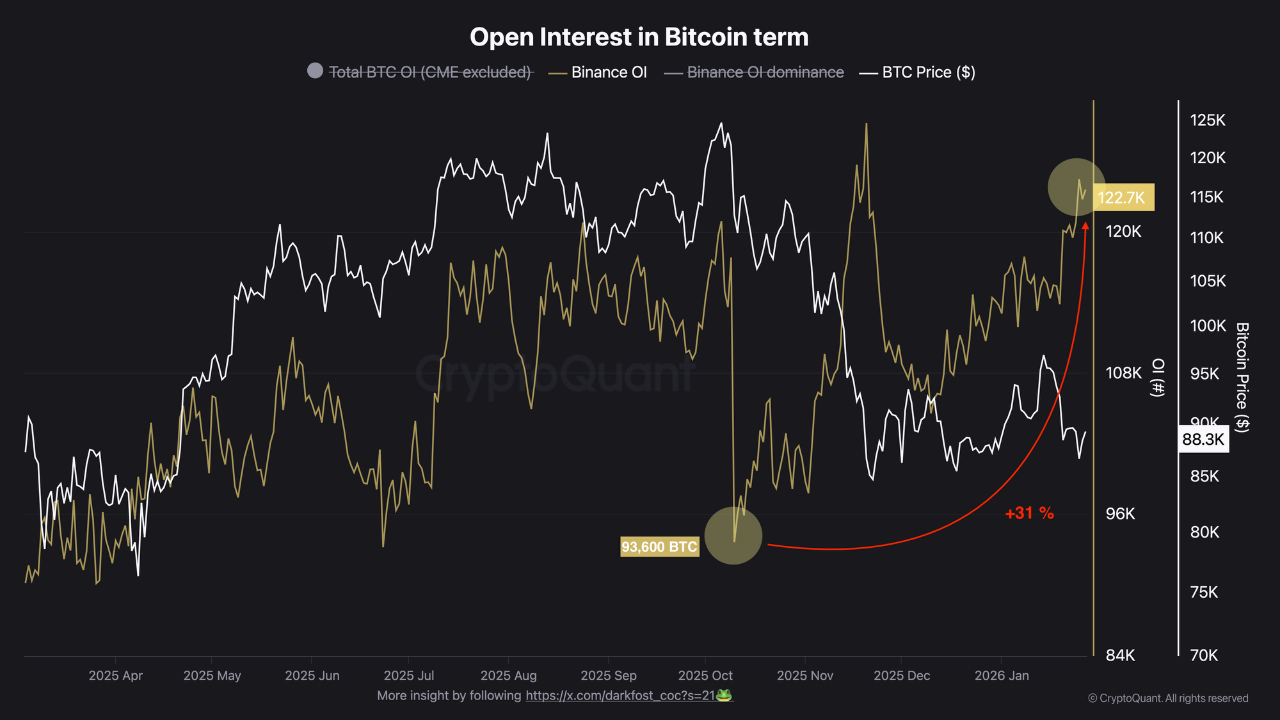
  • Binance open interest rebounds 31%, signaling returning risk appetite.

Global Pullback

The pullback unfolded amid significant losses in traditional markets, impacting both the S&P 500 and the Nasdaq.

The catalyst was largely tied to Microsoft, whose stock dropped more than 12% following announcements about its artificial intelligence investments. That decline triggered a domino effect across global markets, spilling over into commodities and crypto.

Liquidations Surge Despite Mild Bitcoin Correction

Notably, Bitcoin’s price dipped from around $85,500 to $81,110, marking its lowest point in 2026. Meanwhile, gold saw a more dramatic fall from its $5,600 peak to $4,959.

Despite Bitcoin’s relatively contained decline, the move was enough to trigger heavy liquidations in the derivatives market. Nearly $300 million in long positions were wiped out within hours.

Hyperliquid recorded the largest share of liquidations, with $87.1 million in long positions erased. Binance, despite handling some of the highest crypto trading volumes, saw significantly lower liquidations of around $30 million. This contrast suggests that leverage concentration, rather than raw volume, played a major role in the cascade.

Updated figures from CoinGlass show that over 190,000 traders were liquidated in the past 24 hours, with losses exceeding $1.37 billion.

Risk Appetite Returns as Binance Open Interest Rebounds

Meanwhile, Darkfost noted that investor risk appetite remains strong, even after the October 10 event that previously caused widespread liquidity and capital destruction. Binance’s data reflects this trend.

Measured in BTC to neutralize price swings, Binance’s open interest has risen to about 123,500 BTC, up from 93,600 BTC before October 10. This marks a roughly 31% increase, showing that leveraged trading is bouncing back.

Overall, while traditional markets dropped sharply, Bitcoin experienced a smaller pullback, and derivatives are recovering quickly. This indicates that traders remain willing to take risks, even in a volatile macro environment.

Shiba Inu Holds Firm at Key Support Level as Rebound Setup Takes Shape

0

Despite recent weakness, Shiba Inu buyers are stepping in to defend a key support zone, increasing the chances of a short-term rebound. 

The broader financial downturn continues to pressure cryptocurrencies, driving major assets lower. Notably, Shiba Inu has repeatedly tested a critical support level, and analysts now suggest the token may be preparing for a bounce.

Key Points 

  • Shiba Inu is repeatedly defending a critical support level around $0.00000724. 
  • The token last traded near this zone last month and has since returned amid a broader market pullback. 
  • Sustained support at this level strengthens the case for a potential short-term rebound. 
  • However, any meaningful upside would require SHIB to reclaim and hold above $0.00000809. 

Rebound Imminent? 

Popular community analyst SHIB KNIGHT highlighted the observation in his latest Shiba Inu analysis. The accompanying chart shows SHIB pressing into a well-defined support zone around $0.00000724 after a sharp pullback. 

As a result, he noted that buyers have repeatedly defended the price from falling below this crucial support. This pattern signals strong demand at lower levels and growing seller exhaustion. As support continues to hold, KNIGHT suggested that the setup may signal an imminent rebound. 

Shiba Inu Defends Crucial Support

Historical Context 

For context, SHIB last traded at $0.0000072 in December 2025 during a broader market decline. Although early recovery attempts failed, bulls regained control earlier this month, pushing the token toward $0.00001. 

However, persistent selling pressure soon dragged SHIB back to the $0.0000072 support yesterday amid the broader market slump. Despite ongoing volatility, buyers have stepped in aggressively to defend this level, limiting further downside. 

Currently, SHIB trades near this support zone at approximately $0.000007276 and could be aiming for a rebound, according to KNIGHT. However, a clean break below the level would invalidate the setup and could open the door to further downside. 

Shiba Inu Next Move

Meanwhile, Shiba Inu has faced sharp volatility over the past day, with prices swinging between $0.0000075 and $0.0000071. As a result, SHIB lost a key support at $0.00000748, which has now flipped into resistance, while $0.00000724 serves as the immediate support. However, if this level fails, the next support lies at $0.0000069, which could offer temporary relief if selling pressure persists. 

Moreover, SHIB must reclaim the 0.236 Fibonacci retracement level around $0.00000809 to trigger any meaningful upside. Else, recovery attempts may remain limited. 

Trump Taps Pro-Bitcoin Kevin Warsh to Lead Federal Reserve

0

President Donald Trump has nominated Kevin Warsh to serve as the next chair of the U.S. Federal Reserve, ending weeks of speculation about who would lead the central bank.

The decision, announced Friday, immediately drew attention from both traditional financial markets and the crypto sector. Warsh is widely known for his firm stance on inflation, while maintaining a notably measured and at times open view of Bitcoin.

Key Points

  • Kevin Warsh served on the Federal Reserve Board of Governors from 2006 to 2011.
  • At 35, he became the youngest Fed governor in history.
  • Warsh is widely regarded as a monetary policy hawk, focused on controlling inflation.
  • He has publicly stated that Bitcoin does not threaten Fed policy and views it as a generational alternative to gold.
  • Warsh is a partner at Duquesne Family Office and a visiting fellow at the Hoover Institution.
  • Senate confirmation is required before he can succeed Jerome Powell, whose term expires in May.

Nomination Announcement

Trump revealed his choice in a post on Truth Social, citing Warsh’s extensive background in finance, monetary policy, and public service. He suggested that Warsh has the potential to become one of the most influential leaders in the Federal Reserve’s history.

The announcement followed a dramatic shift in market expectations. Late Thursday, prediction markets began signaling a near-certain outcome. On Polymarket, Warsh’s implied odds surged to roughly 95 percent from about 39 percent earlier in the day. Kalshi showed a similar jump after Trump said he would publicly announce his decision on Friday morning.

With the nomination now official, attention turns to the Senate confirmation process. If confirmed, Warsh would succeed current Fed Chair Jerome Powell, whose term expires in May.

Warsh’s Experience Inside and Outside the Fed

Warsh brings deep institutional experience to the role. He served on the Federal Reserve’s Board of Governors from 2006 to 2011, spanning both the George W. Bush and Barack Obama administrations. At just 35 years old, he became the youngest Fed governor in history.

His influence extended beyond Washington. Warsh represented the Federal Reserve at G-20 meetings and later oversaw key internal operations, placing him at the center of the institution’s decision-making during a turbulent period for global finance.

Since leaving the Fed, Warsh has remained active in both policy and markets. He is a visiting fellow in economics at the Hoover Institution and lectures at Stanford Graduate School of Business. In addition, he is a partner at Duquesne Family Office, working alongside prominent investor Stanley Druckenmiller.

Bitcoin Views Draw Crypto Market Attention

While Warsh’s résumé alone would command attention, his views on Bitcoin have added a distinct dimension to market reaction.

Crypto investors have closely followed his public comments. At a Hoover Institution event last July, Warsh said Bitcoin does not threaten the Federal Reserve’s ability to conduct monetary policy. Instead, he described it as a signal, one that can reflect whether policymakers are making sound decisions.

Warsh has also likened Bitcoin’s rise to a generational shift away from gold, noting that younger investors increasingly see it as a modern alternative store of value.

His interest is not purely theoretical. Warsh has indirect ties to the crypto industry, including early involvement with the algorithmic stablecoin project Basis and an advisory role with crypto index manager Bitwise.

Inflation Hawk With a Clear Reputation

Despite these crypto-friendly remarks, Warsh’s broader reputation remains unchanged. He is widely viewed as a monetary policy hawk, known for consistently warning about inflation risks, even during periods of economic stress.

That stance has not gone unnoticed by economists. Bloomberg Chief U.S. Economist Anna Wong recently summarized it bluntly, noting that those hoping for a lenient approach to inflation are unlikely to find it in Warsh.

What Comes Next

Warsh’s nomination concludes a competitive selection process that reportedly included Fed Governor Christopher Waller, National Economic Council Director Kevin Hassett, and BlackRock executive Rick Rieder. With the choice now made, the focus shifts fully to Senate confirmation.

For markets, the nomination offers both familiarity and uncertainty. Warsh brings deep institutional knowledge and a firm anti-inflation track record. Meanwhile, his openness toward Bitcoin sets him apart from previous Fed leaders. If confirmed, how those views translate into policy will be closely watched.

Glassnode Identifies Four Events That Contributed to the Latest Bitcoin Crash to $81,000

0

Glassnode has identified four separate events that contributed to the latest Bitcoin crash to the $81,000 region.

Notably, Bitcoin (BTC) has remained under heavy pressure since reaching a local peak of $94,000 on Jan. 14. Despite this weakness, BTC attempted a short-term rebound on Jan. 26, staging a three-day recovery move that lifted prices back above $90,000 by Jan. 28.

However, the recovery has failed to hold. Soon after reclaiming $90,000, Bitcoin has now encountered another intense wave of selling pressure. Within just two days, the price dropped by more than 7%, dragging BTC down to $81,040 before a modest rebound to the current price of $82,800.

As the market absorbed the latest downturn, on-chain analytics firm Glassnode recently identified four different forces that contributed to the selling pressure surrounding Bitcoin.

Key Points

  • Bitcoin recently slid to as low as $81,040 after failing to sustain a recovery above $90,000 by Jan. 28.
  • Glassnode confirmed that the $90,000 area lacked strong support and identified four factors that contributed to this downtrend.
  • One factor is the selloff campaign among long-term holders, who have distributed over 12K BTC per day on average in the last 30 days.
  • U.S. spot Bitcoin ETFs also contributed, recording $984 million in outflows since Jan. 27.
  • Long liquidations dominated the downturn, with $752 million of $792 million in liquidations over 24 hours coming from long positions.

Long-Term Holder Distribution

In its latest report, Glassnode stressed that the $90,000 price zone showed signs of instability even before the latest drop. Citing options-related data, the firm noted that this level lacked strong support and left Bitcoin vulnerable to sharp declines once selling pressure resumed. It then mentioned four factors that led to the drop.

Glassnode identified long-term holder activity as the first major contributor. Over the past 30 days, long-term holders have distributed more than 12,000 BTC per day on average, translating to about 370,000 BTC per month. This distribution has created ongoing sell-side pressure.

Bitcoin Spent Volume Glassnode
Bitcoin Spent Volume | Glassnode

Data from the accompanying chart shows that during the downturn in Q4 2025, long-term holder selling surged to a peak of over 53,000 BTC per day. However, toward the end of 2025, the aggressive selling eased, and the slowdown carried into the start of the new year.

Nonetheless, this relief was temporary. After dropping to a low of around 10,000 BTC per day, long-term holder distribution has started to rise again, 

ETF Outflows and Miner Transfers

The second factor highlighted by Glassnode was a sharp reversal in U.S. spot Bitcoin ETF flows. These products recently began witnessing net outflows, removing a major source of spot demand that had previously helped absorb selling pressure.

After a modest $6.84 million inflow on Jan. 26, which interrupted what would have been nine consecutive days of inflows, Bitcoin ETFs quickly turned negative. 

Bitcoin ETF Net Flows Glassnode
Bitcoin ETF Net Flows | Glassnode

From Jan. 27 onward, total outflows reached $984 million, with a single intraday withdrawal of $817.87 million, the largest intraday outflow recorded this year. In total, ETFs have posted $1.1 billion in outflows this month.

Glassnode also highlighted renewed miner selling as the third pressure point. After a brief pause earlier in the year, miners resumed transferring Bitcoin to exchanges throughout January. The Net Transfer Volume from miners now sits around -48 BTC.

Bitcoin Net Miner Transfer Volume Glassnode
Bitcoin Net Miner Transfer Volume | Glassnode

Long Liquidations

The fourth factor involves a surge in forced liquidations as prices fell. As Bitcoin moved lower, leveraged long positions began to unwind, bolstering the sell-off. Glassnode estimated that roughly $300 million in long liquidations initially kicked in as the downturn emerged.

Bitcoin Total Liquidations Glassnode
Bitcoin Total Liquidations | Glassnode

Over the past 24 hours, total liquidations have reached $792 million, with $752 million tied to long positions alone. This means nearly 95% of all liquidations came from traders betting on higher prices. Yesterday alone, as total liquidations totaled $450 million, long positions accounted for $432.96 million, representing 96% of the total.

SEC and CFTC Collaborate on Project Crypto to Harmonize Crypto Regulation

0

The U.S. CFTC and SEC have agreed to jointly lead a regulatory effort, dubbed “Project Crypto,” to modernize oversight of digital asset markets.

The collaboration was announced Thursday at a joint regulatory forum hosted by both agencies. Officials said the move reflects the growing convergence of financial technologies, trading platforms, and asset classes, an evolution that has increasingly blurred traditional regulatory boundaries.

SEC Chair Paul Atkins confirmed that Project Crypto will be managed collaboratively. In his remarks, he argued that existing regulatory divisions no longer reflect how modern markets actually function, calling for a more integrated approach to supervision.

Key Points

  • Project Crypto will be jointly managed by the SEC and CFTC to integrate oversight of digital assets.
  • The initiative formalizes cooperation that began after the agencies ended their jurisdictional standoff in September.
  • New CFTC Chair Michael Selig confirmed the agency will align its crypto framework with the SEC rather than creating a standalone system.
  • Regulators plan to develop a shared taxonomy clarifying which digital assets qualify as securities.
  • Congress is advancing legislation on digital asset regulation, but progress has been uneven, with delays caused by the treatment of stablecoins.
  • The CFTC will also revisit rules on prediction markets, withdrawing previous proposals that limited political and sports-related contracts.

Regulatory Tensions Give Way to Cooperation

The joint effort marks a significant departure from recent history. Until last year, the SEC and CFTC were publicly divided over which agency should regulate most cryptocurrencies.

Rostin Behnam, who previously chaired the CFTC, had stated that most digital tokens are classified as commodities. At the same time, former SEC Chair Gary Gensler maintained that most tokens, aside from Bitcoin, qualified as securities.

That long-running dispute began to ease in September, when then-Acting CFTC Chair Caroline Pham announced that the agencies would end their jurisdictional standoff and coordinate oversight. Project Crypto now formalizes that détente.

Atkins warned that fragmented regulation across an interconnected market creates confusion instead of protecting investors. He stressed that this underscores the urgency of a unified regulatory framework.

New CFTC Chair Sets an Early Direction

Against this backdrop, newly appointed CFTC Chair Michael Selig, who assumed office last month, outlined his regulatory priorities during one of his first public appearances.

Selig said the CFTC will not pursue a standalone crypto framework. Instead, the agency will align its work directly with the SEC under Project Crypto. He directed staff to collaborate on joint rulemaking, focusing on a shared taxonomy proposed by Atkins to clarify which digital assets qualify as securities.

Selig described the approach as an interim solution while Congress works toward comprehensive crypto legislation.

Congress Advances Slowly as Regulators Act

Lawmakers continue to debate how to structure digital asset regulation, with proposals that could expand the CFTC’s authority and formally divide oversight between agencies.

However, progress has been uneven. Earlier Thursday, the Senate Agriculture Committee advanced its digital asset bill along party lines. 

Meanwhile, the Senate Banking Committee has yet to hold a hearing. Disputes over how to treat stablecoin yields have slowed momentum.

Despite these challenges, Selig said Congress is nearing action, warning that U.S. leadership in digital assets cannot be taken for granted.

Atkins echoed that sentiment in a WSJ interview published Thursday, noting that legislative clarity remains the best long-term outcome. However, he added that regulators can still take action in the meantime under existing authority.

The Journal also reported that the SEC and CFTC plan to sign an MOU that would formally codify their cooperation.

Prediction Markets Become Part of the Regulatory Reset

Beyond crypto, Selig also signaled a shift in the CFTC’s approach to prediction markets and event-based contracts.

He directed staff to withdraw a 2024 proposal that would have prohibited political and sports-related contracts. Additionally, he rescinded a 2025 advisory that had warned firms about engaging in sports-related event contracts. According to Selig, those measures created uncertainty rather than regulatory clarity.

Interest in prediction markets has surged in recent years, with platforms such as Polymarket and Kalshi expanding rapidly during the 2024 U.S. election cycle. Former Chair Behnam had previously warned that election betting posed risks and argued such activity should be regulated at the state level.

The CFTC previously barred Polymarket from serving U.S. users over licensing issues, though that restriction was lifted last year. Under the Trump administration, several firms—including Gemini Titan, MIAX Derivatives Exchange, Polymarket US, and Bitnomial—received approval to enter the market.

Trump-backed Truth Social is also exploring prediction-market tools through a partnership with Crypto.com.

Looking ahead, Selig said CFTC staff will draft new rules for event-based contracts, highlighting the importance of establishing clearer standards. He noted that such standards are critical to providing market participants with greater certainty.

XRP Breaks Below Its 1-Year Support Range: What’s Next?

0

XRP now trades in a fragile zone, slipping below a support range that held the market together for more than a year. 

Amid the ongoing downtrend that has persisted since the drop from $3.66 in July 2025, XRP is now breaking below a critical support area within the $1.8 to $2.1 range. This area had held for over a year, providing a cushion against steeper declines during periods of sustained price struggles.

The latest collapse below this range could spell doom for XRP if the next support levels do not hold up well. Specifically, XRP now looks to the $1.7 to $1.75 range for immediate support, with the $1.8 to $2.1 level now acting as resistance. If XRP can reclaim the $2 mark, its fortunes could change for the better.

Key Points

  • XRP has now slipped below the $1.8 to $2.1 support range amid the latest wave of bearish pressure.
  • This support range acted as a critical defense against steeper drops during periods of sustained downturns, protecting XRP for over a year.
  • With the latest breach, XRP now needs to maintain the $1.7 to $1.75 support area to cushion further declines.
  • A recovery above $2 from the current position could flip the trend bullish, allowing XRP to aim for higher targets.

How XRP Established Support Around $1.8 to $2.1

Market analyst Krillin first called attention to this long-standing support range last month. As XRP held this area despite the Q4 2025 downturn, he commended the asset’s resilience, stressing that XRP had maintained the support for over a year.

The current price structure began in late 2024. Specifically, in November 2024, XRP surged from around $0.50 to above $2.00 in just a few 3-day candles. XRP then turned $2.00 into a significant psychological level after pushing above it by December 2024. 

XRP 3D Chart Krillin
XRP 3D Chart | Krillin

The rally continued through early 2025, pushing XRP into the $3.00 to $3.30 range before a pullback tested support near $2.00. This marked the first major corrective phase of the cycle. Between April and June 2025, XRP settled into a consolidation above the $1.8 to $2.1 red support zone, repeatedly testing this area. 

However, a recovery effort pushed prices to $3.66 by July 2025, a nearly sevenfold move from the November 2024 lows. After this peak, XRP entered a distribution phase, forming lower highs and lower lows, eventually losing $2.80 and $2.50. By Q4 2025 and into January 2026, XRP returned to the red support zone as prices corrected.

New XRP Support Levels to Watch

Now, Krillin confirmed that the support seems to be breaking. From here, the next and most important support sits between $1.70 and $1.75, which lines up with the current price area. XRP must hold this zone to avoid another sharp leg down. 

Below this area, the next level to watch is $1.50, a psychological price zone where buyers may attempt to slow the move. If XRP fails to hold $1.50, the chart opens toward the $1.00 to $1.10 range, which marks a broader structural support area. 

Previous Support Flips to Resistance

On the upside, XRP faces heavy resistance just above current levels. The most critical barrier stands at $1.8 to $2.1, the same red zone that previously acted as strong support. XRP has already broken below this area, and the price now struggles to move back above it. As long as XRP trades under $2.00, sellers remain in control.

If buyers defend the $1.70 to $1.75 area and push prices back above $2.00, the market could begin to stabilize. In this case, XRP may grind higher toward $2.50, using the former support zone as a base. However, if price fails to hold current levels, a drop below $1.70 would likely pull XRP toward $1.60, followed by a test of $1.50. 

Analyst Expects Steeper Declines Before Rebound

Meanwhile, analyst Protechtor believes the recent drop below $1.95 is a sign that the latest rally lacked strength. He sees the move as a corrective one and believes the market risks sliding toward $1.60 if selling pressure continues, even though some lower-probability bullish outcomes still exist.

Another market watcher, Chart Nerd, suggested that XRP may need to move lower before any strong recovery begins. He placed potential downside targets around $1.50 and $1.30, where the market could experience deeper stress before sentiment improves.