
Home Blog Page 368

Hoskinson Explains Why Cardano Isn’t as Fast as Solana

0

Cardano founder Charles Hoskinson has explained why the network has not prioritized matching Solana’s transaction speed.

For context, Solana ranks among the fastest blockchains globally. While it has a theoretical throughput of up to 65,000 transactions per second (TPS), the network typically processes between 1,500 and 4,000 TPS under real-world conditions.

Consequently, Solana currently outperforms many major blockchains, including Cardano. By comparison, Cardano has a theoretical maximum of around 1,000 TPS, with real-world throughput generally ranging between 250 and 1,000 TPS.

Hoskinson Reveals Why Cardano Lags Behind Solana in Speed

In recent times, many have questioned why Cardano has not achieved a throughput comparable to Solana. Cardano founder addressed this ongoing comparison in a livestream on Monday.

According to Hoskinson, achieving extreme transaction speed is technically feasible. He stressed that as far back as 2018, protocols like RapidChain demonstrated that high throughput was already possible. Meanwhile, he suggested that raw speed alone does not define a resilient blockchain.

Hoskinson emphasized that Cardano’s architecture deliberately prioritizes decentralization, security, and long-term sustainability. He explained that maintaining features such as 50% Byzantine resistance, Nakamoto-style recovery, and full decentralization introduces trade-offs that naturally limit how fast a network can safely operate.

Designing Cardano to Last for 100 Years

Hoskinson stressed that balancing all of these properties simultaneously is far more challenging than simply optimizing the network’s performance. He acknowledged that some critics may perceive this approach as unnecessary or slow-moving.

Yet, he emphasized that the network’s design philosophy reflects a conscious, deliberate choice rather than a technical limitation. Specifically, Hoskinson stressed that his focus remains on building Cardano as a robust, enduring project, capable of lasting 100 years without being corrupted or destroyed, while providing meaningful utility for everyone.

Ongoing Efforts to Enhance Cardano Speed

Even though Cardano is not prioritizing raw speed, Hoskinson emphasized the importance of building Leios, a scalability solution designed to bring the network closer to Solana-level performance. He acknowledged that implementing such improvements takes time, but stressed that the goal is to deliver them correctly, rather than rushing or compromising quality.

As The Crypto Basic previously reported, Hoskinson anticipates that Leios could be available as early as next year. Similarly, the development team is also advancing speed enhancements through the Hydra upgrade.

The update, which launched v1.0.0 in October, achieved 1 million TPS in stress tests, and the team is now working to replicate this milestone on mainnet.

Notably, Hoskinson believes that this deliberate approach will prove decisive, positioning Cardano as a long-term winner because the project bet on the correct principles.
Here’s XRP Price If XRP Works Alongside SWIFT, as Proposed by Ripple Chairman

0

Ripple Chairman Chris Larsen suggested years back that XRP could work alongside SWIFT, but how would this development impact the price of the token?

For context, in July 2015, Chris Larsen, Ripple co-founder and then-CEO, shared the company’s long-term vision for global payments during an interview with Global Finance Magazine. Larsen clarified that Ripple does not plan to replace existing financial infrastructure, such as SWIFT or ACH, but to work with them.

Larsen Said Ripple Could Work Alongside SWIFT 

During the interview, Larsen, who is now Ripple’s Chairman, compared Ripple with early blockchain systems like Bitcoin. He explained that Bitcoin introduced the idea of a single global digital currency meant to serve as an alternative to existing financial systems. 

Larsen acknowledged Bitcoin’s breakthrough, which allows money transfers between networks without a central operator. However, he argued that Bitcoin faced two major limitations. 

According to Larsen, Bitcoin either required global adoption as a single currency or forced users to constantly convert between Bitcoin and fiat currencies, which exposed them to the same currency risks present in today’s system. Due to these constraints, he said Bitcoin worked better for consumers and merchants than for large financial institutions.

Larsen then explained how Ripple was different. He described Ripple as a payments rail that connects financial networks and enables real-time settlement in any currency. He stressed that Ripple does not plan to replace messaging systems or payment networks. Instead, Ripple could operate alongside SWIFT’s global messaging services. 

XRP Price if XRP Integrates with SWIFT

Over 15 years later, the XRP community has revived Larsen’s comments, especially his reference to Ripple working alongside SWIFT. 

Chart Nerd, a market analyst and XRP community member, called attention to the remarks, speculating on the potential market reaction if SWIFT corridors migrated to Ripple’s XRPL-based payment network, RippleNet.

In a later disclosure, Chart Nerd pointed out that, in 2024, SWIFT boasted of roughly 40,000 corridors. According to him, these corridors processed about $150 trillion in cross-border value each year. 

Considering these figures, an XRP integration with SWIFT as a bridge asset for global settlement could have a massive impact on the XRP price. However, it remains unclear how much the XRP price could rise. As a result, we consulted Google Gemini. 

In response, Google Gemini stated that if XRP integrated directly into SWIFT or worked seamlessly with it to provide liquidity, XRP would move from a speculative asset to a major part of global financial infrastructure. 

Based on this assumption, Gemini projected a hypothetical XRP price range of $80 to $120. The chatbot explained that this estimate relied on XRP capturing a large share of the liquidity needed to facilitate the $150 trillion in annual cross-border transactions. 

XRP Price Prediction Google Gemini
XRP Price Prediction | Google Gemini

Could XRP Still Integrate with SWIFT?

Despite these projections, discussions around XRP working with SWIFT have cooled due to recent developments. Specifically, SWIFT appears to have moved forward with its own blockchain initiatives that do not include XRP. 

In October 2024, SWIFT announced that global banks would begin live trials of digital asset and currency transactions over the SWIFT network starting in 2025, with a focus on interoperability.

Later, on Sept. 29, 2025, SWIFT revealed plans to integrate a blockchain-based shared digital ledger into its infrastructure. That project involves collaboration with over 30 banks and Consensys, an Ethereum-focused firm, and targets real-time, 24/7 cross-border payments using regulated tokenized assets, stablecoins, and CBDCs.

Solana Price Prediction for Dec 16: Here’s Key Level for SOL to Reclaim

Solana fell in the previous day as traders watched a key reclaim level, with momentum still negative and support zones in focus.

Notably, over the past 24 hours, Solana fell about 4.7% to $125.91, while trading within a daily range of $124.08 to $134.26. That range shows buyers tried to push prices higher, but sellers pushed back. It also shows buyers stepped in near the sub-$124s, keeping volatility high even after the first drop.

The move is also playing out in a market with real depth: SOL is sitting near a $71.15B market cap with roughly $5.60B in 24-hour volume. Over the past 7 days, SOL is down about 4.5%, and over the past 14 days, it is down about 0.8%. This range-bound activity shows Solana is caught between dip buyers and sellers who are still defending rebounds. Can Solana launch to higher prices?

Can Solana Test Higher Levels?

Looking at a TradingView chart, Solana is currently trading below the first Fibonacci retracement level at $126.48 (0.236), which suggests the sellers are still controlling the price. However, a green candle can be seen trying to head towards this resistance.

Solana Daily Chart
Solana Daily Chart

If price can reclaim $126.48, the next upside areas to watch are $128.18 (0.382) and $129.55 (0.5). A stronger recovery would then bring $130.92 (0.618) into focus, followed by $132.88 (0.786) and the prior swing high around $135.37 (1.0). On the upper extension side, $142.56 (1.618) stands out as a longer-shot target only if momentum fully flips bullish.

Momentum remains soft based on the Chande Momentum Oscillator (9), which sits near -32 and stays below the zero line. This points to bearish pressure still being present even though price action has started to stabilize. For the rebound to look more convincing, the oscillator would need to reverse toward zero, which would signal selling force is fading and buyers are regaining influence.

On the downside, the key support zone is around $123.73, with additional support psychologically near $124. If that area breaks cleanly, the next downside risk opens toward the $122 region. 

Here’s Solana’s Entry Zone

Looking at social media commentary, analyst Kamran Asghar said on X that traders should “not get trapped” because he believes Solana is setting up a liquidity sweep. In his view, SOL could dip below $130 to trigger stop-losses (“grab stops”), then quickly reclaim that level.

Solana Prediction
Solana Prediction

He also called attention to a deeper downside scenario: a move into the $100 support area, which he labels as a “manipulation” phase on his setup. Asghar claimed that the zone would be the best entry area in his thesis, before any larger rebound attempt.

After hitting this entry point, he predicts SOL to surge and retrace into a distribution zone, then shoot into the area above $220. To reach $220 from $125.91, Solana would need to surge about 74.7%.

MetaMask Adds Native Bitcoin Support, Accelerating Multi-Chain Ambitions

0

MetaMask has taken another major step toward becoming a truly multi-chain wallet with the launch of native Bitcoin support.

The update enables users to interact directly with the Bitcoin network from within MetaMask, according to a company announcement released Monday.

Known primarily as an Ethereum wallet, MetaMask is developed by Consensys and widely used across the crypto industry. With this move, the platform is supporting multiple blockchain ecosystems under a single interface.

Bitcoin Functionality Comes Directly to the Wallet

The new integration enables users to purchase Bitcoin with fiat currencies directly in the app and to send and receive BTC via standard on-chain transactions.

MetaMask has also introduced cross-chain asset swaps, allowing users to exchange Bitcoin for EVM-based tokens directly within the wallet. Swaps between Bitcoin and Solana-based assets are also supported.

To encourage adoption, MetaMask said users who swap into Bitcoin will earn MetaMask Rewards points.

Initial Technical Support and Future Upgrades

Initially, MetaMask’s Bitcoin support includes native SegWit addresses. The company stated that compatibility with Taproot addresses is planned for a future update.

This Bitcoin expansion builds on earlier work around non-EVM networks. MetaMask previously introduced Snap plugins to extend wallet support beyond Ethereum.

Through Snaps, users already had access to Bitcoin layer-2 networks, including BOB. The new native Bitcoin support moves beyond plugins toward deeper integration.

Part of a Wider Wave of Feature Releases

Notably, the Bitcoin launch arrives amid a busy period of product development for MetaMask. Recent updates include a Polymarket onramp and the launch of the mUSD stablecoin.

The wallet has also added in-app perpetual trading powered by Hyperliquid. Together, these features reflect MetaMask’s push to keep more activity inside the app.

At the same time, MetaMask recently unveiled a physical MetaMask Card. The card operates on Linea, an Ethereum layer-2 network developed by Consensys.

MetaMask first outlined its multi-chain roadmap earlier this year, with native Solana support serving as the initial step. At the time, the team indicated that Bitcoin integration was targeted for the third quarter.

While the release ultimately arrived in the fourth quarter, the launch fulfills that earlier commitment and further advances MetaMask’s broader multi-chain ambitions.

What Comes Next

The update also comes as Consensys prepares for a potential initial public offering. Founded in 2014, the company is positioning its flagship products for broader market relevance.

MetaMask has also signaled progress toward an upcoming MASK rollout. In October, the wallet previewed what it described as one of the largest on-chain rewards programs to date, featuring more than $30 million in incentives tied to the Linea network.

Consensys CEO Joseph Lubin has confirmed that work on MASK is ongoing, though the company has not yet announced a specific launch date.

Expert Says Shiba Inu Is Dead Unless This Level Breaks

0

According to an expert analysis, Shiba Inu will continue its current sideways trend until it breaks above these key resistance areas.

Specifically, market expert MMB Trader shared this outlook in a recent TradingView analysis, coinciding with a persistent market correction. The downtrend saw Shiba Inu correct 4.5% in the past 24 hours, bringing its year-to-date (YTD) retracement to 62.9%.

Shiba Inu Must Break Above This Level

Notably, MMB Trader proclaimed Shiba Inu dead unless it breaks above crucial resistance levels.

For context, SHIB is approaching a key weekly support level around $0.0000060 amid price weakness. However, the analyst sees this low price as a good buying opportunity, highlighting a bullish technical structure.

Specifically, his Shiba Inu price prediction expects a 5x to 7x rally from current levels. But, for that to occur, Shiba Inu has to make a decisive move above two key resistance levels.

An accompanying chart shows that they are both descending resistance trendlines above the $0.000010 former support level. The first supply zone lies around $0.00001165, which is 51% away from the current market price.

Shiba Inu Analysis/MMB Trader

If this breaks, the second and most crucial resistance level that Shiba Inu needs to defy is the $0.000014 area. The analyst emphasized that doing so would validate a bullish reversal for the meme coin and kickstart the next upward phase.

Heavy Pump Targets

Furthermore, the analysis highlighted the targets for the upcoming heavy pump if Shiba Inu breaks above this area. The chart shows that the first target is a 337% uptick to $0.00003364, aligning with the December 2024 high.

The second target is $0.00005480, representing a 611% growth, while the ultimate target is a 903% increase to $0.0000773.

Remarkably, the analyst has remained consistent in his prediction that Shiba Inu could still recover to $0.0000773 but must first revert its current bearish state. In September, he highlighted the support at $0.000006 as the area where SHIB could finally receive momentum for this impulsive uptrend.

Interestingly, it is slightly lower than analyst Javon Marks’ target of $0.000081. Marks cited sustained breakout and bullish divergence as factors that would spark this SHIB resurgence.

Bank of America Predicts Multi-Year Transition of Banks to Blockchain

0

U.S. banks are preparing for a gradual but lasting shift toward blockchain-based finance, according to Bank of America.

In a research report released Monday, the firm observed that regulatory discussions on crypto are gradually giving way to concrete implementation, thereby setting the stage for banks to shift more activity on-chain in the coming years.

This transition, Bank of America said, is being shaped directly by U.S. banking regulators, who are beginning to define how stablecoins and tokenized deposits can function within the traditional financial system.

Regulation Moves From Planning to Execution

According to Bank of America analysts led by Ebrahim Poonawala, regulatory momentum is now clearly visible.

For instance, the Office of the Comptroller of the Currency (OCC), the Federal Deposit Insurance Corp. (FDIC), and the Federal Reserve are jointly outlining standards for digital-asset activity.

Rather than broad policy signals, the report indicated that recent actions demonstrate practical rulemaking. This marks the beginning of a multi-year shift that could bring payments and real-world assets onto blockchain infrastructure.

OCC Actions Support On-Chain Banking Activity

One of the clearest signs of progress comes from the OCC. Bank of America noted that the agency has provisionally authorized five digital-asset companies to operate under national trust bank charters.

These approvals allow crypto custody and stablecoin-related services to operate inside the federally regulated banking system. However, the report emphasized that such services must be offered as fiduciary activities and supported by robust compliance, liquidity, and risk controls.

By opening this pathway, the OCC is signaling growing federal acceptance of on-chain banking models, the analysts said.

FDIC Stablecoin Rules Expected This Week

Meanwhile, attention is shifting to the FDIC, along with the OCC’s actions. Bank of America expects the agency to release a proposed rule as early as this week.

The proposal will outline the procedures by which stablecoins intended for payment, issued by FDIC-regulated bank subsidiaries, may secure regulatory approval in accordance with the standards set forth under the GENIUS Act.

Under the law, final rules must be completed by July 2026, with implementation scheduled for January 2027. This timeline reinforces the idea of a measured, multi-year transition rather than a sudden change.

Federal Reserve Coordinates Oversight Standards

At the same time, the Federal Reserve is aligning its approach with other regulators. Bank of America stated that Federal Reserve officials have indicated coordination on capital, liquidity, and risk-allocation standards among stablecoin issuers.

These measures are also mandated under the GENIUS Act. Together, the steps suggest regulators are working toward a unified framework that supports innovation while maintaining financial stability.

Global Developments Reinforce the Trend

The report noted that U.S. efforts are not happening in isolation. Bank of America linked domestic developments to a broader global push to regulate stablecoins.

As an example, the analysts cited a recent Bank of England proposal for systemically important sterling stablecoins. That framework includes asset-backing rules and exposure limits.

Tokenized Deposits Gain Attention

Beyond regulation, banks are also testing new market structures. Bank of America pointed to initiatives by Singapore-based DBS and JPMorgan as evidence of this shift.

Specifically, the two banks are working on a system that would enable seamless transfer of tokenized assets between public and private blockchains. In fact, this work builds on JPMorgan’s JPMD tokenized deposit initiative, the analysts said.

These projects have intensified debate over whether tokenized deposits could eventually serve as an alternative to stablecoins.

Looking ahead, Bank of America envisions a potential shift of bonds, stocks, money-market instruments, and international payments onto blockchain-enabled platforms.

To keep pace, banks will need to cultivate advanced expertise in blockchain technology and assess the opportunities presented by tokenized assets and on-chain settlement frameworks. The analysts said this evolution will unfold gradually, but its impact on the banking sector could be significant.

Top Shiba Inu Developer Reacts as SHIB Engineering Manager Announces Departure

0

A prominent member of the Shiba Inu engineering team has announced his departure from the project. 

In a recent post on X, Johndoeshib confirmed that he is stepping away from Shib.io as his tenure with the project has reached a “natural conclusion.”

Before the announcement, John served as the engineering manager for the Shiba Inu ecosystem and played a key role in advancing its technical development. In his statement, he expressed pride in the work completed during his tenure. He pointed to the utility built on the Shib.io platform and commended the resilience of the Shiba Inu community.

Next Phase

Following his departure, John disclosed that he is moving on to new endeavors while remaining a long-term observer of SHIB. At the same time, he reaffirmed his confidence in the team’s decentralized vision.

This suggests his exit does not reflect internal instability or a loss of faith in Shiba Inu’s broader roadmap. Notably, John has updated his X bio to read “Ex engineering manager at Shib.io,” further confirming his departure.

Shiba Inu team member announces exit
Shiba Inu team member announces exit.

Shortly afterward, he shared insights into his next focus: a project called HypeIt, a social platform to enable users to create and earn. John outlined plans for HypeIt’s next iteration, emphasizing a deliberate build phase for long-term scalability and maximizing value for the community.

Team Members Express Gratitude

The announcement drew quick support from within the Shiba Inu development team. Notably, top developer Kaal Dhairya publicly thanked John for his contributions to the Shiba Inu ecosystem, wished him success in his future endeavors, and emphasized that the team will miss his presence.

Additionally, other ecosystem members, including Mazrael, also praised John’s contributions, noting that his work within the Shiba Inu ecosystem significantly strengthens his professional profile.

Community Reacts

Meanwhile, the announcement also sparked reactions from other members of the Shiba Inu community. In particular, some users, including Jolt, asked John to clarify what he meant by leaving SHIB after reaching a “natural conclusion.”

On the other hand, some members speculated that John might be distancing himself from the project, with a few critics going as far as to label Shiba Inu a “sunk ship.”

The development follows recent tensions within the Shiba Inu ecosystem. Just days earlier, K9 Finance DAO, Shiba Inu’s official liquid staking partner, announced that it may reconsider its relationship with Shibarium if the SHIB team fails to compensate victims of the Shibarium Bridge hack. K9 Finance cited a lack of communication from the Shiba Inu team regarding the incident as the primary reason for its stance.

Meanwhile, a separate disclosure from an on-chain investigator suggested that the team did not formally report the incident to relevant authorities, raising broader concerns about the handling of the situation.

However, John’s statement makes a clear distinction between these developments and his departure. According to him, he is leaving the Shiba Inu ecosystem to focus on HypeIt and not in response to the recent controversies.

Pundit Says If XRP Crashes to $0.20, He’ll Buy So Much It “Won’t Even Be Funny”

0

XRP is under renewed pressure, and long-term bulls are determined to capitalize on the buying opportunity.

Notably, XRP is trading at $1.89, down more than 6% on the day, after losing the $2 psychological level. The token is now 16.42% lower over the past month and 19.32% down over the last eight weeks.

Against this backdrop, widely followed XRP pundit XRPee stirred discussion in the community by calling for an extreme price drop. In particular, he stated that if XRP were to crash as low as $0.20, he would aggressively accumulate. He considers such a move a once-in-a-lifetime opportunity rather than a threat.

“I’m going to buy so much XRP it’s not even gonna be funny,” XRPee tweeted. “My face will be in the history books,” he added.

“$0.20 XRP Is Not Happening”

Meanwhile, many commenters do not agree with the premise. One commenter argued that XRP can never drop to $0.20, considering the outlook too extreme to be realistic. For context, a drop to $0.20 from the current level would amount to a collapse of 89.41%.

Factoring in XRP’s July peak of $3.66, the potential outcome becomes even more dramatic — a 94.5% fall. Despite this, XRPee maintains that the outlook is possible.

However, Steamer Cap warned that a crash of that magnitude could bring severe exchange illiquidity, making it difficult for most traders to buy the dip.

Other community members joined the discussion with their own hypothetical strategies. User Marculus said he already has a buy order waiting at $0.50, joking about waking up to find his capital fully deployed into XRP at that level.

Other market reactions

Buying 1M XRP If Major Crash Happens

Meanwhile, XRPee’s tweet disclosing plans to buy XRP at extreme levels aligns with a growing trend. Earlier this month, veteran investor Pumpius tweeted he would deploy $1 million to buy 1 million XRP if the price drops to $1 each.

Pumpius, who bought Bitcoin in 2013, revealed he has placed limit orders to capitalize on a potential crash amid growing fears of another sudden price collapse, similar to October.

Notably, the overall theme in these discussions is that conviction in a major XRP bull run in the short term is low. Many are looking out for a bear season after 2025, which saw some crypto assets set new all-time highs.

How Low Could XRP Really Go?

In July, analyst EGRAG warned investors to consider downside risks in the next bear market. He outlined two key scenarios in which XRP could crash 97% to $0.80 or 85% to $1.30, depending on the peak price the coin attained.

Interestingly, EGRAG also noted that a sub-$0.30 price, while extreme, is not impossible given historical cycles. Despite bearish projections, he anticipates a final bullish surge above $3 before these scenarios play out.

Analyst Who Correctly Predicted XRP Crash to $1.88 Sets His Next Price Target

0

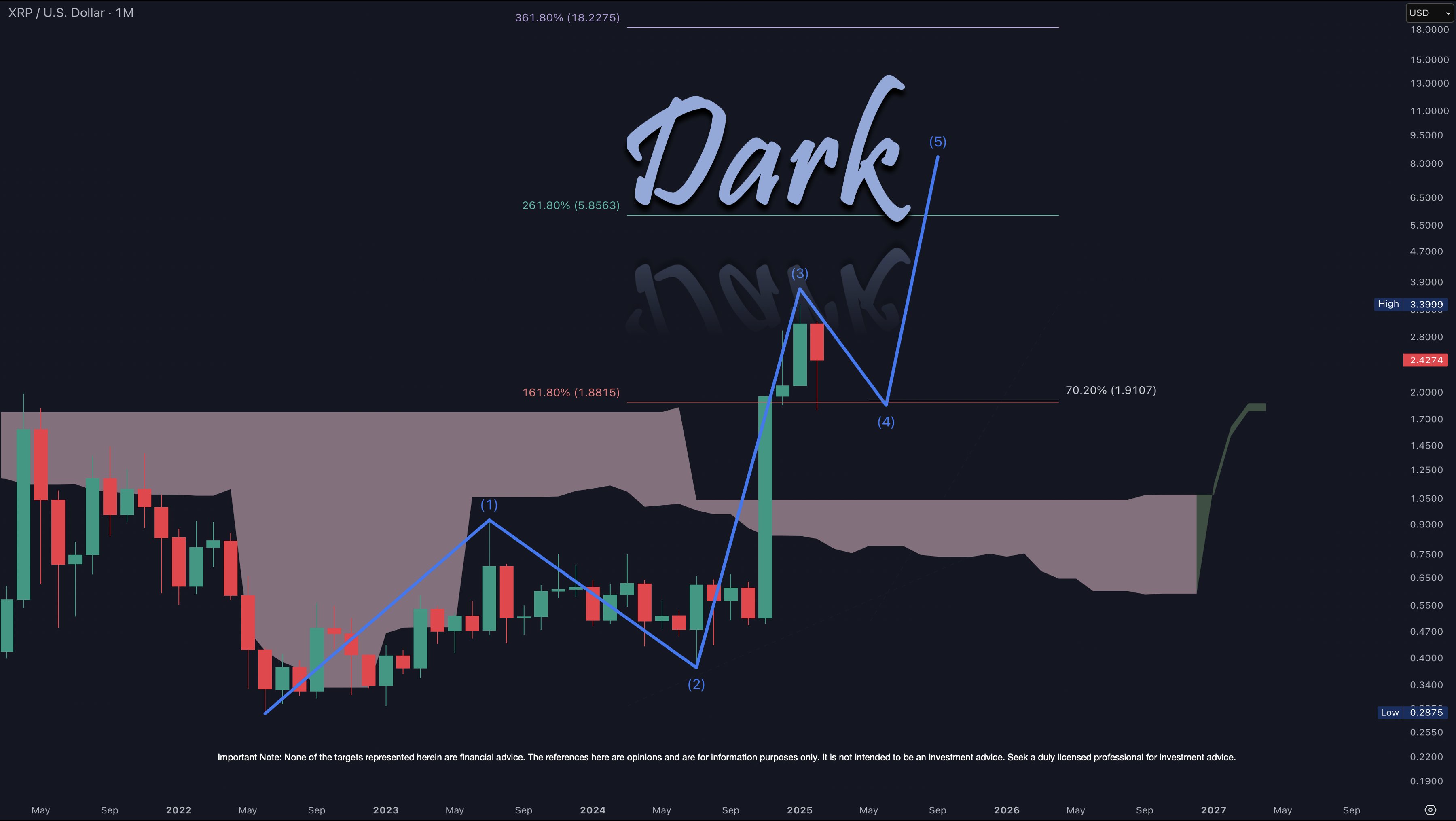
As noted by market expert Dark Defender, the XRP price has completed Wave 4 in its Elliot Wave pattern and is poised to soar over 200% from here.

The XRP price is on the cusp of a significant movement, as the token has completed Wave 4 in its Elliot Wave pattern. As the altcoin continues to advance in line with predictions, market experts like Dark Defender set sights on a new target of $5.85 in Wave 5, an over 207% rise from the current price.

Bear Market Hasn’t Yet Started

In a recent X post, crypto analyst Dark Defender shared his bullish perspectives on the XRP token. The analyst utilized Elliott Wave theory, asserting that XRP will achieve a new peak in this cycle.

Notably, Dark Defender has been tracking the Wave 4 since February 13, 2025. Based on his analysis, the token completed Wave A at $1.60 in April and Wave B at $3.66 in July. The analyst marked $1.88 as the completion point of Wave C of the Monthly Wave 4, which is now technically confirmed as done.

XRP 1M Chart Dark Defender
XRP 1M Chart | Dark Defender

Dark Defender noted that he stayed calm during XRP’s price movements, identifying a key support zone between $2.2222 and $1.8815. While XRP dropped to this level, it managed to bounce back, completing Wave C of Wave 4 at $1.88. 

Ignore FUD

In his previous analysis in February, Dark Defender urged investors and traders to ignore FUD (Fear, Uncertainty, Doubt) and instead focus on the potential developments. He presented a technical analysis chart for the XRP/USD pair, outlining its long-term projection based on historical market cycles and technical indicators.

Using the Elliot Wave theory and Fibonacci levels, the expert identified the key support around $1.88, which has been tested and held firm during market corrections. According to his analysis, Waves 1 to 3 show a clear impulsive structure. 

Building on this momentum, Wave 4 has also unfolded as a healthy corrective phase, retracing toward the $1.90–$2.00 zone in line with the 70.2% Fibonacci level. During this phase, the XRP price managed to stay above critical structural support and preserve the broader bullish trend.

Currently, XRP is experiencing high volatility. At the time of writing, the crypto token trades for $1.88, down 5.6% in a day. This negative momentum is further bolstered by its weekly and monthly declines, having dropped 8% in a week and 16% in a month.

SEC Chair Warns Crypto Could Become a Surveillance Tool Without Privacy Safeguards

0

U.S. securities regulators are raising concerns about how crypto regulation may evolve, warning that excessive transparency could erode privacy and disrupt market behavior.

These issues were central to discussions at the SEC Crypto Task Force Roundtable on Financial Surveillance and Privacy, where senior officials examined how blockchain technology challenges existing regulatory models.

During the session, SEC Chairman Paul Atkins and Commissioner Hester Peirce outlined how public blockchains present both regulatory opportunities and significant risks.

Public Blockchains Offer Unmatched Transparency

Atkins began by emphasizing the unique openness of public blockchains. Every transaction is permanently recorded on a ledger that anyone can access. He noted that no traditional financial system offers comparable visibility.

Building on that point, Atkins explained that blockchain analysis firms have already developed tools to associate wallet activity with real-world identities. While useful for enforcement, he cautioned that this capability could also raise serious privacy questions if applied too broadly.

Risk of Turning Crypto Into a Surveillance Network

From transparency, Atkins shifted to potential regulatory overreach. He warned that treating every wallet as a regulated intermediary could fundamentally change the crypto ecosystem. Similarly, blanket transaction reporting requirements could lead to constant financial monitoring.

According to Atkins, such an approach risks transforming crypto into an unprecedented surveillance system. Therefore, he stressed that regulation should not assume all activity is suspicious by default.

Market Transparency Could Alter Trading Behavior

Beyond privacy concerns, Atkins highlighted how full visibility could affect market dynamics. If trading strategies become visible in real time, normal market incentives may break down.

He explained that exposure of orders, hedging strategies, and portfolio changes could, over time, encourage front-running and imitation. Consequently, these behaviors could make market-making and underwriting less attractive, weakening liquidity and efficiency.

Blockchain Can Support Privacy-Conscious Compliance

Despite these risks, Atkins underscored that blockchain technology is not inherently hostile to privacy. He pointed to emerging tools that enable users to demonstrate compliance without disclosing complete financial histories.

Such systems could help regulated platforms verify users while avoiding permanent tracking of lawful activity. This approach demonstrates that oversight and privacy need not be mutually exclusive.

Atkins framed the broader issue as a question of balance. Governments must be able to perform essential security functions, but mass surveillance of lawful transactions should not be the default. 

Protecting citizens’ privacy, Atkins added, strengthens civil liberties while leaving space for innovation.

Peirce Highlights Disintermediation and Privacy Concerns

Following Atkins’ remarks, Commissioner Hester Peirce expanded the discussion by focusing on the structural impact of crypto. She noted that tokenized securities and digital assets often operate without established intermediaries, including brokers.

This shift, Peirce explained, reduces the amount of transactional data flowing through conventional regulatory channels. However, she also acknowledged that public blockchains remain fully transparent, creating a different kind of oversight challenge.

Rethinking Financial Privacy in the Crypto Era

Peirce argued that financial privacy in the United States has steadily declined. In her view, crypto has accelerated a long-overdue conversation about how much surveillance is appropriate.

As adoption continues to grow, she called for a careful reassessment of when and how transactions should be monitored. Ultimately, the goal is to protect consumers from wrongdoing without sacrificing fundamental privacy rights.