
Home Blog Page 370

JPMorgan Launches First Ethereum-Based Tokenized Money-Market Fund

0

JPMorgan Chase has introduced a tokenized money-market fund on the Ethereum blockchain, according to The Wall Street Journal.

The launch represents JPMorgan’s first tokenized money-market fund. With this move, the bank becomes the largest Global Systemically Important Bank (G-SIB) to introduce such a product on a public blockchain. 

Given the firm’s roughly $4 trillion in assets under management (AUM), the development carries significant implications for global financial markets.

Fund Design and Investor Eligibility

Specifically, the product, named My OnChain Net Yield Fund (MONY), was initially funded with $100 million by JPMorgan Asset Management. The fund is scheduled to accept outside qualified investors starting this week.

However, access to the fund is restricted to qualified investors, with a minimum investment of $1 million. In practice, participants can subscribe to or redeem shares using either traditional cash or Circle’s USDC stablecoin.

Structurally, MONY resembles a conventional money-market fund. It invests in short-term debt instruments and distributes interest daily. However, the key distinction lies in its operational framework.

By operating on Ethereum, the fund enables near-instant settlement and continuous access, allowing investors to deploy idle capital more efficiently. Additionally, the on-chain structure provides real-time transparency into ownership and fund activity.

JPMorgan developed the fund using Kinexys Digital Assets, its in-house tokenization platform. The bank views MONY as a proving ground for future on-chain investment vehicles, with insights from this launch expected to inform a broader rollout of blockchain-based products.

Part of a Broader Industry Shift

JPMorgan’s entry follows similar initiatives by other major asset managers. For instance, Franklin Templeton introduced its BENJI tokenized fund in 2021. Later, in 2024, BlackRock entered the space with its BUIDL fund, developed in partnership with Securitize.

According to RWA.xyz, BlackRock’s BUIDL fund has accumulated $2 billion in assets. The same data provider shows that tokenized money-market funds grew from $3 billion to $9 billion within a year.

Market Growth and Strategic Outlook

Beyond money-market funds, the momentum continues across the broader tokenization landscape. In fact, a joint report from Ripple and BCG estimates that the market for tokenized assets could reach $18.9 trillion by 2033, signaling sustained institutional adoption.

In this context, John Donohue, head of global liquidity at JPMorgan Asset Management, told The Wall Street Journal that client interest in tokenization is substantial.

He added that on-chain systems can meaningfully improve transaction speed and operational efficiency, thereby reinforcing the bank’s long-term commitment to this technology.
Ripple Earns Front-Page Mention in The New York Times

0

The New York Times (NYT) spotlighted Ripple on its front page today, positioning the company at the center of a shift in U.S. crypto regulation under President Donald Trump.

Ripple featured in an NYT investigative report today titled “Trump Warmed to Crypto, and S.E.C. Eased Up,” authored by Andrea Fuller, Ben Protess, and others. 

The report, highlighted by XRP pundit Crypto Eri, examined how the SEC rolled back its enforcement actions against major crypto firms following Trump’s return to the White House. 

SEC Shifting Stance on Crypto Cases  

Within the story, the NYT highlighted that Ripple spent several years locked in an intense legal battle with the SEC. It noted that the SEC’s softer approach shows a bigger shift in how the federal government deals with crypto. 

According to the report, the SEC, under the Trump administration, sought to reduce a court-ordered penalty imposed on Ripple, signaling a clear retreat from its previously aggressive posture. 

For an agency known for rarely backing down, especially after securing partial legal victories, this move stood out. The NYT highlighted Ripple’s case as a symbol of a broader regulatory reversal rather than an isolated adjustment. It also mentioned other crypto-related cases the SEC froze and dismissed, including its cases against Binance and Gemini.

Overall, the New York Times reported that the SEC not only eased up on high-profile cases but also scaled back more than 60% of the crypto-related enforcement actions that were active when Trump resumed office. The regulator paused litigation, reduced penalties, and dismissed cases outright as part of this broader shift in approach. 

Why Ripple’s Case Stands Out 

While the analysis referenced several crypto firms, Ripple’s inclusion carries particular significance. Many industry observers long viewed the lawsuit, filed in December 2020, as a defining test of whether U.S. securities laws broadly apply to digital assets. 

That question reached a turning point in July 2023, when a New York federal judge ruled that XRP itself is not a security. In the same landmark decision, the court held that Ripple’s programmatic sales of XRP did not constitute investment contracts. 

However, it also found that the company violated securities laws in connection with certain past sales of XRP to institutional investors. As a result, Ripple was ordered to pay a $125 million fine and prohibited from further violating federal securities laws through its future institutional XRP sales.

Meanwhile, the SEC filed an appeal in October 2023, while Ripple also filed a cross-appeal. The case later took a dramatic turn after Donald Trump returned to the White House. 

In the months following his inauguration, the SEC moved to freeze most ongoing crypto cases, including Ripple’s. It also sought to reduce the penalty and lift the injunction on the company.

Ultimately, efforts to modify the ruling proved unsuccessful. Both parties later agreed to withdraw their appeals and proceed under the original verdict. In August 2024, the U.S. Court of Appeals for the Second Circuit granted the joint request to dismiss the appeals, formally bringing the years-long Ripple case to a close. 

Solana Price Forecast for Dec 15: SOL Now Stabilizing After Prolonged Decline

The Solana price is stabilizing at key support while momentum indicators signal slowing selling pressure. Where’s SOL headed?

Solana’s latest move looks less like a slow, steady climb and more like a quick reset after a sudden shakeout. In the 24-hour snapshot, SOL is holding around $132.23 (about 0.7% pump on the day), after dipping near $129.28 and then snapping back toward the $132.80 intraday high.

Notably, the daily chart is a V-shaped rebound followed by steadier, higher steps, suggesting buyers defended the lows and then kept pressure on the upside.

Under the surface, activity remains heavy, with roughly $3.16B in 24-hour volume and a market cap near $74.3B. Still, the wider tape is mixed: SOL is down 4.2% on the week and down 6.2% over 30 days, which keeps the bigger trend from looking fully repaired. The key question now is whether this bounce is just relief, or the start of a more durable push.

Is Solana Price Stabilizing?

Solana’s daily chart shows price stabilizing after a prolonged decline from the $240 area achieved earlier in September.

Recent candles are however clustering around the $130–$145 zone. This range has acted as short-term support, as repeated attempts to push lower have failed to gain follow-through. While the broader trend remains bearish due to a series of lower highs, the slowing downside move suggests sellers are losing momentum near current levels.

Solana 1-Day Chart
Solana 1-Day Chart

Momentum indicators support this view. The RSI is holding around 43, below the neutral 50 mark but well above oversold territory. This indicates weak momentum rather than aggressive selling.

At the same time, the Chande Momentum Oscillator remains around neutral, showing that bearish pressure has faded compared with earlier sell-offs. Together, these indicators point to consolidation rather than continuation of the downtrend.

From a technical perspective, $130 remains the key support to watch, with deeper downside risk opening toward $125 and $122 if this level breaks. On the upside, $140 stands as the first meaningful resistance, followed by the $155–$160 zone where previous breakdowns occurred.

Usage Metrics Put Solana Ahead in 2025

Meanwhile, adding to the bullish momentum, Jon Ma, co-founder and CEO of Artemis, said that Solana stands out as the most used blockchain in 2025 when measured by on-chain activity rather than capital-based metrics.

According to Ma, Solana ranks first across several key usage indicators. Specifically, he noted that the network leads in monthly active users with about 98 million, roughly five times more than Base.

Solana also tops transaction count with approximately 34 billion transactions, far ahead of BNB Chain. In addition, Ma highlighted that Solana recorded the highest trading volume at $1.6 trillion, surpassing Ethereum, while also leading in application fees at $5 billion and network revenue at $1.5 billion.

However, Ma emphasized that Ethereum continues to dominate in several important areas. He said Ethereum remains ahead in total transfer volume, total value locked, developer activity, and stablecoin supply, where Solana ranks between second and third.

Even so, Ma concluded that based strictly on user activity and transactional usage, Solana can be considered the most used blockchain network in 2025.

XRP to Hit $100: Here’s Timeline and What Makes This Forecast Different

0

YoungHoon Kim, an entrepreneur who claims to hold the world’s highest IQ score of 276, has issued a bold XRP price prediction.

In his latest commentary, he argued that XRP’s price could reach $100 within the next five years. Kim emphasized that this view reflects his personal outlook and is not financial advice.

The statement has gained attention across the crypto community, especially given his background as a long-time Bitcoin supporter.

From Bitcoin Maximalist to XRP Bull

Kim has long been known for his pro-Bitcoin stance. In recent months, he repeatedly described Bitcoin as entering a new supercycle and projected aggressive price targets, including six-figure levels in the near term.

However, last week, Kim surprised many by announcing that he would begin buying XRP going forward. While he did not indicate that he was abandoning Bitcoin, the move confirms an expansion of his crypto focus. His latest comment builds on that shift, extending his XRP interest into a multi-year bullish outlook.

In particular, he sees XRP trading in triple digits by the 2030s, an outlook suggesting a potential 4,900% upside for those holding XRP around $2 today.

Notably, Kim’s XRP comments come at a time when interest in the XRP ecosystem has been picking up. Community figures have pointed to a series of developments that have renewed optimism, including:

  • XRP ETFs accumulating over $1 billion within a month of launch
  • Ripple securing approval for a banking charter from the OCC
  • XRP treasury setups by major institutions

Analysts Align on Long-Term $100 XRP Thesis

Meanwhile, Kim is not alone in projecting a triple-digit XRP price over the long term. Several XRP analysts have argued that a $100 valuation could emerge before 2030.

XRP community figure 24hrscrypto recently cited low global crypto adoption, increasing institutional interest, and XRP’s position in cross-border payments and tokenized finance as reasons for a potential triple-digit price.

With roughly 7.39 million XRP wallets globally, analysts often highlight how small current participation is relative to the world’s population. From this perspective, they argue that XRP’s present price does not yet reflect its potential role in a more on-chain global financial system.

Conservative Forecasts Still Lag Behind

Despite the growing number of bullish projections, more traditional industry forecasts remain cautious. Some research firms, like Telegon and Changelly, place XRP’s long-term value well below $100 by 2030. Even Bitwise sees XRP under $30 by 2030, even under optimistic scenarios.

Whether XRP ultimately reaches $100 within five years remains uncertain. However, comments from high-profile figures like YoungHoon Kim continue to amplify discussions around XRP’s potential.

Analyst Says Here’s Why You’re Underpricing XRP

0

An XRP community analyst says the market has not yet priced in recent regulatory progress involving Ripple.

In a tweet, XRP commentator Alex Cobb drew attention to a series of developments he believes the market is overlooking. He highlighted Ripple’s approved banking license and the company’s pursuit of direct access to the Federal Reserve system, concluding that XRP remains underpriced given these moves.

The argument is that Ripple is moving deeper into the core of the U.S. financial system, while XRP’s valuation continues to trade as if these efforts carry limited impact.

OCC Approval Changes Ripple’s Standing

The backdrop to Cobb’s view is Ripple’s conditional approval from the U.S. Office of the Comptroller of the Currency (OCC) to charter a national trust bank. This approval places Ripple among a very small group of crypto firms to reach this stage, following Anchorage Digital and alongside firms such as Circle and Fidelity Digital Assets.

By securing this status, Ripple brings its U.S. dollar–backed stablecoin, RLUSD, under direct federal oversight. At the same time, it remains regulated at the state level by the New York Department of Financial Services.

Ripple’s leadership has framed this dual structure as a high standard for compliance, confirming a long-term commitment to operating within U.S. financial regulations.

Fed Master Account as the Next Catalyst

Beyond the bank charter, Ripple is also pursuing a Federal Reserve master account. While the Fed has not yet granted such access, policymakers are now exploring a limited, or “skinny,” version of the account for non-bank entities.

Even with restrictions, such access would allow Ripple to connect directly to the Fed’s payment infrastructure. This could improve the efficiency with which reserves backing RLUSD are managed, reducing reliance on intermediaries.

From the XRP community’s perspective, this would further strengthen Ripple’s role in real-time payments and settlement.

XRP Is Still Mispriced

Notably, Ripple’s progress with U.S. regulators, banks, and payment systems appears to be moving faster than XRP’s price reflects. XRP is trading at $1.98 today, down 0.68% over the past day and 12% over the past month.

Meanwhile, XRP commentators believe the market is currently offering a rapidly closing window to buy XRP at a discount. They argue that as Ripple continues to integrate more deeply with traditional finance, the utility narrative surrounding XRP could regain momentum, potentially supporting a price recovery.

Back in July, Alpha Lions Academy founder Edoardo Farina urged followers to buy XRP ahead of a supposed U.S. Treasury “announcement.”

His comments come after Ripple confirmed it has applied for a U.S. national bank charter and a Fed master account, moves that have led XRP supporters to believe the company is positioning itself at the heart of a new financial system.

What Comes Next

It is worth noting that the OCC approval remains conditional, and Ripple’s national trust bank cannot operate until all requirements are met. The Federal Reserve’s “skinny” master account is also still only a proposal.

As Ripple moves closer to the heart of the U.S. financial system, XRP supporters believe the market may eventually reassess how it values XRP.

Pundit Flags an XRP Price Explosion No One Sees Coming

0

A well-known pundit suggests that the favorable developments in the XRP ecosystem and across the market could be leading to an unexpected XRP price explosion.

For context, despite a steady stream of bullish developments, the XRP price has remained largely bearish in recent months. Reports around the end of QT by the U.S. Federal Reserve, the launch of XRP ETFs, and growing activity within XRP’s DeFi ecosystem have failed to push the price higher. 

Instead, XRP has hovered around the $2 level and is down more than 4% year-to-date. However, according to market commentator Zach Rector, these developments may be setting the stage for a sharp and unexpected price surge.

“We’re More Likely at the Bottom”

During a recent appearance on the Paul Barron Show, Rector joined host Paul Barron to discuss why he believes the market is misreading XRP’s current position. 

In the opening session, Barron called attention to Coinbase’s latest moves, including plans to launch a prediction market on Dec. 17 alongside tokenized stocks. He questioned whether these developments signal a market top.

Rector disagreed with this notion, arguing that current conditions instead suggest the market is nearing a bottom. He explained that the expansion of on-chain tokenized markets is increasing access and liquidity, even if early use cases appear trivial. 

According to Rector, speculative betting markets may initially attract attention, but they often serve as a gateway to more serious tokenization efforts. 

Tokenization is Still Early

He highlighted recent reports involving the Depository Trust & Clearing Corporation, which plans to bring parts of its operations on-chain. Rector called this development a major step forward, given DTCC’s position as one of the world’s largest securities clearinghouses.

According to him, DTCC oversees an estimated $3-4 quadrillion in assets. He emphasized that this shows how early discussions around tokenizing tens or hundreds of trillions of dollars once sounded unrealistic. Now, industry leaders openly discuss tokenizing assets measured in quadrillions. 

The market pundit highlighted comments from Franklin Templeton’s Sandy Kaul, who spoke at Ripple’s Swell conference about releasing “trapped” global liquidity through tokenization. Rector said her vision went beyond traditional securities, extending to IP rights, sports ownership, and entirely new markets that could become accessible through blockchain.

Meanwhile, Barron expanded on this point by noting the scale of trapped capital across countries, international banks, and high-net-worth structures, as well as in real-world assets and intellectual property. He stressed that Ripple and the XRP Ledger sit at the center of many of these tokenization and infrastructure developments.

Could XRP See $1 Again?

Regarding XRP’s price performance, which has remained bearish since October, Barron reminded his audience that XRP is still up 1,700% from March 2020 lows and has continued to hold $2. However, he asked whether the market could ever see XRP return to the $1 level. 

Rector dismissed this scenario as extremely unlikely, suggesting it would require an extraordinary black swan event. He revealed his trading strategy, explaining that he holds a long XRP position and continues to add on dips. According to him, he has set buy orders around $1.91, just above a key $1.90 order block.

Major XRP Targets

Rector acknowledged that he initially entered an XRP position at an average cost of $3.40 in July but has since lowered his average cost to about $2.23 through dollar-cost averaging. 

He outlined major historical support levels, including $1.60 in April, $1.77 during the October 10 liquidation event, and $1.81 in November. He noted that XRP has consistently formed higher lows throughout the year, confirming his belief that a drop to $1 would require a severe market shock.

Meanwhile, speaking further, Rector said he expects one more short-term downside move within the next week, followed by a recovery. He projected Bitcoin reclaiming $100,000 and XRP rebounding toward $2.70. 

Looking ahead, he outlined a Q1 2026 XRP target just under $10, with an expected range between $5 and $8 before eventually moving into double digits later in 2026. He also suggested that, over a 12-month horizon, XRP could reach the $15 to $20 range.

$300M in Crypto Lost to Zoom Malware Scams, Security Alliance Reports

0

Cybersecurity experts are warning cryptocurrency users about a rapidly escalating social-engineering threat.

According to the Security Alliance (SEAL), North Korean hackers are increasingly using fake Zoom meetings to distribute malware and steal digital assets. The nonprofit says it is now tracking several such scam attempts every day. These operations are highly targeted and designed to exploit trust within professional and social networks.

Rising Losses Trigger Alarm

SEAL researcher Taylor Monahan said the scale of the damage is already significant. She estimates that more than $300 million has been stolen through this tactic so far. 

The scale of the losses underscores how quickly the scheme has evolved. As crypto adoption expands, attackers are shifting away from purely technical exploits and instead refining methods that rely on human trust and familiarity.

How the Scam Unfolds on Zoom

According to Monahan, the attack typically begins on Telegram. Victims receive messages from accounts that appear to belong to people they already know, lowering suspicion and encouraging conversation.

Over time, the exchange naturally moves toward reconnecting on a Zoom call. Shortly before the meeting, the attacker shares a link that appears legitimate and does not immediately raise red flags.

Once the call begins, the setup looks convincing. Victims often see familiar faces, sometimes joined by what appear to be colleagues or business partners.

Monahan emphasized that these visuals are not created using artificial intelligence or deepfake technology. Instead, hackers rely on real video footage taken from prior hacks or publicly available recordings, such as podcasts.

After a brief interaction, the attackers claim there are audio problems. To resolve the issue, they send a file described as a routine software patch or update.

Opening the file installs malware on the victim’s device. The attackers then end the call calmly, often suggesting they reconnect at a later time.

What Hackers Gain After Infection

Although the interaction ends quietly, the compromise is already underway. Once the malware is active, attackers gain broad access to the system.

Monahan said this can include passwords, private keys, and cryptocurrency wallets, as well as sensitive company data and internal tools.

Telegram accounts are a primary target. After taking control, attackers review stored contacts and impersonate the victim to approach new targets, allowing the scam to spread rapidly through trusted networks.

Urgent Steps After Clicking a Malicious Link

Monahan stressed that speed is critical after any suspected exposure. She advised users to disconnect from the internet immediately and power down the affected device.

Using a separate, clean device, victims should transfer funds to new wallets and immediately change all account passwords. Where available, two-factor authentication should be enabled.

Before the compromised device is reused, it must undergo a complete memory wipe to remove any lingering malware.

Why Telegram Security Matters

Telegram plays a central role in the spread of the scam, making account security especially important. Monahan urged users to review active sessions in Telegram’s settings and terminate any unfamiliar connections immediately.

Passwords should be changed, and multifactor authentication enabled. If an account is compromised, users should notify their contacts immediately.

Failing to do so, Monahan warned, allows attackers to exploit trusted relationships and expand the campaign.

SEAL noted that the campaign highlights ongoing risks across the cryptocurrency sector, where social engineering remains one of the most effective attack methods.

The organization continues to monitor activity diligently and advises users to exercise caution when receiving unexpected meeting requests, even if they appear to originate from familiar contacts.

Cardano Risks 80% Drop as SuperTrend Flips Bearish

0

A key indicator has flipped bearish for Cardano, with historical context suggesting a steep decline is on the horizon for the asset.

Notably, this analysis came from top chartist Ali Martinez, even as Cardano corrects considerably. The asset has corrected 1.23% in the past 24 hours and 7.7% in the past seven days, taking its current price to $0.40.

More Cardano Downsides?

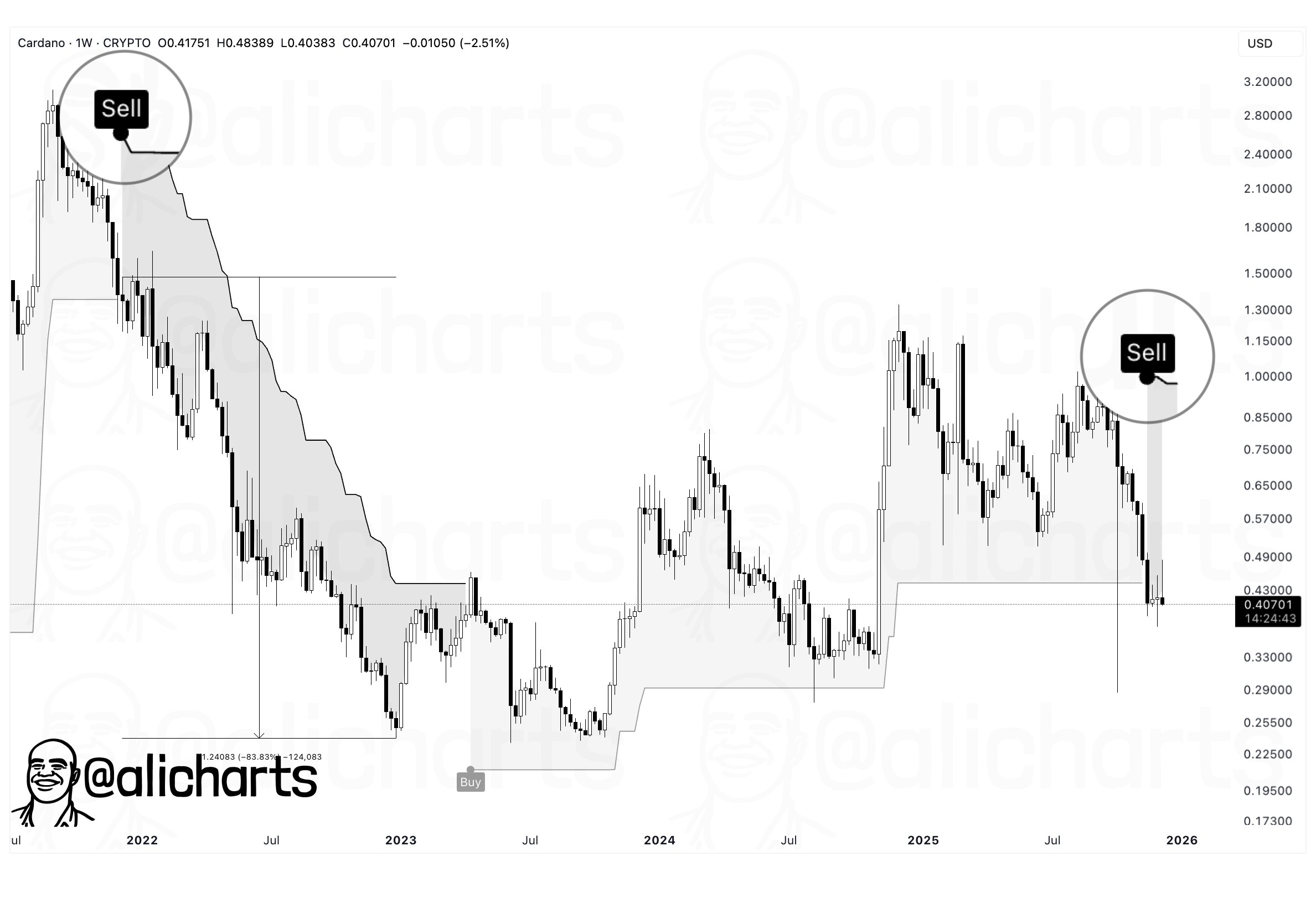
Martinez identified that the Cardano SuperTrend has turned negative on the weekly chart. For the uninitiated, the SuperTrend indicator dictates price direction and uses the Average True Range (ATR) to signal buying or selling opportunities. This indicator has turned bearish, signaling that downward momentum could persist for Cardano.

For context, the SuperTrend spelled doom for Cardano the last time it occurred on this timeframe. Martinez highlighted that ADA dropped by 80% the last time this indicator turned bearish, a trend holders should be wary of.

An accompanying chart shows that this happened in early December 2021 after ADA printed three consecutive weekly red candlesticks. Specifically, Cardano opened at $1.38 that week and, in subsequent weeks, dumped 84% to bear-market lows of $0.22 in June 2023.

SuperTrend Flashes Sell Signal for Cardano

If history repeats, ADA could retest multi-year lows. Specifically, from its current price of $0.403, the cryptocurrency could drop to $0.064, a level it last traded at in early 2020. However, such a drop may be unlikely.

Bulls Disagree

Remarkably, several other analysts have expressed a conflicting view. Instead of a price crash, they foresee a rebound to new highs.

One such analyst is Quantum Ascend, who predicted that Cardano is ready for an impulsive upside move. He highlighted that ADA trends near the low of a multi-year channel and may have bottomed around the current support level.

Citing similarities with the 2020 rally, he asserted a surge to a conservative target of $5.56. However, his primary target for this surge is $10.4.

Captain Faibik also disclosed he is “buying some Cardano here” as it is a good entry opportunity. He targets a recovery to $0.70, representing a 73% rise.

Pundit Says Traders Could Pump or Tank XRP Price with Just 10M XRP

0

Vincent Van Code, a market commentator, has suggested that relatively lower volumes of XRP trades could have a massive impact on the XRP price.

The software engineer revealed this at a time when XRP is witnessing increased market apathy amid the ongoing price downtrend. For context, XRP recently broke below the $2 support after holding above this level for days. Currently trading for $1.99, XRP has collapsed 29.6% over the past three months.

XRP Volume Collapses on Binance

After losing the $2 mark, the bulls have continued to battle toward recovering it but have faced struggles. Amid the market uncertainty, XRP’s volume across exchanges appears to be dropping as well, a trend highlighted by Vincent Van Code.

According to Van Code, who claims to have founded multiple AI startups, XRP’s volume has remained “super low” over the past few days. He pointed out that at the time of his disclosure, the XRP/USDT volume on Binance had collapsed to around $89 million. This is remarkably low, considering the pair hit highs around $3 billion in volume.

Data from the XRP/USDT Binance chart on TradingView confirms this disclosure. Specifically, after the pair soared to a peak daily volume of 125.13 million XRP or around $250 million on Dec. 10, it started seeing massive declines in the following days. By Dec. 12, volume had dropped to 78.09 million XRP worth $156 million.

This drop persisted into the weekend, with volumes on Saturday, Dec. 13, collapsing to 44.2 million ($88.4 million) and 45.16 million or $90 million on Sunday, Dec. 14. It remains to be seen if these figures will improve in the new week.

Similar Trend Across Multiple Exchanges

Importantly, this trend is not unique to Binance, as XRP’s trading volumes across multiple exchanges have also declined recently. For instance, the XRP/USD volume on Bitstamp dropped to 9.62 million XRP on Dec. 14, down from the 37 million XRP peak on Dec. 1. The XRP/USD volume on Coinbase also crashed from 164 million XRP on Dec. 1 to 35.92 million XRP on Dec. 14.

Such low volumes often indicate apathy, as traders step away from the market during market uncertainties. However, it also presents an opportunity for large whales to dictate the flow of the market by using relatively lower capital.

“10M XRP Could Pump or Tank the Price”

Speaking on the ongoing trend, Van Code pointed out how the market remains largely vulnerable to such price swings at its current state. According to Van Code, now that the XRP/USDT volume has dropped to around 89 million XRP, a trader with just 10 million XRP worth $20 million could push the XRP price up with a single buy or drag the price down with a single sell.

Specifically, when trading volume and order-book depth fall, fewer buy and sell orders sit at each price level. In this situation, a large market order, such as 10 million XRP, can move through multiple price levels and push the price sharply higher or lower. Low liquidity increases slippage and magnifies price impact.

However, low volume does not always mean weak liquidity. A deep order book can still absorb large trades. Moreover, Binance alone does not represent the entire XRP market. Liquidity on other exchanges, the use of limit or OTC orders, and the timing of the trade can all reduce or offset the impact.

Brandt Shows Bitcoin Has Violated Its Parabolic Advance, Major Correction Looming?

0

Market expert Peter Brandt warns of a looming Bitcoin price correction as the asset violates the parabolic advance pattern. 

The Bitcoin price has been experiencing a wild ride lately, exhibiting high volatility over the past few weeks. This has sparked concerns among investors and enthusiasts, with experts warning about the sustained negative momentum and potential downfalls.

Parabolic Advance Pattern Broken

Amid this downtrend, veteran trader Peter Brandt, in his latest X post, raised concerns over the Bitcoin price’s potential trajectory. 

He cited the cryptocurrency’s historical pattern of parabolic advances, often followed by notable corrections. The trader’s analysis is based on BTC’s recent violation of this parabolic advance trendline. 

Notably, Brandt argued that the cryptocurrency’s bull cycles have experienced “exponential decay,” indicating that each successive period has been marked by diminishing returns. 

According to the chart presented by Peter Brandt, the Bitcoin price history has been marked by periods of parabolic growth, highlighted by red lines. 

The chart indicates that each time BTC dropped below these lines, significant price declines followed. Specifically, the previous cycles have experienced declines of over 75% after breaching the parabolic trendline.

Bitcoin 1W Chart Peter Brandt
Bitcoin 1W Chart | Peter Brandt

For instance, in the 2010-2012 cycle, the BTC price rose to a high of nearly $20, from its post-launch low. Soon, this bull run was hit by a market correction, with the price eventually reaching $4. This downtrend was foreshadowed by the parabolic line’s breach. 

Another instance shown in the chart is the 2019-2021 cycle, where Bitcoin reached an all-time high of $67k, only to plummet to $16k in 2022. As the same pattern is being repeated in the 2023-2025 cycle, with the crypto currently diverging from its parabolic rise, a similar correction is likely to occur in 2026.

Market Implications: Is a Bitcoin Price Correction Ahead?

As of press time, Bitcoin is exchanging hands at $89,701, marking a marginal 0.45% dip in a day. Over the past week and month, the coin has seen more notable downticks of 1.5% and 6.4%, respectively. 

After hitting $92k recently, the Bitcoin price started plummeting, breaking its parabolic advance pattern. This bearish momentum has sparked concerns among traders and investors, with analysts, including Brandt, predicting a possible crash.

As per Peter Brandt’s analysis, the current Bitcoin cycle peaked at an all-time high of $126k in October. Based on this framework, BTC could undergo an 80% correction, placing the target at a severe low of $25k. 

However, analysts like CryptoBusy remain bullish about BTC’s potential future. The analyst believes that the Bitcoin price’s pullback into the Asian open is part of the broader narrative of fading year-end liquidity. 

As the price has returned to test the multi-year trendline, BTC is likely to continue its upward momentum, according to CryptoBusy. This current trendline is noteworthy as it has served as a major support for higher lows since 2023.