
Home Blog Page 488

BitMine Sees an Unrealized Loss of $2.13B in Ethereum

0

Ethereum followed a broader market correction, severely impacting the holdings of BitMine, the largest treasury Ether holder.

BitMine Immersion Technologies has acquired Ethereum immensely since it began an Ether-based corporate treasury strategy in late June. Barely four months in, the Tom Lee-chaired company has amassed a staggering 2.83 million ETH, becoming the leader in the Ethereum treasury firm category.

Market Downside Severely Impacts BitMine Ether Stash

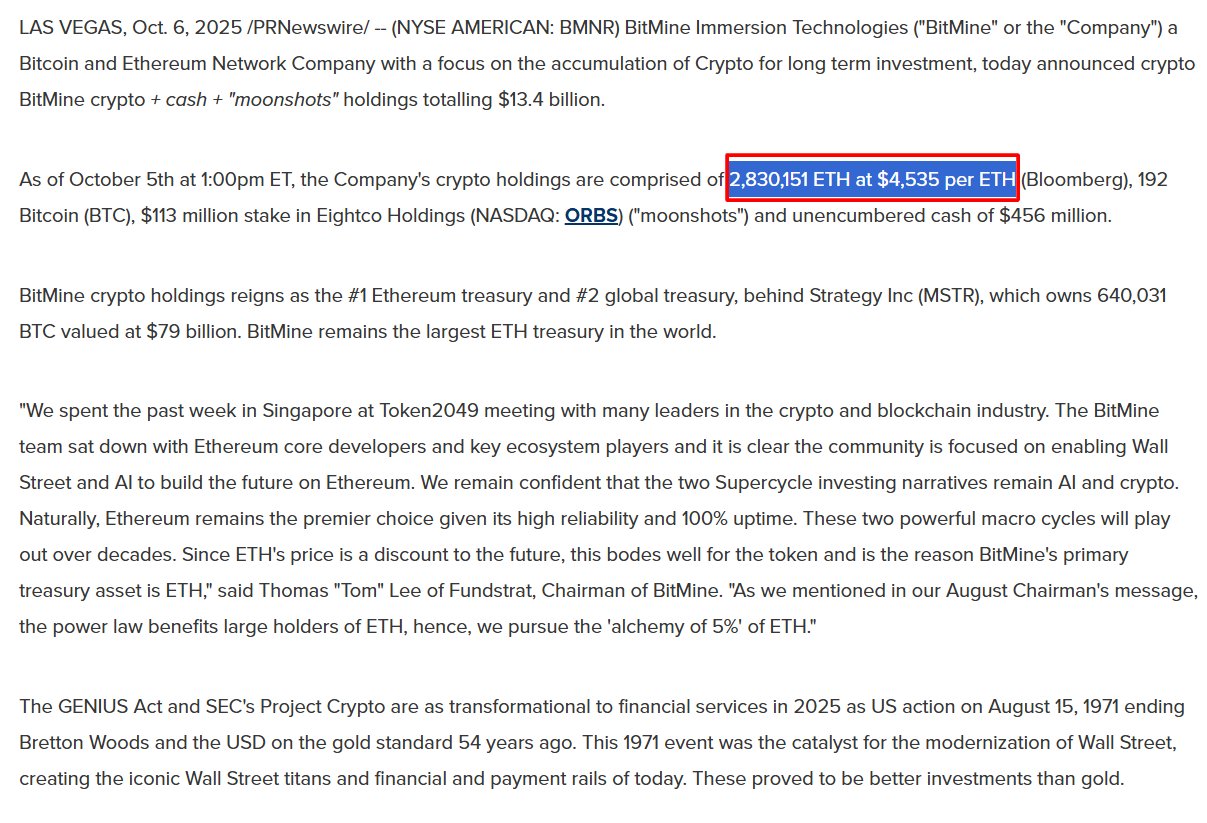
Notably, BitMine disclosed that it acquired its 2,830,151 ETH holdings as of October 5 at an average price of $4,535 per token. This means its purchasing cost is a staggering $12.8 billion, accruing 2.34% of Ethereum’s total supply.
BitMine's Ethereum Average Cost
BitMine’s Ethereum Average Cost

However, Ethereum dipped to $3,510 on Friday, spurred by Donald Trump’s renewed trade war with China. While Ether has rebounded from the low to trade at $3,780 at the time of writing, it still sits miles below BitMine’s average cost price.

For perspective, at the current price of $3,780, the Ether holdings are worth $10.69 billion. This marks a difference of $2.13 billion from BitMine’s $12.8 billion buying cost. However, the 16.48% loss remains unrealized at the time of writing.

BitMine Buys the Ethereum Dip

Despite the unrealized losses, BitMine has shown commitment to buying more. Lookonchain identified that two new wallets tied to the company just withdrew millions of Ethereum from exchanges, taking advantage of the discounted price.

Specifically, address “0x8DF4” withdrew 24,409 ETH from Kraken four hours ago, with another BitMine-tied wallet, “0xedf1,” buying 8,914 ETH from FalconX. The recent accumulated figure totaled 33,323 ETH, worth $126.4 million.

Meanwhile, this follows an ongoing whale dip buying trend. Lookonchain highlighted that another OTC whale bought 14,165 ETH ($55.5 million) from FalconX, Coinbase, and Wintermute a few hours ago.

Even Hackers Panic-Sold Ethereum

Nonetheless, the Ethereum capitulation saw even hackers panic-sell their holdings. Lookonchain shared in a parallel tweet that two wallets linked to hackers could not bear the market crash and sold at a loss.

The wallet dumped 5,480 ETH ($20.47 million) bought a week ago at an average price of $3,735, resulting in a loss of $3.7 million.

Here’s What Cardano Price Could Be If Hydra Scaling Unlocks 1M TPS

0

Following the release of the latest version of Cardano Hydra scaling solution, several entities believe the upgrade could positively influence ADA price over the long term.  

Cardano (ADA) is still attempting to recover from the massive bloodbath that rocked the broader crypto market on October 10. The sharp downturn came after President Donald Trump announced plans to impose an additional 100% tariff on goods imported from China. 

This sparked fears of a renewed trade war and fueled a widespread sell-off across global markets, including cryptocurrencies. Amid the panic, Cardano, which had reached a 24-hour high of $0.8227 on October 10, plunged to a low of $0.3330, marking a staggering 59% decline in a single day. 

Hydra 1.0.0 Launch Boosts Community Sentiment 

However, Cardano price quickly showed signs of resilience, rebounding to around $0.60 and currently trading near $0.6485. Despite the steep correction, Cardano enthusiasts remain optimistic, pointing to the recent launch of Hydra 1.0.0, the network’s scaling solution, as a potential catalyst for future growth. 

Many believe that Hydra’s high-performance capabilities could pave the way for renewed momentum once market conditions stabilize. One of Hydra’s standout achievements is its ability to process over 1 million transactions per second (TPS) during a Doom gaming test, showcasing its remarkable scalability potential.

This milestone has sparked renewed optimism within the Cardano community, with many believing that achieving similar performance on the mainnet could significantly enhance scalability and drive wider adoption of decentralized applications (dApps). 

Potential Price of Cardano if Hydra Unlocks 1M TPS and Real dApp Adoption 

Building on this enthusiasm, we consulted two different AI models, ChatGPT and Gemini, to explore potential scenarios for ADA price if Hydra successfully delivers 1 million transactions per second (TPS) on the Cardano mainnet and accelerates the growth of decentralized applications. 

ChatGPT Analysis 

Leading chatbot ChatGPT issued its prediction under three different scenarios: base, optimistic, and highly optimistic cases. 

The base case considers a scenario where Hydra under-delivers and does not drive the adoption of dApps. If this happens, ChatGPT emphasized that ADA would follow its usual growth trend and only spike to the range of $1.20 – $1.80, representing growth of 85-177% from the current price of $0.6485. 

In the optimistic scenario, ChatGPT estimated that Cardano price could spike to around $2 – $3 if the Cardano scaling solution unlocks 1 million TPS and moderate dApp adoption. From its current price of $0.6485, ADA would need to rally 208% to reach $2 and 362% to reach the $3 target. 

In the highly optimistic scenario, ChatGPT pegs the estimated price range at $3 – $5. Reaching the $5 target demands a rally of 671% from the current level. The assumption fueling the prediction is that Hydra, along with other upgrades, would help Cardano become one of the most dominant smart contract platforms, potentially attracting significant external capital and user growth to fuel the rally.  

ChatGPT ADA Prediction

Gemini Forecast 

However, Google’s AI model Gemini issued a more bullish forecast. According to Gemini, the price of Cardamo could spike to between $5 and $10 if Hydra scaling achieves 1 million transactions per second, alongside strong dApp adoption.

Notably, it suggested that the price of ADA could surpass $10 under a sustained bull market cycle. To reach the peak price, ADA would need to rise 1,442% from its current level. 

Gemini ADA prediction

Expert Says XRP Can Still Witness Most Bullish Weekly Candle in History

0

XRP could be on the verge of posting its most bullish weekly candle ever, according to veteran investor Patrick L. Riley.

In a tweet earlier today, Riley noted that if XRP closes the week tomorrow (Sunday) at $3.1150, it would mark the most bullish weekly candle in the token’s history. The statement suggests this development could make the current week one of XRP’s most significant in terms of gains.

The observation comes amid a sudden overnight bloodbath in the crypto market, during which several assets, including XRP, Bitcoin, and Ethereum, experienced flash crashes, plunging to historic lows before swiftly recovering.

XRP Dipped 56% in One Day

Specifically, XRP’s price plummeted to $1.2543 on Binance, down from daily highs of $2.8372. This represented a dramatic 56% flash crash within a 24-hour window.

During the same period, Bitcoin dropped from $122,550 to as low as $102,000, a level last seen in June. Other altcoins, like SUI, suffered even more devastating losses, plunging from $3.47 to $0.5597, nearing their all-time lows—all within just 24 hours.

The dramatic collapse in prices followed President Trump’s announcement of new tariffs on China. The announcement triggered $19 billion in liquidations across the derivatives market and wiped out $1.65 trillion from the U.S. stock market.

Despite the market turmoil, analysts like Riley are pointing to a potentially historic rebound for XRP.

XRP Set to Mark Most Bullish Weekly Candle in History?

After crashing to $1.25, XRP has rebounded approximately 100% to a current price of around $2.40. Although this is still below its weekly high, Riley believes that a weekly close at $3.115 would mark the most bullish weekly candle in the token’s history.

For context, a move from yesterday’s low of $1.2543 to $3.1150 would represent a 148% increase. However, this would not be XRP’s biggest weekly gain ever.

Back in December 2017, XRP posted a more substantial 215% weekly gain, rising from $0.22598 to $0.70969, an increase of $0.48471.

XRP chart showing strongest weekly candles from 2017 | TradingView

In the current scenario, XRP opened this week at $2.9705. A close at $3.115 would translate to a modest weekly gain of just 4.86%, far from its historical best.

However, considering the bounce from its weekly low, XRP could be said to have recorded one of the strongest recoveries of the year, aligning more closely with Riley’s perspective.

XRP Logs Highest Quarterly Close in History

Beyond the weekly chart, XRP recently set a new milestone by recording its highest quarterly close ever.

The token closed Q3 2025 at $2.846, marking a 27.16% gain from its Q2 close of $2.23. This makes September 2025 the third-highest monthly close in XRP’s history, behind January 2025 ($3.03) and July 2025 ($3.02).

With Q4 now underway, analysts are optimistic about even stronger performance. Historically, XRP tends to perform best in the fourth quarter. 

On average, it gains 140% during Q4, with notable rallies including a 240% surge in Q4 2024 and a record-setting 1,064% explosion in Q4 2017.

Peter Brandt Says Profit Taken as XRP Dropped to His Bearish Target

0

Market veteran Peter Brandt has responded to the XRP community trolls with profit claims as XRP briefly dropped to his bearish target.

Brandt appears to now have bragging rights in his heated exchange with XRP proponents. He took to X to flaunt his win, as macroeconomic headwinds in the global market forced XRP to his earlier downside target.

“Target reached. Profits taken,” the veteran trader was quick to share on Friday.

XRP Breaks Down from Descending Triangle

Notably, this comes as XRP broke down from a descending triangle yesterday, with Donald Trump’s renewed tariff war with China spurring a broader market downtrend. For context, the US president brandished a 100% levy on Chinese imports effective November 1.

This saw US equities, stocks, and the broader crypto market tumbling, with XRP not left out. The token recorded one of its largest capitulation wicks in history, briefly touching $1.37 on Thursday.

Brandt predicted a drop to $2.22 in his earlier analysis, citing that a daily close below $2.66 would confirm a breakdown from the descending triangle. However, things developed quickly with XRP, probably reaching the analyst’s target for a short trade faster than he anticipated.

Did Brandt Get Lucky?

Nonetheless, the XRP community was not having it, even though XRP followed Brandt’s prediction. Several reactions claimed that the veteran trader got lucky, as an unknown event forced XRP downwards rather than his projected triangle breakdown.

Notably, the XRP capsize came purely from an adverse market reaction to fundamental developments rather than a technical analysis-driven correction. XRP proponents made their case with this, insisting market conditions simply favored him.

Others also claimed he predicted that a close at $2.66 would confirm the move, an event that never occurred. Notably, XRP broke down and reached the target with one daily candle, while Brandt suggested traders wait for confirmation before entering the short.

Meanwhile, Brandt refused to admit to this. He claimed to use a 1934 book written by Richard W. Schabacker to accurately predict the capsize. He also claimed he entered all his trades intraday, suggesting he took the trade before the correction.

XRP Correction Wipes Over $700M in 24 Hours

The correction affected XRP positions worth a staggering $708 million in the past 24 hours. Over $615 million of liquidations were long positions, while $92 million of late shorts also took the hit.

XRP Liquidations
XRP Liquidations

XRP is down over 13% in the past 24 hours, with its market cap now standing at $146 billion. This culminates in a price of $2.44, which represents a 78% rebound from the lows of $1.37 reached yesterday.

This followed a broader market trend, which saw a record $19.3 billion worth of trading positions liquidated in the past 24 hours. Remarkably, this is the largest ever in history, stamping October 10 into the crypto history books.

Expert Says ‘XRP Black Swan’ Made History as XRP Loses 1.27 Dollars

0

Popular XRP community figure Chad Steingraber emphasized that history has just been made, describing the latest XRP liquidation event as an XRP Black Swan.

October 10 will go down as one of the most unforgettable days in crypto history — a day marked by one of the strongest liquidation waves the market has ever witnessed.

Global financial markets, including cryptocurrencies, suffered a dramatic plunge after U.S. President Donald Trump announced plans to impose an additional 100% tariff on goods imported from China. 

The announcement immediately rekindled fears of a renewed trade war, triggering a massive sell-off in equities, commodities, and crypto assets. Notably, the total crypto market capitalization tumbled below the $4 trillion mark, settling around $3.70 trillion, as widespread liquidations wiped out billions in value.

XRP Loses $1.27 of Its Value in Hours 

XRP, which has demonstrated resilience over the past few days, was not spared. The token, which had been trading steadily around the $2.80 range over the past few days, suffered a steep decline. Amid the broader market turmoil, it plunged below $2 for the first time in months. 

Notably, XRP experienced a dramatic price swing during the market turmoil. From trading around $2.80 at 03:00 p.m. (UTC) on October 10, the token plummeted to a low of $1.53 a few hours later, marking a sharp loss of $1.27. 

However, it quickly showcased its trademark resilience. Following the steep drop, the asset rebounded above $2, eventually closing at $2.35 by the end of the day. 

Crypto Market Sees Biggest Liquidation in History 

The extreme volatility that swept through the broader crypto market delivered a crushing blow to leveraged traders. Yesterday, within just 12 hours, an estimated $19.14 billion in long and short positions were liquidated, marking what CoinGlass referred to as the largest liquidation event in crypto history. 

Long positions bore the brunt of the havoc, suffering losses of approximately $16.71 billion, while short positions accounted for about $2.43 billion during the same period.

As of now, total liquidations over the past 24 hours have risen slightly to $19.31 billion, with longs contributing $16.81 billion and shorts adding $2.49 billion in losses. 

Screenshot 2025 10 11 044646
XRP Liquidation Data

‘XRP Black Swan’ 

Meanwhile, XRP leveraged traders were not spared from the market-wide bloodbath. Popular community analyst Chad Steingraber highlighted this massive liquidation event, calling it a ‘Black Swan’ moment for XRP.

According to the analyst, XRP saw its largest long liquidation in history, with losses hitting $422.1 million at the time of the X post.

At press time, data from CoinGlass shows that approximately $707 million in XRP positions were liquidated over the past 24 hours.  Notably, short positions accounted for roughly $91.96 million in losses. Long traders took the heaviest hit, with losses now rising to around $615.46 million, marking the largest liquidation event in XRP’s history. 

XRP Liquidation data


As of press time, XRP was trading at $2.41, reflecting a 14.47% decline over the past 24 hours and extending its weekly losses to 20.3%. 

Here’s Why XRP Has Some of the Most Frustrated Retail Traders Right Now

0

A market commentator and XRP community pundit has shared why XRP is currently witnessing its worst retail sentiment in six months.

For context, market analytical resource Santiment first called attention to the increasingly bearish sentiment XRP has faced in recent times. Specifically, Santiment found that XRP is currently seeing the same level of bearish sentiment it witnessed six months ago when President Donald Trump announced his tariffs.

Unrealistic XRP to $1000 Expectations

With the crowd growing extremely fearful, Zach Rector, an XRP community figure, recently came up to highlight some of the factors that may have triggered this level of bearish sentiment.

According to him, multiple new entrants to the XRP market entered the scene this year with high hopes, especially following XRP’s meteoric surge from last November. For context, XRP rallied from $0.5 in November 2024 to a peak of $3.4 in January 2025. This marked a remarkable 580% surge within three months.

XRP’s run, which made it the best-performing asset among the top crypto tokens, attracted several new investors who anticipated another meteoric rally. In addition, market veterans such as Raoul Pal became bullish on XRP, contributing to the influx of new investors awaiting another run.

Within this period, bullish sentiments dominated the scene, and several XRP community figures floated ambitious price targets such as $50, $100, and even $1,000. According to Rector, these new investors held onto these targets and had unrealistic expectations for XRP’s price movements.

Now that XRP has failed to meet these expectations, sentiment has quickly turned sour, leading to the current retail FUD that has dominated the market. 

Poor Economic Conditions

In addition to this, Rector also called attention to poor economic conditions that have kept everyday investors on edge. Notably, such economic situations often push investors to seek a safe haven in alternative assets like XRP. However, with XRP also failing to provide a reliable safety net, increased bearish sentiments have emerged.

Zach Rector on X
Zach Rector on X

According to Rector, a combination of these factors has resulted in frustration for the average retail XRP trader. He noted that he hopes these traders will not sell off their XRP holdings in an attempt to vent their frustration. This is because he believes the arrival of institutional investors and ETFs is inevitable once the ongoing U.S. government shutdown ends.

Rector is one of the XRP community pundits who believe XRP ETFs will gain approval and lead to rapid price surges. In a previous commentary, he argued that following the government shutdown, XRP ETFs could emerge and XRP would be on its way to double digits.

XRP Whales Offloading Up to $50,000,000 in XRP Per Day

0

Data shared by CryptoQuant’s analyst Maartunn shows that XRP whales are offloading their tokens.

Notably, this trend comes at a time when XRP is facing bearish pressure. Notably, the token has dropped by over 6% in the last seven days, although it is in the green in the 14-day timeframe.

After pushing past $3 on October 3, XRP plummeted below $2.50 a week later. Since then, the highest it has gone is $2.83, currently changing hands at $2.43. This drop notably coincides with massive whale offloading, often a negative signal for the market.

Sell Pressure Persists

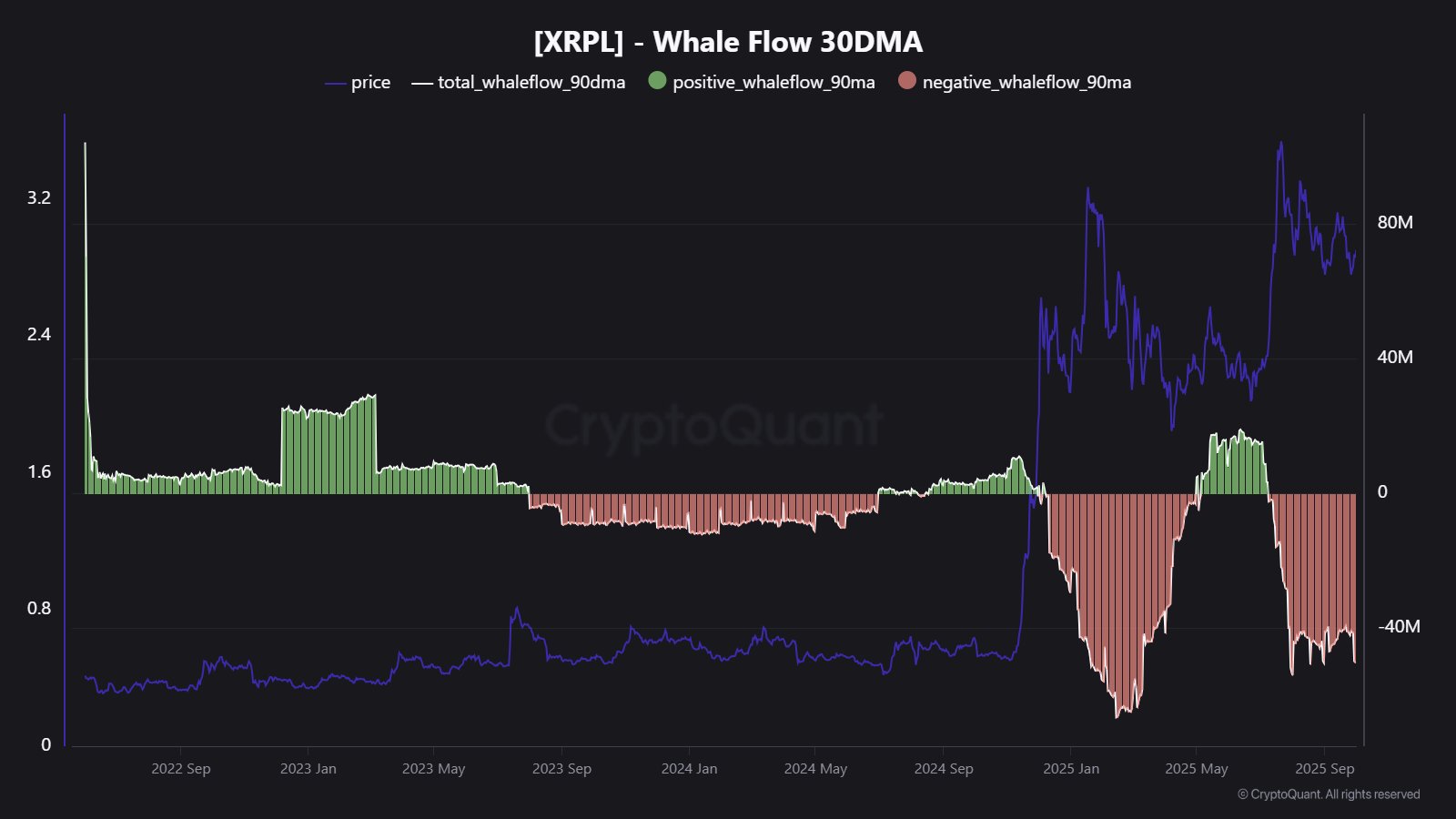
According to data shared by CryptoQuant’s Maartunn, on average, XRP whales are selling $50 million per day. Martuun’s chart shows that during 2022 through early 2023, whale flow was predominantly positive on the 30DMA. This accumulation phase coincided with price stability, suggesting whales were building positions.

XRP Whale Flow CryptoQuant
XRP Whale Flow | CryptoQuant

Meanwhile, mid-2023 through the first three quarters of 2024 turned decisively negative. During this time, the price was range-bound, albeit with fluctuations. After a surge in whale inflows throughout the rest of the year, XRP saw a spike in price, reaching a high of $3.4 on January 16, 2025.

Notably, during the spike, whale inflows were in the negative region. This was the most negative reading on the entire chart, as investors possibly began profit-taking trades amid XRP’s rally above $3. 

However, a brief accumulation window occurred in April as XRP collapsed to the $2 support level. This accumulation persisted until late June, when XRP recovered above the $2 mark. The recovery led to the latest round of profit-taking trades, which have endured until now.

Currently, whale flow shows sustained negative pressure at approximately -$50 million per day. The whale behavior observed from the chart indicates that whales tend to take profits when XRP recovers to greater heights but accumulate more during price drops.

$8T Morgan Stanley Opens Bitcoin Access to All Wealth Clients

0

The $8 trillion wealth management firm Morgan Stanley is making a significant change in how it offers Bitcoin and crypto investments.

Starting October 15, the firm will allow all clients to invest in crypto funds, no matter their account size or risk level. This is a major update from when only wealthy clients with at least $1.5 million and a high-risk tolerance could invest in crypto through the bank.

Old Rules Are Gone

For many years, Morgan Stanley limited crypto investments to a small group of clients, mainly those with taxable brokerage accounts. Now, those limits are gone. Clients can include crypto investments in any type of account, even retirement accounts.

This change comes as more clients want to invest in Bitcoin and other digital assets as they become more mainstream. It also helps Morgan Stanley stay competitive against companies like Coinbase, which are attracting many retail crypto investors.

Automated Monitoring to Manage Risk

Although Morgan Stanley is opening crypto access to more clients, it is careful about managing risks. The firm will use automated systems to watch client portfolios and prevent too much investment in these volatile assets.

The bank’s global investment committee recommends clients start with no more than 4% of their portfolio in crypto, depending on their goals.

Only Bitcoin ETFs for Now

Meanwhile, even with wider access, Morgan Stanley’s crypto choices remain narrow. Advisors can currently only suggest Bitcoin ETFs from BlackRock and Fidelity. However, the firm is watching the market closely and may add more options, like Ethereum and Solana, in the future.

This strategy helps the firm enter the crypto space gradually while keeping the stability and trust clients expect. Morgan Stanley plans to adjust its offerings as the market and client demand evolve.

Staying Competitive in an Expanding Market

Morgan Stanley’s move is part of a plan to keep its competitive edge. More financial institutions are now embracing cryptocurrencies, following a change in government attitudes after President Donald Trump’s election. Morgan Stanley’s decision fits this trend.

A few months ago, it announced that clients will be able to trade Bitcoin, Ethereum, and Solana directly through its E-Trade platform.

Also, back in May, Morgan Stanley stated that Bitcoin’s multi-trillion-dollar market cap has become large enough to qualify as a U.S. reserve asset. In parallel, the firm estimated that a $370 billion allocation would match its global market weight. 

Meanwhile, Morgan Stanley noted that Bitcoin’s higher volatility still challenges its suitability as a reserve asset. 

Nonetheless, the Trump administration is moving forward with a Strategic Bitcoin Reserve plan. Internationally, the UK and Switzerland have rejected Bitcoin as a reserve asset due to volatility risks.

Russia Embraces Crypto Regulation as Millions of Citizens Turn to Bitcoin

0

Russia is preparing to introduce a formal legal framework for cryptocurrencies after years of uncertainty.

The move follows a surge in digital asset adoption, with officials estimating that about 20 million Russians now use cryptocurrencies for investment, savings, and cross-border transactions.

Crypto Adoption Outpaces Government Expectations

Deputy Finance Minister Ivan Chebeskov confirmed that cryptocurrency use has reached a level the state can no longer ignore.

Speaking to the local news media outlet TASS, he said Russia must “acknowledge reality” and design systems to protect its citizens.

“We recognize that crypto exists, millions of our citizens are already using it,” Chebeskov stated. “Our task is to create a secure infrastructure that delivers both technological and economic benefits.”

Notably, the statement marks a significant shift from earlier positions when Russian regulators pushed for strict limitations or outright bans on digital assets.

Billions in Bitcoin and Crypto Holdings

Furthermore, as of March 2025, data from the Central Bank of Russia shows that residents held over 827 billion rubles in crypto assets. This marks a 27% increase compared to the previous year.

Bitcoin remains the dominant choice, accounting for over 60% of holdings. Meanwhile, Ethereum (22%) and major stablecoins such as USDT and USDC together comprise 15.9%.

Executives at Sberbank, the country’s largest commercial bank, believe the real figure is far higher. According to Alexander Vedyakhin, a top executive at Sberbank, total digital assets owned by Russians may exceed $40 billion.

“Market data confirms that interest in crypto investment among individuals and companies continues to grow,” Vedyakhin said at the Finopolis 2025 forum.

Central Bank Signals Readiness for Crypto Integration

The Central Bank of Russia, known for its conservative approach, now appears more open. Gradually, it is showing a willingness to allow controlled participation in the crypto sector.

Earlier this week, First Deputy Governor Vladimir Chistyukhin announced plans to allow banks to handle crypto transactions. The move, set to take effect under strict supervision, is scheduled to begin in 2026.

Moreover, he revealed that the regulator will conduct a comprehensive survey of crypto investing and lending early next year. The results from this survey will help guide future policymaking.

Three-Year Roadmap Toward Regulation

At the Finopolis 2025 conference, Vladimir Chistyukhin said he expects a gradual path toward full regulation of digital assets. He added that this process is likely to unfold over the next three years.

Specifically, according to him, the process will begin in 2025 with the completion of legislative drafts and consultation among key stakeholders.

By 2026, lawmakers will subsequently adopt a comprehensive crypto investment law, paving the way for the first licenses to be issued to service providers.

Following that, in 2027, Russia plans to align its criminal and administrative codes with the new framework. This step is to ensure greater legal consistency and effective enforcement.

Once the framework is established, Chistyukhin believes it will legitimize crypto activities, reduce illicit transactions, and protect consumers from financial fraud.

Ultimately, the government expects the regulated environment to attract new investments, foster fintech innovation, and strengthen the overall transparency of the digital economy.

Hackers Siphon Over $21M in Stablecoins After Private Key Leak, Bridge Funds to Ethereum

0

Blockchain security firm PeckShield has reported a major breach, which resulted in the loss of more than $20 million worth of stablecoins. 

According to PeckShield, an unidentified user with the blockchain address 0x0cdC…E955 suffered losses of approximately $21 million in digital assets on the Hyperliquid platform. 

The stolen funds primarily consisted of stablecoins, including 17.75 million DAI and 3.11 million MSYRUPUSDP. PeckShield confirmed that the attackers gained unauthorized access to the victim’s wallet through a private key leak. 

Hackers Bridge Funds to Ethereum 

In this case, after the attackers drained the $21 million worth of stablecoins, they bridged the assets on the Ethereum network. Most crypto scammers usually explore this option in an attempt to conceal or redistribute the funds. 

Screenshots shared by PeckShield show that the attackers distributed the stolen stablecoins across three separate wallets, holding approximately 10.08 million DAI, another 6.19 million DAI, and 3.11 million MSYRUPUSDP, respectively. At the time of writing, the stolen funds are still held in the wallets and have not yet moved. 

Other Crypto Heists in 2025 

The development adds to the growing list of thefts that have been reported in the crypto market this year. In the first half of 2025, blockchain security firm TRM Labs reported that attackers stole a whopping $2.1 billion worth of digital assets from the crypto market. 

Last month alone, around $127 million was carted away across more than 20 major crypto-related cases, including Shiba Inu’s Shibarium Bridge exploit.

While some crypto thefts are nearly impossible to prevent, many incidents can be avoided through stronger security practices. 

As expected, the latest development has reignited discussions around the importance of private key security to prevent such scenarios. To reduce the risk of a private key leak, experts recommend storing private keys offline and enabling two-factor authentication (2FA) whenever possible.