

Home Blog Page 508

Ex-Ripple Director Explains Why XRP is 10 Times More in Value Then LINK

0

Former Ripple director Matt Hamilton believes comparing XRP to Chainlink misses the point, as the protocols housing both assets are inherently different.

His remarks came as discussions about why XRP commands such a large lead in market value recently resurfaced.

Chainlink Spotlights Swift’s Blockchain Ambitions

For context, the discussions started after Swift announced yesterday that it would add a blockchain-based shared ledger to its infrastructure. According to Swift, it has already brought in more than 30 financial institutions to help design the system. 

Notably, its first use case will focus on 24/7 international payments, with Consensys developing the initial prototype. Swift said it will move quickly to deliver the first phase before expanding into future stages.

Interestingly, Chainlink welcomed the news, using the opportunity to point out its collaboration with Swift. The oracle provider said the move confirmed the real-world value of blockchains and oracle networks in upgrading financial infrastructure. 

“Why is XRP Much Larger Than Chainlink?”

Responding to this, former Coinroutes Chairman Dave Weisberger challenged the current market gap between XRP and Chainlink. 

Specifically, he argued that Chainlink’s partnership with Swift and its plan to share revenue with token holders give LINK a strong case for a higher valuation. Weisberger questioned why XRP’s market cap stood at more than ten times LINK’s, despite those factors.

For context, XRP ranks as the fourth-largest crypto asset with a market cap of about $173.35 billion. Meanwhile, Chainlink sits in twelfth place with $14.6 billion. This shows XRP’s valuation is nearly 12 times higher. For LINK to surpass XRP, its price would need to jump more than 1,000% to reach $255.

Ex Ripple Director Responds

Replying to Weisberger’s question, Hamilton suggested that the comparison is amiss. According to Hamilton, XRP is the native asset of the XRP Ledger, which serves as a full blockchain network. This justifies its larger valuation.

Meanwhile, he explained that, by contrast, Chainlink is only a protocol where its token plays a limited role. For this reason, comparing the two valuations directly doesn’t make sense.

One XRP supporter tried to simplify Hamilton’s point by saying LINK functions like a platform such as LinkedIn, while XRP acts more like a currency with its own operating system.

Weisberger countered that even LinkedIn generates profits and that shareholders benefit from those earnings. He said Chainlink, although less straightforward, has set up a way to share revenues with its token holders. 

On the other hand, he said XRP derives value from its scarcity and small transaction burn. He added that XRP’s strength lies in its low cost of use, and if its price climbs too high, that affordability could weaken.

WrathofKahneman, a well-known figure in the XRP community, disagreed. He said XRP’s burn rate is so small it barely matters. 

WOK argued that a higher XRP price actually makes it more efficient as a settlement asset. He also pointed out that transaction fees remain adjustable and minimal, which keeps the network affordable even if the token’s value rises.

XRP ETF Approval Odds Are Now ‘Essentially 100%,’ Here’s Why

0

Bloomberg analyst Eric Balchunas has declared that the chances of approval for multiple crypto ETFs, including those focused on XRP, are now essentially 100%. 

The ETF analyst issued his bold prediction after journalist Eleanor Terrett reported that the SEC had instructed prospective issuers of XRP, Solana, Dogecoin, Litecoin, and Cardano ETFs to withdraw their 19b-4 exchange filings. 

Why XRP ETF Approval Appears Guaranteed

This directive follows the SEC’s recent approval of the Generic Listing Standards, which eliminates the need for the traditional 19b-4 filings and their lengthy review process. According to Terrett, prospective crypto issuers will withdraw their 19b-4 filings this week. 

Reacting to the report, Balchunas stated that the outcome was anticipated. He noted that the old 19b-4 exchange filings are not required under the Generic Listing Standards. 

Accordingly, he emphasized that the chances of approval for these crypto ETFs, including those tied to XRP, are now at 100%.

With the SEC removing the need for the 19b-4 filing, Balchunas emphasized that the only step left is for the SEC’s Division of Corporation Finance to give formal approval to the S-1 filings. Accordingly, this makes the approval of crypto ETFs a matter of when, not if. 

Approval Could Come Any Day 

Underscoring the momentum, Balchunas pointed out that prospective issuers of Solana ETFs have already filed their fourth amendment. Reports indicate that issuers aiming to launch XRP ETFs in the U.S. were required to file their final amendments last week.  

Following the submission of final amendments for spot crypto ETFs, Balchunas urged investors to be prepared, noting that approval “could come any day.” 

Meanwhile, prediction platform Polymarket has already settled its wager on whether an XRP ETF would launch this year, with a firm “Yes.”

The outcome follows the SEC’s tacit approval of the REX-Osprey XRP ETF (XRPR), which debuted impressively with $37.75 million in first-day trading volume. 

The REX-Osprey XRP ETF currently holds $31.8 million in assets under management (AUM), with a daily inflow of $5.3 million. Investors also expect the several spot XRP ETFs under SEC review to draw strong demand if approved. 

Here’s What Happens to XRP if Bitcoin Smashes $469,000

0

Prominent market commentator Jay forecasts that XRP could soon hit a double-digit milestone, while also projecting major price surges for assets like Bitcoin and Ethereum.

The crypto market has been struggling over the past few weeks, with leading assets, including XRP, facing significant price declines. 

In particular, XRP has shed 10.3% of its value over the past two weeks and has also fallen by 6.9% over the past month. Over the past week, the token has plummeted by 7.01%, with its price crashing below the psychological $3 territory to $2.85. 

XRP to Hit $10 This Cycle 

Despite XRP’s recent lackluster performance, prominent market commentator Jay remains optimistic that it could defy the bearish trend and set a new all-time high in the current cycle.

Jay shared this outlook while outlining bold predictions for several major crypto assets. He forecasted that XRP could surge to a new all-time high of $10 in the current market cycle, echoing a similar outlook shared by Jake Claver, CEO of Digital Ascension Group. For the uninitiated, the current cycle is expected to end by December 2025. 

Therefore, XRP would need to skyrocket by 258.42% from its current price to reach the $10 target, potentially pushing its market cap to $598.26 billion. 

Bold Outlook for BTC, ETH, SOL, and HYPE 

Notably, Jay also predicted the cycle top of major assets such as Bitcoin (BTC), Ethereum (ETH), Solana (SOL), and Hyperliquid (HYPE). According to him, Bitcoin, Ethereum, Solana, and Hyperliquid could rise to $469,000, $25,000, $1,000, and $300, respectively. 

To hit these targets, BTC would need to climb 328% from its current price, ETH 528%, SOL 395%, and HYPE 570%. By comparison, XRP would only require a 258% rally — which is relatively smaller — to reach the $10 goal. 

Potential Drivers 

However, Jay did not highlight any catalysts that could drive these cryptos to the new price milestones. Meanwhile, for XRP, there is growing confidence that the current downturn will soon come to an end for the token.  

This optimism is fueled by several factors, particularly the growing hype around upcoming spot-backed XRP ETFs. Since the SEC approved the first-ever spot XRP ETF earlier this month, expectations are rising that other related products under review could gain approval next month. Speculation suggests that these funds could draw significant inflows into the XRP ecosystem, potentially lifting its price.

In a recent interview, Claver pointed to increased retail and institutional adoption as another key driver of XRP’s growth. Corporate interest has already begun to materialize, with Trident Digital Tech Holdings allocating $500 million toward establishing an XRP-focused treasury.

Another catalyst lies in expanding opportunities for XRP holders to participate in DeFi. Platforms such as Axelar, Flare Network, and Uphold are rolling out initiatives that enable investors to earn yields of up to 10% annually, further enhancing XRP’s utility and appeal. 

Despite this growing optimism, it remains uncertain whether XRP can achieve this lofty $10 price. 

“Most Restrictive in the EU”: Poland’s Crypto Bill Draws Industry Backlash

0

Poland’s lower house of parliament has approved a sweeping bill to regulate cryptocurrency services, setting the stage for one of the EU’s toughest digital asset laws.

Specifically, lawmakers have approved Bill 1424, titled the Crypto-Asset Market Act. The measure now advances to the Senate for deliberation before being sent to President Karol Nawrocki for final approval.

According to proponents, the law would bring Poland’s legislation in line with the EU’s MiCA framework to harmonize rules across member states. Notably, the bill passed with 230 votes in favor and 196 against.

Licensing Regime and Regulatory Oversight

If enacted, the legislation would establish a mandatory licensing framework for all crypto asset service providers (CASPs). Both domestic companies and foreign firms operating in Poland fall under its scope.

To qualify, applicants must submit extensive documentation. This would cover their corporate structures, capital adequacy, compliance mechanisms, internal controls, risk management strategies, and anti-money laundering procedures.

Poland’s regulator, the Komisja Nadzoru Finansowego (KNF), would serve as the sole authority responsible for reviewing and granting these licenses.

Businesses already active in the sector would have a six-month transition period to comply with the new regulations. Once that period ends, any unlicensed operation could face forced closure and legal consequences.

Heavy Penalties for Non-Compliance

The law also introduces criminal penalties for firms that attempt to operate without authorization. Sanctions include fines of up to $2.8 million and prison sentences of up to two years.

Such strict enforcement mechanisms have fueled concerns among stakeholders that the legislation prioritizes control over innovation.

Fierce Criticism from Opposition

Opposition politicians have been quick to condemn the bill. In a post on X, Janusz Kowalski, a member of the conservative Law and Justice party, described the act as the most restrictive crypto law in the EU. He warned that the regulation could jeopardize the interests of Poland’s three million crypto holders.

Kowalski also criticized the excessive length of the legislation, which runs to 118 pages. He noted that this is far more than the shorter frameworks adopted by countries such as Germany and the Czech Republic.

Meanwhile, pro-blockchain politician Tomasz Mentzen raised alarms about the KNF’s capacity to manage the licensing process. According to him, the regulator already takes an average of 30 months to process applications. If the new law is enforced, he argued, many firms could face crippling delays, leading to the “destruction of blockchain and stablecoins in Poland.”

He also called on the Senate and President Karol Nawrocki to intervene and block the bill to protect Poland’s cryptocurrency market.

Election Promises Meet Regulatory Reality

The timing of the debate is notable, as it follows closely on the heels of Poland’s presidential election in June.

The winner, Karol Nawrocki, secured 50.9% of the vote in the runoff. During his campaign, he pledged to defend innovation and oppose what he called “tyrannical regulations” that restrict individual freedoms.

His rival, Sławomir Mentzen, who finished third in the first round, went even further, promising to establish a Bitcoin reserve if elected. Although unsuccessful, his strong pro-crypto stance signaled the growing political relevance of digital assets in Poland.

Bitcoin Leads $812M Weekly Outflows from Crypto Funds as US Macro Data Rattles Markets

0

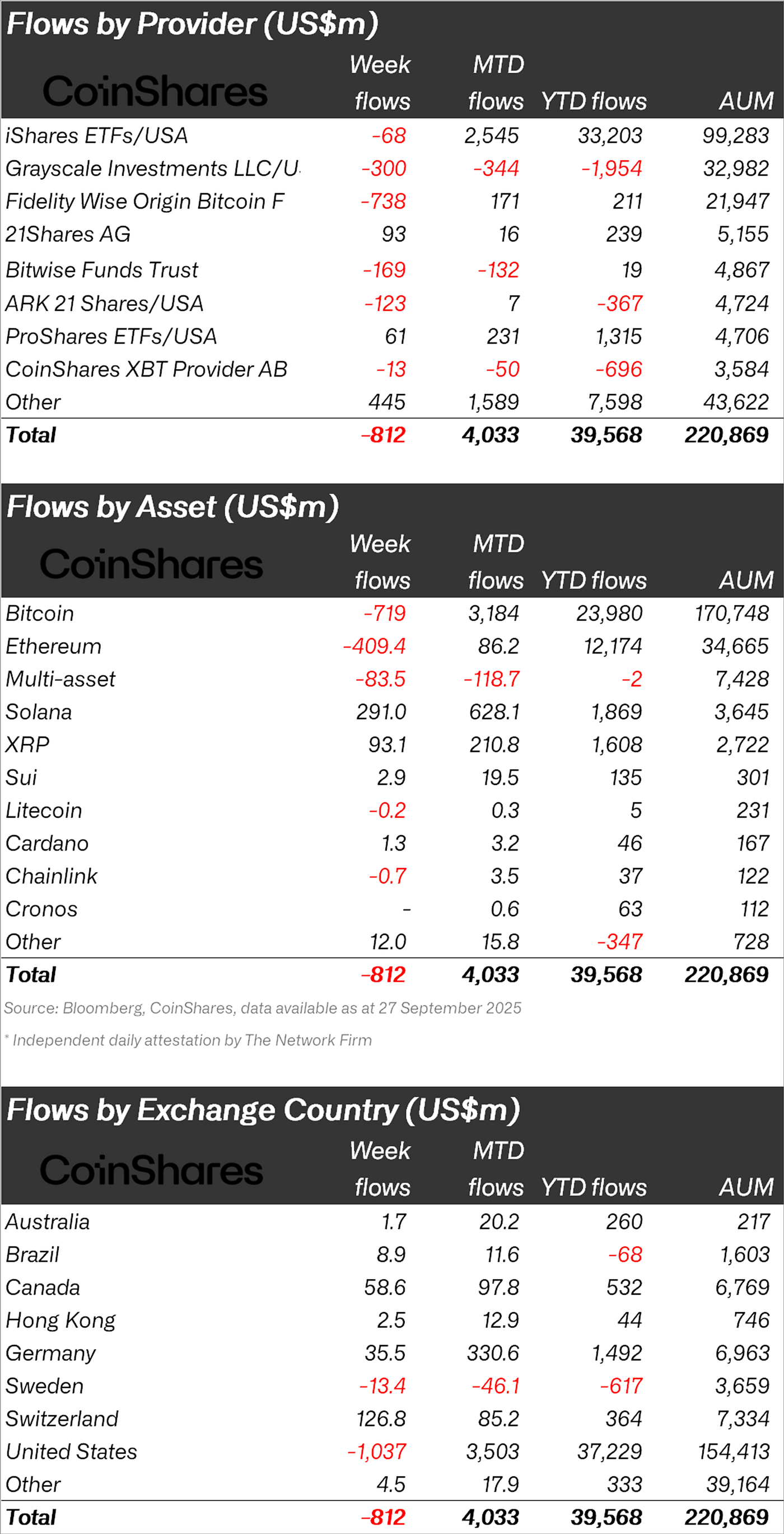
Crypto asset investment products experienced a notable pullback last week, led by Bitcoin, with outflows totaling $812 million. 

Despite this short-term dip, the year-to-date inflows remain strong at $39.6 billion, according to CoinShares’ latest weekly report. This implies sustained investor interest close to last year’s record $48.6 billion.

US Markets Drive Outflows Amid Rate Cut Doubts

The U.S. led the pack with outflows amounting to $1 billion. This decline in investment activity comes as expectations for two US interest rate cuts in 2025 have cooled following stronger-than-expected macroeconomic data, including modified GDP figures.

Notably, the negative sentiment is concentrated in the U.S., as other regions show resilience, with inflows continuing to flow steadily. Switzerland, Canada, and Germany stand out as key bright spots. 

Specifically, they attracted $126.8 million, $58.6 million, and $35.5 million, respectively, in inflows last week. This suggests investor confidence outside the US remains relatively strong.

Bitcoin and Ethereum Face Pressure

Among major digital assets, Bitcoin faced the largest weekly outflows with $719 million leaving investment products. Notably, there was no corresponding rise in short positions against Bitcoin.

Ethereum also experienced notable outflows of $409 million, with September seeing a sharp slowdown in inflows at just $86.2 million for the month compared to $12 billion year-to-date. This pause highlights caution among investors amid the ongoing price struggles from ETH and BTC in the spot market.

Solana and XRP Emerge as Top Performers

Meanwhile, Solana bucked the trend with strong inflows of $291 million. The altcoin’s surge in investor interest is widely attributed to anticipation surrounding upcoming U.S. ETF launches in October. 

This latest weekly inflow has elevated Solana’s month-to-date to $628 million, while the yearly figures are at $1.86 billion.

Likewise, XRP also witnessed positive inflows of $93.1 million, benefiting from similar ETF-related optimism. Now, XRP investments have seen monthly flows of $210 million and yearly positive flows of $1.6 billion. 

Notably, the assets under management for Solana ETPs are now at $3.64 billion, while those of XRP are at $2.72 billion.

Other crypto assets that registered positive flows for the week include Cardano and SUI.

Jim Cramer Says “Buy Crypto” as US National Debt Ticks On

0

CNBC’s Mad Money host Jim Cramer has advised crypto adoption amid staggering US national debt figures.

Cramer shared this on his X post on Monday, recommending cryptocurrencies as a potential solution to the economic recession that may result from the growing national debt. While he did not categorically state this, his “buy crypto” message, accompanied by a display of the US national debt, tells the whole story.

Growing National Debt and Crypto as the Solution

The accompanying image is the National Debt Clock located on Anita’s Way in New York. The digital display clock shows that the US debt now stands at $37.63 trillion. Of this figure, the current debt share per family stands at a staggering $955,708, slowly approaching the $1 million mark. 

.

The US National Debt Clock

Remarkably, the recent comment from Cramer marks the latest instance that the notable market commentator is advocating for crypto exposure.

Cramer’s line of thought for these comments hinges on his belief that cryptocurrencies serve as a hedge against economic situations, such as the current one. Specifically, he mentioned Bitcoin, the largest cryptocurrency by market cap, in a similar recommendation in July, calling it a “hedge against $37 trillion debt.”

Cramer Is Bullish on Bitcoin and Crypto

The popular TV host stated at the time that the worsening debt is a concern for every US family, and Bitcoin is the asset they would want to hold. He revealed he is buying a lot of Bitcoin, and others should do the same.

In January, he also called Bitcoin a great investment to hold, advocating that his viewers should include the apex cryptocurrency in a well-diversified portfolio. However, Cramer kicked against buying Bitcoin indirectly through MicroStrategy stock.

Remarkably, several other market analysts share a similar belief with Cramer on Bitcoin’s role as a hedge against inflation. Venture capitalist Tim Draper believes that governmental inefficiencies will ensure that Bitcoin will appreciate infinitely against the dollar.

Saylor Says Buy Bitcoin

Meanwhile, Cramer’s post elicited mixed reactions from the crypto community. It drew comments from even Strategy chairman Michael Saylor, who reviseed his “buy crypto” advocacy to “buy bitcoin.”

Some other reactions expressed skepticism over the presenter’s bullish crypto stance. They suggested the clarion call was in fact, bearish, citing Cramer’s track record of predictions.

For context, the Mad Money host is popular for major prediction fails. Despite his overall bullish stance, Cramer has made several assertions that Bitcoin would correct considerably; however, the reverse occurred. 

One of the most notable instances was when he predicted that Bitcoin would crash in January 2024. However, the asset quickly regained bullish momentum, setting the stage for its 43% surge in February. Notably, these events have earned him the “inverse Cramer” reputation.


Qatar National Bank Adopts JPMorgan’s Blockchain for USD Corporate Payments

0

Qatar National Bank (QNB), one of the largest lenders in the Middle East, has partnered with JPMorgan to use blockchain technology for processing US dollar corporate payments.

The move represents a major advancement in adopting blockchain technology in regional banking.

Speeding Up Cross-Border Payments

Under the new arrangement, QNB will adopt JPMorgan’s Kinexys Digital Payments system, a blockchain-based platform designed to settle dollar transactions in near real time. Consequently, business clients in Qatar will be able to complete transfers within minutes, rather than waiting several days under the traditional banking system.

Kamel Moris, executive vice president of transactional banking at QNB, highlighted the change as a breakthrough for treasurers. “We can now offer continuous, around-the-clock service and guarantee payments within approximately two minutes,” he said.

Conventional rails for international transfers are often limited by time zones and settlement windows. To overcome these delays, QNB is shifting to blockchain infrastructure while also providing continuous access to dollar liquidity for its corporate clients.

Kinexys: JPMorgan’s Expanding Blockchain Platform

Kinexys, rebranded from Onyx in 2024, stems from JPMorgan’s blockchain initiatives launched in 2019. The platform processes an estimated $2 billion worth of transactions each day, connecting banks across multiple regions to settle payments more efficiently.

QNB began leveraging the system in March 2025, joining a growing number of regional banks already participating in the network. These include Emirates NBD, Commercial Bank of Dubai, Bank ABC, First Abu Dhabi Bank, and Saudi National Bank.

Broader Web3 Strategy

The Kinexys partnership is part of QNB’s broader digital transformation agenda, which extends beyond payments.

In July 2025, QNB partnered with DMZ Finance to introduce the QCD Money Market. It is the first tokenized money market fund in the Dubai International Financial Centre (DIFC). The fund obtained official DIFC authorization, marking a major milestone for regulated tokenized assets in the Gulf region.

Later this year, during the Web Summit Qatar 2025, QNB entered into a memorandum of understanding with the Qatar Financial Centre. This collaboration enables fintech companies to leverage QNB’s infrastructure. It also opens avenues in areas such as digital assets, tokenization, and embedded financial services.

In 2021, Finansbank, the Turkish arm of the bank, joined forces with Ripple to test a new international payment service. The project leveraged RippleNet technology to enable instant cross-border money transfers.

These moves laid the foundation for QNB’s current strategy of integrating blockchain into its mainstream operations.

Shiba Inu Trendline Breakout Targets 25% Long Profit

0

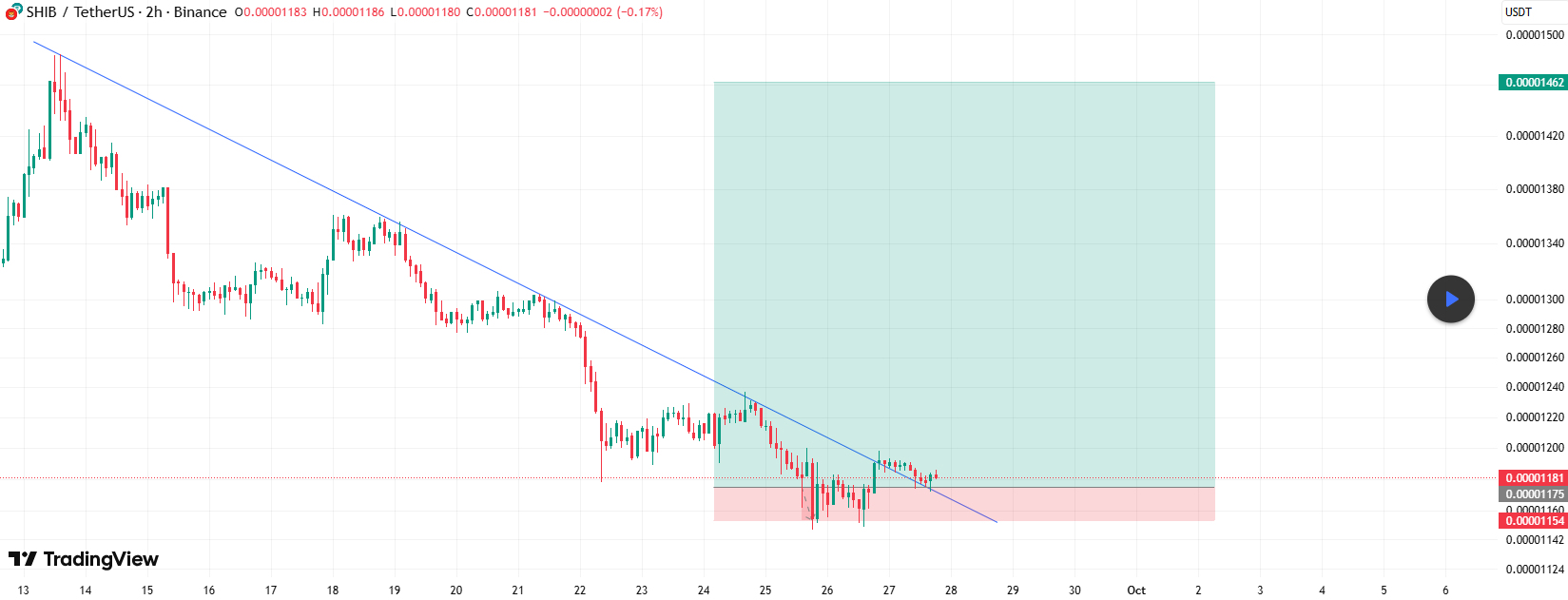
Shiba Inu has broken out from a descending trendline on a lower timeframe, sparking predictions of a near-term rally towards September’s high.

A recent TradingView analysis from “Satososhi1242” spotlighted this, tipping Shiba Inu to rebound considerably from recent downsides. Notably, the doggy-themed meme token corrected 5.65% last week but has shown signs of life over the past 24 hours.

For context, Shiba Inu is up 1.83% in the past 24 hours, cutting down its losses over the past seven days to 1.47%. It is now down only 2.63% since the start of September, showing strength, especially as the month nears its end.

Shiba Inu 25% Rally Imminent

Notably, the market watcher highlighted in his analysis that Shiba Inu has been trending within a descending channel on the 2-hour timeframe. This followed its September 13 peak at $0.00001484, where SHIB’s earlier bullish momentum faced a roadblock.

Since the high, Shiba Inu has been making lower highs and lower lows and trending below the descending resistance neckline. However, as the market began to recover, the meme coin followed, breaking above the trendline late on Sunday.

Upon breakout, SHIB retested the channel, dropping to $0.00001158 before resuming a bullish continuation. Now, the analyst has predicted a sustained push to $0.00001460, representing a 25% profit from his entry point. From the current market price of $0.00001190, this marks a 22.7% growth.

Shiba Inu Trendline Breakout

Shiba Inu Bulls Grow Louder

Remarkably, his analysis contributes to the renewed enthusiasm within the Shiba Inu community, suggesting that SHIB may reverse bearish trends and target higher prices. One such projection came from Market Spotter, who predicted an even higher target for Shiba Inu.

His analysis featured a potential breakout from a falling wedge on the weekly chart, one with a history of sparking a rally for the token. Taking a page from the previous occurrence in February 2024, he predicted that Shiba Inu would target a rally to $0.00004567.

Another analysis predicts a 600% upsurge for Shiba Inu. Specifically, MMBTrader shared that while the short-term outlook appears bearish, SHIB will post a jaw-dropping comeback, targeting a four-year high of $0.00007730.

Despite the bullish sentiments, Shiba Inu would have to sustain momentum to hit any of these targets. Notably, The Crypto Basic earlier reported that $0.00001230 is a key support area that SHIB needs to reclaim. Until it does that, the token faces the risk of a further downtrend to $0.0000110.

‘XRP Is Dead,’ but History Suggests Otherwise: Analyst

0

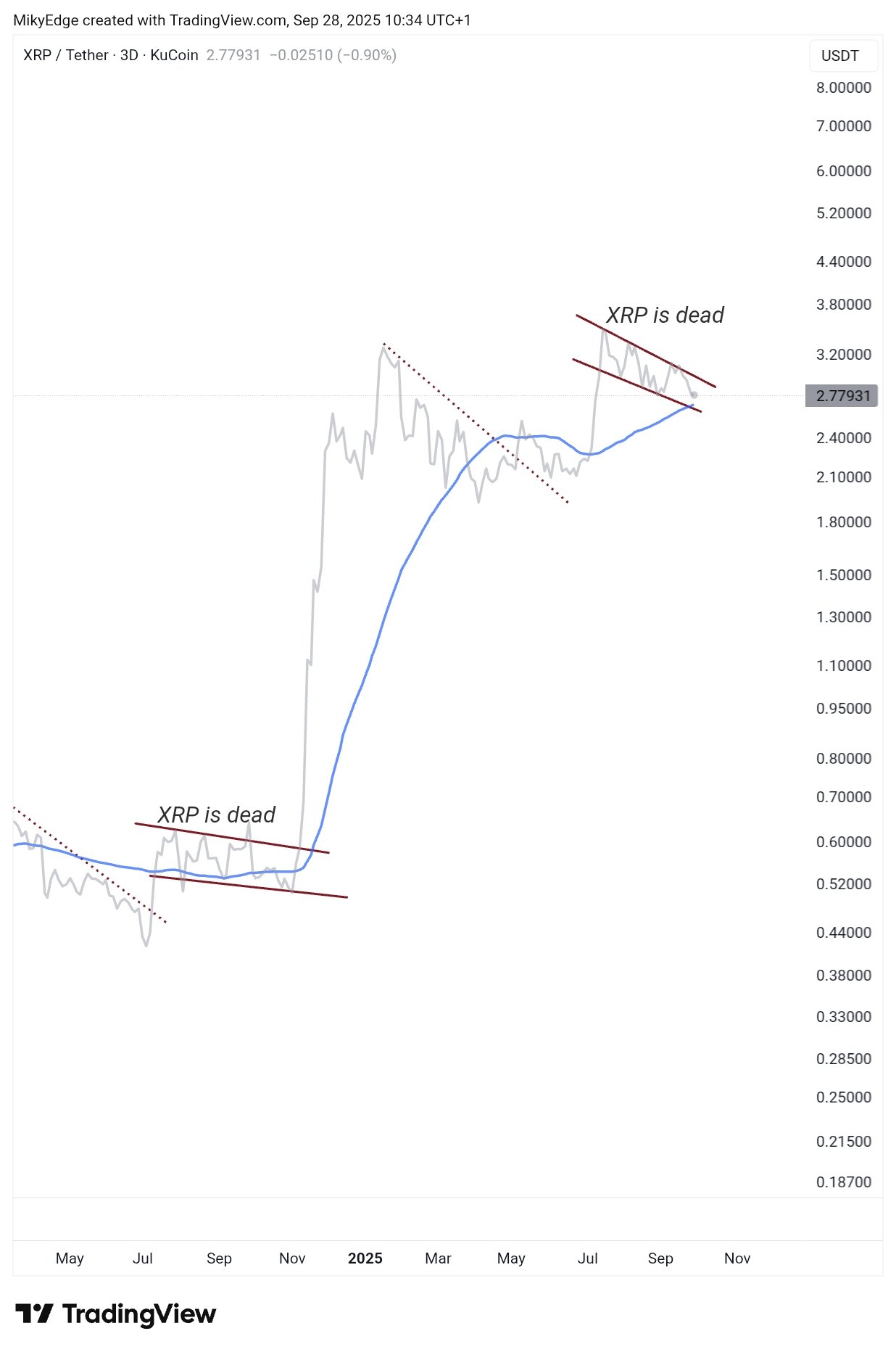
Economist and trader Mikybull recently shared a chart on X with the caption, “XRP is dead.”

While the statement may sound bearish, Mikybull used the phrase to highlight a recurring market pattern where skepticism peaks just before a strong recovery.

XRP Repeating Descending Channel

The chart shows XRP moving within a downward-sloping channel, drawn with red trend lines. At the same time, a long-term moving average (blue curve) continues to rise. This mirrors a phase seen in mid-2024, when XRP faced similar doubts.

At that time, the token drifted lower to $0.38 and remained in a tight range for weeks as sentiment turned negative, only to break out sharply once the consolidation ended by late 2024.

Image

Breakout History Offers a Clue

In that previous run, the prolonged pullback gave way to a sudden rally that surprised many traders who had written the asset off.

Mikybull’s latest observation suggests that XRP may be setting up for a similar move. The pattern of a falling channel alongside a rising moving average has historically marked the end of a consolidation phase, rather than the beginning of a prolonged downturn.

Essentially, while short-term price action looks weak and may continue to test support levels, the underlying upward slope of the moving average points to a still-intact long-term trend.

For traders watching XRP around $2.80, the current “dead” phase means the early stages of another significant breakout, especially as the market enters the final quarter of the year, a historically bullish season.

Interestingly, while XRP’s price is in a quiet phase, deep-pocketed investors are silently accumulating ahead of the next major pump.

Whales Already Positioning for XRP’s Next Major Move

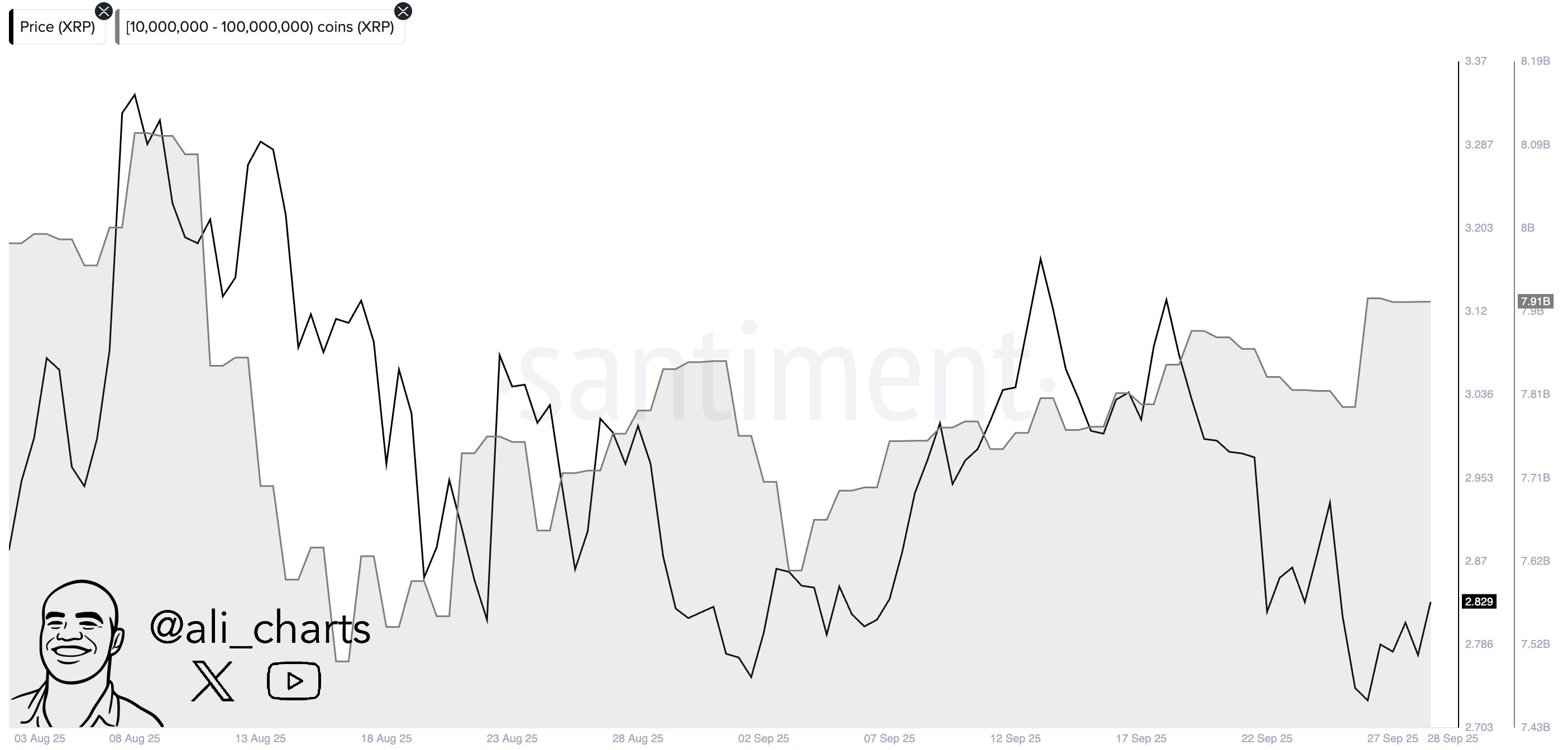
In a tweet today, analyst Ali Martinez revealed that whales have bought 120 million XRP over the past three days, investing over $300 million in the XRP market. Notably, these are investors holding between 10 million and 100 million XRP tokens each.

Their collective balance was under 7.8 billion XRP last week. However, as of today, their total has reached 7.91 billion. The last time they held this much XRP was in mid-August.

At that time, their holdings even reached 8 billion, but they gradually sold off their positions, which explains XRP’s price decline earlier this month. Now, they have resumed buying, positioning for the next rebound.

Image

More Bullish Factor

The market is also widely anticipating the SEC’s decision on XRP ETFs in October. Proponents believe that approval could open the floodgates for capital inflows, pushing prices much higher.

Essentially, XRP’s next rebound is backed by a strong technical setup, major whale accumulation, and solid fundamentals—factors that some believe could help the coin reach $10 by the end of the year.

Here’s What Cardano Price Could Be if It Captures 20% of the Crypto Market

0

Fresh analysis suggests that Cardano could reach a new all-time high if it captures just 20% of the global crypto market cap. 

The broader crypto market is still in free fall, slipping 0.24% in the past 24 hours to a total valuation of $3.77 trillion. Amid this downturn, Cardano (ADA) has taken a steeper hit, shedding 1.75% of its value in the same timeframe to hold a market cap of $27.72 billion. 

At the time of writing, one ADA was worth $0.774, boasting a daily volume of $562.21 million. Despite its recent pullback, ADA remains one of the most closely watched cryptocurrencies due to its position as the 10th largest token globally. 

Mixed Reactions Surround ADA’s Potential 

Cardano supporters, including founder Charles Hoskinson, remain optimistic about the long-term potential of ADA. Back in July, Hoskinson speculated that the token could surge by 1,000x. Initial estimates at the time showed the growth could push ADA’s price to nearly $800 per coin. However, the bold forecast sparked mixed reactions. 

While some enthusiasts welcomed Hoskinson’s bold forecast, skeptics quickly dismissed it as unrealistic, pointing to the market cap implications. With a circulating supply of 35.81 billion tokens, a price of $800 would give ADA a market cap of $28.64 trillion—far exceeding the entire global crypto valuation. 

ADA Price If It Captures 20% of Global Crypto Market Cap 

Critics argued that a more modest target would be far more realistic. Against this backdrop, we examined what ADA’s price might look like if it were to capture just 20% of the total crypto market capitalization. 

As noted earlier, the broader crypto market currently stands at $3.77 trillion, reflecting a 0.24% decline over the past 24 hours. Cardano’s market cap stands at $27.72 billion, accounting for just 0.73% of the total. 

If ADA were to capture 20% of the entire crypto market, its valuation would soar to an impressive $754 billion. This marks a staggering 2,620% increase from its current level. It is worth noting that this estimated valuation exceeds the current market cap of Ethereum, which stands at $483.58 billion. 

The price of ADA at this valuation depends mainly on the token’s circulating supply. Currently, only 35.81 billion ADA tokens are in circulation, out of a total of 45 billion. 

Based on the current circulating supply of 35.81 billion, the projected valuation of $754 billion translates into a price of roughly $21. We arrived at this price by dividing the estimated market cap ($754 billion) by the circulating supply (35.81 billion). 

While the projection may appear ambitious, some analyses frame $21 as a realistic target. Last year, The Crypto Basic estimated ADA could reach $21 if its market cap matched that of Elon Musk’s electric vehicle giant, Tesla. 

Similarly, a previous forecast from crypto trading platform Changelly projected that ADA might hit the $21 milestone by March 2033.