
Home Blog Page 512

WisdomTree Says There Will Be a Supply Shock for XRP Before Bitcoin

0

XRP community researcher SMQKE has drawn attention to a statement from $100 billion asset manager, WisdomTree, suggesting XRP could face a supply shock well before Bitcoin.

For context, WisdomTree commented on XRP’s supply dynamics in a report last November, comparing the investment outlook for XRP and Bitcoin.

Meanwhile, in recent weeks, there have been increased discussions about XRP experiencing a supply shock soon. These commentaries are due to the back-to-back launch of DeFi yield opportunities for XRP and institutional accumulation.

Amid this, SMQKE referenced a statement from WisdomTree, noting that Bitcoin will reach its maximum supply of 21 million coins around the year 2140. This is over a century from now, but before then, BTC will continue to see issuance of new coins. In contrast, XRP will reach its full supply “within the next few years.”

How XRP Supply Model Works

Notably, this suggestion is based on the massive volume of XRP locked in escrow, with a monthly release.

Since 2017, Ripple has been releasing 1 billion XRP from escrow each month to provide markets with a predictable supply. It sends back to escrow tokens not distributed. This system will continue until the remaining 35.3 billion XRP in escrow is fully out.

Typically, as the company releases 1 billion XRP, it relocks about 700 million. Effectively, 300 million tokens enter the market per month, with minor variations in some months.

At this rate, analysts project that Ripple’s escrow could last approximately 9 years and 8 months, concluding around 2035. However, scenarios vary:

  • 400M/month usage (starting 2026): depletion by 2033
  • +100M/year usage increase (from 2026): depletion in 6 years
  • No re-locking: escrow depleted in 3 years

Why Analysts Expect a Supply Shock

Once the escrow releases end, burned transaction fees will be the only factor reducing supply, meaning XRP’s total count will start to shrink permanently.

WisdomTree’s report highlighted how transaction fees on the XRP Ledger (XRPL) are systematically burned, gradually applying deflationary pressure to XRP’s total supply of 100 billion units. Since launch, over 14.2 million XRP have been permanently removed through this process.

In contrast, Bitcoin’s fixed 21 million supply will not be fully mined until around 2140, resulting in a much longer scarcity timeline. WisdomTree argues this makes XRP a strong complement to Bitcoin, offering near-term scarcity alongside fast and low-cost transactions.
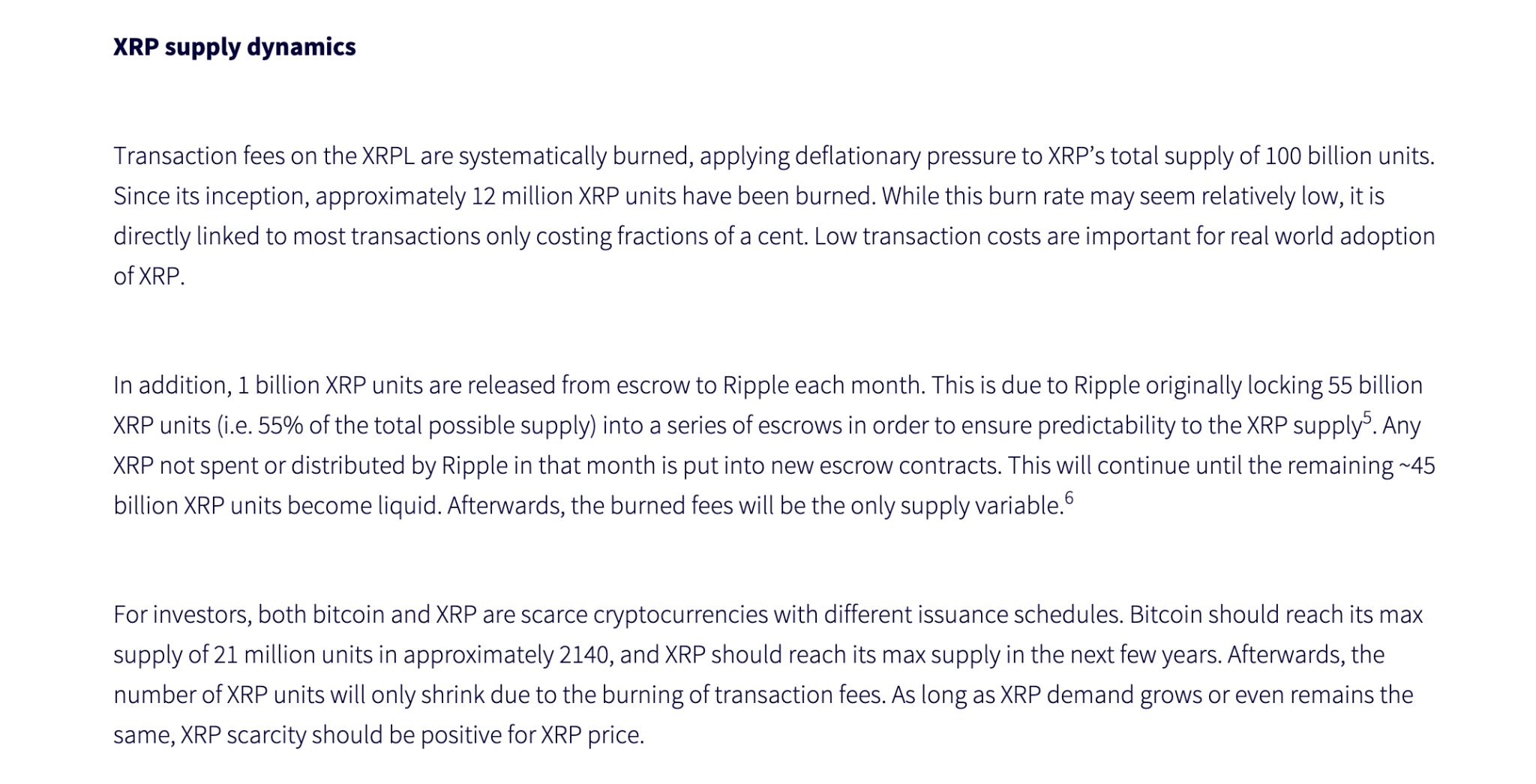
WisdomTree commentary on XRP supply dynamics

Meanwhile, beyond burns, XRP community members warn of a looming supply crunch due to mXRP and FXRP projects from Axelar and Flare. These products plan to lock up to 13% (approximately 8 billion XRP) in DeFi activities.

Moreover, asset managers with longer-term views are also buying XRP as treasury assets. ETFs that invest in XRP are likely to arrive next month.

Based on this, calls for a supply shock have intensified, with many speculating on how it could impact XRP’s long-term price. Some use this theory to call for triple-digit XRP prices.

Diversified Crypto Exposure

WisdomTree’s report concludes that holding Bitcoin and XRP can help investors balance risk and tap into their unique strengths. Bitcoin is a long-term store of value, and XRP is an efficient, low-fee digital payment asset with approaching supply limits.

Here’s the Level Cardano Price Must Hold Before It Can Soar to $1.33

0

A market technician has shared an important level the Cardano price must maintain before a recovery to greater heights.

Notably, Cardano price has slipped into a bearish phase as the broader crypto market struggles, recently dropping below the $0.80 mark. ADA now trades near $0.76 and sits in a zone that could decide whether it climbs toward $1.33 or sinks to lower supports.

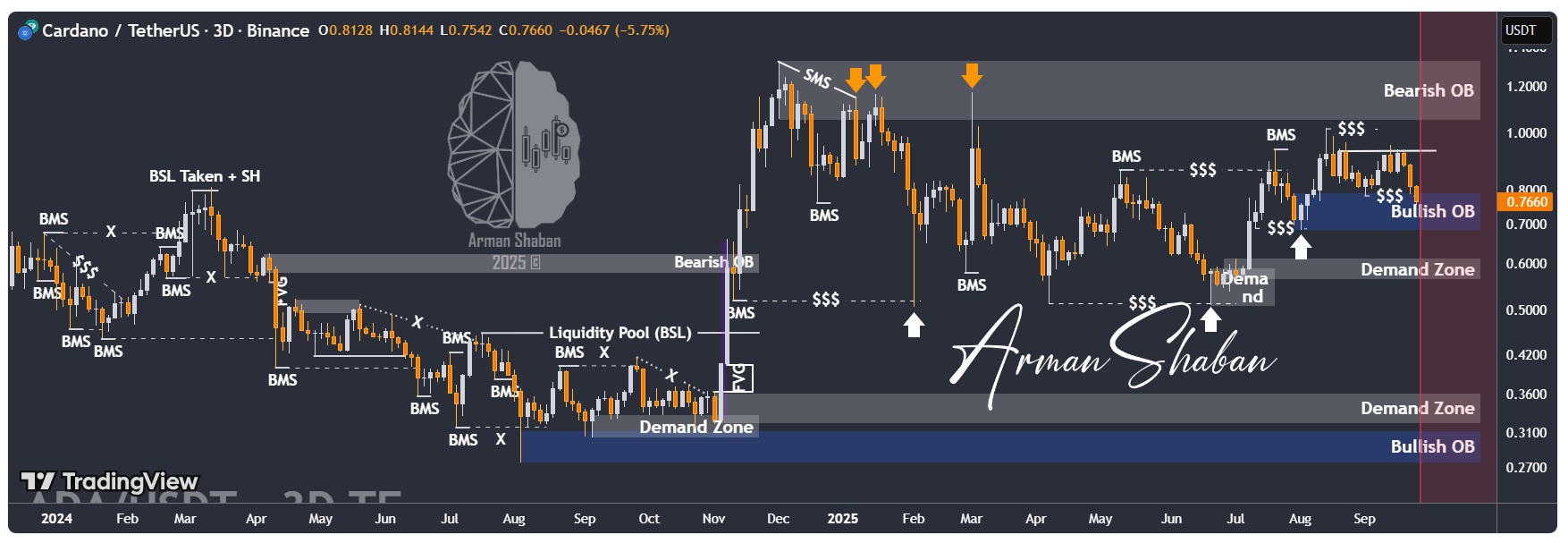
Market analyst Arman Shaban recently discussed the token’s current price position in a TradingView analysis. The market watcher highlighted the $0.68 to $0.78 range as the major area to watch. 

Cardano Price Journey Toward the Demand Zone

For context, this zone features a bullish order block and a demand base, making it the most important level on the chart at press time. ADA’s latest decline has taken it back into this pocket, and the market now waits to see if buyers can step in to hold the line.

Data from Shaban’s 3-day chart shows that in early May, sellers pushed Cardano below $0.7, triggering a liquidity sweep. Interestingly, buyers quickly absorbed the move, and by June, the market formed a major demand zone. This base launched a rally that touched the $0.94 high in July, shifting the market structure to bullish.

However, the rally met resistance at this price, which represented a Break of Market Structure (BMS). The resulting retracement led the Cardano price to retest a bullish order block by August, which buyers defended, confirming the zone as valid support. 

Cardano 3D Chart
Cardano 3D Chart | Arman Shaban

A rebound ensued, carrying the price higher into late August and early September, when ADA hit resistance around $1.00. However, sellers regained control and have now dragged Cardano back into the $0.68–$0.78 demand area, where it currently trades. This also represents the previous bullish order block.

ADA Targets $1.33 in the Mid-Term

Shaban stressed that this zone could make or break Cardano’s outlook. If the level holds, ADA could stage a rebound with near-term targets at $0.85, $0.95, and $1.00. A sustained push through those levels could open the way to mid-term goals at $1.05, $1.17, and $1.33. 

However, if the Cardano price slips under $0.68, the bullish structure collapses, and deeper demand clusters further down the chart could enter the picture.

Notably, other analysts remain bullish on Cardano’s short-term price action. For instance, Ali Martinez previously noted that as long as Cardano stays above $0.80, a rebound toward $0.95 remains possible. However, ADA has relinquished this mark, but market participants await a rebound above it.

Speaking on the recent decline, analyst Man of Bitcoin explained that the Cardano price has dropped below support, and this removed the direct bullish setup. He argued that a break above $0.83 would be the first sign of a bottom, but he emphasized that the market still lacks a confirmed low.

For the long term, Martinez is also bullish, previously pointing to Cardano’s performance in the past cycle. He noted that ADA peaked at the 1.272 Fibonacci extension then, and if history repeats, it could reach between $3 and $6 this cycle.

Cardano Price Chart Ali Martinez
Cardano Price Chart | Ali Martinez

BlackRock XRP ETF: Factors That Could Drive Decision for a Potential ETF Launch

0

BlackRock, the world’s largest asset manager, has outlined key factors that could shape its decision to launch a spot XRP ETF. 

The insights came from Robbie Mitchnick, the firm’s Head of Digital Assets, during an interview with ETF analyst Nate Geraci. In the interview, Geraci referenced his public prediction that BlackRock would file for a spot XRP ETF in the United States, given the success of its spot Bitcoin and Ethereum funds. 

Despite acknowledging that BlackRock would not speak directly on specific coins like XRP, Geraci cleverly shifted the question toward the firm’s plans for future crypto-related ETFs. 

Factors Influencing BlackRock’s Crypto ETF Launches 

Responding, Michnick did not deny or confirm BlackRock’s immediate plans to join the race to launch an ETF focused on XRP. Instead, he outlines the framework that BlackRock uses when evaluating new cryptocurrency products. 

He emphasized that any decision to expand its crypto-related products, including a potential XRP ETF, primarily hinges on client demand. 

This would help the company determine whether its customers want exposure to the particular token through an ETF. It implies that without strong client demand, the company is unlikely to proceed with bringing the product to market. 

According to Mitchnick, other factors also come into play during the evaluation of crypto-related ETF opportunities. These include fundamentals such as market capitalization, maturity, and liquidity of the underlying asset. 

Additionally, BlackRock considers how a potential ETF would fit into broader client strategies before moving forward with the launch of a new product. According to Mitchnick, the evaluation is a continuous process, not a one-time assessment, indicating that BlackRock is open but cautious about further expansion of crypto ETFs. 

Is XRP Next for a BlackRock ETF? 

BlackRock has achieved significant success in the crypto ETF market. Its Bitcoin ETF has drawn $60.25 billion in inflows, and its Ethereum ETF attracted $13.35 billion in inflows. 

Building on the success of these funds, attention has shifted to which token BlackRock might pursue next for an ETF. While the firm has not confirmed any plans for an XRP ETF filing, the asset is increasingly meeting its evaluation criteria. 

XRP continues to rank as the third-largest non-stablecoin cryptocurrency, with a market capitalization of $165.08 billion. The regulatory cloud hanging over it has cleared with the conclusion of the SEC lawsuit.

Moreover, the strong debut of the REX-Osprey XRP ETF, which saw $37.5 million in trading volume on its first day, highlights the growing demand for such a product. 

Currently, investors are awaiting the SEC’s decision on multiple XRP ETF proposals from asset managers such as 21Shares, Franklin Templeton, and Canary, among others.

From next month, the SEC must decide the fate of some of these funds, with speculation suggesting that they could follow the path of Bitcoin and Ethereum ETFs and secure approval. 

KuCoin Appeals $14.5M Fine From Canadian Regulator Over Alleged AML Violations

0

KuCoin crypto exchange has taken legal action against a major penalty imposed by Canadian regulators, arguing that the decision is unfair and excessive.

The case stems from a $19 million CAD ($14 million USD) fine levied by the Financial Transactions and Reports Analysis Centre of Canada (FINTRAC). The regulator claims KuCoin repeatedly ignored mandatory reporting requirements designed to detect and prevent money laundering and terrorist financing.

FINTRAC Findings

According to FINTRAC, KuCoin failed to register as a money-services business in Canada, a basic requirement for platforms facilitating crypto transactions.

The agency said that between 2021 and 2024, the exchange failed to report nearly 3,000 large transactions involving cryptocurrency. Additionally, regulators identified 33 separate instances where KuCoin failed to flag suspicious activity. These lapses included instances that could have been linked to criminal or terrorist networks.

FINTRAC described the company’s violations as “severe”, stressing that reporting obligations are central to Canada’s financial monitoring framework. Officials said that lapses of this scale undermine efforts to safeguard the country’s financial system from abuse.

The penalty against KuCoin represents the largest portion of all fines imposed by FINTRAC over the past year. During that time, the agency issued 23 penalties totaling about $25 million.

KuCoin Pushes Back

In response, KuCoin confirmed it has filed an appeal with the Federal Court of Canada. The company stated that it disagrees with both the findings and the severity of the penalty.

“While KuCoin respects the decision-making process and remains committed to compliance, we do not agree with the conclusion that we operate as a Foreign Money Services Business in Canada,” the firm stated.

KuCoin also described the fine as “excessive and punitive in nature”. It argues that it does not accurately reflect the company’s ongoing efforts to improve transparency and regulatory engagement.

Pattern of Global Scrutiny

This is not the first time KuCoin has faced legal and regulatory challenges. In 2023, the Ontario Securities Commission (OSC) penalized the platform for failing to comply with Canadian securities laws.

Earlier this year, the exchange settled with the U.S. Department of Justice (DOJ). Under the agreement, KuCoin pleaded guilty to operating without proper licensing and agreed to pay nearly $300 million. As a further condition, the company committed to fully withdrawing from the American market.

Expert Says All Eyes on XRP Final Low Before Wave 3 Rally

0

A top market analyst suggests XRP is in the final lap of price retracement before resuming another round of bullish push to unprecedented levels.

Specifically, CasiTrades shared this bias in her recent analytical breakdown of the current XRP price trend. She highlighted in her Thursday X post that the rejection from the $3 resistance has seen the token lose another major Fibonacci support level at $2.79.

For context, XRP experienced a sharp 6% drop on Thursday, falling from a high of $2.94 to close at $2.74. This was its largest single-day drop since August 19, mirroring a broader market decline.

Still No New Lows for XRP

However, CasiTrades emphasized that XRP has yet to make a new low despite its steep correction yesterday. Despite dropping to $2.72, XRP trades above its early September lows of $2.70, showing sheer strength even in the face of adversity.

Nonetheless, the bearish momentum is glaring as the relative strength index (RSI) shows intense selling pressure. The indicator has made lower lows with the price of XRP on the hourly chart, a move that negates CasiTrades’ expectations.

She noted that she anticipated a bullish divergence on the RSI to build the momentum for a price rebound. While this is forming on higher timeframes, lower timeframes still indicate bearish momentum, suggesting that the retracement trend may not be fully exhausted.

One Last XRP Dip? Here Are Levels to Watch

As a result, the experienced analyst believes that XRP may test lower prices in the near term. She noted that altcoins like Ethereum and Dogecoin have already reached their bottom targets, but XRP may require one last dip to exhaust selling pressure fully.

If prices retreat further, she predicts XRP to reach the bottom consolidation trendline at around $2.715. The 1-hour RSI has maintained a clear trendline while also displaying a bullish divergence, suggesting that a probable drop to $2.715 will confirm the exhaustion of selling pressure.

Meanwhile, CasiTrades identified the 0.50 Fibonacci level at $2.79 as a level that could turn the bearish tides around for XRP. She predicted that a daily close above the level would set the tone for a rally to higher prices. According to the analyst, the recent correction is not a weakness but rather a shakeout before a fresh market trend emerges.

Wave 3 Target for XRP

Upon the exhaustion of the consolidatory pressure, the analyst expects the third wave of a bullish price pattern to commence. Her chart shows the first target is to reclaim the 0.382 and 0.236 Fibonacci levels at $2.99 and $3.24, respectively.

XRP Analysis Casi Trades
XRP Analysis | Casi Trades

However, an earlier analysis suggests that XRP could rise even higher. Notably, the Wave 3 is part of a larger 5-wave Elliot Wave structure, which targets new all-time highs of $4.50 and $5.40. This represents a 63% and 95.6% price uptick from the current market price of $2.76.

Trump-Backed World Liberty Financial to Launch Buyback and Burn Program for WLFI Tokens

0

World Liberty Financial (WLFI), a digital asset venture backed by U.S. President Donald Trump and his family, is set to begin implementing its buyback and burn strategy this week.

The initiative, approved through a near-unanimous governance vote, aims to reduce token supply and strengthen long-term holder confidence.

According to the project’s latest governance update, WLFI will immediately start using 100% of its treasury liquidity fees to buy back tokens from the open market. These tokens will then be sent to a burn address for permanent removal from circulation.

The team has also committed to posting every buyback and burn transaction publicly. This transparent reporting aims to reassure the community and demonstrate accountability as the program unfolds.

Near-Unanimous Community Approval

The governance vote, which passed last week, received 99.8% support, with only 0.06% of votes in opposition. The team described the measure as the foundation of WLFI’s tokenomics strategy to favor long-term investors over short-term speculators. 

“This program removes tokens from circulation held by participants not committed to WLFI’s long-term growth and direction,” the governance proposal stated.

Early Struggles Amplify Pressure

The urgency of this initiative stems from WLFI’s troubled launch. The token went live on September 1, but within three days, its value dropped by 40%, even after a one-off burn of 47 million tokens on September 3.

Since then, the decline has continued, with WLFI now trading at $0.1926. This marks a drop of more than 58% from its debut, according to CoinMarketCap.

Questions Over Market Impact

While the buyback and burn plan seeks to reduce circulating supply and create upward price pressure, the proposal lacked details on the scale of revenues available for buybacks.

Without such estimates, it remains unclear how impactful the program will be in the short term. Still, transparent reporting may provide reassurance to long-term holders who are watching the market closely.

Next Steps

Implementation begins this week across Ethereum, BNB Chain, and Solana, where WLFI maintains liquidity positions. Tokens purchased during buybacks will be permanently removed, and detailed reports will be shared after each transaction.

Whether this initiative can slow the decline and stabilize WLFI’s price remains to be seen, but the project is betting on transparency and community trust to chart its path to recovery.

Here’s How High 1 XRP Could Go if RLUSD Taps Into $189T Derivatives Market

0

Some analysts believe XRP could benefit as Ripple’s RLUSD may soon get a chance to break into the $189 trillion derivatives market in the U.S.. 

Notably, this chance could come from the Commodity Futures Trading Commission’s (CFTC) new initiative. For context, recent reports confirmed that the CFTC, under Acting Chair Caroline Pham, has launched an initiative that targets tokenized collateral, including stablecoins, for use in derivatives markets. 

RLUSD Could Benefit from the CFTC’s New Initiative

The plan is part of the commission’s broader “crypto sprint” to improve collateral management, strengthen capital efficiency, and act on the recommendations of the President’s Working Group on Digital Asset Markets. 

The agency said tokenized collateral, especially payment stablecoins from licensed U.S. issuers, could improve derivatives contracts. To determine the next steps, the CFTC is taking public comments until October 20, 2025, before moving ahead with new pilot programs.

If this materializes, stablecoins, including RLUSD, could tap into the massive derivatives market. To put things into perspective, at the end of 2024, the global notional value of derivatives topped $700 trillion. 

Interestingly, the U.S. share accounted for 27%, about $189 trillion, which the CFTC oversees through its regulation of futures, swaps, and options. 

Considering this size, RLUSD could benefit if regulators allow stablecoins into the system. Moreover, with the stablecoin also clearing on the XRP Ledger, higher adoption could lift activity across the network. As a result, some analysts believe such a development could also impact XRP, which acts as the network’s gas token.

XRP Price if RLUSD Taps $189T Derivatives Market 

However, it remains unclear how much this would impact the XRP price. So, to explore that possibility, we asked Google’s AI chatbot Gemini what XRP could look like a year after such an initiative takes hold.

In response, Gemini suggested that the idea was fascinating. It explained that if RLUSD were used as collateral, even in a small slice of the $189 trillion U.S. market, the result could be massive institutional traffic on the XRP Ledger. 

According to Gemini, this kind of adoption would raise settlement activity on RLUSD, which in turn would lift XRP demand since the token covers transaction fees across the network.

Gemini Predicts XRP Price if RLUSD Taps Into US Derivatives Market

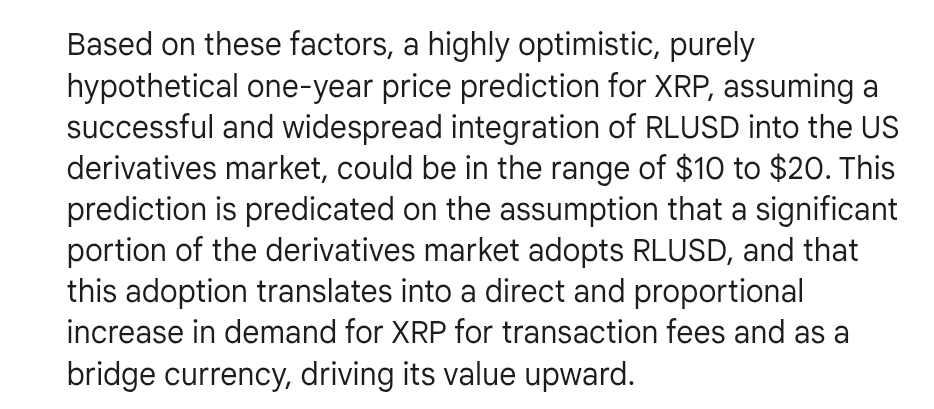
Gemini also pointed out that a CFTC green light would give RLUSD regulatory credibility. This could pull traditional financial institutions into the XRPL, leading to new integrations and expanding use cases. Based on those factors, Gemini suggested that under a bullish outcome, XRP could trade between $10 and $20 within a year of RLUSD entering the U.S. derivatives market.

However, there is no guarantee that the XRP price would react this favorably to the development. As a result, investors should not make investments from these predictions.

Analyst Says Bearish Momentum Builds for Shiba Inu Below Key Resistance

0

Shiba Inu (SHIB) faced another rejection from a critical resistance area, which could pave the way for further bearish price developments.

Shiba Inu is retracing like other cryptocurrencies, as the global market cap drops to $3.75 trillion. The dog-themed meme coin dropped 4% on Thursday, extending its retracement over the past seven days to more than 7%.

Notably, Shiba Inu is on track for another significant weekly decline, having fallen by 6.87% in the previous week. The bearish momentum has seen it give back all its earlier gains in the month, dropping 14.5% from its intra-month high of $0.00001484 to the current price of $0.0000170.

Shiba Inu Rejected from Crucial Resistance

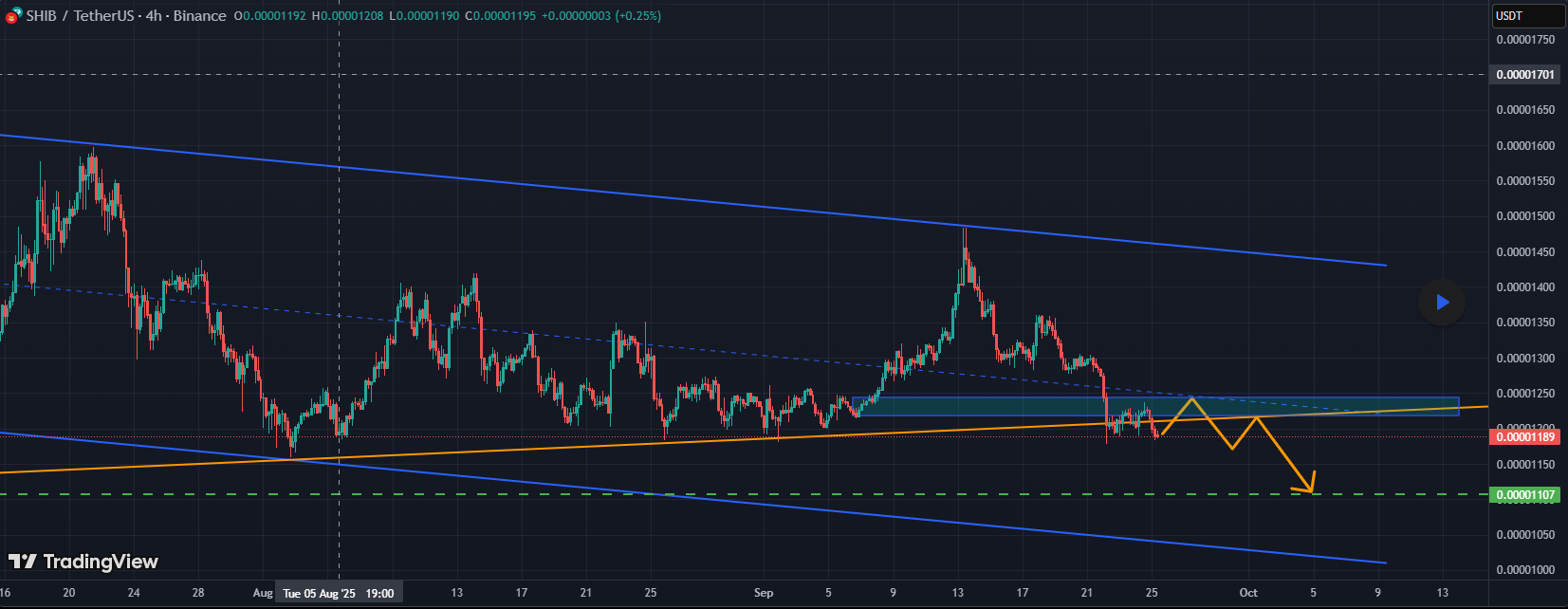
Meanwhile, while Shiba Inu follows a broader market downward trend, a recent TradingView analysis from RTED_Investing identifies a possible catalyst for its price capitulation. His 4-hour timeframe commentary highlights that SHIB faced strong rejection at the $0.00001484 and $0.00001360 resistance areas.

An accompanying chart shows that SHIB consolidated around the $0.00001230 support area in early September before bouncing from there to $0.00001484 on September 13. However, Shiba Inu could not sustain the momentum following a negative ecosystem development.

Shiba Inu Analysis | RTED_Investing

The recent bearish trend also pushed Shiba Inu below the $0.00001361 resistance and back to the $0.00001230 support. Notably, the recent rejection was part of SHIB’s trend in a descending channel, where it is currently on a corrective wave after a rejection from the structure’s top. Shiba Inu attempted to break out on September 13 but failed to overcome the upper trendline resistance.

SHIB Support Levels to Watch

Meanwhile, analyst RTED_Investing shared a Shiba Inu prediction of the support levels to watch amid persisting bearish momentum. According to him, the $0.00001230 support level remains a key focus point, as its rejection would likely encourage a deeper correction.

At the time of writing, Shiba Inu has broken below the support area, trading at $0.0000170. According to the commentary, the subsequent support level to watch is at $0.00001100, which he identified as a potential buying area. From the current market price, this represents a 35% correction.

Importantly, this is not the lower support trendline of the descending channel, suggesting that prices could continue to decline if the broader market momentum remains bearish. A separate analysis from MMBTrader has highlighted a revisit of the support at $0.000010 and $0.00000600 as the worst-case scenario for Shiba Inu.

Nonetheless, the analysis also suggests that Shiba Inu would rebound extensively after this protracted period of price correction. It projected a pump to $0.00007730, representing a 354.7% price growth from here.

Expert Says No to XRP 8–10% Return Offerings — Here’s Why

0

Well-known XRP commentator Digital Asset Investor (DAI) says he is staying out of the current 8–10% yield offerings, choosing security over returns.

In a tweet, he highlighted that while some XRP yield products are advertising 8–10% annual returns, he would rather “trade 3–5% of that yield” for an insurance policy protecting his XRP holdings against loss with a well-established insurance company.

The community pundit stressed that until such insurance is available, he is “sitting on the sidelines keeping my XRP safe for now.”

His caution comes from the lingering scars of past financial schemes that offered attractive returns but ended in disaster.

Choosing Safety Over High XRP Returns

Specifically, Digital Asset Investor cited Charles Ponzi’s infamous 1920 scheme, which promised a 50% return in just 45 days before collapsing in less than a year.

Decades later, Bernie Madoff lured investors with a seemingly steady 10–12% annual return, only for his operation to unravel in a $65 billion fraud.

During the late 1990s dot-com bubble, expectations of 20% or more evaporated when the market burst in 2000.

In 2006, subprime mortgage-backed collateralized debt obligations offered yields of 8–15% on supposedly AAA-rated assets, ultimately contributing to the 2008 financial meltdown.

More recently, crypto lending platforms like Celsius and Anchor promised 12–20% yields before their dramatic collapses wiped out billions. Even private lending schemes offering 15–20% have frequently turned out to be scams.

In other words, these episodes highlight how enticing yields can often mask underlying risks.

Image by Digital Asset Investor

XRP Yield Opportunities Are Expanding

His warning comes as XRP yield products are gaining traction. For instance, Uphold exchange recently revealed it is closer to launching its own XRP yield feature.

Meanwhile, Flare Network’s FAssets protocol has brought XRP into decentralized finance (DeFi). Notably, it enables holders to mint FXRP, a one-to-one representation of XRP, allowing them to earn on-chain yield through trading, lending, and stablecoin minting.

Interestingly, market participants minted the first 5 million XRP cap in just a few hours, showing a strong appetite for DeFi-ready XRP.

Flare’s upcoming Firelight protocol aims to introduce stXRP, a liquid staking version of XRP targeting around 7% annual returns.

At the same time, Axelar unveiled mXRP at Ripple’s Seoul 2025 event, promising approximately 10% APY through liquid staking.

These innovations are transforming XRP from a payments-focused token into a DeFi asset capable of generating passive income.

While DeFi protocols like Flare and new staking options such as mXRP offer exciting opportunities, Digital Asset Investor’s stance highlights the importance of protecting principal while chasing yield.

Insurance options for crypto assets remain limited, and the memory of high-profile collapses, from Ponzi schemes to recent crypto lending failures, makes some investors wary.

Disclosed Security Practices Around New XRP Yields

Notably, Flare says it secures FAssets through four security audits, bug bounties via Immunefi, community audits through Code4rena, and 24/7 monitoring by Hypernative.

In mXRP’s case, Hyperithm manages the deposited XRP, while Midas creates the mXRP product. If there are any losses, Hyperithm and Axelar are responsible.

Meanwhile, Anodos Finance co-founder Panos Mekras believes that adding liquidity to the XRP/mXRP automated market maker pool carries “virtually zero risk” compared to other pools and assets. This is due to price differences and minimal impermanent loss.

However, he emphasized that nothing is entirely risk-free, including mXRP and FXRP, each of which carries its own types of risks.

Mekras reminded investors to “play responsibly,” cautioning against any claims that suggest absolute safety.

Top U.S. Exchange Reveals 5-Year XRP Return on Investment

0

U.S.-based crypto exchange Gemini caught the attention of XRP enthusiasts after showing how a $1,000 investment in the token has skyrocketed over the past five years. 

In a post on X, Gemini compared the five-year returns of several popular cryptocurrencies, including XRP. According to the exchange, a $1,000 investment in XRP five years ago was worth approximately $10,700 as of September 25, representing a tenfold increase.

At the time Gemini posted the estimate on September 25 at 3:00 p.m. (UTC), XRP was at $2.84. Meanwhile, five years ago, in September 2020, the coin traded around $0.265. At that price, an investment of $1,000 in XRP would have procured 3,767 tokens.

The $1,000, which seemed like a modest investment back in September 2020, has now grown to an impressive $10,700. At XRP’s July peak of $3.65, that same investment would have been worth roughly $13,750.

XRP Outperforms LINK and Litecoin

While XRP investors would have enjoyed substantial gains on a $1,000 investment made five years ago, Gemini’s data paints a less impressive picture for Chainlink (LINK).

According to the data, a $1,000 investment in LINK five years ago was worth about $1,940 at the time of the post, indicating a return of less than 2x.

The comparison looks even weaker for Litecoin (LTC), where Gemini’s data showed a $1,000 investment in September 2020 had only grown to about $1,260. However, a review of LTC’s price history on CoinMarketCap suggests otherwise. In September 2020, LTC traded at around $42 and currently trades at $103.

In other words, a $1,000 investment in Litecoin at that time would now be worth over $2,452. Meanwhile, this remains well below the gains seen with XRP, but stronger than Gemini’s initial estimate.

Additionally, XRP outpaced both Ethereum and Bitcoin, which delivered five-year returns of $10,104 and $9,310, respectively. However, it still fell short of Dogecoin’s explosive rally, where a $1,000 investment ballooned to roughly $85,000 over the same period.

Strong Resilience Despite SEC Legal Tussle

The data highlights XRP’s resilience in the face of significant regulatory hurdles. Legal expert Bill Morgan also noted that the five-year period during which a $1,000 XRP investment grew to $10,700 largely coincided with the SEC’s lawsuit against Ripple.

The SEC filed its lawsuit against Ripple in December 2020. The lawsuit dragged on for nearly five years before finally concluding last month.

Despite facing a high-profile from the U.S. SEC, XRP still managed to achieve consistent growth, surpassing Chainlink and Litecoin in returns.

In the meantime, XRP has surged 373% over the past year, currently trading at $2.76, with a year-to-date gain of 32.9%. However, a broader market downturn led to a 7.78% loss over the past month and an 8.84% decline this week.