
Home Blog Page 515

Serious Risk Looms for 1.5M Shiba Inu Holders – Here’s Why

0
Shiba Inu 1.5 million holders face growing risks due to weak leadership, lack of transparent governance, and inconsistent delivery on promises. 

Despite its early successes, including the evolution into an ecosystem with multiple projects and tokens, Shiba Inu now faces significant challenges.

Once projected to break into the top five cryptocurrencies, Shiba Inu is now showing vulnerabilities for its more than 1.5 million investors holding SHIB.

Stagnant Shiba Inu Price and Declining Ecosystem Tokens

Notably, Shiba Inu’s ecosystem tokens, including SHIB, BONE, and LEASH, have underperformed in recent times. In particular, SHIB’s price has largely remained stagnant around the $0.00001 level.

Although it occasionally tracks the broader market’s bearish trends, the token has consistently struggled to join major rallies alongside established assets such as Bitcoin and XRP.  This year alone, Shiba Inu has slumped by 43.7%, with its price currently standing at $0.00001189.

Compounding the problem, ecosystem tokens BONE and LEASH have also experienced significant drawdowns in recent months. While BONE is down 26.97% over the past week to $0.1374, LEASH has plummeted by 22.01% in the same timeframe and currently trades at $7.51.

Lack of Transparent Leadership

Another major red flag with Shiba Inu lies in the team’s continued preference for anonymous leadership. For years, lead developer Shytoshi Kusama and other team members have chosen to remain faceless, possibly to avoid accountability.

After the Shibarium Bridge attack earlier this month, top developer Kaal Dhairya publicly stated that he is not the project’s leader.

Earlier in January, Kusama also revealed plans to step down as the lead visionary of Shiba Inu. While he suggested holding an election to appoint a new leader, no timeline has been announced for this process.

Meanwhile, history shows that even projects with visible leadership have collapsed overnight. Consider FTX and Terra, which once commanded enormous trust but imploded dramatically, causing widespread user losses.

If projects like Terra and FTX, with known leadership, could fail, then Shiba Inu’s future, with its anonymous team, appears even more uncertain.

Low Community Engagement

The Shiba Inu team has decreased its engagement with the community, with Kusama occasionally going silent for weeks. He recently set his account to private, allowing only approved followers to see posts.

Shytoshi Kusama X account in private mode

Even Lucie, the marketing lead who was once active on social media, has scaled back her engagement on X.

This lack of communication leaves the project vulnerable to FUD (Fear, Uncertainty, and Doubt), which malicious actors could exploit to mislead or prey on investors, potentially resulting in financial losses.

No Major Breakthrough After Shibarium Bridge Hack

On September 12, Shiba Inu confirmed that malicious actors had hacked the Shibarium Bridge, stealing assets worth over $4 million. More than two weeks later, the team has yet to recover the stolen funds.

Although the team collaborated with K9 Finance to offer a bounty of 50 ETH to retrieve the stolen funds, the attackers ignored the offer. Instead, they have continued to sell the assets from the loot. Earlier this week, the attackers swapped over 2,000 BAD tokens (obtained through the heist) for 3.2 ETH.

While containment measures remain in place, the Shiba Inu ecosystem team has not provided a timeline for reopening the Shibarium Bridge. With no significant success achieved so far, concerns are mounting over the security of Shibarium, a platform many expected to draw more users into the Shiba Inu ecosystem.

Unfinished Projects and Broken Promises

The Shiba Inu ecosystem is filled with half-finished projects. Some of which include Shib: The Metaverse, NFT marketplace, and privacy-focused Layer-3 blockchain. Each missed milestone erodes investor trust, prompting many SHIB holders to wonder if the project’s roadmap is more hype than substance.

Final Thoughts

For Shiba Inu’s 1.5 million holders, the risks are mounting. Without strong leadership, transparent governance, and consistent delivery on promises, the project risks becoming a cautionary tale instead of a success story.

Unless the team addresses these issues directly, Shiba Inu could follow in the footsteps of other failed projects that once dominated headlines.
Here’s Why a Cardano Rebound to $0.95 Is Still on the Table

0

Cardano can still rally to higher prices, but analysis suggests it would have to hold a key support level for the upward push to materialize.

Prominent market commentator Ali Martinez highlighted this in a recent X analysis, raising optimism among Cardano holders amid the ongoing market capitulation. ADA has continued to fall, mirroring the broader trend, but the top chartist is not ruling out a rebound yet.

With Ethereum losing the $4,000 price mark, Cardano has corrected 3% in the past 24 hours, currently trading at $0.79. Overall, ADA has dropped 12.6% over the last seven days, entirely wiping out its gains this year.

Upward Possibilities Remain for Cardano

However, according to Martinez, Cardano could still target higher prices from here. Specifically, his Cardano price prediction in a September 24 tweet suggests that a rebound to $0.95 stays on the table, but he shared what it must do to initiate the needed momentum.

The analyst highlighted that as long as $0.80 holds for Cardano, it can still rally to $0.95. Notably, the price mark aligns with the lower support trendline in the ADA/USDT chart in the 4-hour timeframe.

Cardano Support/Ali Martinez

The support had previously contained bearish price escalation for Cardano earlier in the month when it fell to $0.78. The token consolidated around the support before rallying to the resistance area at $0.95 on September 13.

Martinez believes a similar event would occur if ADA simply held the support. Meanwhile, the token currently trends at $0.793, slightly lower but still within range. If bulls step in and prevent lower prices, then Cardano could rally nearly 20% from here to retest the resistance at $0.95.

Aligning Cardano Outlook

Meanwhile, Crypto T also shares a similar view on Cardano’s current price action. The analyst highlighted that ADA has now retested the support level at $0.787, which aligns with a descending trendline on the 1-hour chart.

Cardano Analysis/Crypto T

He noted that Cardano needs to hold its current level to rebound. If it stays above the support trendline, the market watcher believes the following resistance targets are $0.814 and $0.824.

Bearish Case for Cardano

Nonetheless, the possibility of Cardano seeing lower prices still exists, according to WiverRiders. The analyst identified a double-top formation on the ADA chart, indicating an extended bearish trend for the token.

The two tops formed at $0.954 and $0.935 on September 13 and 18, respectively. Remarkably, prices have since declined extensively, and the analysis predicts further downside from the current market prices. Specifically, the commentator’s target for the bearish formation is $0.768, which is barely 3% away from this level.

Ohio Approves Bitcoin Payments for State Services

0

The Ohio State Board of Deposit has given final approval for residents to pay state fees and services using cryptocurrency.

On Wednesday, the board unanimously cleared the last hurdle by selecting a vendor to process crypto transactions, including Bitcoin. 

The decision concludes a months-long effort that began in April, when Secretary of State Frank LaRose and State Treasurer Robert Sprague urged the board to consider crypto payment options.

In May, the proposal won unanimous board support, but it required final vendor approval before implementation. That step was completed this week, clearing the path for digital payments.

“This is exactly why Ohio consistently ranks among the best states to do business,” LaRose said in a statement. “We are not afraid to embrace new tools and technologies that encourage investment and growth.”

Rising Demand for Digital Options

LaRose emphasized that his office processes hundreds of thousands of filings each year, from business registrations to campaign finance reports. According to him, many customers have requested an easier way to pay using cryptocurrency.

“I’ve heard the demand firsthand,” LaRose explained. “Ohioans are asking for a crypto option, and I’m proud we’re now the first to provide it.”

The development quickly drew attention from the digital asset community. In a social media post, Coinbase Chief Legal Officer Paul Grewal hailed the move, writing: “Government payments in Ohio today. Everything on-chain tomorrow.”

Ohio Broader Push into Digital Assets

The vendor approval is just one part of Ohio’s growing digital asset agenda. In June, the state House advanced the Ohio Blockchain Basics Act, a measure that prevents local governments from restricting the use of digital assets. The law also exempts crypto transactions under $200 from capital gains tax reporting, easing adoption for small users.

Meanwhile, LaRose has also thrown his support behind House Bill 18, which seeks to create an Ohio Strategic Crypto Reserve. The reserve would be funded by a share of the state’s investment earnings and would hold digital assets as part of Ohio’s broader financial strategy.

National Landscape of Crypto Reserves

Ohio’s activity comes amid a wave of state-level initiatives to integrate Bitcoin into public policy. According to the Bitcoin Laws tracker, 47 states have introduced Strategic Bitcoin Reserve (SBR) proposals. Of those, about 26 remain under active discussion.

Some states have acted more quickly than others. Arizona, Texas, and New Hampshire are among those advancing legislation furthest, while most others are still stuck in committee reviews.

However, in Michigan, momentum has recently shifted. After seven months of inaction, lawmakers advanced House Bill 4087 to the Government Operations Committee this week, reviving the state’s push for a Bitcoin reserve.

Whales Scoop Up $270M in ASTER as CEO Unveils Bold Roadmap

0

Whales are stepping up their accumulation of ASTER as CEO Leonard unveils an ambitious development roadmap.

According to blockchain analytics from Lookonchain, two large investors recently acquired 118.25 million tokens, valued at $270.8 million. Together, these purchases account for 7.13% of the token’s circulating supply.

Among them, a single entity controlling around 15 wallets withdrew 68.25 million tokens, valued at $156.3 million, from Aster DEX only four days ago.

Meanwhile, another wallet tied to software pioneer Daniel Larimer and investment firm Galaxy Digital pulled 50 million ASTER from Gateio over the past two days.

Such heavy accumulation suggests growing conviction among major holders, even as the broader crypto market remains bearish.

Image by Lookonchain

CEO Leonard Outlines Next Growth Phase

This surge in whale activity comes as CEO Leonard Aster unveiled bold new plans for the project. Speaking to the community, he confirmed that the team is preparing to roll out its own Layer-1 blockchain, called Aster Chain. 

Currently in internal testing, Aster Chain is a privacy-first network with advanced features. It promises sub-second finality, low transaction fees, and built-in perpetual contracts. 

More importantly, it introduces a mechanism for verifiable trading without exposing user positions, an attempt to reconcile privacy with accountability in decentralized finance.

The timing of these whale purchases aligns with Leonard’s announcement, suggesting that large investors may be anticipating major utility gains once Aster Chain goes live.

Binance Listing Under Negotiation

Moreover, Leonard revealed that the project is also in active talks with Binance, the world’s largest cryptocurrency exchange, about a potential listing. While no date has been confirmed, he acknowledged that the listing is part of their broader strategy. 

“Binance listing is in our plan,” Leonard said, “but negotiations are still ongoing, and we cannot share exact timing.”

For the CEO, the ultimate ambition is not simply to exchange access but influence. His goal is for Aster to become as integral to DeFi as Binance has been to centralized trading.

Community Buyback Program in the Works

Beyond the blockchain rollout and CEX listing discussions, Leonard also addressed community concerns about value retention. During an AMA, he confirmed that the team is preparing a token buyback program.

While final details are still under review, Leonard called buybacks the most direct way to reward long-term holders.

He referenced rival exchange Hyperliquid, which has been aggressively repurchasing its HYPE tokens, as an example of how such programs can build trust and strengthen token value. An official announcement on Aster’s buybacks is expected in the coming weeks.

ASTER Price and Market Performance

In light of these developments, the ASTER token recently hit a new all-time high of $2.4 before stabilizing at $2.01.

This surge looks even more dramatic when set against ASTER’s short history. Since launching at $0.02 earlier this month, the token has soared over 10,000%. It now commands a $3.5 billion market cap, ranking as the 36th largest cryptocurrency globally.

Influential Figures Shape Narrative

ASTER and its rapid rise have also drawn attention owing to links to influential figures. As reported by The Crypto Basic, Changpeng Zhao (CZ), the ex-CEO of Binance, has shown support for the project. His reputation in the industry has been cited as a factor that boosted visibility and confidence among some investors.

Charles Hoskinson Says Cardano Is Sound Money

0

Cardano founder Charles Hoskinson is extremely bullish on Cardano and its unique properties, recently insisting that it is a sound form of money.

Hoskinson was quick to correct Gabrel Abed, the chairman of Binance and ReserveOne, on his recent Bitcoin comments. Abed noted in a Wednesday tweet that Bitcoin is a decentralized sound money, but the Cardano founder felt he had omitted a crucial cryptocurrency from that unique category.

Cardano Is Sound Money

Reacting to the tweet, Hoskinson suggested that Cardano can also pride itself in being in the “sound money” category with Bitcoin. He noted today that the prominent cryptocurrency, alongside Bitcoin, is also a decentralized and reliable form of money.

For the uninitiated, sound money is a term used to describe a currency whose value does not deteriorate with time. Specifically, it is money that is inflation and debasement-proof, maintaining its purchasing power and reliability over a long period of time.

Notably, sound money is an ideal store of value, and only a few currencies achieve this status. Over the years, many have placed gold in that category, with Bitcoin slowly gaining a reputation as one too. Industry leaders also regard the premier crypto asset as the most decentralized cryptocurrency in existence.

However, Hoskinson believes Cardano should be in the same class as Bitcoin. He claimed that “Bitcoin and Cardano are decentralized, sound money.”

Interestingly, reactions further built a case for his bold statement. A user suggested that BTC is not the only sound money and highlighted why Cardano also fits into the group. He claimed Cardano is a “decentralized backbone of the financial payment system,” which runs millions of transactions per second without downtime. He added that Cardano also has a self-replenishing treasury and decentralized on-chain governance.

 Charles Hoskinson Gigabullish on Cardano

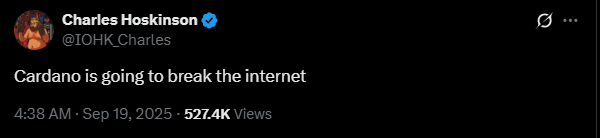
Meanwhile, this is not the first time that Hoskinson has argued that Cardano should rank among the best in the industry. A few days back, he claimed that Cardano is going to break the internet, indicating his bullish disposition towards the trajectory of the ADA ecosystem.

Screenshot 2025 09 25 073246
Hoskinson’s Cardano Tweet

The founder also stated in June that Cardano is the biggest threat to Bitcoin’s dominance. He noted that Cardano has consistently demonstrated qualities of decentralization and sound money while also addressing some of Bitcoin’s limitations.

Hoskinson claimed that Cardano has solved the Nakamoto consensus, placing it on par with Bitcoin as regards transaction validity. He also mentioned that Cardano has a better network model than Bitcoin, citing the Extended UTXO, which improves on the crypto leader’s UTXO.

According to him, these innovations would ensure that Cardano outpaces rivals in the long term, and Bitcoin is not left out. This also builds on his claims that Cardano is better than Ethereum, which he believes is doomed to fail.

SEC Approves Hashdex Nasdaq Crypto ETF to Hold XRP

0

The U.S. SEC has approved the Hashdex Nasdaq Crypto US ETF to hold XRP alongside Bitcoin and Ethereum. 

Nate Geraci, the president of NovaDius Wealth Management, drew attention to the development in a post on X today. His remarks came shortly after the SEC approved the Hashdex Nasdaq Crypto Index US ETF to support more assets beyond Bitcoin and Ethereum.

For context, the SEC approved the Hashdex fund for launch last year, enabling exposure to Bitcoin and Ethereum. In March, Hashdex requested an amendment to include XRP and other assets in the ETF. However, the filing did not receive immediate approval.

Accordingly, the issuer filed the amendment under the SEC’s new generic listing standards, a framework designed to expedite spot ETF approvals. It also requested a waiver of the five-business-day prior notice period under Rule 19b-4(f)(6)(iii), enabling the amendment to take effect immediately.

XRP Now Features in Hashdex Nasdaq Crypto ETF

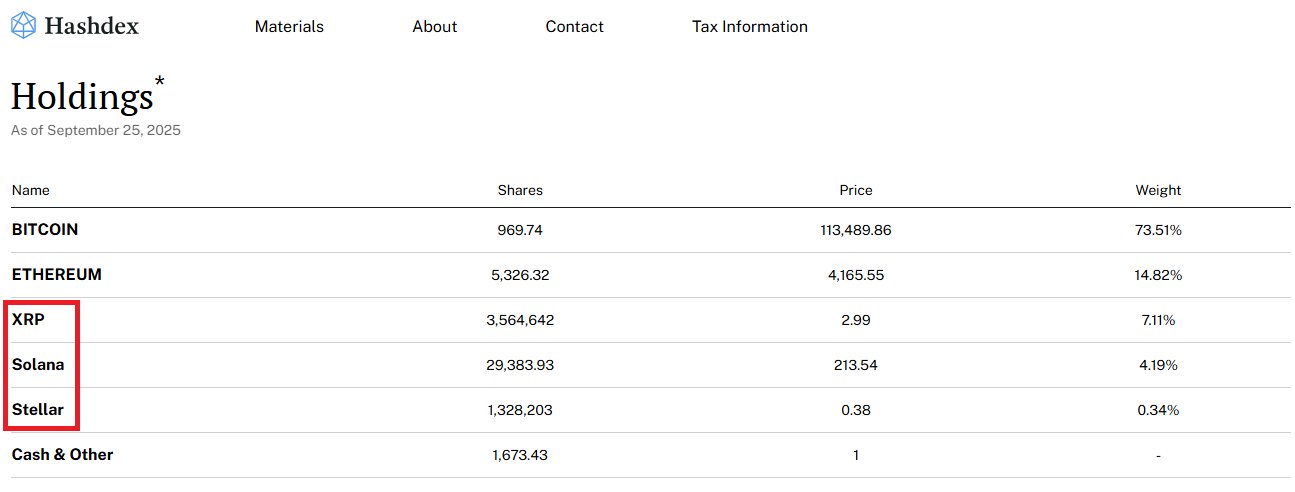
Following the filing, Geraci stated that the ETF has received approval to hold cryptocurrencies beyond Bitcoin and Ethereum. In other words, the ETF would now hold other assets such as XRP, Solana (SOL), and Stellar (XLM).

As of today, XRP stands as the third-largest asset in the Hashdex Nasdaq Crypto Index Fund behind Ethereum and Bitcoin. It represents 7.11% of the fund’s portfolio, with over 3.5 million XRP-related shares already listed in the fund. However, SOL and XLM make up 4.19% and 0.34% of the fund as of September 25.

Image

More XRP ETFs

Interestingly, XRP has been gaining traction in the capital markets recently. Previously overshadowed by uncertainty from the SEC’s lawsuit against Ripple, the token has since secured multiple ETF approvals.

While XRP already has several futures-based ETFs, it recently secured spot ETF approval with the launch of the REX-Osprey XRP ETF (XRPR) earlier this month. The fund surprised investors by recording $37.5 million in volume on its first day of trading.

After XRPR’s impressive performance, XRP enthusiasts anticipate strong demand for upcoming XRP-focused spot ETFs. Franklin, 21Shares, and Canary are among prospective issuers awaiting SEC approval to launch spot XRP ETFs in the U.S.

Sources with direct knowledge claim the XRP ETF applications have advanced in the review process. As a result, they expect prospective issuers to submit their final amendments this week.

Currently, the SEC faces a deadline next month to approve or deny XRP ETF proposals from Bitwise, Grayscale, and other issuers.

Given the SEC’s pro-crypto approach, there is high optimism that the regulator could approve the funds next month. Now, market participants look forward to seeing the SEC approve all proposed XRP ETFs on the same day as it did for Bitcoin and Ethereum ETFs.

Flare Hits 5,000,000 XRP in Just 4 Hours: Details

0

The long-anticipated FAssets project from Flare has officially gone live, and its debut within the XRP ecosystem has exceeded expectations.

For context, the Flare team announced the launch of FAssets yesterday, making it the second yield-bearing project for XRP holders to debut this week. However, following the launch, the network introduced a weekly cap to control supply in the early days.

FAssets Hits Weekly Cap of 5M XRP in 4 Hours

Interestingly, the XRP community quickly pushed it to the ceiling. Specifically, amid a surge in demand, the project reached the weekly minting cap of 5 million XRP only four hours after launch.

Flare co-founder Hugo Philion confirmed the milestone in a post on X and explained that the caps are important because they ensure the project witnesses a responsible rollout. Philion promised that the team will implement higher caps the following week. 

Moreover, he also urged users not to chase FXRP on Flare-based decentralized exchanges at inflated prices, warning that supply-and-demand imbalances could briefly distort trading values. 

Responding to inquiries, the Flare co-founder added that while the community has driven the first wave, institutions will only step in once the FXRP supply grows past $100 million.

Impressive Figures from the FXRP Dashboard

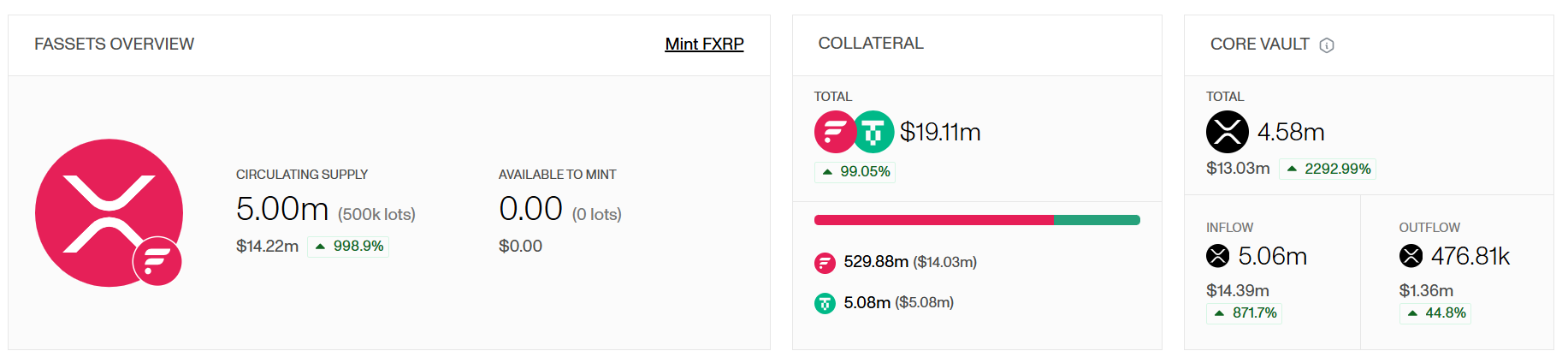
Figures from the FAssets dashboard reveal just how quickly the project took off. Specifically, FXRP circulation has reached 5 million tokens, split into 500,000 lots, with a combined value of $14.22 million. All minting slots are already filled, leaving none available for week one. 

FAssets Dashboard Shows Impressive XRP Figures

Meanwhile, reward pools amount to $6,940, and total value locked stands at $14.03 million as of press time. Collateral has reached $19.11 million, made up of $14.03 million in Flare and $5.08 million in USDT. The Core Vault sees 5.06 million XRP flow in over 24 hours, while outflows have totaled 476,810 XRP within the same period.

Speaking on the recent development, the Flare team called the quick minting a community-driven milestone and confirmed that the next big step would be institutional adoption.

The FAssets Debut

For the uninitiated, Flare noted in its announcement that it introduced FAssets as a way to turn non-smart contract tokens like XRP into DeFi-ready assets. FXRP, the first of these, mirrors XRP one-to-one and runs on an overcollateralized system of independent agents secured by Flare’s native data protocols. 

This setup gives XRP access to the full spectrum of DeFi activity on Flare, including trading, lending, stablecoin creation, and liquid staking. Flare called this effort the beginning of an “XRP DeFi awakening.”

The team put a strong focus on security from the outset. Flare ran at least four separate audits with firms such as Zellic and Coinspect, supported ongoing bug bounty programs with Immunefi, and invited community reviews on Code4rena. 

Within the announcement, Flare also revealed how users can get FXRP. Notably, the most direct route involves minting: first moving XRP from the XRP Ledger into a self-custody wallet such as Ledger or Bifrost, then minting through AU or Oracle Daemon. 

For users unable to mint directly, FXRP is available on decentralized exchanges in the Flare ecosystem, including SparkDEX, BlazeSwap, and Enosys. Wallet providers such as Luminite and Oxen Flow also plan to add swap functions to simplify access.

The launch came with incentives as well. Specifically, Flare directed rewards in the form of rFLR to DeFi pools that bring significant value locked or boost on-chain activity. The team described these incentives as only the start, with plans to expand integrations for FXRP and stXRP, a liquid-staked version of XRP created by Firelight, in the coming weeks.

Algopear Co-founder Says XRP Price Will Shock Millions

0

HighVibeAssets, the pseudonymous co-founder of Algopear, predicts that XRP price will “shock millions” as Ripple’s NDAs expire amid widespread skepticism.

Notably, this statement comes as Bitcoin advocates warn that altcoins like XRP continue to underperform against BTC and are “not worth it.” 

In response, HighVibeAssets remarked that the naysayers could end up having only themselves to blame.

“XRP Price Is Going to Shock Millions”

HighVibeAssets asserted that XRP’s price is poised for a dramatic surge that will catch many by surprise. He claimed that Ripple’s non-disclosure agreements (NDAs) are expiring and associated contracts are being released almost daily.

According to him, investors have had ample time to accumulate XRP at lower prices, but institutional interest may soon drive the price beyond the reach of retail investors.

The XRP community believes Ripple’s partnerships with banks and payment providers have long been shrouded in confidentiality. 

NDAs expiring “by the day,” as HighVibeAssets claims, suggest that more institutional announcements could soon hit the market to create new demand for XRP liquidity.

Meanwhile, the coin is already seeing massive institutional interest and new partnership announcements. Still, recent price performance has not reflected much of the positive news, at least not to the satisfaction of XRP holders.

Bitcoin Skeptics See a Different Picture

However, many do not share the widespread belief of the XRP Army. In an episode of the Mr M Podcast, Cory Klippsten, CEO of Swan Bitcoin, presented a strong counterpoint. He argued that almost every altcoin, including XRP, loses value over time when measured in Bitcoin terms.

According to Klippsten, throughout crypto history, only XRP and Dogecoin have ever set a new all-time high against Bitcoin after their initial peaks. Yet, both have since fallen far below those highs.

He added that altcoins tend to follow pump-and-dump cycles rather than serve as long-term stores of value.

Notably, XRP is currently trading around $2.87, up 388% since last year, far outpacing Bitcoin’s 78% yearly rise.

XRP/BTC chart

However, Klippsten’s analysis highlights that while XRP’s fiat gains may appear impressive, its performance relative to Bitcoin has historically lagged.

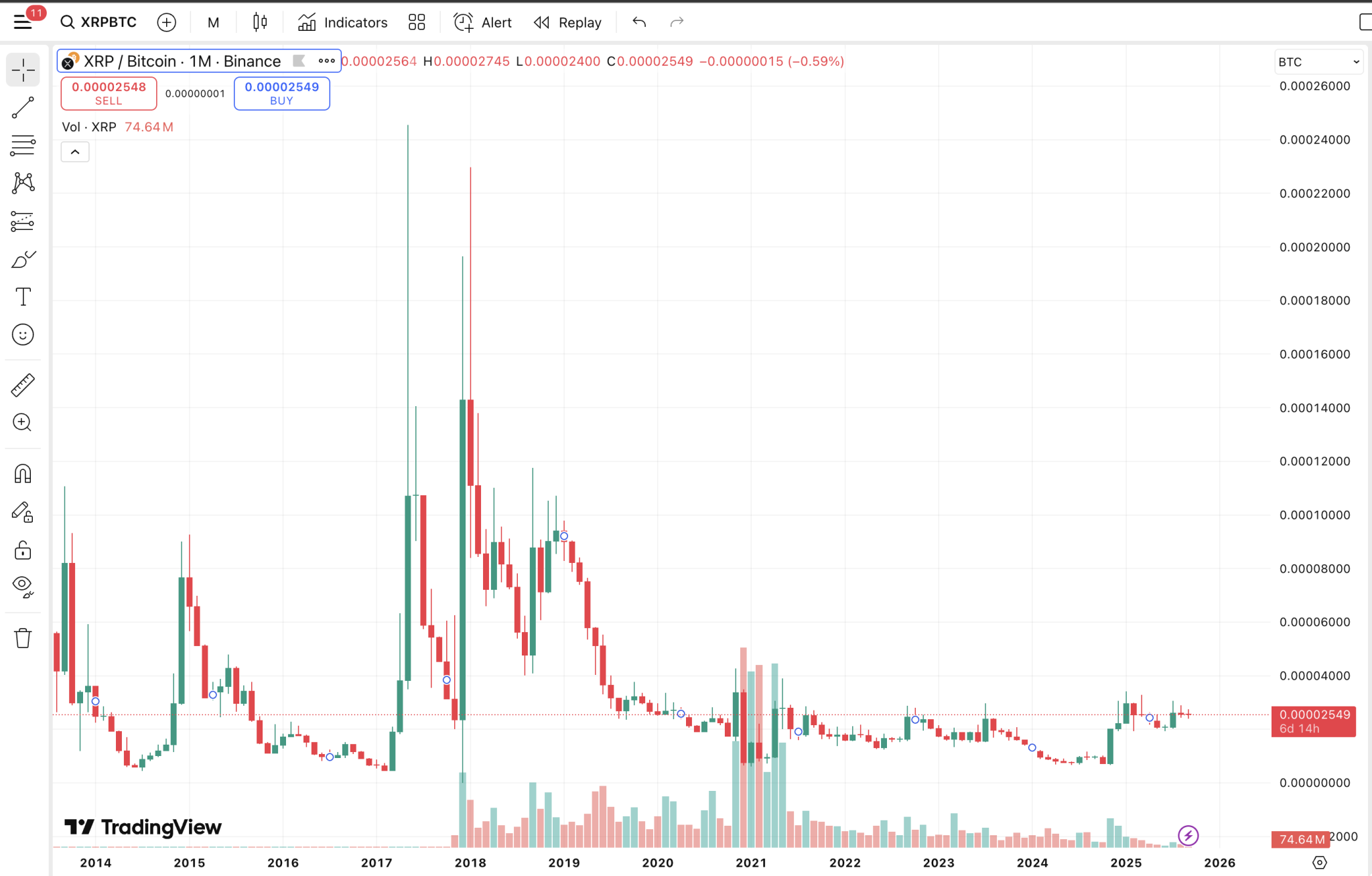
Indeed, this perspective holds when examining the XRP/BTC chart. XRP/BTC’s all-time performance shows a massive loss of 54.38%, according to TradingView data.

The pair currently trades at 0.00002551 BTC, compared to its all-time high of 0.00024607 BTC set back in 2017. 

This massive underperformance is further reflected in the fact that Bitcoin has set several new peak levels since its 2021 high.

XRP failed to set a new all-time high during the 2021 bull run, with many attributing this to the ongoing SEC lawsuit. As a result, the coin still trades below its 2018 all-time high, something that may have significantly impacted the XRP/BTC ratio.

The XRP/BTC chart
The XRP/BTC chart

Can XRP/BTC Ever Reclaim Its Historic Peak?

Still, many analysts are projecting that XRP/BTC could revisit its peak during this cycle, as sentiment around XRP has improved.

For instance, widely followed Bitcoin analyst Dr. Cat has projected that XRP could reach $19 to $32 during this bull cycle, assuming Bitcoin surges to $270,000. His forecast is based on the hope that XRP/BTC could rise to 7,000–12,000 satoshis, a range last seen during the 2017–2018 peak.

The current XRP/BTC value is 2,675 satoshis, with the chart approaching key resistance. Dr. Cat suggests a breakout could occur by 2026, aligning with Bitcoin’s potential doubling.

Tom Lee Forecasts $250K Bitcoin and $12K Ethereum by Year-End

0

Fundstrat co-founder and BitMine Chairman Tom Lee has doubled down on bullish targets for the two largest cryptocurrencies: Bitcoin and Ethereum.

Speaking at Korea Blockchain Week 2025, Lee predicted Bitcoin could climb to between $200,000 and $250,000 by the end of this year.

For Ethereum, he projected prices between $10,000 and $12,000. He noted that the rally could extend to $15,000 as the market enters what he described as “real price discovery.”

Lee argued that both assets are on the cusp of a new growth phase, with Ethereum in particular set to enter a “super cycle” lasting 10 to 15 years.

Why Lee Is Bullish on Bitcoin

Lee pointed to historical patterns showing that Bitcoin often performs well in the fourth quarter. He added that the Federal Reserve’s recent pivot from a hawkish stance to a more dovish position is creating a supportive environment for risk assets.

On Ethereum, Lee argued that its appeal lies in its neutrality and scalability for future applications. He described it as the blockchain most trusted by both Wall Street and policymakers in Washington.

Lee tied Ethereum’s importance to the rise of artificial intelligence and robotics, predicting that a future token-driven economy for machines will likely be built on Ethereum. He also pointed to recent remarks by President Trump about the need for “proof-of-human” systems. According to him, such developments will further solidify Ethereum’s role.

BitMine’s Treasury Bet on Ethereum

Lee’s optimism is also reflected in BitMine’s business model. Earlier this year, the company transformed itself into an Ethereum-focused treasury firm. Since then, its market capitalization has jumped from $37.6 million in June to nearly $9.5 billion in September.

Today, BitMine Immersion Technologies holds 2.41 million ETH worth over $10 billion, securing its position as the largest Ethereum treasury globally. This also makes it the second-largest overall crypto treasury, behind Strategy.

According to Lee, both firms have effectively become large-cap crypto stocks. Their size and liquidity could soon lead to inclusion in major equity indices, a move that would bring steady passive investment flows and help sustain their valuations.

Diverging Views From Critics

Despite Lee’s bullish stance, not all industry voices share his enthusiasm. In a post on X, Andrew Kang, co-founder of Mechanism Capital, offered a sharp critique of Lee’s Ethereum thesis.

Kang argued that the adoption of stablecoins and real-world assets has not led to an increase in Ethereum’s network fees. He noted that much of the new activity in decentralized finance is moving to Solana and Arbitrum, both of which offer faster and cheaper transactions.

He also dismissed the comparison of Ethereum to “digital oil,” saying the analogy overstates ETH’s role. According to Kang, institutional buyers are not rushing into Ethereum, and technical signals suggest the token may remain range-bound rather than entering a super cycle.

Countdown to Launch Begins as Final Amendments on XRP Spot ETF Filings Expected This Week

0

Prospective issuers of spot crypto ETFs, including those tied to XRP and Solana, are to submit final amendments to their applications in the coming days. 

Nate Geraci, the President of NovaDius Wealth Management, shared the notice in an X post today, citing a Reuters report. 

According to the report, three sources stated that prospective issuers may submit final amendments to the XRP and Solana ETF applications by the end of this week. 

XRP ETF Review Process Advancing Rapidly 

Since the SEC approved spot ETFs for Bitcoin and Ethereum last year, several issuers have applied to launch similar products focused on other cryptocurrencies, including XRP and Solana. 

Canary, Bitwise, Grayscale, and Franklin are among the issuers seeking to roll out XRP and Solana ETFs. In a recent statement, Bitwise President Teddy Fusaro stated that the filings are well advanced in the review process. 

Notably, these issuers have been amending their filings since July, following the SEC’s introduction of its new listing standards. 

Last month, at least seven asset managers, including Grayscale and Bitwise, amended their XRP ETF applications. The updates aim to improve product flexibility by permitting creation and redemption in XRP, cash, or in-kind. 

At the time, Geraci and other crypto stakeholders claimed the issuers were responding to specific requests from the SEC.

Similarly, issuers seeking to launch spot Solana ETFs in the U.S. also amended their applications last month. As the review process advances, sources claim that the final wave of amendments could happen this week. 

Countdown to Launch is On 

Interestingly, Geraci noted that the countdown to the launch of XRP and Solana ETFs has begun, suggesting their rollout could be imminent. 

In the meantime, speculation suggests that the SEC could approve the products for launch early next month. The timeframe coincides with the SEC’s final decision deadline for several spot XRP and Solana ETFs. 

Specifically, the SEC has a final deadline of October 10 to decide on Grayscale’s request to convert its Solana Trust to a spot ETF. 

The SEC is also expected to decide on multiple Solana ETF filings later in October, as well as several XRP ETF applications during the same period.

While each filing carries its own deadline, the agency could issue rulings on all the products simultaneously, similar to its approach with the Bitcoin and Ethereum ETFs.