

Home Blog Page 520

Strive and Semler Scientific Announce Bitcoin Treasury Merger, Combined Holdings Surpass 10,900 BTC

0

Strive, a Bitcoin treasury firm, has agreed to acquire fellow BTC treasury firm Semler Scientific in an all-stock transaction at a 210% premium.

For each Semler share, investors will receive 21.05 shares of Strive Class A stock worth approximately $90.52 per share. Both companies’ boards have approved the deal, which remains subject to standard closing conditions.

Major Bitcoin Acquisition

Alongside the merger announcement, Strive revealed the purchase of 5,816 Bitcoin for its corporate treasury with a total investment of $675 million. This raised Strive’s own holdings to 5,886 BTC.

Following the merger, the combined company will hold more than 10,900 Bitcoin, positioning it as one of the fastest-growing publicly traded corporate Bitcoin holders.

Bitcoin Treasury and Preventive Diagnostics

Notably, Strive announced plans to operate under a “preferred equity only” leverage model to avoid debt maturity risks commonly associated with leveraged Bitcoin strategies. 

Management also highlighted plans to expand Bitcoin per share over time in an effort to outperform Bitcoin itself.

Simultaneously, the merged entity will evaluate opportunities to monetize or distribute Semler Scientific’s profitable diagnostics business.

Notably, Semler’s healthcare division specializes in the early detection of chronic diseases and markets its FDA-cleared QuantaFlo test, which measures arterial blood flow.

Executive Commentary

Strive’s management and board will remain in place, while Semler Scientific Chairman Eric Semler will join the combined board.

Notably, Strive CEO Matt Cole described the merger as a strategic move between two leading Bitcoin treasury firms to build a larger, more innovative platform for acquiring BTC.

Meanwhile, Eric Semler said the merger delivers strong value to shareholders through a substantial premium and exposure to an innovative Bitcoin strategy.

He added that the deal will also help expand Semler’s medical business into a broader preventative care and wellness platform focused on the early detection of chronic diseases. This two-part strategy seeks to enhance financial performance and long-term growth.

With more than 10,900 BTC on its balance sheet and plans to grow Bitcoin per share, the merged company will rank among the top 12 publicly traded firms with the largest BTC holdings.

Bitcoin Leads as Crypto Investment Products Attract $1.9B

0

Crypto investment funds pulled in $1.9 billion last week, showing investors are regaining confidence after the Federal Reserve’s recent rate cut. 

The move, which market observers regard as a cautious “hawkish” cut, caused some hesitation at first. However, by Thursday and Friday, investors added $746 million as markets adjusted and turned back toward digital assets, according to CoinShares’ latest report.

Bitcoin Leads Flows by Asset

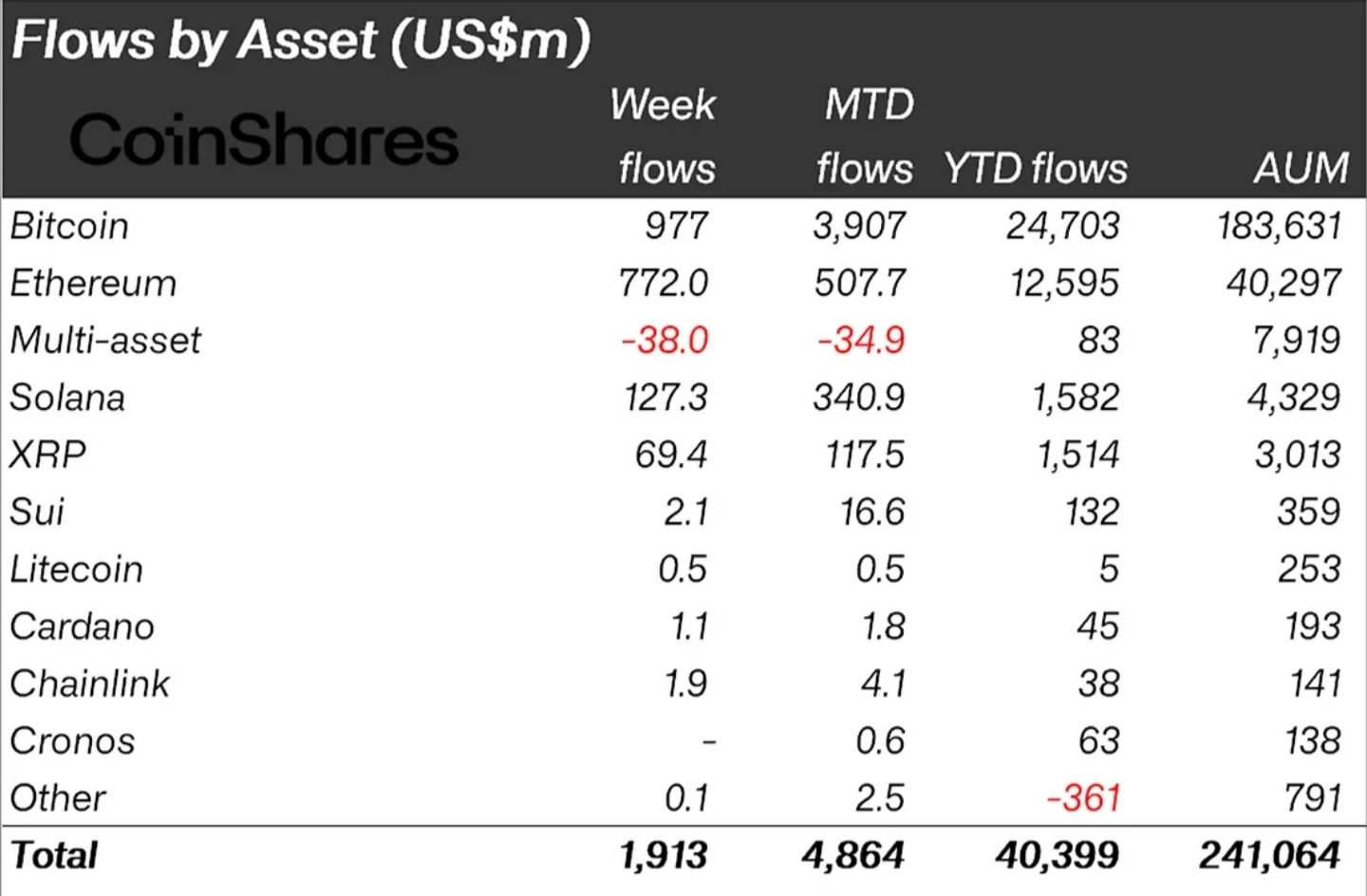
Expectedly, Bitcoin captured the largest share of inflows. Investors poured $977 million into Bitcoin funds during the week, lifting its monthly total to $3.9 billion and year-to-date flows to $24.7 billion. Its assets under management (AuM) climbed to $183.6 billion. 

Ethereum followed closely. Notably, the altcoin king gained $772 million in new inflows last week and now holds $507.7 million for the month. Investors have committed $12.6 billion to Ethereum this year, pushing its AuM to a record $40.3 billion.

Bitcoin Leads Flows by Assets CoinShares
Bitcoin Leads Flows by Asset | CoinShares

Interestingly, Solana and XRP also saw strong demand. Solana drew $127.3 million for the week, $340.9 million for the month, and $1.6 billion since January. Its AuM now stands at $4.3 billion. Meanwhile, XRP attracted $69.4 million in weekly inflows and $117.5 million in September, with $1.5 billion so far this year. Its total AuM reached $3 billion.

Also, other assets saw smaller but steady inflows. Sui picked up $2.1 million with an AuM of $359 million. Chainlink added $1.9 million and now manages $141 million. Cardano gained $1.1 million, bringing its AuM to $193 million, while Litecoin pulled in $0.5 million with $253 million in AuM.

However, multi-asset funds moved the other way, recording $38 million in outflows, though they still hold $7.9 billion overall. This confirms growing investor appetite for single-asset products instead.

Flows by Providers and Regions

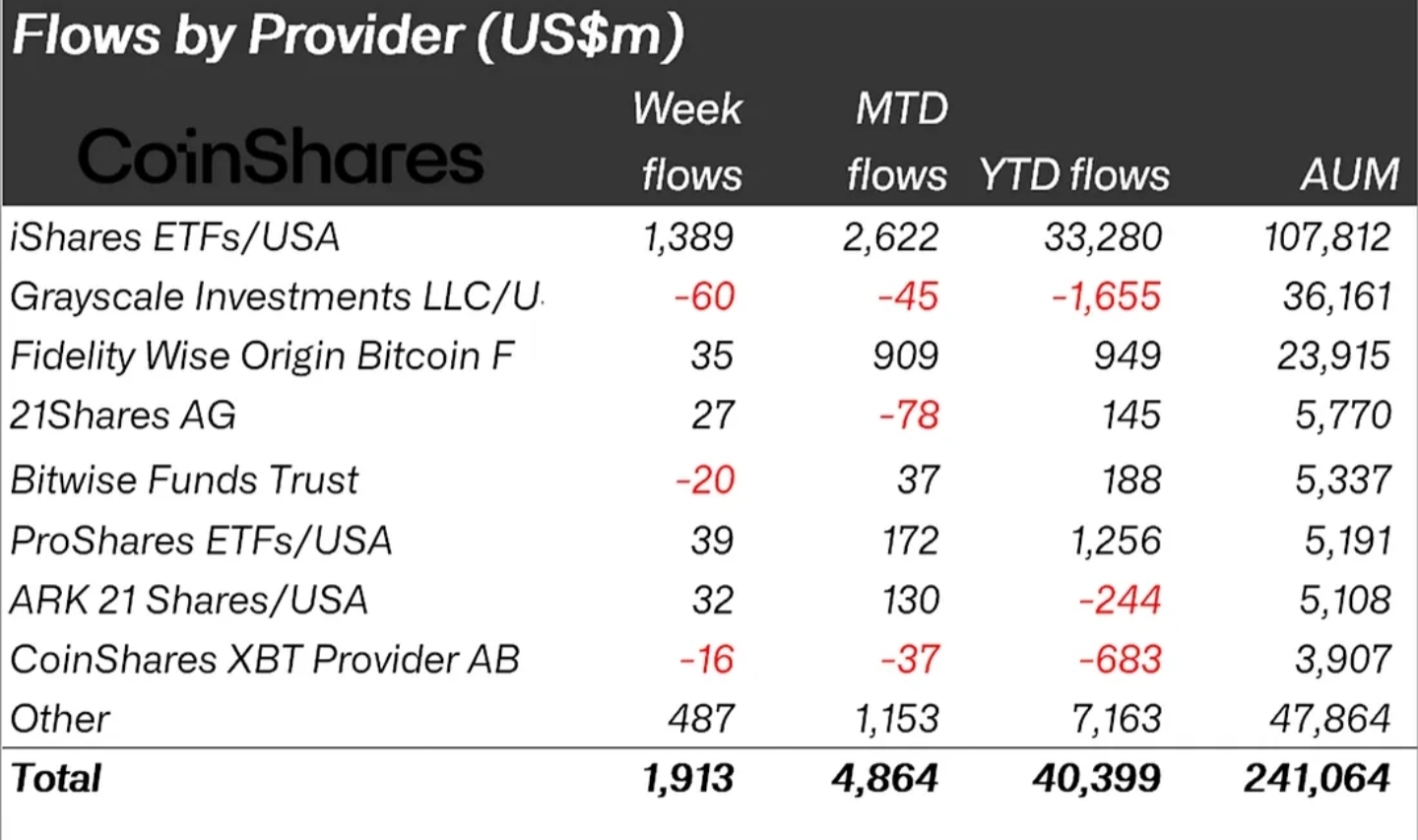
Among fund providers, iShares ETFs in the U.S. took the lead, collecting $1.39 billion last week. Their monthly inflows hit $2.6 billion, and year-to-date they have gathered $33.3 billion. iShares now oversees $107.8 billion in crypto assets. 

Flows by Provider CoinShares

Fidelity’s Wise Origin Bitcoin Fund added $35 million last week, bringing its September total to $909 million and year-to-date flows to $949 million. On the other hand, Grayscale saw investors pull $60 million from its products last week. Its monthly outflows reached $45 million, and year-to-date redemptions totaled $1.65 billion, though it still holds $36.2 billion in assets.

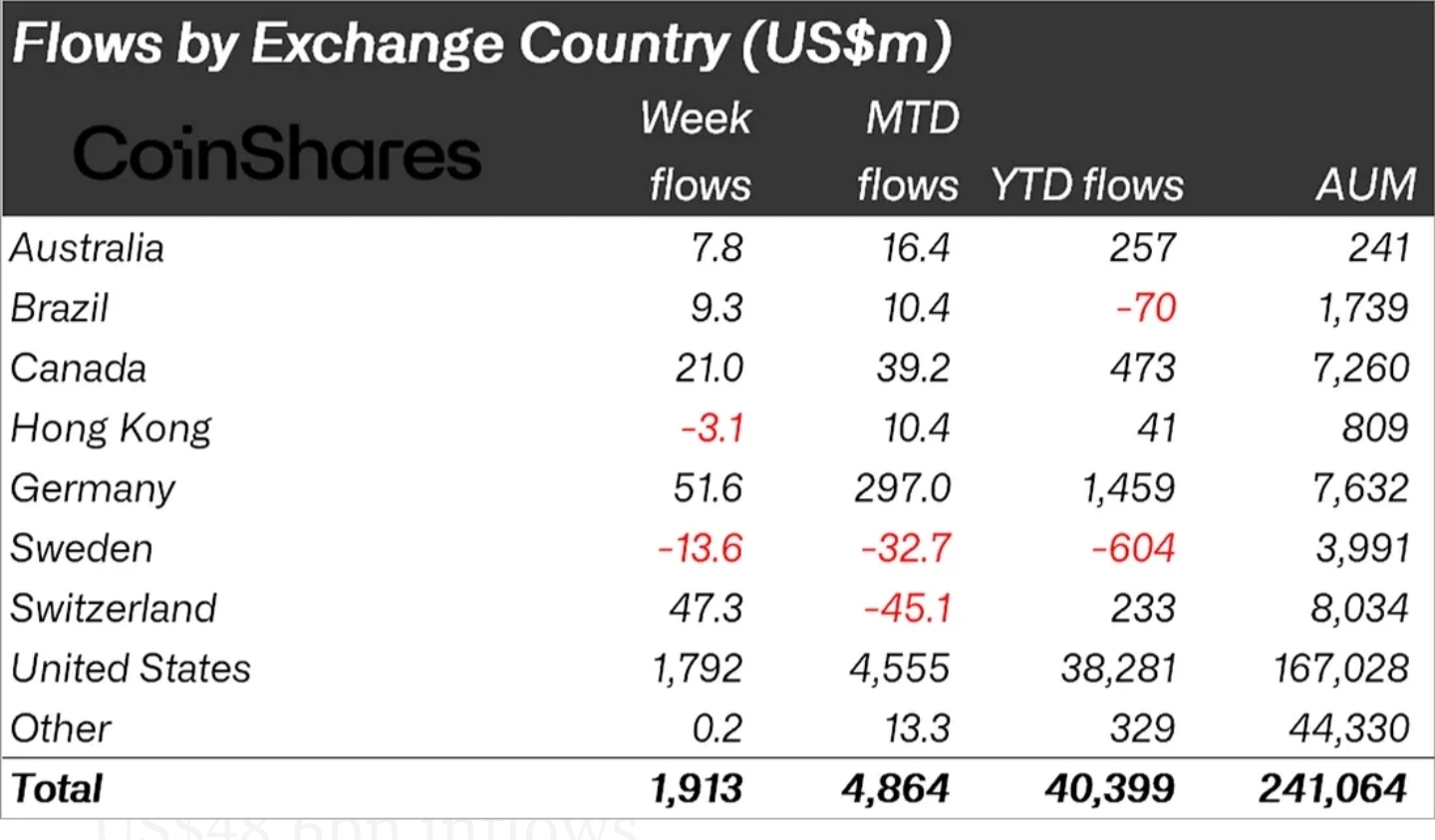
Regarding regions, the United States dominated, attracting $1.79 billion in inflows. Its monthly total reached $4.6 billion, with $38.3 billion added this year. Remarkably, the U.S. now manages $167 billion in crypto assets. 

Flows by Region CoinShares
Flows by Region | CoinShares

Germany followed with $51.6 million in weekly inflows and $297 million for the month, bringing its year-to-date flows to $1.46 billion and its AuM to $7.6 billion. Switzerland added $47.3 million for the week, but monthly outflows of $45.1 million cut into its totals. Canada gained $21 million last week.

Overall, total YTD flows across digital asset funds rose to $40.4 billion, the highest level this year. With momentum building in Bitcoin, Ethereum, Solana, and XRP, the market looks set to match or even surpass last year’s $48.6 billion in inflows. Specifically, Solana and XRP are expecting new ETF products in the coming weeks.

Bitcoin Will Coexist with Gold in Central Banks’ Balance Sheets by 2030: Deutsche Bank Report

0

Prominent multinational investment bank Deutsche Bank has predicted that central banks will adopt Bitcoin as a reserve asset alongside gold within the next five years.

Its recent research, spotlighted by Matthew Sigel, the head of digital asset research at VanEck, asserts that Bitcoin would coexist with gold in the purses of central banks globally. Deutsche Bank emphasized that this could happen as early as 2030.

The report highlighted that Bitcoin is more of a complementary asset to gold, rather than a rival, as some have suggested. The bank noted that both are “safe-haven” alternatives to traditional assets and would continue to gradually eat into the portfolios of central banks.

Why Central Banks Will Hold Bitcoin

Notably, Deutsche Bank identified why Bitcoin is likely to continue attracting nation-states, one of which includes its scarce property. Currently boasting a market cap of $2.2 trillion, BTC’s 19.92 million circulating supply means that approximately 95% of its total 21 million cap is already in circulation.

Bitcoin vs Gold Deutsche Bank Report
Bitcoin vs Gold | Deutsche Bank Report

The remaining 5% supply will unlock in the next 115 years, a mechanism that would drive drought for Bitcoin. The report noted that this scarce quality, along with its reputation as a hedge against inflation, would draw national-level demand for Bitcoin.

Remarkably, this sentiment is gaining momentum as industry leaders have repeatedly echoed its reality. For instance, Coinbase CEO Brian Armstrong believes central banks will hold more Bitcoin in their reserves soon but noted that this would be at the expense of their gold stash.

History Is Repeating with Bitcoin: Deutsche Bank

Furthermore, the report shared that Bitcoin looks like early gold, and this time will not be different. Specifically, gold experienced its fair share of turbulence and skepticism in its early days, but has since moved past that phase to become an asset worth over $20 trillion.

Deutsche Bank highlighted that Bitcoin is following this trend and expects Bitcoin to continue seeing a higher adoption rate. It believes that macroeconomic tailwinds and clearer regulatory policies will spur a broader adoption of Bitcoin as a store of value.

Accompanying this global awakening will be a drop in Bitcoin volatility. The report emphasized that Bitcoin would become less volatile over time as liquidity matures, mirroring the trajectory of gold. 

Additionally, Deutsche Bank mentioned that Bitcoin would transition from a speculative asset to a legitimate component of the global financial system with the US-led adoption push.

“So long as we are human, Bitcoin and other alternative assets will likely continue to compete for our attention,” the report concluded.

Meanwhile, another key highlight of the research is the assertion that Bitcoin and gold will not replace the US dollar as reserve assets. While they, along with other alternative currencies, have shredded the dollar’s dominance, the investment bank claims they will not completely displace it.

Where Could Bitcoin Be By 2030?

With the report suggesting that Bitcoin will enter more central bank balance sheets by 2030, prominent market participants have also predicted the asset’s price for that year. Aside from Pantera Capital founder Dan Morehead’s $750,000 projection, most other outlooks have a threshold of at least $1 million per coin.

Robert Kiyosaki says $1 million; the Winklevoss twins agree with this projection, while Ark Invest predicts even higher prices. The Cathie Wood-led asset manager predicted that $1.5 million is the base case and Bitcoin will reach $2.4 million in a bull case.

XRP Holders in Europe and Asia Can Now Earn Up to 8% Yield on Idle XRP

0

Popular tokenization platform Midas and Interop Labs have jointly launched a new product to allow XRP holders to earn up to 8% annual percentage yield (APY). 

Pro-crypto journalist Eleanor Terrett reported today that Midas, in partnership with Interop Labs, has launched a new liquid staking token called mXRP on the XRP Ledger (XRPL). 

The product, which was officially unveiled at the XRPL Seoul 2025 conference, is powered by Axelar’s XRPL EVM integration. With this integration, users can participate in the new DeFi opportunity without needing to transfer their tokens off the XRPL. 

Notably, the initiative enables users to deposit XRP and mint mXRP on Axelar, while allowing them to earn annual yields of 6–8%. According to Terrett, this yield will be generated through a combination of off-chain and on-chain investment strategies, such as liquidity provision and market making. 

Notably, professional asset managers will help to manage the investments. The team behind the product is marketing it as the first-ever DeFi product on the XRP Ledger. 

Supported Regions 

In the meantime, access to mXRP is limited to customers in Asia and Europe. The announcement did not specify when the product will be available for customers in other jurisdictions, including the United States. 

Commenting on the launch, Axelar’s co-founder, Georgios Vlachos, noted that connecting the XRP Ledger to decentralized finance would unlock new use cases, including tokenization and trading integrations.

Midas co-founder and CEO Dennis Dinkelmeyer also echoed a similar sentiment. According to him, the newly introduced liquid staking token would unlock new use cases for XRP through strong community demand and DeFi integration. 

He emphasized that mXRP could tap into the vast dormant supply of XRP by allowing holders to mint mXRP and use it in DeFi activities like liquidity provision and market making, while generating 6–8% annual returns. 

XRP Holders to Access More DeFi Opportunities 

The launch comes amid growing efforts to bring DeFi opportunities to XRP holders. As reported earlier, Cardano founder Charles Hoskinson revealed plans to grant XRP holders access to the world of DeFi. 

He disclosed plans to position Midnight as the official DeFi layer of the XRP ecosystem, enabling XRP holders to pursue higher yields through lending, staking, and liquidity provision. 

Aster Price Prediction: Here’s How Aster Breakout Patterns Signal Potential Upside Momentum

0

A notable analyst, Zoe, recently highlighted that the Aster price had broken out of a key structure, indicating the potential for further upside. 

Notably, the analyst suggests that the breakout has set the stage for potential continuation, though confirmation will depend on how the current setup develops in the coming sessions. This commentary comes as Bitcoin and the broader market face persistent struggles.

For context, the Aster token launched on September 17 as the native asset of the Aster ecosystem. It is a multi-utility token designed for governance, staking, and incentivizing community participation. ASTER also serves as the medium for transaction fees and reward distribution. Notably, the latest analysis confirms that it seems to be recovering from a recent downtrend spell.

Descending Trendline Breakout Signals Recovery

Specifically, in a recent analysis, Zoe highlighted Aster price breaking out of a descending trendline that had capped its upside since it dropped from the $1.9 peak in the morning of September 21.

Her 15-minute chart shows the breakout emerging near $1.45, with initial resistance at $1.55 now in focus. Meanwhile, the next key level is marked at $1.69, which represents a mid-range barrier within the structure. 

Aster 15m Chart Zoe
Aster 15m Chart Zoe

Notably, the analyst identifies $1.92 as the breakout target, forming the upper resistance zone in her setup. This represents yesterday’s local top. Furthermore, support rests between $1.34 and $1.44, making this range critical in holding the breakout intact while the price builds toward her projected target. 

Importantly, she does not specify any timeline for when this target could be achieved, leaving the projection tied solely to price action.

Breakout From Falling Channel Adds Momentum

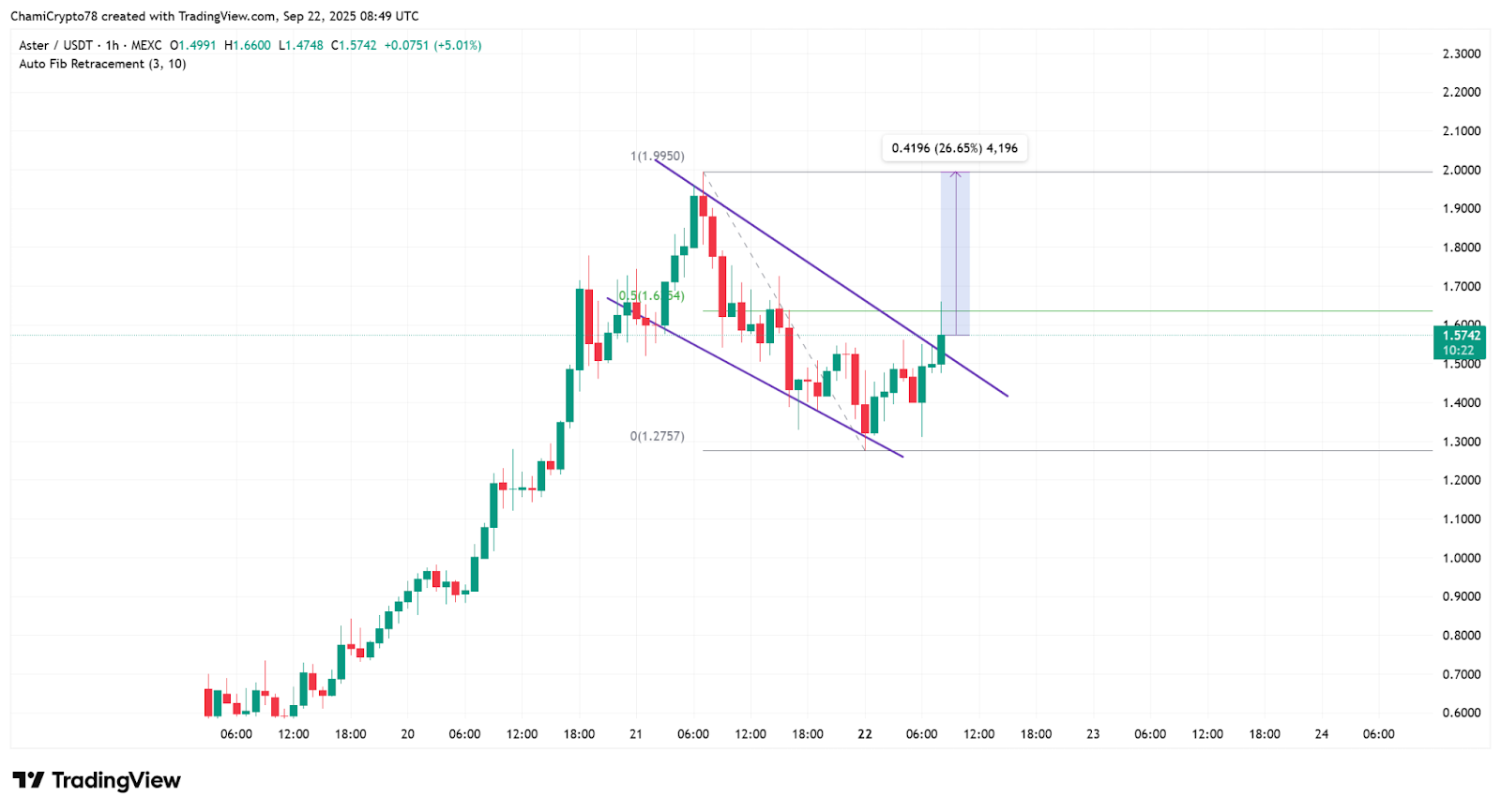
Meanwhile, another expert, Smith, highlighted Aster trading within a falling channel on the 1-hour chart, consistently printing lower highs and lower lows. His analysis projected that a breakout from this channel could trigger a 50% rally, setting a target near the $2 level. 

Interestingly, the latest chart data now confirms this breakout, with Aster having already completed a significant portion of the projected move. Importantly, only about 26% remains for the price to achieve Smith’s target, with resistance checkpoints at $1.69 and $1.80 before $2. 

Aster 1h Chart
Aster 1h Chart

Currently, Aster holds a market cap of about $2.71 billion at a price of $1.63, based on its circulating supply of 1.65 billion tokens. If the asset approaches the $2 level projected in the breakout structures, its market cap would expand to roughly $3.3 billion. Interestingly, this would add more than half a billion dollars in value from relatively modest price movement. 

Here’s What 1 XRP May Be Worth by 2030, 2035, 2040, and 2050

0

What could XRP price surge to by 2030, 2035, 2040, and even 2050 if the bullish developments from this year price in?

Notably, XRP continues to wrestle with price resistance, trading near $3 at press time. At this position, some market participants express concerns that XRP has struggled to break past the $3 psychological mark despite first reaching it in January. 

XRP Still in a Bullish Position?

However, others see strength in the fact that XRP has managed to hold this level amid the ongoing market turbulence. For context, XRP has gained close to 40%year-to-date, beating Bitcoin’s 22.83% rise and Ethereum’s 29.29% increase. 

Expectedly, this resilience has bolstered optimism. Moreover, confidence has grown further as the Ripple vs. SEC battle comes to an end, expectations of XRP ETFs grow ahead of October, and institutions show rising interest through corporate treasury holdings. 

With these bullish developments, the question now is where XRP could go next if they are all priced in. To answer this, we asked two AI chatbots, Google Gemini and ChatGPT, for their long-term views on XRP. 

ChatGPT and Google Gemini Predict XRP Price

In its response, Google Gemini stressed that no model could predict crypto prices with certainty. However, it presented a possible trajectory if adoption and regulation continue to work in XRP’s favor. 

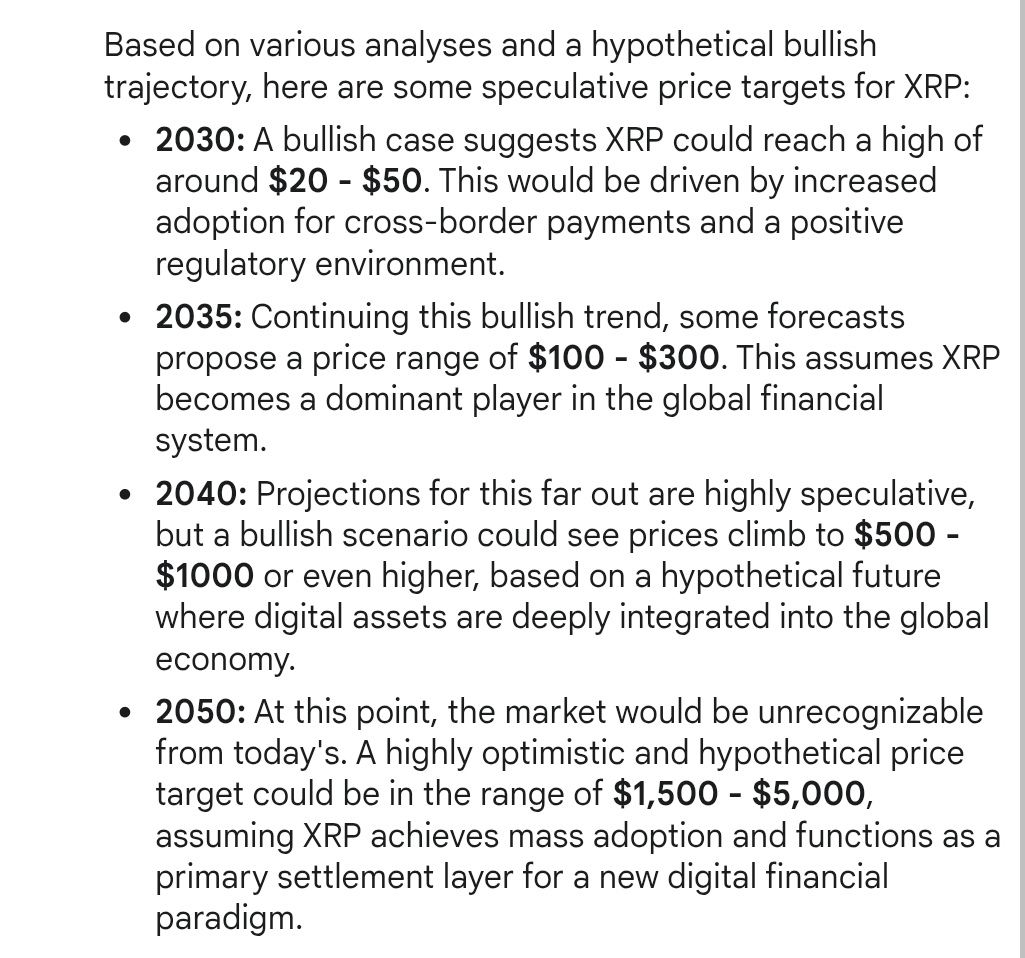
First, Gemini suggested XRP could trade between $20 and $50 by 2030, driven by cross-border payment adoption. Meanwhile, by 2035, it projected a price between $100 and $300 if XRP establishes itself in global finance. 

XRP Price Predictions Google Gemini

For 2040, the chatbot set a range of $500 to $1,000 should crypto assets fully integrate into the global economy. Finally, Gemini forecasted an optimistic 2050 where XRP could soar to between $1,500 and $5,000 if it becomes a core settlement layer in digital finance.

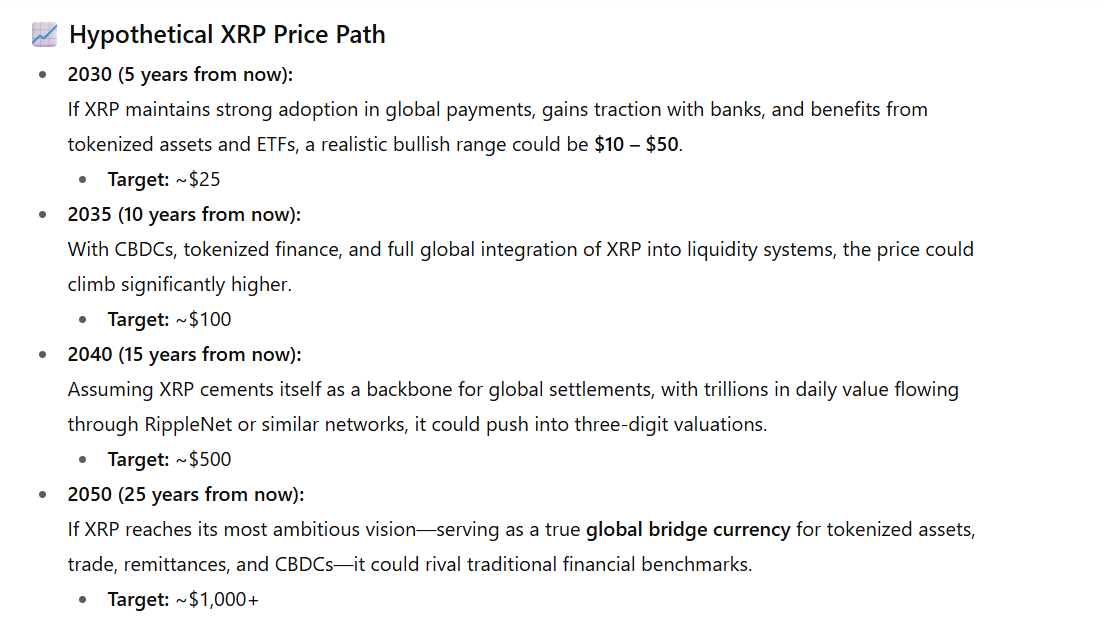
Interestingly, ChatGPT also highlighted extremely bullish targets. According to the chatbot, XRP could rise to about $25 by 2030 if banks, ETFs, and tokenized assets boost adoption. Meanwhile, by 2035, it placed the price around $100 as CBDCs and global liquidity systems embrace XRP. 

XRP Price Predictions ChatGPT

For 2040, ChatGPT suggested a jump to $500 if the token powers trillions in cross-border settlements. By 2050, the LLM model believes XRP could cross $1,000 if it matures into a true bridge currency for tokenized assets, remittances, trade, and CBDCs.

Price Predictions from Changelly

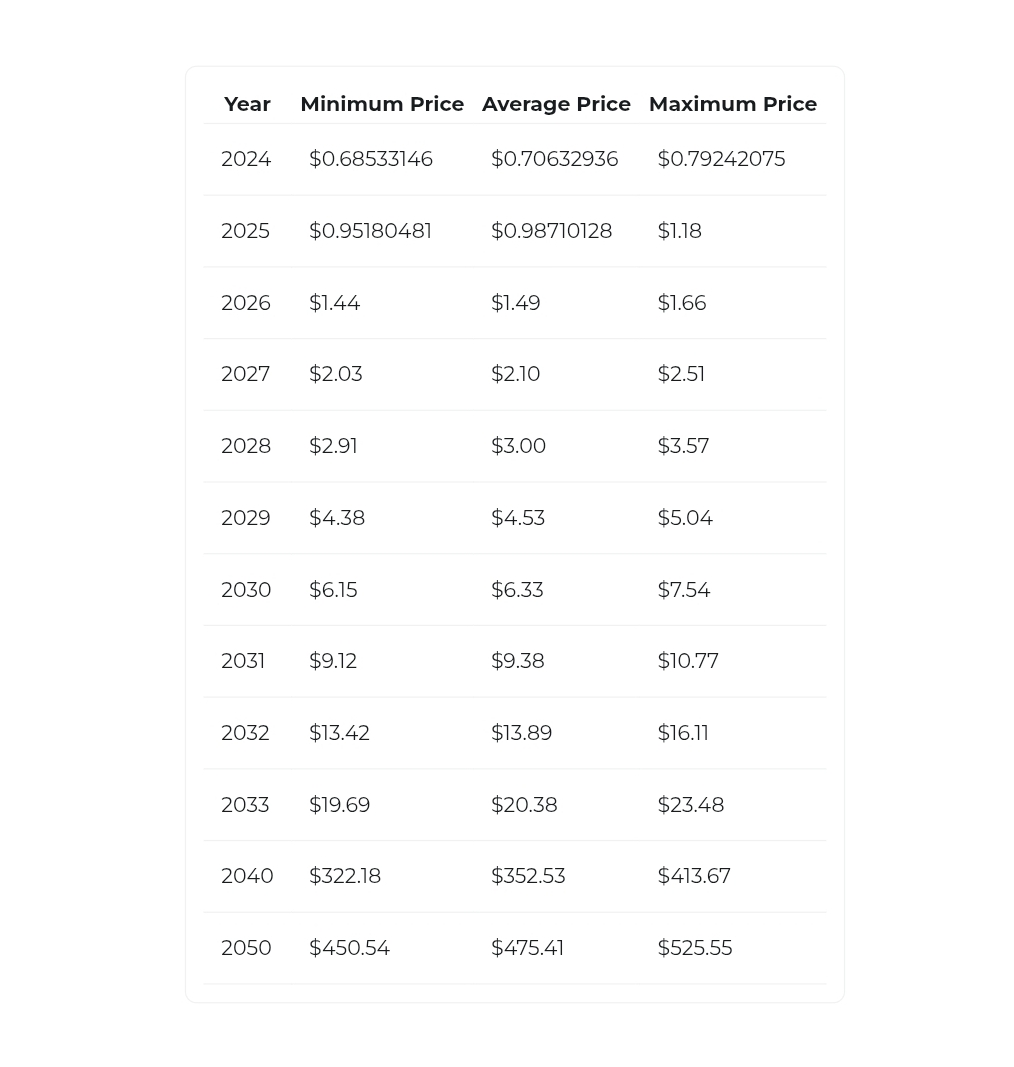
Meanwhile, analysts at Changelly presented more conservative numbers. Specifically, they forecast a maximum of $7.54 by 2030. For 2040, they expect an average of $352, with a possible peak at $413. Their 2050 outlook was even more restrained, with a minimum price of $450, an average of $475, and a maximum of $525.

XRP Price Predictions Changelly
XRP Price Predictions | Changelly

However, it is important to note that these predictions are merely hypothetical and do not represent financial advice. Notably, while XRP still has the potential to surpass some of these levels, there is no guarantee it will even reach the most conservative targets.

Shiba Inu Hack Update: Bridge Down and Recovery Unclear

0

The team behind the Shiba Inu ecosystem has released a detailed update following the recent hack of the Shibarium Bridge. 

As previously reported, hackers gained unauthorized access to the Shibarium Bridge validator and drained multiple cryptocurrency assets, including SHIB and ETH, totaling over $4 million. 

The team swiftly moved to suspend the bridge to protect the remaining funds. Now, top developer Kaal Dhairya provides the community with a detailed update on the incident and the measures to contain it. 

What Really Happened 

In a personal foreword, Dhairya expressed frustration with the incident. Explaining what really happened, he noted that the incident occurred on September 12, at 18:44 (UTC). Around that time, malicious actors compromised validators’ keys to push a malicious state through Shibarium’s Bridge. 

Using stake amplification and manipulated checkpoint proofs, they withdrew multiple assets, such as SHIB, ETH, and ROAR. He confirmed that the attackers have already sold some of these assets, but refused to share details about the transactions for security reasons. 

Containment Measures 

Following the attack, Dhairya said the team has implemented several measures to contain the breach and prevent a possible recurrence. Notably, the ecosystem team has restricted the bridge operations to block further unauthorized withdrawals. 

It also implemented contract-side protections to secure deposits, withdrawals, and staking paths. Additionally, the team has also secured portions of BONE tokens at risk and immobilized the attackers’ short-term stake. 

Other containment measures include shifting to multi-party hardware custody while also rotating validators’ signers. It has also engaged independent researchers, law enforcement, and response firms to assist with ongoing investigations. 

In the meantime, a 24/7 monitoring system has been deployed to monitor the attackers’ on-chain flows. 

Roadmap Forward 

Dhairya outlined a four-phase roadmap to strengthen security and guide the project’s recovery from the recent hack. 

The first phase, dubbed containment, which is currently ongoing, involves maintaining bridge restrictions and live monitoring. The second phase (Hardening) has commenced. In this phase, Shiba Inu, alongside cybersecurity firm Hexens, will implement stronger custody and other infrastructure upgrades. 

The third phase is called Safe Restoration. Here, the team plans to reopen Shibarium Bridge after a full independent review, as well as successful integrity checks and tests. 

Lastly, the Postmortem and community process involves publishing a full report and proposing remediation strategies for affected users. 

No Date for Bridge Reopening and Asset Recovery

With the bridge still paused, Dhairya emphasized that the team’s priority is containment and implementation of hardening measures to prevent any further losses. 

However, Dhairya did not specify any timeline for the bridge’s reopening, assuring the community that the team will share updates through official channels. 

Responding to questions about asset recovery, he suggested that the team will also share any compensation or claims process later, once the bridge is secured. 

Furthermore, if the funds cannot be recovered, the team will develop a backup plan to be presented to the community for review once a secure solution is in place. 

In the meantime, the team has taken notable steps toward recovering the stolen assets. As reported by The Crypto Basic, Shiba Inu partnered with K9 Finance to launch a bounty program, offering the attackers 50 ETH as an incentive to return the funds. So far, the team has not revealed whether the attackers have made any contact to accept the offer. 

Shiba Inu Could Suffer Biggest Losses Yet— Here’s the Worst-Case Scenario

0

Shiba Inu faces severe downward pressure, with recent ecosystem developments fueling pessimism. How low can the SHIB price go?

The broader cryptocurrency market is on a downward spiral, spurred by Bitcoin’s drop to $112,000 on Monday. Meanwhile, the meme coin sector is in focus, particularly with Shiba Inu’s escalating troubles.

SHIB dropped 6% in the past 24 hours to $0.00001207, with $1.50 million worth of positions affected. Over 95% of these positions ($1.43 million) were long positions, adding to the broader market bull wreckage, which liquidated over $1.59 billion.

Shiba Inu Relinquishes Earlier September Gains

Meanwhile, the recent Shiba Inu retracement has pushed it to relinquish all its earlier gains from the start of September. Recall that the second-largest meme coin by market cap rallied to an intra-month high of $0.00001484 but has now fallen below its opening price of $0.00001219.

Aside from a broader market correction, certain ecosystem developments have contributed to this decline in price. For context, the Shibarium bridge suffered a flash loan attack on September 12, resulting in a loss of $2.4 million. While the Shiba Inu ecosystem team has offered a 50 ETH bounty, there have not been many positive developments from that front.

The pessimism following the hack saw Shiba Inu and other Shib-native tokens correct extensively. SHIB has been on a downtrend since then, with today’s sell-off adding to the losses.

Shiba Inu Struggles to Hold Major Moving Averages

Meanwhile, Shiba Inu now trades below major moving averages on the weekly timeframe, placing it well within bearish territory. After breaking above the 20-week moving averages earlier in the month, analysts predicted it would soar to new heights as long as it stays above.

Analyst SwallowAcademy shared that Shiba Inu would target a rally to the 200-week exponential moving average, currently at $0.00001517, and could further rally to $0.000024 upon breakout. This, however, has not materialized, with SHIB facing rejection around the EMA two weeks ago.

Currently, Shiba Inu trades below major moving averages, such as the 200-day and 50-day, having also fallen below the 20-day MA with its bearish close on Sunday. Staying below them suggests bearish momentum and could pave the way for the meme coin to retest its major support levels.

Will SHIB Add More Zeros?

With prices looking weak, analysis has identified how low Shiba Inu can go. According to MMB Trader, the token could retest two major weekly supports before its next flight to greater heights.

His first target is a retest of the $0.000010 support. Notably, the area has cushioned Shiba Inu from seeing lower prices several times in recent months, and the analyst is keen on a repeat. 

If it doesn’t hold, MMB Trader identified the next local support at $0.000006. At the current market prices, a drop to these supports culminates in a 17% and 50.2% retracement, respectively.

ASTER Token Skyrockets 9,900% Post-CZ Endorsement

0

Aster (ASTER), the native token of the decentralized derivatives platform Aster, has delivered one of the most spectacular debuts of 2025.

Launched at just $0.02 during its token generation event (TGE) on September 17, 2025, Aster stunned traders by climbing to $2 within four days. 

This rapid surge of 9,900% briefly pushed its market capitalization to $3.3 billion. Consequently, it secured its place as one of the most remarkable token launches in recent memory.

Even after cooling to $1.59 earlier today, Aster’s growth story continues to attract the attention of both retail investors and institutional players.

Bold New Approach to Derivatives

Aster powers a multi-chain perpetual DEX developed by YZi Labs (formerly Binance Labs). Unlike conventional platforms, it introduces features such as hidden orders and leverage up to 1001x, targeting professional traders.

The exchange is backed by PancakeSwap and positions itself as a direct competitor to Hyperliquid, the market leader in decentralized derivatives.

The Zhao Factor

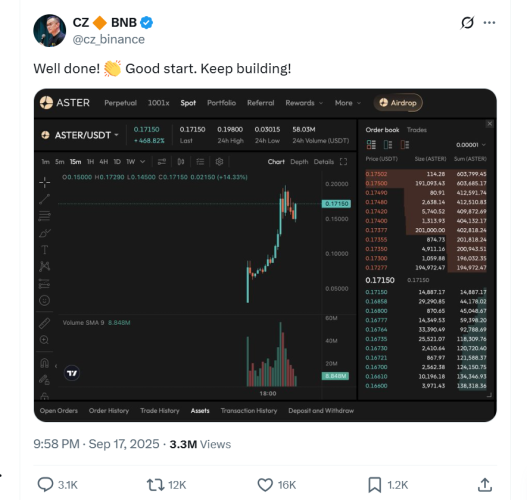
The rapid rise of ASTER has been fueled by Changpeng Zhao (CZ), the influential former CEO of Binance. Zhao has openly endorsed the project, describing its TGE as a “strong start” and encouraging developers to keep innovating.

On September 19, Zhao disclosed on X (formerly Twitter) that Aster had become the second-largest holder of BSC-USDT, behind only Binance itself. 

According to Arkham Intelligence data, Aster’s wallet holds $131 million in USDT, while Binance’s hot wallet leads with $236 million.

This endorsement significantly boosted investor confidence. Zhao’s ongoing association with YZi Labs has also added further legitimacy to the project, ensuring it is not dismissed as just another speculative token launch.

CZ Tweet about Aster Coin

From ApolloX to Aster: A Strategic Rebrand

Aster’s rise is not happening in isolation. The project has roots going back to 2021, when it launched as ApolloX, an early decentralized derivatives exchange. In late 2024, ApolloX merged with Astherus, leading to a complete rebrand as Aster.

The transition saw ApolloX’s original token, APX, being swapped for ASTER during the TGE, rewarding early supporters with substantial windfalls. 

For context, blockchain analytics firm Lookonchain revealed that one investor saw a $226,000 APX position transform into over $7.7 million after conversion.

Trading Volumes and Market Competition

Despite being in an early stage, Aster has already secured a foothold in decentralized derivatives trading.

According to DeFiLlama, Aster processed $3.67 billion in trading volume in the past 24 hours. This achievement places it among the top decentralized derivatives platforms.

However, the scale of competition is evident. Rival platform Hyperliquid processed $12.8 billion over the same period.

Analysts See Further Upside

Despite stiff competition, analysts remain optimistic about Aster’s trajectory. In a post on X, a prominent crypto trader, Marcell, suggested that the token could reach $4, implying a potential 151% upside from current levels.

EU Finance Ministers Approve Roadmap for Digital Euro Launch

0

The European Union has taken another step toward introducing a digital euro, as finance ministers agreed on a roadmap to guide its potential launch. 

The initiative, led by the European Central Bank (ECB), aims to strengthen Europe’s financial independence and reduce its reliance on American payment giants, Visa and Mastercard.

Why Europe Wants a Digital Euro

For years, EU leaders have debated how to reduce the continent’s dependence on external players in critical areas such as energy, defense, and finance.

Payments have emerged as a central concern. Today, Europe’s cross-border transactions are largely dominated by US-based systems, a reality that many policymakers view as a strategic vulnerability.

The digital euro is being developed as an electronic wallet backed by the European Central Bank. It aims to complement cash and work seamlessly alongside it, offering citizens and businesses a payment method built entirely on European infrastructure.

ECB officials argue that such a system is crucial not only for economic efficiency. It also plays a key role in safeguarding political and financial sovereignty.

Concerns from Lawmakers and Banks

Despite its promise, the project has not been universally welcomed. Lawmakers and commercial banks have raised alarms about the risks it could pose. One major fear is that citizens may transfer large sums from their bank accounts into digital euros. Such transfers could trigger a destabilizing outflow of deposits.

Others point to the potential cost of implementation and warn that the system could give authorities new tools that might erode personal privacy. These concerns have slowed progress and forced the ECB to seek compromises with member states.

Compromise at the Copenhagen Meeting

According to a recent Reuters report, EU finance ministers met in Copenhagen on Friday with ECB President Christine Lagarde and European Commissioner Valdis Dombrovskis. After extensive discussions, the group reached a compromise on two contentious issues: the decision-making process and the holding limits.

Under the new understanding, finance ministers will have a formal say before the ECB decides whether to issue the currency. This ensures governments retain influence over the final step.

In addition, ministers agreed on a framework for setting limits on the amount of digital euro each resident can hold, a safeguard intended to prevent bank runs.

Although details of these holding limits have not been disclosed, the agreement marks a significant step forward. A participant told Reuters that the ECB will submit its proposals on limits for approval by the European Council of Finance Ministers.

Legislative Hurdles Still Ahead

Meanwhile, the project’s political and legal journey is far from complete. In June 2023, the European Commission proposed legislation to establish the digital euro. However, approval is still required from both the European Parliament and the European Council.

The Council has committed to finalizing its review by the end of this year, but the timeline remains tight. The ECB hopes legislation will be in place by June 2026.

Even then, officials estimate it will take between two and a half to three years to design, test, and roll out the system. This means the digital euro is unlikely to become a reality before 2029.

Filling Gaps in Europe’s Payment Landscape

Some EU countries already run national digital payment systems, but none of these operate seamlessly across the 27-member bloc. As a result, European consumers and businesses often depend on American companies for cross-border payments. 

A unified digital euro would resolve this issue by providing a single, continent-wide payment solution.

“Symbol of Sovereignty”

Beyond the technical and financial aspects, ECB President Christine Lagarde stressed that the initiative is not just about payments.

“The digital euro is a symbol of Europe’s sovereignty,” she said at the press conference. “It shows our capacity to control cross-border payments through European infrastructure and solutions.”