Home Blog Page 545

Cardano Bull Reveals When He’ll Start Selling His ADA Bag

0

Dan Gambardello, a well-known crypto analyst and long-time Cardano supporter, recently explained when he plans to start selling his ADA holdings. 

In his recent analysis, Gambardello said he will handle this cycle differently from the last one. In 2021, he mostly held through upswings, but this time he plans to talk openly about selling and taking profits. According to him, preparation is everything, and investors should have a clear plan before markets take off.

How the Risk Score Determines Cardano Exit Points

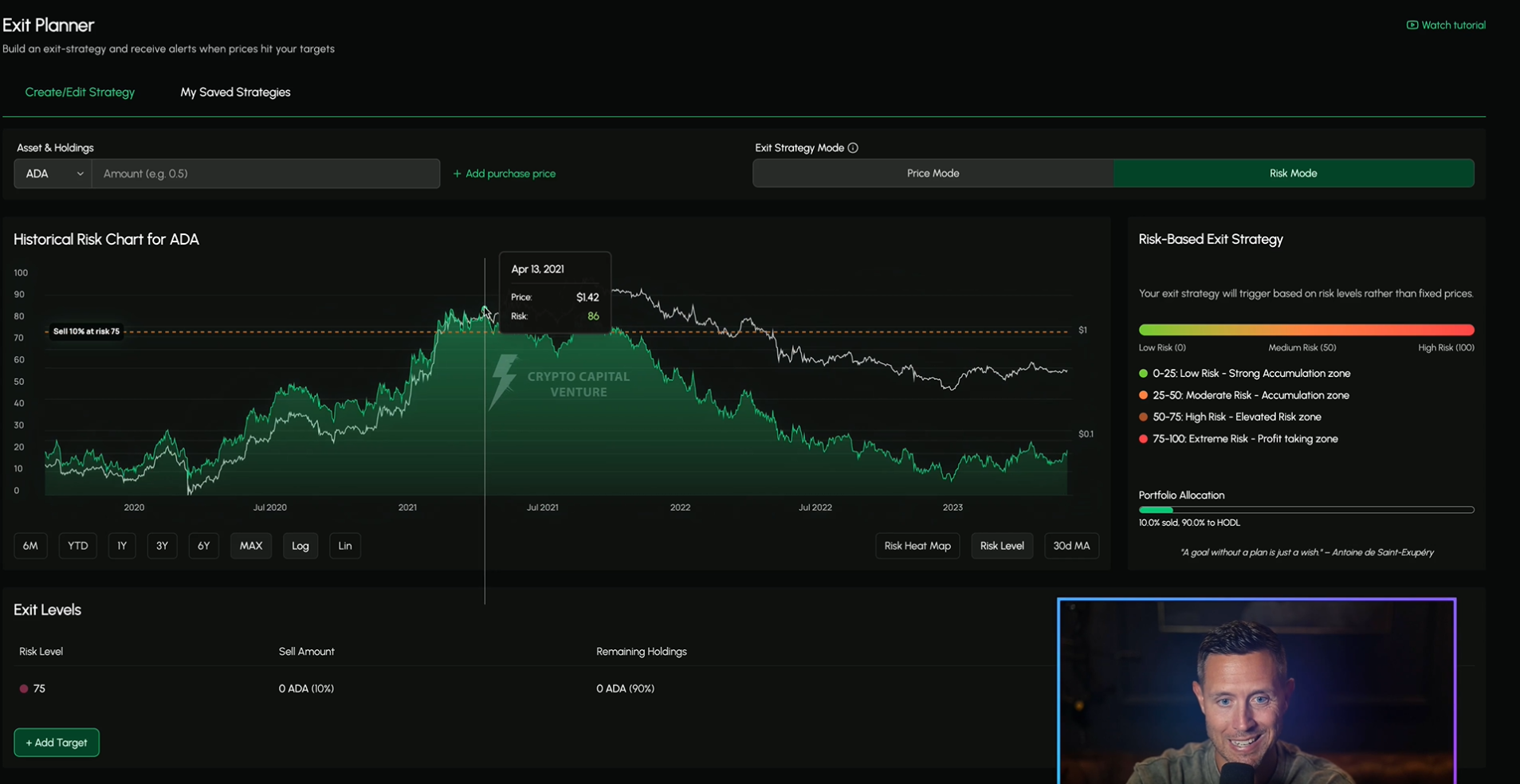
Notably, the market analyst bases his strategy on a “risk score” that runs from zero to one hundred. For context, scores between 25 and 50 signal moderate risk, 50 to 75 mark high risk, and 75 to 100 show extreme risk. 

Gambardello confirmed that in past cycles, both Ethereum and Cardano reached major turning points when they hit 75. For instance, Ethereum topped out just weeks after reaching that level two cycles ago.  Meanwhile, in 2021, it marked the beginning of months of volatility leading up to the final high.

The analyst believes Cardano shows a similar pattern. He described 75 as the best point to start scaling out of ADA, although it has previously climbed higher. Notably, in the last bull run, ADA’s risk hit 86, while two cycles ago it climbed to 93. Still, Gambardello sees 75 as the most reliable level to start selling.
Cardano 2021 Peak Risk Levels Dan Gambardello

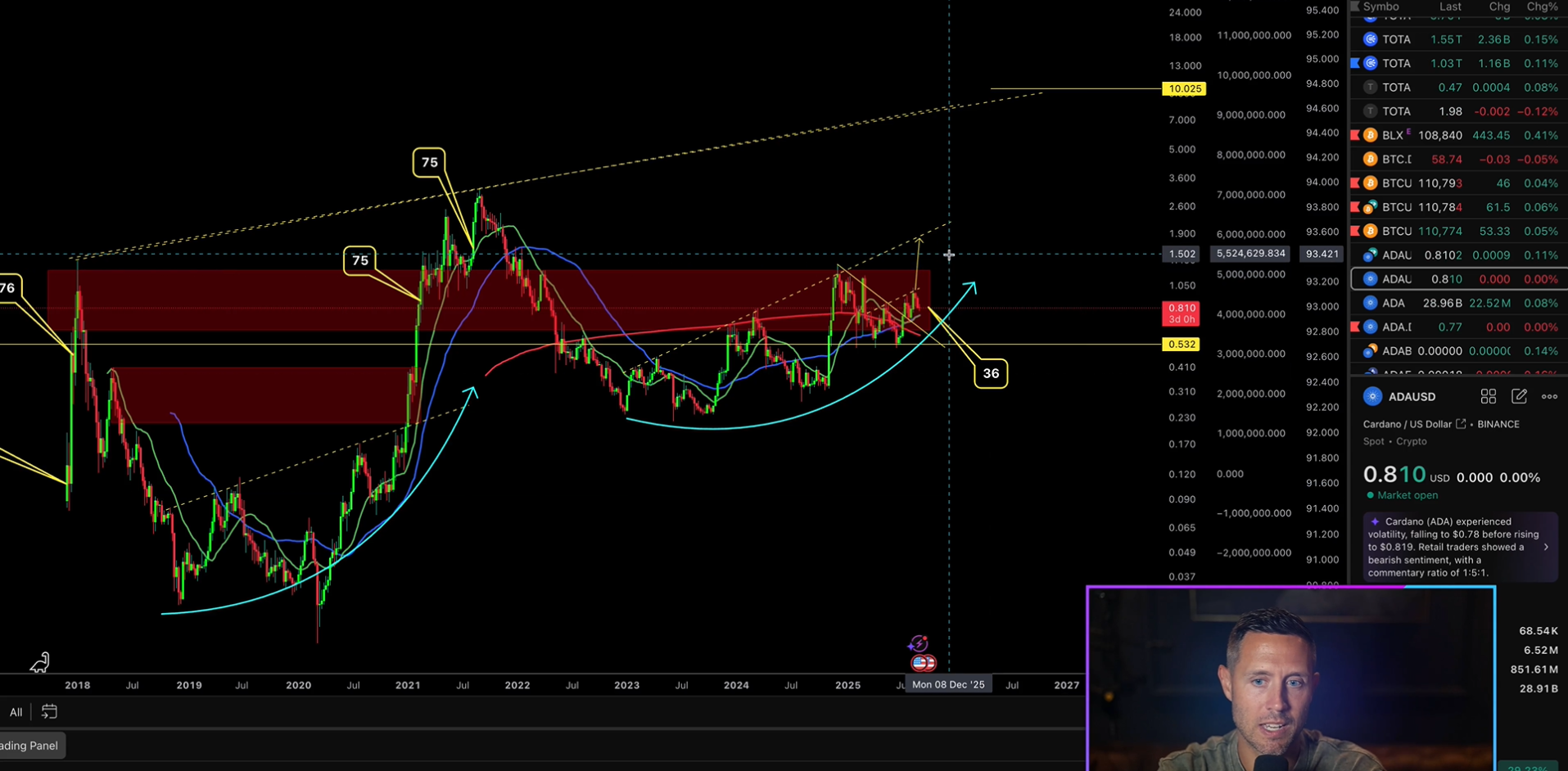
Right now, Cardano sits at a risk score of 36, which he classifies as a “moderate buy.” This puts ADA in a pre-bull market phase. However, Gambardello warned that the change to higher risk levels can happen quickly. 

For instance, two cycles ago, Cardano jumped from a score of 34 to 76 in only a few weeks, while its price shot from about $0.09 to nearly $0.59. He said investors should expect this kind of speed again and prepare their exits before the market accelerates.
Cardano Risk Score Chart

The $1 to $3 Range for Long-Term Cardano Buyers

He also pointed out that holders do not need to wait for 75 before taking profits. Particularly, for long-term ADA buyers, the $1 to $3 range is already an ideal spot to sell portions of their holdings. 

Many investors accumulated at much lower prices, and securing gains between $1.40 and $2.00 makes sense after years of waiting. Gambardello said he will likely do the same, using that range to lock in profits even before higher alerts trigger.

However, he noted that his most exciting moment would be the moment Cardano breaks above its all-time high of $3.1, attained in September 2021. Once ADA clears the $3 mark, Gambardello said he will focus on how price interacts with the risk score. 

Notably, if the risk level pushes toward 75 as ADA hits new highs, this will act as his strongest signal to sell aggressively. He noted that history shows ADA rarely sustains momentum once it enters that risk zone. However, Gambardello had predicted a possible run to $10.

For additional context, he compared ADA’s setup with Ethereum’s. Currently, Ethereum carries a risk score of 49, but in past cycles it has climbed to 75 in a matter of weeks. This same burst of speed could also apply to ADA, which is why he places so much importance on planning ahead.

Essentially, Gambardello noted that discipline matters more than emotion. He plans to take some profits between $1 and $3, but once Cardano hits a risk score of 75, he will start selling in a structured way. He urged investors to set up their own plans now instead of waiting for the rally.
Tether Eyes Gold Sector as Stablecoin Profits Fuel Expansion

0

Stablecoin giant Tether is ramping up investments in gold, seeking opportunities from mining to tokenized bullion, as the metal outperforms Bitcoin in 2025.

According to the latest report from Financial Times, the firm has already held multiple discussions with gold sector players. Some negotiations have advanced to deal-making, while others have fallen through.

Early Stakes and Failed Talks

The company’s most visible move so far has been a $105 million minority investment in Toronto-listed royalty firm Elemental Altus. This gave Tether a direct foothold in the gold royalty business, where companies earn a share of revenue from mining projects without operating the mines themselves.

However, not every conversation has ended in a deal. Tether was also in talks with Terranova Resources, an investment vehicle based in the British Virgin Islands. While both sides explored potential cooperation, the discussions did not produce an agreement.

Still, market insiders believe more acquisitions may be on the horizon.

Billions in Profits and Reserves to Back Growth

Behind this expansion lies Tether’s strong financial position. The firm generated $5.7 billion in profits during the first half of 2025 alone. With USDT’s market cap now standing at $168 billion, Tether has both the liquidity and the momentum to enter new markets.

The company already has significant exposure to hard assets. It owns $8.7 billion worth of physical gold bars, stored securely in Zurich. Alongside gold, U.S. Treasuries remain a core part of its reserves, reinforcing stability for its stablecoin.

Gold Outshines Bitcoin in 2025

Tether’s renewed focus on gold comes at a time when the metal has been outperforming digital assets. Since the start of 2025, gold has surged 37%, while Bitcoin has advanced 22%.

The contrast is striking for investors who long believed Bitcoin would displace gold as the ultimate store of value. Instead, recent market conditions have highlighted gold’s resilience.

Gold prices reached a record high above $3,600 per ounce in August. Analysts see further gains, with Goldman Sachs projecting $5,000 and Matrixport expecting at least $4,000 in the months ahead.

For Tether, this rally provides a financial and symbolic justification for its gold strategy.

XAUt Token Gains as Investors Seek Safety

Tether is not only buying gold but also offering it as a digital asset. The company operates XAUt, a token backed by physical bullion.

As gold prices surged, XAUt saw its market cap jump to $877 million, with the token recently trading around $3,559. That marks a 5% rise within a week, even as the wider crypto market has faced selling pressure.

For investors, XAUt allows exposure to gold’s stability while maintaining the flexibility of a digital asset.

Paolo Ardoino’s Gold Philosophy

Tether’s pivot is closely tied to the views of its CEO, Paolo Ardoino. A long-time supporter of gold, Ardoino has repeatedly argued that it offers deeper reliability than national currencies.

At the Bitcoin 2025 Conference, he referred to gold as “natural Bitcoin”. While many crypto enthusiasts view Bitcoin as “digital gold,” Ardoino argued that physical gold possesses the same qualities of scarcity and trust but avoids the speculative risks that weigh on cryptocurrencies.

His stance has helped shape Tether’s strategy, providing the company with a philosophical anchor for its financial decisions.

Industry Skepticism and Strategic Questions

Despite Tether’s enthusiasm, reaction from the traditional gold sector has been cautious. Mining executives, used to decades of conservative investment practices, doubt whether Tether has a clear long-term plan.

One executive summarized the sentiment bluntly: “They like gold. I don’t think they have a strategy.”

Skepticism also comes from the fact that mining companies have struggled to match gold’s rally in their stock performance.

Political and Strategic Shifts

The gold push also coincides with a new political dimension at Tether. Earlier this year, the company hired Bo Hines, a former Trump crypto official, as a strategic advisor. His arrival suggests Tether is seeking stronger ties with regulators and policymakers while preparing to expand its global footprint.

Meanwhile, economist Peter Schiff noted that despite the recent sharp rise in gold and silver prices, there are no signs of excessive speculation.

Schiff advised against selling miners too early, implying that gold mining companies remain undervalued relative to the metal’s price. If his view holds, firms like Tether could be positioning themselves ahead of a broader sector revaluation.

Bitcoin Bond Company CEO Explains Why XRP Will Fail As Payment Option

0

Pierre Rochard, the CEO of The Bitcoin Bond Company and a long-time Bitcoin advocate, insists XRP will fail to match Bitcoin because it acts as a utility token.

Rochard said this during one of his latest commentaries in which he criticized altcoins XRP, Ethereum, and Solana. According to him, these assets will never overtake Bitcoin because they rely on what he calls the “utility thesis” of crypto.

XRP Will Fail as a Payment Method

Rochard explained that this thesis assumes that a blockchain’s native token will gain value as more people use the network. However, he completely dismissed this idea. To him, any successful company that needs blockchain technology will build its own system of payments rather than depend on someone else’s. 

Meanwhile, he argued that Bitcoin does not need outside projects to consume its blockspace in order to thrive. Instead, it draws strength from network effects that are hard to copy, combined with its decentralized nature, censorship resistance, and fixed supply monetary policy.

Rochard made these comments shortly after Stripe CEO Patrick Collison unveiled Tempo, a blockchain created in partnership with Paradigm. Collison described Tempo as a payments-focused network designed for speed, efficiency, and real-world financial use cases. 

He noted that current blockchains fall short for payments because they use fees tied to their own tokens and lack features like cost-efficient batch transfers. However, Tempo can process more than 10,000 transactions per second and has already partnered with major firms such as Shopify, Visa, Revolut, and Deutsche Bank.

Rochard believes Tempo’s launch proved his point. In a previous disclosure, he said token issuance and stablecoins on Ethereum only emerged because of regulatory loopholes. Once regulators provide clear rules, he believes centralized blockchains like Tempo will dominate specific use cases, leaving tokens such as ETH, SOL, and XRP with little value.

Rochard Admits XRP is a Utility Token

This was not the first time Rochard took aim at utility tokens. In August, he argued that making assets like ETH and XRP, which he called “security tokens,” more useful might encourage some adoption, but it would not increase demand for them.

Earlier in the year, he described XRP as a utility token, but claimed it is not a commodity. He admitted the token serves a function, but he insisted that utility alone does not translate into real value.

XRP proponents strongly disagree with this point. They believe XRP’s role as a utility token can drive massive adoption, especially if it helps transform cross-border payments. 

The XRP-SWIFT Discussion

Most of them continue to argue that XRP could either complement or replace SWIFT, the global financial messaging system, by providing a faster and cheaper way to settle international transactions.

On the other side, Chainlink advocates have pushed back against the idea of XRP replacing SWIFT. Notably, they often highlight Chainlink’s collaboration with the network as proof that no single blockchain will take SWIFT’s place. 

Interestingly, one proponent recently shared a presentation from Chainlink co-founder Sergey Nazarov on how this works. He showed that a SWIFT payment message can be converted into an on-chain event, which then triggers a digital asset transaction. 

According to Nazarov, this process allows banks and institutions to use their existing infrastructure while connecting with hundreds of blockchains. He described it as a secure, cost-effective way to settle digital assets and still maintain the standards that financial institutions already trust.

Despite the pushback from the Chainlink community, XRP proponents argue that even with Chainlink’s involvement, SWIFT could still adopt blockchains like the XRPL for settlement. They see Chainlink as a bridge rather than a replacement, and they believe XRP’s design gives it an advantage in improving SWIFT’s payment flows.

Will XRP Price See Another Major Dump? Digital Ascension CEO Weighs In

0

Jake Claver, CEO of Digital Ascension Group, recently addressed the ongoing discussion about whether XRP could revisit lower price levels.

He highlighted that many investors overlooked XRP when it was trading between $0.30 and $0.50, often dismissing it as “garbage”. Now, as XRP edges higher, those same investors are wishing for a chance to re-enter at those lower levels.

Claver stressed that buyers had years to accumulate XRP at those prices. To him, the days of XRP trading below $0.50 are gone for good, suggesting that major corrections are unlikely to push the coin back to those levels.

ETFs, Volume, and Market Support

Claver pointed out that XRP’s price resilience sets it apart from other tokens, which often experience sharp rallies followed by 90% drops. In contrast, XRP has found consistent support alongside Bitcoin and continues to benefit from strong trading volume.

For context, XRP sees an average daily trading volume of $5 billion and a monthly volume of around $140 billion, ranking it among the top four excluding stablecoins. This highlights significant market participation and interest in the coin.

Beyond volume, Claver highlighted that with ETF products now in play, the market is unlikely to allow XRP to fall back to its previous lows. Spot XRP ETFs are expected to launch next month, with projections of $5 billion in investments flowing in within weeks.

Because of this, many believe XRP is more likely to rise than to experience a major retracement back to the $0.50 range. As of today, XRP is trading at $2.84, maintaining over 400% in gains since November 2024.

Notably, institutional interest is surging. Companies have disclosed over $1 billion to establish XRP treasuries, further supporting the argument that deep corrections back to historic lows are increasingly unlikely.

“What Goes Up Must Come Down”

Meanwhile, some technical analysts believe the adage—what goes up must come down—still applies to XRP and other crypto assets, regardless of bullish fundamentals or institutional backing.

For instance, analyst EGRAG has used historical trends to outline various crash scenarios for XRP, suggesting that a drop to as low as $0.30 is still possible after a blow-off top.

However, he notes that the eventual lows will depend on how high XRP peaks. For example, a peak at $27 could result in a correction below $1, while a peak at $9 might lead to $1.3.

Today’s Price Will Become Significant

Meanwhile, Claver believes XRP is positioned for sustained long-term growth. He noted that if Bitcoin continues its upward trajectory, XRP will follow.

He also pointed to potential catalysts, such as reverse carry trade dynamics and XRP’s use in backend settlement for stock market ETFs. According to Claver, these factors could propel XRP to levels where small differences in entry points—whether $2.50 or $3—will become insignificant once the token reaches triple-digit valuations.

Dollar-Cost Averaging Over Timing the Market

Instead of waiting for an unlikely major price drop, Claver recommends dollar-cost averaging (DCA) as the best strategy for most investors. He suggests investors should buy small amounts when liquidity permits, also warning against using leverage. In his view, XRP’s next major move is more likely to be upward than downward.

Air China to Explore XRP Payment Solutions for 60M+ Members

0

Pro-XRP legal expert Bill Morgan points to Webus International’s partnership with Air China as evidence of XRP’s growing real-world adoption. 

Earlier this week, Webus International disclosed its strategic partnership with Air China, which gives it access to the airline’s 60 million PhoenixMiles loyalty members.

60M+ Air China PhoenixMiles Members to Access XRP-Powered Payment Solution

While the partnership primarily focuses on providing premium chauffeur and airport transfer services through Webus’ travel brand Wetour, a standout feature of the alliance is the integration of XRP payment support into the platform.

According to the announcement, plans are underway to grant over 60 million Air China’s PhoenixMiles members access to Wetour’s overseas platform, which supports XRP payments.

This implies that Air China’s PhoenixMiles members can leverage the XRP payment solution for faster settlements, along with other benefits, such as blockchain-enabled vouchers and tokenized rewards.

However, this integration remains subject to future business development and regulatory approval, as noted in the official announcement.

Attorney Morgan Reacts

Attorney Bill Morgan weighed in on the announcement, acknowledging that some critics will likely downplay it by pointing out that, while it mentions “XRP payment support,” it does not specifically or explicitly state that XRP will be used in transactions.

Nonetheless, he emphasized that the announcement reflects real adoption of XRP, irrespective of what critics think about the phrasing. “For me, it shows adoption of XRP,” he said.

Webus Ties with XRP

For context, Wetour’s parent company, Webus International, is no stranger to the XRP community. In June, The Crypto Basic reported that Webus filed with the SEC to establish a $300 million XRP treasury reserve.

In addition to establishing an XRP reserve, Webus also confirmed plans to integrate the XRP Ledger (XRPL) for frictionless cross-border settlements.

XRPL has earned a reputation in the crypto industry due to its ability to settle transactions within 3-5 seconds. In addition, users get to pay an incredibly low fee of less than a cent for these transactions.

Shortly after launching its XRP treasury reserve initiative, Webus expanded its Wetour platform to support payments in both XRP and Ripple’s RLUSD stablecoin. Through the integration, Wetour users can acquire promotional coupons and product vouchers using XRP.

Currently, Webus plans to expand the XRP-powered solution to Air China’s PhoenixMiles members, enabling them to enjoy faster settlements and other blockchain-related rewards.

Stripe Introduces New Layer-1 Blockchain to Power Real-world Payments

0

Fintech giant Stripe and crypto venture firm Paradigm have unveiled Tempo, a new layer-1 blockchain to power real-world payments using stablecoins.

In an X post, Stripe CEO Patrick Collison described Tempo as a “payments-oriented L1 blockchain” for financial services and large-scale payment applications.

Though backed by Stripe and Paradigm, Tempo will operate as an independent company. This structure allows it to serve a broader range of partners without being tied to a single corporate agenda.

Collison explained that Stripe and Paradigm are only the initial investors, leaving room for industry participation as the ecosystem develops.

Big Names Join as Design Partners 

Building on its independent foundation, Tempo is launching with a formidable roster of early partners that will help guide its development. These collaborators span the tech, fintech, and banking sectors, including AI leaders OpenAI and Anthropic, e‑commerce innovators DoorDash and Shopify, and financial powerhouses such as Revolut, Nubank, Lead Bank, Mercury, Deutsche Bank, and Standard Chartered.

Together, they will help shape features for businesses handling global payments, remittances, and on‑chain financial products.

Collison confirmed that the blockchain will launch with an independent and diverse validator set and gradually transition to permissionless validation, ensuring resilience and decentralization.

Key Features of Tempo

Tempo offers several distinctive features. The blockchain will include a built-in automated market maker to allow neutral use of multiple stablecoins. 

Unlike most blockchains, it will not issue a native token at launch. Instead, users will pay transaction fees directly with stablecoins, which reduces volatility and facilitates adoption.

The platform prioritizes global payouts, microtransactions, tokenized deposits, and agent-based payments, making it suitable for real-world financial applications where traditional blockchains often face hurdles. 

Collison noted that the focus is on real-world usability, not speculative trading.

Leadership and Team

The project is led by Matt Huang, Paradigm’s co-founder and managing partner. Huang will continue his role at Paradigm while guiding Tempo’s development. 

As of today, the Tempo team consists of approximately 15 members, including engineers and cryptocurrency experts.

Launch Timeline Still Unclear

Despite the announcement, no official launch date has been shared. Sources indicate the project remains in its early phase, with technology and governance frameworks under development.

Industry watchers expect more details on the rollout once Tempo finalizes its validator system and business integrations.

Stripe’s Expanding Crypto Strategy

Tempo is the latest step in Stripe’s growing involvement in cryptocurrency. In October 2024, the company acquired Bridge, a stablecoin infrastructure startup, for $1.1 billion. 

In June 2024, it partnered with Coinbase to integrate the Base Layer 2 network into Stripe’s crypto payment products. 

More recently, in June 2025, Stripe acquired Privy, a wallet company focused on user-friendly crypto storage. 

Together, these moves highlight Stripe’s long-term commitment to blockchain technology as a foundation for the future of payments.

Why Tempo Matters

Stablecoins are becoming a central part of digital finance, but existing infrastructure often fails to meet the demands of large-scale businesses. By focusing on speed, neutrality, and compliance, Tempo could become the go-to blockchain for enterprise payments. 

Matt Huang highlighted that Tempo combines Stripe’s expertise in payments with Paradigm’s strength in crypto infrastructure. 

“As stablecoins go mainstream, there’s a need for optimized infrastructure,” he said in a post announcing the project.

We Are Going to Take XRP to New Heights, Says Flare Founder

0

Flare CEO Hugo Philion has reiterated his ambition to enhance the XRP ecosystem far beyond its current state.

He is doubling down on his commitment to unlocking billions in XRP liquidity through DeFi integration.

Taking XRP to New Heights

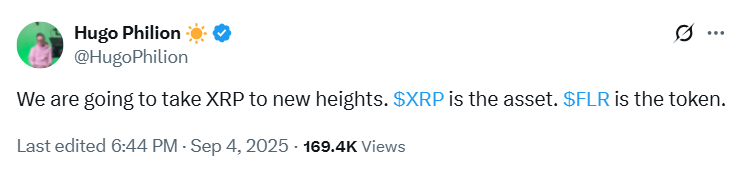
In a tweet on Thursday, Philion said his team is “going to take XRP to new heights”. The statement builds on the company’s longstanding mission to transform XRP into a yield-bearing asset. He highlighted XRP as the core asset and FLR as the enabling token. Notably, this positions Flare as the missing link between XRP and decentralized finance.

Flare CEO on X
Flare CEO on X

Notably, Philion’s latest statement comes on the back of a series of announcements made this year. In March, he revealed that Flare was preparing low-risk staking opportunities for XRP holders, allowing them to secure services across multiple ecosystems and earn rewards with minimal validator risks.

By June, the concept had evolved into Firelight, a liquid staking protocol that enables XRP holders to wrap tokens into FXRP and mint stXRP for use in DeFi. Institutions quickly took notice. For instance, VivoPower committed $100 million in XRP. Meanwhile, Uphold joined as a key launch partner.

Yield Opportunities Emerge

In August, details of Firelight’s potential yields came to light. Speaking with Scott Melker, Philion and Sentora CTO Jesus Rodriguez revealed that XRP could generate annual returns of 4–7% through Firelight. For an asset that has historically offered no yield, this represented a breakthrough.

They designed the system to remain non-custodial and decentralized, avoiding the risks investors witness with centralized exchanges. With wrapped XRP (FXRP) secured on Flare and represented by stXRP, holders can participate in lending, borrowing, and even minting stablecoins, similar to Ethereum’s MakerDAO model.

Expanding Beyond Cross-Border Payments

XRP has long faced criticism for its lack of native smart contract support, limiting its role in DeFi. However, Flare’s EVM compatibility, oracle services, and cross-chain integrations aim to change that. Firelight is now unlocking idle liquidity estimated at over $100 billion in untapped XRP to position XRP as a serious player in on-chain finance.

Community voices like attorney Bill Morgan have echoed this sentiment. He previously noted that XRP needs to “work harder” and expand its utility beyond cross-border payments. With Firelight, that vision is beginning to materialize.

How Will XRP’s Price React?

Meanwhile, Flare’s push to bring DeFi to XRP has continued to spark discussion about its potential impact on XRP’s price. EasyA co-founder Dom Kwok noted that XRP has not yet had its breakout DeFi moment but already reached a peak market cap of over $200 billion.

He argued that XRP could scale to four figures once it experiences a true DeFi breakout, supported by institutional adoption, stablecoin payments, ETFs, and increased retail participation.

Jack Ma-Linked Yunfeng Financial Bets Big on Ethereum With 10,000 ETH Purchase

0

Jack Ma–backed Yunfeng Financial Group, listed in Hong Kong, purchased 10,000 Ethereum worth $44 million, marking a deeper move into digital asset ventures.

The company confirmed that the acquisition was funded entirely through its available cash resources. The move comes as part of Yunfeng’s expansion into Web3, digital assets, and artificial intelligence. Ethereum will serve as a strategic reserve asset for the group.

Ethereum to Be Treated as Investment Asset

In its announcement, Yunfeng clarified that Ethereum will be reported as part of its investment portfolio in official financial reports. The company emphasized that ETH will support tokenization projects and serve as a foundation for new Web3 financial solutions.

Management noted that ETH holdings would not only diversify the company’s assets but also reduce reliance on traditional fiat currencies. The group further outlined potential use cases for Ethereum in insurance, decentralized finance, and new product development.

The company stated that this marks the beginning of its digital asset strategy. Yunfeng plans to expand its treasury allocation by adding other leading cryptocurrencies, including Bitcoin (BTC) and Solana (SOL). 

Such diversification will align Yunfeng’s services, ranging from brokerage and asset management to insurance, with new opportunities in decentralized markets.

The Jack Ma Factor in Yunfeng Financial

Public filings show that Alibaba founder Jack Ma holds about 11.15% of Yunfeng Financial through Yunfeng Capital. While he is not directly involved in day-to-day operations, his stake connects the fintech firm to one of China’s most influential entrepreneurs. 

This link enhances Yunfeng’s visibility as it transitions from a traditional financial services provider to a company more deeply engaged with blockchain technologies.

Institutional ETH Buying Spree

Beyond Yunfeng’s purchase, market data reveal a wider institutional rush into Ethereum. Blockchain analytics firm Lookonchain reported that whales and institutions have bought 218,750 ETH, worth nearly $943 million, in the past two days alone.

Among these purchases, BitMine Immersion Technologies emerged as the largest corporate buyer, securing 69,603 ETH worth $300 million from BitGo and Galaxy Digital.

Meanwhile, five newly created wallets accumulated 102,455 ETH through FalconX, valued at $441.6 million.

Falling Exchange Reserves Signal Supply Crunch

This wave of corporate and whale buying comes at a time when Ethereum’s availability on centralized exchanges is rapidly shrinking.

Data from CryptoQuant shows reserves have dropped by almost 10.7 million ETH since September 2022. Current balances stand at just 17.4 million ETH, down from a peak of 28.8 million.

Over the past three months, approximately 2.5 million ETH have been withdrawn from exchanges, primarily absorbed by corporate treasuries and exchange-traded funds.

This supply squeeze has coincided with Ethereum reaching a record high of $4,953.73 in late August 2025. As of press time, ETH trades at $4,340, down 0.67% over the last 24 hours.

Fib Analysis Shows XRP at $31 and Ethereum at $8,000 on Same Level

0

A notable market technician has shown that XRP and Ethereum could eye lofty targets at the same Fibonacci extension level.

The crypto market is still trying to bounce back after the latest downturn. XRP, which currently trades for $2.81, is working to push back above $3. Meanwhile, Ethereum is also showing signs of recovery as it fights for $4,500, with its price sitting close to $4,339. 

As market participants focus on these short-term struggles, analyst EGRAG Crypto has pointed out that both XRP and Ethereum may share the same long-term destination.

In his latest analysis, EGRAG’s charts trace both tokens back to their 2018 highs and 2020 lows. He applied Fibonacci extensions to the cycle and highlighted how both assets point to the same target level: the 1.618 extension. Data shows this zone sets Ethereum’s next major target around $8,000 and XRP’s near $31.

Ethereum Price Action

Specifically, Ethereum’s weekly chart starts with its January 2018 peak, where the coin topped out at $1,420 before sliding all the way to its March 2020 low of $88.2. Notably, this cycle bottom created the base for the current multi-year push. 

From this range, Fibonacci extensions line up major levels: $623 at the 0.702 ratio, $1,413 at the 1.0 ratio, $4,405 at the 1.414 ratio, and $7,700 to $8,000 at the 1.618 extension. EGRAG calls this extension the critical long-term target.

He also pointed out an inverse head-and-shoulders structure that has formed since 2021. The left shoulder formed between May and November 2021, the head formed from November 2021 to March 2024, and the right shoulder has taken shape since March 2024. A breakout targets the Fib. 1.618 level of around $8,000.

XRP Price Action

Interestingly, XRP’s chart follows the same timeline. Specifically, XRP reached its peak of $3.31 in January 2018, dropped to a low of $0.1140 in March 2020, and spent years consolidating until the breakout in November 2024. 

From this high-to-low move, Fibonacci extensions set up $3.52 at the 1.0 ratio, $15.23 at the 1.414 ratio, and $31.34 at the 1.618 extension. EGRAG places XRP’s target between $27 and $31, in line with this projection.

Meanwhile, instead of a head-and-shoulders setup, XRP’s chart shows a massive contracting triangle stretching from 2018 into 2025. Its price action squeezed inside the triangle for years until breaking out recently. 

EGRAG measured the height of that triangle and used it to project the next move. Remarkably, the projection aligns with the same $31 zone marked by the Fibonacci extension.

Both Assets Target the Same Fib. 1.618 Level

Essentially, data from the ETH and XRP charts shows interesting similarities. Notably, Ethereum and XRP topped out in early 2018, bottomed in March 2020, and are now climbing toward Fibonacci extensions drawn from those exact points. The method gives Ethereum a target of around $8,000 and XRP a target near $31.

XRP and Ethereum Fib Targets EGRAG Crypto
XRP and Ethereum Fib Targets | EGRAG Crypto

Highlighting this, EGRAG questioned why many traders believe Ethereum will hit its extension target while dismissing XRP’s chances. He noted that some analysts even expect Ethereum to reach as high as $15,000 to $20,000 in just a few months, yet show no confidence in XRP following the same math.

The market analyst also confirmed that he is not dismissing the possibility of a longer cycle. In his outlook, the market could stretch into 2028, with a major top forming in late 2025 before a downturn begins in 2026. 

Meanwhile, EGRAG suggests Ethereum may first reach its Fibonacci target, but XRP could still outpace it later on. Notably, at a price of $8,000, ETH will have a market cap of $965.6 billion. However, at the $31 price, XRP’s valuation would sit at $1.84 trillion.

Ripple Confirms BlackRock To Attend Swell Conference

0

Ripple has confirmed that a BlackRock executive will be among the high-profile participants at its upcoming Swell 2025 Conference. 

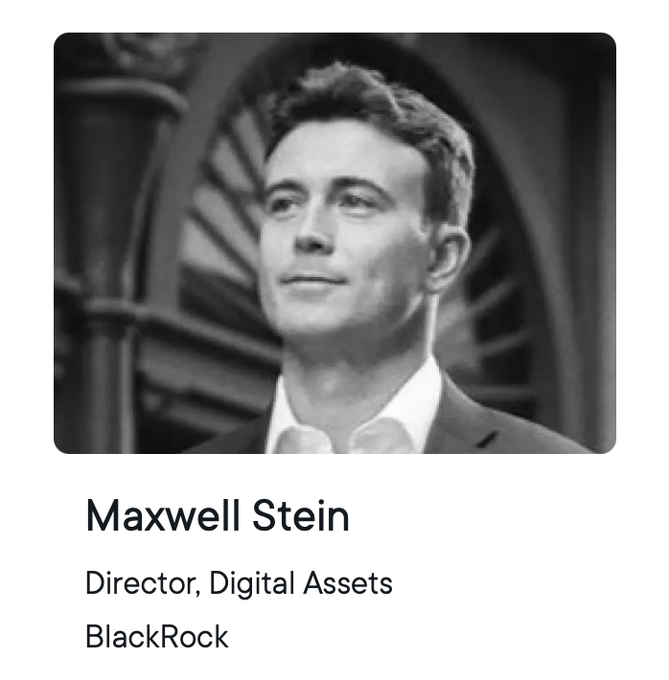
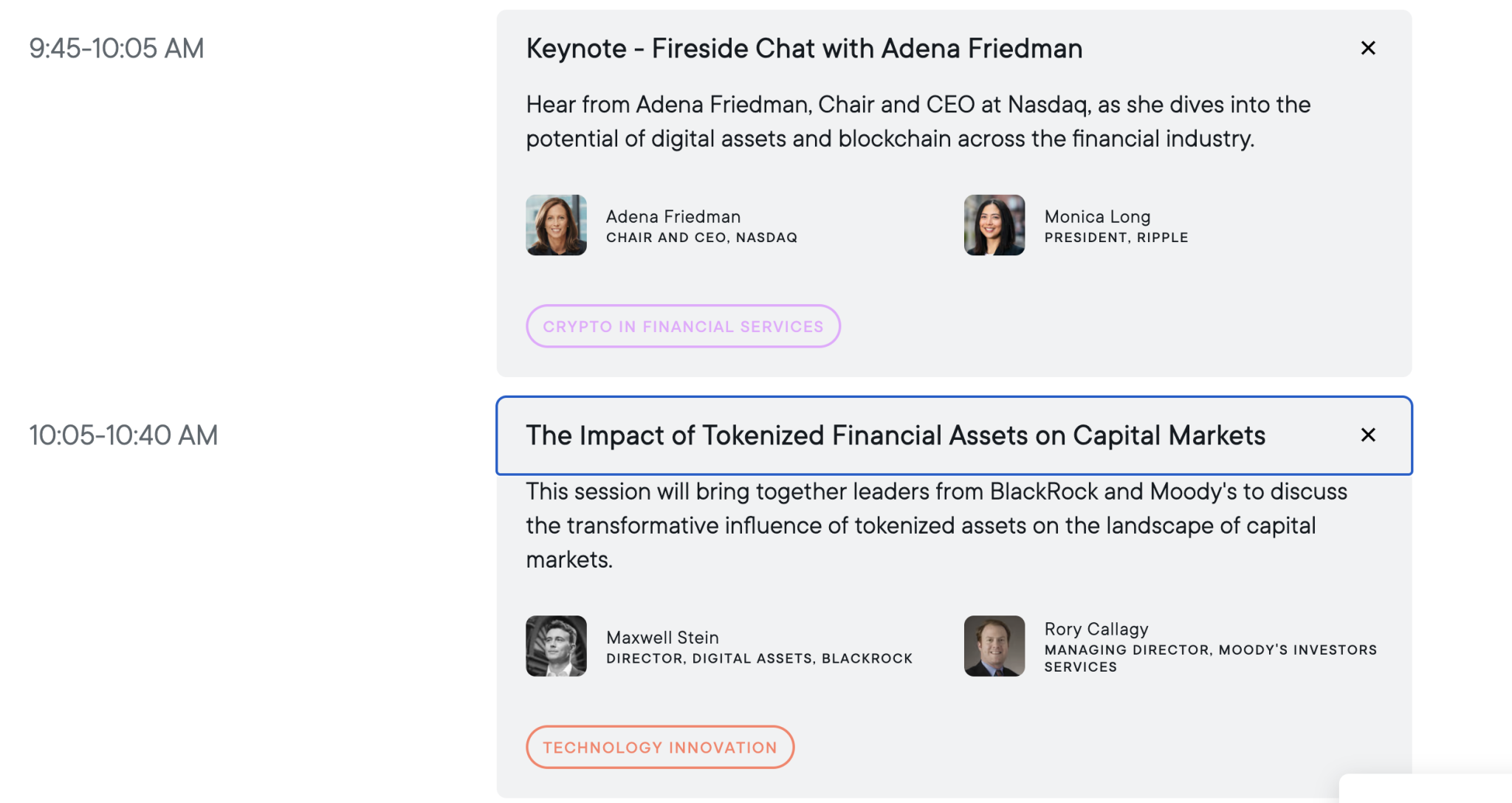
In particular, BlackRock’s Director of Digital Assets, Maxwell Stein, has been listed as one of the featured speakers for the 2025 Swell conference. The event will take place in New York City from November 4 – 5.  

BlackRock exec to attend Ripple Swell

Other speakers include Ripple Chairman Chris Larsen, Ripple CEO Brad Garlinghouse, Nasdaq Chair Adena Friedman, and OKX CIO Jason Lau, among others. 

Stein’s Main Topic of Discussion 

Stein’s participation in Ripple’s upcoming conference has fueled discussions in the XRP community. Many are expecting him to shed light on BlackRock’s stance toward crypto ETFs and whether an XRP product could be on the horizon. 

According to the official agenda, Stein will join Rory Callagy of Moody’s Investors Services to explore how tokenized financial assets are reshaping capital markets. Meanwhile, the agenda did not indicate whether Stein would comment on BlackRock’s XRP ETF plans. 

For context, despite increasing institutional interest in XRP, highlighted by several ETF filings, BlackRock has not yet applied to launch such a product. The asset manager currently offers standalone crypto ETFs linked to Bitcoin and Ethereum. 

Earlier speculation suggested that the world’s largest manager avoided XRP due to the lawsuit between the SEC and Ripple. Even after the case concluded last month, BlackRock has maintained that it has no immediate plans for an XRP ETF. 

It remains uncertain whether BlackRock will review this stance at the Ripple Swell conference. 

Ripple Unveils Swell Agenda 

Meanwhile, Ripple has unveiled the agenda for the 2025 Swell, confirming that industry leaders will discuss key trends in crypto, including payments, stablecoins, real-world adoption, and regulation. 

Per the official agenda, Ripple will hold a welcome reception on November 3, from 4 to 7 PM (ET). The main event will kick off the following day, starting with registration, breakfast, and networking from 7:30-9:30 AM (ET). 

Afterward, Ripple President Monica Long will give an opening remark and will subsequently join Nasdaq’s Adena for a fireside chat. Sessions on the use of stablecoins in cross-border payments and crypto ETFs will also be held on November 4.

The day will conclude with “Swellebration,” a celebratory event to allow attendees to unwind and connect.  

BlackRock executive among other speakers at Ripple Sweell

Events lined up for Day 2, on November 5, include a discussion on digital asset adoption maturity, U.S. leadership in the sector, crime prevention in the space, as well as keynotes and a fireside chat with the Ripple CEO.