Home Blog Page 547

Ripple Expands RLUSD Stablecoin into Africa

0

Ripple is introducing its U.S. dollar-backed stablecoin, RLUSD, to African markets through strategic fintech collaborations and humanitarian projects.

In a tweet early today, Ripple announced that its RLUSD is now entering African markets. The launch is made possible through three major fintech partners: Chipper Cash, VALR, and Yellow Card. Each platform has a strong footprint in the region and brings direct access to millions of users.

Ripple executives say the move is part of a broader plan to make RLUSD a trusted option for institutional clients worldwide.

Rapid Growth Since Launch

RLUSD debuted in late 2024 and has seen steady adoption across global financial ecosystems. According to DefiLlama, the token’s market capitalization has grown to $709.95 million as of Thursday.

Ripple says this growth reflects strong demand from banks, exchanges, and payment providers that need a compliant and stable asset for digital transactions.

Humanitarian Innovation in Kenya

Ripple is also highlighting humanitarian use cases. In Kenya, RLUSD is powering pilot projects designed by Mercy Corps Ventures. These include blockchain-based insurance products that help communities manage drought and rainfall risks. Such programs highlight how digital assets contribute to climate resilience in areas often struck by extreme weather.

Ripple says Africa provides an ideal testing ground for these innovations due to its large unbanked population and pressing economic challenges.

Building a Global Network

Ripple continues to expand RLUSD distribution channels. The stablecoin is now accessible through major global exchanges, including Gemini, Kraken, Bitso, Bitstamp, Bullish, LMAX, Uphold, Mercado Bitcoin, Independent Reserve, and CoinMENA.

This growing network enables institutions worldwide to access RLUSD for payments, settlement, and collateral management.

The company positions RLUSD as both a financial tool and a technological bridge between traditional banking and blockchain systems.

Competing in a Crowded Stablecoin Market

Africa already has widespread stablecoin adoption, with USDT commonly used for remittances and savings. However, RLUSD is being promoted as a regulated alternative, designed for institutional needs and compliant with strict global standards.

Ripple argues that compliance features will differentiate RLUSD in regions where trust and security are major concerns.

Transaction Activity Shows Momentum

On-chain activity shows that RLUSD is gaining traction, but it remains far behind market leaders. Data from Artemis reveals that monthly transaction volumes rose from $119.6 million in July to $193.9 million in August.

By comparison, established stablecoins on Ethereum and Tron handle billions in transactions each month. Ripple acknowledges the gap but sees strong growth potential as institutions adopt RLUSD.

Executive Insights

Ripple executives emphasize that RLUSD has already proved its value in enterprise use cases.

Jack McDonald, SVP of Stablecoins at Ripple, said demand continues to grow across payments, tokenization, and collateral markets.

Meanwhile, Ham Serunjogi, CEO of Chipper Cash, said RLUSD is “uniquely positioned to accelerate institutional blockchain adoption across Africa and beyond.”

Both leaders emphasized that regulated stablecoins can play a decisive role in expanding financial access while strengthening global trade networks.

XRP Uncertainty: Is XRP Still Worth Holding

0

Crypto rivalries often get noisy, and in the past few weeks, XRP has again become the target of sharp criticisms. 

Particularly, Chainlink and Litecoin proponents have renewed attacks on XRP, questioning whether XRP still has a place in the future of digital assets. However, despite the chatter, XRP continues to show strength through its performance with rebuttals from within its community.

Chainlink’s Growing Institutional Appeal Leads to XRP Criticisms

Notably, Chainlink’s growing institutional presence has been a major point. Having secured partnerships with SWIFT, Mastercard, and others, Chainlink has built a reputation as the go-to provider of oracle services for decentralized finance and tokenized markets. 

As a result, Chainlink community figures have recently claimed that these moves put LINK ahead of XRP as the “banking coin” for major institutions.

Interestingly, Chainlink’s new deal with the U.S. Department of Commerce provided another reason for these commentaries. Notably, the partnership will bring major economic data to different blockchains, but the XRP Ledger was not included. 

This led to some critics suggesting the government snubbed XRPL due to a lack of trust. However, XRP proponents have pushed back.

XRP Proponents Push Back

For instance, dUNL validator Vet explained that the issue surrounding XRPL’s snob was due to infrastructure. According to Vet, the government leveraged Chainlink and Pyth, and since neither of them has yet to support XRPL, the network wasn’t part of the rollout. He argued that the decision had nothing to do with bias.

Meanwhile, in another commentary, some Chainlink advocates claimed these recent developments had enlightened investors, leading to a rotation of capital from XRP to LINK.

Nonetheless, attorney Bill Morgan dismissed these claims with chart data. He pointed to trading data that shows XRP holding its ground against LINK and reminded critics that XRP has delivered stronger gains this year. 

Also, former Ripple developer Matt Hamilton stressed that both communities should recognize that XRP and LINK serve very different purposes. Specifically, XRP drives payments and settlement, while LINK primarily powers oracles. These are two roles that don’t cancel each other out.

Litecoin Fuels the XRP Attacks

Meanwhile, Litecoin also joined the campaign when its official account mocked XRP’s adoption story, comparing it to the foul smell of a comet. The post led to backlash from XRP’s community.

In his response, attorney Morgan compared XRP’s current market ranking and rising market cap with Litecoin’s steady decline. He also noted that XRP plays a role in major policy conversations, including at a White House crypto roundtable, while Litecoin has largely faded from relevance.

Other community voices also stepped up. For one, Digital Asset Investor brushed off claims that XRP holders were leaving for Chainlink. He called the idea nothing more than a fear campaign designed to create doubt. Multiple XRP community figures share this view, arguing that the project continues to attract unfair criticism that doesn’t match its actual track record.

Subtle Jab from SWIFT CIO

Even outside these community skirmishes, XRP faced shots from industry leaders. Notably, SWIFT’s Chief Innovation Officer, Tom Zschach, recently took a subtle jab at Ripple and XRP, arguing that surviving lawsuits does not prove resilience. He said real adoption depends on trust and shared governance, not legal battles. 

In response, Osama E., Agile Lead at Sharkforce Consulting, argued that XRP’s years of legal scrutiny have actually strengthened its position. He said the network has proven itself more than most other blockchains and now stands out as one of the most battle-tested systems in the industry.

Despite all the drama, XRP has kept its momentum. Notably, it stands out as one of the biggest gainers in the past year, up 403% within this period despite the recent drop to $2.82. This outpaces the growth from LINK (+111%) and LTC (+71%) in the same timeframe.

Here’s the Possible XRP Price if Tokenization Reaches 10% of Global GDP by 2030

0

XRP could benefit tremendously if tokenization claims 10% of the global GDP by 2030 and the XRPL captures a considerable chunk of the market.

Notably, Ripple recently highlighted that tokenization will be immensely important in the future of finance. In a recent report on digital assets custody, the company emphasized that custody deals more on trust.

Tokenization Could Make up 10% of Global GDP by 2030

Ripple explained that as tokenization trends continue to grow, institutions entering the space will need the same level of security, trading access, and risk management they rely on with traditional assets. 

Interestingly, what caught most investors’ attention was Ripple’s mention of a Boston Consulting Group forecast that by 2030, tokenized assets could account for 10% of global GDP. 

For context, in 2020, the global economy was worth $86.116 trillion, according to the Federal Reserve Bank of St. Louis. It grew to $98.365 trillion in 2021, $102.434 trillion in 2022, and $106.970 trillion in 2023. By 2024, estimates put the global GDP at a whopping $111.236 trillion. 

This indicates that since 2020, the world economy has grown at an average annual rate of 6.69%. If this pace continues, global GDP could reach $164 trillion by 2030. Meanwhile, should 10% of that total become tokenized, the tokenization market would be worth about $16.4 trillion by 2030.

XRPL Eyeing Growing Tokenization Market

This massive opportunity leads to questions about which networks could capture the lion’s share of tokenization. Many analysts highlight the XRP Ledger as a strong candidate. For instance, Bitwise has pointed to XRP as one of the cleanest ways to invest in tokenization. Also, Ripple’s CTO, David Schwartz, confirmed two years ago that the ledger was pivoting toward this area.

Amid this growing conversation, how much of the market could the XRPL realistically capture? If the ledger secures just 15% of tokenized assets, it would represent $2.46 trillion in value. However, it remains uncertain how this could impact the XRP price.

XRP Price if Tokenization Claims 10% of Global GDP by 2030

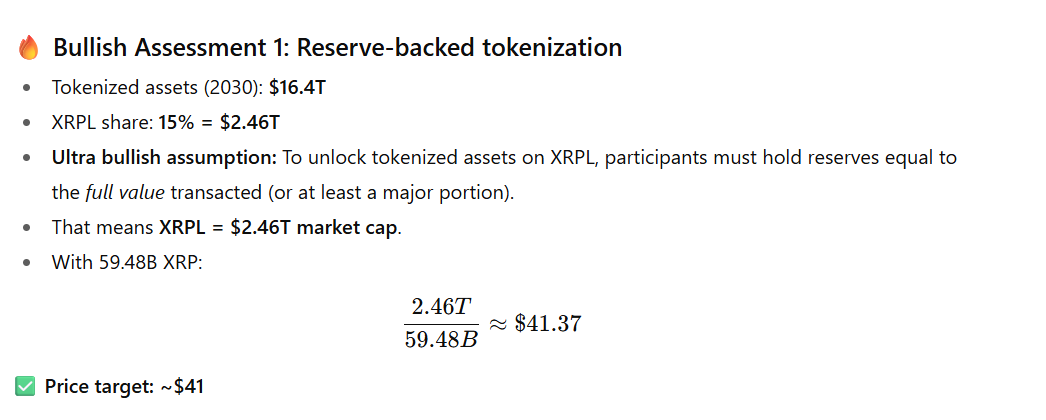
To have an assessment, we asked OpenAI’s chatbot ChatGPT. According to ChatGPT, in a bullish scenario where reserves on XRPL fully back tokenized assets, XRP’s market cap would equal $2.46 trillion. With 59.48 billion tokens in circulation, that would push the price to around $41. 

XRP Reserve Backed Tokenization Assessment ChatGPT
XRP Reserve Backed Tokenization Assessment | ChatGPT

However, this would likely not be the case, as tokenization value does not translate to market valuation. For instance, today, the XRPL houses around $306.8 million in tokenized assets, but XRP has a market cap of $168 billion.

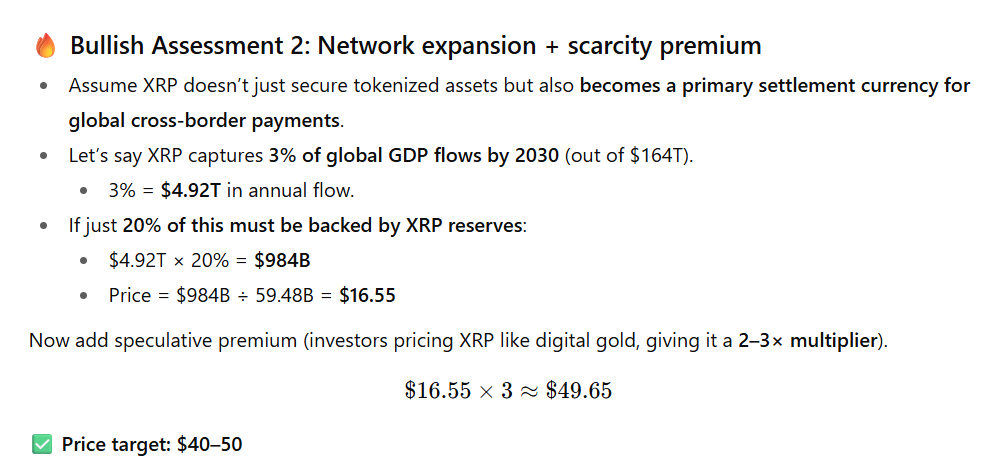
Meanwhile, ChatGPT also considered another case where XRP expands beyond tokenization and becomes a major settlement currency for cross-border payments. If XRP handles 3% of global GDP flows, roughly $4.92 trillion in 2030, and 20% of that flow requires XRP reserves, the total would come to $984 billion. 

XRP Network Expansion Assessment ChatGPT
XRP Network Expansion Assessment | ChatGPT

Specifically, this directly translates to $16.55 per token. However, factoring in speculative premiums, ChatGPT placed the price range between $40 and $50.

Meanwhile, in a more ambitious “moonshot” scenario, ChatGPT suggested that if XRP captures a share of both tokenized assets and cross-border payments, its value could break past $100.

XRP Bullish Moonshot Target ChatGPT
XRP Bullish Moonshot Target | ChatGPT

US Fed to Host Public Forum on Future of Digital Payments

0

The U.S. Federal Reserve has announced that it will host a Payments Innovation Conference in October.

The gathering will explore how emerging technologies are reshaping the financial system. Regulators, academics, technology experts, and financial institutions participate in a full day of panels and discussions.

Notably, the event will cover some of the most debated innovations in the industry. These include stablecoin business models, tokenization of assets and services, the convergence of traditional and decentralized finance, and the role of artificial intelligence in payments.

According to the Fed, the conference will also provide an opportunity for industry leaders to share perspectives on the opportunities and risks in these technologies.

Fed’s Emphasis on Safety and Efficiency

In a statement announcing the event, Federal Reserve Governor Christopher Waller said that innovation has always been a driving force in payments. He noted that consumers and businesses are demanding faster, safer, and more flexible options. As a result, regulators must evaluate new approaches.

Waller added that the conference would serve as a platform for exchanging ideas. These discussions will center on enhancing the security and efficiency of the payment system.

Importantly, the Fed confirmed that the proceedings will be livestreamed and made publicly available on its website. This move ensures transparency and provides wider access to the debates.

Policy Shifts Signal Openness to Crypto

The Fed’s decision to organize such a forum comes amid a noticeable change in its policy stance toward digital assets. Earlier this year, the central bank withdrew guidance that had discouraged banks from engaging in crypto and stablecoin activities.

It also ended special supervisory programs that were tasked with overseeing banks involved in cryptocurrency businesses. Additionally, the removal of the “reputational risk” classification from bank examinations is also a step toward normalizing banking relationships with crypto firms. 

These moves have been welcomed by industry participants who argued that prior rules effectively led to “crypto debanking.”

Stablecoins Gaining Recognition in Policy Circles

Stablecoins remain one of the most discussed areas of innovation. The minutes from the July meeting of the Federal Open Market Committee (FOMC) suggested that fiat-pegged stablecoins could play a useful role in enhancing payment efficiency.

Committee members also observed that greater adoption of stablecoins could increase demand for high-quality collateral, particularly U.S. Treasury securities.

This marks a significant acknowledgment from the Fed that such digital instruments may complement the existing financial system rather than pose a threat to it.

By spotlighting stablecoins and tokenization, the Fed is signaling that it sees these technologies as more than passing trends. Instead, they are building blocks of the future financial system, capable of reducing friction in cross-border transactions, improving settlement speed, and opening new avenues for financial inclusion.

Cardano Founder Demands Apology from Critics After Audit Confirms 99%+ ADA Vouchers Redeemed

0

A recent forensic audit and investigative report has exonerated Cardano founder Charles Hoskinson of all allegations tied to the project’s ADA voucher program. 

Cardano’s development arm, Input Output Global (IOG), released the 128-page investigative report and forensic audit.

The investigation, carried out by accounting firm BDO and law firm McDermott, Will & Schulte, examined Cardano’s voucher program, its blockchain upgrades, voucher redemptions, and how the ADA linked to unredeemed vouchers was utilized. 

Controversy Surrounding ADA Initial Sale 

Unlike most crypto projects, the team behind Cardano used a voucher system for its initial fundraising and ADA distribution. Instead of allowing investors to purchase ADA directly, the team sold vouchers to early investors in different phases. 

Following the mainnet launch of the Cardano network, users can redeem these vouchers for ADA tokens. Several years after the redemption, rumors began circulating that Hoskinson and IOG had misappropriated $600 million worth of ADA linked to the program. 

Critics alleged that the Cardano founder embedded hidden code in the 2021 Allegra hard fork to manipulate the blockchain. Despite denying the claims, Hoskinson emphasized the need for an audit to dismiss the allegations. 

Consequently, the IOG employed the services of BDO and McDermott to investigate the voucher program in May. 

Investigation Scope 

Their investigation focused mainly on five allegations, including misleading sales practices employed in the voucher program, insiders’ misuse or theft of ADA belonging to voucher holders, and blockchain upgrades blocking ADA redemption. 

The investigation also focused on claims that the blockchain upgrade deleted voucher holders’ private keys and that unredeemed ADA was improperly redirected to Cardano Development Holdings (CDH). 

Findings 

After reviewing thousands of documents, conducting forensic analysis of on-chain and off-chain data, and interviewing 18 current employees, BDO and McDermott concluded that the claims are baseless. 

They shared data showing that users successfully redeemed 14,282 vouchers, which represents 25,850,401,508 (roughly 25.9 billion) ADA tokens. This accounts for 99.2% of the total ADA tokens sold in the voucher program. 

According to the report, users redeemed 97% of these vouchers by the end of Cardano’s first development phase — the Byron era. Notably, as of August 15, 2025, that figure spiked to 99.2%. 

Furthermore, the report indicated that the IOG legally transferred the remaining unclaimed ADA to CDH. The funds were subsequently earmarked for Intersect-powered community projects and ecosystem development. 

In conclusion, the report found that the IOG acted diligently in handling the Cardano voucher program. 

Cardano Founder Hoskinson Seeks Apology 

Reacting, Hoskinson suggested that he expects critics who publicly accused him to apologize, especially now that the audit has debunked the allegations leveled against him. 

Ukraine Approves First Draft of Bill to Legalize and Tax Bitcoin

0

Ukraine’s parliament has approved the first draft of a bill that seeks to legalize crypto and introduce a new tax regime on profits from crypto transactions.

According to MP Yaroslav Zhelezniak, who shared the update on his Telegram channel, the measure secured 246 votes in favor, signaling strong political support.

The proposal is part of Ukraine’s broader effort to modernize financial regulation and align with international standards. Officials believe clear taxation rules could boost state revenues while encouraging legitimate use of digital currencies.

Tax Rates and Incentives

The draft law outlines a dual tax structure. Profits from cryptocurrencies, such as Bitcoin, would be subject to an 18% income tax and a 5% military tax. This brings the total to 23%. This figure is consistent with earlier recommendations from Ukraine’s financial regulator.

To encourage early compliance, the bill proposes a preferential 5% tax on converting crypto into fiat currency during the first year of implementation. Lawmakers hope this incentive will smooth the transition and attract more users into the formal system.

Regulatory Authority Still Undecided

While the bill lays out clear tax obligations, it leaves open the question of oversight. Lawmakers have not yet determined whether the National Bank of Ukraine or the National Securities and Stock Market Commission will supervise the sector.

MP Zhelezniak has said that amendments are expected before the bill’s second reading. He also emphasized that the current draft is a starting point only and may undergo significant revisions.

Ukraine’s Strong Position in Global Adoption

Ukraine is already recognized as one of the world’s most active crypto markets. In the 2025 Global Crypto Adoption Index by Chainalysis, the country ranks eighth overall. It performs especially well in categories such as centralized trading volumes and DeFi participation, highlighting its broad appeal.

Digital assets have played a crucial role in Ukraine’s economy, particularly since its war with Russia in 2022. They have facilitated fundraising, cross-border payments, and financial support to communities. Observers note that this unique context has accelerated crypto adoption compared to many other countries.

Global Shift Toward Crypto Taxation

Ukraine’s initiative comes as more governments worldwide are formulating policies for digital assets.

In Denmark, the Tax Law Council proposed in October 2024 to tax unrealized crypto gains, though the measure is still under review.

Brazil followed a different path in June 2025 by ending its previous exemptions and introducing a 17.5% flat tax on crypto profits. 

In the United States, representatives in the lower legislative chamber were scheduled to hold a hearing in July 2025 on a framework for taxing crypto assets.

Top Investor Shares Personal Plan to Make $1,000,000 with XRP

0

Veteran crypto investor Austin Hilton has revealed his personal roadmap for turning his XRP holdings into a million-dollar profit.

Hilton explained that his approach is straightforward, long-term, and built on discipline rather than complicated tactics.

Long-Term Hold Strategy

Specifically, Hilton noted that his main approach revolves around buying and holding XRP over the years. He said he has accumulated XRP steadily and plans to hold until the asset reaches at least a 30x return from current levels.

That translates to an XRP price target of around $80–$90, which he believes is achievable in the future. For Hilton, patience and long-term vision are the cornerstones of his profit strategy. In his words:

“I think XRP will go beyond that. And I don’t really care how long it takes—whether it takes a year or two, three, four, or five. I’m going to hold.”

This aligns with the perspective of other XRP commentators who urge investors to secure a bag of 10,000 tokens and remain patient for the coin to enter the triple-digit range, enabling portfolios to reach million-dollar levels.

In July, investor Armando Pantoja said he is willing to wait for XRP to eventually reach $1,000 per coin, even if it takes over 10 years. This price outlook would make modest holdings worth $2,850 today (1,000 XRP) grow into a million-dollar fortune.

Consistently Buying XRP, Even in Red Markets

The second component of Hilton’s plan is consistent accumulation. He claims to continue buying XRP weekly, regardless of market conditions.

Instead of being discouraged during downturns, he views red days as opportunities to acquire more at a discount. He stressed that while others panic and sell, his focus remains on strengthening his portfolio for the long run.

“So, I continue to buy even on the red days. Why? Because buying at $2.85 is still a deal relative to where it’s going to be,” he said.

Don’t Sell on Fear

Hilton also noted that it is important to stay unemotional. He said he avoids selling during market crashes or reacting to negative narratives suggesting XRP could fail. Instead, he treats dips as entry points, as he believes XRP, and crypto more broadly, are here to stay.

Hilton dismissed the idea that making money with XRP requires complicated strategies. For him, success boils down to three things: holding long-term, consistently buying, and blocking out short-term noise.

While XRP won’t create overnight millionaires, he believes time and disciplined investing will deliver results.

Diversify, Not Just XRP

In addition to holding XRP, Hilton also uses swing trading tools to expand his profits. However, he emphasized that these are secondary to his main XRP strategy, which he believes is simple but effective.

Notably, Hilton also emphasized the importance of diversification in crypto. He noted that he owns stocks, bonds, mutual funds, and other crypto assets in addition to XRP. He advised against putting all eggs in one basket, as this could expose one’s portfolio to risk.

Here’s How High XRP Could Soar if Ethereum Reaches $62,000, as Predicted by Tom Lee

0

Widely followed XRP analyst Cryptoinsightuk has shared how high he believes XRP could go if Ethereum reaches $62,000.

In recent months, there have been growing discussions about ETH prices reaching unprecedented levels. One of the boldest forecasts for Ethereum that has gained traction is the $62,000 target popularized by Fundstrat’s Tom Lee.

Meanwhile, some are now considering the broader implications of such a price level for the altcoin market. For instance, Cryptoinsightuk suggested that XRP could soar to $50 if ETH were to surpass $62,000 this cycle, as Lee predicted.

Tom Lee’s Path to $62,000 for Ethereum

In a recent analysis shared by Altcoin Daily, Tom Lee explained the foundation of his bold case for Ethereum reaching $62,000, citing the Wyckoff methodology.

According to Lee, Ethereum’s current market structure resembles a massive “base,” similar to the one that preceded its 54x rally from $90 in 2020 to its all-time high of $4,866. With the new base forming from the $1,385 level, Lee argues that Ethereum is building potential energy for another outsized breakout.

Ethereum-to-Bitcoin Ratio Analysis

Another key factor in Lee’s projection is the Ethereum-to-Bitcoin ratio. The long-term eight-year average sits at 0.0479, while the current ratio lingers below that at 0.0403. Meanwhile, the 2021 peak reached 0.0807.

Lee believes Ethereum not only has room to return to its historical average but could also surpass prior highs—especially as it becomes the preferred chain for Wall Street to build payment rails and financial infrastructure.

Fundstrat models Ethereum’s potential price levels using different Bitcoin targets and ETH/BTC ratios. If Bitcoin climbs to $250,000 and Ethereum returns to its average ratio, ETH could range between $12,000 and $22,000.

However, factoring in Ethereum’s role in replacing traditional banking payment rails, Lee suggests its implied value could climb as high as $62,000, corresponding to an ETH/BTC ratio of 0.25.

Technical Outlook: $9,000 by Early 2026

Adding to the bullish case, Fundstrat’s technical strategist Mark Newton projects Ethereum could reach $5,500 by September 2025 and as high as $9,000 by early January 2026. While not as extreme as Lee’s long-term scenario, Newton’s technical analysis underscores strong upward potential in the next cycle.

What a $62,000 ETH Means for XRP and the Altcoin Market

For context, Ethereum is trading at $4,315 today, after dipping 13% from its all-time high of $4,953. The journey from here to $62,000 requires a growth of 1,337%. Notably, this aggressive target could give Ethereum a market cap of approximately $7.48 trillion.

Meanwhile, Bitcoin would need to be trading somewhere near $500,000 to maintain a significant lead ahead of Ethereum. Together, both would command a market cap of over $17 trillion in these ambitious scenarios.

Given their historical 72.4% dominance, the global crypto market could be close to $24 trillion. This would leave the broader altcoin market with around $7 trillion.

Cryptoinsightuk believes XRP could command the next biggest share of the market, with a $50 unit price equating to about $3 trillion. Indeed, XRP currently trails only Bitcoin and Ethereum in the crypto rankings. Notably, XRP demands a growth of 1,685% from its current position to reach $50.

However, he also stated that he does not expect these ambitious price scenarios to play out in this cycle or anytime soon. He instead stressed that while Tom Lee’s aggressive $62,000 ETH prediction is receiving applause, a similar outlook for XRP is often met with widespread criticism and skepticism, with many calling such projections unrealistic.

Analyst Warns XRP Must Push to $22, or the Cycle Top Is Already In

0

A well-known market technician believes XRP will likely rally by another 674% to a two-digit price if it hasn’t already topped for this cycle.

Analyst EGRAG Crypto said this while discussing XRP’s current price position and its future outlook. For context, after dropping from the $3.66 peak in July to a floor price of $2.69 on Sept. 1, XRP appears to have entered a recovery phase, having gained 5.57% since the recent floor.

Does XRP Have More Room for Growth?

Meanwhile, discussions around XRP’s top price for this bull run have gained steam. While some believe there is no more room for growth beyond the $3.66 high, others insist there is, but suggest the potential push beyond $3.66 may likely not be by a large margin.

For instance, market watcher Crypto Rover predicted late last month that while Ethereum (ETH) could reach a peak of $9,500 in the next four months, XRP may only see a top price of $4.8 within this period. This represented a mild 57% increase from its price at the time.

However, EGRAG disputed claims that XRP may top out at $4, projecting much higher targets. In his latest analysis, he still dismissed these claims but included an important nuance for a better market outlook.

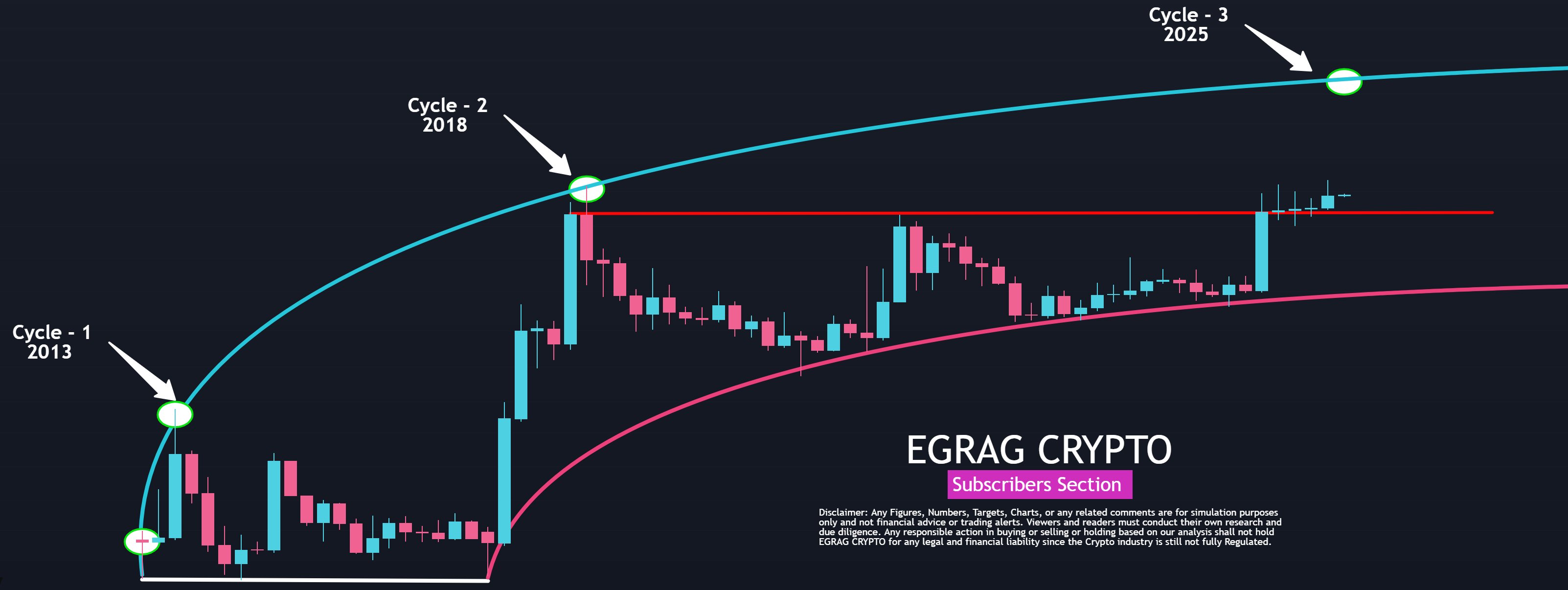
According to EGRAG’s recent disclosure, if XRP is incapable of reaching his lofty $22 target, then it has already topped at $3.66, and there’s no in-between. He presented a chart detailing XRP’s historical price movements as a guide to his forecast.

While he placed the chart and broader analysis behind a paywall, exclusively for subscribers, the analyst provides a sneak peek for onlookers. Specifically, his chart features two curves at the top and bottom. The top curve has marked XRP’s peak for each cycle, while the bottom one has marked its bottom.

If XRP Has Not Topped, Then Its Peak Lies Around $22

For instance, in Cycle 1, when XRP hit the top curve at a price of $0.0614 in December 2013, this marked the top of that cycle. Meanwhile, in Cycle 2, XRP retested the top curve at a price of $3.31 in January 2018. Expectedly, this represented the top for that cycle.

XRP Chart EGRAG Crypto
XRP Chart | EGRAG Crypto

However, in this cycle, despite XRP reaching a new peak of $3.66 in July, its price action is still far below the top curve. This essentially suggests that XRP might still have more room for growth before reaching its top for this cycle.

Notably, EGRAG’s chart shows that the top curve aligns with an XRP price of around $22, which represents a 674% increase from the current price of $2.84. The market analyst believes that if XRP still has more upside potential, then the next uptrend would take prices to this level.

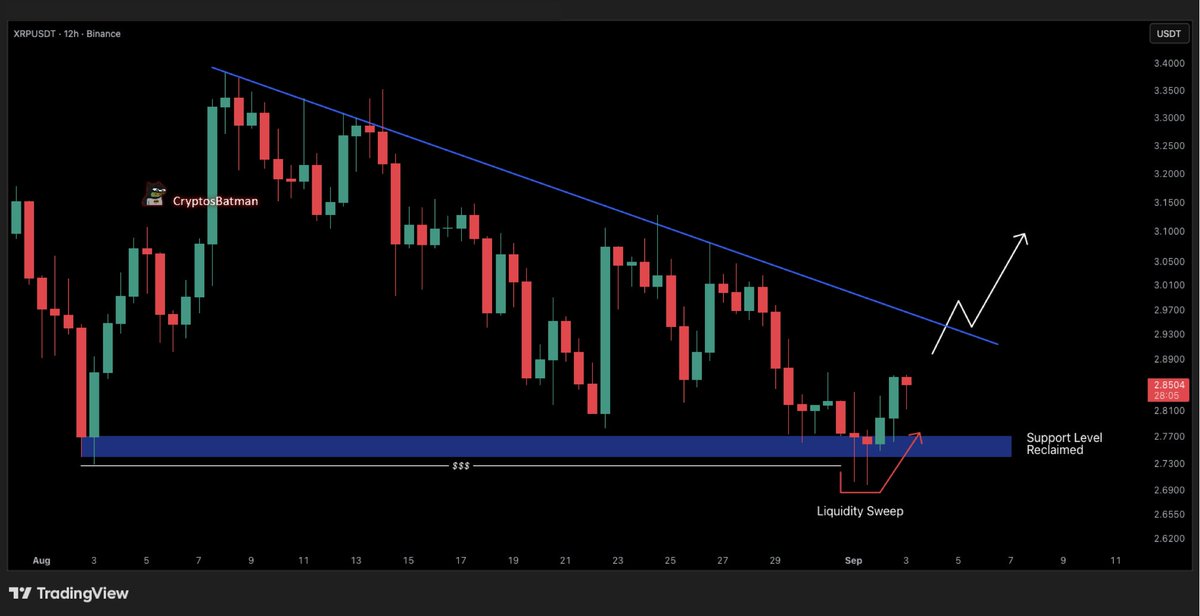
However, EGRAG suggests the other possibility is that XRP would not observe another upward push, but maintain $3.66 as its peak, the same way it missed the top curve during the 2021 run. Nonetheless, multiple analyses do not agree with this. For instance, Batman recently predicted an imminent push higher after XRP swept liquidity and found support around $2.7.

XRP 12h Chart Batman
XRP 12h Chart | Batman

Shiba Inu Announces 40,453,074 SHIB Giveaway to Celebrate This Historic Milestone

0

Shiba Inu’s ecosystem team has unveiled a special giveaway to celebrate SHIB’s debut on the first-ever cross-chain lending market. 

The announcement comes barely a few hours after Chainlink’s flagship project Folks Finance listed Shiba Inu on its cross-chain lending markets. The initiative aims to allow users to lend and borrow SHIB across 12 blockchains, including Polygon, Avalanche, Arbitrum, and Base. 

New SHIB Giveaway 

Shortly after the announcement, Shiba Inu unveiled a special giveaway to celebrate the historic milestone of its first-ever listing on cross-chain lending markets. 

To celebrate the development, the Shiba Inu ecosystem team will reward one lucky community member with $500 worth of SHIB. This is equivalent to 40,453,074 (40.45 million) SHIB tokens, given the asset’s current price of $0.00001236.  

Qualification Requirement 

To participate in the giveaway, participants must like and repost Folks Finance’s announcement about SHIB’s cross-chain lending market listing. 

Users must also follow the official X handles of Folks Finance and that of Shiba Inu. Lastly, participants are mandated to tag three friends in the comment section of the giveaway announcement. 

The giveaway, which began yesterday at 07:49 PM (UTC), will run for 48 hours. This implies that the giveaway event will end on September 5, at 7:49 PM (UTC). 

xAI Grok to Select Winner

Interestingly, Shiba Inu will utilize xAI’s chatbot, Grok, to determine the winner of the giveaway, ensuring transparency and fairness. 

According to the announcement, the AI model will randomly select one lucky winner after 48 hours have elapsed. In the meantime, the giveaway has attracted strong participation from the Shiba Inu community. Despite only being unveiled just a few hours ago, the giveaway has 1,300 comments, 1,500 reposts, and 2,100 likes. 

This promo is part of an effort to reward loyal Shiba Inu community members and also boost awareness for SHIB’s cross-chain integration into Folks Finance’s lending markets. 

Shiba Inu’s move into the cross-chain lending space extends its utility beyond meme culture, positioning the token within blockchain-based financial services. 

Besides Shiba Inu, Folks Finance also announced special incentives for users who deposit their SHIB tokens in its lending markets. Depositors are currently earning a 9.08% annual percentage yield (APY). 

The incentive is already paying off as the amount of SHIB deposited now stands at $32,000, representing a 28% spike from the $25,000 reported yesterday.