Home Blog Page 555

R-Squared Value of XRP Shows Next Target Could be Epic

0

A well-known market analyst has insisted that the next XRP target will be epic, as XRP continues to follow his bullish structure.

This disclosure came from EGRAG Crypto, which has persistently suggested that XRP still has more room to grow in this cycle. In his latest market commentary, EGRAG reiterated this stance, calling the investing community’s attention to the R-squared value for XRP in relation to a previously highlighted regression model.

The XRP R-Squared Value Around Its Regression Model

For the uninitiated, the regression model EGRAG used is a method that helps track and predict XRP price movements over time. Essentially, it maps XRP’s past prices on a log scale and produces a trend line with upper and lower bands (set by standard deviations) that present the most likely price ranges moving forward.

Meanwhile, the R-squared value shows how well this regression model matches the real price data. It indicates how much of the price movement can be explained by the model rather than by random chance. 

Notably, a higher R-squared, closer to 1, means the model does a good job of capturing the actual trend, showing high correlation. Meanwhile, a lower value, closer to 0, means the model isn’t very reliable in explaining what’s happening with the price. This indicates low correlation between the model and actual price action.

XRP R Squared Value EGRAG Crypto
XRP R Squared Value | EGRAG Crypto

EGRAG has confirmed that the R-squared value currently sits at 0.84754, which means the model explains about 85% of XRP’s price movements. This is important because it confirms that XRP is following this regression model closely, making its price action highly predictable by using the model.

What XRP Target Does the Model Predict?

Interestingly, the regression model predicts some bullish price action for XRP in the near future. EGRAG highlighted this in a previous market report, revealing that XRP has the potential to reach one of three targets depending on how it interacts with the upper regression line.

Currently, XRP trades slightly above the mid-line, and a push to the upper line could take XRP to a price of $18, $27, or $200. Specifically, if XRP misses the top regression line by 45% as it did in April 2021, its top price would only sit around $18. 

However, if it perfectly hits the top line as it did in December 2013, May 2017, and September 2018, the price would sit at $27. Meanwhile, an overshoot over the top regression line, similar to what happened in January 2018, would push the XRP price to an ambitious $200. As a result, EGRAG insists the next XRP target would be epic.

This indicates that any of the three outcomes would still bode well for XRP, resulting in a 514% to 6,725% uptick from the current price of $2.93. However, EGRAG’s most referenced XRP target is the $27 price, which the analyst has consistently championed over multiple analyses. For context, XRP would need to rise 821% to hit the $27 target.

On-Chain Labor Proof: Fedrok AG Pilots In Ghana’s Cocoa Supply Chain

0

Ten-year-olds still swing machetes on Ghanaian cocoa farms that feed global chocolate giants. After decades of industry promises, over 1.5 million children work in conditions that would be illegal anywhere else.

Swiss blockchain firm Fedrok AG and Ghanaian agribusiness FarmRight Ghana have launched a pilot designed to help prevent child labor from cocoa and palm oil supply chains. The initiative marries Fedrok’s “Proof-of-Green” blockchain with FarmRight’s deep-rooted credibility among Ghanaian farmers, creating a system that aims to be transparent, tamper-proof, and, most importantly, scalable.

The initiative targets a problem that has persisted despite years of industry commitments. Ghana produces approximately 20% of global cocoa, yet investigations continue to find young children working in dangerous conditions on supplier farms.

“Transparency is the key to ending child labor, and blockchain can deliver that,” said Dr. Philip Blazdell, Fedrok’s CEO.

Here’s how it works in practice. When farms hire workers, they scan palm veins for identification. To verify ages, the data is compared with government records. Once on the blockchain, the data itself is immutable, but the integrity of the system depends on the integrity of this initial, on-the-ground process to prevent fraudulent records from entering the system.

Every employment contract gets permanently recorded on Fedrok’s blockchain. Independent and surprise audits get logged with digital signatures and timestamps. Anonymous community tips get stored where they can’t disappear. Most importantly, farms that prove they’re child-labor-free gain a blockchain-verified “seal” that grants them access to premium buyers who are willing to pay more for ethically sourced cocoa. This economic reward, rather than a top-down mandate, is what could make this initiative sustainable where others have faltered.

“It’s not enough to tell farmers to do better,” Randy Boaitey, founder of FarmRight Ghana explained. “We’re making sure that doing better actually pays.” The long-term viability, however, will hinge on farmers seeing a clear return on the necessary initial investment in the technology, which includes biometric scanners, training, and reliable internet connectivity in remote areas, with offline/low-bandwidth workflows for patchy coverage.

This matters because regulation is coming whether companies like it or not. The European Union’s Deforestation Regulation will soon require companies to prove their supply chains are free from human rights abuses and environmental damage. The upcoming Corporate Sustainability Due Diligence Directive extends these requirements further. Companies caught with child labor in their chains face massive fines and market exclusion. Nestlé, Mars, and Mondelez have all made public commitments to stop child labor from their supply chains. However, progress has been slow and verification difficult.

The system utilizes Fedrok’s Layer-1 blockchain, an EVM-compatible blockchain that is optimized for high-frequency ESG data logging. In addition to handling multiple compliance frameworks, the infrastructure integrates with existing certification systems.

Fedrok takes a different approach from most crypto companies. Instead of engaging in speculative trading, they solely concentrate on environmental and social impact. CEO Blazdell calls himself a ‘systems engineer,’ not a ‘crypto entrepreneur.’

The company’s “Proof-of-Green” consensus mechanism rewards blockchain activity powered by renewable energy. Their FDK token links on-chain activities to measured environmental impact by reflecting certified carbon results. Fedrok has earned ISO 9001 and ISO 14001 certifications and applied for membership with VQF, a FINMA-recognised self-regulatory organisation (SRO) under Switzerland’s AML Act. This compliance-first approach targets institutional clients demanding verifiable sustainability credentials.

“We’ve long fought for organic and sustainable farming,” Boaitey said. “Now we have a tool that gives proof of fairness to the world.”

Ghana represents one front in Fedrok’s global expansion. In India, the company partners with TechXEarthSpace on underground CO2 sequestration projects. In Papua New Guinea, their T4G Pay platform enables indigenous landowners to receive verified payments for mangrove restoration. In Madagascar, they’re piloting “Cash for Trash” programs that transform community recycling into tradeable digital assets.

For Ghana’s cocoa industry, the experiment represents a test of whether technology can succeed where traditional oversight has failed. Plans include partnerships with government ministries and certification bodies. Shoppers might soon scan QR codes to verify their chocolate came from verified child-labor-free farms. The country’s 800,000 employed farm families could gain access to premium markets and carbon financing if the system proves scalable.

If successful, the model could extend beyond Ghana to other cocoa-producing regions in West Africa and to additional crops where child labor remains endemic. The blockchain infrastructure is designed to be replicable across different countries and regulatory frameworks.

Whether this finally solves a problem that has resisted decades of corporate promises remains to be seen. Traditional oversight failed because it was expensive, infrequent, and easy to manipulate. On-chain records are constant and tamper-evident, the cost driver is field verification and making sure bad data can’t enter in the first place.

The children working Ghana’s cocoa farms have heard plenty of promises before. This time, the verification system doesn’t rely on trust. It runs on math, cryptography, and economic incentives that make protecting children more profitable than exploiting them.

If it works, chocolate might finally taste sweeter.

Chainlink Partners with US Government to Bring Economic Data On-Chain

0

In a landmark move, Chainlink has partnered with the U.S. Department of Commerce (DOC) to deliver key macroeconomic data from the Bureau of Economic Analysis on-chain.

This initiative makes information surrounding Real Final Sales to Private Domestic Purchasers, real GDP, and the Personal Consumption Expenditures Price Index available to developers and protocols within blockchain ecosystems.

The data, updated monthly or quarterly, will initially be accessible across ten networks. They include Ethereum, Avalanche, Arbitrum, Botanix, Base, Optimism, Linea, Sonic, Mantle, and ZKsync.

Chainlink Expands Use Cases for Blockchain Markets

By delivering trusted government statistics on-chain, Chainlink is opening the door to new applications in DeFi and beyond.

Potential use cases include automated trading strategies, tokenized asset management, prediction markets, and risk analysis for lending protocols. Developers can now integrate these feeds directly through Chainlink’s infrastructure.

This marks a major step toward merging traditional economic data with decentralized markets. It enables greater transparency, efficiency, and real-time responsiveness.

Notably, the Chainlink–U.S. government partnership comes after months of speculation about the U.S. government adopting a blockchain network to enhance transparency. The initial secrecy around which chain would be adopted led to multiple rounds of speculation within the crypto community.

As a result, the recent announcement has sparked an industry-wide reaction. Reacting to the news, Nate Geraci, president of ETFStore, remarked that the crypto ecosystem is evolving faster than many can keep pace with.

Chainlink’s native token, LINK, is fast benefiting from the momentum. The coin has surged 5% at press time, despite a largely stagnant crypto market.

Strengthening Ties with US Regulators

Meanwhile, this partnership builds on Chainlink’s engagement with U.S. policymakers. In recent years, the project has collaborated with the SEC and participated in high-level discussions with lawmakers, including Senator Tim Scott and the President’s Working Group on Digital Assets.

Chainlink’s role was also recognized during the signing of the GENIUS Act—the landmark federal framework for stablecoins—where co-founder Sergey Nazarov joined government and industry leaders.

Priding itself as the industry-standard oracle provider, Chainlink said it secures billions in value across DeFi and has partnered with institutions such as SWIFT, Fidelity International, and UBS.

With the DOC collaboration, Chainlink is now further showing how oracles can serve as critical infrastructure for connecting government data with blockchain markets.

This move marks a major advancement in on-chain innovation. It also shows growing recognition of blockchain’s role in financial infrastructure at the highest levels of government.

Cardano Founder Says SWIFT and Legacy Financial Systems Are Going to Die

0

Cardano founder Charles Hoskinson has criticized traditional financial infrastructures, particularly SWIFT, forecasting their eventual demise. 

Speaking in an interview on the David Lin Report, Hoskinson predicted that SWIFT and other large traditional financial systems will eventually “die” due to their inability to sustain themselves. 

He backed up this claim by pointing to several shortcomings of legacy financial systems. In his view, legacy financial systems have numerous complexities and also impose high trust requirements, which can be frustrating for everyday users. 

Despite efforts to maintain secure transactions, he stressed that traditional financial systems remain vulnerable to fraud. 

Comparing Wire Transfers and Blockchain Transactions 

Interestingly, Hoskinson compared wire transfers with blockchain transactions to showcase the inefficiencies of traditional financial systems. According to him, sending a wire transfer requires multiple disclosures, fraud checks, and even post-transfer verification calls from the financial institution. 

However, he suggested that it is easier to complete a transfer from a multi-signature wallet, such as Ledger. He argued that blockchain solutions provide superior security and greater ease of use. With biometric authentication from an Android or iOS device, Hoskinson said the blockchain system confirms the user’s identity instantly. 

Moreover, Hoskinson noted that blockchain transactions are near-instant and cheap with no intermediary interrogating the sender. 

“Legacy Financial System Is Broken”

Given the disparity between legacy financial infrastructure and blockchain-powered alternatives, the Cardano founder said the former is a broken system. He added that traditional systems will no longer be viable once people start using competitors, especially blockchain-powered payment systems. 

Hoskinson’s remarks suggest that traditional financial infrastructures, such as SWIFT, are outdated and destined to decline due to inefficiencies. Other major crypto stakeholders, like Eric Trump, have echoed a similar sentiment. 

As previously reported, the second son of the U.S. President also believes that the current traditional financial infrastructure is broken. He cautioned that unless traditional banks reform their operations, they risk going into extinction over the next 10 years. 

In the meantime, traditional financial institutions are enhancing their operations with blockchain. A case in point is JPMorgan’s use of its blockchain-based Onyx platform for instant payments. Also, SWIFT is in an active partnership with Chainlink to enhance its operations.

Tether to Launch USDT Natively on Bitcoin

0

Tether has announced that it will launch its stablecoin USDT natively on Bitcoin through the recently launched RGB Protocol.

Tether, which is the largest stablecoin issuer, shared this in its blog post in August, marking a breakthrough for tokenized assets on Bitcoin. USDT would become the first-ever native stablecoin on the Bitcoin network, leveraging RGB technology to enable the trading of the dollar-pegged token.

USDT Comes Natively to Bitcoin

The entire architecture of the Bitcoin blockchain has ensured that tokenized assets do not exist natively on the “most secure and decentralized network.” Nonetheless, RGB aims to address this with its next-generational technology.

The protocol launched on the Bitcoin mainnet in mid-July with its 0.11.1 release, ushering in compatibility for smart contracts and asset issuance systems. It came with tokenization tools that allow users to create and send digital assets on the Bitcoin and Lightning Networks.

Now, Tether is leveraging this protocol to launch USDT natively on the Bitcoin blockchain. This ensures that users can transact the stablecoin directly on the network, bringing lightweight payments to the billions of users who use it.

Notably, the technology enables users to hold and move Bitcoin and USDT through the same wallet while maintaining their lightweight and confidential nature. The transactions are processed off-chain, allowing users to enjoy the same privacy and decentralization benefits associated with the Bitcoin network.

The Native Smart Contract Functions that Bitcoin Deserves

Reacting to the development, Tether CEO Paolo Ardoino insisted that Bitcoin is finally getting the stablecoin feel that it deserves. He added that USDT would gain a “new pathway with Bitcoin” through the RGB Protocol, reestablishing its long-standing sentiment that the leading cryptocurrency should offer more to users beyond its reputation as a store of value.

Moreover, this is just one of the broader efforts to roll out DeFi for Bitcoin users. Industry leaders have tipped this push to unlock trillions of dollars in liquidity domiciled on the Bitcoin network to other chains, boosting transactional activities and TVL of all involved parties.

Remarkably, Ardoino earlier teased the prospect of USDT’s availability on the Bitcoin network in April, calling it a return to its natural habitat. He confirmed that the stablecoin will launch on the Bitcoin Lightning Network during the interview, powered by Taproot Assets.

Meanwhile, with RGB, users can do more. The protocol also allows users to hold and move non-fungible tokens (NFTs) and custom tokens within the Bitcoin ecosystem.

Onchain Sleuth ZachXBT Claims XRP Holders Are Exit Liquidity, and Provide No Value to the Industry

0

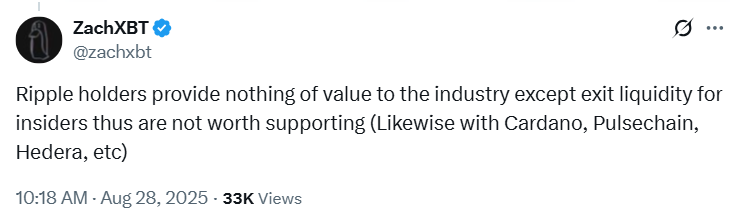
Blockchain investigator ZachXBT has criticized XRP and its holders, claiming they provide nothing of value to the broader crypto industry.

In a recent disclosure, the on-chain sleuth confirmed that he does not provide support to the XRP community and even revealed he will mock anyone from the community who reaches out to him for help.

ZachXBT Says XRP Holders Bring No Value to the Industry

When asked why he takes such a hard stance, Zach claimed that XRP investors, which he called “Ripple holders,” bring nothing of value to the industry. 

He argued that their only role is to provide insiders with exit liquidity and placed XRP in the same category as Cardano, Pulsechain, and Hedera. According to Zach, none of these chains create meaningful contributions worth backing.

ZachXBT Takes Aim at XRP

Meanwhile, responding to questions earlier this month about why everyone in the broader crypto community seems to hate XRP, Zach presented some reasons that bordered on supply distribution and “bad mechanics.” 

He pointed to insiders holding large amounts of supply, marketing strategies that he said misrepresent paid partnerships as real adoption, the loss of early XRPL blocks, weak mechanics, and the lack of strong analytics tools for the network.

Zach’s Consistent XRP Criticisms

Notably, this is not the first time Zach has gone after XRP. Over the years, he has repeatedly claimed that holders serve only as exit liquidity for Ripple’s founders. 

Back in March, he argued that one of the best ways to judge a chain’s legitimacy was by checking how many native stablecoins major issuers like Circle, Tether, or Paxos had deployed on it. At the time, he pointed out that both Cardano and XRP had none.

However, three months later, in June, Circle launched USDC on the XRP Ledger. Circle explained that businesses, exchanges, and developers could now use USDC across a wide range of financial services on XRPL. 

Nonetheless, Zach has maintained his criticisms. Despite these developments, he remains one of the most visible voices around Ripple. In January 2024, he was the first to draw attention to the $112.5 million hack that drained XRP from Ripple co-founder and chairman Chris Larsen’s wallet.

Community Reactions

Meanwhile, Zach’s latest remarks have triggered mixed reactions from within the XRP community. Eri, a prominent voice among XRP supporters, called the situation a real shame. 

She said Zach had built his reputation as a trusted on-chain investigator who helped track down bad actors. She added that he had worked closely with Ripple through TRM Labs, which had only recently praised him publicly. Eri urged him to reconsider his stance, stressing that many still respect his work.

Meanwhile, Vet, an XRPL dUNL validator, pointed out that the XRP community continues to face criticism from all angles: first from Bitcoin maximalists, then from Chainlink supporters, and now from Zach. He suggested that the community should embrace the scrutiny.

However, Eminence CTO Daniel Keller argued that the uproar over Zach’s decision not to help further was another case of unnecessary XRP drama. Keller said people who neither pay for nor contribute to a service should not complain when someone refuses to continue offering it. He called the situation peak audacity.

Another community member disagreed with this stance, saying the backlash had little to do with Zach stepping away and more to do with him implying XRP itself was worthless.

$100 XRP Could Be Life-Changing: Experts Reveal How Many XRP You’d Need to Become a Millionaire

0

Crypto commentators Abdullah “Abs” Nassif and Johnny broke down the latest XRP Rich List update.

They leveraged the data to offer fresh insight into how many tokens investors need to join the top percentiles of holders. This came up in a recent episode of the Good Evening Crypto podcast, where they examined what it would take to become a millionaire if XRP reaches triple-digit prices.

XRP Rich List Update Shows Smaller Community Than Expected

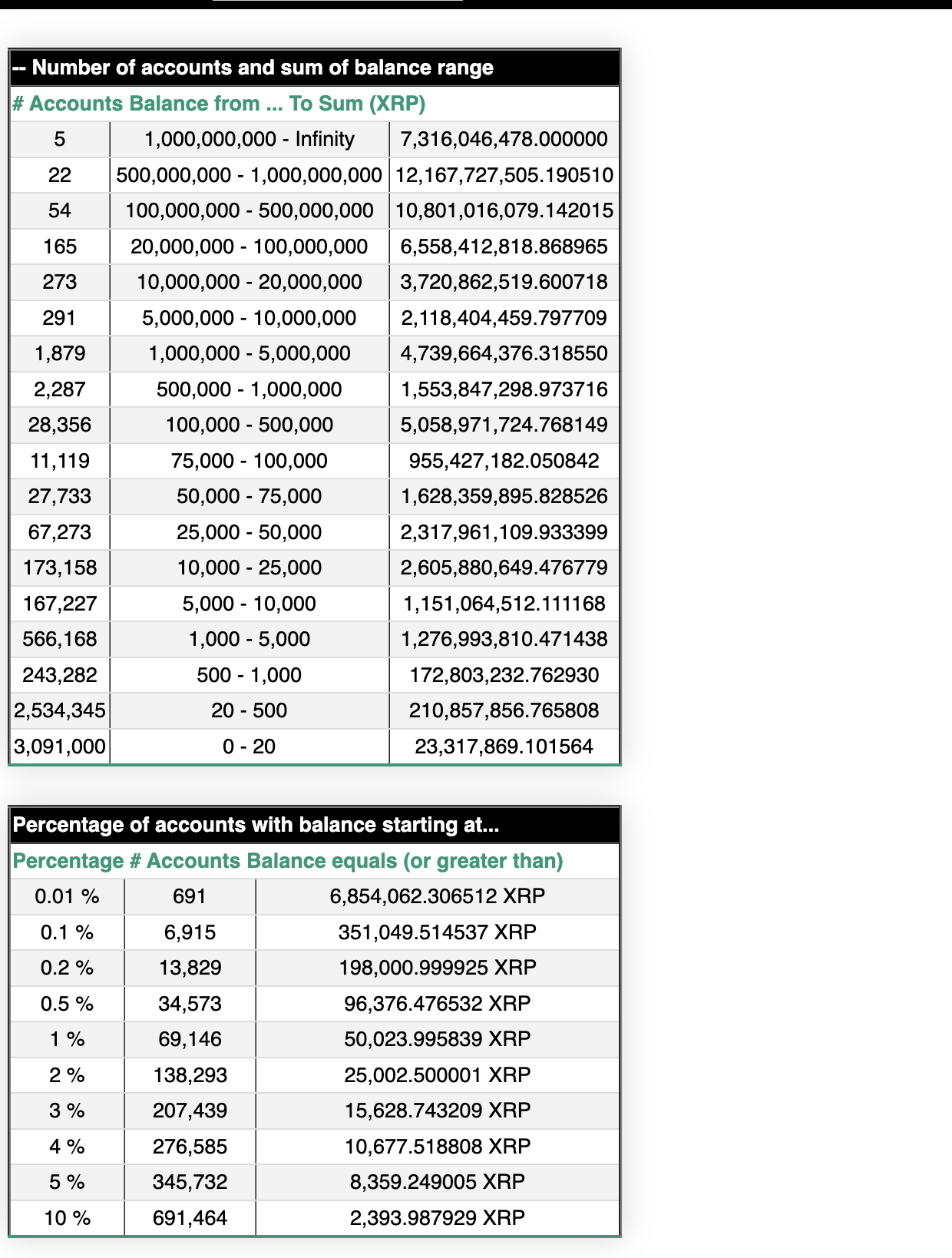
According to Abs, the new Rich List reveals that fewer tokens than ever are required to rank among the top 10% of XRP holders. Just 2,396 XRP is enough to join that tier. He added further context with a breakdown of the top categories:

  • 8,359 XRP places a wallet in the top 5%
  • 10,677 XRP ranks in the top 4%
  • 25,002 XRP secures the top 2%
  • 50,023 XRP qualifies for the top 1%
  • 96,376 XRP sits in the top 0.5%
  • 351,049 XRP enters the top 0.1%

Abs noted that despite XRP’s global reach, there are fewer than one million wallets holding more than 2,300 tokens—making the community smaller than many investors assume. In particular, only 691,464 XRP wallets hold that quantity of tokens.

Meanwhile, 6.915 million wallets hold XRP globally. Of this, 3.09 million addresses hold just 0 to 20 XRP, while another 2.53 million wallets hold just 20 to 500 XRP tokens.

XRP Rich List
XRP Rich List

The commentators stressed that today’s XRP holders are still early in what could become a global race to accumulate XRP. They noted that, considering some investors control multiple wallets, the actual number of people holding XRP is significantly smaller than the 6.9 million wallet count—a minute fraction of the global population.

How $100 XRP Could Change the Game

The podcast discussion also explored the potential outcomes if XRP were to reach $100 in the coming years. Abs pointed out that anyone holding just 2,500 tokens, enough to be in the top 10%, would see their holdings rise to $250,000.

Johnny took it further, highlighting potential millionaire milestones if XRP were to trade at $100 per coin:

  • 10,000 XRP at $100 = $1 million
  • 50,000 XRP at $100 = $5 million
  • 350,000 XRP at $100 = $35 million

He noted that even relatively small early investments could translate into life-changing holdings if XRP follows a path similar to other breakout assets.

You’re Early: XRP Could Reach $7,500 Within 18–24 Months

Specifically, Abs drew comparisons between XRP’s current stage and the early days of Bitcoin and Tesla stock. Ten years ago, Bitcoin was around $250, and few believed it could reach $100,000.

Tesla, after years of regulatory challenges, skyrocketed from $9 to around $400 within a few months after resolving issues with the SEC.

Nassif argued that, now that XRP’s lawsuit with the SEC has ended favorably and the coin remains around $3, its price could follow a similar trajectory to Tesla’s. Interestingly, he sees the potential for XRP to reach $7,500 within 18–24 months.

Top Social Media Star Camilla Araujo Says She Holds $1.3M in XRP

0

A casual podcast featuring two popular social influencers has gone viral in the XRP community after one of the hosts revealed she holds over $1 million worth of XRP.

The revelation even sparked commentary about why BlackRock should have already filed for an XRP ETF.

“I Have $1.3M in XRP”

Notably, the podcast featured well-known social media influencers Julia Filippo and Camilla Araujo, blending humor with serious investment talk.

Camilla Araújo is a Brazilian-American model and social media influencer who gained widespread attention after appearing in MrBeast’s 2021 “Squid Game in Real Life” video as contestant number 067. Since then, she’s built a robust online presence across platforms like Instagram, TikTok, and YouTube.

Specifically, at some point, Filippo mentioned that she needs help with investing. Responding to this, Araujo replied that she would recommend crypto, revealing that she personally holds $1.3 million in XRP.

Araujo went on to predict that the token could eventually surge to $10 per coin, providing her with life-changing wealth based on her XRP portfolio.

This suggests she holds over 500,000 XRP tokens, as she valued her holdings at $1.3 million when the coin traded around $2. If XRP reaches $10, her holdings would multiply approximately fivefold.

Meanwhile, Araujo’s disclosure of her XRP position has sparked widespread attention within the XRP community.

Interestingly, many are interpreting it as a “top signal” for the coin. It suggests that when major influencers, typically outside the crypto community, start calling for massive price movements, it may be a sign of an impending decline. As a result, some humorously suggest it’s time to short XRP.

Rather than joining in on the laughter and frenzy surrounding Araujo’s XRP disclosure, Nate Geraci, President of ETFStore, steered the conversation in a different direction. He used the viral video to highlight the growing popularity of XRP in unexpected circles.

Where Is BlackRock?

He expressed wonder at why, despite XRP’s widespread appeal, BlackRock—the world’s largest asset manager—has not yet filed for an XRP ETF.

His comments echo widespread expectations for BlackRock to enter the XRP space following its success with Bitcoin and Ethereum ETFs. Geraci has repeatedly stated that it would be “illogical” for BlackRock to ignore XRP given its rising demand and expanding market.

However, the deadline for the SEC’s decision on pending XRP ETFs is approaching, and BlackRock has shown no interest in pursuing ETFs beyond Bitcoin and Ethereum.

Institutional Appetite Already Building

Geraci’s remarks come at a time when institutional products tied to XRP are gaining traction. CME Group’s XRP futures contracts recently surpassed $1 billion in open interest in just over three months.

Meanwhile, futures-based XRP ETFs have attracted over $800 million in assets, with daily trading volumes climbing higher since their debut.

For many market observers, BlackRock’s absence from the XRP ETF race is concerning. Other asset managers, including Grayscale, Franklin, and Bitwise, have already filed for XRP ETFs, while the SEC faces final deadlines in Q4 2025.

Geraci has suggested that BlackRock may be waiting for clearer regulations before entering the market, but he believes the asset manager is running out of time. The resolution of the Ripple lawsuit has renewed expectations. Yet BlackRock has still shown no interest in an XRP ETF.

Notably, XRP’s recent rally pushed its market cap to $185 billion, briefly overtaking BlackRock’s $177.8 billion and placing XRP among the top 100 global assets. This surge led crypto commentator Zach Rector to predict that BlackRock will eventually launch an XRP ETF.

XRP is 10 Times Bigger, but LINK is the Real Banking Coin: Top Analyst

0

Top analyst and Coin Compass host Quinten has sparked another community debate with recent comments that Chainlink, not XRP, is the real banking coin.

The analyst fueled the ongoing comparison between the XRP and Chainlink ecosystems with an argument in his Wednesday tweet. He claimed that contrary to the popular belief that XRP is the “banker’s coin,” Chainlink is better suited for this reputation.

Chainlink: The Real Banking Coin?

XRP has its use case in the traditional financial system, specifically in cross-border payments. Specifically, Ripple utilizes it for its payment network, which enables large banking institutions to process transactions on-chain in a cheaper and faster manner.

Notably, this use case has led to the narrative that XRP is a banking coin. Furthermore, the XRP community believes that with the growing TradFi drift toward blockchain settlement, XRP will become central in a system that will compete with or displace trillion-dollar settlement firms like SWIFT.

Meanwhile, according to Quinten, Chainlink is the real banking coin. While he did not provide further context, his comments align with recent arguments from Chainlink enthusiasts. For context, advocate Zach Rynes recently claimed that Chainlink is more compatible to work with SWIFT than XRP.

He based this argument on already existing partnerships between the two entities. Furthermore, he noted that Chainlink has also partnered with other top institutions, such as Mastercard, the DTCC, and central banks, thereby positioning the ecosystem better for mainstream banking adoption than XRP.

XRP Is 10 Times Bigger Than Chainlink

However, in his recent comments, Quinten admitted that XRP is 10 times larger than Chainlink, likely referring to the market cap disparity. For perspective, XRP trades at $3 with a market cap of $178.6 billion, in contrast to Chainlink’s $16.2 billion valuation at a current price of $24.

Nonetheless, he used this to gauge the base target for Chainlink. Considering its alleged better traction with banking institutions, Quinten projected that LINK would increase by at least tenfold to $250, bringing it closer to the current valuation of XRP.

Interestingly, the outlook aligns with a parallel prediction from Rekt Fencer, who forecasted a price range of $250 to $400 for Chainlink by the end of Q4 2025. Notably, he also predicts that XRP will reach between $8.50 and $9 within the same timeframe.

Reactions Trail Chainlink Claims

Nonetheless, the comparison between Chainlink and XRP does not make sense to many. Quinten’s comments also sparked a conversation on which is better, attracting differing opinions from members of the XRP community.

For context, a user called out Quinten for persistently talking about XRP, insinuating that he is using it to draw attention. Another enthusiast had a slightly softer tone, noting that while LINK will shine, XRP will dominate the crypto market.

Fears of Shiba Inu Adding a Fifth Zero Ease: Here’s Why

0

Shiba Inu strong performance in recent days, fueled by whale accumulation and a bullish RSI signal, has eased concerns of a potential drop below $0.00001. 

Amid the recent market downturn that hit major assets like Shiba Inu, some experts speculated that SHIB could add a fifth zero to its price. 

For context, Shiba Inu’s price dropped to $0.00001188 on August 25, marking its lowest in two weeks. At the time, it almost lost the $0.000011 support level, which could have led to a further downturn below the $0.000010 mark. 

Why Shiba Inu May Not Add Another Zero Soon

However, recent market developments have eased concerns about Shiba Inu dropping below $0.00001 and adding a fifth zero to its price. 

Bullish Technical Indicators 

Data from TradingView suggests that Shiba Inu is no longer in oversold territory as its Relative Strength Index (RSI) is neutral at 47. In addition, Shiba Inu has rebounded above the nine-day moving average, mitigating any downside selling pressure. 

At the moment, Shiba Inu has surged above its August 25 low of $0.000001188. It is currently changing hands at $0.00001270, representing a 24-hour spike of 2.72% and a 1.45% weekly improvement. 

Spike in Whale Activity 

Large investors have fueled Shiba Inu’s latest rally, easing fears that SHIB might add another zero to its price. Specifically, one whale has been accumulating SHIB from the San Francisco-based exchange Coinbase recently. 

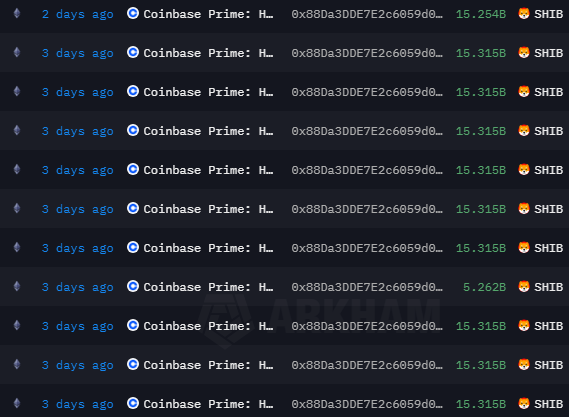
Over the past three days, an unknown investor withdrew approximately 204.3 billion SHIB from the exchange into a new Ethereum wallet through 14 transactions. Most of these transactions contained at least 15.31 billion SHIB tokens. 

Whale withdraws SHIB from Coinbase

The accumulation attracted the attention of Shiba Inu enthusiasts and also fueled optimism for a potential rally. Amid Shiba Inu’s renewed momentum, boosted by bullish technical indicators and increased whale activity, the likelihood of SHIB adding another zero to its price in the near term has slightly diminished. 

The last time Shiba Inu traded with five leading zeros after its decimal was on February 27, 2024. It also came close to adding another zero this year, on June 22, when its price dropped to $0.00001010. 

However, SHIB has held steady above $0.00001. Instead of adding a zero, analysts suggest that Shiba Inu could rally toward a new all-time high of at least $0.0001 this cycle.