Home Blog Page 557

Investors Flock To XYZVerse (XYZ) For Promising Potential While ONDO & TAO Price Stagnates In Altseason

0

Rising excitement surrounds XYZVerse (XYZ), a new project drawing attention as traders search for fresh opportunities. While big names like ONDO and TAO see little action, newcomers are shifting focus. Questions now hang in the air about what sets XYZVerse apart and if it really can change the way meme tokens are seen.

Ondo Finance Brings Bonds to Blockchain

Ondo Finance is positioning itself at the intersection of traditional fixed income and digital assets, turning U.S. Treasuries into tokenized products designed for retail and institutional investors alike. The project splits its efforts between product development and technical infrastructure, with backing from established names: BlackRock manages the underlying bonds, while Coinbase provides custody.

Its main product, USDY, functions like a stablecoin but pays yield sourced from government securities. In contrast to rivals that rely on idle reserves or algorithmic stability mechanisms, USDY delivers income tied to prevailing interest rates. With benchmark yields still elevated, ONDO holders see direct benefits from that cash flow. For investors weary of volatile DeFi tokens and speculative meme coins, Ondo is marketing itself as a defensive play with regulatory guardrails.

TAO Positions as Currency for Collaborative AI

TAO, the native token of the Bittensor network, aims to become the payment layer for decentralized artificial intelligence. The network coordinates contributions from multiple machine-learning models, rewarding those whose outputs add value. Users and developers can pay for access to the network’s collective intelligence in TAO, while contributors earn the token for participating.

Unlike AI-linked tokens that rely on broad narratives, TAO ties directly to computational work and demand for inference. Its supply is fixed, while usage creates ongoing token sinks. Advocates compare its role to Bitcoin in money transfer or Ethereum in decentralized apps—positioning TAO as a system that directly “rewards thought.”

As large technology firms spend heavily on data and compute capacity, Bittensor leverages distributed hardware worldwide to deliver similar outputs, spreading earnings across participants. If investor appetite continues to shift toward tokens with functional utility over marketing-driven hype, TAO could broaden from niche positioning to a more mainstream allocation in digital-asset portfolios.

XYZVerse Presale Pulls In $15M as Sports-Meme Mashup Gains Steam

XYZVerse is making noise in crypto circles with its unusual pitch: mix the hype of meme coins with the passion of sports fandom. Aimed at football, basketball, MMA, and esports communities, the project is selling itself as a meeting ground for fans who want both entertainment and upside.

So far, the concept is catching on. The presale has already raised over $15 million, pushing the token closer to its upcoming Token Generation Event (TGE).  

Roadmap: From Launch to Listings

The team is laying out a growth plan that stretches well beyond the presale:

  • Token Generation Event (TGE): Once the presale ends, $XYZ tokens will go live, backed by a heavy marketing push.
  • Exchange Listings: CEX and DEX listings are planned soon after TGE, designed to give $XYZ broader liquidity.
  • Deflationary Burn: Over 17.13% of supply is set to be burned over time, tightening circulation and potentially lifting demand.
  • Sports Partnerships: Talks with sports groups and influencers aim to expand reach and strengthen brand credibility

Why It’s Gaining Traction

XYZVerse isn’t just leaning on memes—it’s tying in tokenomics, clear milestones, and one of the larger airdrop allocations in the space. That mix has drawn in a growing investor base looking for more than quick-flip hype.

Join XYZVerse, the Next Moonshot Opportunity

Conclusion

ONDO and TAO remain solid, but XYZVerse, the first all-sport memecoin, fuses sports passion with meme culture, targets 50x gains, offers early, community-driven entry, and leads the 2025 bull run.

You can find more information about XYZVerse (XYZ) here:

Website

Telegram

X

Disclaimer: This Press release article is provided by the Client. The Client is solely responsible for this page’s content, quality, accuracy, products, advertising, or other materials. Readers should conduct their own research before taking any actions related to the material available on this page. The Crypto Basic is not responsible for the accuracy of info and any damage or loss caused or alleged to be caused by the use of or reliance on any content, goods, or services mentioned in this press release article.

Please note that The Crypto Basic does not endorse or support any content or product on this page. We strongly advise readers to conduct their own research before acting on any information presented here and assume full responsibility for their decisions. This article should not be considered investment advice.
ARB Ignites 140% Surge In 60 Days. Experts Eye Unich As The Next Breakout

0

In the last 60 days, ARB’s impressive 140% surge has reignited excitement in the crypto space, leaving many wondering what’s next. Unich OTC Exchange, a promising platform built on Solana, is quickly grabbing attention with its innovative approach to OTC trading. As the market shifts, Unich is emerging as a fresh opportunity for those looking to get ahead.

Unpacking ARB’s Explosive 140% Rally: Key Drivers And Momentum

Arbitrum ($ARB) surged an impressive 140% from $0.25 in late June 2025 to $0.62 by mid-August, fueled by a mix of institutional adoption and strong ecosystem growth. PayPal’s integration of its PYUSD stablecoin on Arbitrum brought traditional finance and blockchain together, attracting significant capital inflows. Additionally, Wyoming’s launch of the state-backed FRNT stablecoin validated Arbitrum’s infrastructure for regulated assets, potentially driving real-world asset (RWA) projects. The Ronin Network’s proposal to migrate to Arbitrum Orbit further enhanced its gaming dominance, pushing up transaction fees.

On-chain metrics reflected this growth, with total value locked (TVL) reaching $3.39 billion, stablecoin market cap rising from $1.21 billion in May to $3.9 billion, and weekly transactions doubling to $20.5 million. Technically, ARB broke out of a 200-day consolidation range above $0.50, turning it into support.

Trading volumes spiked to $914 million daily, and a falling wedge pattern coupled with a double bottom reversal indicated a bullish trend. The RSI reached 65-72, signaling a healthy market, while the MACD histogram showed upward momentum. This mix of solid fundamentals and technical momentum drove ARB’s breakout, reflecting a maturing Layer-2 demand.

As ARB continues its strong run, it’s worth noting that another altcoin – despite not having reached TGE yet – is starting to show a comparable momentum: Unich OTC. Similar to how Arbitrum ($ARB) addressed Ethereum’s scalability issues with its efficient Layer-2 infrastructure, Unich is solving a key challenge in crypto trading by offering transparent, low-cost OTC solutions for pre-TGE tokens through its smart-contract-powered Pre-Market exchange on Solana’s high-performance network.

Unich Positioned To Capture The Next Spotlight

Unich Pre-Market platform has already made waves by listing over 60 tokens, many of which are emerging projects with strong liquidity. Notable examples include Switchboard and NodeGo, both of which have recorded around $6 million in trading volume. Even larger deals, such as Doodles and Pump.fun, have reached impressive volumes of $20 million.

This growing ecosystem underscores Unich’s success in providing secure, transparent trading for pre-TGE tokens, and highlights its role in transforming the OTC market.

The Unich community is buzzing with excitement globally, with key figures and KOLs recognizing it as one of the most promising projects in the Solana ecosystem. The momentum continues to grow, driven by Unich IDO structure that rewards early participants through a referral program, users can earn up to 11% rewards – 8% in USDT and 3% in $UN tokens.

For those interested in high-returns pre-TGE opportunities, it’s notable that $UN’s fully diluted valuation is around $150 million – relatively small when set against projects like Jupiter, Solayer, or AAVE, whose FDVs typically range from $700M to $3B. This gap suggests that $UN is still at an early stage, with significant room to grow and capture wider market attention.

Just as ARB’s 140% surge sparked massive attention, Unich’s unique features and growing community suggest it is poised for a similar rise. With the Unich token sale currently live, now is the time for early investors to get involved and be part of the next big move in crypto.

Disclaimer: This Press release article is provided by the Client. The Client is solely responsible for this page’s content, quality, accuracy, products, advertising, or other materials. Readers should conduct their own research before taking any actions related to the material available on this page. The Crypto Basic is not responsible for the accuracy of info and any damage or loss caused or alleged to be caused by the use of or reliance on any content, goods, or services mentioned in this press release article.

Please note that The Crypto Basic does not endorse or support any content or product on this page. We strongly advise readers to conduct their own research before acting on any information presented here and assume full responsibility for their decisions. This article should not be considered investment advice.
Hong Kong Officials Withdraw from Bitcoin Asia 2025 Amid Eric Trump Appearance

0

A senior Hong Kong regulator and a legislator have pulled out of Bitcoin Asia 2025 amid the planned appearance of Donald Trump’s son Eric Trump.

This is one of the world’s largest crypto conferences set to occur in Hong Kong on August 28 and 29. The withdrawals came after Eric Trump, son of U.S. President Donald Trump, was confirmed as a featured speaker.

Eric Yip Chee-hang, director of Hong Kong’s Securities and Futures Commission, and legislator Johnny Ng Kit-chong both initially planned to speak but have since withdrawn from the official agenda. Sources told the South China Morning Post that there had been an instruction for lawmakers to avoid the event if it featured Eric Trump.

Political Sensitivity Amid US-China Tensions

The move highlights the sensitivity of Hong Kong’s role in crypto development amid strained China-U.S. relations. Lau Siu-kai, a consultant to Beijing’s think tank, said officials wanted to avoid any impression that Hong Kong was aligning with or flattering the Trump administration.

The Trump family’s deep connections in Bitcoin-related ventures have also drawn criticism in the past for potential conflicts of interest.

Since Donald Trump returned to the White House, the U.S. has rolled out crypto-friendly regulations, while also escalating trade tensions with China. Hong Kong, caught in the middle, has been hit with U.S. tariffs as high as 145% on its exports.

Eric Trump’s Role at Bitcoin Asia

Despite the withdrawals, Eric Trump remains a key attraction for the event. He will speak for two Friday sessions titled “All in on Bitcoin” and “Bitcoin Takes Over the World.” 

Eric co-founded the mining venture American Bitcoin and has links to World Liberty Financial, a family-backed digital asset initiative.

The presence of a Trump family member highlights the U.S. administration’s push to position itself as the “crypto capital of the planet” while building global influence through Bitcoin.

Hong Kong’s Push for Digital Assets

Meanwhile, Hong Kong continues its drive to establish itself as Asia’s crypto hub. The city rolled out its updated Policy Statement 2.0 on Digital Assets in June. It also enforced a stablecoin ordinance on August 1, enabling real-time, low-cost cross-border transactions.

Meanwhile, Joshua Chu, co-chair of the Hong Kong Web3 Association, downplayed political motives. According to him, the withdrawal decisions were personal. He argued that Eric Trump’s participation reflects Hong Kong’s rising importance on the global crypto stage.

Ultimately, Bitcoin Asia returns to Hong Kong for its second edition. But Eric Trump’s attendance is drawing global attention. The conference highlights opportunities and challenges for Hong Kong as it seeks to balance crypto innovation with political realities.

Mastercard Strengthens Its Ties with Circle in New Stablecoin Settlement Rollout for EEMEA Merchants

0

Mastercard has announced a new digital asset settlement solution for merchants and acquirers in the EEMEA region through a strategic tie-up with Circle.

Notably, the card giant disclosed in an August 26 blog post that it has expanded its partnership with stablecoin issuer Circle to provide digital settlement services to users in the EEMEA. This would allow acquirers in Eastern Europe, the Middle East, and Africa (EEMEA) to use USDC in the Mastercard payment system for the first time.

For the uninitiated, an acquirer or an acquiring bank is a financial body that processes transactions on behalf of a merchant. They provide the necessary infrastructure to support merchants in processing electronic payments.

New Settlement Rail for EEMEA Mastercard Acquirers

The strengthened ties between Mastercard and Circle introduce a new payment rail for acquirers and merchants in the EEMEA, enabling them to settle transactions in stablecoins. They will launch this new payment system with Circle’s USDC and EURC.

Remarkably, the move further solidifies Mastercard’s commitment to bridging the gap between traditional finance and blockchain. The payment card service provider’s next stop is in the EEMEA, with Bahrain’s Arab Financial Services and Eazy Financial Services the first to leverage the new stablecoin rail.

Notably, Circle and Mastercard have an existing partnership in the Eastern Europe, Middle East, and Africa region, but for crypto card payments. It involves the use of USDC by Bybit and SILKPAY to settle transactions.

Meanwhile, Mastercard is also collaborating with Circle to introduce an option that enables merchants to receive payments in cryptocurrencies, regardless of the customer’s preferred payment method. This means that even if a user settles a transaction in fiat, the merchant will receive the payment in digital assets.

Mastercard’s Crypto Push

Notably, Mastercard continues to deepen its roots in the crypto space with strategic partnerships and individual rollouts. The endgame is to bring its success in TradFi into the nascent industry. 

Recently, the card payment giant onboarded several crypto settlements onto its global payment network. Notably, it was part of Gemini’s XRP credit card launch. The US-based exchange launched the XRP-focused card service in collaboration with Ripple, with all related transactions running on Mastercard’s payment system.

Mastercard also rolled out a stablecoin off-ramp payment system in a tie-up with MoonPay. The settlement solution targets 150 million businesses globally, further simplifying the use of crypto cards among users and merchants.

Analysts Warn of Share Dilution Risks as Strategy Prints More Stock to Buy Bitcoin

0

Crypto market analysts are now raising concerns over Strategy’s latest move to issue new shares in order to buy more Bitcoin. 

For context, the company announced in an Aug. 25 SEC filing that it had raised hundreds of millions of dollars for fresh Bitcoin purchases shortly after releasing a new guidance a week earlier that essentially went back on its promise not to issue more shares below 2.5x mNAV.

Strategy Essentially Diluting Shares to Buy Bitcoin

Today, CryptoQuant analyst JA Maartunn pointed out how quickly things had changed. Before the new policy rolled out on Aug. 18, Strategy barely raised any fresh capital. Specifically, it issued nothing on Aug. 3, about $18 million on Aug. 10, and roughly $51 million on Aug. 17. 

However, once the company dropped its “no dilution below 2.5x mNAV” rule, it suddenly raised $359 million in just a week. Notably, the numbers show a company running out of momentum and leaning on dilution to keep buying Bitcoin.

Two days earlier, right after the recent BTC purchase, Satoshi Radio Podcast host Bart Mol shared Strategy’s filing and made fun of the company by comparing its share sales to a money printer running nonstop. His comment showed growing skepticism among investors who see the approach as risky.

Strategy’s Latest Bitcoin Purchase

According to the filing, Strategy sold $309.9 million worth of MSTR stock at an average price of $354.05, along with $47.1 million from preferred shares across several classes. 

In total, the company brought in more than $357 million and used the money to buy 3,081 Bitcoin. This lifted its total holdings to 632,457 BTC, around 3% of all coins in circulation, and moved it closer to its long-term goal of holding 1 million coins, now about 63% complete.

The buy strengthens Strategy’s position as the largest corporate Bitcoin holder, but the way it financed the purchase has raised concerns. 

On Aug. 18, Chairman Michael Saylor introduced new guidance based on the market net asset value, or mNAV. This ratio compares the company’s stock price to the value of its Bitcoin holdings. 

The New Guidance

The guidance explained that if the stock traded at more than four times its mNAV, Strategy would issue shares aggressively to buy Bitcoin. At 2.5 to 4x, it would issue shares selectively. 

Meanwhile, if the stock fell below 2.5x, new issuance would shift toward covering debt, dividends, and other needs. However, should shares drop below 1x, Strategy could borrow to buy back its own stock.

This new guidance was in direct contrast to the previous one, with which the firm promised not to issue new shares for Bitcoin purchase if the mNAV is below 2.5x. Now, a week later, with MSTR stock at $348.92, about 1.6x its mNAV, Strategy has issued new shares shortly after the new guidance. 

Previous Strategy Equity Guidance

For context, the main concern is dilution. Specifically, every time Strategy sells more stock, it creates more claims on the same amount of Bitcoin. Each share ends up backed by less Bitcoin than before, which weakens the value for existing shareholders unless they buy more stock.

Notably, this approach allows Strategy to keep building its Bitcoin reserves and use its debt capacity, which currently sits at 21% of Bitcoin NAV with headroom up to 30%. However, issuing stock at such low multiples reduces shareholder value and risks turning Strategy into a diluted Bitcoin trust. Critics like Peter Schiff had issued prior warnings.

Forbes Shares XRP Price Timeline for the Next 5 Years

0

Forbes contributor Zennon Kapron has outlined what the next five years could look like for XRP, following the resolution of its legal battle with the SEC.

In August 2025, the SEC and Ripple dismissed their appeals, leaving intact the 2023 ruling that sales of XRP on public exchanges are not securities. This outcome has lifted a major barrier to institutional adoption. It allows XRP to reassert itself as one of the leading cryptocurrencies by market capitalization.

XRP’s Current Market Position

Currently, XRP is trading at $3, with a market cap of around $179 billion, ranking it among the top three digital assets. Daily trading volume regularly surpasses $6 billion, while improved liquidity metrics make it more viable for larger institutional orders.

Its price now hovers close to levels last seen during the 2017–2018 bull cycle amid renewed investor confidence in the token.

Utility and Adoption Outlook

The Forbes article noted that XRP’s next phase will be determined by its use in payments beyond speculation. It cited an estimate of over $5 by Finder as XRP price by 2030, but most would suggest this is a bearish outlook especially considering XRP’s drivers identified by the Forbes report.

For one, the XRP Ledger, optimized for low-cost and fast settlement, added an automated market maker (AMM) in 2024 to deepen liquidity. According to XRPScan data, AMMs have accumulated over 11.7 million XRP tokens across 22,035 active pools.

Meanwhile, Forbes noted that Ripple Payments (formerly RippleNet) now covers more than 90 markets and supports settlements in fiat currencies, stablecoins, and XRP. Corridors like Japan–Philippines and Africa’s Onafriq are already leveraging XRP. 

As a result, broader adoption could be driven by cost-cutting in remittances, which exceeded $685 billion globally in 2024, with average fees around 6%.

Institutional Demand and ETFs

The report also noted that Ripple’s dollar-backed stablecoin, RLUSD, custodied by BNY, is aimed at attracting institutions. They have the flexibility to route some transactions through XRP when it proves more efficient.

Further, other avenues to generate demand for XRP include ETFs. The report highlighted that multiple filings for U.S. spot XRP ETFs could unlock a new demand channel, similar to what happened with Bitcoin and Ethereum ETFs.

Forbes’ Five-Year Outlook for XRP

According to the analysis, XRP’s upside lies in its newfound legal clarity, expanding payment corridors, and growing liquidity. These factors make it more attractive for payments and investment products.

However, competition from stablecoins, central bank digital currencies, and upgrades to existing systems like SWIFT could limit adoption.

Regarding XRP’s five-year outlook, Forbes cited a Finder expert panel in July 2025, which predicted that XRP would trade at $2.80 by year-end and $5.25 by 2030.

It said whether XRP realizes that trajectory depends largely on how much of Ripple’s payment flows pass through XRP rather than fiat or stablecoins.

Meanwhile, other industry publications have also issued XRP price forecasts for 2030, most of which are optimistic. Bitwise, for example, expects XRP to trade at $29 by 2030. Telgaon predicts $48, while Changelly forecasts $23.

Meanwhile, prominent voices in the XRP community have set much higher targets, such as $100 and beyond.

Forbes concludes that with legal uncertainty resolved, XRP has a stronger footing. Yet, its long-term role will depend on adoption in real-world corridors and institutional access through capital markets.

Pundit Says Buying All These XRP Dips Like There’s No Tomorrow, Insists $2-$3 Now The New $0.45-$0.55

0

The current sideways price development surrounding XRP offers a rare buying opportunity, and a notable pundit reveals he is not taking it for granted.

For context, XRP reclaimed $3 on Tuesday, posting its first green candle in four days. This temporary setback follows a broader market trend, spurred by macroeconomic headwinds and profit-taking crypto whales.

Nonetheless, the brief decline to $2.82 two days ago presented a good opportunity, one that XRP enthusiasts claimed was another chance to buy at a low price. The sentiment springs from a growing belief that XRP will launch into uncharted territories in the near term.

Dips Are for Buying More XRP: Pundit

Content creator DustyBC Crypto shares this sentiment, advocating for buying the XRP dip in his recent post. He disclosed that he is already taking this approach and is stacking the third-largest cryptocurrency by market cap at this price discount “like there is no tomorrow.”

Fueling this sentiment is his belief that the current XRP trend between $2 and $3 shares a similarity with the token’s price between $0.45 and $0.55. Notably, XRP has fluctuated between $2 and $3 for the greater part of the last nine months, and the enthusiast believes it is the new $0.45 to $0.55.

The comparison suggests that XRP will break out of its current range, as it did after consolidating between $0.45 and $0.55 for years, to target higher prices. Remarkably, XRP surged 500% from $0.50 in November 2024 to $3.40 in January, when it broke out of the range, and a similar rally would likely take XRP to double digits.

Meanwhile, DustyBC insinuated that the rally would happen in no time, adding that he cannot wait for the next XRP uptrend to start. This also aligns with the strengthening conviction within the XRP community that XRP’s bull cycle is not over yet.

Aligning Views on The XRP Dip

Interestingly, several other analysts share DustyBC Crypto’s view that the XRP dip is a rare opportunity. Alex Cobb recently called the XRP drop below $3 unreal, insisting that it is a “psyop to try and steal your coins.”

The analyst further urged XRP holders not to sell “the greatest investment of all time” to prominent institutions like BlackRock. He also predicted a rebound to $3.60 before the end of August.

Meanwhile, Coach JV called acquiring XRP below $3 a massive blessing. He emphasized that it is during market uncertainties that real investors create generational wealth. Specifically, they buy the fears and reap the reward for their resilience when the market rebounds.

Moreover, a recent report has highlighted the benefits of buying during uncertain times and holding XRP on a long-term basis. The analysis reveals that those who bought and still hold their XRP over the past year have seen their portfolio grow by 5.168 times, representing an increase of over 410%.

XRP Risk Metrics Suggest Top Not Reached Yet as 1-Year Holders Enjoy 5.16x ROI

0

Recent data has highlighted the jaw-dropping portfolio upside an investor would record if he held XRP over the past year.

XRP trended lower over the past few weeks, consolidating considerably from its July peak of $3.66. It dropped to $2.82 two days ago before yesterday’s 5.4% growth ensured it reclaimed the $3 support.

Yet, zooming out shows that, despite the volatility, XRP has been substantially profitable to holders. A recent analysis highlighted that holding XRP for the past year has yielded a massive return on investment.

XRP Investors One Year Ago Up 5.168x

Benjamin Cowen shared data from Into The Cryptoverse, which measured the ROI for holding XRP for 365 days. It identified the historic rise in holder profitability on a one-year scale alongside its price movement.

An attached chart highlights a green horizontal line, indicating an ROI of 1. A trend above it underscores that the long-term holders are in profit, while below shows they are in a loss.

Specifically, the chart shows that the latest ROI multiplier stands at 5.168, indicating that those who acquired XRP one year ago have seen a 5.168 times return on investment. Notably, the staggering gains stem from the XRP rally from $0.50 in November to $3.66 last month before the ongoing retracement.

For perspective, XRP opened at $0.58 on August 27, 2024. At the current market price of $3.00, this represents an exact 5.173x, or 417%, increase. The jaw-dropping upside indicates the benefits of holding XRP on a long-term basis.

Cowen also shared in a separate post that the 365-day running ROI for Ethereum holders is at 1.854x, which is less than a twofold increase or 100%. The contrast in gains highlights that XRP has been more profitable to hold over the past year than Ethereum despite the latter’s recent bullish push.

XRP 365-day Running ROI/Benjamin Cowen

Interestingly, early XRP adopters have experienced higher returns on their portfolios. In 2017, XRP holders saw over a 100 times portfolio upside when its price rose to its current all-time high of $3.84.

Another period of explosive gains was observed in 2021, when investors who held for one year experienced over 10x rallies in their portfolio. However, a dip below breakeven occurred during the 2022 and 2023 bear season.

XRP Risk Metrics Suggests Top Not Yet In

Meanwhile, Cowen also shared the XRP historical risk level chart in a parallel tweet, which shows the token’s risk relative to its price. The metric, gauged between 0 and 1, highlights the current market condition, providing insight for investors looking to know when to buy or sell.

An extreme risk level (closer to 1) typically indicates a market top, while a low risk level (closer to 0) suggests a market bottom or consolidation. For perspective, XRP peaked and retraced in all instances when the risk level reached 1, as seen between 2013 and 2021.

XRP Historical Risk Levels/Benjamin Cowen

XRP peaked at $0.0614 in December 2013 and $0.0280 a year later when the metric reached 1. A similar event happened at $0.3989 in May 2017, at $3.84 in January 2018, and at $1.9690 in April 2021.

Meanwhile, although the current risk value of 0.737 is closer to the extremely risky level, it remains well below 1. This suggests that XRP could still see further upside, and its price would not correct extensively, as seen in previous instances, unless spurred by external factors.

Updated XRP Rich List Shows How Much XRP Is Needed to Enter as Top 10% of Accounts Grow to 690,984

0

The capital investors would need to enter the XRP rich list has dropped since the start of the month, while the top 10% accounts have increased.

While XRP has remained stagnant in August, with a 1% drop since the start of the month, the amount required to enter the XRP rich list appears to have dropped in recent weeks. Notably, investors now need less than $7,200 to be among the top 10% richest XRP addresses.

XRP Rich List Capital Requirement Drops

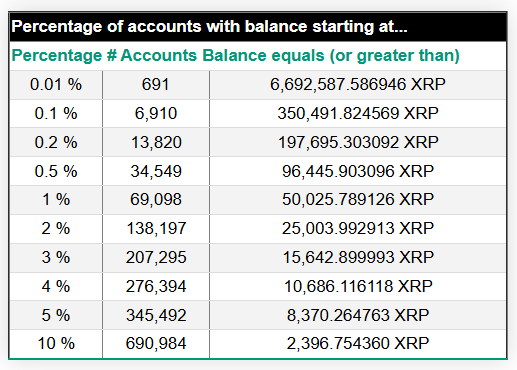
This is according to data from the community-driven platform rich-list.info. Specifically, to enter the top 10% list, an investor must hold around 2,396.7 XRP tokens. At the current price of about $3, this translates to an investment of $7,190.1, a slight drop from the figure from earlier in the month.

For context, The Crypto Basic confirmed in an Aug. 4 report that the requirement for entering this top 10% XRP rich list was 2,433 XRP worth $7,299 at the time. This means that the necessary capital for being among the top 10% richest XRP addresses has dropped by about 32 XRP or $108 over the past three weeks.

This gives investors a golden opportunity to enter the XRP rich list with reduced investments. Interestingly, some market participants appear to be taking advantage of this opportunity. During the Aug. 4 report, there were 679,990 accounts on the top 10% list. Today, that figure has increased to 690,984, indicating that over 11,000 wallets have slipped into this tier.

XRP Rich List
XRP Rich List

Moreover, the capital necessary for entering the top 5% XRP rich list has also dropped from 8,517 XRP worth $25,551 earlier in the month to 8,370 XRP valued $25,110. Meanwhile, addresses in the top 5% have increased from 339,995 to 345,492, confirming that 5,497 wallets have seized the opportunity to enter the top 5% with lower capital.

For the top 1%, the capital requirement has also dropped from 50,108 XRP ($150,324) to 50,025 ($150,075). In addition to this, about 1,099 new addresses have slipped into the top 1% list, with the total number of addresses now sitting at 69,098.

Analysts Already Eyeing Higher Prices

While the decline in these capital requirements might be minimal, they still give investors the chance to amass XRP at discounted prices before the imminent explosive rallies predicted by several market commentators. For instance, most recently, Zach Rector argued that XRP was on the verge of recording the most hated rally in crypto. 

Meanwhile, analyst EGRAG is eyeing $40 as his optimistic target for XRP after a breakout from a W pattern. If this materialized, it would take $95,840 to enter the top 10% XRP rich list at the current token requirement, $334,800 to reach the top 5%, and over $2 million to become a top 1% wallet. However, there is no guarantee XRP will reach this price target.

Pundit Boldly Predicts When XRP Will Overtake Bitcoin and Ethereum

0

XRP market commentator Coach JV has made an ambitious prediction that XRP will rise to become the world’s number one cryptocurrency.

He sees a future timeline in which XRP overtakes Bitcoin and Ethereum in terms of dominance.

From SEC Lawsuit to XRP Credit Card

In his remarks, Coach JV recalled the turbulent period in 2020 when the U.S. Securities and Exchange Commission (SEC) filed a lawsuit against Ripple. At the time, several exchanges delisted XRP, and confidence in the token plummeted.

Fast forward to today, Ripple has prevailed in its legal battle, and its executives are now openly supporting new consumer products tied directly to XRP.

Specifically, Ripple CEO Brad Garlinghouse and CTO David Schwartz recently shared photos celebrating the launch of the Gemini XRP Credit Card. This first-of-its-kind product gives users up to 4% cashback in XRP on purchases such as fuel, dining, and groceries.

Gemini founder Tyler Winklevoss also showed support by granting Garlinghouse the card’s “whale limit.”

Coach JV’s Bold Forecast

According to Coach JV, Ripple’s victory over the SEC and its growing presence in mainstream finance will help XRP rise into the top two global cryptocurrencies. He predicts Ripple will evolve into a bank and become “one of the most disruptive companies in the financial system.”

By 2030, he envisions XRP positioned alongside or even above Bitcoin.

“I believe XRP will be number one, and Bitcoin will be number two. That is my prediction by 2030, so let’s see how this plays out,” he said. Coach JV added that his personal investment in XRP has already provided financial freedom for his family.

The Journey for XRP to Flip Bitcoin

However, XRP faces a significant challenge in surpassing Bitcoin. For context, XRP currently has a market cap of only $178.5 billion, whereas Bitcoin’s market cap stands at approximately $2.2 trillion, over 12 times larger.

In other words, XRP would need its market cap to increase by over $2 trillion to have a chance at overtaking Bitcoin. This scenario would require XRP to reach a unit price of approximately $38.

However, XRP is unlikely to surge over 1,160% from its current price of around $3 to $38 while Bitcoin remains stagnant. If Bitcoin continues to grow, the gap will only widen, making a “flippening” even more challenging.

Notably, several industry leaders, including the CEO of Coinbase and the founder of Cardano, have predicted that Bitcoin could reach $1 million per coin by 2030. That would give Bitcoin a market cap of over $20 trillion.

In comparison, Telegaon projects XRP could reach a maximum price of $48 by 2030, while Changelly forecasts around $23. Both projections give XRP a market cap of less than $3 trillion. 

Even in the highly optimistic case that XRP hits $100, its market cap would still fall far short of Bitcoin’s projected $20 trillion.