Home Blog Page 588

Novogratz Says Trump’s Executive Order Could Unlock Billions for Bitcoin and Crypto

0

Galaxy Digital CEO Mike Novogratz believes that the upcoming executive order from Donald Trump could unlock significant capital inflows into Bitcoin and the broader cryptocurrency market.

Novogratz made the remarks in a live interview with CNBC, saying Donald Trump’s recent comments supporting crypto investments in 401(k) retirement plans could unlock a massive influx of capital into the digital asset space.

President Donald Trump to Sign Executive Order to Expand 401(k)

President Donald Trump is expected to sign a new executive order that would permit retirement accounts like 401(k)s to include alternative investments such as crypto, private equity, and real estate. The order directs the Labor Secretary to review fiduciary rules under ERISA to ease private market investments in retirement accounts.

Traditionally excluded due to higher fees and lockup periods, private assets have gained traction in pensions and endowments and have seen limited acceptance in 401(k)s since 2020.

This move is a win for the alternative asset industry, with firms like BlackRock and Empower already planning to introduce private investments in retirement funds. 

A Potential Gateway for Trillions in Retirement Savings to Bitcoin

The 401(k) system is one of the largest retirement savings vehicles in the United States, with over $8.7 trillion in assets under management.

Allowing cryptocurrencies in these plans could significantly increase exposure for long-term investors. For many Americans, 401(k)s are their primary means of retirement investment. 

Novogratz believes this policy shift would offer a direct path for retail and institutional investors to participate in the crypto market through regulated and tax-advantaged channels. He explained that as crypto investment options become more accessible through familiar financial institutions like Fidelity or T. Rowe Price, broader participation in the digital asset ecosystem is likely to follow.

Expanding Access Through Public Equity and Treasury Platforms

Beyond Trump’s proposal, Novogratz highlighted how treasury firms and publicly traded companies are playing a growing role in expanding access to cryptocurrencies. He explained that a broader range of financial channels is now enabling more investors to enter the market.

He emphasized that public equity markets, which are significantly larger than the current crypto market, are providing new on-ramps for investors. As more publicly traded firms integrate crypto into their business models, capital from institutional investors will continue to flow into the space at an accelerated pace.

Bull Market Momentum and Policy Implications

Novogratz confirmed that the crypto industry is currently in a bull market. However, he cautioned that bull cycles do not last forever and that investors should take advantage of favorable conditions while they persist.

He also pointed out that the alignment of political support, like Trump’s policy comments, with market trends could create a strong tailwind for crypto adoption across both Wall Street and Main Street.

Notably, Novogratz had earlier predicted that Bitcoin would surpass gold and reach $1 million per coin, driven by rising institutional adoption and shifting investor preferences. He pointed to BlackRock’s Bitcoin Trust and a broader move away from the U.S. dollar as key catalysts. 

Following these positive developments, the Bitcoin price jumped to $116,297, a 2.0% rise in the past day. Similarly, Ethereum trades $3,824, a 6.3% rise in the past day.

Ethereum Gains Momentum Through Institutional Products

Turning to Ethereum, Novogratz described its investment story as distinct from Bitcoin’s. While Bitcoin is often viewed as digital gold and a hedge against government debt, Ethereum is gaining traction as the underlying infrastructure for decentralized applications and stablecoins.

He said that firms like ConsenSys and Fundstrat have created Ethereum-focused treasury companies, offering public market investors access to staking, lending, and derivative products. As more capital flows into these platforms, Ethereum’s price continues to rise.

SharpLink Raises $200M to Strengthen Ethereum Holdings, Eyes $2B Treasury Milestone

SharpLink Gaming, a Nasdaq-listed firm focused on Ethereum adoption, has secured $200 million in fresh capital through a registered direct offering led by four global institutional investors.

The raise, priced at $19.50 per share, comes as the company intensifies its ambition to become the world’s top corporate ETH holder. 

The new capital will be directed toward expanding SharpLink’s Ethereum treasury, which could exceed $2 billion in value once the firm fully deploys the funds. The offering will close around August 8, 2025, pending customary conditions.

Strong Institutional Support

Notably, the firm structured the offering under an effective shelf registration statement filed with the SEC, with A.G.P./Alliance Global Partners serving as lead placement agent. Société Générale joined as co-placement agent, while Cantor Fitzgerald acted as financial advisor to SharpLink.

SharpLink’s Co-CEO, Joseph Chalom, noted that the involvement of globally recognized institutions further validates the company’s ETH-centric mission.

Mission to Accumulate, Stake, and Grow Ethereum Portfolio

The company’s ETH-per-share growth strategy rests on three pillars: Accumulate ETH, Stake ETH, and Grow ETH-per-share. 

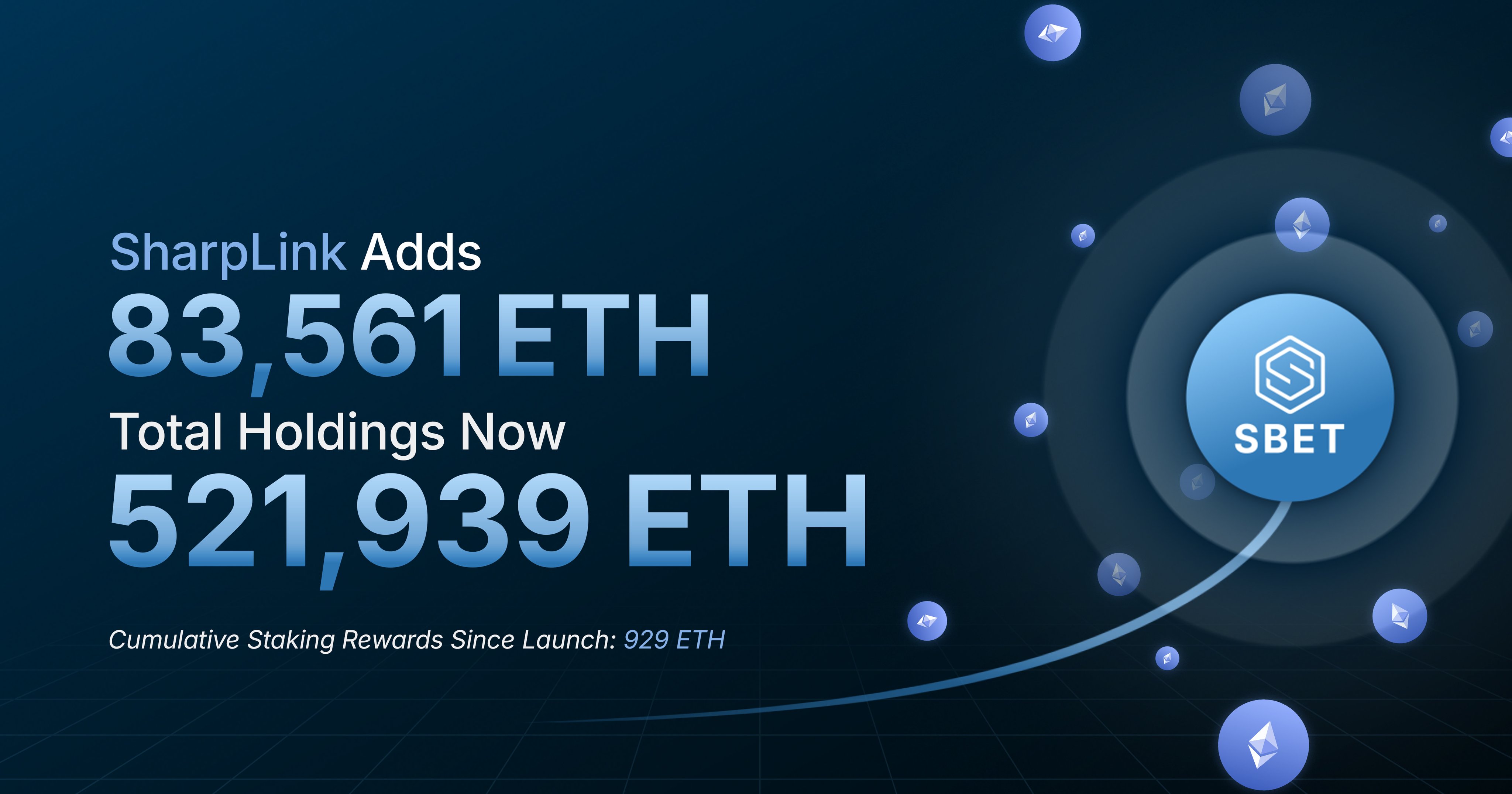
Essentially, SharpLink positions itself not just as a gaming innovator but as a long-term Ethereum treasury reserve institution. The company recently disclosed its acquisition of 83,561 ETH for approximately $264 million. The acquisition brought its total holdings to 521,939 ETH worth over $1.98 billion. Effectively, SharpLink stands as the second-largest corporate ETH holder, trailing only BitMine.

Image

With Ethereum increasingly regarded as the foundational layer of decentralized finance, SharpLink is betting that ETH’s long-term value will outperform traditional fiat-based reserves.

Expanding Corporate Investment in Crypto 

With its aggressive accumulation strategy, SharpLink is setting a blueprint as Ethereum matures into a global settlement layer. The company is carving out a niche that offers equity investors indirect exposure to ETH via SBET shares.

This approach mirrors Michael Saylor’s strategy with Bitcoin, where many traditional investors gain BTC exposure primarily through MicroStrategy stock.

In recent months, several public companies have disclosed building substantial positions in other digital assets like XRP, Solana, and Hyperliquid. Even meme coins like Dogecoin, as well as BNB, Litecoin, and newer entrants like Sui, have found their way onto corporate balance sheets.

Essentially, the institutional crypto investment landscape, once dominated by Bitcoin, has become noticeably more diverse.

Here Is XRP Price If Governments Hold It as Part of Their Crypto Reserves

New projections show XRP could approach double-digit value if top global economies allocate just 5% of their reserves to the asset.

A growing number of analysts and policymakers are exploring whether governments could hold cryptocurrencies like XRP in their national reserves. With increasing recognition of digital assets’ utility, the idea of sovereign entities accumulating XRP is no longer fringe. 

The United States recently added weight to this scenario with a presidential executive order proposing a national digital asset reserve. Bitcoin’s position has been largely cemented, with numerous governments already holding it.

Meanwhile, Ripple’s global payment infrastructure and XRP’s utility in cross-border settlements make it an appealing option for governments looking to diversify reserves beyond Bitcoin and gold. 

Top 6 Economies Could Push XRP to New Highs

A recent analysis modeled the potential impact if the top six global economies, China, Japan, Switzerland, India, Russia, and the United States, decided to allocate a small portion of their foreign reserves to XRP. These countries collectively control over $6.6 trillion in reserve assets.

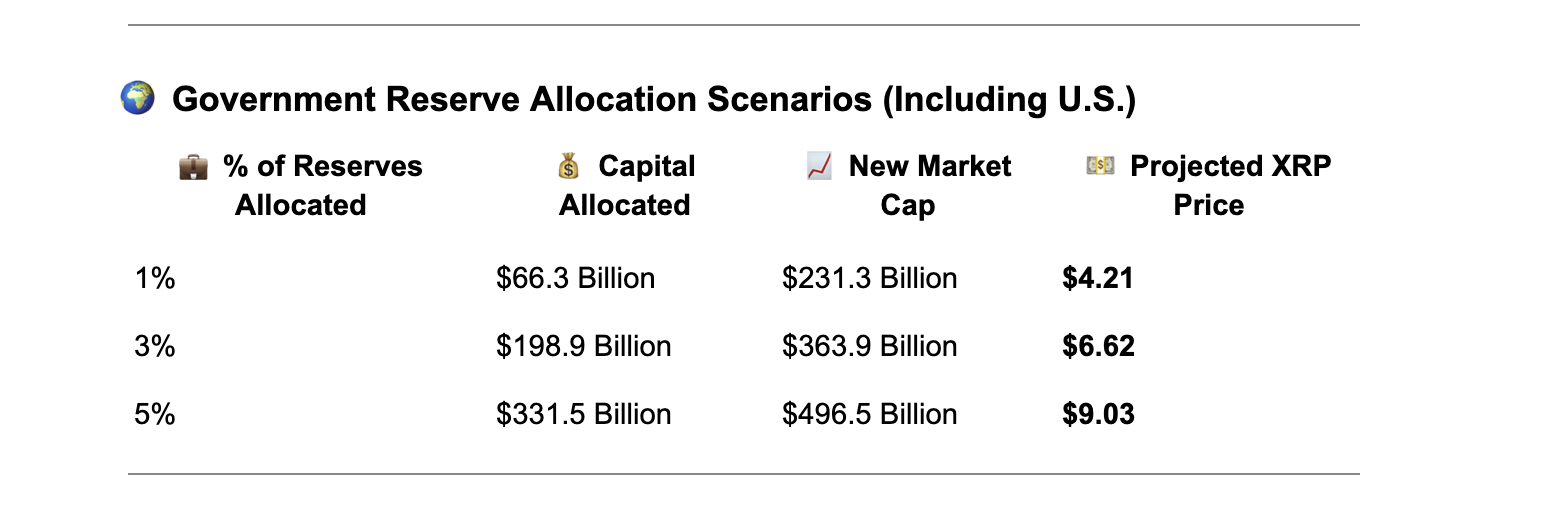
If just 1% of that total, roughly $66.3 billion, were invested into XRP, its market capitalization would climb from around $165 billion to approximately $231.3 billion, pushing its price from $3  to about $4.21.

However, at a 3% allocation, or $198.9 billion, the XRP price could rise to around $6.62. And at 5% allocation, which equates to $331.5 billion, XRP’s market cap could approach $496.5 billion.

Specifically, this would result in a projected price of approximately $9.03. For a coin trading around $3 today, this would mark a new all-time high.

XRP price outlooks by ChatGPT

Can XRP Price Grow Even Higher?

However, it’s important to note that directly adding capital to XRP’s market cap assumes a perfectly linear relationship, which rarely holds in crypto markets. 

Due to thin order books and limited liquidity at higher price levels, large inflows often cause exponential price reactions. In this case, even a $66 billion investment might drive up to ten times more market value as buying pressure cascades through the system. 

This means XRP could potentially exceed the $9 projection under real-world conditions, especially if speculative interest kicks in.

Strategic Reserve Developments in the U.S.

Notably, the idea of XRP in government reserves aligns with a January 2025 executive order signed by President Trump. It called for the development of a federal digital asset strategy. 

This included the creation of a national strategic crypto reserve consisting of assets like Bitcoin, XRP, USDC, and other U.S.-linked coins. Ripple CEO Brad Garlinghouse has supported the initiative. Interestingly, has engaged with policymakers to promote XRP’s inclusion.

Beyond price, inclusion in government reserves would give XRP massive credibility as a sovereign-grade asset. It would mark a turning point for the digital currency. And with just a small percentage of allocation, the price trajectory could be extraordinary.

Donald Trump to Sign Executive Order to Allow Bitcoin and Crypto In 401(K)s

0

US President Donald Trump will sign an executive order on Thursday allowing the inclusion of Bitcoin and cryptocurrencies in retirement funds.

Bloomberg first reported the development today, one that would open the digital asset market to a new stream of capital influx. Specifically, the executive order would allow Bitcoin, alongside private equities, real estate, and other alternative investments, access to the US 401(k) market.

This comes on the heels of a recent declaration that lifted the restrictions preventing retirement funds from buying Bitcoin. For context, the US Department of Labor in May rescinded a years-long guideline discouraging retirement funds from including cryptocurrencies.

Bitcoin to Access $43T Retirement Market

For perspective, the US retirement assets totaled $43 trillion in the first quarter of 2025, a market that Trump’s executive order today would give the crypto industry access to. Trump’s order will mandate Washington regulators to reevaluate and clarify existing rules, allowing 401(k) funds to invest in alternative assets like Bitcoin.

Before the recent relapse, the US DOL encouraged these funds to invest in US bonds, stocks, and other low-risk markets. However, with digital assets gaining mainstream adoption, they are emerging as worthy assets for investment diversification.

Moreover, Trump has declared that he wants to make America the crypto capital of the world. The order, which the president will sign by 4 pm (UTC) today, adds to his broader effort to bolster the industry’s reach in the US market.

Galaxy Digital CEO Mike Novogratz told CNBC that the order would expand access to cryptocurrencies, bringing in more capital into the sector.

“That’s a monster pool of capital,” he emphasizes, noting that such avenues would commonize exposure to the crypto ecosystem.

Broader Effort to Boost Crypto Mainstream Stay

The order further aligns with Trump’s push to ensure that crypto thrives in the US and continues that way beyond his tenure. His administration has been fronting the establishment of clear guidelines that would guide regulators in their dealings with the emerging industry.

Besides rolling back restrictions and closing regulatory probes into major crypto firms, he has also signed an executive order to create a national crypto reserve, including Bitcoin, Ethereum, and XRP, among others.

Trump recently signed the GENIUS Act, the first federal crypto bill in US history. Notably, he played a crucial part in the final passage in the US House, lobbying with GOP hardliners to vote in favor of the bill.

Bitcoin and other assets have also grown considerably owing to these efforts. Today, they also reacted to the development. BTC reclaimed $116,000 for the first time since July 31, with Ethereum and XRP respectively rallying 6% and 3.4% in the past 24 hours.

Glassnode Explains Why Bitcoin Still Sits in the Middle of a Bull Market, Not the End

0

A recent Glassnode report indicates that the current Bitcoin trend around its STH cost basis mirrors mid-bull cycle behaviors.

Notably, Bitcoin has faced pressure since falling from its all-time high of $123,000 in mid-July. Specifically, it dropped to $111,000 at the start of August before bouncing back above $116,000. 

While the recovery has helped stabilize sentiment, investors still wonder whether the bull run has peaked. In its latest report, Blockchain analytics firm Glassnode suggested that the market remains in bullish territory, and that the current pullback doesn’t signal the end of the cycle.

Bitcoin Sitting Well Above the STH Cost Basis

Glassnode highlighted the Short-Term Holder (STH) cost basis in its report. For the uninitiated, this figure tracks the average price paid by traders who bought Bitcoin within the last 155 days. Right now, the cost basis sits at $106,100. 

Bitcoin continues to trade above this level, which historically separates bullish conditions from bearish ones. Glassnode believes this setup resembles the kind of structure seen in the middle of a bull market, even if the recent drop adds some short-term risk.

The accompanying chart supports this commentary. Specifically, Bitcoin climbed back above the STH cost basis in April 2025, after staying below it during a dip earlier in the year. This correction, which started in late February, pushed Bitcoin below $90,000. It stayed under pressure until April, when buyers stepped back in and pushed prices higher. 

Bitcoin STH Cost Basis Model Glassnode
Bitcoin STH Cost Basis Model | Glassnode

Before the drop, Bitcoin first broke above the STH cost basis during this bull run in late 2024, shortly after Donald Trump’s election victory. The rally lifted the price past $100,000, and Bitcoin held above $90,000 and $100,000 until the February setback. As of now, Bitcoin trades around $116,359, well above the $106,100 threshold.

However, even with this strong position, Bitcoin still struggles to move past the average entry price of recent short-term top buyers, another important metric. This figure sits at $116,900. Glassnode warned that failing to break above this level could extend the current sideways movement or even trigger another drop back toward $110,000.

Bitcoin Seeing Accumulation, but Needs Higher Pressure to Form Solid Base

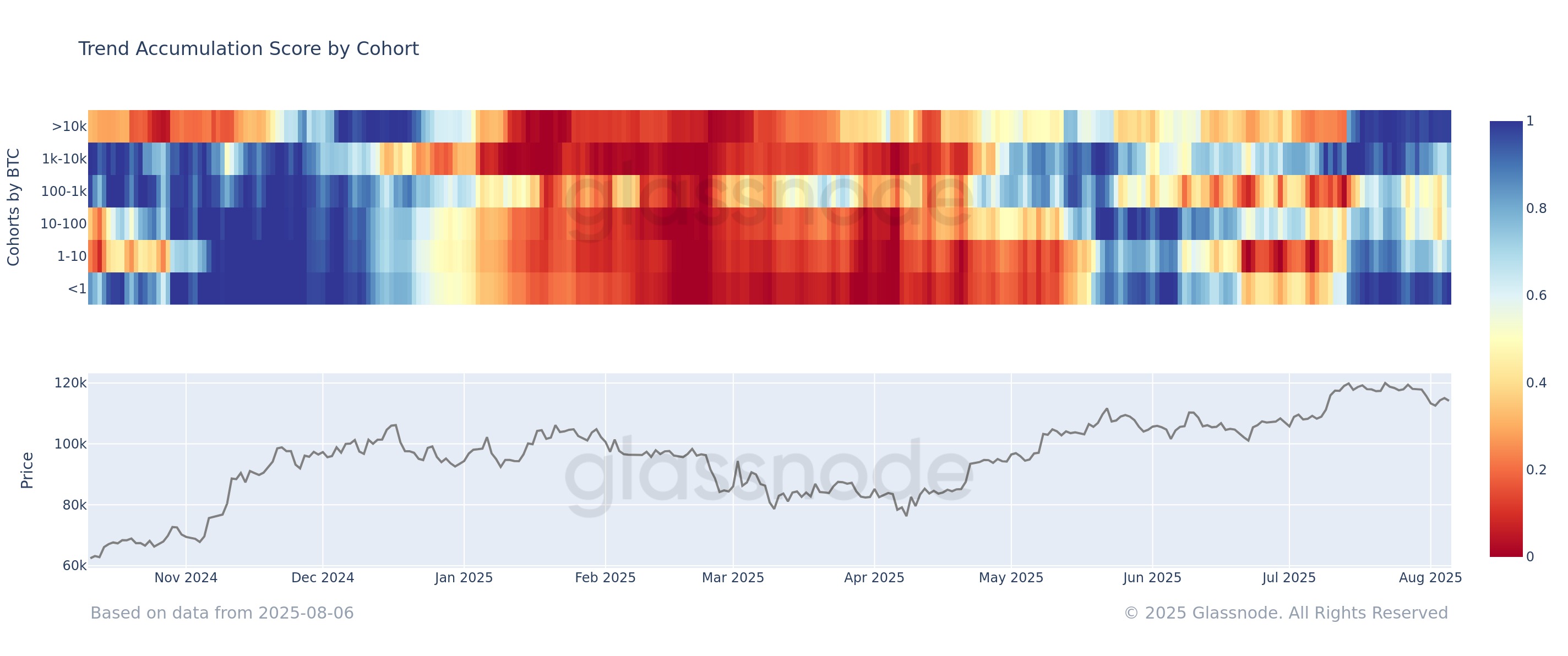
In another analysis, the firm confirmed that over the past 15 days, both whales, those holding over 10,000 BTC, and small holders with less than 1 BTC have steadily added to their positions. .

Bitcoin Trend Accumulation Chart by Cohort Glassnode
Bitcoin Trend Accumulation Chart by Cohort | Glassnode

This behavior shows that both large and retail investors used the dip to accumulate more Bitcoin. Still, Glassnode reminded investors that this trend comes from a 15-day moving average, so it may not fully capture the latest changes in the market.

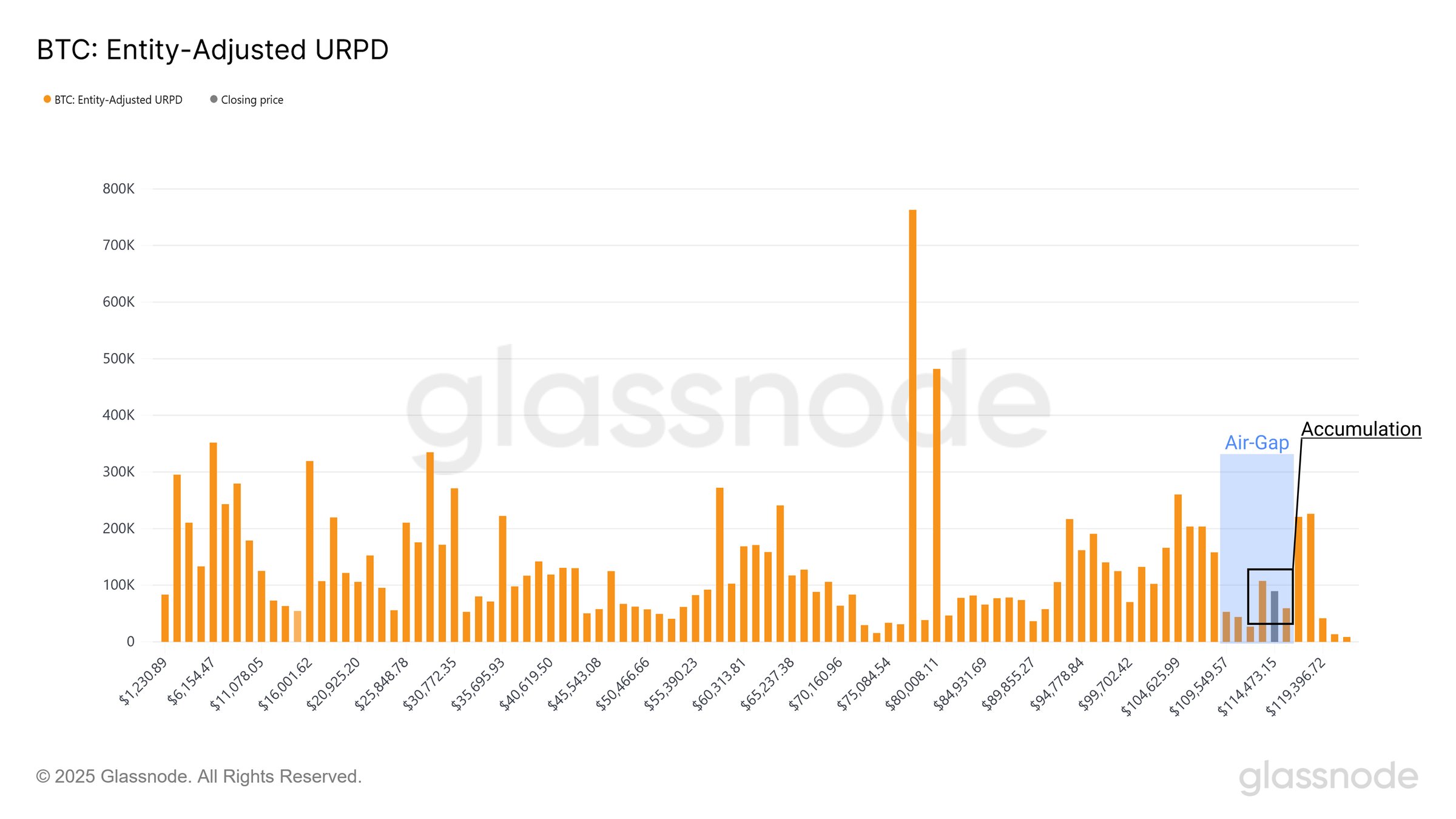
Glassnode also revealed that buyers picked up about 120,000 BTC during the recovery from $112,000 to $114,000. This shows clear interest at those levels. However, Bitcoin’s supply between $110,000 and $116,000 remains thin, so the market needs more consistent buying in that range to build solid support.

Bitcoin URPD Glassnode
Bitcoin URPD | Glassnode

Further, Swissblock, another market research firm, confirmed that the market remains strong. It described the correction as a necessary pause, not a sign of deeper weakness. 

The firm noted that Net Realized Profit and Loss has dropped sharply, while selling pressure remains low. It also pointed out that SOPR continues to drift lower, not collapse. This suggests people are locking in gains without panic selling. According to Swissblock, investors still aim to sell at higher prices, which shows confidence in the broader uptrend.

Here’s When Bitcoin Can Reach $1 Million Price, According to Elliott Wave Theory

While optimism remains high for Bitcoin to break new peaks, a new analysis suggests the top may already be in, and the journey to $1 million could be delayed.

This outlook comes from a long-term Elliott Wave analysis by More Crypto Online. While he acknowledges that Bitcoin is on track to reach $1 million, the analyst believes this will happen in the next major market cycle following a significant correction expected after 2028.

Bitcoin Current Position According to Elliott Wave Theory

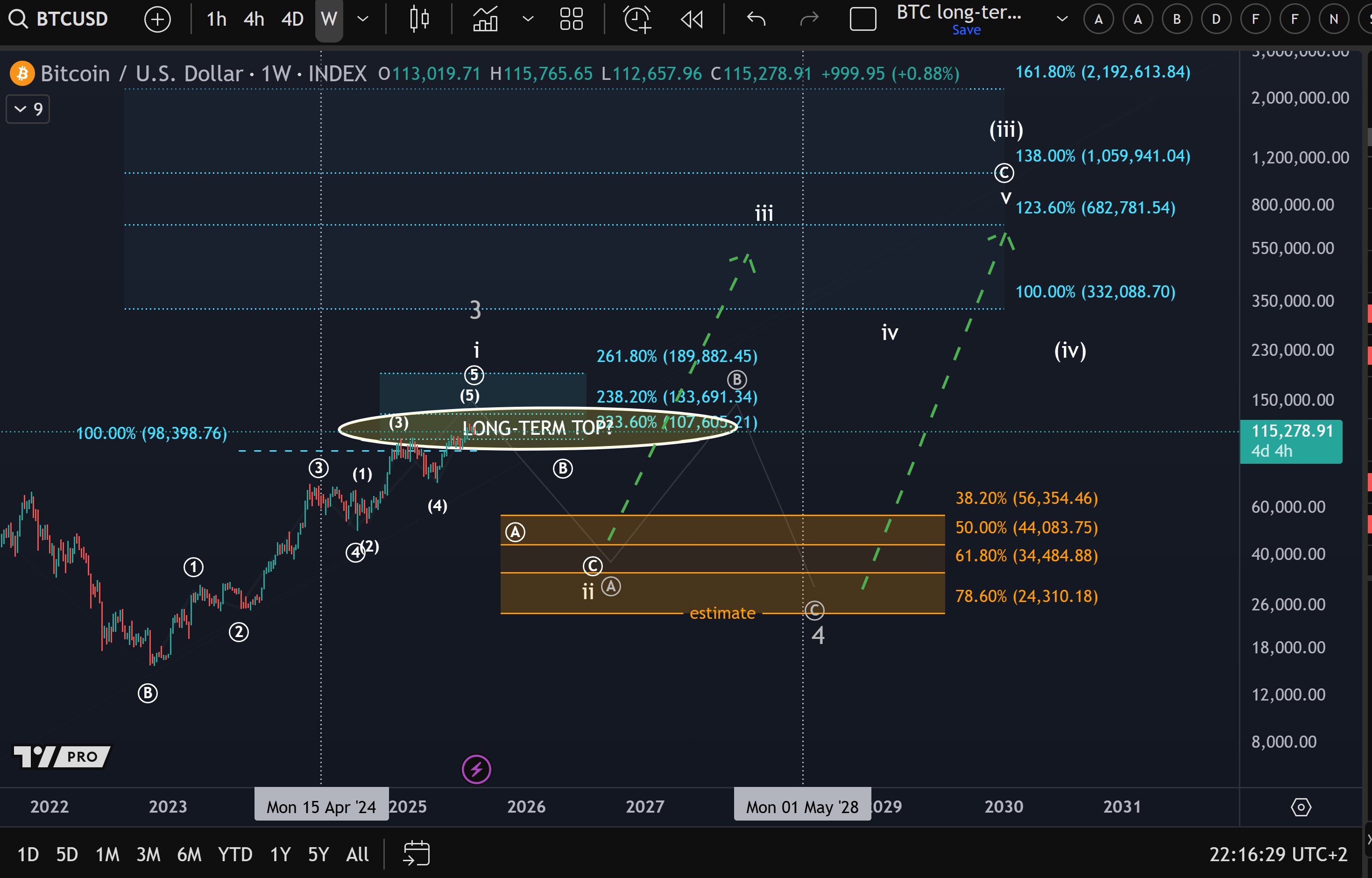
According to the analysis, Bitcoin’s current price action is showing signs of nearing a major local top. The forecast, built on the 1-week BTC chart, suggests Bitcoin is completing Wave 3 of a larger five-wave structure.

The chart identifies a possible “Long-Term Top” forming between $107,600 and $123,000 for the current sub-wave. From this range, the analyst anticipates a dip toward $50,000, before a final push upward.

From there, the wave structure could see Bitcoin extend to new local highs between $133,691 and $189,882 by 2026–2027. These figures align with Fibonacci extensions (223.6% to 261.8%).

For context, Bitcoin reached $123,200 last month and has since pulled back to $111,943. It now trades above $116,000, but the analyst warns of a possible near-term dip, followed by a dramatic rise of up to 63% before the bullish phase concludes.

Severe Correction Into 2028 

Following the projected peak, the analyst expects a deep Wave 4 correction that could last into 2028. Fibonacci retracement levels place this correction zone within $56,354 (38.2%), $44,083 (50%), $34,484 (61.8%), and $24,310 (78.6%).

In perspective, a retracement to $56,000 would represent a 51% decline from current levels. The more extreme target of $24,310 suggests a possible 79% crash.

Such steep corrections are not unprecedented. Bitcoin dropped from $69,000 in 2021 to $15,000 in 2022. This supports the analyst’s view that brutal retracements often precede new market cycles.

Final Parabolic Wave Could Push BTC Past $1 Million

After the correction, the analysis predicts Wave 5, the final leg of the Elliott cycle, could drive Bitcoin into its most explosive phase yet. The projected Fibonacci extension targets include:

  • $332,000 (100%)
  • $682,000 (123.6%)
  • $1,059,000 (138%)
  • $2.19 million (161.8%)
Bitcoin Elliott Wave analysis by More Crypto Online

Essentially, the analysis argues that Bitcoin could reach $1 million or more, but in the early 2030s, once the next halving and bear market play out.

Counter Perspectives

While many in the crypto industry agree that Bitcoin could reach $1 million by 2030, not everyone supports the idea of a severe drawdown to $24,000.

Michael Saylor, for instance, recently stated that a “crypto winter is not coming back,” citing institutional demand. CryptoQuant CEO Ki Young Ju has also suggested the traditional bull-bear cycle is broken, thanks to increased long-term holding and institutional inflows.

These counterpoints suggest that while temporary dips may occur, massive retracements like those in past cycles may not repeat, especially with large buyers now supporting the market.

Ripple Acquires Rail for $200M, Gaining 10% of Global Stablecoin Payment Flow

0

Ripple has agreed to acquire Rail for $200 million, as part of efforts to dominate stablecoin-based global payments. 

The San Francisco-based fintech company announced the development today. According to the announcement, the deal will enable Ripple and Rail to jointly offer the most comprehensive stablecoin payment solution the market has ever seen.

Also, through the acquisition, Ripple intends to boost its longstanding leadership in digital assets payment infrastructure. Ripple has already gained a reputation in the payments sector, offering market-leading digital asset liquidity and a broad payout network.

The company has also secured over 60 licenses from global regulators to ensure it manages customers’ payment flows compliantly. By acquiring Rail, Ripple will integrate the firm’s virtual account system and automated back-office tools into its payments solution to simplify and enhance its transaction processing.

Executive Commentary

Commenting on the development, Ripple’s president, Monica Long, highlighted the growing relevance of stablecoins in modern finance. She stated that the latest acquisition will position Ripple for the “next phase of innovation and adoption of stablecoins and blockchain in global payments.”

Moreover, Monica hailed Ripple’s network as one of the world’s most-used remittance platforms, noting that the acquisition will bolster its ability to move money across borders for clients.

In a statement issued on X, Ripple’s CEO Brad Garlinghouse expressed excitement about the acquisition. He suggested that Ripple is moving at full speed even in an otherwise dull month.

“Ripple and Rail together will be the go-to provider of stablecoin payment infrastructure for global financial institutions around the world,” he remarked.

In reaction, Rail CEO Bhanu Kohli highlighted the company’s prowess in global B2B remittance over the past four years. He revealed that Rail is expected to process over 10% of the $36 billion global B2B stablecoin payments this year.

Based on this projection, XRP community figure WrathofKahneman said Ripple has “purchased 10% of the global stablecoin payment flow.”

Benefits of the Acquisition

Through the acquisition, Ripple will offer end-to-end stablecoin payouts. This initiative will allow customers to send payments using stablecoins without holding crypto on their balance sheets.

Ripple will also provide flexibility to its customers through the acquisition, allowing them to manage multiple payment types through a single platform.

With the acquisition, Ripple’s clients will gain access to premium digital asset liquidity, virtual accounts, and a compliant, enterprise-grade payment system.

Since launching its RLUSD stablecoin last year, Ripple has been making significant efforts to expand its footprint in the sector. Last month, it selected Bank of New York (BNY Mellon) to custody the reserves backing its stablecoin.

Now, by acquiring Rail, Ripple aims to solidify its position as a leader in stablecoin-based global payments.

Analyst Says the “When XRP Moon” Question is Outdated; Here’s the Real Question

0

XRP macro analyst Versan Aljarrah says the real question does not revolve around when XRP will moon, but when its price suppression will end.

In a post on X, Aljarrah, who founded the Black Swan Capitalist with his brother, alleged that at the $3 price, XRP currently faces suppression through coordinated regulatory and market actions. 

Claims of Coordinated Market Suppression of XRP

Aljarrah suggests that these mechanisms, which keep XRP from following the price trajectory of Bitcoin and Ethereum, exist within exchanges, trading algorithms, and regulatory frameworks.

He claims that whenever XRP begins to gain trading volume or show upward momentum, it encounters artificial resistance. According to him, this resistance often takes the form of spoof orders, wash trading, and algorithmic trading bots that interrupt natural market movements.

SEC Lawsuit and U.S. Market Restrictions

The analyst revisited the SEC’s December 2020 lawsuit against Ripple, which accused the company of selling unregistered securities. Aljarrah claims the timing was strategic, halting XRP’s rise just as it gained institutional exposure via MoneyGram and other partners.

He noted that following the lawsuit, major U.S. exchanges like Coinbase and Kraken delisted XRP. This move limited retail investor access and froze institutional interest within the United States. 

Interestingly, XRP community figure “All Things XRP” echoed similar sentiment last year when he revisited the impact of the SEC’s 2020 lawsuit against Ripple, arguing the damage went far beyond price. The commentator says the lawsuit also stalled the project’s growth, disrupted innovation, and drained investor momentum. 

Ripple’s Global Expansion and Hidden Utility

Speaking further, Aljarrah said despite domestic challenges, Ripple has continued to grow its On-Demand Liquidity (ODL) network abroad. ODL uses XRP to settle cross-border payments. However, Aljarrah claims that the system processes much of this volume off-exchange through private corridors and OTC desks.

He suggests that this setup helps avoid slippage and limits price impact on public markets. “XRP is being used,” he wrote, “but the price impact is being rerouted.”

Institutional Access and Retail Exclusion of XRP

Aljarrah believes that while the market restricted retail interest in the U.S., institutions gained early access to XRP via private investment vehicles and regulatory sandboxes. He suggests that accumulation took place behind closed doors, away from public view.

He maintains that significant transaction flows involving XRP are taking place, but they do not appear on public trading charts. To him, this helps explain how XRP can be actively used for settlements while its market price stays relatively unchanged.

Notably, this is not the first time there has been questions about XRP price suppression. Wealth advisor and XRP supporter Mickle raised concerns about CoinMarketCap’s method for calculating XRP’s market cap, calling it misleading. He claimed the platform uses an arbitrary circulating supply figure of 56 billion XRP, excluding tokens held in Ripple’s escrow. 

Mickle argued that since XRP moves in and out of escrow regularly, most tokens have been part of the circulating supply at some point, and excluding over 40 billion from calculation undervalues XRP’s actual market size.

Interestingly, Max Avery had claimed that the suppression of XRP is fading after Ripple’s partial court win against the SEC. He argues the crackdown under Gary Gensler aimed to delay crypto, not stop it, giving traditional finance time to adapt. Notably, Ripple’s case with the SEC remains unsettled. 

Wealth Manager Says BlackRock Will File for Spot XRP ETF, Says It’s Just Running Late

0

Nate Geraci, the President of NovaDius Wealth Management, remains confident that BlackRock will eventually file for spot XRP and Solana ETFs.

Geraci reiterated this perspective in his latest appearance on the Thinking Crypto Podcast with Tony Edward, discussing the recent developments in the SEC’s decisions relating to crypto ETFs. 

They examined the SEC’s approval of in-kind redemptions for crypto-related exchange-traded products (ETPs) and the agency’s decision to greenlight and delay basket ETF products from Grayscale Investments and Bitwise. 

Notably, the conversation took an interesting turn when Edward asked Geraci to comment on whether BlackRock will file for XRP or Solana ETFs after successfully launching similar products for Bitcoin and Ethereum. 

“BlackRock Will File for XRP and Solana ETFs”

In response, Geraci emphasized that he believes BlackRock will file for both XRP and Solana ETFs. With other asset managers like Bitwise, Franklin, and Grayscale already in the application process for standalone XRP and Solana ETFs, he warned that BlackRock is “getting a bit late” in joining the race. 

For context, asset managers in the U.S. indicated interest in launching Solana and XRP ETFs in June and October 2024, respectively. The approval process has begun ever since, with the SEC delaying its decision on the products on several occasions. 

According to sources, the SEC has a final deadline of Q4 2025 to decide whether the ETFs tied to XRP and Ethereum will see the light of day. 

“We’re getting closer to the finish line, and they [BlackRock] still haven’t filed,” Geraci said. He suggested that the world’s largest asset manager could be waiting for the release of a formal regulatory framework before “swooping in at the last minute” and eventually filing for the spot and XRP ETFs. 

Why BlackRock Will File for XRP and Solana ETFs 

His confidence stems from BlackRock’s longstanding advocacy for index-based products, like the S&P 500. He suggested that the firm consider indexing as an appropriate way to access various asset classes. 

Given BlackRock’s commitment to index strategies, Geraci expects the firm to launch a broad index-based crypto ETF featuring multiple tokens. 

“If you’re going to do that, then it seems like you would have standalone spot crypto ETFs as well,” he stated.  

Beyond indexing, Geraci believes that BlackRock might file for an XRP or Solana ETF for defensive purposes. He acknowledged BlackRock’s dominant market position in the crypto ETF market, noting that the firm has the largest Bitcoin and Ethereum ETFs. 

However, he expects BlackRock to apply for more crypto ETFs to gain an early mover advantage if the products eventually gain traction. 

Geraci added that if BlackRock continues to offer only Bitcoin and Ethereum ETFs and refuses to file for similar products for XRP and Solana, then the asset manager is already choosing winners, which he finds illogical. 

“I still think that they will file for those [XRP and Solana ETFs] and launch both, but I will say we’re getting a little bit late in the process,” he concluded.

Analyst Says Prepare for All-Time High as Dogecoin Flashes Classic Reversal Pattern

0

The bearish trend on the Dogecoin price could be nearing its end, as a top market analyst predicts a reversal to new all-time highs.

Specifically, Dogegod shared the outlook in an August 6 tweet as the cryptocurrency market continues its consolidatory momentum. Despite a 3% price rebound for DOGE in the past 24 hours, the meme coin has retraced 28.5% from its July high of $0.288 and 34.5% year-to-date.

Classic Reversal to New Highs for Dogecoin

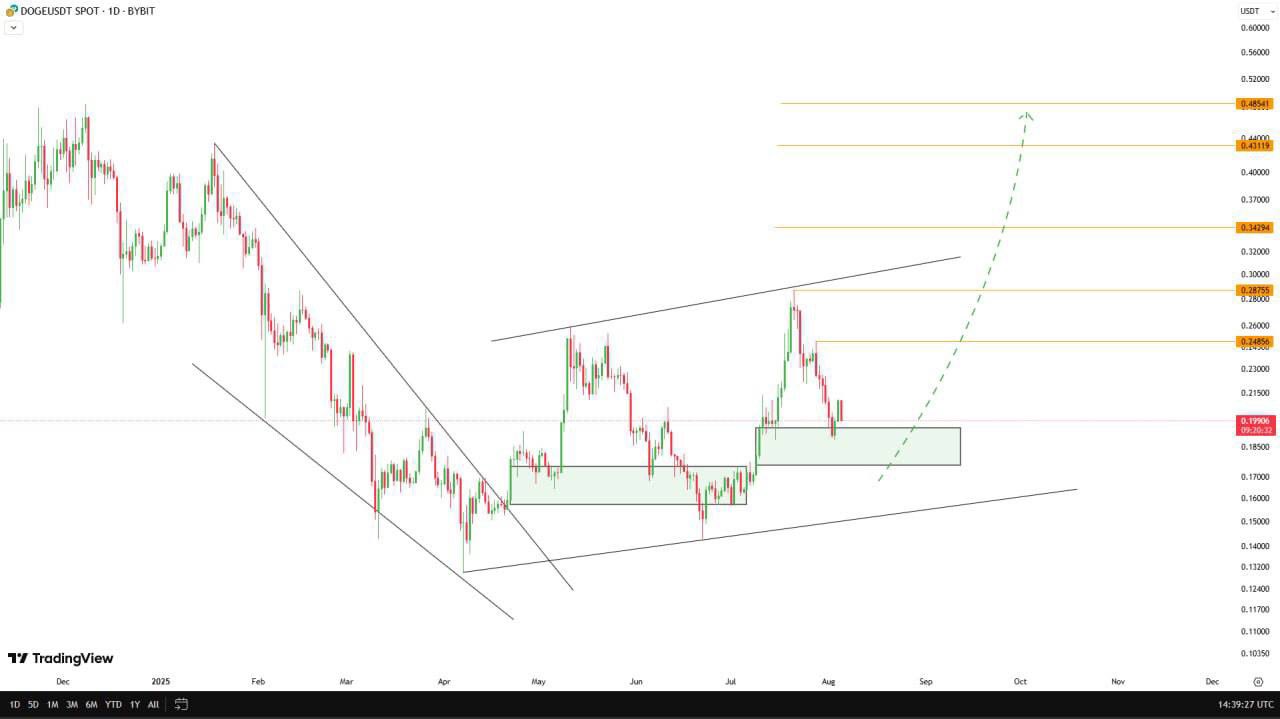
However, Dogegod expects an impending price shift for Dogecoin, citing a flashing reversal signal on the daily timeframe. An accompanying chart shows that Dogecoin has just bounced from a crucial support, suggesting a change in momentum.

Dogecoin Analysis/Dogegod

For context, Dogecoin dropped to a low of $0.188 on August 2, spurred by recent price weakness. Notably, the downtrend saw it retest a support level between $0.20 and $0.175.

Remarkably, the support stopped Dogecoin from further price correction on July 15, when it also dropped to $0.188. The momentum from the zone, coupled with a broader market bullish trend, pushed DOGE to July’s high of $0.288. Notably, the high also aligns with the top of an ascending channel, as shown in the analyst’s chart.

Meanwhile, Dogegod suggested that the bounce from the support would endure, ensuring a classic reversal uptrend to a new all-time high. His chart shows a 135.7% uptick, first to $0.4854 before completing an over 258% surge past the current all-time high of $0.7376 to unprecedented prices.

Larger Bottom: Larger Pump for Dogecoin

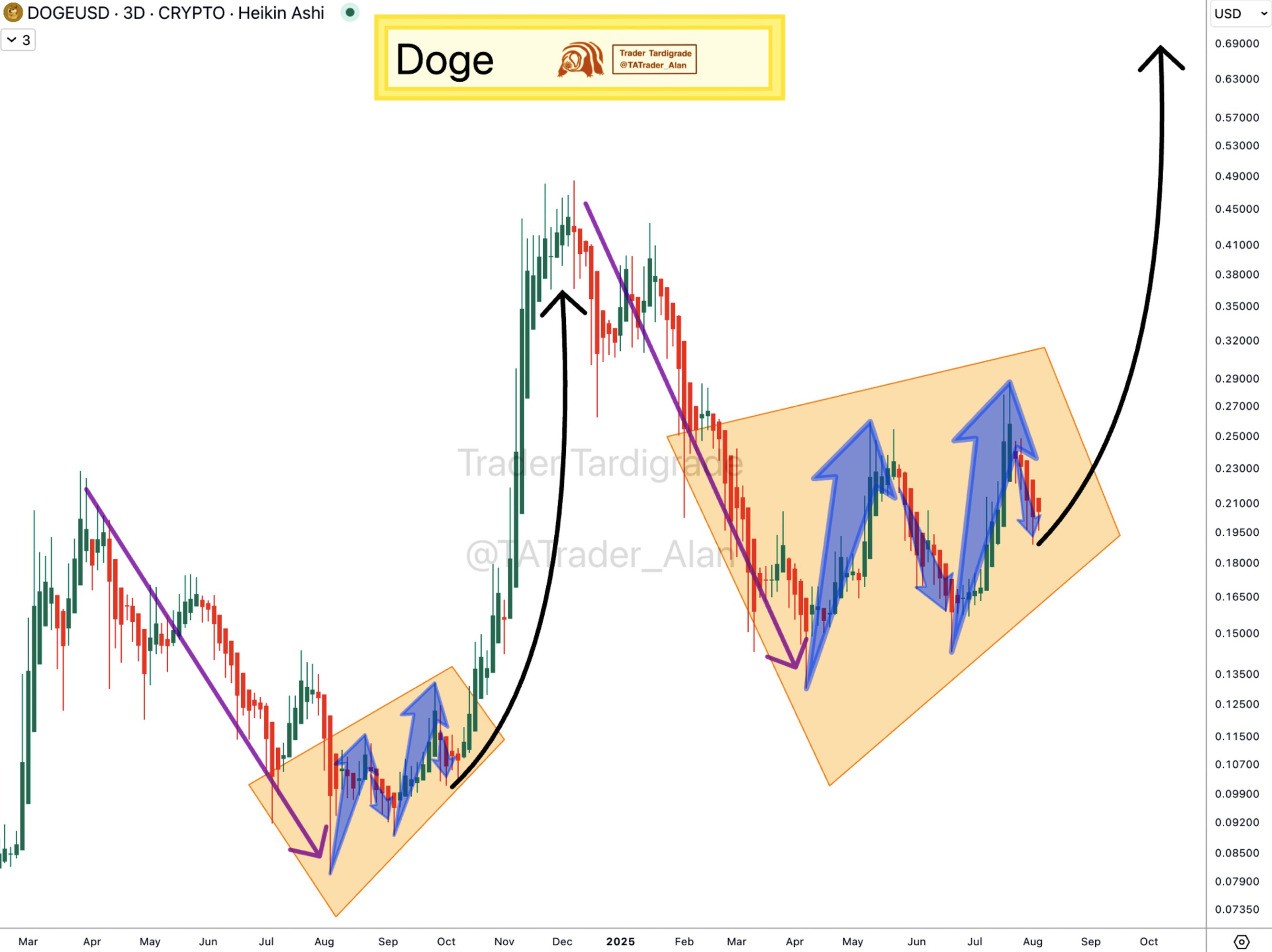
Interestingly, Dogegod’s bullish analysis aligns with that of TraderTardigrade, who highlights that Dogecoin is currently within a consolidatory phase. His Thursday tweet shows that the meme coin is presently forming a solid base, building momentum for a larger price rally compared to the one seen in November 2024.

An accompanying chart shows that Dogecoin has been ranging within a price zone since late February, with the price making highs and lows. DOGE was in a similar but smaller base between July and early November 2024 before the breakout to December’s high of $0.4846.

Dogecoin Forming Bullish Base/TraderTardigrade

TraderTardigrade expects the same outcome but with a larger pump, due to a larger base. He predicted that the next surge would push Dogecoin to $0.6900, representing a 235% rally from the current market price.