Home Blog Page 627

Pundit Explains How the Three US Crypto Bills Could Benefit Ripple and XRP

0

An XRP community pundit has dissected the three pro-crypto bills currently in the US House and how they could benefit both Ripple and XRP.

Specifically, RippleXity discussed the GENIUS Act, the CLARITY Act, and the Anti-CBDC Surveillance State bill, along with their possible impact, particularly on Ripple and XRP. He shared this in a July 16 post, as all three bills are up for a ruling in the US House of Representatives this week.

Details of the GENIUS Act and What It Could Mean for Ripple and XRP Adoption

The pundit began with the GENIUS Act, a bill that has caught the attention of Donald Trump. The stablecoin legislative bill bounced back in the US House on Wednesday after a 217-212 vote ensured a final ruling will hold today.

For the uninitiated, the Guiding and Establishing National Innovation for US Stablecoins (GENIUS) legislation aims to establish a clear regulatory framework for fiat-pegged digital assets in the United States. Some of the features of the bill include a 1:1 reserve backing for issuers, regular audits, and federal and state oversight.

RippleXity highlighted that the bill will legitimize stablecoins, pave the way for mainstream adoption of RLUSD, and allow Ripple to bridge regulated stablecoins globally. The passage of the GENIUS Act would also foster real-world asset tokenization, expected to draw institutions to the XRP Ledger and push XRP to unprecedented prices.

“This bill doesn’t just protect Ripple, it legitimizes its entire strategy,” the pundit added.

Impact of the CLARITY Bill on Ripple and XRP

Meanwhile, he referred to the CLARITY Act as the most significant and crucial legislation that Ripple has ever faced. This perception comes amid Ripple’s long-standing case with the US Securities and Exchange Commission.

The CLARITY bill focuses on the crypto market structure, defining in clear terms what digital assets are and who regulates what between the US SEC and the Commodities Futures Trading Commission (CFTC).

For Ripple, the pundit says the legislation could reverse the existing jurisdiction that brands its primary XRP sales to institutional investors as offering unregistered securities. Notably, Judge Analisa Torres issued this ruling in 2023, placing an induction on Ripple’s institutional sales of XRP.

Furthermore, it would protect XRP in the secondary market and limit future regulatory overreach. This would pave the way for Ripple to scale the adoption of XRP in the United States.

What the Anti-CBDC Act Holds for Ripple and XRP

The Anti-CBDC bill, which the House GOP agreed to attach to the National Defense Authorization Act, imposes permanent impediments to the Federal Reserve’s CBDC efforts. For context, the legislation prevents the central bank from ever issuing CBDC, preserving the rail for private blockchains to offer settlement solutions.

For Ripple, this ensures that CBDCs do not sideline XRP, further bolstering its use in cross-border payments. The bill also supports Ripple’s CBDC efforts with other countries, thereby expanding XRP’s reach.

Conclusively, the pundit noted that the three bills would increase XRP’s utility in the traditional banking system and spur institutional adoption. They would also legitimize Ripple’s business, drawing more attention to its RWA tokenization push.

According to him, Ripple’s intention is not only to win its case against the SEC but also to become the infrastructure for a new financial system. Remarkably, the three crypto bills would greenlight this vision.

Senator Lummis Calls Alleged US Bitcoin Dump a “Strategic Blunder”

0

Pro-crypto Senator Cynthia Lummis reacts to reports that the United States government has sold more than 80% of its Bitcoin stash, referring to the move as a strategic blunder.

Yesterday, the crypto community was stirred by reports claiming that the U.S. government had offloaded a significant portion of its nearly 200,000 BTC stash. Some sources stated that the sale had reduced the government’s Bitcoin holdings to just 28,988 BTC, an 85% drop from the 198,012 BTC it held earlier this year.

Senator Lummis Reacts

For context, the reports emerged after a FOIA response from the U.S. Marshals Service (USMS) surfaced online, suggesting that the agency held roughly 29,000 BTC.

The USMS is responsible for managing and auctioning off seized cryptocurrencies, including Bitcoin, in the United States. As such, the news that it holds only 29K BTC alarmed the crypto industry.

Notably, Senator Lummis reacted to the report via a post on X, expressing shock that the government may have sold off 80% of its Bitcoin holdings. She stated that if the reports were accurate, then the government had made a total strategic blunder. In her view, such a move may set the U.S. several years backward in the global Bitcoin race.

US Government Current Bitcoin Holdings

Meanwhile, the claims that the U.S. government has sold most of its Bitcoin holdings misinterpret the FOIA response.

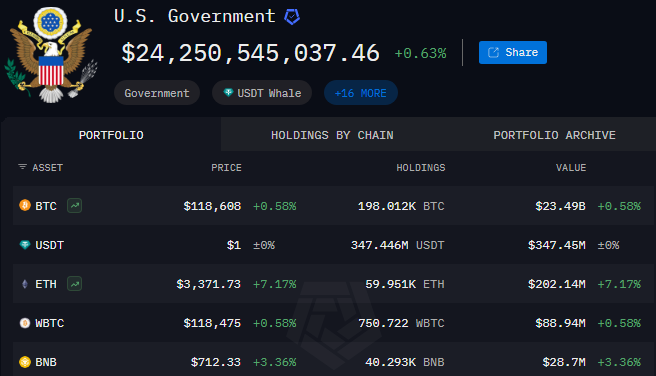
While the response indicated that USMS holds roughly 29,000 BTC, on-chain data from Arkham Intelligence shows the U.S. government still has approximately 200,000 BTC. The government obtained these assets through criminal and civil forfeitures.

Tracked public wallets indicate that the government still holds a total of 198,012 Bitcoin, currently worth $23.49 billion. The U.S. plans to retain them for several years, anticipating a future price increase and using the proceeds to help offset national debt..

President Donald Trump outlined this strategy while signing an executive order earlier this year. He ordered the BTC tokens to be held in a strategic reserve.

Interestingly, Trump intends to grow the U.S. Bitcoin stash over the years through budget-neutral ways. Per the order, the president directed the Commerce and Treasury departments to propose ways the government can acquire more BTC without incurring any costs to taxpayers.

In the meantime, the government’s portfolio is currently worth $24.25 billion. It comprises multiple crypto assets, including 347 million USDT, 59,951 ETH ($202.14 million), 750 wBTC ($88.94 million), and 40,293 BNB ($28.7 million).

US government crypto holdings

Journalist Addresses Misrepresentation of FOIA Response

However, Lola L33tz, the independent journalist who filed the FOIA request, addressed the public misinterpretation of the USMS response, particularly the reference to Arkham Intelligence data, which indicates that the U.S. government still holds roughly 200,000 BTC.

Lola clarified the distinction between seized and forfeited crypto assets. She explained that seized assets are held by law enforcement agencies, such as the FBI, following court-authorized actions. In contrast, forfeited assets have been legally declared government property, typically through judicial rulings or settlements.

Essentially, the remaining Bitcoin is likely still under seizure but not yet forfeited, which explains why it is not in USMS custody or included in the FOIA disclosure. Notably, Lola emphasized that the USMS is the primary custodian of forfeited Bitcoin, not all government-held BTC.

“This doesn’t mean that the U.S. government has sold any Bitcoin,” Lola added. “It just means that whatever these U.S. Treasury sites estimate is likely wrong, as they don’t seem to differentiate between seized and forfeited coins.”

Don’t Forget Shiba Inu, It Will Fly Soon: Analyst Highlights Path for a 130% SHIB Rally to $0.0000335

0

Amid a recent price rebound, a top analyst has predicted that Shiba Inu is on the cusp of a rally to levels last seen over a year ago.

Shiba Inu, the second-largest meme coin by market cap, recently started to rebound after a period of price underperformance. For perspective, Shiba Inu dropped 69% from its high of $0.0000334 in December 2024 to a low of $0.00001004 in June, while Bitcoin reached multiple all-time highs within that timeframe.

Currently, Shiba Inu is still down 31% from its opening price on January 1, but things seem to be changing quickly for the meme coin. Specifically, SHIB has rallied 17% in the past seven days and is up 6.2% over the past day, as it continues to cut down its losses.

Shiba Inu Regaining Momentum

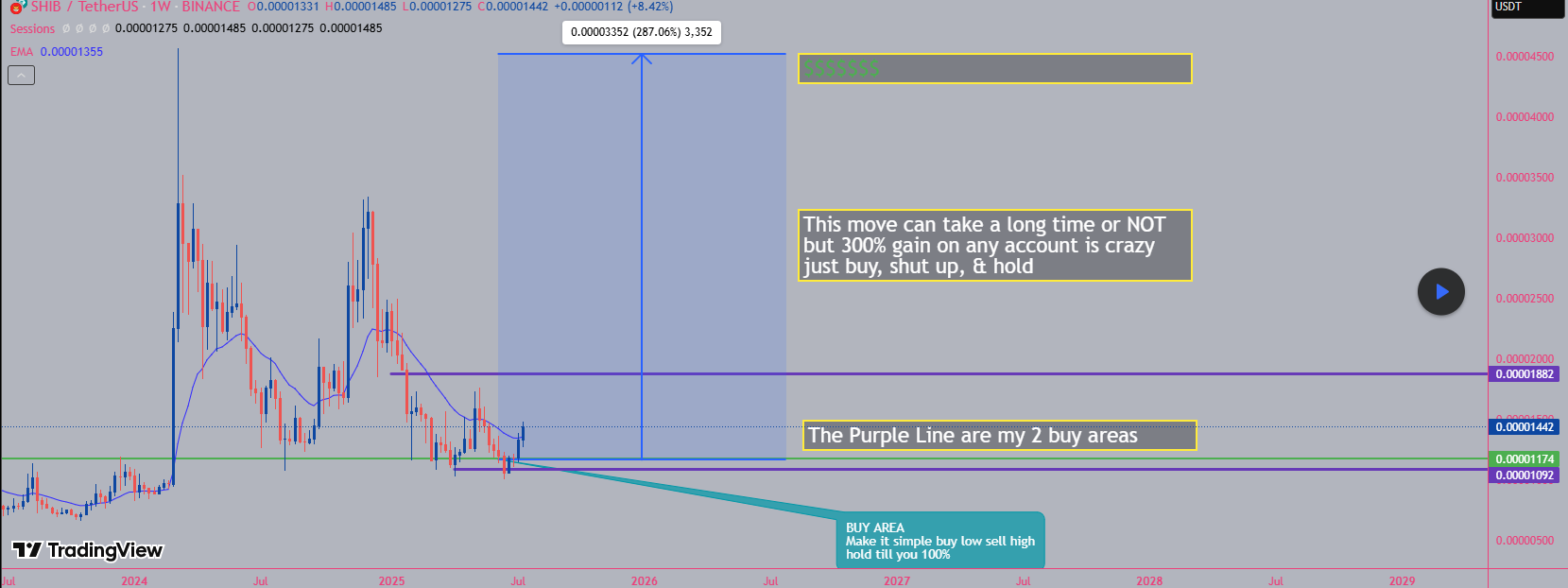
Amid its building price momentum, analyst GehavianGoals has predicted that Shiba Inu will sustain the current bullish traction. He shared that Shiba Inu will “fly soon,” highlighting its possible price target and potential buy areas.

An accompanying chart highlights that SHIB rebounded from a major resistance on the weekly chart, a potential catalyst for its recent momentum. The token has tested the demand zone multiple times this year and on one occasion last year, rejecting lower prices at each attempt.

Shiba Inu Analysis GehavianGoals
Shiba Inu Analysis | GehavianGoals

For context, Shiba Inu rallied extensively from the support in early 2024, reaching a high of $0.00004567. However, it faced insurmountable resistance, which sparked a retracement to the same support on August 5, 2024.

Meanwhile, Shiba Inu bounced from this support area to its December peak before facing another rejection. Since then, the memecoin has retested the $0.000011 support level four times, specifically on February 3, March 11, April 7, and most recently on June 22.

Buy Areas as SHIB Set for Massive Rally

Notably, the market watcher set his first buy area for the impending rally at $0.00001092, an area that Shiba Inu has since surpassed. Nonetheless, there is another buy opportunity at $0.0000188, which is about 31% away from its current price.

For his target, he predicts a 130% rally from Shiba Inu’s current price to a 21-month high of $0.00003352. However, from his first entry at $0.00001092, it would amount to a 206% upsurge.

The analyst did not provide a timeline for this rally but advised patience among holders. He revealed that he has been in a Shiba Inu trade for five months and would not mind holding for one to two years, as long as it reaches his target.

Moreover, he joins a growing list of bulls calling for higher prices for Shiba Inu. For perspective, a recent analysis highlighted that SHIB will reclaim $0.000035 if it clears several major supply clusters.

XRP Surges Past $3: Here’s What’s Next After 32% Weekly Rally

XRP has again taken center stage in the crypto market after posting a 32% rally in a week that saw it break through its six-month resistance.

Today, it surged past the $3 mark for the second time this week. Now, XRP is trading at $3.15 at press time, its highest price point since January. This move has reignited bullish sentiment and triggered technical discussions around whether it can sustain its momentum.

Weighing in on XRP’s price action is Brian Quinlivan, Director of Marketing at Santiment. He noted that while Bitcoin’s new all-time highs have dominated headlines, XRP’s movement suggests something more significant is brewing beneath the surface.

Muted Hype, Strong Performance

In a recent podcast, Quinlivan noted that despite the impressive price surge, XRP remains surprisingly under the radar. Market sentiment hasn’t shown the kind of euphoria typically expected from such a move, largely because mainstream focus has remained on Bitcoin’s breakout.

Essentially, XRP’s surge hasn’t translated into the type of widespread attention that often leads to overheated conditions. This lack of retail frenzy may be a blessing in disguise, Quinlivan noted.

Furthermore, he added that XRP’s initial break above the $3 resistance level earlier this week triggered a wave of sell orders. However, the subsequent retracement has been relatively minor.

In particular, XRP dipped to $2.8085 shortly after reaching $3.05 on Monday. According to Quinlivan, the key question is whether the next leg up can print a higher high.

Indeed, the bulls have reclaimed the stage, with XRP reaching an intraday high of $3.17 at press time.

XRP MVRV Flashes Caution as Price Cools

While short-term sentiment appears stable, on-chain data suggests some caution. XRP’s Market Value to Realized Value (MVRV) ratio has entered a historically risky zone.

According to Santiment’s models, short-term holders are currently up 24.5%, while long-term holders are sitting on unrealized gains as high as 47%. These levels have historically preceded abrupt corrections. 

Notably, the last time XRP’s 30-day MVRV reached similar highs, the price fell more than 40% in the following months. Currently, the MVRV isn’t at its peak. Yet, both short- and long-term metrics are in zones where profit-taking becomes statistically more likely.

What’s Next?

Although technicals suggest a short-term pullback may be due, sentiment indicators imply that any correction might be shallow and brief. If XRP dips below $2.70, retail fear could prompt some to exit positions. 

However, this may set the stage for institutional investors to step in and accumulate, potentially sending the price back above $3 quickly. Quinlivan noted that XRP could retest $3.50 as momentum rebuilds.

Ultimately, attention still centers on Bitcoin, and the broader altcoin rally is just beginning to take shape. In effect, XRP could benefit from rotational liquidity once the market refocuses on large caps beyond Bitcoin.

Here’s XRP’s Price If It Forms a 180% Daily Candle

0

The XRP price could immediately shoot up to a new all-time high if XRP were to record another 180% daily candle close like it did in 2017.

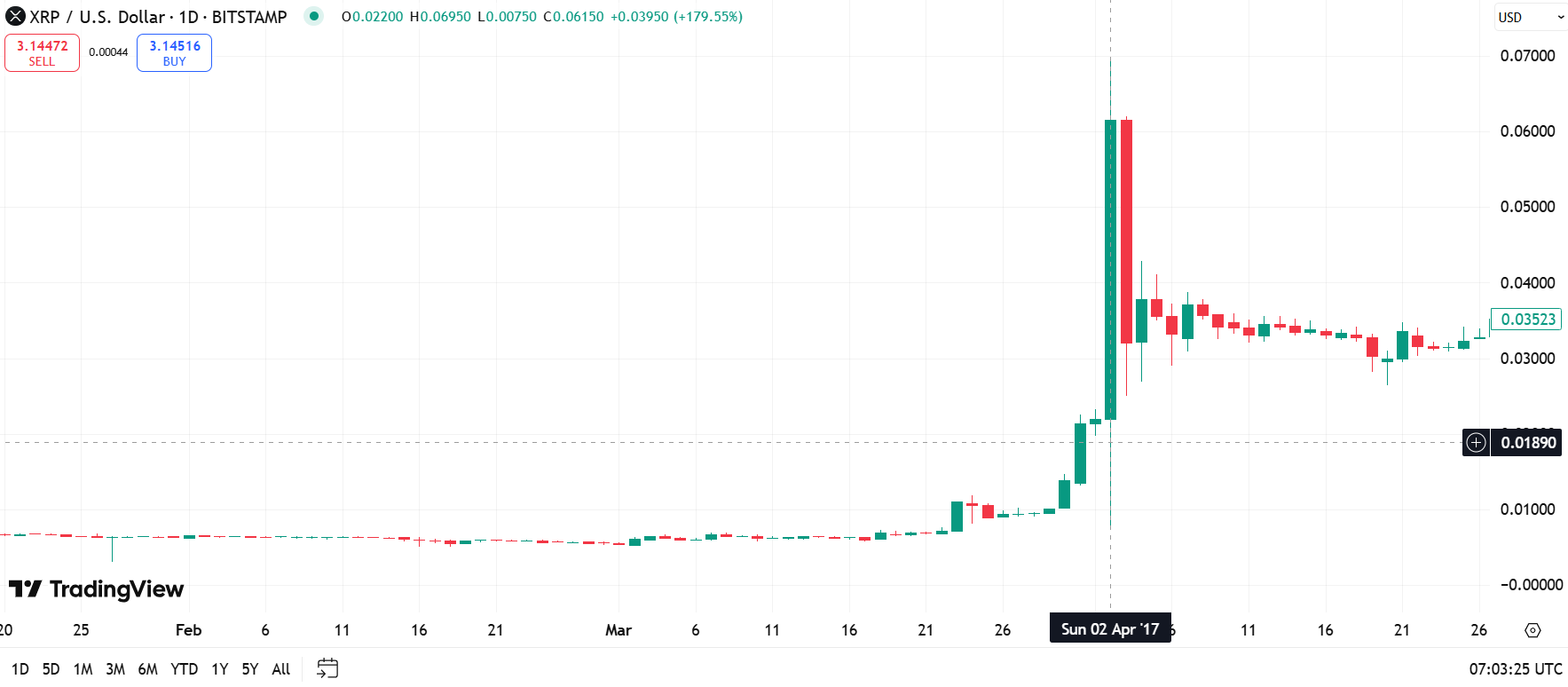
Sistine Research analysts called attention to this prospect in a recent post on X, pondering on the possibility of XRP witnessing a daily candle close of over 100%. According to them, XRP did indeed observe an impressive 181% increase within a single day during the 2017 rally.

XRP Surged 180% in a Day in April 2017

Notably, market data confirms this disclosure. XRP reached this impressive feat when it recovered from the bearish trend that pushed its price to lower lows from 2016 to early 2017. As a rebound emerged in March 2017, prices began to see impressive surges, with occasional daily gains of around 20% and 50%.

However, the most substantial daily close occurred on April 2, 2017. XRP began this day with a price of $0.0220 but eventually surged 216% to a peak of $0.0695 before facing massive resistance. Despite this resistance, XRP held strong above the $0.06 region, closing the day with a value of $0.6150. This marked a 179.55% increase on that day.

XRP Price 180 Daily Gain
XRP Price Daily Gain

While it lost some of these gains the next day, dropping 47% on April 3, 2017, the general uptrend was maintained, with XRP eventually soaring to $3.84 by January 2018. Nonetheless, the 179.55% gain on April 2 represented its largest intraday gain in history.

What if XRP Price Secured 180% Intraday Gains Again?

Since then, XRP has failed to replicate the rapid spike, but Sistine Research analysts are now reviving discussions around a possible repetition. This comes at a time when XRP is showing signs of a recovery, having rallied past the $3 resistance in recent times, as it trades for $3.13 at press time.

While it remains highly speculative, we assessed how much the XRP price could be if it repeated the 180% intraday gain. Should XRP replicate such a run from the current position, its price would surge to a new all-time high of $8.76 within a day. 

At this price, XRP’s market cap would grow to $518 billion, which would represent an addition of $332 billion in valuation within a day. While this remains highly improbable, it is important to note that XRP would not actually need to welcome $332 billion in new capital to see its market cap spike by such a margin.

For instance, market analyst Dom discovered in May that XRP added $16.6 billion worth of valuation with a mere $61 million in buy pressure. This translates to an inflow-to-valuation multiplier of around 272x. With this rate, XRP’s market cap would only need $1.22 billion in net buy pressure to rise by $332 billion in a day.

However, the prospect still remains speculative. Despite this, XRP has shown its penchant for rapid intraday spikes in recent times. For instance, on March 2, 2025, the XRP price rose 34%, adding $43 billion to the market cap that day. Also, on July 13, 2023, following Judge Analisa Torres’ ruling in the SEC case, XRP price spiked 73%.

Ethereum Spot ETFs Record Highest Daily Inflow at $726M, as Prices Hit 6-Month High

0

The buzz around the Ethereum ecosystem has intensified amid record daily Ethereum spot ETFs inflows and a price rally to a six-month high.

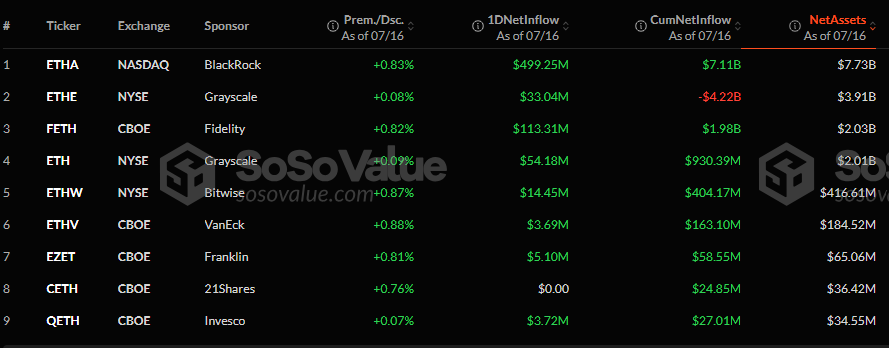
For context, data from Sosovalue shows that the US Ethereum spot ETFs amassed their highest daily inflow since inception yesterday. The funds experienced a record-breaking single-day inflow of $726.7 million, driven by sustained demand from both institutions and retail investors.

Demand for Ethereum Spot ETFs Hit Fever Pitch

Interestingly, the Ethereum investment products had been on an 8-day streak before yesterday’s massive inflows. They not only extended the streak but also beat their former daily record of $428 million on December 5, setting a new milestone.

The US Ethereum spot ETFs brought in $726 million on Wednesday, led by the BlackRock iShares Ethereum Trust (ETHA). The investment vehicle recorded a daily inflow of $499 million, bringing its cumulative net inflow to $7.11 billion.

Meanwhile, the Fidelity Ethereum Fund (FETH) raked in the second-largest inflows on July 16, bringing in $113 million. It now has a net cumulative inflow of $1.98 billion, falling short of ETHA’s by a considerable margin but also maintaining a healthy lead over other products.

Other funds, such as the Grayscale Ethereum Trust (ETHE), the Grayscale Mini Trust (ETH), and the Bitwise Ethereum ETF (ETHW), recorded substantial inflows of $54 million, $33 million, and $14.5 million, respectively, in what was an overall positive performance.

Ethereum Spot ETF Flow on Record Breaking Day
Ethereum Spot ETF Flow on Record-Breaking Day

Notably, the stellar outing drew the attention of notable market participants. Specifically, Nate Geraci, the president of ETF Stores, highlighted the record-setting day in a tweet today. He noted that the ETFs have accumulated $1.8 billion over the past five trading days, a sign of accelerated institutional traction.

Ethereum’s Price Reacts

Meanwhile, Ethereum responded positively to the increased accumulation, outperforming all cryptocurrencies in the top 10 ranking by market capitalization, except for XRP. Ether has increased 7.58% in the past 24 hours to reach $3,380.

Remarkably, Ethereum has not reached this price level in six months. For context, it last traded above $3,380 on January 31, correcting massively from the mark to prices below $1,500.

Nonetheless, the altcoin leader has regained bullish momentum and is set for higher prices. According to a recent report from The Crypto Basic, analysis shows Ether’s next target is a rally to $4,000, with other altcoins benefiting from the momentum.

US House Clears Procedural Hurdle for Crypto Bills: Here’s Timeline for Final Votes on GENIUS and CLARITY Act

0

The U.S. House has cleared a major procedural hurdle toward establishing the first-ever stablecoin regulation and clearer crypto regulations. 

This comes after the House voted to advance three crypto-related bills, including the GENIUS Act, the Anti-CBDC bill, and the CLARITY Act. Recall that lawmakers had previously voted 196-223 against the advancement of the three bills. 

As reported earlier, the previous measure saw 13 Republicans join 210 Democrats to vote “Nay” against the bill. However, President Donald Trump urged House members, especially Republicans, to vote “yes” in the final procedural vote and position the United States as the leader in crypto. 

House Clears Procedural Hurdle and Sets New Record

Interestingly, members of Congress passed a final procedural vote on the GENIUS Act, the CLARITY Act, and the Anti-CBDC bill, eventually setting the floor votes for each bill alongside the defense spending bill. The bills advanced with 217 yes votes, which surpassed the 212 “Nays.”

Notably, the voting exercise set a new House record by lasting ten hours—the longest in history. Famous pro-crypto journalist Eleanor Terrett disclosed that the vote lasted 10 hours due to the inclusion of crypto. 

Republicans Switch Votes to Clear Procedural Hurdle 

According to Terrett, several Republicans changed their votes multiple times (from no to yes to no) within 24 hours, reflecting intense lobbying behind the scenes. 

Sources told Terrett that they spotted some Republicans at the Capitol Hill Club socializing nearby in anticipation of a late-night vote switch. 

One major factor that helped advance the bills was the commitment to include anti-CBDC language in the National Defense Authorization Act (NDAA). This provision aims to block the federal government from issuing a CBDC through the Federal Reserve.  

Commenting on the development, Rep. Bryan Steil confirmed that the exercise turned out to be the longest rule vote in the U.S. House. He expressed confidence that the House will pass all three crypto-related legislation to have them signed into law soon. 

“We took a step forward today, even though it took longer than we thought. I think we’re going to get all of this done [all bills passed] by the end of the week,” Steil said. 

Timeline for Final Passage Vote

It is worth noting that yesterday’s vote aimed to establish the rules governing the final order and votes for the individual crypto-related bills. 

Following the advancement, the House is expected to hold a final passage vote for the GENIUS Act today. The vote on the CLARITY Act is tentatively slated for next week. 

However, the anti-CBDC provision vote, which has now been tucked into the NDAA defense-spending bill, has yet to be scheduled. 

Pundit Says XRP Breakout Hidden In Plain Sight: Details

0

An XRP community commentator has identified a hidden Dollar index (DXY) Pattern that could point to the next XRP price breakout.

This pattern was recently highlighted by Vandell Aljarrah, who co-founded the Black Swan Capitalist with his brother Versan Aljarrah. Notably, he shared a chart showing that over the past seven years, XRP price has broken out to greater heights whenever the Dollar Index, or DXY, dropped sharply to specific lows.

XRP Pumps Whenever DXY Drops

Data from the chart shows that this pattern first played out during the 2017/2018 broader crypto market bull run. Specifically, after hitting a peak of 103.8 in January 2017, the DXY collapsed in the months that followed, reaching a local bottom of 88 by January 2018.

Interestingly, the XRP price moved in the opposite direction. Notably, following a drop to $0.005 in February 2017, XRP recovered impressively, as the DXY crashed. Over the following months, XRP surged, eventually reaching an all-time high of $3.8 in January 2018. This ATH price coincided with the DXY bottom that month.

The DXY rebounded shortly after, and, expectedly, XRP retraced considerably to reach new lows. However, the chart shows that the Dollar Index again crashed to a low of 89 in mid-2021. During this period, XRP embarked on another uptrend, reaching a peak of $1.96 before correcting.

This pattern played out a third time during the November 2024 rally by XRP, but at a lower rate. Specifically, the XRP upsurge from Q4 2024 coincided with a drop in the DXY to 100.6. Despite the DXY recovering later, XRP went on to record a near 600% increase to $3.4 by January 2025.

Possible Repetition?

Now, the DXY is crashing again as prevalent U.S. economic policies lead to a weaker dollar. Amid this drop, Vandell sees a possible collapse back to the 88 region from January 2018. Should this occur, the pundit expects XRP to record another explosive breakout.

Also, further data from the chart shows trends that lend credence to an imminent XRP run. For context, from January 2018 to October 2024, XRP traded within a large symmetrical triangle. When it rallied in November 2024, it broke above this symmetrical triangle.

However, after hitting $3.4 in January 2025, XRP corrected and has since been trading within a smaller symmetrical triangle, which could equally pass as a bull pennant. Interestingly, the latest rally above $3 has seen XRP break above this triangle, which could lead to further gains.

Speaking on this, Vandell suggested that this pattern was “hidden in plain sight,” as several analysts have failed to notice it. Moreover, market watcher Ali Martinez recently confirmed that whales have bought 2.2 billion XRP over the past week. These tokens are now worth $6.82 billion, as XRP currently trades for $3.14. This whale accumulation could grant further strength to the imminent upward push.

Bulgaria’s Sold Bitcoin Stash Now Worth 82% of Its National Debt

New data reveals that the 213,500 Bitcoin tokens Bulgaria sold in 2018 would now account for nearly 82% of its national debt.

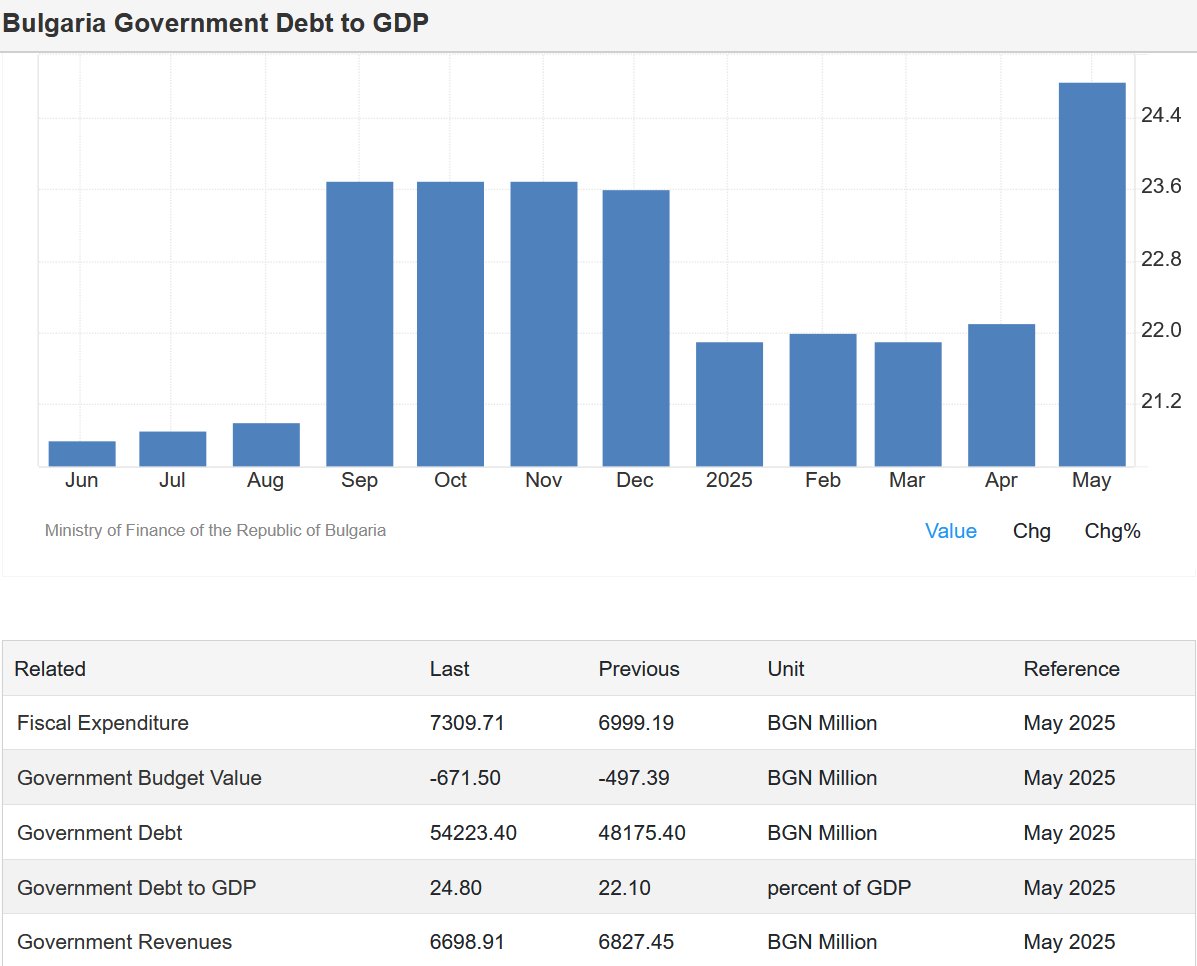
According to figures from Bulgaria’s Ministry of Finance, the country’s government debt rose significantly in May 2025 to BGN 54.2 billion, up from BGN 48.2 billion the previous month. This pushed the debt-to-GDP ratio to 24.8%, a substantial jump from 22.1% in April.

Fiscal expenditure also increased to BGN 7.3 billion, outpacing government revenues of BGN 6.7 billion and resulting in a widened budget deficit of BGN -671.5 million.

Image

The Forgotten Bitcoin Trove

Meanwhile, back in 2017, Bulgarian authorities seized 213,519 BTC in a crackdown on organized cybercrime. At the time, Bitcoin was trading below $3,000, valuing the haul at less than $640 million. Interestingly, reports suggest the government sold the BTC in 2018, though the details remain unclear.

Fast forward to July 2025, Bitcoin has reached an all-time high of $123,200. That same stash would now be worth approximately $26.3 billion at peak valuation or BGN 44.29 billion at current exchange rates.

Nearly 82% of the National Debt

To put this in perspective, the unrealized value of the Bitcoin once held by the Bulgarian government now equals nearly 82% of its total public debt. This suggests that simply holding the seized BTC could have helped the country cover nearly all of its debt obligations.

German Government’s $6B Bitcoin Fumble

Meanwhile, Bulgaria is not alone in this missed opportunity. Between June and July 2024, the German government made waves in the crypto space by continuously selling off BTC. In particular, it liquidated 49,858 BTC at an average price of $57,900, netting $2.89 billion.

However, just a year later, the price of BTC has more than doubled. Had the government held on to its Bitcoin, it would now be sitting on a fortune exceeding $6.1 billion.

A Costly Lesson in Long-Term Vision

The BTC sagas of Bulgaria and Germany remind the public about crypto’s long-term potential and the cost of underestimating it. Even the U.S. government has acknowledged losing a $17 billion fortune due to a lack of long-term vision for Bitcoin.

These early exits are now some of the most expensive missed opportunities in government financial history.

However, in recent times, governments are increasingly re-evaluating their stance on holding Bitcoin. Notably, the U.S. government has prohibited the sale of seized BTC, instead choosing to consolidate assets into a national reserve for long-term purposes.

Meanwhile, nations like El Salvador, having shown early foresight, doubled down on their Bitcoin holdings, a strategy that is now paying off handsomely.

Fidelity Urges Congress to Fix Bitcoin and Crypto Tax Rules as Lawmakers Push New Regulations

0

Fidelity’s Senior Tax Counsel VP , Sarah Reilly, told lawmakers during a congressional hearing today that the crypto industry urgently needs tax rules that are clear, consistent, and easy to follow. 

Speaking alongside Blockchain Association CEO Summer Mersinger at an ongoing House Ways & Means Subcommittee session, Reilly called attention to the challenges crypto investors and companies face under current tax law.

Fidelity VP Calls for Better Crypto Tax Rules

She pointed out that without proper guidance, individuals and institutions have no choice but to rely on outdated tax principles and vague internal IRS policies. According to her, these stopgap measures do not cover the full range of digital asset transactions. Reilly stressed that this confusion does more than create frustration; it causes real harm.

Further, she explained that unclear tax rules weaken public trust, lead to different outcomes for similar taxpayers, and make it harder for people to follow the law. 

Reilly warned that this uncertainty drives innovation and investment out of the U.S. Notably, she used staking as an example, saying that unclear rules about how to report staking rewards have already pushed much of the activity offshore. Just last December, the IRS insisted on taxing unrealized gains from staking.

The Fidelity VP urged Congress to step in. Essentially, she said lawmakers must update parts of the tax code that touch on digital assets, like those on securities lending, mark-to-market elections, and U.S. trading safe harbors. 

She also asked for new rules that specifically cover newer developments like staking and stablecoins. Reilly clarified that most tax laws in place today were written before crypto existed, so they don’t reflect how the market works now.

Her call for change comes as lawmakers consider a group of major crypto bills. These include the GENIUS Act, which would set rules for stablecoins; the CLARITY Act, which would define whether digital assets fall under securities or commodities law; and a bill that would block the Federal Reserve from launching a central bank digital currency. 

Tax Policies Surrounding Crypto

While Congress debates these proposals, the IRS has already introduced stricter reporting rules. From April 15, 2025, every taxpayer who traded or earned crypto or NFTs in 2024 must report all transactions, even those worth only a few dollars. Those who don’t comply could face steep fines or even jail time.

Also, starting January 2025, crypto exchanges and brokers like Coinbase must send the IRS Form 1099-DIV, showing the gross proceeds from customer trades. The agency postponed rules mandating exchanges to report cost basis data until January 2026. 

However, these rules don’t apply to decentralized platforms, which don’t hold users’ funds and often can’t access transaction data. Further, the IRS also changed how taxpayers must calculate their crypto cost basis, mandating that investors must track gains wallet by wallet, instead of using one combined method. 

At the same time, some states are easing up on crypto taxes. For instance, Missouri has moved to scrap capital gains taxes on crypto, signaling a possible change toward friendlier tax policies at the state level.

Meanwhile, Congress continues its biggest push yet to regulate the broader crypto market. Though the House blocked the GENIUS Act in a procedural vote, pressure from President Trump has revived the bill, along with the CLARITY Act and the anti-CBDC proposal. Lawmakers expect to vote again today.