Home Blog Page 629

Here’s The Valhalla Gate Key that Could Take XRP to $12 to $23

0

A notable market watcher has identified what he believes is the “Valhalla gate key” to push XRP to a two-digit price range.

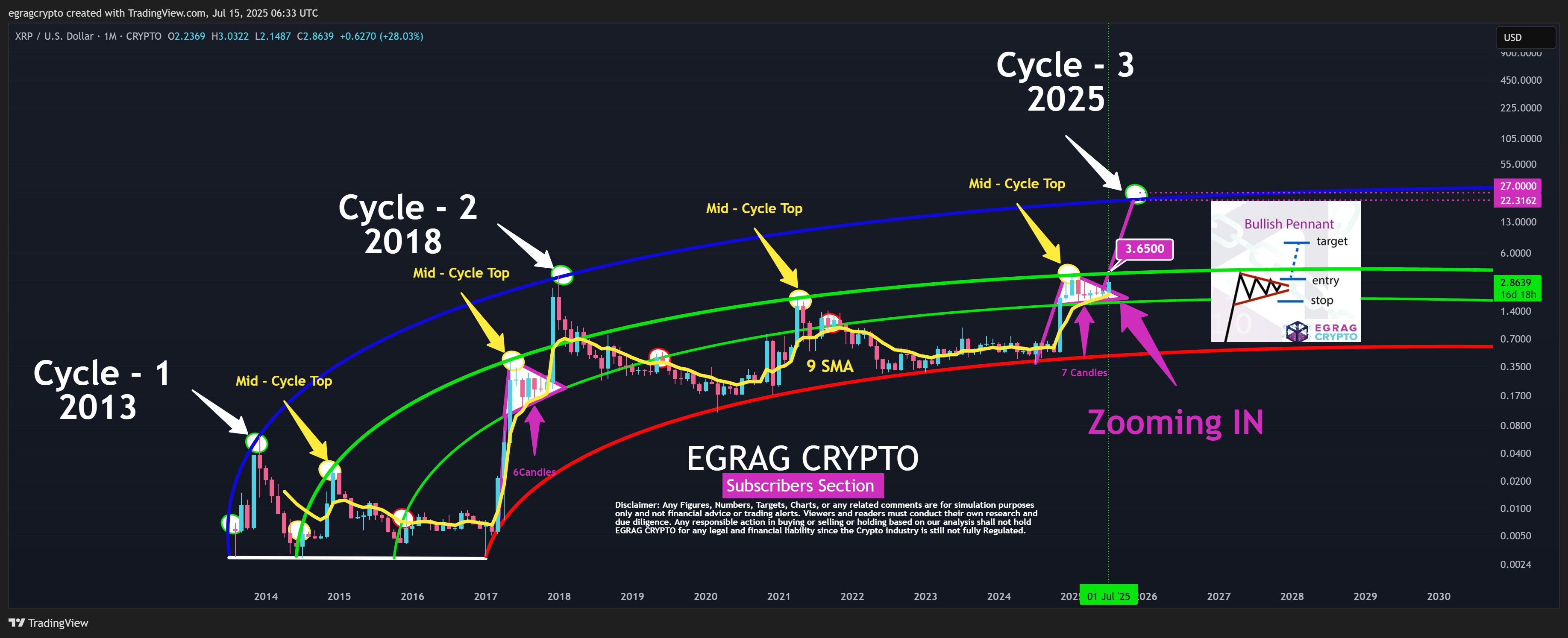
Analyst EGRAG Crypto revealed this in his latest XRP analysis, indicating that the Valhalla gate key is the $3.65 level. Notably, he presented a monthly XRP chart featuring two cycle tops and three mid-cycle tops in relation to the 9-period SMA. According to him, this chart is his favorite, and he usually leverages it to identify XRP’s next move.

XRP Navigates Cycles 1 and 2

Specifically, details from the chart show that XRP tends to hit a mid-cycle top and a cycle top in each bull run, but the timeline has been inconsistent. For instance, in what he calls Cycle 1, XRP first reached a cycle top of $0.0614 in December 2013 before correcting. After this, it then hit a mid-cycle top of $0.0280 in December 2014 after bouncing off the 9 SMA.

Meanwhile, in Cycle 2, XRP first claimed a mid-cycle top of $0.3988 in May 2017 before retracing. This retracement, which lasted six months, formed a bullish pennant. Interestingly, during the retracement, XRP again retested and bounced off the 9 SMA. Following this bounce, it soared to a cycle top of $3.8 in January 2018.

Notably, XRP again reached a mid-cycle top of $1.96 in April 2021 during the bull run at the time. However, EGRAG confirmed that he does not regard this as a separate cycle. For context, XRP failed to find its full potential during this run, partly due to the SEC lawsuit.

The Cycle 3

Data from EGRAG’s chart shows that XRP formed another mid-cycle top during the November 2024 to January 2025 run in what he now considers Cycle 3. Specifically, XRP reached a mid-cycle top of $3.4 in January 2025 and corrected.
XRP Cycle Moves EGRAG Crypto
XRP Cycle Moves | EGRAG Crypto

The ensuing correction led to a bullish pennant that lasted for seven months, similar to what happened during the 2017 bull run. During this correction, XRP bounced off the 9 SMA again and then recovered. Now, it has broken above the bullish pennant on the back of the latest upward push that saw it retest $3. 

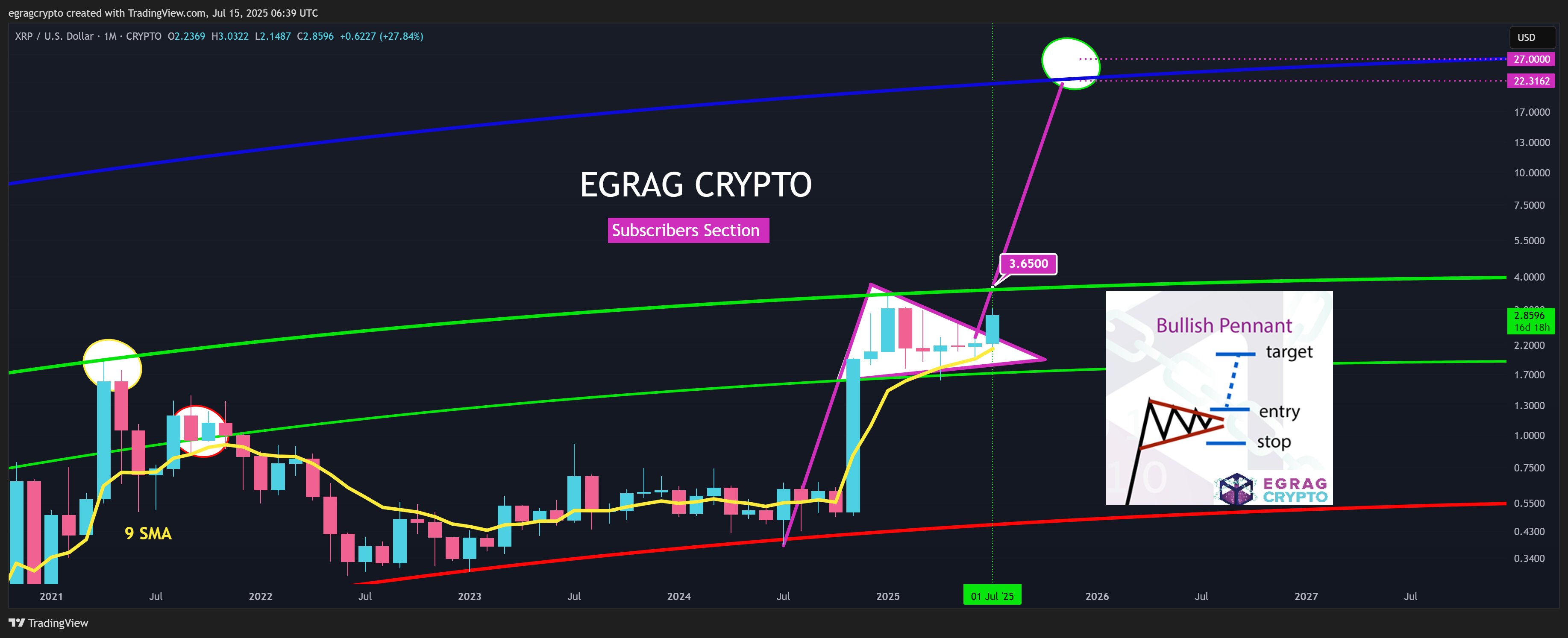
EGRAG identified this recent bullish run, confirming that XRP has bounced off the 9 SMA and broken above the bullish pennant. According to him, the market is now awaiting its next price movement.

XRP’s Targets Once It Breaches the Valhalla Gate Key

However, the analyst confirmed that XRP would first need to breach the $3.65 level, which aligns with his upper green ribbon. EGRAG calls this mark the “Valhalla gate key” and insists that until XRP hits and closes above this price level, it will not secure a decisive breakout.
The Valhalla Gate Key

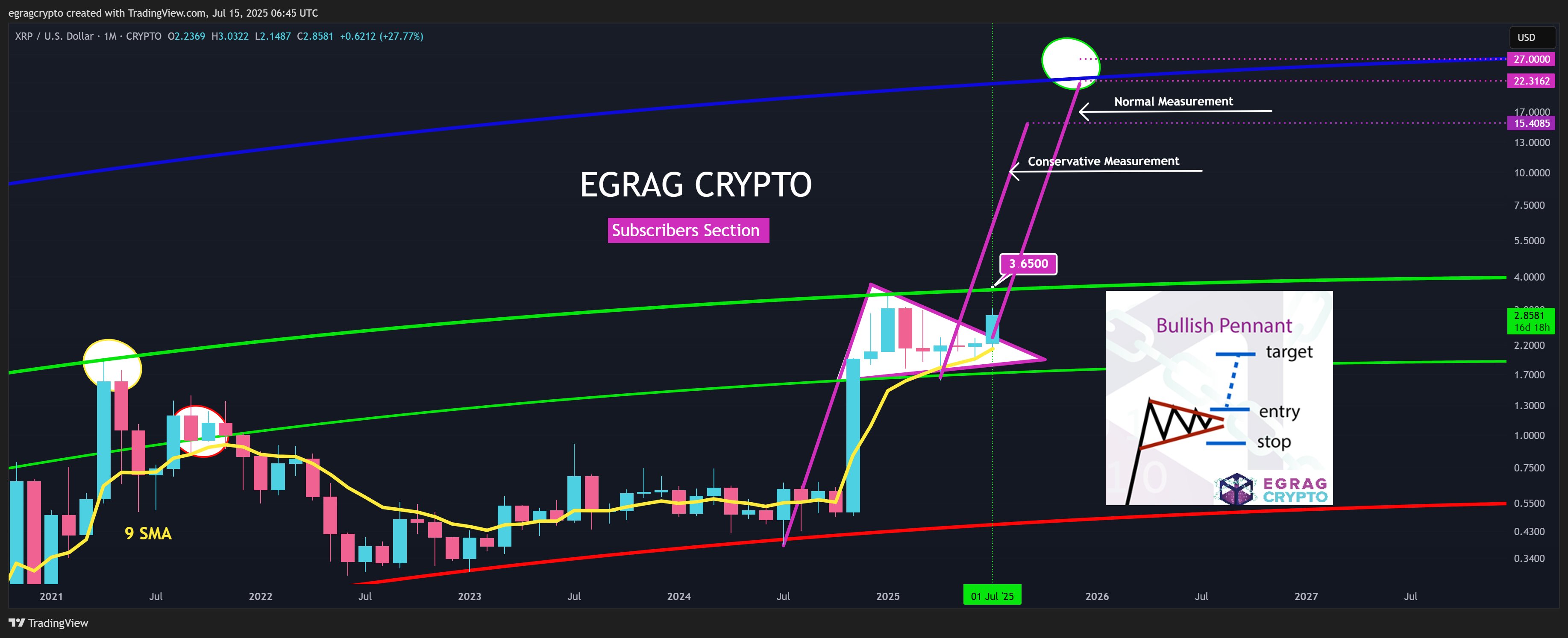
Once XRP closes above $3.65 with conviction, EGRAG suggests there are four targets based on two possibilities from the measured move. The first possibility is a full pole breakout. In this case, the normal pole measurement leads to a target of $23, while the conservative pole measurement results in a $15 target.
Full Pole Breakout Targets
Full and Conservative Pole Breakout Targets

Meanwhile, the second possibility is a conservative pole breakout. For this, EGRAG says the normal measurement is $16, while the conservative measurement is $12. Overall, he sets an XRP target range of $12 to $23, requiring a 313% to 693% rise from the current price of $2.90.

Trump Talks Crypto, Assures GENIUS Act Will Pass Today Despite Tuesday’s Setback

0

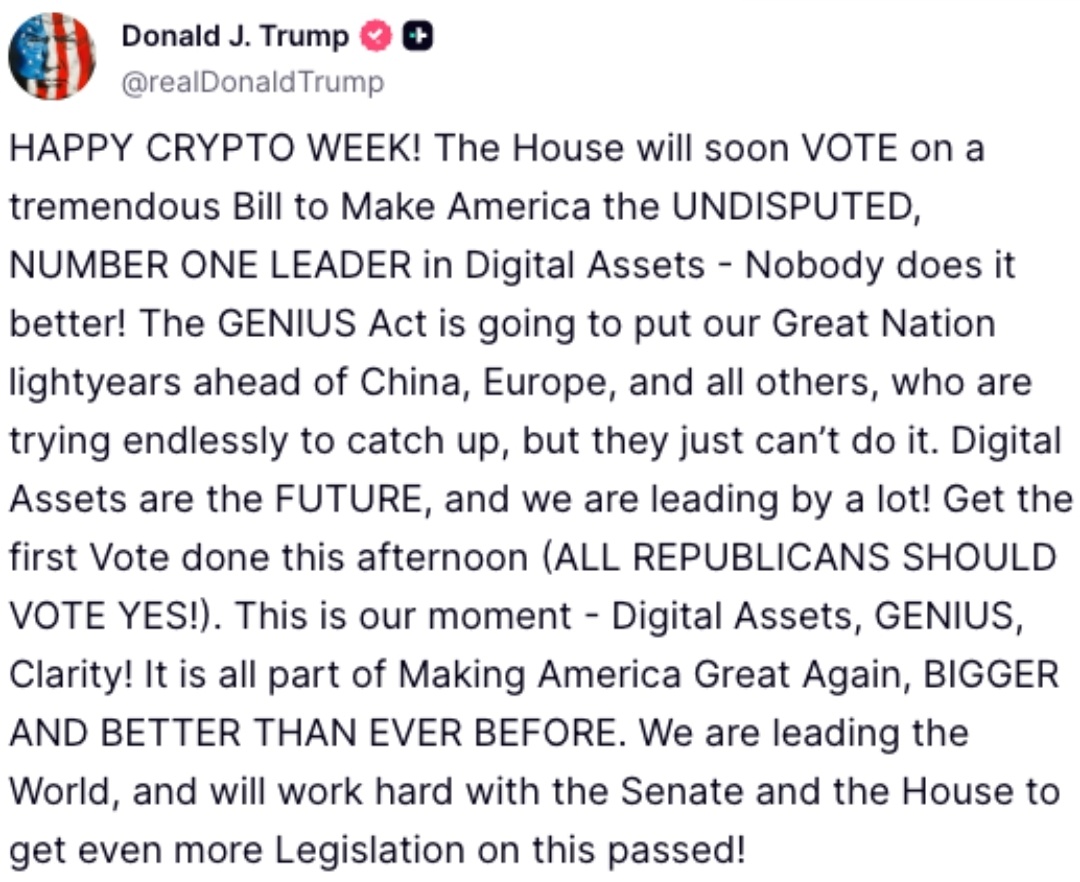
Donald Trump’s latest Truth Social posts reaffirm his support for cryptocurrencies as he pushes for the US House GOP to pass the GENIUS Act.

The Crypto Week kicked off on Monday, and even the US president is a fan. He wished the US House of Representatives a happy Crypto Week ahead of the votes on three “tremendous” bills that will position America as the undisputed leader in the crypto space.

Trump’s Truth Social Post Ahead of GENIUS Act Voting

Notably, the US House went to the polls on Tuesday to vote on the advancement of three bills: the GENIUS Act, the CLARITY bill, and the Anti-CBDC bill. Reports show that the bills did not pass yesterday, as divided Republicans and unyielding Democrats dealt a blow to the passage.

Stablecoin Legislation Fails to Pass on First Vote

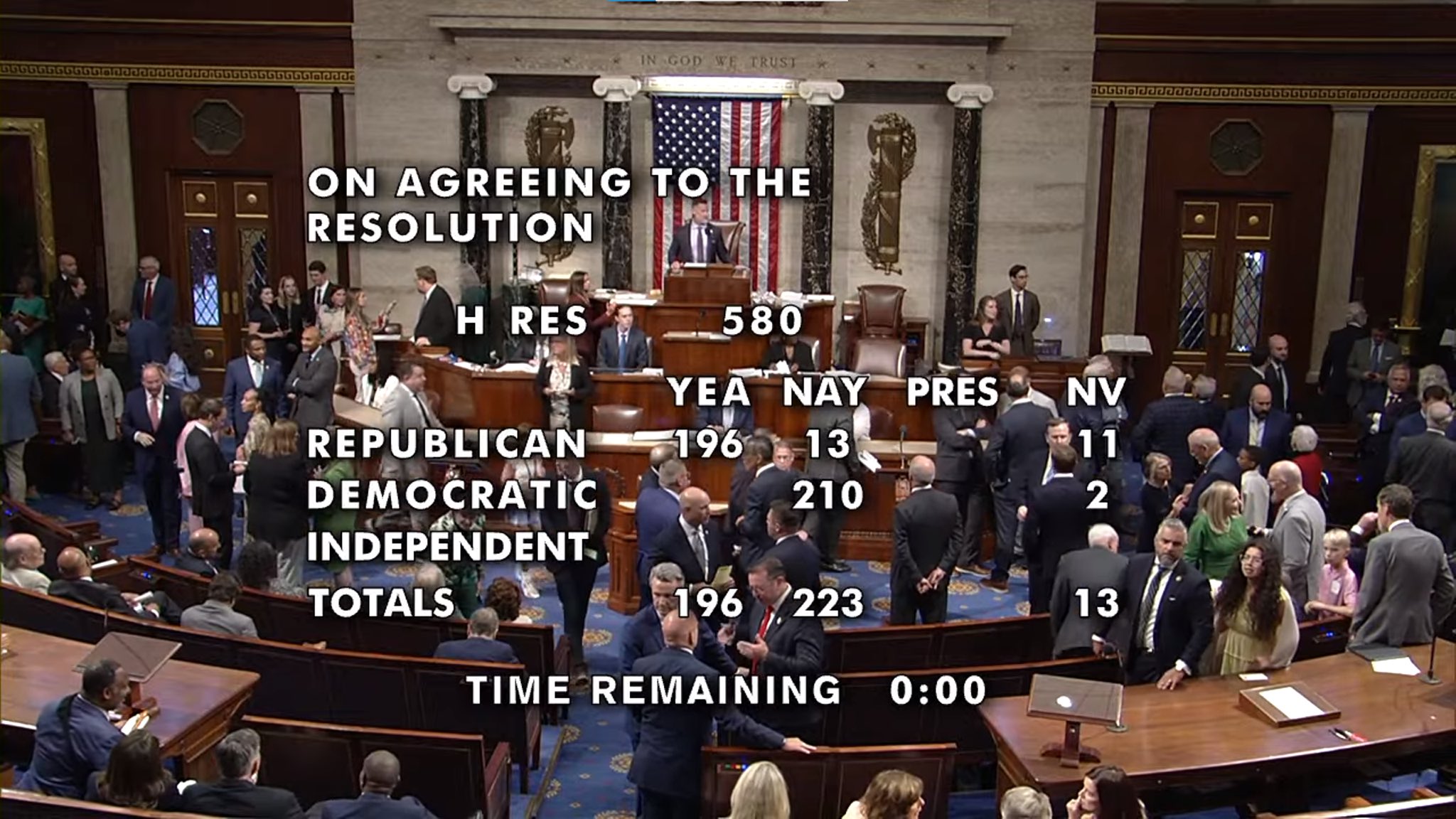
Despite the call from Trump that all Republicans vote yes to the GENIUS Act passing, some GOP hardliners repealed the bill. For context, 580 US congresspeople were present to vote on the approval of the stablecoin bill yesterday, and 223 members voted no.

Of the 223 nay votes, 210 came from the Democrats, who united to prevent the bill from passing at the first trial. Interestingly, only two present Democrat members did not vote on the bill, and all who voted repealed it.

However, the Republicans seemed divided in contrast to the Democrats. Of the majority of 220 present members, 196 voted yes, 13 voted no, and 11 stayed on the fence. This brought the results of the poll to 196-223 against the passing of the stablecoin bill.

Final Results of the Voting

Some of the Republican no voters include Andy Biggs, Victoria Spartz, Michael Cloud, Majority Leader Steve Scalise, and Anna Paulina Luna. Meanwhile, Florida’s Luna shared that her concerns stemmed from the fact that the GENIUS Act did not specifically ban the creation of central bank digital currencies (CBDCs).

Moreover, Speaker of the House Mike Johnson disclosed that the lack of bipartisan support for the GENIUS Act came from arguments that all three crypto bills should pass the House simultaneously, rather than being voted on individually.

Trump Assures GENIUS Act Will Pass Today

Again, the pro-Bitcoin president swung into action after the votes, as disclosed in another Truth Social post. Trump noted that he had a discussion in the Oval Office with 11 of the 12 GOP House members required to pass the GENIUS Act and had convinced them to vote for the bill today.

The meeting, which House Speaker Johnson attended by telephone, ended with the GOP hardliners agreeing to vote in favor of the stablecoin bill on Wednesday.

The US House will vote on the GENIUS Act bill again today, and the crypto industry hopes it will finally pass.

Pundit Questions XRP Escrow, Governance, and Utility Amid Resurfaced Jed McCaleb Interview 

0

An interview with Jed McCaleb, co-founder of both Ripple and Stellar, has resurfaced, reviving the argument around XRP and XLM. 

The interview, originally aired by CNBC in March 2018, was recently shared by Stellar community member “Stellar Expert.” Alongside the clip, he asked several questions about Ripple’s practices and XRP’s structure.

McCaleb Reveals Why He Left Ripple

In the interview, McCaleb explained that he left Ripple to build a network with a different philosophy. He said he wanted to create something more open, more decentralized, and less tied to a single organization. 

To him, this meant launching Stellar as a nonprofit and focusing on building a system that worked more like the internet: something anyone could use, without needing approval from a central authority. 

He criticized Ripple for giving too much control to one company. In addition, he suggested that the way its validators worked made it hard for outside participants to get involved.

Building on this, Stellar Expert asked why Ripple continues to “dump on retail,” why the company can allegedly change network rules, why RippleNet relies on a group of validators linked to Ripple Labs, and what real role XRP plays for everyday users, given Ripple’s focus on banks and institutions.

Ripple’s Escrow Releases

Notably, the answer to his first question lies in the escrow system Ripple set up back in 2017. The company locked 55 billion XRP into monthly time-based contracts that release one billion tokens each month. 

However, not all of it ends up in the market. Any unused tokens simply return to escrow, and Ripple publishes regular reports detailing these movements. The goal isn’t to flood the market but to support its payment infrastructure, especially for On-Demand Liquidity (ODL), which uses XRP to settle cross-border payments. 

These sales mostly go to financial institutions and liquidity partners, not retail traders. Specifically, the firm designed the system for transparency and stability, not short-term profit. Ripple CTO David Schwartz has insisted that there’s nothing more they could do with their large XRP stash.

Does Ripple Have Unquestionable Control of the XRPL?

Meanwhile, the second question focuses on a common misunderstanding. Notably, Ripple doesn’t control how the XRP Ledger works. Any update or change to the network has to gain approval by at least 80% of the validators on the network, and that level of agreement must hold for two weeks before anything goes into effect. 

Ripple itself only operates one validator out of more than 150 worldwide. So, while Ripple has influence due to its renown, it can’t force changes on the network without consensus from the broader community.

Also, the third question, about validator control, builds on the second. Ripple does publish a default list of trusted validators, called the Unique Node List (UNL), but that list is not fixed, and anyone can choose their own. 

Moreover, validators on the network include universities, independent developers, exchanges, and other organizations, not just Ripple. This means no single group, including Ripple, can make decisions on its own. 

XRP Still Has Utility Beyond Bank Use

Finally, regarding public use of XRP, the token plays a much larger role than just supporting RippleNet. While XRP’s design is more attractive to financial institutions and banks, the XRP Ledger is open-source, and anyone can build on it or use its features. 

Developers have created a decentralized exchange that has been running since 2012, allowing people to trade assets with minimal fees. Other projects are using the network for NFTs, tokenized real estate, and even stablecoins like RLUSD. 

Individuals can send money using XRP in seconds, with near-zero fees, and this is useful for remittances and micropayments. It is also available on major exchanges and wallet apps, meaning access to XRP isn’t limited to institutions.

SEC Commissioner Says Delays in XRP ETF Reviews Are Procedural, Not Rejection

0

U.S. SEC Commissioner Hester Peirce has addressed the frustration over the slow pace of review for spot-based crypto ETFs, including those tied to XRP. 

Several investors have expressed frustration over the SEC’s repeated delays in deciding the fate of spot ETFs tied to altcoins, such as XRP. In June, the commission delayed its decision on Franklin Templeton’s spot XRP ETF application, just as it had done for several XRP ETF filings in previous months. 

Reason Behind Delays  

Speaking in a recent interview on The David Lin Report (TDLR), Commissioner Peirce commented on the SEC’s repeated delays in approving XRP ETFs, highlighting the decision-making process. 

Peirce said she expected the frustration from investors, stating that she had warned them about it right from the beginning. While acknowledging the growing complaints, the SEC Commissioner emphasized that the SEC, as a bureaucracy, adheres to specific rules in its processes. 

This procedure ensures that the SEC moves deliberately, not quickly, which eventually delays the review of applications, as evidenced in the XRP ETF filings. Nonetheless, the commissioner confirmed that the SEC is still reviewing multiple altcoin ETF filings, as well as other exchange-traded product (ETP) applications. 

“[…] So we are working through. We have gotten a lot of applications on the exchange-traded product side. And so we’re working through those,” she remarked.

Despite the growing complaints, Peirce suggested that the SEC would stick to its established review process for the multiple applications for altcoin ETFs. She stressed that this extensive review will “definitely frustrate people.” 

SEC Is Not Ruling Out Spot XRP ETF Launch 

However, the commissioner clarified that the SEC is not ruling out the potential launch of XRP ETFs despite the delays. 

“When you see delays, you should not assume that [the SEC is] ruling it out,” she said. Delaying decisions on financial products is part of the SEC’s review process, ensuring ample time for thorough evaluation. 

Potential Deadline for XRP ETF Launch 

For context, more than 10 prospective issuers, including Franklin Templeton and Bitwise, are seeking to launch spot XRP ETFs in the United States.

So far, the SEC has already missed the first two decision deadlines for these products. The third deadline for some of these products is scheduled for August, while the fourth and final deadline is in October. 

Several experts, like Bloomberg ETF analysts Eric Balchunas and James Seyffart, believe the SEC will approve these spot XRP ETF applications by October.

Although the SEC has yet to approve any spot XRP ETF applications, the commission has given tacit approval for the launch of multiple futures XRP ETFs, like Teucrium 2x Long Daily XRP ETF.

LERN360 Is Doing What Web3 Edtech Has Only Promised And Turning It Into Reality

0

For years, Web3 projects in education have promised to decentralize learning, reward users with tokens, and make global knowledge accessible across languages. The vision was bold – but delivery has consistently fallen short.

LERN360 enters the scene with a clear difference: not just a concept, but a fully designed learning economy that integrates AI, blockchain, and real token utility. It’s not about disrupting education with hype. It’s about building infrastructure that actually works – for learners, educators, and the entire ecosystem.

A New Model for Global Learning

LERN360 is designed to remove the core frictions of modern online education. No more language barriers, centralized credentialing, or “learn” models that lead nowhere. The platform introduces a system where progress is recognized on-chain, knowledge is personalized through AI, and incentives are aligned across all users.

  • AI translates and adapts content in real time, offering each user a personalized, multilingual experience
  • Blockchain ensures that every certificate and credential is verifiable, secure, and tamper-proof
  • $LERN tokens fuel a circular economy of learning, teaching, earning, and governing

This isn’t just another Web3 use case – it’s an entirely new layer of infrastructure for scalable, inclusive, and rewarding education.

More Than a Token: A Real Incentive Mechanism

In most Web3 edtech projects, tokens are an afterthought – loosely tied to speculative value, with little functional use. LERN360 takes a different approach. The $LERN token is embedded into every part of the platform’s logic. It creates a feedback loop that rewards genuine participation and reinforces long-term utility.

The token flow is simple, but powerful:

– Learn and earn $LERN by completing verified courses
– Use tokens to unlock advanced content, expert sessions, and AI tools
– Create educational content and earn both tokens and on-chain reputation
– Participate in platform governance through DAO proposals and voting

Each action contributes value to the system. The more people engage, the stronger the economy becomes – this is what token utility should look like.

What Makes LERN360 Different?

The edtech space is full of ambition, but short on delivery. Here’s where LERN360 stands apart:

  • Multilingual by default: Every course is designed for global access, powered by AI-based real-time translation
  • Proof of progress: All credentials and achievements are on-chain, transparent, and secure
  • Skill-to-earn model: Incentives are directly tied to learning outcomes – not just time spent
  • DAO structure: Platform evolution is guided by its users, not a centralized entity
  • Real-world utility: Tokens have purpose from day one – for learners, creators, and community contributors

This isn’t about replacing traditional education. It’s about expanding access, increasing accountability, and rewarding participation in a way that legacy platforms can’t.

Why It Matters Now

The market is saturated with roadmaps, MVPs, and buzzwords. But learners don’t need more promises – they need systems that respect their time and reward their growth. LERN360 is designed for long-term adoption, not short-term noise.

As the platform prepares for its next phase, early supporters have a chance to engage not just as users, but as stakeholders in a growing decentralized ecosystem. Through the $LERN pre-sale, contributors gain early access to features, tools, and governance rights – all tied to real educational value.

This is not a pitch for another token. It’s an invitation to help shape a smarter, more inclusive global learning economy.

Learn more: lern360.ai

Disclaimer: This Press release article is provided by the Client. The Client is solely responsible for this page’s content, quality, accuracy, products, advertising, or other materials. Readers should conduct their own research before taking any actions related to the material available on this page. The Crypto Basic is not responsible for the accuracy of info and any damage or loss caused or alleged to be caused by the use of or reliance on any content, goods, or services mentioned in this press release article.

Please note that The Crypto Basic does not endorse or support any content or product on this page. We strongly advise readers to conduct their own research before acting on any information presented here and assume full responsibility for their decisions. This article should not be considered investment advice.

Giant Whale Shorts Ethereum with 18x Leverage After Making $15M Profit

After Ethereum broke a five-month high, the coin has come under pressure once again, this time from whales betting against its uptrend.

On-chain data reveals that a high-profile trader, known with the wallet address 0x2258, has opened a massive short position against ETH. This move follows a series of successful trades that have already netted the whale over $15 million in profit.

$62.5M Ethereum Short Opens Amid Tight Market Conditions

According to data tracked through Hyperdash, whale 0x2258 has opened a short position worth $62.42 million, equivalent to 20,474 ETH, using a staggering 18x leverage.

The entry price sits at $3,060.45. With ETH trading below $3,000 at press time, the whale’s position is currently yielding an unrealized profit of over $1.14 million (30% ROE).

The position’s liquidation price is $3,505.34, giving the whale a relatively narrow buffer should ETH prices spike. Notably, Ethereum last traded at this level in January 2025, six months ago, making this a significant resistance level. 

The whale appears confident that ETH won’t reclaim that level soon, hence the aggressive leverage against ETH bulls.

History of Outsmarting James Wynn

This isn’t the whale’s first significant move. Specifically, trader 0x2258 has gained a reputation for taking the opposite side of James Wynn’s trades and profiting handsomely.

Notably, James Wynn made waves in the crypto space months ago for high-stakes positions that resulted in the loss of multimillion-dollar fortunes. Back in May:

  • On May 24, 0x2258 began shorting ETH and Bitcoin as Wynn went long.
  • On May 25, after Wynn exited his long positions, 0x2258 closed his shorts, pocketing $1.36 million.
  • When Wynn flipped short, 0x2258 went long and exited with a $2.54 million profit a day later.
  • The cycle repeated, and by May 26, the whale had accumulated a $5.6 million profit in just three days.

This strategic inverse trading continued to compound profits, ultimately contributing to over $15 million in total realized gains.

Overall, the current ETH short highlights a lack of confidence in Ethereum’s ongoing bull trend, even as Bitcoin continues to break through higher resistance levels.

Moreover, the trader’s contrarian strategy against high-profile influencers like James Wynn continues to draw attention. Whether this new short results in another multimillion-dollar win remains to be seen.

Stablecoins Will Be the Future of Global Money Movement: Circle CEO

0

Circle CEO Jeremy Allaire has a bold outlook for stablecoins, predicting that they could power the future of intra and inter-border transactions.

Allaire made these claims in a recent interview on CNBC’s Money Movers. He highlighted the growing adoption of stablecoins and how Circle positions itself as a pioneer in offering transactional services to retail and institutional users.

Stablecoins: A Major Upgrade to The Financial System

Allaire suggested that stablecoins and digital assets have improved the global financial system. Beyond retail users, institutions are also turning to these currencies for their daily transactions, leveraging their better proficiency than existing rails.

Nonetheless, he noted that stablecoin adoption is still in its early days. With emerging use cases, especially in the cross-border payment market, he projected that more users would embrace the technological innovation.

Meanwhile, the Circle CEO highlighted that these fiat-pegged digital currencies are rapidly becoming a go-to tool for routine transactions. According to him, this new innovation simplifies transactions in the same way as messaging on WhatsApp.

Stablecoin’s instant transactional ability and low cost are at the forefront of this simplified payment system. Notably, Allaire stressed that households, businesses, and nations are using this means, which he branded as the “future of global money movement.”

Institutions Demonstrate Traction For Stablecoins

Furthermore, this concept is resonating among prominent financial institutions as they seek ways to leverage the stablecoin transactional rail. The growing buzz around the industry was showcased in Circle’s recent initial public offering.

For context, Circle upsized its valuation to $7.2 billion following increased demand during its IPO, raising $1.1 billion from the event at a $31 per share sale. Notably, its stock launched on the NYSE in June at around $69 per share and has since skyrocketed over 500%.

Its post-IPO success demonstrated a massive investor demand for products offering exposure to the stablecoin market. Meanwhile, the lure for such products could increase further amid stablecoin regulatory breakthroughs in the US Senate and House.

Moreover, US Treasury Secretary Scott Bessent projected that the dollar-pegged stablecoin market would reach $2 trillion in the next few years, with brokerage firm Bernstein expecting a global valuation of $4 trillion by 2035.

In the meantime, Circle’s USDC has a market capitalization of $62.7 billion, accounting for 24% of the total $261 billion stablecoin market. Tether’s USDT dominates the sector with a market cap of $160 billion.

TRUMP Meme Coin Set to Unlock 40M Tokens Tomorrow: How Could the Market React?

0

The TRUMP meme coin is about to see a major change in supply, with 40 million tokens set to enter the market tomorrow. 

Messari, a prominent crypto analytics firm, shared this update, noting that the tokens represent 20% of the supply and are worth around $370 million. Messari described this as the largest unlock left in the project’s schedule, triggering concerns about how this inflation could affect price action in the short term.

TRUMP’s Tokenomics

Notably, the TRUMP meme coin follows a structured release plan that dates back to its official launch on Jan. 17, 2025, just before Donald Trump’s second presidential inauguration. 

TRUMP Meme Coin Allocations Messari
TRUMP Meme Coin Allocations | Messari

The project introduced one billion tokens in total. However, it released 200 million tokens (20%) to the public at launch while locking away the remaining 800 million (80%) for affiliated companies like CIC Digital LLC and Fight Fight Fight LLC, both linked to Trump’s business empire.

According to the project’s roadmap, these reserved tokens remain locked for a period between three and twelve months, after which they gradually unlock on a daily basis over two years.

So far, the token’s distribution has met criticism. Specifically, just 40 wallets, mostly tied to Trump-linked entities, control over 90% of the combined TRUMP and MELANIA coin supply. Meanwhile, retail investors hold less than 10% of the supply, and most individual wallets carry token values below $100. 

This lopsided structure has triggered red flags about market manipulation and unequal opportunity, with multiple critics warning that the project benefits a small circle at the expense of everyday buyers. Interestingly, The Crypto Basic confirmed in May that only 58 wallets saw $1 billion in profit, while more than 750,000 retail wallets observed losses.

Trump Meme Coin Already Seeing Price Struggles

Notably, since July 12, the coin has failed to keep up with the wider market’s gains. Instead, it has recorded three straight days of losses and looks set to post a fourth consecutive red day. 

Over this period, TRUMP’s price has dropped by over 8.5%, while most top assets rallied. Despite the pullback, the token continues to hold above the $9 support zone, hovering around $9.10. 

Now, with 40 million new tokens entering circulation tomorrow, traders could expect more downside pressure, especially if early holders decide to cash out. However, if the market successfully absorbs the resulting sell-side pressure, optimism could emerge among investors.

Recall that the TRUMP meme coin got off to an amazing start in January, soaring over 800% in just hours and briefly hitting a $15 billion market cap before settling around $12–13 billion. 

However, extreme volatility soon took over. For instance, shortly after Melania Trump launched her own meme coin, TRUMP’s value dropped by more than half within minutes. Despite occasional upswings, the overall trend has been down. Its current price of $9.1 represents an 88% drop from the Jan. 19 peak of $75.

Veteran Trader Shares How High XRP Could Go this Cycle if Bitcoin Doubles from Here

As a new bullish phase sweeps through the crypto market, analysts are now speculating how high top crypto assets like XRP and Bitcoin could rise.

In a recent post, a crypto investor with over a decade of experience, “ProfitMana,” shared his realistic price targets for 13 crypto tokens. He highlighted their potential to yield investors between 2X and 30X returns during the current bull run.

Bitcoin to $250K

Unsurprisingly, Bitcoin topped the list, with Mana projecting an additional 2X upside from its current level. Notably, it touched a peak of $123,200 on July 14. This surge briefly pushed its market cap above Amazon and Google, making it the fifth most valuable asset in the world with a $2.4 trillion valuation.

However, Mana’s outlook suggests that Bitcoin could surpass the $200,000 mark this year, potentially reaching $250,000, as many have previously projected. He described this outlook as “guaranteed.” At press time, however, BTC is undergoing a correction, dipping to $116,000.

Ethereum, XRP, and Solana Price Outlooks

For leading altcoins like Ethereum, XRP, and Solana, Mana expects even stronger performance than Bitcoin. He suggested that Ethereum could “easily” achieve a 4X gain from current levels. With Ethereum surpassing $3,000 yesterday, this forecast implies a peak price of $12,000.

Such a surge would give Ethereum a market cap of approximately $1.44 trillion. It would place ETH ahead of Broadcom and bring it into competition with Saudi Aramco.

Regarding XRP, Mana projected a “solid” 5X surge from current prices. Since XRP briefly reclaimed the $3 mark this week, the veteran investor is now targeting up to $15 for XRP this cycle.

At $15, XRP’s market cap would exceed $885 billion, bringing it closer to the $1 trillion threshold. Notably, this would rank XRP above companies like JPMorgan Chase and Walmart.

However, this $15 price projection still falls short of expectations from parts of the XRP community, where some believe the minimum target this cycle should be $50.

For Solana (SOL), the analyst similarly predicted a 5X increase from current levels, which he believes could happen with ease. The price of SOL slightly surpassed $168 on Monday.

According to the analyst, Solana could reach prices above $800 this season, aligning closely with the expectations of those who have forecasted a $1,000 target for SOL in this cycle.

Other Altcoins

For other trending altcoins like SUI, SEI, Arbitrum (ARB), and Ondo Finance (ONDO), the analyst predicts gains ranging from 4X to 9X. He believes these tokens will achieve those price levels with minimal resistance.

Meme Coin Outlooks

The list also includes some of the most popular meme coins such as WIF, SPX, PEPE, FARTCOIN, PENGU, and RIO. Here, the projected returns are even more significant due to their high-risk, high-volatility nature.

For example, the analyst suggested RIO could surge 30X, PENGU could gain 15X, and FARTCOIN might rally 12X. Over the past few days of the bull run, some of these coins, such as PENGU, have already doubled in price. Despite the ongoing correction in the broader market, this meme coin still shows a remarkable 104% weekly gain.

Standard Chartered Becomes First Global Bank to Offer Institutional Bitcoin and Ethereum Spot Trading

0

Crypto-friendly bank Standard Chartered announces the launch of Bitcoin and Ethereum spot trading services for institutional clients. 

Rene Michau, the global head of digital assets at Standard Chartered, revealed the development in an emailed statement, as reported by Reuters.

According to Michau, the new service is available to institutional clients globally, facilitated through the bank’s U.K. investment banking platform. These clients include multinational corporations, asset managers, and other financial institutions. 

He emphasized that the new service positions Standard Chartered as “the first global systemically important bank” offering spot-based trading services for Bitcoin and Ethereum. 

Notably, Standard Chartered integrated the crypto trading service into its existing FX trading platform. The rationale is to allow institutional clients of its U.K. branch to trade Bitcoin and Ethereum via familiar interfaces. 

In the meantime, the bank is considering granting institutional clients 24/5 access to the service as demand soars. 

Previous Crypto Offerings 

Standard Chartered is no stranger to the crypto market, as it currently offers two in-house crypto products through the companies it backs – Zodia Markets and Zodia Custody. 

With Zodia Markets, Standard Chartered customers can trade over 70 crypto assets. On the other hand, users can store their digital currencies through the institutional-grade custodian solution, Zodia Custody. 

Moreover, Standard Chartered also counts Singapore-based tokenization platform Libeara among its subsidiaries. With Libeara, the bank offers asset tokenization services to its institutional clients. 

Now, it has launched spot-based Bitcoin and Ethereum trading services, allowing institutional clients to trade two of the world’s largest cryptocurrencies through familiar interfaces. Per Michau, plans are underway to expand the offering by introducing non-deliverable forwards (NDFs), specifically for Bitcoin and Ethereum. 

Standard Chartered Predictions for Bitcoin and Ethereum 

The development comes as the prices of Bitcoin and Ethereum record significant surges. While Bitcoin clinched a new all-time high of $123,200, Ethereum crossed $3,000 yesterday for the first time since February 2. 

Aside from offering crypto-related services, Standard Chartered is also bullish on the prospects of Bitcoin and Ethereum. Earlier this month, it predicted that Bitcoin would reach $135,000 by Q3 2025 and ultimately hit $200,000 by the end of this year. 

For Ethereum, Standard Chartered sees the second-biggest cryptocurrency clinching a maximum target of $4,000 this year. It initially set a lofty target of $10,000 for Ethereum. However, the bank reduced its ETH forecast to $4,000 from $10,000 in March, due to the rise of other Layer-2 blockchains, such as Base.