Home Blog Page 646

Buy XRP Before the US Treasury “Announces It”: Pundit Explains Why

Alpha Lions Academy founder Edoardo Farina has sparked renewed speculation about XRP, urging his followers to buy the asset before the U.S. Treasury “announces it.”

Though he didn’t elaborate, the post adds to a growing list of bold claims Farina has made regarding XRP’s potential role in future U.S. financial infrastructure. His latest message builds on previous theories that the Treasury may have already acquired a significant portion of Ripple’s escrowed XRP through undisclosed agreements.

Ripple’s Growing Ties with US Financial Authorities

Farina’s warning comes just days after Ripple confirmed it has applied for a U.S. national bank charter. Ripple has also applied for a Federal Reserve master account through its affiliate, Standard Custody. Such access would allow Ripple to custody reserves for its dollar-pegged stablecoin, RLUSD, directly at the Fed.

The combination of a national charter and potential Fed access has fueled belief within the XRP community that Ripple is positioning itself at the center of a new financial system, one possibly tied to government-level infrastructure.

XRP Escrow Ownership Theories

Farina has long claimed that the XRP escrow, which currently holds over 37 billion XRP, may no longer be entirely under Ripple’s control. He suggests that global entities such as the U.S. Treasury, the International Monetary Fund (IMF), and the Bank for International Settlements (BIS) may have acquired portions of the escrow through private agreements dating back to 2019–2020. However, this remains speculative.

Interestingly, Farina admitted there’s no verifiable on-chain evidence to confirm these claims. “I can’t present evidence for this, but I have strong reasons to believe it,” he said, a remark that has drawn mockery.

Nevertheless, Farina persists, arguing that the XRP Ledger cannot reveal the true beneficiaries of any potential NDA-bound arrangements. He continues to promote the narrative that the escrowed XRP could serve as a strategic reserve asset and that such moves are being made “silently.”

“The Announcement Will Change Everything”

Farina believes that a U.S. Treasury announcement, if it confirms any involvement with XRP, would be a game-changing moment for the asset’s valuation and legitimacy. His tweet suggests that insiders may already be aware of developments that have not yet been disclosed.

Still, this remains one of his many speculative theories. Farina hopes it will eventually be proven true. Notably, Ripple’s latest pursuit of a banking license has emboldened him. 

He recalls being called “crazy” in the past for suggesting that Ripple would become a bank, but recent developments now appear to align with his earlier predictions.

As a result, he continues to emphasize the potential for a U.S. Treasury announcement involving XRP.

Meanwhile, critics point out the speculative nature of such claims, rumors that have circulated within the XRP community for years without concrete evidence.

Yet for XRP enthusiasts, it’s one more reason to remain bullish. “You don’t know how big this is,” one commenter said.

Hoskinson Reacts to Claims of a Cardano Backdoor That Allows Government to Seize Users’ Tokens

0

Cardano founder Charles Hoskinson has reacted to claims that the government can seize users’ tokens by asking him to confiscate them.

The founder asked how this was possible in a tweet on Thursday, joining a heated debate between Bitcoin maximalists and altcoin enthusiasts. He was particularly drawn to the conversation when a user remarked that the government can censor or seize assets on Cardano through him.

“I’d love someone to explain to me”

Hoskinson sought further clarification on what the user meant when he claimed that the founder can censor or freeze assets on Cardano with a directive from the government. “I’ll wait,” he added.

Notably, the Bitcoin maxi’s comment came despite Cardano’s shift into a fully decentralized network in September. For context, the layer one blockchain implemented the Chang upgrade last September and entered the Voltaire era, a phase in its roadmap where power shifted to every Cardano holder, represented by stake pool operators (SPOs) and delegated representatives (dReps).

Prior to the upgrade, Hoskinson and other major stakeholders of the Cardano network burned their genesis key, which offered them unique access to the blockchain. As a result, Hoskinson’s reaction expressed his surprise that someone with an understanding of blockchain technology could make such comments.

Nonetheless, Hoskinson had earlier noted that it would take time for people to understand what had really happened on Cardano. He made the remark when a similar comment circulated in March. According to him, it would take years and strong media publicity for people to finally understand that Cardano is fully decentralized.

How It All Came About

The comment originated from a clip where Robinhood’s CEO, Vlad Tenev, noted it is time to move beyond Bitcoin and meme coins to real-world asset tokenization on the blockchain. This came after Robinhood launched a protocol that allows European users to trade American stocks directly on its platform.

A Bitcoin proponent, Breeadman, posted the video, triggering a debate within the crypto community. A user claimed that if RWA tokenization gains momentum, there would be no use for Bitcoin again.

Meanwhile, the debate on whether governments can seize Bitcoin emerged after Breadman claimed that governments can seize tokenized stocks but cannot confiscate self-custodied BTC. When some altcoin proponents clarified that the feature applies to all other cryptocurrencies, a comment emerged that the government could pressure Hoskinson and other founders to censor or confiscate users’ assets.

However, this is not possible on Cardano, following its fully decentralized feature. Hoskinson also clarified that there is no backdoor to Midnight, the forthcoming privacy-focused sidechain on the Cardano network.

Remarkably, several misconceptions are widespread regarding Midnight, particularly its data-privacy claims. Some speculate that law enforcement can access users’ information as part of Midnight’s regulatory compliance clause and can freeze users’ assets using the obtained details.

In truth, Midnight can provide enforcement agencies with access to data, but only after they follow the necessary legal processes. Nonetheless, this would be a selective disclosure that does not involve confiscating users’ assets.

US Senate to Feature Ripple CEO in Hearing on Crypto Market Structure

0

Ripple CEO Brad Garlinghouse and other prominent crypto stakeholders will participate as witnesses at the upcoming Senate hearing on the crypto market structure. 

The Senate Banking Committee has scheduled a full committee hearing on the proposed Market Structure legislation for next week.

Last month, four Republican Senators, Tim Scott, Cynthia Lummis, Bill Hagerty, and Thom Tillis, introduced the legislation.

The legislation aims to resolve the longstanding regulatory confusion in the cryptocurrency market by specifying the conditions that determine which token qualifies as a security or a commodity. While the SEC regulates assets with securities tags, the CFTC oversees those classified as commodities.

Garlinghouse to Attend as Witness

Less than two weeks after its introduction, the Senate Banking Committee has scheduled a full committee hearing on the legislation. Eleanor Terrett, the host of Crypto in America media outlet, reported that the hearing will take place on Wednesday, July 9, at 10 a.m. ET.

Notably, Ripple CEO Brad Garlinghouse will appear as a witness. Other industry stakeholders expected to testify include Summer Mersinger of the Blockchain Association, Chainalysis CEO Jonathan Levin, and Dan Robinson of Paradigm.

Justifying Garlinghouse’s Inclusion

While Terrett highlighted several leading industry figures as witnesses, many view Garlinghouse’s inclusion as fully justified.

Attorney John Deaton has highlighted that Ripple and XRP exemplify the regulatory uncertainty that plagues the crypto industry. He cited a series of events illustrating how Ripple and XRP have been treated inconsistently by U.S. regulators.

According to Deaton, Ripple Chairman Chris Larsen met with the Federal Reserve, the SEC, and the U.S. Treasury as early as 2013, explaining XRP and its underlying technology, XRP Ledger (XRPL). The following year, the U.S. Government Accountability Office (GAO) referred to XRP as a virtual currency.

In 2015, Ripple reached an agreement with the U.S. Financial Crimes Enforcement Network (FinCEN) to comply with banking laws after being fined $700 million over a sale involving Roger Ver.

According to Deaton, the SEC and FinCEN were in an information-sharing arrangement, which gave the securities regulators exclusive access to Ripple’s information.

Three years later, on June 14, 2018, the SEC’s enforcement lawyers conducted an internal Howey assessment of XRP to determine whether it constitutes a security. However, the lawyers did not recommend an enforcement action, as mentioned by Judge Analisa Torres in the Ripple case.

In August 2018, Ripple executives, including Garlinghouse, met with the SEC to resolve the lack of clarity regarding XRP. Deaton suggested that the Ripple execs visited the SEC shortly after the agency gave Bitcoin and Ethereum a free pass via the infamous Hinman speech.

Deaton stated that during the meeting, the SEC did not inform Ripple about any securities law violations, despite having substantial knowledge of every XRP transaction.

FSOC and Coinbase Call XRP a Currency

Furthermore, the Financial Stability Oversight Council (FSOC) published a report in 2019 co-signed by the SEC and CFTC chairs, which referred to XRP as a virtual currency.

That same year, Coinbase informed the SEC of its intention to list XRP after its evaluation framework determined that the coin was not a security. However, the SEC did not reject Coinbase’s request, and the exchange proceeded to list XRP. The exchange also promoted XRP’s utility in cross-border settlements, alongside the stablecoin USDC.

In June 2019, MoneyGram disclosed in an SEC filing that it would be utilizing XRP for cross-border payments. Deaton said the SEC knew that MoneyGram would sell XRP in the secondary markets but did not object.

According to Deaton, XRP is traded across more than 200 crypto exchanges globally, with several countries declaring it a non-security. Despite these facts, the SEC still sued Ripple in December 2020, alleging that all XRP transactions since 2013 were investment contracts.

Deaton argues that despite various agencies—including the FSOC and FinCEN—referring to XRP as a currency, the SEC persisted in classifying it as a security.

Given the regulatory inconsistencies surrounding XRP and Ripple, Garlinghouse’s appearance at the upcoming market structure hearing could push Congress to provide the clarity the crypto industry has long awaited.

If You Can Buy XRP then Why Buy XLM, ALGO, HBAR, or QNT

Fefe, a notable market pundit and XRP community member, has shared why he believes some investors opt to buy other altcoins instead of XRP.

The analyst discussed this in a recent commentary on X amid the mild market-wide recovery attempt, which XRP has leveraged to reclaim the $2.2 level. Notably, XRP initially spiked to a high of $2.31 yesterday before eventually correcting to now trade at $2.24.

Why Buy XLM, ALGO, HBAR, or QNT When You Can Buy XRP?

While this recovery push was not an explosive one, it presented a preview of XRP’s potential to record rapid, impressive gains like the 580% spike from November 2024 to January 2025. Notably, this is one of the reasons market pundits like Fefe have persistently asked investors to procure XRP now that it trades at a lower value.

In his latest commentary, Fefe questioned why any investor would pass up on XRP to purchase other altcoins. Specifically, he called attention to four different crypto assets others may see as rivals to XRP. However, his comments suggested there is no logical reason why an investor would go for any of these tokens while ignoring XRP.

According to Fefe, these altcoins include Stellar (XLM), which many regard as XRP’s direct rival, but others view as the project with the closest tech to XRP. Fefe also mentioned Hedera (HBAR), which has made strides in the RWA tokenization scene. He also spotlighted Algorand (ALGO) and Quant (QNT). 

Fefe believes the only reason some individuals will choose these tokens instead of XRP is doubt. Accordingly, he urged investors to do away with doubts when looking to commit to an asset. Notably, conviction plays an important role during such a phase. In his own conviction, Fefe insisted that XRP is the standard.

XRP Has Outperformed Most of These Assets

Interestingly, XRP outperformed most of the aforementioned assets during the latest market-wide explosive rally. Specifically, during the upsurge, QNT rallied by 190% to $171 by December 2024, while ALGO spiked by a more impressive 436% to $0.6139 within the same period.

Meanwhile, HBAR saw the largest increase, even outpacing XRP, as it surged to a new peak of $0.4010 by January 2025, marking a 766% increase from its November 2024 price. XLM saw a rapid 468% increase in November alone and then witnessed a massive correction in the following months.

For XRP, the rally spread across multiple months just like HBAR. Notably, XRP surged 568% from $0.5088 in November 2024 to $3.4 in January 2025, beating every other asset on this list besides HBAR. Moreover, XRP has sustained its rally better than the others, as it is still up 340% from the November price. 

Market veterans such as John Bollinger, creator of the Bollinger Bands, have praised XRP for this resilience. In addition, several analysts believe XRP could leverage the current $2 support for a massive uptick, with some projecting a rally to $27. For this reason, Fefe sees XRP as the best bet within a pool of altcoins.

XRP Holders Deserve Prosperity As They Are On Right Side of History: Pundit

A prominent XRP community pundit has suggested that XRP holders deserve prosperity due to their well-known ability to “speak the truth.”

Edoardo Farina, Alpha Lions Academy founder and XRPHealthcare’s Head of Social Adoption, made this claim in a recent post on the back of the latest developments surrounding the XRP and Ripple ecosystems.

Farina: “We Deserve Prosperity”

According to Farina, XRP community members who have been vocal about several issues have been proven right over and over again. Farina emphasized that despite the facts pointing in the opposite direction, XRP proponents have always had the courage to speak up, and more often than not, the market proves them right.

He called attention to the lingering SEC lawsuit, which began in December 2020, and XRP’s range-bound price action around $0.5. The community pundit stressed that these events lasted for what felt like an eternity, still, the community persevered in its resolve.

Farina insists that XRP proponents were on the right side of history. As a result, he suggested that they all deserve prosperity. For context, the community has always been vocal about certain events, even when the rest of the crypto space says the opposite.

Cases Where XRP Proponents Spoke “The Truth”

Notably, the latest of these events happened when Ripple officially applied to procure a U.S. banking license. According to CEO Brad Garlinghouse’s announcement, the firm, through its subsidiary Standard Custody, also applied for a Fed master account for RLUSD.

Interestingly, before now, some XRP community commentators had championed the narrative that Ripple was on a mission to disrupt the entire financial system, and this would require them to operate like a bank. 

Just last month, The Crypto Basic reported that US politician Greg Kidd was pushing for a regulation that would allow firms like Ripple to procure a U.S. banking license. The report confirmed that Ripple was already making inroads within the banking scene. However, at the time, a banking license seemed far-fetched. 

In addition to the banking license discussions, the XRP community also made comments on the Ripple vs. SEC case. Specifically, proponents insisted that XRP was not a security, and in July 2023, Judge Analisa Torres ruled accordingly. XRP pundits also projected that the case could end favorably for XRP, and this is also on the verge of materializing.

Moreover, while XRP struggled at the $0.5 to $0.6 price level for years, XRP proponents remained optimistic. Notably, at this price, XRP was largely underperforming for years while the rest of the market made strides. Interestingly, in November 2024, a breakout occurred, as predicted by the community, with XRP currently sitting above $2.

Now, the community has remained vocal about certain other events, which at this moment seem unrealistic. For one, they see a future where XRP captures a portion of SWIFT’s daily volume. In addition, some pundits have suggested that the XRPL could be a go-to platform for tokenization. Also, some believe XRP will soon surge to a two-digit price. Currently, these visions seem extremely audacious.

Here’s XRP Price if the Whole World is Tokenized and XRP Captures 1% of Its Value

Expert projections suggest XRP could grow to a double-digit price if the global economy gets tokenized and XRP captures 1% of the value.

The finance scene is moving toward blockchain. Tokenization, the process of turning real-world assets like stocks and bonds into digital tokens, is no longer a theory. Notably, it’s now becoming a reality. 

Dom Kwok, co-founder of the blockchain education firm Easy A, recently suggested that the entire global economy will eventually run on tokenized systems. 

This growing belief has triggered interest in projects that could power this future. Interestingly, XRP is one of the most practical options. Several analysts and XRP community members argue that XRP could handle a meaningful portion of value flowing through a tokenized economy.

However, the extent of the impact on XRP price remains uncertain. As a result, to explore several possibilities, we asked ChatGPT: if global tokenization becomes the standard and XRP handles just 1% of that value, what could its price look like?

XRP Price if It Captures 1% of Global Tokenized Economy

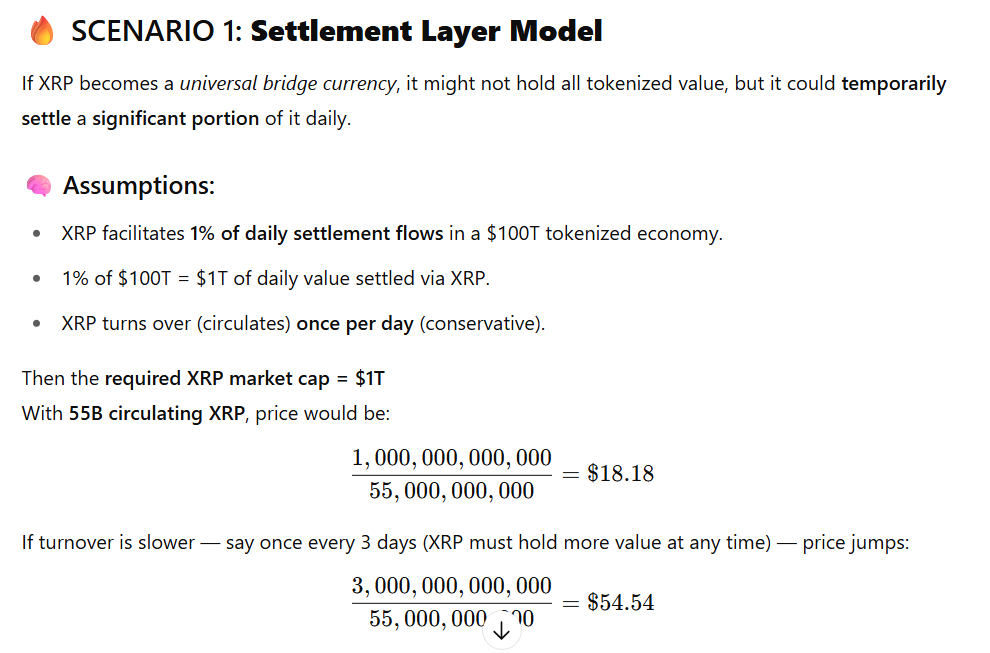
Responding, ChatGPT presented two major scenarios. In the first, XRP acts as a settlement layer. With this scenario, ChatGPT assumed a $100 trillion worth of tokenized global economy. 

If XRP facilitates just 1% of the daily settlement volume, this translates to $1 trillion moving through XRP each day. Now, should XRP circulate once daily, then XRP’s market cap needs to reach $1 trillion. The chatbot considered a circulating supply of 55 billion tokens. In this case, XRP could trade at around $18.18.

Now, if XRP turns over more slowly, say once every three days, it would need to support $3 trillion in settlements at any given time. With this, the price jumps to $54.54. In this settlement-based model, ChatGPT projected XRP’s price could land between $18 and $55.

XRP Price Prediction ChatGPT
XRP Price Prediction | ChatGPT

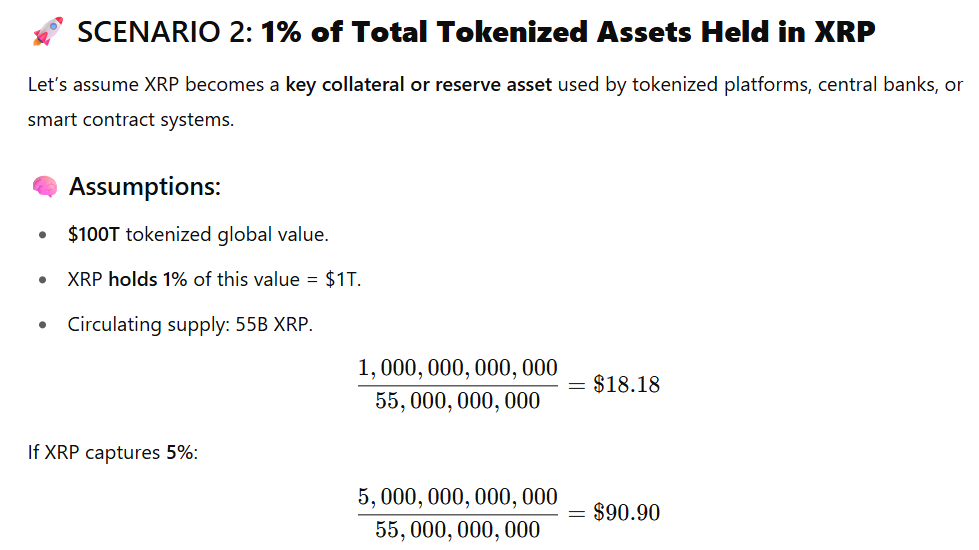
Meanwhile, the second scenario focused on XRP as a store of value. If XRP becomes a reserve or collateral asset holding just 1% of the world’s tokenized assets, that still amounts to $1 trillion. 

With the same circulating supply, XRP again reaches $18.18. If it grabs a 5% share instead, the price climbs to $90.90. So, in this model, XRP’s value could range from $18 to just over $90.

XRP Price Prediction ChatGPT
XRP Price Prediction | ChatGPT

ChatGPT based these figures on projections from major institutions. BlackRock, Citigroup, the Boston Consulting Group, and the World Economic Forum expect tokenized assets to reach between $30 trillion and $68 trillion by 2030. Some estimates stretch that number to over $100 trillion in the decades ahead.

Global Tokenization Trends

Notably, data backs these projections. In the first half of 2025 alone, the tokenized real-world asset (RWA) market grew from $8.6 billion to more than $23 billion, a 260% rise. That’s also an 85% increase from the $15.2 billion recorded at the end of 2024. 

By August 2024, the total value locked (TVL) in tokenized RWAs passed $7 billion. Experts expect that figure to hit $50 billion by year’s end, with some even predicting it could break $500 billion shortly after. Long-term forecasts show the market could reach $13.5 trillion to $16 trillion by 2030 and possibly $18.9 trillion by 2033.

Interestingly, institutional players have moved in with full force. BlackRock, JPMorgan, Goldman Sachs, BNP Paribas, Franklin Templeton, Apollo, and Fidelity have gone beyond trials and now actively deploy tokenized products. For instance, BlackRock launched its BUIDL fund in March 2024. Just a few months later, Goldman Sachs and BNP Paribas rolled out a pilot program on the Canton Network.

Also, DeFi protocols now support tokenized RWAs. Platforms like Ethena, Maple, Spark, Morpho, and Kamino allow tokenized assets to move and generate returns inside DeFi systems. Tools like RedStone’s oracles provide accurate pricing, helping these assets fit into institutional-grade environments.

Meanwhile, Larry Fink, BlackRock’s CEO, has become one of the strongest voices pushing for tokenization. In his 2025 letter to investors, he wrote that every stock, bond, and fund could be tokenized, and he called this change the future of investing. 

Fink also pushed for regulatory approval at the 2025 World Economic Forum in Davos. He argued that tokenized stocks and bonds would simplify voting and ownership and lower the barriers to investment by allowing fractional ownership and more liquidity.

Here’s What XRP Could Be Worth If It Matches USDT’s Peak Daily Volume of $292B This Year

The XRP fair value calculator indicates that XRP price could reach ambitious levels if XRP handled USDT’s peak daily volume this year under the right conditions.

XRP has been at the center of attention among critics and supporters. While some believe its price is on the verge of collapsing, others insist that the market still undervalues it at the $2 price range.

After reaching an all-time high of $3.84 during the 2018 bull run, XRP fell. So far, it hasn’t surpassed this price in recent years. Still, many see XRP as more than just a token. 

Notably, they often regard it as a bridge asset for global payments, with the potential to change how value moves across borders. That belief has continued to influence efforts to calculate what XRP might truly be worth when institutions use it at scale.

XRP Fair Valuation 

To get a fair valuation, we recently leveraged a calculator based on a research model from Robert Mitchnick and Susan Athey. Notably, the model doesn’t rely on hype or speculation. Instead, it values digital assets by measuring how much real-world utility they can deliver. 

Using this tool, we conducted a new analysis to see what XRP could be worth if it processed the highest daily transaction volume that Tether (USDT) reached this year.

For context, USDT consistently dominates daily trading volume across the crypto market. As the leading stablecoin, it supports countless trading pairs, including Bitcoin and Ethereum. 

This widespread use drives its volume higher than any other single crypto asset. Specifically, on Feb. 3, USDT peaked at $292 billion in daily volume. In contrast, XRP’s peak daily volume in recent years is $51.7 billion, a height it attained last December. 

The Right Parameters

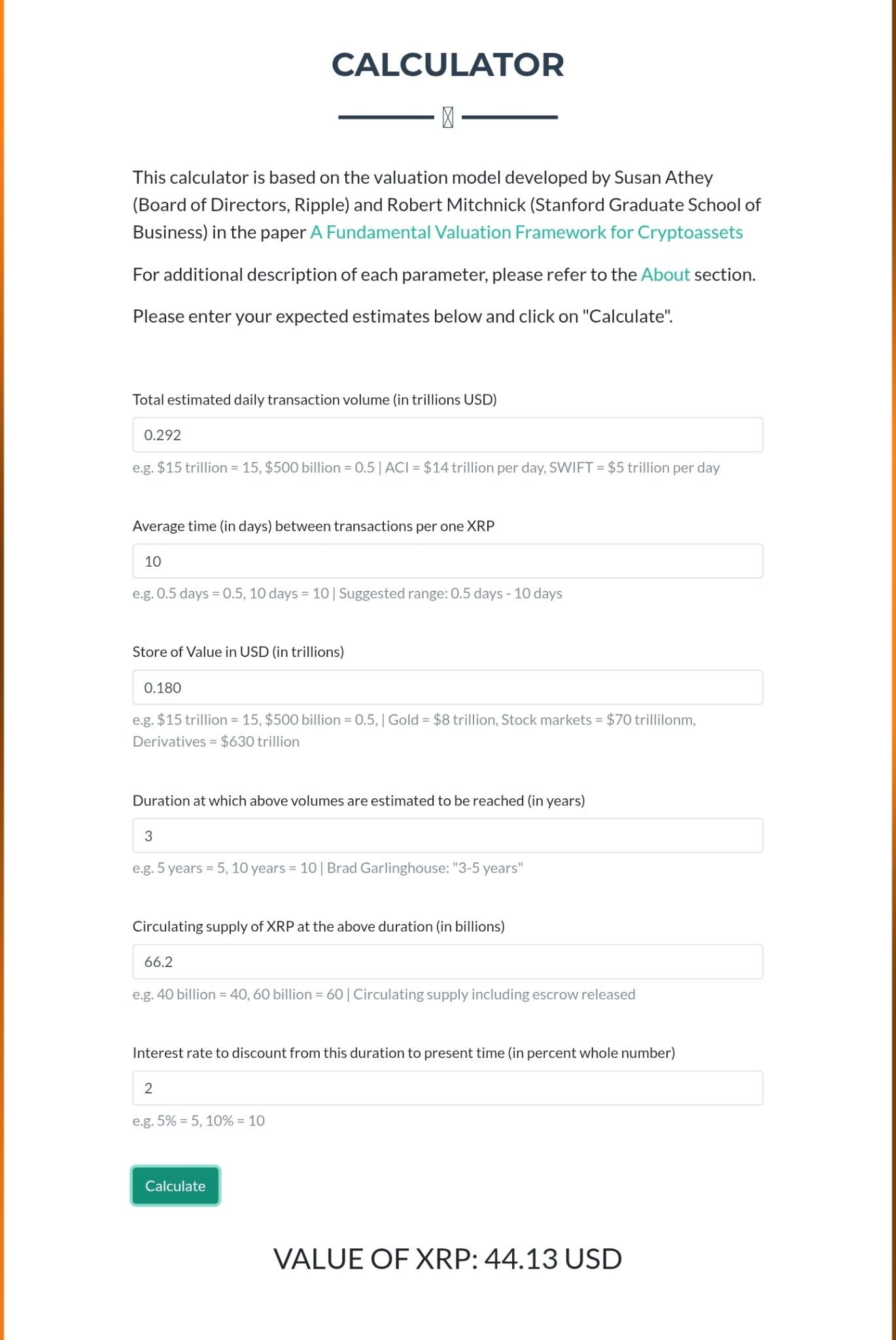
In our assessment, we used $0.292 trillion ($292 billion) as the expected daily volume. This indicates the level of activity XRP would need to reach to match USDT’s peak. Also, we set the average time between transactions per XRP at 10 days, assuming financial institutions actively use XRP to settle transfers multiple times per month.

For the store of value, we used $180 billion. Meanwhile, we chose a three-year time frame for these conditions to materialize. This window gives enough time for new partnerships, clearer regulations, and wider adoption to take XRP into heavier usage. 

Furthermore, we also projected that XRP’s circulating supply would grow to 66.2 billion, which includes expected releases from escrow. For context, Ripple often leaves 200 million new XRP in the market each month, translating to 7.2 billion tokens in three years. Adding this to the current supply of 59 billion leads to 66.2 billion XRP.

XRP Fair Value Calculator

Meanwhile, to adjust the future price back to present-day value, we applied a 2% interest rate. This represents an average return someone might expect each year over the next three years.

XRP Price at a $292B Daily Volume

Interestingly, after we plugged in all the numbers, the calculator delivered a projected value of $44.13 per XRP. Notably, this is a massive leap from its current price of $2.24, representing a growth of 1,870%. Notably, last August, pundit Mickle predicted XRP to reach $44. Also, in March 2025, EGRAG Crypto projected a possible rally to $44. 

However, this assessment does not particularly suggest XRP will hit this price in the future. Rather, it shows what could happen if XRP starts handling the kind of activity stablecoins like USDT already see under the right conditions.

Crypto Now Makes up a Large Portion of Donald Trump’s $6.4B Fortune: Bloomberg

President Donald Trump’s fortune has taken a turn toward digital assets, with crypto now making up a major share of his $6.4 billion net worth. 

According to a new report from Bloomberg, crypto-related ventures have added at least $620 million to his wealth in just a few months. Interestingly, this figure outpaces the earnings from his longtime real estate business.

WLF is The Chief Source of Trump’s Crypto Wealth

Notably, Trump’s digital portfolio sees strength from multiple areas, but World Liberty Financial (WLF) is the major source. Specifically, the company runs a token sales platform and issues a stablecoin called USD1. 

Trump and his family earned around $390 million from token sales alone. On top of that, they hold a 40% equity stake in WLF. Notably, Bloomberg values this at roughly $560 million based on comparisons to Circle.

Meanwhile, Trump’s holdings also include over 22 billion WLF tokens, which carry a notional value of $2 billion. However, Bloomberg excluded them from his net worth because they remain locked up and not yet tradable, though WLF recently suggested that may soon change.

WLF’s stablecoin, USD1, has grown rapidly and now has $2.2 billion in circulation. Bloomberg estimates that the reserves behind it could bring in about $100 million in yield this year. Trump’s share of this income likely forms another steady stream in his crypto earnings, though it remains speculative.

Trump’s Fortune from Memecoins

Further, another big crypto win came through a Trump-branded memecoin, launched earlier this year. Trump-linked entities, including Fight Fight Fight and CIC Digital, control 80% of the token supply. Bloomberg estimates that Trump has already cashed out around $150 million from memecoin sales and trading. 

Moreover, an additional 800 million tokens, currently valued at more than $7 billion, will start unlocking later this month over a three-year schedule. These tokens are not included in his net worth yet, but they could boost it depending on market trends.

American Bitcoin and Non-Crypto Ventures

However, Trump’s crypto interests do not end there. In addition to these ventures, he also owns a 20% stake in American Bitcoin, a startup that plans to go public through a merger with Gryphon Digital Mining. 

Notably, Bloomberg reports that the new entity is currently worth more than $3 billion, despite the mining equipment behind it having a book value of just $120 million. Based on that valuation, Trump’s stake could be worth around $600 million.

Meanwhile, Truth Social, the social media platform under Trump Media & Technology Group, remains one of the largest individual pieces of his financial portfolio. Despite reporting a $401 million loss last year, the stock still contributes $2 billion to his net worth. 

Bloomberg also noted a major gain in real estate: Trump National Doral in Miami jumped in value from $350 million to $1.5 billion after local authorities approved plans to build 1,500 luxury condos on the property. This approval gave Trump a $1.15 billion boost from that asset alone.

An Overview of Trump’s Wealth

Altogether, Bloomberg outlined the makeup of Trump’s fortune: $390 million from WLF token sales, $560 million from his WLF equity stake, $2 billion in locked WLF tokens, $100 million in estimated yield from USD1 stablecoin reserves.

Donald Trump Ventures Bloomberg
Donald Trump Ventures | Bloomberg

Further, the net worth also includes $150 million in cashed-out memecoin gains, $7 billion in vesting memecoins, $600 million from his American Bitcoin stake, and $2 billion from Truth Social. In addition, the President boasts a $1.15 billion gain from Doral rounds.

Bloomberg clarified that not every item appears in the $6.4 billion total. It excludes or discounts some assets, like the locked tokens and illiquid holdings, due to uncertainty around their market value.

Tether and Adecoagro Partner to Launch Renewable Bitcoin Mining Initiative in Brazil

Largest stablecoin issuer Tether Holdings has entered a Bitcoin mining collaboration with Adecoagro, a major South American agricultural and renewable energy company. 

The joint initiative aims to utilize Adecoagro’s surplus clean energy to power Bitcoin mining operations. This creates a new sort of connection between agriculture, energy markets, and blockchain technology.

Notably, Adecoagro boasts over 230 megawatts of renewable generation capacity. The company is now looking to stabilize a portion of that energy by allocating it to BTC mining. This approach explores a more predictable and lucrative demand channel.

Strategic Diversification

Speaking on the development, Adecoagro CEO Mariano Bosch emphasized that the company views the initiative as a way to stabilize a portion of the energy it currently sells on the spot market. It also allows the firm to lock in pricing and gain exposure to the potential upside of Bitcoin.

For Adecoagro, the initiative is a way to monetize excess electricity and bet on Bitcoin as a long-term store of value, much like the company’s core land assets. This marks one of the first instances of a major agribusiness integrating Bitcoin into its operational and financial strategy.

Tether Doubles Down on Bitcoin Mining

Meanwhile, Tether has been expanding its portfolio of sustainable mining operations globally. It brings its expertise in crypto assets and proprietary site management software, Tether Mining OS, to this project. The system will be open-sourced in the coming months to promote transparency and innovation.

Tether sees the model as a way to drive financial inclusion and improve energy efficiency. According to CEO Paolo Ardoino, it also acts as a blueprint for responsible innovation that links technology with sustainability.

Notably, Juan Sartori, Tether’s Head of Business Initiatives, also serves as chairman of Adecoagro’s Board of Directors. Due to this dual role, the collaboration required formal approval from Adecoagro’s Independent Committee, in accordance with corporate governance protocols for related-party transactions.

Overall, Tether and Adecoagro are pioneering a new model by linking Bitcoin mining to agricultural energy production. This approach could be replicated across the Global South, where renewable energy is plentiful but frequently underutilized.

Stablecoin Regulation Could Fuel a $15-20 Trillion Crypto Industry, Says Trump Executive Director

0

Trump’s Executive Director, Bo Hines, has made a bold prediction regarding the future of the crypto industry, especially amid the anticipated stablecoin regulation. 

Hines, in an interview hosted by MARA CEO Fred Thiel, believes that the Genius Act, which is expected to pass soon, will have monumental effects on the financial landscape. The Genius Act has successfully passed through Senate procedural steps and is now under active floor discussions.

The Significance of the Genius Act

In a discussion with Fred Thiel, CEO of Bitcoin miner MARA, Hines emphasized that the Genius Act represents a rare opportunity for bipartisan legislation to move forward in the Senate. He points out that the last time such legislation was passed was in 2018. According to Hines, both parties understand the necessity for the United States to take the lead in modernizing financial systems.

“Everything else has evolved: the ways in which we communicate, the technology that we use, [but] the ways in which we move money really hasn’t,” Hines noted, suggesting that this delay in updating financial systems has been shocking to many people.

Hines explained that the Genius Act allows for instant settlement times, more cost-effective payments, greater transparency, and secures the global dominance of the US dollar for decades.

He stressed that this legislation should be a bipartisan effort and feels optimistic about its prospects. Speaking further, he mentioned that they’ve already gained support from 15 Democrats on the closure vote and hopes to see it passed in the coming week.

Capital Injection and Industry Growth

Hines also outlined the significant impact this legislation will have on the digital assets ecosystem. He predicts a capital injection of enormous proportions, pushing the crypto industry to a valuation of $15-$20 trillion. With a current crypto market cap of $3.39 trillion, it would surge by approximately 342.48% to reach $15 trillion.

He said this legislation will provide the foundation for key developments like tokenized public securities and 24/7 markets. Moreover, he believes that anyone wishing to access US capital markets will be required to use a dollar-backed stablecoin.

“This is what positions the United States to be the global leader,” he added, advocating for the country to take the lead in adopting digital asset financial technology.

Bitcoin’s Role in the New Digital Ecosystem

Later in the interview, Hines discussed the broader implications of the stablecoin legislation on Bitcoin. He suggested that Bitcoiners will benefit from the increased capital flowing in and out of various asset classes. As more capital becomes available, Hines predicts that people will be purchasing Bitcoin in large amounts.

“We view Bitcoin as digital gold,” Hines reiterated. He again highlighted the idea that Bitcoin is a commodity, not a security, and mentioned its intrinsic stored value, finite nature, and decentralized qualities.

Regarding the government’s potential Bitcoin acquisition strategy, Hines stressed that the goal is to accumulate as much Bitcoin as possible. When asked how much Bitcoin the government should aim for, Hines dismissed the question as “silly,” emphasizing the need to gather as much as feasible within a budget-neutral framework.

Public-Private Partnerships for Bitcoin Accumulation

The MARA CEO Thiel also explored the possibility of a public-private partnership to facilitate Bitcoin accumulation. Thiel believes this could solve two problems simultaneously: it would help the government accumulate Bitcoin while also boosting hash rate capacity among US Bitcoin miners. 

Thiel suggested that the US government could partner with Bitcoin miners and use energy resources to generate Bitcoin for the country’s strategic reserve, an idea Hines describes as “phenomenal.”